Doha Museum of Islamic Arts Opens
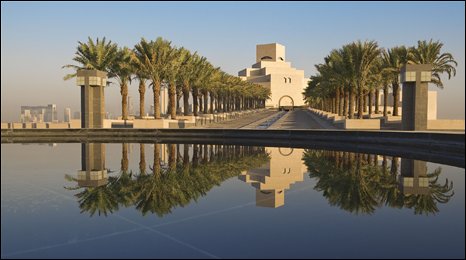
My friends in Doha tell me that the long-awaited Museum of Islamic Arts, designed by I.M. Pei (who showed up for the opening, along with Robert de Niro) opened this weekend. I can hardly wait to see it for myself.
By Lawrence Pollard
BBC News, Doha
A few years ago, prices in London auction houses went through the roof – not for the classic modern or contemporary art, but for works from the Islamic world.
Fabulous jewels, manuscripts and ceramics were fetching 10 times their estimate and more, and it soon emerged this was thanks to the al-Thani family, rulers of Qatar, the tiny gas-rich Gulf state.
They had tempted the veteran architect I M Pei – the man behind the glass pyramid at the Louvre – to design one last statement building, a spectacular museum on a purpose-built island in Doha, which would house only the best Islamic art.
Then they went shopping for their collection.
And this weekend the museum opens, a dramatic pile of white limestone shapes inspired by Islamic architecture and full of 800 of the finest examples of Islamic art.
Not long ago, the idea of culture being a reason to visit the Gulf would have made other Arabs laugh. No longer.
The Syrian cultural historian Rana Kabbani sees a political element to the museum, putting Doha on the cultural map.
“I think all the rulers in the Gulf see what they really lack is culture on a grand scale, as a kind of imperial identity. It’s a political-cultural lack. They have the means, and they’re going for it.”
The hope is that – like hosting a Grand Prix or buying a football club – a fabulous collection of art will bring prestige, attract tourists and create a brand.
That’s why along the coast, two museums are planned for Abu Dhabi – branches of the Louvre and Guggenheim.
New conversation
But what exactly is the Islamic art in the collection? What can ceramics from southern Spain have in common with metalwork from the Silk Route city of Samarkand?
One thing which links them is the misconceptions about Islamic art held by both east and west.
Designer and writer Navid Akhtar explains: “The conversation tends to go: ‘How come you don’t paint people? Because its forbidden.’
“There’s little understanding of the scriptures or commentaries, or the concept of art, so we’re left with a limited conversation.
“There’s a lot of figurative Islamic art. And the geometric patterns aren’t just pattern.”
The Koran has no comment on the visual arts.
The prophet was firmly against idols, but then so were Jews, orthodox Christians and puritan Anglicans at various times.
Many religions mistrust images but their cultures still end up using them – Islam however has had less use for them.
“The Koran is not a narrative like the old or new testament, it doesn’t tell a story, a narration you can illustrate,” says professor Doris Abouseif, author of Beauty in Arabic Culture.
“The Koran is precepts, it guides but doesn’t narrate.”
Any museum will show Persian and Indian miniatures, or Arab pottery with figures of animals or people.
They won’t be from a mosque, but the figure isn’t banned from wider Islamic culture.
‘Whole language’
One element Islamic objects have in common is intricate geometric patterns.
Some scholars think this is a craft habit, pure and simple, but to many younger Muslim artists the geometry holds something else.
“Pattern is a whole language of colour, form and shape,” says Reem al-Faisal, a Saudi artist-photographer.
“Each colour symbolises a state of the soul or being. It’s poetry translated into material elements.”
Mr Akhtar agrees: “Many of these things, as well as being objects of beauty, have functional usage, but then hidden beyond that is the sense of transcendence that they create.”
The chief curator of the new museum, Oliver Watson, is British, as are many of the staff.
The museum houses 800 artistic and historical works from three continents
The study of Islamic art is a western creation, which Ms al-Faisal says is not a problem so long as more Muslims now take up the study.
“I don’t care if it’s Muslims or Westerners – the problem is that there’s not enough research and that’s a mistake of the Muslims.
“They should have studied their own civilisation far more, they’ve been in hibernation for 500 years. There has to be a reawakening – they have to start studying their own history.”
Qatar’s museum will be just a glittering collection of greatest hits unless it manages to become, as promised, a centre of education and research into the history of this beautiful art.
Doha Nightlife
AdventureMan could hardly wait to show me the change in the very heart of Doha. When I lived in Doha, the Souk al Waqif / Iranian souk was off limits to most Americans, considered a very traditional place, and a dangerous place for a casual visitor.
Of course I went! I have found that if you dress modestly and behave respectably, you have little to worry about in Qatar, or Kuwait, or even Saudi Arabia. People are gracious and kind, and you find the most interesting things – tools for the old coffee roasting braziers, old weavings, old pieces of hand crafted silver . . . you just have to take your time and look.
My favorite booth in the old Doha souks was the man who hand embroidered the men’s bisht, and who pounded the silver flat with a leather covered hammer. I loved the colorful scribe’s booths – sadly, now missing, in the interest of a much larger parking lot for the souks.
Oh! The changes!
They have totally updated the souks – put in reliable electricity and running water, and did not raise the rents for the merchants. Painted everything, gave it a historically accurate facade, put covers over the walking paths made of the old beams and palm branches to shield shoppers from the heat.
But the most amazing change of all is the nightlife. The square where the hardware merchants used to vend their nails and chains and locks, where the shoemakers would mend and polish your shoes is gone, and in it’s place are multiple restaurants and cafes, interspersed with antique shops, specialty shops: people who carve miniature dhows and sailing ships, a shop for sharp edged swords and khanjars, a shop specializing in custom made eqals (the black band that holds the gutra on the head; Qatteris have long tassles coming from the eqal down the back), a couple places for smoking the narghila, and assorted souvenir shops.
Restaurants! Bright twinkling lights! The smell of roasted meats and fresh fruit drinks! Places to sit out in the courtyard, the sounds of laughter . . . Doha has a nightlife!
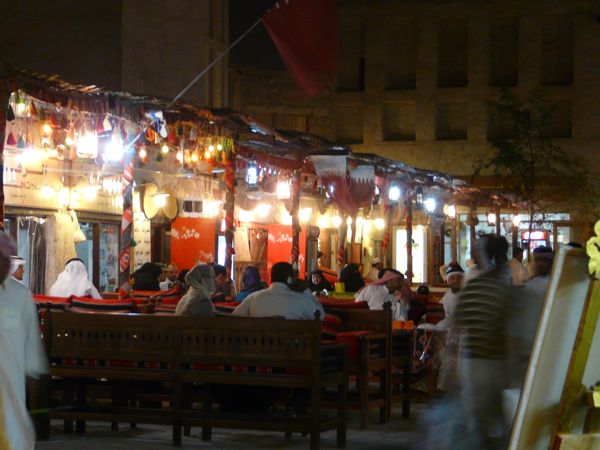

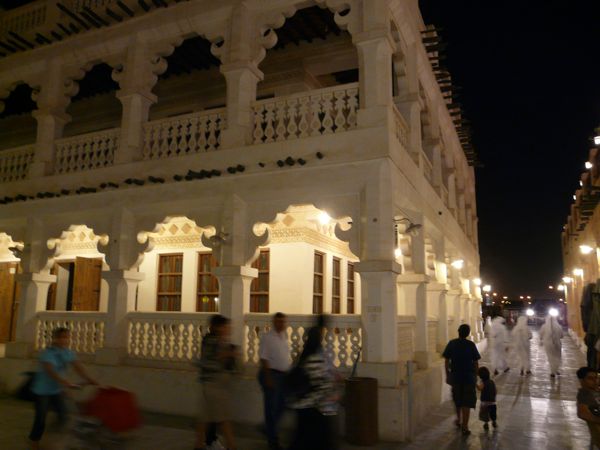


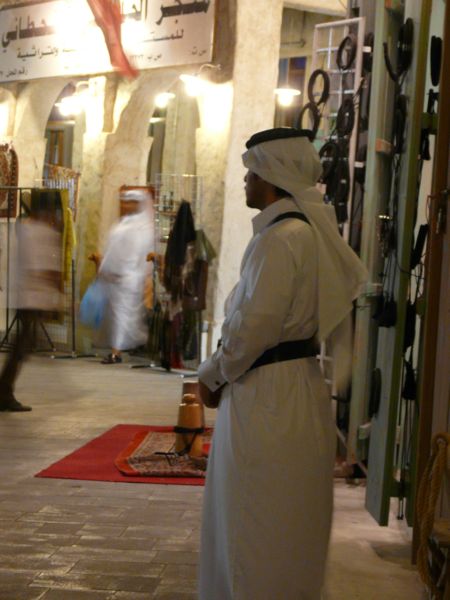
In the midst of the bright lights, the shops, the restaurants and music, there is a police station, and I think it is brilliant – the police dress in traditional clothing:


Palm Island
There used to be a resort out on Palm Island, with a couple restaurants, a swimming area, an amusement park and boats that took the trip out there and back every half hour or so. Now, it’s all gone, flattened. All that is left of Palm Island is this:

And it isn’t even a palm tree!
Truck Loading in Doha
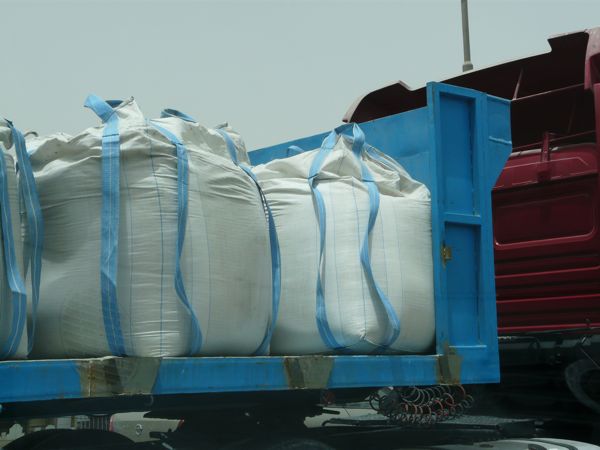
We don’t know what is in these huge sacks; we see the same in Kuwait and think it may be cement on the way to be mixed – or sand to mix with the cement. They are not secured. It may be that the sheer weight of whatever is inside glues it to the truck bed, but we don’t want to be anywhere near these trucks when they go around a sharp curve – or a roundabout.

Here is a close-up. You can see they are not secured in any visible way:
Doha Olympics 2016
Although Doha has been eliminated from the competition, the signs are still up, glorious signs. My favorite one is the woman archer:

Although I also like the joy of the young boy with the banner:

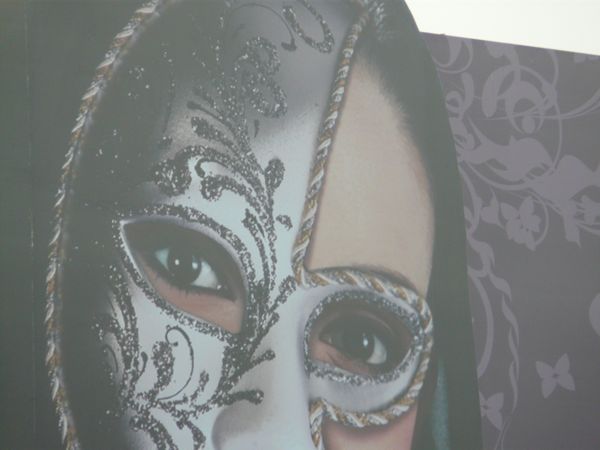
Is it just me, or do most of the women on the banners in Doha bear a resemblance to a young Sheika Mosa?
I love the Doha spirit. The 2016 Summer Olympics were a long shot, and Qatar took the chance. It was seriously considered. Not a lot you can do about the “searing” climate, and, unfortunately, it isn’t cold enough or snowy enough to be considered for the winter olympics, but they have some great golf and tennis tournaments, an a big bicycle tour in February.
Doha Dhow Building
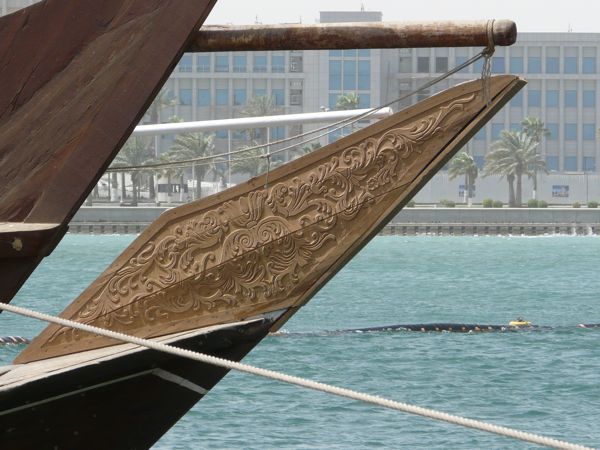
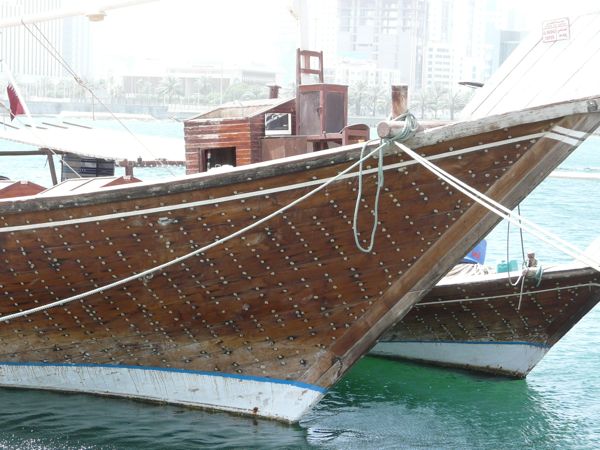
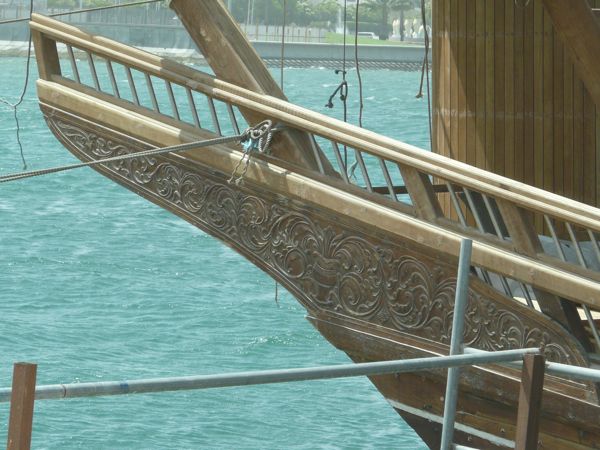
We were so sad, visiting Oman, to see that dhow building has gone into decline in Sur, and then equally delighted to see the craft being revised and guarded in Doha. The new dhows being built preserve the design of the older working dhows, and include extra, labor intensive and expensive touches, like the wood carving:
I had to start with this one, because it includes the fabulous QCPI (Qatar Center for the Presentation of Islam) building in the background – what an impact it gives the Doha skyline!

Night and Day, Doha, The Pearl
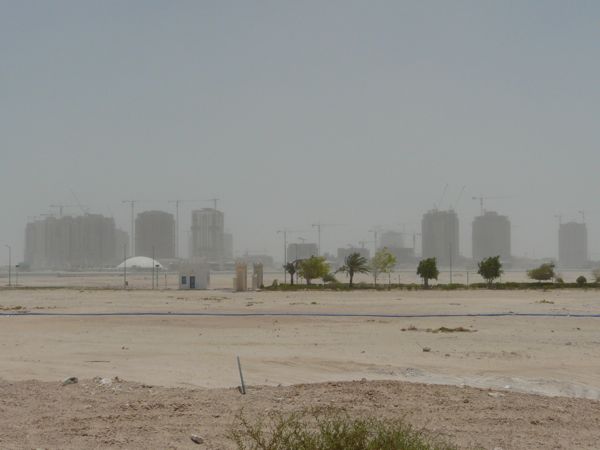
Visiting Doha, AdventureMan took me out to see the new Pearl going up. AdventureMan cracks up – “It’s NOT reclaimed land” he cackles, “they are demolishing old buildings at an incredible rate, and using all that rubble to build this new crop of hotels and residences!”
We watched it when it was just cranes and sandbars.
They’ve come a long way in an amazingly short time. This is the Doha Pearl (they are having the same kind of dusty weather that we are having in Kuwait)
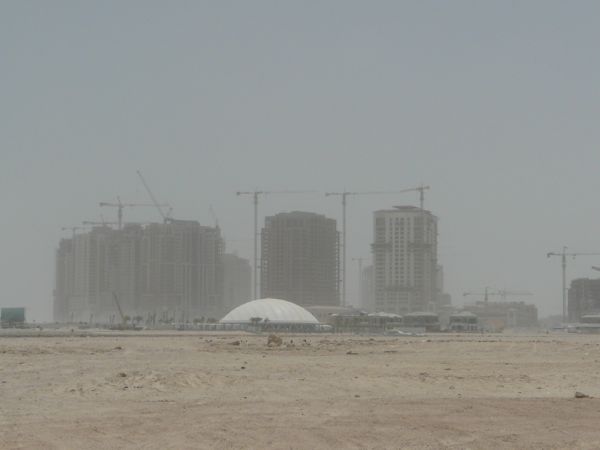
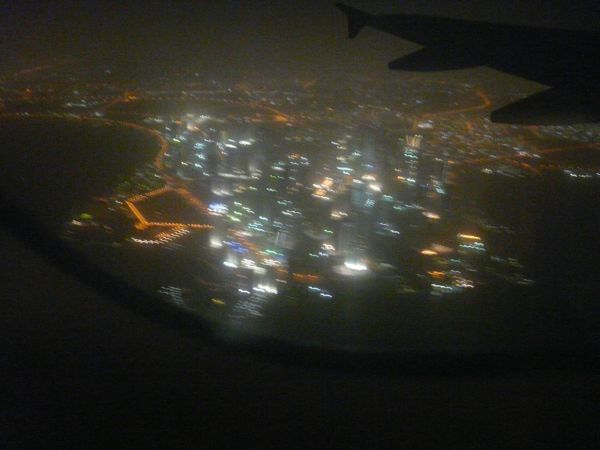
The window is a little cloudy, but you can see it is all lights, camera, action at the building of The Pearl, even at night:
Recent Comments
intlxpatr on Shampoo Ginger tigerbutterya0c5ff1d… on Shampoo Ginger intlxpatr on British Soldier Kidnapped, Esc… John on British Soldier Kidnapped, Esc… intlxpatr on British Soldier Kidnapped, Esc… Wikipedia Donate Button

Amazina


Early Voting in Florida


