Top Colleges Dig Deeper in Wait Lists for Students
Is this a sign of economic times? A demographic portent of things to come? Dipping into the waiting lists is significant enough to show up in The New York Times: Education Good news for the not-quite-first-pick students.
By TAMAR LEWIN
Published: May 9, 2008
In what may be a happy surprise for thousands of high school seniors, Harvard plans to offer admission to 150 to 175 students on its waiting list, and Princeton and the University of Pennsylvania each expect to take 90, creating ripples that will send other highly selective colleges deeper into their waiting lists as well.
“This year has been less predictable than any recent year,” said Eric J. Kaplan, interim dean of admissions at Penn, adding that when one college in the top tier goes deep into its wait list, others are affected. “We all need to fill our classes and replace students who have been taken off wait lists at other institutions. The wait-list activity could extend for a significant time.”
Although colleges turn to wait lists to fill out their classes, it is unusual for the most selective to go so deep, college officials say.
For high-school students graduating in an unusually large class and for colleges trying to shape a freshman class, this has been an unusually challenging year, with the changes in early-admissions programs and the broad expansion of financial aid at many elite universities.
Right up until the May 1 deadline for students to respond to admissions offers, colleges have been unsure what to expect.
“Our class is coming in exactly the way we wanted it to, fitting into the plan we had to get to a class of 1,240,” said Janet Rapelye, dean of admission at Princeton, which, like Harvard and the University of Virginia, eliminated early admissions this year.
Ms. Rapelye said that with such a big change in policy, it was difficult to predict results, so “we deliberately aimed to have a slightly smaller group.”
Harvard would not confirm its plans for its wait list. In an e-mail message sent on Thursday to colleagues at dozens of other institutions and passed on to The New York Times, William Fitzsimmons, the Harvard College dean of admissions, said, “Harvard will admit somewhere in the range of 150 to 175 from the waiting list, possibly more depending on late May 1 returns and other waiting list activity.”
AHarvard spokesman said the college had accepted fewer students this year to avoid overcrowding the freshman class.
The Yale dean of admissions, Jeffrey Brenzel, said there would be about 45 wait-list offers this week and probably another round later this month.
Even colleges that had more than filled their freshman classes were wondering how many students would melt away if admitted off waiting lists elsewhere.
“We’re over target right now, so we’re in good shape,” said Rick Shaw, the Stanford dean of admissions. “But I’m keeping a small group on the wait list, because I think there’ll be some impact of wait-list activity at other schools.”
At Dartmouth, Maria Laskaris, the dean of admissions, said although Dartmouth had more than enough accepted students committing, she was “in a holding pattern, because it depends on what other schools do.”
That’s Very Different!
A grin today from the FAIL Blog. This one had me helpless with the giggles.

Even some English speakers have problems with why this is funny – the word they meant to use on the news captioning was “evacuating.” The word they used has a very different meaning.
Travel Nerds
We are a bunch of travel and geography nerds in my family. Nothing makes us happier than jumping in a airplane, reaching an exotic location and driving, getting our feet on new ground, seeing new things, learning new ways. We all have cameras glued to our hands and laptops stuffed in backpacks.
All my married life, people have looked at me with pity and tole me how they can’t believe I live with such uncertainty, never knowing where I will be in the next year – even the next few months. What I tell them is this – the truth is, we ALL never know. We ALL never know when something will happen that will change our lives dramatically, forever. We live day to day, not thinking about all the things that can happen. If we think too much about them, we might go crazy.
I consider myself blessed. I was created with a restless spirit, a spirit for new experiences and new ways of thinking. I was given a life where all those things became my daily bread.
What is fun for me is watching the next generation of young adults discovering their own lives, who they are meant to be.
My nephew, at Google Earth took his love of geography to new heights. He works in a place he loves, doing work he loves. He wrote to me yesterday, to tell me about a new game being played, a grown-up version of the old “Where in the World is Carmen Sandiego.” (one of the earliest computer games for kids) He has published a really really hard one on the Google team LatLong blog (as he says, he has the home court advantage in this game!) and he refers us to another blog, Where on GoogleEarth? where there are a series of contests to see if you can identify landmarks, special places, from the sky.
Here, for example, is the photo from contest #22 – and people have to write in telling what it is. Can YOU tell what it is? 🙂

Bullying and 19 Minutes; Jodi Picoult
When my blogging friend Chirp makes a recommendation, I have learned to order the book and read it. She reads books that make you think! The latest book is Jodi Picoult’s 19 Minutes, a book about a kid who is sensitive and kind and funny, and plays by the rules – he is good at sharing, and listening and all the things we try to teach our children to be good at.
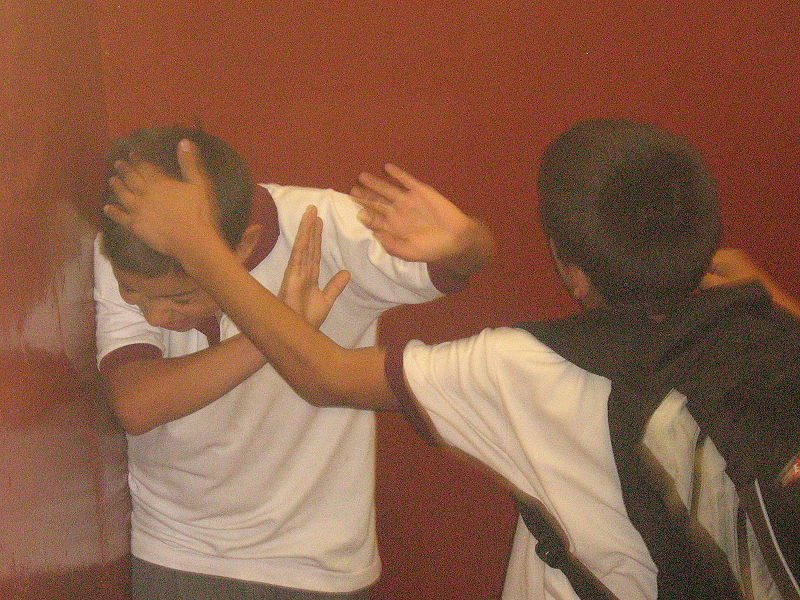
He gets bullied. From the time he starts school, he is bullied physically and mentally and emotionally. He does the right thing – he reports it. The schools do nothing, or so little that it only makes things worse for him. Pushed too far, one day snaps, he goes ballistic. He walks into the school and shoots 19 of his classmates.
One problem is access to weapons. Literally, physically teenagers have not yet developed the judgement areas of the brain. I am guessing in males it takes even longer, and I only guess that because of all the traffic fatalities and physical damage adolescent boys inflict upon themselves – and their victims. Maybe it is that fatal combination of poor judgement and testosterone that pushes them too far. Access to weapons – guns, knives, fast cars – makes them even more lethal.
Before I wrote this review, however, I had to do a lot of thinking. This book is about bullying, and even as adults we come across bullies. Our household helpers are terrified of the police – those who are here to protect us. The police use their position to try to bully phone numbers out of pretty Kuwaiti girls, and to exact sexual favors from the Asian domestics. Not all police are bullies, but if a person has that tendency, the position allows him/her to use that power wrongly.
And bullying doesn’t stop with graduation from high school. We are seeing the same kinds of behavior at universities – Virginia Tech – and in the workplace – “going postal” and GMAC just to name two. People who are bullied sometimes turn, they go out in a blaze of glory.
I’ve been bullied. People who are raised to have good manners are often victims of those who are willing to overstep the boundaries. We make excuses for them – we say they are oblivious. I am beginning to think that many a bully is NOT oblivious, but has learned to push to get his or her own way.
With men, the bullying is more physical, and it’s all about jockying for position – number one in the pecking order, the next promotion, the boss’s golf partner, etc. If you think women are gossips – you oughta hear the men! When I hear men “bantering” it’s all about who’s got the “biggest.” Or maybe, the devil whispers in my ear, it’s about who can make you THINK his is the biggest.
With women, in my experience, most of the bullies are physically bigger. They are women who – literally – throw their weight around. They are women who will interrupt anyone and override their suggestion with a loud voice. They are women who have temper tantrums, and hurt feelings, who go from person to person forming alliances that dissolve with the next disagreement. That’s the sad truth – a bully wants his or her own way – all the time. Once you go against them, you have to watch your back.
Picoult has done her homework. Bullies are often likeable enough people! A bully carries his/own burden, however – and that is a desperate need for popularity. You can see this in animal behavior; once a creature has achieved dominance, it takes enormous energy to maintain that position, so much energy that the rest of your life shrinks as your focus must be on maintaining dominance.
The UK, Canada, and the US all have websites about bullying, trying to put a stop to it in the schools. What do they define as bullying?
People calling you names
Making things up to get you into trouble
Hitting, pinching, biting, pushing and shoving
Taking things away from you
Damaging your belongings
Stealing your money
Taking your friends away from you
Posting insulting messages on the internet or by IM (cyberbullying)
Spreading rumours
Threats and intimidation
Making silent or abusive phone calls
Sending you offensive phone texts
Bullies can also frighten you so that you don’t want to go to school, so that you pretend to be ill to avoid them
What can people with manners do against a bully?
In general, the first thing to do is tell an adult – it doesn’t have to be your parents. Additonal suggestions suggest creating your own support network – create a wide network of friends. Join interest groups, in our out of school.
When our son was bullied in school, he worked hard and earned a black belt in karate, and then went on to earn further degrees, and to teach karate – while still in high school. Just knowing that he had a lethal skill made him walk differently, made the bullies afraid to target him. He went to a magnet school, where there was a high degree of chaos, and he sought out and made friends with the biggest people he could find. He used his head. He made it through. Of all his accomplishments, one of the things that made us most proud of him was his ability to stick it out and to prevail.
I worked in a high school. My office was a safe haven for many kids, kids who found high school dynamics pure hell. Most of them were emotionally years ahead of the crowds roaming the hallways, the cruel kids, for whom high school will probably be the highlight of their lives.
“You’re going to love being an adult,” I would tell them. “Hang in there. For them, this may be as good as it gets, but your life is going to get better and better.”
Geeks don’t always get a lot of respect. The two guys that graduated high school at the bottom of the class with my son already had a flourishing computer networking business going. If you haven’t noticed, most of the people who are making it big financially are people who have learned how to use their heads.
I have learned something else. You can beat a bully at his or her own game. Bullies usually rely on instilling fear in others, but rarely do they do their homework.
Choose your battles. Bullying hurts everyone. If you see someone being bullied and you can do something about it then and there, stand up for the person being bullied. All you have to do is say “that’s not funny, just stop.” Many times bullies are so shocked at being challenged, they will stop! If your judgement tells you it would be unsafe to say anything, quickly tell an adult, a supervisor, a manager, what you have seen.
If a bully is trying to push through something you believe is wrong, you can quietly discuss things one on one with others, and make a plan. You can call for a vote! You can quietly stand up to a bully. You can tell a bully “it’s my turn to talk” and they have to shut up! (When you do this, you have to be very careful to listen when the bully is speaking so that everyone knows it really IS your turn to talk.) You can use a little gentle humor – bullies usually only like humor when it is aimed at someone else. They haven’t a clue what to do when it is aimed at them!
If it is annoying, but not something worth fighting over, let the bully get his or her own way. They usually end up shooting themselves in the foot, self-destructing. The adult bully ends up driving people away, and then wondering why he/she has no friends?
Living your own life well is your best revenge!
Thank you, Chirp, for another book that really made me think!
Home Schooling Muslims in America
The New York Times has this fascinating article:
LODI, Calif. — Like dozens of other Pakistani-American girls here, Hajra Bibi stopped attending the local public school when she reached puberty, and began studying at home.
Her family wanted her to clean and cook for her male relatives, and had also worried that other American children would mock both her Muslim religion and her traditional clothes.
“Some men don’t like it when you wear American clothes — they don’t think it is a good thing for girls,” said Miss Bibi, 17, now studying at the 12th-grade level in this agricultural center some 70 miles east of San Francisco. “You have to be respectable.”
Across the United States, Muslims who find that a public school education clashes with their religious or cultural traditions have turned to home schooling. That choice is intended partly as a way to build a solid Muslim identity away from the prejudices that their children, boys and girls alike, can face in schoolyards. But in some cases, as in Ms. Bibi’s, the intent is also to isolate their adolescent and teenage daughters from the corrupting influences that they see in much of American life.
About 40 percent of the Pakistani and other Southeast Asian girls of high school age who are enrolled in the district here are home-schooled, though broader statistics on the number of Muslim children being home-schooled, and how well they do academically, are elusive. Even estimates on the number of all American children being taught at home swing broadly, from one million to two million.
No matter what the faith, parents who make the choice are often inspired by a belief that public schools are havens for social ills like drugs and that they can do better with their children at home.
“I don’t want the behavior,” said Aya Ismael, a Muslim mother home-schooling four children near San Jose. “Little girls are walking around dressing like hoochies, cursing and swearing and showing disrespect toward their elders. In Islam we believe in respect and dignity and honor.”
Still, the subject of home schooling is a contentious one in various Muslim communities, with opponents arguing that Muslim children are better off staying in the system and, if need be, fighting for their rights.
Robina Asghar, a Muslim who does social work in Stockton, Calif., says the fact that her son was repeatedly branded a “terrorist” in school hallways sharpened his interest in civil rights and inspired a dream to become a lawyer. He now attends a Catholic high school.
“My son had a hard time in school, but every time something happened it was a learning moment for him,” Mrs. Asghar said. “He learned how to cope. A lot of people were discriminated against in this country, but the only thing that brings change is education.”
Many parents, however, would rather their children learn in a less difficult environment, and opt to keep them home.
You can read the rest of the article HERE
Colorful Answers
Amethyst:
Main Entry:
am·e·thyst
Pronunciation:
\ˈa-mə-thəst, -(ˌ)thist\
Function:
noun
Etymology:
Middle English amatiste, from Anglo-French & Latin; Anglo-French, from Latin amethystus, from Greek amethystos, literally, remedy against drunkenness, from a- + methyein to be drunk, from methy wine — more at mead
Date:
13th century
1 a: a clear purple or bluish-violet variety of crystallized quartz that is often used as a jeweler’s stone b: a deep purple variety of corundum
2: a moderate purple
— am·e·thys·tine \ˌa-mə-ˈthis-tən\ adjective
Argent
argent
Main Entry:
ar·gent
Pronunciation:
\ˈär-jənt\
Function:
noun
Etymology:
Middle English, from Anglo-French & Latin; Anglo-French, from Latin argentum; akin to Greek argyros silver, argos white, Sanskrit rajata whitish, silvery
Date:
15th century
1archaic : the metal silver; also : whiteness
2: the heraldic color silver or white
— argent adjective
Azure
azure
Main Entry:
azure
Pronunciation:
\ˈa-zhər\
Function:
noun
Etymology:
Middle English asur, from Anglo-French azeure, probably from Old Spanish, modification of Arabic lāzaward, from Persian lāzhuward
Date:
14th century
1archaic : lapis lazuli
2 a: the blue color of the clear sky b: the heraldic color blue
3: the unclouded sky
— azure adjective
Celadon
celadon
Main Entry:
cel·a·don
Pronunciation:
\ˈse-lə-ˌdän, -lə-dən\
Function:
noun
Etymology:
French céladon
Date:
circa 1768
1: a grayish-yellow green
2: a ceramic glaze originated in China that is greenish in color; also : an article with a celadon glaze
Cerise
cerise
Main Entry:
ce·rise
Pronunciation:
\sə-ˈrēs, -ˈrēz\
Function:
noun
Etymology:
French, literally, cherry, from Late Latin ceresia — more at cherry
Date:
1844
: a moderate red
Chartreuse
Main Entry:
char·treuse
Pronunciation:
\shär-ˈtrüz, -ˈtrüs\
Function:
noun
Etymology:
Chartreuse
Date:
1884
: a variable color averaging a brilliant yellow green
Dun
in Entry:
1dun
Pronunciation:
\ˈdən\
Function:
adjective
Etymology:
Middle English, from Old English dunn — more at dusk
Date:
before 12th century
1 a: having the color dun bof a horse : having a grayish-yellow coat with black mane and tail
2: marked by dullness and drabness
— dun·ness \ˈdən-nəs\ noun
Magenta
Main Entry:
ma·gen·ta
Pronunciation:
\mə-ˈjen-tə\
Function:
noun
Etymology:
Magenta, Italy
Date:
1860
1 : fuchsin
2 : a deep purplish red
Puce
puce
Main Entry:
puce
Pronunciation:
\ˈpyüs\
Function:
noun
Etymology:
French, literally, flea, from Old French pulce, from Latin pulic-, pulex — more at psylla
Date:
1833
: a dark red
Smalt
smalt
Main Entry:
smalt
Pronunciation:
\ˈsmȯlt\
Function:
noun
Etymology:
Middle French, from Old Italian smalto, of Germanic origin; akin to Old High German smelzan to melt — more at smelt
Date:
1558
: a deep blue pigment consisting of a powdered glass that contains oxide of cobalt
Smaragd:
Main Entry:
sma·ragd
Pronunciation:
\smə-ˈragd, ˈsma-ˌragd\
Function:
noun
Etymology:
Middle English smaragde, from Latin smaragdus, from Greek smaragdos, of Semitic origin; akin to Akkadian barraqtu gemstone
Date:
13th century
: emerald
— sma·rag·dine \smə-ˈrag-dən, ˈsma-rəg-ˌdīn\ adjective
Terra Cotta
terra-cotta
Main Entry:
ter·ra–cot·ta
Pronunciation:
\ˌter-ə-ˈkä-tə\
Function:
noun
Usage:
often attributive
Etymology:
Italian terra cotta, literally, baked earth
Date:
1722
1: a glazed or unglazed fired clay used especially for statuettes and vases and architectural purposes (as roofing, facing, and relief ornamentation); also : something made of this material
2: a brownish orange
Turmeric
turmeric
Main Entry:
tur·mer·ic
Pronunciation:
\ˈtər-mə-rik also ˈtü-mə- or ˈtyü-\
Function:
noun
Etymology:
Middle English turmeryte
Date:
15th century
1 : an Indian perennial herb (Curcuma longa syn. C. domestica) of the ginger family with a large aromatic yellow rhizome
2 : the boiled, dried, and usually ground rhizome of the turmeric plant used as a coloring agent, a flavoring, or a stimulant
3 : a yellow to reddish-brown dyestuff obtained from turmeric
Turnsole
The dyestuff folium or turnsole, prepared from the annual plant Crozophora tinctoria (“dyers’ crook carrier”, from its use and the curved tip of its spike of florets), was a mainstay of medieval manuscript illuminators from the development of the technique for extracting it in the thirteenth century (Thompson and Hamilton 1933:41). It joined the vegetal-based woad and indigo in the illuminator’s repertory, but the queen of blue colorants was always the expensive lapis lazuli or its substitute azurite, ground to the finest powders. According to its method of preparation, turnsole produced a range of translucent colors from blue, through purple to red, according to its reaction to the acidity or alkalinity of its environment, in the chemical reaction, not understood in the Middle Ages, that is most familiar in the Litmus test.
Folium (“leaf”), was actually derived from the three-lobed fruit, not the leaves. in the early fifteenth century, Cennino Cennini, in his Libro dell’ Arte gives a recipe “IXVIII: How you should tint paper turnsole color” and “ILXXVI To paint a purple or turnsole drapery in fresco.” Textiles soaked in the dye vat would be left in a close damp cellar in an atmosphere produced by pans of urine. It was not realized that the oxidizing urine was producing ammonia, but the technique reminds us how foul-smelling was the dyer’s art.
The colorant was downgraded to a shading glaze and fell out of use in the illuminator’s palette by the turn of the seventeenth century, with the easier availability of less fugitive mineral-derived blue pigments.
Turnsole was used as a food colorant, mentioned in Du Fait de Cuisine which suggests steeping it in milk. The French Cook by François Pierre La Varenne (London 653) mentions turnsole grated in water with a little powder of Iris.
Herbals indicated that the plant grows on sunny, well-drained Mediterranean slopes and called it solsequium from its sunflower-habit of turning its flowers to face the sun, or “Greater Verucaria”;[1] early botanical works gave it synonyms of Morella, Heliotropium tricoccum and Croton tinctorium. (from Wikipedia)
Verdigris
Main Entry:
ver·di·gris
Pronunciation:
\ˈvər-də-ˌgrēs, -ˌgris, -grəs also -ˌgrē\
Function:
noun
Etymology:
Middle English vertegrese, from Anglo-French verdegrece, vert de Grece, literally, green of Greece
Date:
14th century
1 a: a green or greenish-blue poisonous pigment resulting from the action of acetic acid on copper and consisting of one or more basic copper acetates b: normal copper acetate Cu(C2H3O2)2·H2O
2: a green or bluish deposit especially of copper carbonates formed on copper, brass, or bronze surfaces
Except for turnsole, all the definitions above came from Merriam-Webster.com
I especially loved looking on Wikipedia. They always tell you more than you need to know, and I can get lost learning new things about a word I don’t know.
Education and No Child Left Behind
One of the most cynical education programs ever put into place, in my opinion, is the No Child Left Behind program. It’s impact, while claiming lofty goals, in actuality forced schools to exclude students who would fail, so as not to have them on their statistical base.
Quote from article: If low-achieving students leave school early, a school’s performance can rise.
In this story from the New York Times you can read how US schools fudge statistics to have a respectable high school graduation rate for federal funding purposes, while the truth is far less positive.
JACKSON, Miss. — When it comes to high school graduation rates, Mississippi keeps two sets of books.
One team of statisticians working at the state education headquarters here recently calculated the official graduation rate at a respectable 87 percent, which Mississippi reported to Washington. But in another office piled with computer printouts, a second team of number crunchers came up with a different rate: a more sobering 63 percent.
The state schools superintendent, Hank Bounds, says the lower rate is more accurate and uses it in a campaign to combat a dropout crisis.
“We were losing about 13,000 dropouts a year, but publishing reports that said we had graduation rate percentages in the mid-80s,” Mr. Bounds said. “Mathematically, that just doesn’t work out.”
Like Mississippi, many states use an inflated graduation rate for federal reporting requirements under the No Child Left Behind law and a different one at home. As a result, researchers say, federal figures obscure a dropout epidemic so severe that only about 70 percent of the one million American students who start ninth grade each year graduate four years later.
California, for example, sends to Washington an official graduation rate of 83 percent but reports an estimated 67 percent on a state Web site. Delaware reported 84 percent to the federal government but publicized four lower rates at home.
The multiple rates have many causes. Some states have long obscured their real numbers to avoid embarrassment. Others have only recently developed data-tracking systems that allow them to follow dropouts accurately.
The No Child law is also at fault. The law set ambitious goals, enforced through sanctions, to make every student proficient in math and reading. But it established no national school completion goals.
“I liken N.C.L.B. to a mile race,” said Bob Wise, a former West Virginia governor who is president of the Alliance for Excellent Education, a group that seeks to improve schools. “Under N.C.L.B., students are tested rigorously every tenth of a mile. But nobody keeps track as to whether they cross the finish line.”
Furthermore, although the law requires schools to make only minimal annual improvements in their rates, reporting lower rates to Washington could nevertheless cause more high schools to be labeled failing — a disincentive for accurate reporting. With Congressional efforts to rewrite the law stalled, Secretary of Education Margaret Spellings has begun using her executive powers to correct the weaknesses in it. Ms. Spellings’s efforts started Tuesday with a measure aimed at focusing resources on the nation’s worst schools. Graduation rates are also on her agenda.
You can read the rest of the story HERE.
Our young people are the leaders and decision makers of tomorrow. My generation thought we were going to change the world, and here the world continues on it’s merry way to pollution, desolation and degradation. I hope the young people of today can do what we have failed to do – create a better world.
College Level Classes for Older Adults
AdventureMan and I fantasize about what retirement will look like, even though it is a few years ahead of us. It helps to think about what is coming and how we are going to handle it.
We have a house near my Mom, and Mom sent AdventureMan a clipping from the local paper about classes being taught for “older adults” (WHEN did THAT happen, we wonder, when did we become “older” adults???) with the sweet note that AdventureMan could teach a few classes.
Here are some of the classes offered at the college near us:
Africa: A Closer Look
The Canterbury Tales, Part I and Part II
Civil Liberties and Security
Current Issues Forum
End of Life Decisions
Geology of National Parks
The History of the Supreme Court
Jazz: Can You Dig it?
The Many Faces of Hinduism
Native Basketry of the columbia Plateau, Northwest Coast and Arctic Alaska
The Poetry of Billy Collins
The War of 1812
He’s excited about the idea. So as we were planning to pray together before he left for the day, we were chatting excitedly.
“You could teach some classes on buying hand woven carpets! or on Arabic culture! or you could teach about some aspect of Africa!” I suggest. (I have my own projects that keep me very busy.)
“I was thinking more about organizational classes – managing organizations, financial management, that kind of thing . . ” he responded, “You know, like organizing your life . . .”
(I can see that manic gleam come into his eye and I know what is coming next might well be something I don’t want to hear. . .)
“I’ve got it!” he exclaims, and he starts laughing, because he is already cracking himself up. “I can teach a class called . . . HOW TO ORGANIZE YOUR WIFE! Ha ha hahahahahahahahahhahahahahhahahahahhahahhahahah.”
I can’t help it. I am laughing too. But it’s not THAT funny, AdventureMan.
Al Ahmadi Minaret
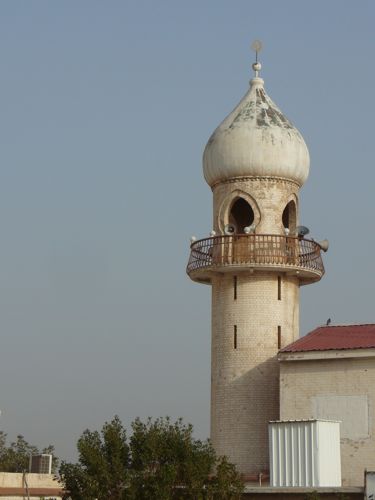
I see a lot of new mosques going up in Kuwait, and I see a lot of renovations. I just wish someone would spruce up this beautiful old minaret in Al Ahmadi. Looks to me like it is well-built, just needs a new coat of paint. And then I start to wonder, do mosques have committees, like churches do? We have the committee for the church grounds, the committee to take care of the altar, the committee to welcome new members, the committee to work with church school programs for the children . . . it goes on and on!
Do mosques have citizens committees?
Segregation – Integration – Choice
A fascinating new and very long article from The New York Times Magazine section discusses a school where boys and girls have a choice of integrated or segregated classrooms – in the same school.
I would have hated going to an all-girl school, and at the same time, I think it is far for people to have a choice in how they want to learn. What was right for me is not right for everyone else, and maybe not for YOU – or your children.
Here is a quote from deep in the article, about how things are succeeding at one same-sex school. I wonder how this technique would fly in Kuwait 😉
If a child arrives at 7:31 a.m., his parents will receive a call at 5:45 the next morning to make sure that boy will be at school on time.
By ELIZABETH WEIL
Published: March 2, 2008
On an unseasonably cold day last November in Foley, Ala., Colby Royster and Michael Peterson, two students in William Bender’s fourth-grade public-school class, informed me that the class corn snake could eat a rat faster than the class boa constrictor. Bender teaches 26 fourth graders, all boys. Down the hall and around the corner, Michelle Gay teaches 26 fourth-grade girls. The boys like being on their own, they say, because girls don’t appreciate their jokes and think boys are too messy, and are also scared of snakes. The walls of the boys’ classroom are painted blue, the light bulbs emit a cool white light and the thermostat is set to 69 degrees. In the girls’ room, by contrast, the walls are yellow, the light bulbs emit a warm yellow light and the temperature is kept six degrees warmer, as per the instructions of Leonard Sax, a family physician turned author and advocate who this May will quit his medical practice to devote himself full time to promoting single-sex public education.
Foley Intermediate School began offering separate classes for boys and girls a few years ago, after the school’s principal, Lee Mansell, read a book by Michael Gurian called “Boys and Girls Learn Differently!” After that, she read a magazine article by Sax and thought that his insights would help improve the test scores of Foley’s lowest-achieving cohort, minority boys. Sax went on to publish those ideas in “Why Gender Matters: What Parents and Teachers Need to Know About the Emerging Science of Sex Differences.” Both books feature conversion stories of children, particularly boys, failing and on Ritalin in coeducational settings and then pulling themselves together in single-sex schools. Sax’s book and lectures also include neurological diagrams and scores of citations of obscure scientific studies, like one by a Swedish researcher who found, in a study of 96 adults, that males and females have different emotional and cognitive responses to different kinds of light. Sax refers to a few other studies that he says show that girls and boys draw differently, including one from a group of Japanese researchers who found girls’ drawings typically depict still lifes of people, pets or flowers, using 10 or more crayons, favoring warm colors like red, green, beige and brown; boys, on the other hand, draw action, using 6 or fewer colors, mostly cool hues like gray, blue, silver and black. This apparent difference, which Sax argues is hard-wired, causes teachers to praise girls’ artwork and make boys feel that they’re drawing incorrectly. Under Sax’s leadership, teachers learn to say things like, “Damien, take your green crayon and draw some sparks and take your black crayon and draw some black lines coming out from the back of the vehicle, to make it look like it’s going faster.” “Now Damien feels encouraged,” Sax explained to me when I first met him last spring in San Francisco. “To say: ‘Why don’t you use more colors? Why don’t you put someone in the vehicle?’ is as discouraging as if you say to Emily, ‘Well, this is nice, but why don’t you have one of them kick the other one — give us some action.’ ”
During the fall of 2003, Principal Mansell asked her entire faculty to read “Boys and Girls Learn Differently!” and, in the spring of 2004, to attend a one-day seminar led by Sax at the school, explaining boys’ and girls’ innate differences and how to teach to them. She also invited all Foley Intermediate School parents to a meeting extolling the virtues of single-sex public education. Enough parents were impressed that when Foley Intermediate, a school of 322 fourth and fifth graders, reopened after summer recess, the school had four single-sex classrooms: a girls’ and a boys’ class in both the fourth and fifth grades. Four classrooms in each grade remained coed.
Separating schoolboys from schoolgirls has long been a staple of private and parochial education. But the idea is now gaining traction in American public schools, in response to both the desire of parents to have more choice in their children’s public education and the separate education crises girls and boys have been widely reported to experience. The girls’ crisis was cited in the 1990s, when the American Association of University Women published “Shortchanging Girls, Shortchanging America,” which described how girls’ self-esteem plummets during puberty and how girls are subtly discouraged from careers in math and science. More recently, in what Sara Mead, an education expert at the New America Foundation, calls a “man bites dog” sensation, public and parental concerns have shifted to boys. Boys are currently behind their sisters in high-school and college graduation rates. School, the boy-crisis argument goes, is shaped by females to match the abilities of girls (or, as Sax puts it, is taught “by soft-spoken women who bore” boys). In 2006, Doug Anglin, a 17-year-old in Milton, Mass., filed a civil rights complaint with the United States Department of Education, claiming that his high school — where there are twice as many girls on the honor roll as there are boys — discriminated against males. His case did not prevail in the courts, but his sentiment found support in the Legislature and the press. That same year, as part of No Child Left Behind, the federal law that authorizes programs aimed at improving accountability and test scores in public schools, the Department of Education passed new regulations making it easier for districts to create single-sex classrooms and schools.
Foley Intermediate School began offering separate classes for boys and girls a few years ago, after the school’s principal, Lee Mansell, read a book by Michael Gurian called “Boys and Girls Learn Differently!” After that, she read a magazine article by Sax and thought that his insights would help improve the test scores of Foley’s lowest-achieving cohort, minority boys. Sax went on to publish those ideas in “Why Gender Matters: What Parents and Teachers Need to Know About the Emerging Science of Sex Differences.” Both books feature conversion stories of children, particularly boys, failing and on Ritalin in coeducational settings and then pulling themselves together in single-sex schools. Sax’s book and lectures also include neurological diagrams and scores of citations of obscure scientific studies, like one by a Swedish researcher who found, in a study of 96 adults, that males and females have different emotional and cognitive responses to different kinds of light. Sax refers to a few other studies that he says show that girls and boys draw differently, including one from a group of Japanese researchers who found girls’ drawings typically depict still lifes of people, pets or flowers, using 10 or more crayons, favoring warm colors like red, green, beige and brown; boys, on the other hand, draw action, using 6 or fewer colors, mostly cool hues like gray, blue, silver and black. This apparent difference, which Sax argues is hard-wired, causes teachers to praise girls’ artwork and make boys feel that they’re drawing incorrectly. Under Sax’s leadership, teachers learn to say things like, “Damien, take your green crayon and draw some sparks and take your black crayon and draw some black lines coming out from the back of the vehicle, to make it look like it’s going faster.” “Now Damien feels encouraged,” Sax explained to me when I first met him last spring in San Francisco. “To say: ‘Why don’t you use more colors? Why don’t you put someone in the vehicle?’ is as discouraging as if you say to Emily, ‘Well, this is nice, but why don’t you have one of them kick the other one — give us some action.’ ”
During the fall of 2003, Principal Mansell asked her entire faculty to read “Boys and Girls Learn Differently!” and, in the spring of 2004, to attend a one-day seminar led by Sax at the school, explaining boys’ and girls’ innate differences and how to teach to them. She also invited all Foley Intermediate School parents to a meeting extolling the virtues of single-sex public education. Enough parents were impressed that when Foley Intermediate, a school of 322 fourth and fifth graders, reopened after summer recess, the school had four single-sex classrooms: a girls’ and a boys’ class in both the fourth and fifth grades. Four classrooms in each grade remained coed.
Separating schoolboys from schoolgirls has long been a staple of private and parochial education. But the idea is now gaining traction in American public schools, in response to both the desire of parents to have more choice in their children’s public education and the separate education crises girls and boys have been widely reported to experience. The girls’ crisis was cited in the 1990s, when the American Association of University Women published “Shortchanging Girls, Shortchanging America,” which described how girls’ self-esteem plummets during puberty and how girls are subtly discouraged from careers in math and science. More recently, in what Sara Mead, an education expert at the New America Foundation, calls a “man bites dog” sensation, public and parental concerns have shifted to boys. Boys are currently behind their sisters in high-school and college graduation rates. School, the boy-crisis argument goes, is shaped by females to match the abilities of girls (or, as Sax puts it, is taught “by soft-spoken women who bore” boys). In 2006, Doug Anglin, a 17-year-old in Milton, Mass., filed a civil rights complaint with the United States Department of Education, claiming that his high school — where there are twice as many girls on the honor roll as there are boys — discriminated against males. His case did not prevail in the courts, but his sentiment found support in the Legislature and the press. That same year, as part of No Child Left Behind, the federal law that authorizes programs aimed at improving accountability and test scores in public schools, the Department of Education passed new regulations making it easier for districts to create single-sex classrooms and schools.
Recent Comments
ExpatAlien on What Country am I Living … intlxpatr on Yellowstone: Old Faithful to C… Michelle on Yellowstone: Old Faithful to C… Cathy on No Grown-Ups in Charge intlxpatr on Waiting for Snow Wikipedia Donate Button

Amazina


Early Voting in Florida


 Here There and Everywhere