Did You Get the Dashboard Gas Emissions E-mail?
I did.
Here is what I read this morning in the Qatar Gulf Times:
Steamy car interiors do not produce gas: expert
By Sarmad Qazi
The National Campaign for Road Accident Prevention (NCFRAP) yesterday dismissed as “false” a purported e-mail from “Saudi Geophysical and Environmental Consulting” making the rounds, saying that a poisonous gas forms in cars parked under direct sunlight.
There is no such company in Saudi Arabia, it has been learnt. However, a national organisation, “Saudi Geophysical” has been in operation since 1998.
“This is absolutely false. It is true that vehicles parked under direct sunlight get hot, but the formation of any poisonous gas is absolutely ridiculous,” Ademola Ilori, adviser to the Traffic Department said yesterday.
The e-mail cautions motorists to leave the vehicle’s doors well and windows open for a while, to let the “gas” escape.
“Based on scientific research, it is found that there is a gas called gasoline, emitted from the seats, air fresheners and seat covers, when parking your car in the sun particularly when the temperature is higher than 15 degrees Fahrenheit or 6 degress Celsius,” one of the six paragraphs from the e-mail reads.
According to Ilori, on a typical sunny day in Qatar, the temperature inside a parked vehicle can easily exceed 50 degrees C in just ten to twenty minutes.
“Hot weather brings unique challenges to vehicles. It can present dangerous conditions for both the vehicle and its occupants but fortunately most incidents can easily be avoided,” Ilori said.
“Studies show that 75% of the temperature rise occurs within five minutes of closing the doors and goes up to 51-67C within 15 minutes. Leaving the windows (cracking) slightly open does not keep the temperature at a safe level,” he added.
Sharing summer driving tips, the official said that motorists should check oil, transmission fluid, windshield washer, battery level and strength, tyre pressure, etc before taking their vehicles out.
“Drivers need to stay cool as well, by drinking a lot of water (not ice cold) especially those who travel in vehicles without air-conditioning. Of particular importance for motorists is to keep an eye on the lights and gauges when driving in hot weather.
“If your temperature gauge moves up, turn on the heater to its highest and hottest setting. It will be uncomfortable, but it will help draw some of the heat away from the engine. If you are stopped in traffic put the vehicle in “P” (or neutral for manual gears) and lightly step on the gas to help circulate the coolant,” he said.
In case the temperature gauge enters the “red zone”, a vehicle should immediately be pulled off the road and the engine be shut.
However, at this point, motorists should not attempt to remove the radiator cap as the hot pressurised coolant will spray out with great force.
“Do not pour water over the radiator or engine, since a dramatic change in temperature could cause damage. After the engine cools, add a 50-50 mix of coolant and water to the reservoir to bring it up to its proper level,” Ilori said.
Gushing Oil Stopped
This is what the latest live feed of the Gulf Oil gusher looks like:
It is not totally stopped. It has already spewed millions of gallons of life-killing petroleum into the Gulf. No one knows how well it will hold, or if it will hold. No one knows what the long term effects of this gaffe will be.
We’re just all glad it is tamed for now.
News and Roosters
“How’d you sleep?” I cheerily greeted my sister, Sparkle, newly arrived from Paris to our small farming village in Germany.
“That #*%@ing ROOSTER!” she exclaimed. “He started crowing around 3:00 a.m. and never stopped! You must have heard him! He was right under our window!”

No. No, there was no rooster under our windows. The nearest rooster was up in the next farm, maybe 100 yards away. But I kind of remembered when we first moved in, I think I remember we heard him. We no longer heard him. You just get used to it, I guess.
What brings this to mind is that KUOW in Seattle has a program today on the Seattle City Council vote – they are about to vote to increase the number of chickens allowed by ‘urban farmers’ but to prohibit the roosters.
You can hear the discussion for yourself by going to KUOW. There are some hilarious comments, one by a man who said “Sure, ban roosters, right after you ban boom boxes, and teenagers, and heavy trucks, and garbage pickups. There are a lot worse sounds in the city than roosters!” (I may have paraphrased that quote, I was laughing too hard to write it all down.)
AdventureMan and I love National Public Radio. We support our local NPR station, WUWF in Pensacola, which I listen to while I am driving, but when I am working on a project, I still stream KUOW, which I started doing while I was living in the Gulf. I love the huge variety of opinions and subjects, and I appreciate that there is more news in the world than what they show on TV, after all, on TV they can only show what they have film footage of. There are books to be discussed, and movies, and music, and social situations in Khandahar and Botswana and Sri Lanka and boy soldiers in Liberia . . . things I haven’t a clue about unless I listen to my national public radio station. I read the paper daily. I watch the news once a day – but it doesn’t meet the depth of coverage of NPR.
I think chickens are pretty cool. They are also pretty stupid, but I am all for a chicken or two, fresh eggs, etc. When I needed fresh eggs in Germany, I just walked up the hill and bought them from the chicken lady. When I asked my landlady about recycling, she just laughed, and we walked our food leftovers, peelings, coffee grounds, etc up the hill and threw them over the fence for the chickens. I don’t even mind roosters. Sorry, Sparkle!
Pensacola Oil Spill Editorial Cartoon
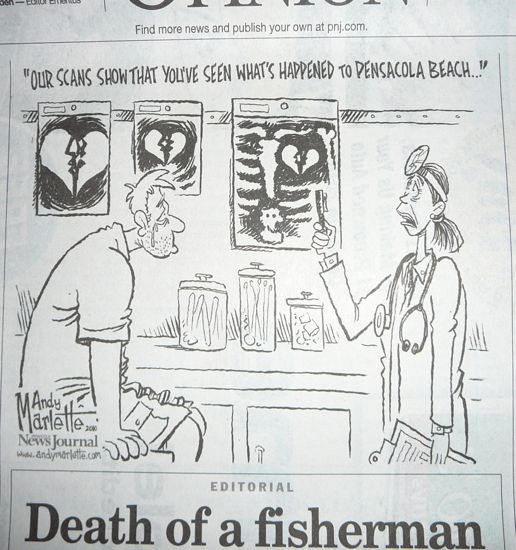
The editorial underneath, Death of a Fisherman, refers to the suicide of a charter boat fisherman. His business tanked, he joined the BP clean-up. After an early morning meeting, he killed himself. All he ever wanted to do was fish. His heart was broken.
Heartache in Pensacola
It’s a beautiful full moon over the oil soaked beaches of Pensacola. There is a beach advisory against children on the beach, against pregnant women or people with weak immune systems being on the beach. The surf is contaminated with oil and VOC, which is volatile organic compounds, whatever that means, it is bad.
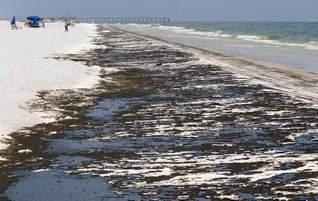


Checking Out Pensacola Beach
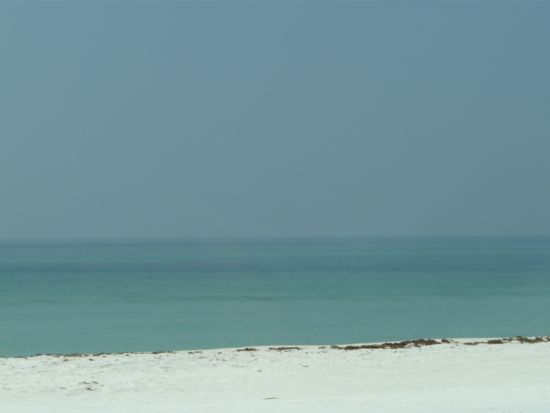
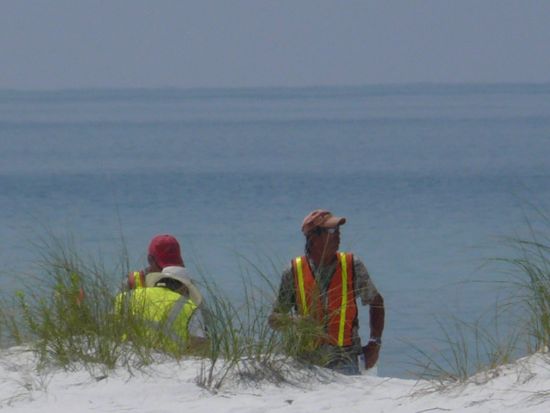
After our water aerobics class this morning, AdventureMan and I drove out to the beautiful sugar-white sandy beaches of Pensacola to check the damage. The clean up crews have been busy, and the beaches look gorgeous. People are sunning, swimming, and sharing the beaches with the clean up crews.
A big huge electronic sign announces that the road to the beach will be closed all day tomorrow. How can you close a major road? Is this Kuwait, or Qatar, where the will of the Amir says “Make it so!” and it is so? Oh. Wait. President Obama is coming, so the road will be his and his alone to go out to the beaches and see what we saw today.
The huge, gigantic glob of oil has only sent tendrils, so far, to the pristine white beaches, but doom impends as storms and winds blow the thick oily sludge toward the shores. God willing, President Obama will find a way to encourage British Petroleum to work with a little more conviction and energy to find a long term solution to this unthinkable TWO MONTHS and hundreds of thousands of gallons spewing into the Gulf.


Hurricanes and Oil Spills – How they Mix
Thank you, Enviro-Girl, for forwarding me this information:
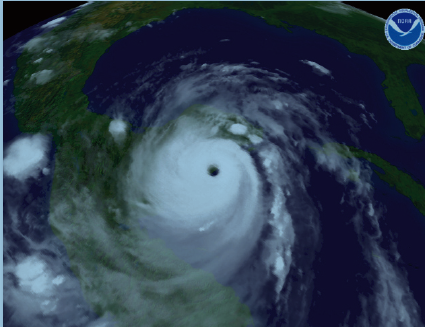
What will happen to a hurricane that runs through
this oil slick?
• Most hurricanes span an enormous area of the
ocean (200-300 miles) — far wider than the
current size of the spill.
• If the slick remains small in comparison to a
typical hurricane’s general environment and size,
the anticipated impact on the hurricane would
be minimal.
• The oil is not expected to appreciably affect either
the intensity or the track of a fully developed
tropical storm or hurricane.
• The oil slick would have little effect on the storm
surge or near-shore wave heights.
What will the hurricane do to the oil slick in
the Gulf?
• The high winds and seas will mix and “weather”
the oil which can help accelerate the
biodegradation process.
• The high winds may distribute oil over a wider
area, but it is difficult to model exactly where the
oil may be transported.
• Movement of oil would depend greatly on the
track of the hurricane.
• Storms’ surges may carry oil into the coastline
and inland as far as the surge reaches. Debris
resulting from the hurricane may be contaminated
by oil from the Deepwater Horizon incident, but
also from other oil releases that may occur during
the storm.
• A hurricane’s winds rotate counter-clockwise.
Thus, in VERY GENERAL TERMS:
o A hurricane passing to the west of the oil slick
could drive oil to the coast.
o A hurricane passing to the east of the slick
could drive the oil away from the coast.
o However, the details of the evolution of the
storm, the track, the wind speed, the size, the
forward motion and the intensity are all
unknowns at this point and may alter this
general statement.
Will the oil slick help or hurt a storm from
developing in the Gulf?
• Evaporation from the sea surface fuels tropical
storms and hurricanes. Over relatively calm water
(such as for a developing tropical depression or
disturbance), in theory, an oil slick could suppress
evaporation if the layer is thick enough, by not
allowing contact of the water to the air.
• With less evaporation one might assume there
would be less moisture available to fuel the
hurricane and thus reduce its strength.
• However, except for immediately near the source,
the slick is very patchy. At moderate wind speeds,
such as those found in approaching tropical
storms and hurricanes, a thin layer of oil such as
is the case with the current slick (except in very
limited areas near the well) would likely break into
pools on the surface or mix as drops in the upper
layers of the ocean. (The heaviest surface slicks,
however, could re-coalesce at the surface after the
storm passes.)
• This would allow much of the water to remain in
touch with the overlying air and greatly reduce
any effect the oil may have on evaporation.
• Therefore, the oil slick is not likely to have a
significant impact on the hurricane.
Will the hurricane pull up
the oil that is below the
surface of the Gulf?
• All of the sampling to date
shows that except near
the leaking well, the
subsurface dispersed oil is in
parts per million levels or less. The hurricane will
mix the waters of the Gulf and disperse the oil
even further.
Have we had experience in the past with
hurricanes and oil spills?
• Yes, but our experience has been primarily with oil
spills that occurred because of the storm, not
from an existing oil slick and an ongoing release
of oil from the seafloor.
• The experience from hurricanes Katrina and Rita
(2005) was that oil released during the storms
became very widely dispersed.
• Dozens of significant spills and hundreds of
smaller spills occurred from offshore facilities,
shoreside facilities, vessel sinkings, etc.
Will there be oil in the rain related to
a hurricane?
• No. Hurricanes draw water vapor from a large
area, much larger than the area covered by oil,
and rain is produced in clouds circulating
the hurricane.
Learn more about NOAA’s response to the BP oil
spill at http://response.restoration.noaa.gov/
deepwaterhorizon.
To learn more about NOAA, visit
http://www.noaa.gov.
Hurricane Season Begins Today
As if the oil spill isn’t enough, today is the first day of hurricane season.

The hurricane guide tells us to have three days worth of food and water stored to get people through a hurricane and its aftermath – loss of electricity, highways blocked with fallen trees, etc. We have a safe room, a large closet next to an outside wall. We have a 7 gallon water storage container, and matches. I’m still working on the rest; I don’t want to be one of those running to the supermarket the day the hurricane might hit.
The good news – for us – is that we did not buy a house in the evacuation zone.

You cannot imagine how seductive some of these houses are. We had assumed we would buy a house on the water. Our beautiful 10th floor apartment on the Arabian Gulf in Kuwait gave us a taste for an endless water view, and that’s what we were looking for:
House 1

House 2
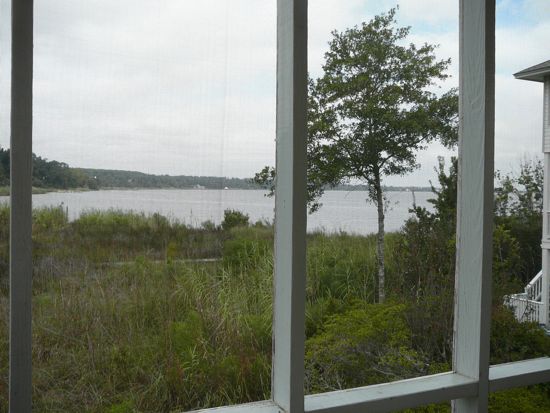
House 3
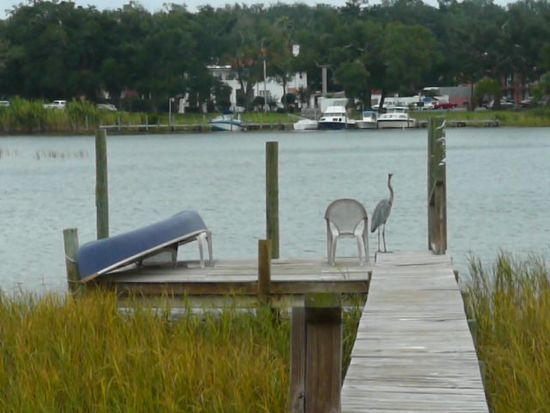
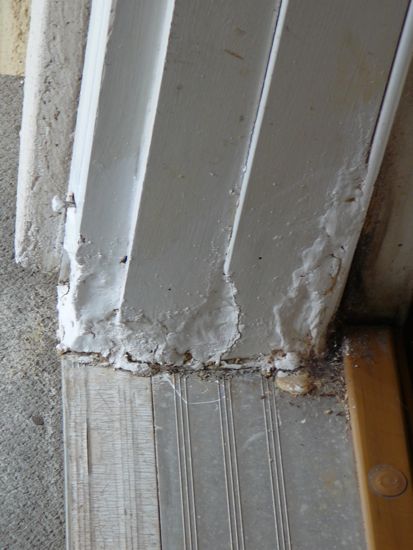
Every house on the water faces the possibility of serious damage in a hurricane. Two of the houses had damage from Ivan, one had ongoing damage from the dampness of being adjacent – well, almost inside – the wetlands. The wetlands are encroaching on two of the properties. One house, we totally loved. We could see ourselves living there, even facing the danger of hurricanes. That is, until we visited the basement, felt the humidity, saw a rotting pillar and realized we would face an unending battle with rot. The doorframe to the outside was rubbery with dampness:
It was a real blow to us giving up our dream.
On the other hand, it is a relief, now, knowing we are not in an evacuation zone.
There are no guarantees against a direct hit by a hurricane. All we have done is improved our odds, somewhat, which is about the best you can do when you live in a hurricane zone.
BBC and the Oil Spill and Ethiopian Elections
You would think that living here on the Gulf Coast within miles of the huge oil spill spewing out to putrefy the beautiful, sparkling gulf waters, that we would have the best, most comprehensive coverage of the local news.
Not so.
“I love BBC!” I called out from my studio to AdventureMan, in his study next door. “Who else is covering the Ethiopian elections in such detail? And they have the best coverage of the oil spill!”
Here is the latest; and excerpt from the Huffington Post:
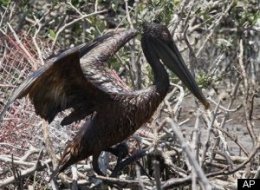
BARATARIA BAY, La. (AP) — As officials approached to survey the damage the Gulf oil spill caused in coastal marshes, some brown pelicans couldn’t fly away Sunday. All they could do was hobble.
Several pelicans were coated in oil on Barataria Bay off Louisiana, their usually brown and white feathers now jet black. Pelican eggs were glazed with rust-colored gunk, and new hatchlings and nests were also coated with crude.
It is unclear if the area can even be cleaned, or if the birds can be saved. It is also unknown how much of the Gulf Coast will end up looking the same way because of a well that has spewed untold millions of gallons of oil since an offshore rig exploded more than a month ago.
“As we talk, a total of more than 65 miles of our shoreline now has been oiled,” said Louisiana Gov. Bobby Jindal, who announced new efforts to keep the spill from spreading.
A mile-long tube operating for about a week has siphoned off more than half a million gallons in the past week, but it began sucking up oil at a slower rate over the weekend. Even at its best the effort did not capture all the oil leaking, and the next attempt to stanch the flow won’t be put into action until at least Tuesday. . . .
In Barataria Bay, orange oil had made its way a good 6 inches onto the shore, coating grasses and the nests of brown pelicans in mangrove trees. Just six months ago, the birds had been removed from the federal endangered species list.
The pelicans struggled to clean the crude from their bodies, splashing in the water and preening themselves. One stood at the edge of the island with its wings lifted slightly, its head drooping — so encrusted in oil it couldn’t fly.
Wildlife officials tried to rescue oil-soaked pelicans Sunday, but they suspended their efforts after spooking the birds. They weren’t sure whether they would try again. U.S. Fish and Wildlife spokeswoman Stacy Shelton said it is sometimes better to leave the animals alone than to disturb their colony.
Pelicans are especially vulnerable to oil. Not only could they eat tainted fish and feed it to their young, but they could die of hypothermia or drowning if they’re soaked in oil.
Globs of oil have soaked through containment booms set up in the area. Plaquemines Parish President Billy Nungesser said BP needed to send more booms. He said it would be up to federal wildlife authorities to decide whether to try to clean the oil that has already washed ashore.
Victory at the Shrimp Basket
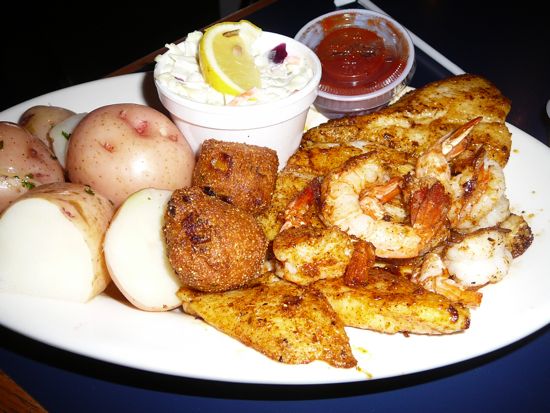
This is a moral victory. AdventureMan and I ate at the Shrimp Basket last week and we DID NOT eat fried food! We tried their non-fried platters, AdventureMan had the grilled fish and shrimp, and I had the blackened fish and shrimps. I took the photo before eating! (another victory, woooo HOOOO!)
Yes, I did dip my shrimp in the melted butter. I could not resist. This is one of the best seafood meals I have had in a long time, it was totally delicious.
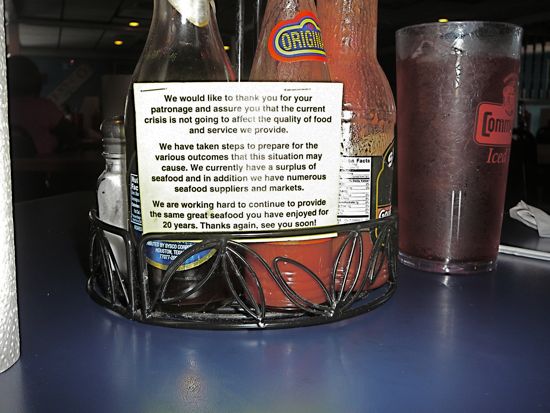
On the table was this sign:
The oil has started coming ashore in Louisiana. It is thick and gooey, and it is sticking to the marshlands, clinging to delicate feathers on birds and suffocating wildlife. This is the beginning of a long, long, ugly process of trying to reclaim what nature never intended the oil to touch. It is devastating.
Recent Comments
intlxpatr on Shampoo Ginger tigerbutterya0c5ff1d… on Shampoo Ginger intlxpatr on British Soldier Kidnapped, Esc… John on British Soldier Kidnapped, Esc… intlxpatr on British Soldier Kidnapped, Esc… Wikipedia Donate Button

Amazina


Early Voting in Florida


