Sunset at the End of the Year
I saved these for the last, for the last day of the year (where did it GO ??????) because I love sunsets even more than I love sunrises 🙂 No, these are not taken over the Arabian Gulf, but over the Wakulla Springs, as the sun sets in the cold dark days of winter time:


Birding at St. Mark’s National Wildlife Refuge

Some mornings, I am astonished at how wonderful it is to live in a place where we have the luxury to set aside wide tracts of lands to preserve our natural heritage. St. Mark’s National Wildlife Refuge evokes that response in me. It’s even more astonishing that because a couple years ago I bought a lifetime Senior Pass, getting into the national parks is free – for the rest of my life. What a great country we live in. 🙂
It is a cold and frosty morning as we load up to head out to St. Marks for some serious bird watching and photographing. Serious, that is, for AdventureMan, who actually does birding trips with other serious birders. I am a bird-appreciator, as in I know what a cardinal is, and a blue jay. I can pretty well recognize a buzzard. Hey, show me a painting and I can probably tell you who painted it, but birds . . . not so much.

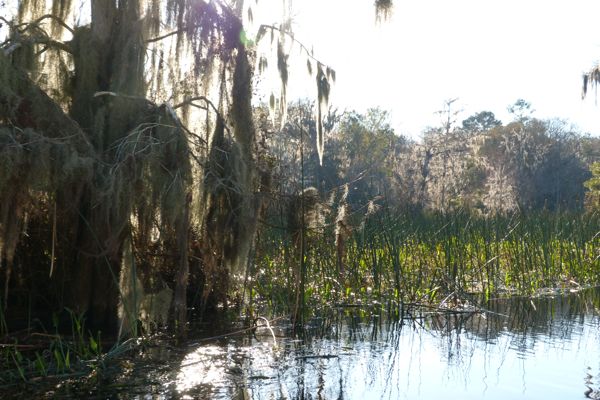
I love being outdoors in Florida on a wonderful clear cool day with fabulous conditions for taking photos. I love just wandering along some of the birding trails and seeing what we can see. It’s an amazing place; in some of the areas where we stopped to wander, it reminded me of places we like to go in Africa, of Zambia, of Namibia, of Botswana . . . some of the habitat is so alike, I can almost hear those tectonic plates creaking apart, drifting, and wonder how much of the flora is directly related to African flora.
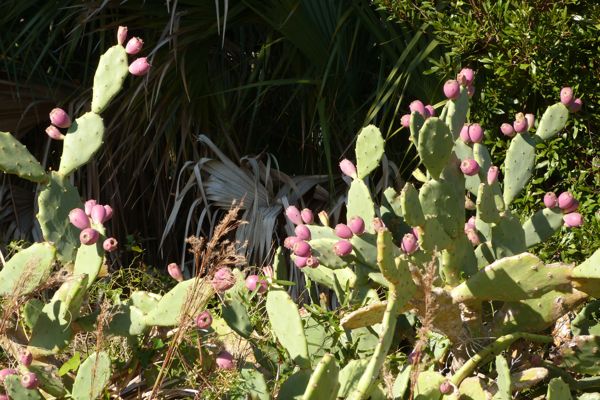
We had these in Tunisia; we called them Prickly Pear, and the Tunisians used them for borders to separate their lands. They also made jam with the prickly pears, and they skinned the leaves and fried up the meat from inside the thick prickly pear leaves. I think what a great border they would make in Pensacola, but a very unfriendly border. Good for keeping away thieves and burglers, but not very attractive, and not very welcoming . . . but very very African:
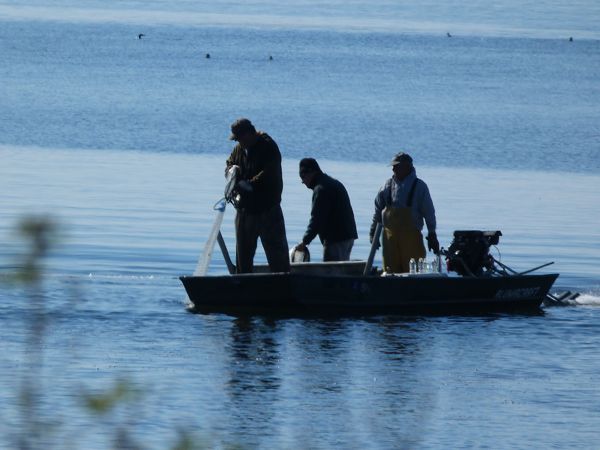
Some fishermen, probably setting some crab traps near the shore:

The St. Mark’s lighthouse:

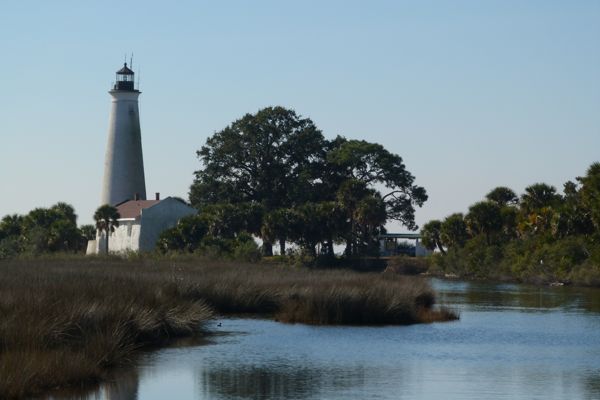

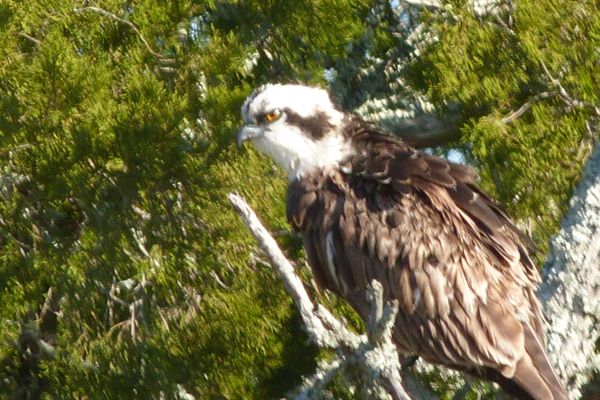

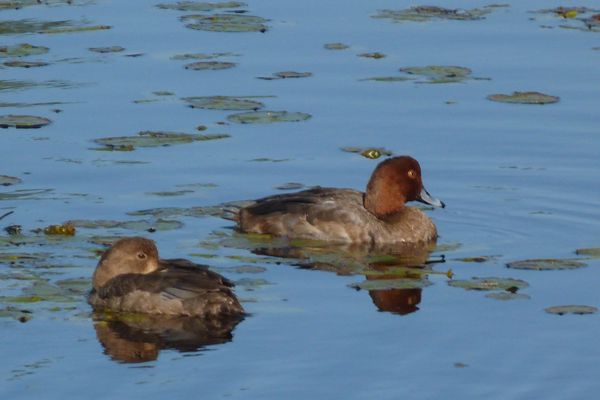
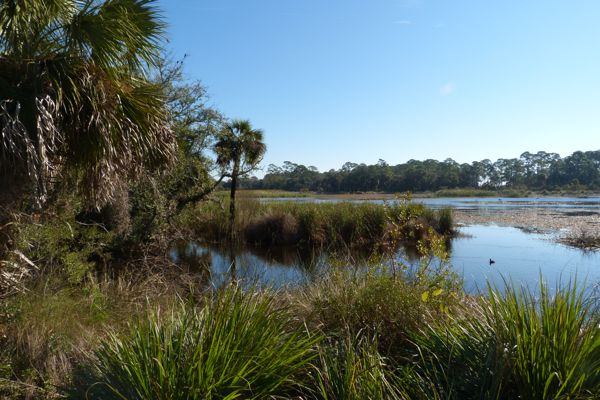


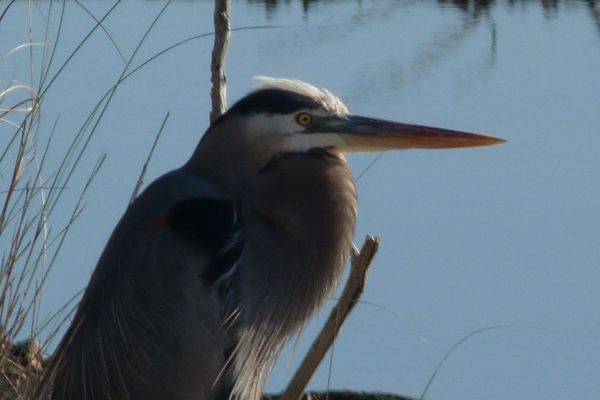
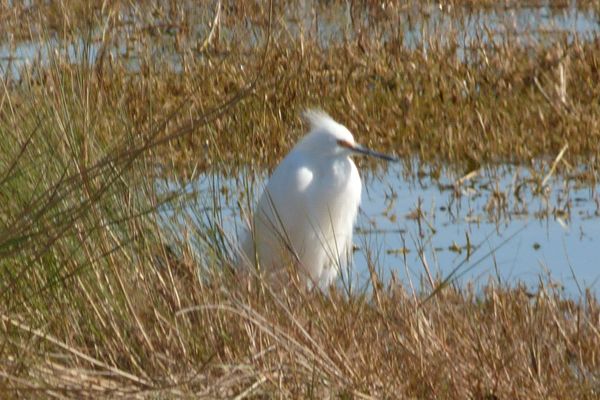
Every now and then you have a lucky moment, and I happened to shoot this heron just as he had a wiggling sparkly fish in his beak, just before he swallowed it. I admit it, I wasn’t trying. If I had been trying, I could never have gotten it just at the right moment:


Some very clever park person went around and made all the deer crossing signs into Rudolph signs, LOL!

The park is full of very serious-faced people carrying HUGE lenses on cameras attached to seriously sturdy tripods, lenses meant to capture the details of the pinfeathers, cameras to document a rare sighting. These people don’t talk about ducks, they talk about Merganzers and Koots, and the rarely seen such-and-such, and I just listen and keep my mouth shut while my head spins.
For me, it’s enough to see these wonderful creatures, free of fear, safe in their migrations. It’s enough to have a cool day, a great day for walking, and NO mosquitos. It’s a great day for my kind of birding, which is very non-serious to be sure.
Horrifying Parenting

After our boat trip, we took a walk to the diving platform to watch the manatees. When we lived in the Tampa/St. Pete/Safety Harbor area, we saw Manatees all the time, and it was heart breaking. They are big, stupid, clumsy animals who do no harm. They love to congregate where there is warm water on a cold winter’s night. Sadly, these slow moving sea cows are often hit and damaged by boaters; the blades of the motors scarring the manatees, often wounding them fatally. They have no defense against the casual, callous cruelty of the oblivious boater.
Here, in Wakulla Springs, they are safe. The only boats allowed in the Springs areas have caged blades; they cannot hurt the manatees.
No, only people can hurt them.
As we were watching the manatee, there was a family there. I try not to judge parents; parenting is hard. I will just make some observations. It was 40 degrees F – not that far from freezing – and the two little girls were dressed in beach clothes and their feet were bare. They were running on the diving platform, while Mom was trying to take photos of the manatees with her iPhone, and dad was trying to keep the little ones rounded up. On the second level, two stories above the ground, one little girl, maybe four years old, runs out to the edge of the diving platform and her dad snatches her back, just in time, as mom continues trying to film the manatees. All this is their business, although I fear for little girls who are raised carelessly, it is not my business.
Then, the older little girl reached down in her pockets and pulled out handsfull of breadcrumbs, which she spread into the water WHILE HER PARENTS WATCHED. Did you not see the signs? Did you not hear the guides? We are not to feed the manatees anything! Bread and breadcrumbs are not a part of their diet! Parents, what are you using for brains? ? ?
No. I did not say anything; I don’t look for trouble. I write it in this blog, and then, God willing, I let it go.
Wakulla Springs Boat Trip
At Wakulla Springs, everything is separate. Like the entrance fee goes to the State. The Wakulla Lodge is run by some corporation with a state contract, I am guessing, and the Wakulla Boat Rides are another separately run concession. If you are staying at the Lodge, or booked for the lunch buffet at the Lodge, you get into the Edward Ball Wakulla Springs State Park for free, instead of paying the $6/vehicle entrance fee.
The boat trip is half the fun. On hot days in the park, you can swim right in the same spring as the manatees, but on chilly winter days – take the boat trip. We took the boat trip twice, it is so much fun, and because we love the late afternoon light. I will share my photos of some of what we saw on the hour long trip below; warning you that trying to get a shot of an underwater manatee is not such an easy thing to do. You may have to use a little imagination to see the manatee 🙂 but I swear, it is there.
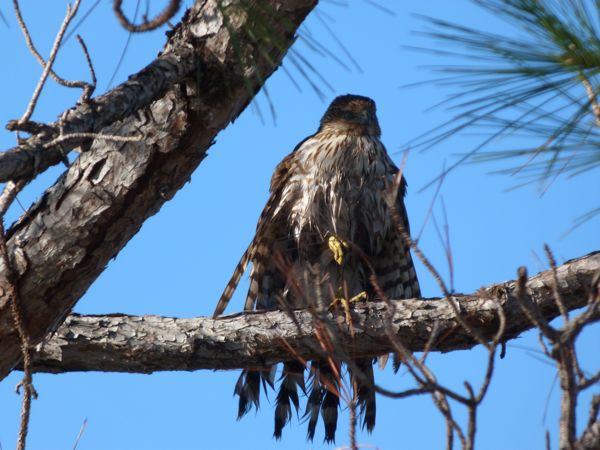
These are leathery buzzards, wintering in Wakulla Springs:

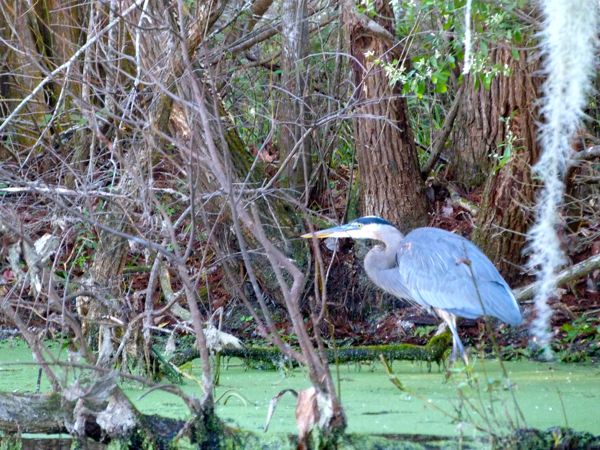
Great Blue Heron:
Little ducks called Koots:

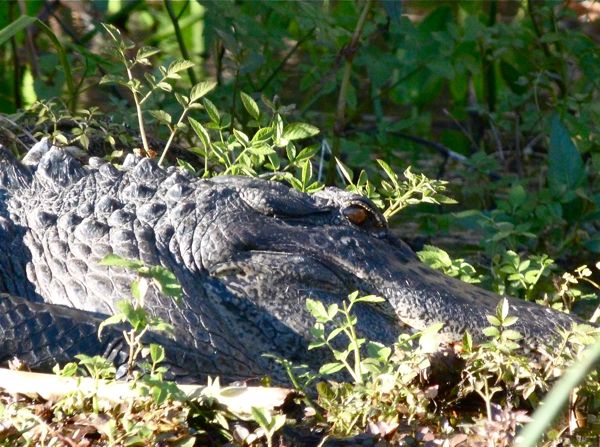
Sunning Gator:

Close up of Gator skin:

Close up Gator head – he was so cold he didn’t even care about the boat being near, he just wanted to soak up as much sun as he could before it set:
Wakulla Springs Cypress:

The Wakulla Springs Lodge from the Springs:
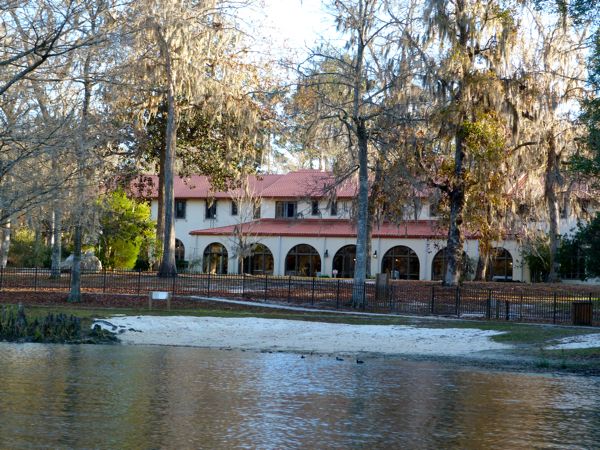
Old fashioned swimming platform:

Buzzards roosting:

Turtle soaking up some sun:

Anhinga drying out his wings:

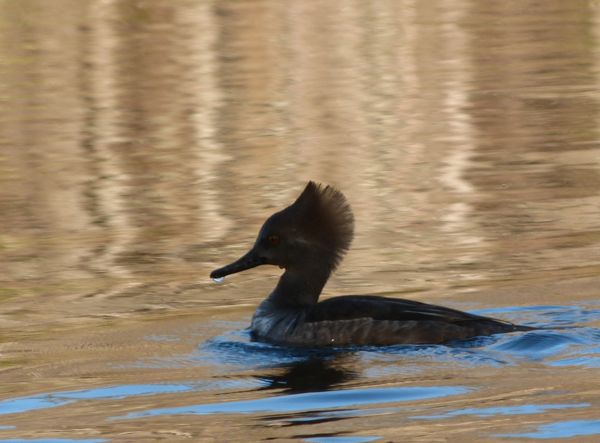
Merganzer Duck – don’t you love his helmeted head?
OK, there it is, the Manatee, otherwise known as a sea cow, a siren, and a sea slug – about the size of a small whale or a very large shark:

Wakulla Springs Lodge: Attitude Matters
AdventureMan and I just had a grand adventure, a trip to Edward Ball Wakulla Springs State Park, where we stayed at the Wakulla Springs Lodge for a couple nights.
I think we mentioned we lived in Florida before, a while back, at which time we came to dislike the commercial Florida intensely – think DisneyWorld and Orlando and schlock-filled shops with T-shirts “3 for $10!” It’s not that I dislike Disney, I grew up with Disney, and Bambi and Peter Pan and Sleeping Beauty and Cinderella. They’re a lot of fun.
But have you been to DisneyWorld recently? Have you paid those prices? And if you want to park there, or stay there, or eat there – it is horrendous! Advertised as family friendly, but a death-knell on a family budget.
There is so much MORE to Florida, some wonderful places. Wakulla Springs is one of our favorites, and not far from another favorite, Appalachicola, home of world famous oysters, fresh out of the Gulf (Gulf of Mexico, :-), for my other Gulf friends) We used to stay at Wakulla Springs while we were living in Kuwait and Qatar, and traveling to the USA to catch some time with our son, at FSU in Tallahassee.
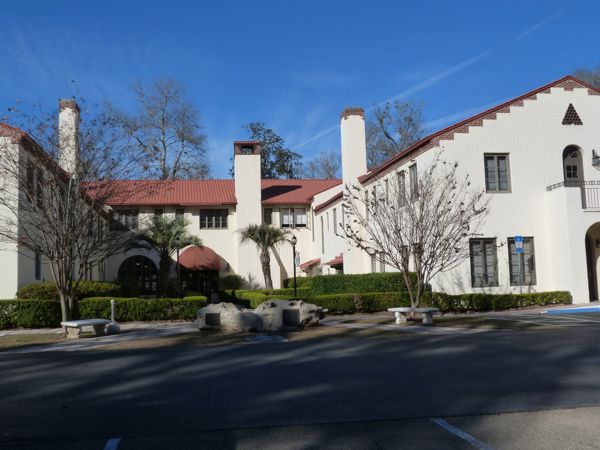
After our drive down, we show up at the counter . . . and the receptionist barely looks at us. She doesn’t get up. She doesn’t have a name tag on; she is wearing a FAMU sweatsuit. We give our names, and she doesn’t say anything to us, just dials a number and talks to someone and then, finally, looks at us and says “we don’t have anything ready. Check-in isn’t until 3:00 o’clock.”
Welcome to Wakulla Springs Lodge. I was speechless. I couldn’t imagine how someone could be so rude! So unwelcoming! We are guests, here to spend our money, and this is how our time in Wakulla begins?
It’s all about attitude. I could feel my temper rising. On the other hand, what good would it do to get angry? Am I going to make a difference in how this young woman welcomes her customer, or am I going to make her day worse than it already is? Sometimes it’s just poor training. Sometimes someone is just having a bad day. Sometimes it’s disgust with corporate management, and this may have been a little of all of the above.
We decided to go to lunch, and the doors closed just as we got there. Wakulla Springs is on a different time zone, and the restaurant is closed!
We were so happy to be going, and now we are having second thoughts. We decide we had better go find something to eat – have you noticed it is easier to be down or angry when you are hungry? Really, really hungry? 😉 We drove to the crossroads that had a few eating places, about half of them closed. There was one I thought “oh please, please, don’t let that be the only one open” and encouraged AdventureMan to drive on, just a little further.
What we discovered will be the next entry 🙂
This is the Wakulla Lodge fireplace:

Edward Ball brought in artisans from Italy to paint the beamed ceiling in the lobby; it is truly lovely:

Later, I sat in the lobby with a cup of coffee, waiting for my boat trip, and a wedding party came in to rehearse for the big day. The mother of the groom had to walk away, trying to staunch the tears, as the pianist practiced “Here Comes the Bride.” I had to cry a little along with her; I LOVE weddings 🙂

The lobby is spacious and light and beautiful. There is a gift shop and ice cream bar at one end of the lobby, and a restaurant at the other end:

These boat trips last about an hour and tell you a lot about the history and wildlife of Wakulla Springs. They are a lot of fun:

The first night, we had a truly indifferent meal in the Wakulla Lodge Restaurant, made bearable by the cheerful and professional waitress, Brittany, who had to tell us that they were totally out of their famous navy bean soup, and also out of the salad we wanted to order.
“We’ve been inundated!” she cried. “The lunch crowd wiped us out!” She was so cheerfully honest we couldn’t help but be cheerful right back. That’s the magic in good customer service.
While the meal was mediocre, Brittany sparkled as she served, and turned what might have been a real downer into just a less-than-memorable meal, we’ve had a few of those now and then, no big deal. With a lesser waitress, it might have been horrible.
All in all, customer service was notable in its imbalance at Wakulla Springs Lodge. Brittany, in the Dining Room, was a star. JJ, a part-timer at the desk, was another star. Our bathroom floor in our room was not clean, but the staff was gracious and eager to please. The ice-cream bar attendant was overworked and grouchy. (Honestly! How can you serve ice cream and be a grouch???)
There is so much potential at Wakulla Springs Lodge. They have this fabulous location, a huge spring where water pumps out thousands of gallons per day, where manatees and wildlife congregate, where movies have been filmed, where serious birders come to “twitch” (check off birds seen), with these fun boat trips, natural attractions, lovely sized rooms, and it just needs some polish to be a seriously first-class destination.
Gemenid Meteor Showers Peak Tonight!
I found this on BBC News; if where you live is as cold – or colder – that Pensacola, you will need to bundle up in a heavy down sleeping bag while you “relax and enjoy the view.”
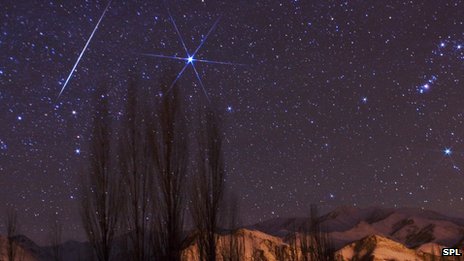
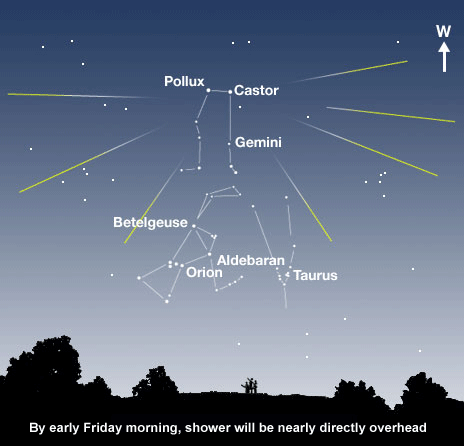
The annual Geminids meteor shower will reach its peak late on Thursday night and into early Friday morning.
The meteors will appear to radiate from a point near the star Castor, in the constellation Gemini.
In the Northern hemisphere, that will be westward and nearly overhead in the early hours of Friday.
Sky watchers can expect an average of dozens of “shooting stars” per hour, made easier to see by darkness provided by the “new moon” phase.
The shower comes about each year as the Earth passes through the path of an asteroid called 3200 Phaethon.
The asteroid leaves behind a trail of rocky debris that the Earth ploughs into each year – debris moving at 35km per second that burns up in the atmosphere in what can be spectacular displays.
According to the International Meteor Organization, the “radiant” – the apparent point from which the meteors seem to come – will be visible from sunset in high northern latitudes, rising at about midnight local time in the southern hemisphere.
“For those old enough or tough enough to stay up until two in the morning, then the radiant point [in the Northern hemisphere] is almost overhead so you could basically look anywhere and see them,” Robert Massey of the Royal Astronomical Society told BBC News. “Go outside, wrap up well, get yourself into a comfortable chair, relax, and enjoy the view.
“It could be 30 [meteors] an hour, it could be 100 an hour. But those are only average figures there maybe a period of 10 minutes that you don’t see anything but equally there may be a period of 10 minutes when you see 30.”
The Geminids are less well-known relative to other annual meteoric performances such as the Perseids, in part because December weather often threatens a clear view of the show.
For the UK that may again be case; BBC Weather reports that southern Scotland and the North of England will have clearest conditions into Friday morning but conditions will tend toward cloudy and windy across the UK through the night.
Severe Weather Warning

The severe weather warning ended at 4, the Pensacola News Journal has photos up uprooted trees and flooded areas, but up above, the skies continue to thunder, and the rain keeps a tumblin’ down.
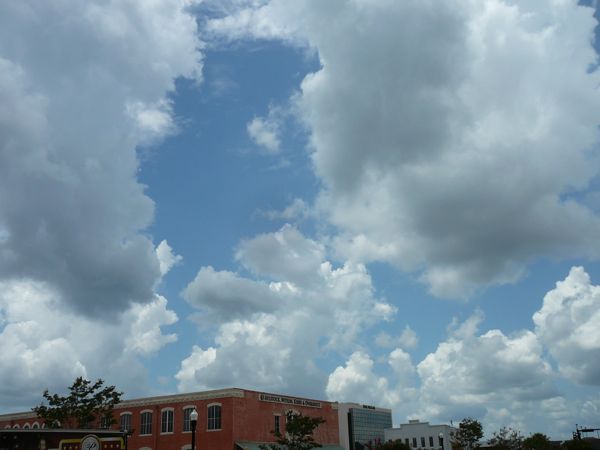
Clouds beginning to pile up:

they just keep coming:
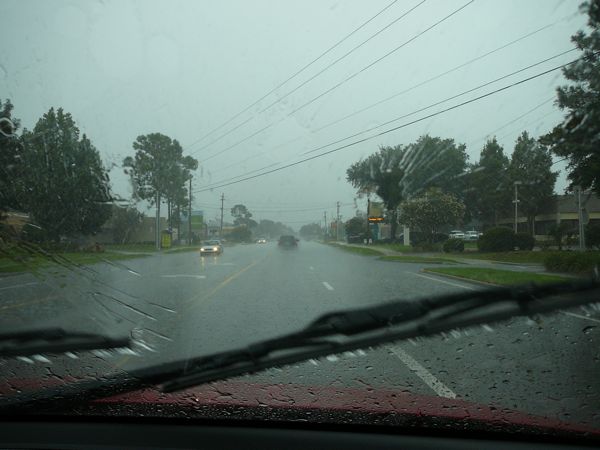
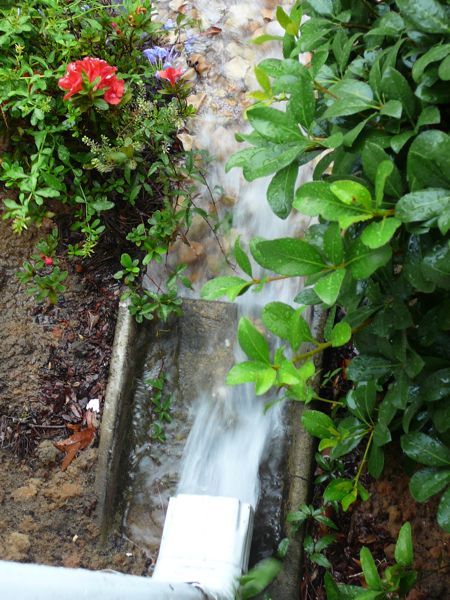
Et le deluge:

My family out in Seattle would kill for some sunshine as we roll into August and the Seafair events begin taking place, the parades, the Blue Angels and the Hydroplane races . . .
The temperatures are down into the seventies, a blessing, but when they go up again, it will once again be HOT AND HUMID.
Deepwater Horizon Spill and Hazards
On the front page of today’s Pensacola News Journal is a report by the Associated Press saying:
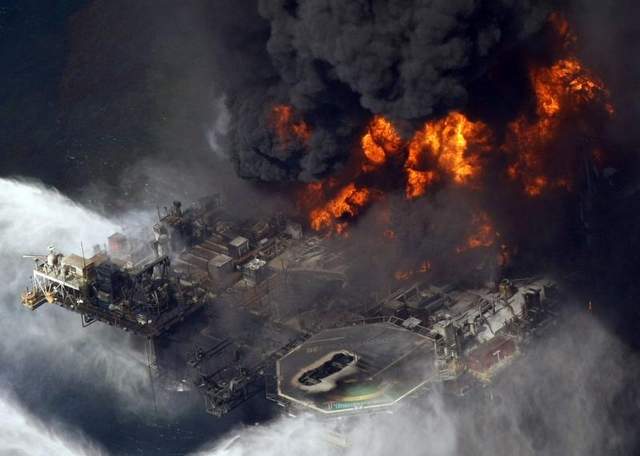
BP Missed Big Hazards, report says: Focus on worker safety obscured other problems.
HOUSTON – BP and the drilling contractor that operated the ill-fated Deepwater Horizon were so focused on worker safety they didn’t do enough to prevent major hazards, such as the 2010 rig explosion in the Gulf of Mexico that killed 11 people, federal investigators said yesterday.
Excuse me? Does that make sense to anyone?? So concerned with safety that 11 people got killed because they overlooked SAFETY problems?? I thought I must be crazy, but the report goes on to say the following:
The panel listed a litany of problems large and small they had already uncovered even though it has not received all of the records from Transocean, the drilling contractor that has challenged the board’s right to investigate the offshore incident.
Among the panel’s findings:
• BP and Transocean’s “bridging document,” designed to align safety procedures between the companies, was generic and addressed only six safety issues, but none of them dealt with major issues.
• The companies didn’t have key process limits or controls for safe drilling.
• There were no written instructions for how to conduct a crucial test at the end of the cementing process, one that ultimately was misinterpreted by the crew after it was conducted several times, each time differently.
• Similar concerns about too narrow a focus on personal safety were raised after an explosion in 2005 at BP’s Texas City refinery that killed 15 people, but few of the panel’s recommendations were implemented on the offshore rig.
“It’s always puzzled me why a company like BP … that has major resources available … is involved with two of the biggest accidents,” said John Bresland, a member of the board who is wrapping up his second five-year term and was involved in both investigations.
The drilling company doesn’t want to cooperate, and doesn’t think the federal government has the right to investigate? The company so focused on worker safety had an agreement with the drilling company that only focused on minor issues? NO key processes or controls?
What is wrong with this story? From this story, it is clear that worker safety was never a focus of BP. BP had another blowup with 15 deaths at a Texas refinery resulting from safety processes that were too narrowly focused, and now they are saying they are too focused on worker safety, and that is why they have so many worker deaths?
I guess, following the same reasoning, that the Deepwater Horizon blowup, which killed sealife, is still blackening beaches, which has created a tar carpet along the ocean floor, created birth defects among birds and mammals, and will create havok for a lifetime to come, all that resulted from BP’s excessive concern for the Environment?
Is this craziness? That kind of communication just makes me crazy.
I don’t care how much they end up paying to universities, groups promoting tourism, people who lost work, wildlife organizations, etc. as a result of the Deepwater Horizon explosion. You have to see that whatever they are paying is to buy silence, to buy complicity, to keep us from complaining too much when problems associated with the explosion continue to – literally – surface. Their money is to co-opt us. No matter what they are paying, it is too little.
James Lee Burke and the Creole Belle
James Lee Burke is number one on my guilty-pleasures list.

I first met his main character Dave Robicheaux in A Morning For Flamingos, a book I picked up in a military library at Lindsay Air Station, a post that doesn’t even exist any more. In the cold dark endless winter in Wiesbaden, Germany, James Lee Burke lit up my life. I had thought I was picking up just another escapist mystery novel, but when James Lee Burke puts words together to describe the way a storm moves in over the bayou, prose becomes poetry.
There is a downside. Whether it is his character Dave Robicheaux, the former New Orleans cop, now head homicide investigator in New Iberia, Louisiana, or his Hackberry Holland series set in West Texas, James Lee Burke’s books are filled with extreme violence and disturbing images that live in your head for a long time.
I’ve recommended James Lee Burke to friends, some of whom have said “Why do you read this trash??? It is HORRIBLE! It is full of over-the-top violence!”
And then again . . . he is writing about some really really bad people. They are out there. There are people who exist who inflict cruelty. I don’t understand it, I can’t begin to fathom where the urge would come from, but I’ve seen it. It’s out there. James Lee Burke pulls up that rock and exposes the dark happenings underneath.
On one level, as I started reading Creole Belle, I thought “Oh James Lee Burke, stop! Stop! It’s the same old formula! A downtrodden victim (often a beautiful woman) cries for help. You and Clete start looking for information and end up beating people up and then they retaliate by threatening your family! There is a rich, beautiful woman who seems vulnerable and who you kind of like, but she is complicated. There are rich amoral people who keep their hands clean, but who are calling the shots and never go to jail! Stop! Stop!”
Well, I should say that, and maybe I should stop. Then he starts talking about the smoke from the sugar cane fields and the bridge over the Bayou Teche, and the big Evangeline oak in St. Martinsville, and I am a goner. I’m sucked in, I’m hooked.
I detest the violence and the images. I keep coming back because James Lee Burke has some important things to say.
I’d love to have him to dinner. I’d love for him and our son to have a chance to talk about Law Enforcement. Here is what James Lee Burke has to say in Creole Bell:
There are three essential truths about law enforcement: Most crimes are not punished; most crimes are not solved through the use of forensic evidence; and informants product the lion’s share of information that puts the bad guys in a cage.
My son hates shows like CSI, and Law and Order, where the evidence convicts the criminals. He says it raises unreal expectations in juries, and makes it harder to get a conviction.
We watched a Violation of Parole hearing, or actually a series of hearings, where the judge asked each individual whose parole was about to be revoked what had happened when he or she was re-arrested. In each case, the parolee had done something stupid; drove a car with an expired license, drove to another state, was arrested driving drunk, etc. EVERY time. The judge made his point, I believe.
From Creole Belle:
But if Caruso was the pro Clete thought she was, she would avoid the mistakes and geographical settings common to the army of miscreants and dysfunctional individuals who constitute the criminal subculture of the United States. Few perpetrators are arrested during the commission of their crimes. They get pulled over for DWI, an expired license tag, or throwing litter on the street. They get busted in barroom beefs, prostitution stings, or fighting with a minimum-wage employee at a roach motel. Their addictions and compulsions govern their lives and place them in predictable circumstances and situations over and over, because they are incapable of changing who and what they are. Their level of stupidity is a source of humor at every stationhouse in the country. Unfortunately, the pros – high end safecrackers and jewel thieves and mobbed-up button men and second story creeps – are usually intelligent, pathological, skilled in what they do, middle class in their tastes and little different in dress and speech and behavior from the rest of us.
And then there are paragraphs like this that discuss the human experience, and have a far wider application than the book:
No one likes to be afraid. Fear is the enemy of love and faith and robs us of all serenity. It steals both our sleep and our sunrise and makes us treacherous and venal and dishonorble. It fills our glands with toxins and effaces our identity and gives flight to any vestige of self-respect. If you have ever been afraid, truly afraid, in a way that makes your hair soggy with sweat and turns your skin gray and fouls your blood and spiritually eviscerates you to the point where you cannot pray lest your prayers be a concesion to your conviction that you’re about to die, you know what I am talking about. This kind of fear has no remedy except motion, no matter what kind. Every person who has experienced war or natural ctastrophe or man-made calamity knows this. The adrenaline surge is so great that you can pick up an automobile with your bare hands, plunge through glass windows in flaming buildings, or attack an enemy whose numbers and weaponry are far superior to yours. No fear of self-injury is as great as the fear that turns your insides to gelatin and shrivels your soul to the size of an amoeba.
Last, but not least, this is what keeps me coming back to James Lee Burke, so much so that I buy the book almost as soon as it is released. James Lee Burke isn’t afraid to take on the big guys. He “gives voice to those who have no voices.” (Proverbs 31:8) His focus is always on the dignity of the common man, the dignity of hard work, done well, and on the dignity of doing unexpected kindnesses to those who have no expectation of kindness.
. . . All was not right with the world. Giant tentacles of oil that had the color and sheen of feces had spread all the way to Florida, and the argument that biodegradation would take care of the problem would be a hard sell with the locals. The photographs of pelicans and egrets and seagulls encased in sludge, their eyes barely visible, wounded the heart and caused parents to shield their children’s eyes. The testimony before congressional committees by Louisiana fisher-people whose way of life was being destroyed did not help matters, either. The oil company responsible for the blowout had spent an estimated $50 million trying to wipe their fingerprints off Louisiana’s wetlands. They hired black people and whites with hush-puppy accents to be their spokesmen on television. The company’s CEO’s tried their best to look ernest and humanitarian, even though the company’s safety record was the worst of any extractive industry doing business in the United States. They also had a way of chartering their offshore enterprises under the flag of countries like Panama. Their record of geopolitical intrigue went all the way back to the installation of the shah of Iran in the 1950’s. Their even bigger problem was an inability to shut their mouths.
They gave misleading information to the media and the government about the volume of oil escaping from the blown well, and made statements on worldwide television about wanting their lives back and the modest impact that millions of gallons of crude would have on the Gulf Coast. For the media, their tone-deafnessness was a gift from a divine hand. Central casting couild not have provided a more inept bunch of villains.
James Lee Burke has a voice, and he uses it. He could just cash in on his reputation as an Edgar Award winning author, but he uses his voice to speak out against injustice and corruption. He is a champion of the people. I’ve written several book reviews, and taken some trips just because I wanted to see James Lee Burke country; if you are interested in those, you can read them here.
I have a concern about this series, in that this book ended differently than all the others. So differently it made me seriously question whether Burke intends to continue writing about Dave Robicheaux or if Dave is about to hang up his shield and call it a day. He’s a guilty pleasure I am not yet ready to give up.
Sorry, China!
Found this on AOL News, reported by the Huffington Post
“Stop! Stop!” says China. “It is illegal to publish air pollution readings!”
LLLLLOOOOLLLLLLLL! Sorry, China, those days are past. Too many ways the information can get out and verified.
(Clarifies translated comment from ministry spokesman)
By Ben Blanchard
BEIJING, June 5 (Reuters) – A senior Chinese official demanded on Tuesday that foreign embassies stop issuing air pollution readings, saying it was against the law and diplomatic conventions, in pointed criticism of a closely watched U.S. embassy index.
The level of air pollution in China’s heaving capital varies, depending on the wind, but a cocktail of smokestack emissions, vehicle exhaust, dust and aerosols often blankets the city in a pungent, beige shroud for days on end.
Many residents dismiss the common official readings of “slight” pollution in Beijing as grossly under-stated.
The U.S. embassy has installed a monitoring point on its roof which releases hourly air-quality data via a widely followed Twitter feed. The U.S. consulates in Shanghai and the southern city of Guangzhou provide a similar service.
While China tightened air pollution monitoring standards in January, the official reading and the U.S. embassy reading can often be far apart.
Chinese experts have criticised the single U.S. embassy monitoring point as “unscientific”.
Deputy Environment Minister Wu Xiaoqing went a step further, saying such readings were illegal and should stop, though he did not directly name the United States.
“According to the Vienna Convention on Diplomatic Relations … foreign diplomats are required to respect and follow local laws and cannot interfere in internal affairs,” Wu told a news conference.
“China’s air quality monitoring and information release involve the public interest and are up to the government. Foreign consulates in China taking it on themselves to monitor air quality and release the information online not only goes against the spirit of the Vienna Convention … it also contravenes relevant environmental protection rules.”
Chinese Foreign Ministry spokesman Liu Weimin called on foreign diplomatic missions to respect China’s laws and regulations and to stop issuing the readings, “especially over the Internet”.
“If the foreign embassies want to collect this kind of information for their own staff and diplomats, I think it’s up to them,” Liu told reporters. “They can’t release this information to the outside world.”
The U.S. embassy acknowledges on its website (http://beijing.usembassy-china.org.cn) that its equipment cannot be relied upon for general monitoring, saying “citywide analysis cannot be done … on data from a lone machine”.
Despite his criticism, Wu acknowledged that China’s air quality and overall environmental situation remained precarious, with more than one tenth of monitored rivers rated severely polluted, for example.
“What needs saving is the country’s air quality, not the government’s face,” Zhou Rong, an energy campaigner for Greenpeace, said in emailed comments. “The environmental authorities must stop finger pointing and start taking actions that really address the issue.” (Additional reporting by Sui-Lee Wee; Editing by Nick Macfie)
And this also from the Huffington Post:
A mushroom-like cloud was spotted over Beijing earlier this week, closely resembling the explosion of an atomic bomb, reports China Daily.
Now, footage of the mysterious cloud has been released on YouTube. One shows raw video of the haze taken from what appears to be a high-rise building, while another video is an edited version documenting the haze on June 14.
The yellow and green haze led Chinese authorities to advise residents to stay inside Monday, according to Agence France-Presse.
While rumors swarmed online about the cause of the unusual cloud, Chinese police arrested two internet users who said the pollution had been triggered by a chlorine leak at a chemical plant or an explosion at a steel refinery, notes The Economic Observer.
Meanwhile, government authorities told the Xinhua news agency straw burning was the cause and denied there had been any industrial accidents.
Air pollution is increasingly becoming a major problem in China, and the government is often accused of downplaying the severity of the problem in metropolitan areas.
Earlier this month, China demanded the U.S. Embassy in Beijing to stop publishing air pollution readings, saying it was against diplomatic conventions and the law.
Recent Comments
intlxpatr on Shampoo Ginger tigerbutterya0c5ff1d… on Shampoo Ginger intlxpatr on British Soldier Kidnapped, Esc… John on British Soldier Kidnapped, Esc… intlxpatr on British Soldier Kidnapped, Esc… Wikipedia Donate Button

Amazina


Early Voting in Florida


