Veteran’s Day Tribute
Thank you for your faithful service to your country, and to mankind.
I Miss St. Martin of Tours

Today is Veteran’s Day in America, and in Europe, it is the patron saint day of St. Martin of Tours (patron saint of France) who, on a cold winter’s night, saw a beggar freezing and took his own warm red cape and split it in half with his sword and gave the begger half.
(I’ve always wondered why he didn’t give the beggar the whole cloak?)
All over Germany, a rider portrays St. Martin in towns and villages, and little children with lanterns on sticks greet him with songs.
Here, you can spend six minutes in a German village, experiencing the St. Martin’s Day parade and the arrival of St. Martin on his horse:
Today is also the beginning of the St. Martin’s goose season, one I used to wait for avidly while living in Germany. Oh Yummmmm.
Happy Veteran’s Day, to all those who have proudly served or are proudly serving our country.
Vote. Vote For Your Candidate, But Vote Because You Can
When it comes to elections and elected officials, I am cynical. To me, it’s almost as if, when a person wants to get elected, just wanting to be elected is an indication that they are unfit for office. Elected office attracts narcissists, men and women hooked on power, people with a void in their hearts which only the acclamation of the crowd can fill . . . and a few good candidates.
If you are a woman and if you know anything about how hard it was for women to get the vote, please, vote. (If you don’t know anything about our fight to vote, click here.) Please be sure to read the comments, too, as the article was written the first year the Kuwaiti women were allowed to vote, and I was writing in Kuwait.
Before you go out to vote, here is some wisdom from the book of Psalms (from today’s readings in The Lectionary) It’s all about power, the illusion of power, and where power actually rests. It will give you hope and courage. Then – go vote. 🙂
Psalm 62
To the leader: according to Jeduthun. A Psalm of David.
1 For God alone my soul waits in silence;
from him comes my salvation.
2 He alone is my rock and my salvation,
my fortress; I shall never be shaken.
3 How long will you assail a person,
will you batter your victim, all of you,
as you would a leaning wall, a tottering fence?
4 Their only plan is to bring down a person of prominence.
They take pleasure in falsehood;
they bless with their mouths,
but inwardly they curse.
Selah
5 For God alone my soul waits in silence,
for my hope is from him.
6 He alone is my rock and my salvation,
my fortress; I shall not be shaken.
7 On God rests my deliverance and my honour;
my mighty rock, my refuge is in God.
8 Trust in him at all times, O people;
pour out your heart before him;
God is a refuge for us.
Selah
9 Those of low estate are but a breath,
those of high estate are a delusion;
in the balances they go up;
they are together lighter than a breath.
10 Put no confidence in extortion,
and set no vain hopes on robbery;
if riches increase, do not set your heart on them.
11 Once God has spoken;
twice have I heard this:
that power belongs to God,
12 and steadfast love belongs to you, O Lord.
For you repay to all
according to their work.
“To Serve You More Efficiently”
This is a photo we saw yesterday in the drive-through window at McDonalds. I will add that AdventureMan hates any kind of drive-through because he thinks there is a greater chance of not really getting what you ordered, but I love the convenience, and I was only ordering one simple thing:
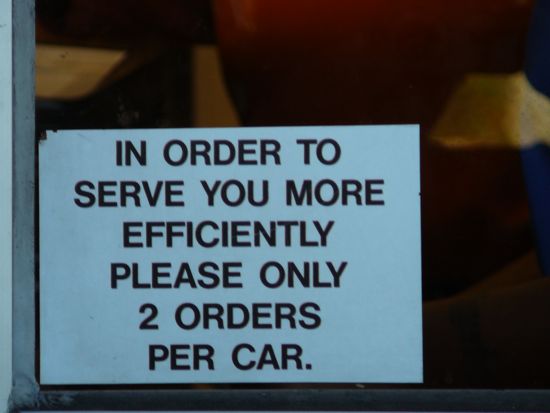
Excuse me? If you have four ladies coming back from a shopping trip (say like) and each wants to pay her own order, you can’t do that? To serve us more efficiently, we can only make two orders per car? If I were a fast-food chain which relied on my customer’s good will, I would serve them, period.
Whenever a bank or a store or a fast-food joint start a sentence with “to serve you more efficiently” start looking for CUTS in service – shorter hours, fewer free services, fewer employees, fewer amenities.
Glycemic Index
On the way to my follow up visit with my doctor, I figured it all out. Diets are hooey. I don’t really need to loose weight; I am happy the way I am. Actually, I am losing weight, but I am so contrary that as soon as I really try, I sabotage myself. Or worse, I lose a lot of weight, and then I put it back on, which is worse. So – no diets for me.
He has the results of all my blood work, and before I can go into my speech, he starts talking about how my trigliceride ratio is all wrong, and that my blood sugar readings would have been OK ten years ago, but now the scale has changed, and although I am a smart woman, my brain is spinning and I never get a chance to give my ‘I am not going on a diet speech’ because he is talking about the GLYCEMIC INDEX and how if we can reverse this all and I will never have to go on medication.
I register that part. I never want to have to go on any medication I have to take every day. That’s for OLD people, not me. Not me!
Diabetes is scary to me. I had a diabetic cat. We did everything, tried all different kinds of insulin, we never did get her blood sugar under control until we put her on special food, when it evened out. Then we moved to Doha, where the vet said he had never seen a diabetic cat before, and where the pharmacies promised me it was the ‘right’ insulin and it wasn’t . . . I really, really do not want to be diabetic.
So I started reading about the glycemic index, and glycemic diets, and oh, my head is spinning, none of the resources agree with one another about what is desirable and what is not! In one place, they will say you can eat pasta, and in another place, they will indicate that you can only eat whole grain pasta, and in one place peanut butter is good, and in another, it is like the worst.
They all agree that you need to be eating mostly fruits, vegetables and whole grains, but watermelon is forbidden, and candy has a lower glycemic number than a baguette. I am SO confused.
Wikipedia says The glycemic index, glycaemic index, or GI is a measure of the effects of carbohydrates on blood sugar levels. Carbohydrates that break down quickly during digestion and release glucose rapidly into the bloodstream have a high GI; carbohydrates that break down more slowly, releasing glucose more gradually into the bloodstream, have a low GI.
I totally get that. It’s the specifics I have problems with, as well as wondering if it works the same for each person (I imagine metabolism gets involved here, and exercise) and there is a part of me that wants to be like an ostrich and bury my head in the sand. It’s all overwhelming.
I slept well last night, but was wide awake at five, worrying about my glycemic index. I decided it might be a good time to walk; we are having really warm weather, so warm the windows are all frosted up from the A/C inside and the heat outside. I used to have water aerobics on Wednesday, but now that I am in the Isaiah study, I don’t get there on Wednesdays, and walking early would be a good substitute.
I headed our with my phone, keys and flashlight, all of which can be used as weapons if I feel endangered, but I discover there is a whole neighborhood full of people out there running and walking at that quiet, dark time of the day. As I reached the top of the hill, there is even a stiff breeze, which feels really good in the sticky humidity. If I can make this a habit, maybe the glycemic index will have less significance. I can hope.
Getting it Wrong
With all my years of living abroad, with all the experience I’ve had keeping my head down, observing, and trying to look and act like the locals, you’d think I’d get it right in my own country, right?
Wrong.
Well, most of the time I get it close enough. Sometimes I am overdressed at the Target or Home Depot. Rarely am I underdressed, but today I was. I looked around the church and I was one of very very few women in short sleeves. Almost every woman was wearing a jacket with either full length sleeves or 3/4 sleeves. Oops, I thought. When you are new, you especially need to try to look like those around you. It must be a calendar thing, not a temperature thing, because the temperatures today are back up in the 80’s; that is not long sleeve weather in my book, but it is in the Southern Lady Book.
One week I wore purple shoes – I love my purple shoes. I realized, too late, that they might go a lot of places, but probably not to our church. Oops.
Florida is particularly hard because there are the long-time Floridians and then those who are more newly arrived. I learned this the last time I lived in Florida, when, thanks be to God, I had an old Florida friend who told me all the inside scoop to help me pass. That was about 20 years ago, though, and some of the information has gotten a little outdated. The first rule, though, is not to look like a tourist. No little sundresses – and if you get a sunburn, you should have T-shirt marks on your arms so people will know you’ve been out fishing or working in the garden. No T-shirts with beachy sayings; T-shirts from the Breast Cancer Run or the Junior League Marketplace are OK.
My big dilemma right now has to do with legwear. I overheard some of the younger women in the locker room at aqua aerobics laughing about ‘old lady’ stockings, and I realized they meant nylon stockings. I haven’t worn them for a long time, except for once or twice in Seattle when I was back in the winter and had to go to funerals, but I don’t know what ladies are wearing in the place of nylon stockings. Nylon stockings in Qatar and Kuwait were pretty much irrelevant; when the temperatures are in the 120’s F, you simply don’t bother, wearing nylons is unthinkable.
You almost can’t even find nylon stockings in Florida, and a lot of the women seem to finesse the matter entirely by wearing pants, or not wearing stockings at all, which you can do in the summer, and of course you can wear pants in the winter, but what do you wear in the winter if you want to wear a skirt? It does get cold in Pensacola, and my legs are going to need some protection. I have a good supply of colored tights, which I have seen some younger women wearing, but this is one of those times when I feel like I have been gone from my own culture for too long and I am out of touch.
As I looked around the women at church today, I also had the funny idea that almost every woman in that church would do just fine in Qatar or Kuwait, they are covered to the elbow – and beyond – and they are covered to the knee, at the very least, with clothing that is mostly not too tight. Just as wearing long sleeves seems to be more cultural than weather-driven, covering your hair in the Islamic countries is more cultural than religious. Mohammed, the Prophet, told the women to ‘cover their adornments;’ it was the men who decided that hair is an adornment. My Saudi women friends told me that it originally meant ‘cover your breasts’. It’s cultural, not religious.
Still working out what works – and what doesn’t – in Pensacola. Praying that all my ‘oops’ are little ones.
Onion Soup of the Pfalz region of Germany
I am printing this just as I found it. The thrill to me is that I can read it and follow it! It is from a blog called ‘Grandmother’s Best Recipes in the Pfalz’ and today I am making Pfalzerzuppe! (It is a onion soup made with creme and a little caraway seed; I often used to eat it at Neuleiningen Castle, in the Bergschanke restaurant.Zwiebelsuppe
“Zwiwwelsupp”
Zwiebelsuppe ist nicht gleich Zwiebelsuppe. Oder auf pfälzisch: Zwiwwelsupp is net wie Zwiwwelsupp. Die nach diesem Rezept ist jedenfalls sehr delikat und würzig.
Zutaten:
- 10 mittlere Zwiebeln (onions, middle sized)
- 500 ml Sahne (cream)
- 1 l Hühnerbrühe (chicken stock)
- Pfeffer, Salz, Kümmel (pepper, salt, caraway seed)
- Butter
- 2-3 EL Mehl (flour)
- 1/5 l Weißwein (aber bitte Pfälzer Wein!) (white wine, Pfalzer white wine, PLEASE!)
Zubereitung:
Geschälte Zwiebeln kleinschneiden und in Butter nur ganz leicht anbräunen. Mit dem Weißwein ablöschen und zur Hälfte einkochen lassen. Das Mehl darüber streuen. Die Brühe und die Sahne hinzugeben und ca. 20 Minuten köcheln lassen, dann abschmecken.
Tipp:
Am Ende des Kochens noch drei Eigelbe mit etwas Sahne verrühren und unter die Suppe ziehen, dann aber nicht mehr aufkochen, sondern gleich servieren.
A Day in Flomaton, Alabama
All we knew when we started the day was that we wanted to explore a little bit north of Pensacola, maybe even up into the part of Alabama that is across the state line to the north (as opposed to the part of Alabama that is across the state border to the west). We thought we were having a very boring day until we wandered into Flomaton, and AdventureMan discovered a railroad museum.
Flomaton is at the very top of the map:

The railroad museum was also an older house, now the museum, and an older 2 room cabin out back, moved from its original location. Here is a recreation of the old front parlor:


The Railroad Collection room:

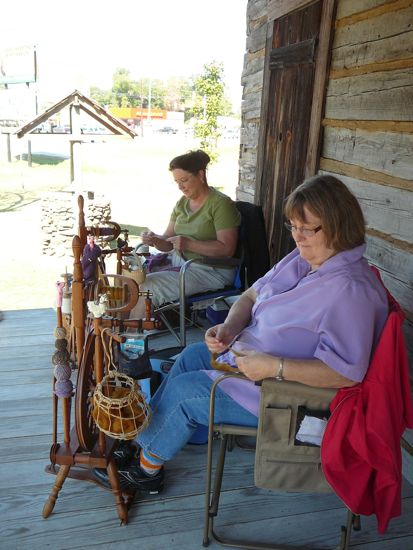
The log cabin was out back of the house, and had two women spinning wool into yarn on the porch, who very graciously allowed me to take their photo:
Inside the log cabin – we were told the couple who lived in this cabin had 12 children; they slept on the floor on pallets at night:


At the museum, there was a flyer about “Back to your hometown weekend” in Alabama, which just happened to be that very weekend. The town was full of returning people, there had been a parade and fireworks the night before (three former homecoming queens told me about this) and there was a street fair to celebrate Home Town Flomaton. 🙂
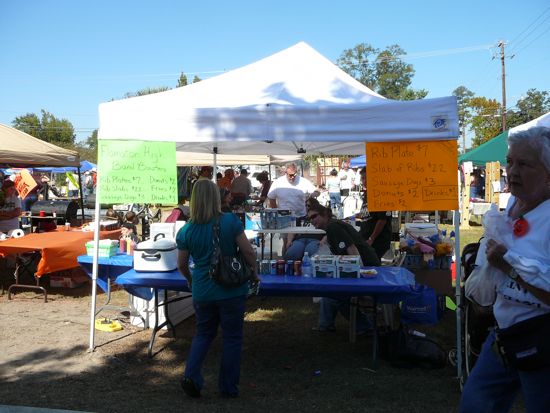
It was nearly lunchtime. We could smell Barbecue. The street fair was just a block away and there was parking right there, right by the fair. It was so much fun:

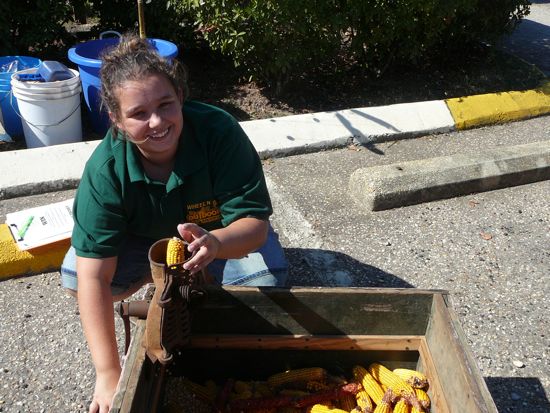
People were so kind and so helpful. This young woman was grinding corn, and we speculated that it must have been a great modern invention, and a real time saver, when it was invented. A woman passing by said she remembers her own mother using the same machine; all the corn was then taken to be ground, and stored in large airtight bottles in a dark ‘keeping room’ with preserves and food to get them through the winter.

This band was playing blues, gospel and country music, and they were pretty good!



As we stood and watched the choir, another woman welcomed us, and told us we really needed to see the new library (it was gorgeous!) and if we hurried, we could catch the Raptor Show at Otter Point. A Raptor Show!



Inside, there was a butterfly house, and several displays of local natural life:

There was also a wonderful hiking trail out over the wetlands, well maintained and beautiful:

The Raptor presentation was very well done, informative and funny, on many levels. They had a large audience of children, who learned a lot, and also adults like us, who also learned a lot. The bald eagle’s beak is deformed by PCB’s, which, although banned back in the 1970’s, are still present in the environment in quantities high enough to cause birth deformities. The only reason they were able to adopt the bald eagle, a protected species, was that while he can hunt, he cannot tear his food apart with his malformed beak.
It was a day full of gracious hospitality. People were so kind to us, and went out of their way to make us feel welcome and to explain what we were looking at. For a day that started with no clear goal, we felt like we had been abundantly blessed by happening across this beautiful October day in Flomaton, Alabama.
Zorba’s at Cordova Mall
I have to admit I am not a big fan of food court eating, but we were at the mall looking for 18 month pajamas with feet, and AdventureMan had seen Zorba’s and wanted to try eating there.

Zorba’s does a great business; all the health and fitness people were buying lunch there. I will also admit that the food court at the Cordova Mall has some pretty good choices; it is a step-up from most food courts and their standard fast-food outlets.
I ordered Chicken Schwerma, and it came with hummus and a small green salad. It wasn’t really like chicken schwerma, which is usually sliced off a huge revolving kebab in tiny thin slices, this was larger grilled chicken pieces, but it tasted good, and that is way more important that having it look like real schwerma.
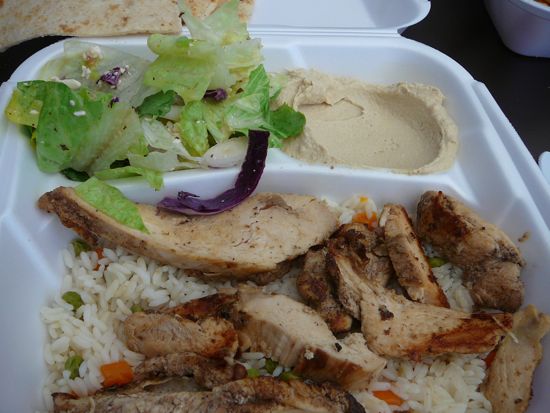 The hummus was good. The salad was good.
AdventureMan ordered a side of Baba Ghannoush, which we both love. This one was delicious and smokey, the way we like it.
 He also ordered a felafel sandwich, and he said that the felafel were homemade, not prepackaged, and the sandwich was delicious.
 We don’t eat french fries. Most of the time it is easy not to eat them, most places buy huge packages of frozen ‘french fries’ and fry ’em up as they are needed, but they are anonymous and boring and not good.
Unfortunately for us, the felafel sandwich came with fabulous french fries, big french fries fried in a good oil, so they were delicious. Yes, I tried one. It was hard not to eat more than one!
 All in all, a better than expected meal from a mall food court. LOL, the Egyptian server behind the counter kept thinking AdventureMan was Lebanese. 🙂
When Bureaucracies Function Well
This week AdventureMan and I explored something new in our lives – Early Voting. We had heard about it from our friends. It’s not like absentee voting, where you are mailed a ballot and you mail it back in after you have filled in your votes. With early voting, you can actually go to a voting place and vote.

We went after lunch, and we didn’t know where it was, but once we got near, we started seeing signs. Great signage.
When we entered the door, there was a lady there to tell us where to go – and more signs, too.
When we got to the right floor, there were signs with arrows and “Vote Here” on them.
When we got to the voting office, there were lots of people to help us get our ballot. When I messed up my first ballot (I hadn’t read an amendment carefully), they quickly did all the necessary paperwork and got me voting again. The second time, the machine accepted my ballot. 🙂
All in all, a fabulous experience. And – they gave me a sticker! We were so impressed with the careful attention to detail that had gone into getting us to the right place and getting our vote accomplished.
Later in the week, I had a mammogram. Being new, I am not in the system, so I have to go through admitting procedures every time I go to a new doctor or a new institution. At the West Florida Hospital, as soon as I got to the right room, I could see a sign telling me where to wait my turn. The receptionist was welcoming AND efficient. There were a lot of people waiting, and one by one we were taken in to have our paperwork done. No need for a pen; you sign on a machine, like you do for credit card purchases in many stores. Then you sit in a small hallway until someone calls your name and you become a human train as a guide leads you to your stop. That part was half hilarious and half annoying. If I knew where it was, I might have gotten there faster on my own, but . . . I didn’t know where it was. As far as systems go – it worked. It kept people orderly. It got a lot of people in and out efficiently, and fairly. No one can break into the lines, claiming to be more important. I am guessing if there is a patient whose malady is serious enough to take precedence, they have procedures they can follow separate from the normal intake procedures.
I have to stop and admire when bureaucracies function as intended, to help us more efficiently accomplish our business. It is when they become a stomping ground for nepotism and inefficiency that they earn my ire.
When I arrived in Qatar, my bank had a Women’s branch which was convenient for me and I loved going there. I was often the only customer, and the women taking care of me were always charming, helpful and friendly. When the same bank broke into another section and became an Islamic bank, instead of a normal bank working with Islamic customs, I was no longer able to use the women’s bank, but I’ve always remembered their personal customer service.
On the other hand, banking in Qatar could be totally tortuous, if you had to use the normal bank where Mr. Important would walk right in front of you as if you didn’t exist, or certainly, as if you were far less important than he was. In Kuwait, at my bank branch, you took a number, and it appeared to me that most of the time the number system was honored, unless it was a personal friend, LOL. Personal friends, or friends of the family, or a friend of a friend of the family always get to go first.
I suspect there are similar exceptions in Pensacola, but less transparent. Mr. Important has his own banker he can go to without waiting, probably in a private office, and it is invisible to the rest of us. Ms. Important, on the other hand, probably has to wait in the waiting room with the rest of us for her mammogram.
Recent Comments
ExpatAlien on What Country am I Living … intlxpatr on Yellowstone: Old Faithful to C… Michelle on Yellowstone: Old Faithful to C… Cathy on No Grown-Ups in Charge intlxpatr on Waiting for Snow Wikipedia Donate Button

Amazina


Early Voting in Florida


 Here There and Everywhere