“It Was a Mistake!” The Fall of the Wall
BBC News reports today that while the ease in travel restrictions was planned, the way it happened – was a mistake!
When the Berlin Wall opened on 9 November 1989 Brian Hanrahan was the BBC News reporter on the ground. This year he’s been back to talk to some of those whose decisions made this key moment in 20th Century history possible.
From the safe distance of 20 years, the opening of the Berlin Wall can be seen as inevitable – the natural consequence of changes that were reshaping Europe. But for most of 1989 it was unthinkable.
And the decision itself was an accident – intended neither to happen the way it did nor to spark off the tumultuous changes that followed.
I heard the inside story of what started this extraordinary rush of events from one of those who made the decision in the East German Politburo – the communist party’s ruling body.
With hindsight, it’s the border guards we must thank
Politburo reformer Hans Modrow
Hans Modrow was a communist reformer in the Gorbachev mould. He had only just been given a place on the Politburo as East Germany’s leaders tried to head off the demands for change that were sweeping the country. But as a new boy his opinions counted for little.
He remembers an agitated discussion about the travel restrictions – the laws which banned most East Germans from leaving the country and which had sparked off the popular discontent.
At the end of it the party leader, Egon Krenz, suddenly produced a new set of regulations. From now on it would be much easier for East Germans to travel.
What annoyed Mr Modrow was the autocratic way in which the Communist Party still did business. “We couldn’t change anything, he says, We sat there like stupid little boys. We just had to do what we were told.”
‘Blurted out’
But now came a blunder that would bring down the Berlin Wall and the East German state with it.
The intention was to announce the changes overnight and phase in the new rules the next morning. Instead one of the Politburo members, Guenter Schabowski, blurted out the plans during a televised press conference – and compounded his error by adding the new rules would come into force “immediately”.
Live press conferences were a novelty in communist days, and Mr Schabowski was becoming something of a celebrity through his appearances. Mr Modrow is still scathing about Mr Schabowski’s preening in front of the media.
The Politburo announce the decision to allow people to cross the border
“The order wasn’t to be published until 0400 in the morning. But Mr Schabowski didn’t notice. He went into an international press conference. And he was so arrogant and full of himself. We had no idea this was happening.”
Mr Schabowski’s announcement was complicated and bureaucratic, and like many others that evening I puzzled over it before concluding that it signalled free travel. If this was true it would mean the end of the Berlin Wall because the whole fearsome structure with its watchtowers, barbed wire and guard dogs had become redundant.
East Berliners were rather quicker off the mark. Tens of thousands of them started turning up at the border demanding to be let across.
But the guards hadn’t been told anything – their standing orders were to stop anyone crossing. Until recently they’d been instructed to shoot to kill anyone who tried.
This night they tried to turn people back – but after a generation being pushed about Berliners turned belligerent and refused to go.
Stunned guards
The standoff between the armed guards and the angry crowds soon grew tense and dangerous.
The guards asked their headquarters for orders but the government ministries in charge of security told them nothing. Mr Modrow and the other Politburo members had gone home unaware of what was going on.
With radio and TV reports bringing more people on to the streets, Mr Modrow says it was the border guards themselves who decided what to do.
“With hindsight it’s the border guards we must thank, not any of us in the Politburo. The guards on the ground – at the time – made the critical decision. They ignored their standing orders. They said, ‘Open the border.'”
I arrived at the main border post just in time to see the barriers swing open as the guards gave up any attempt to regulate the crossing. They looked stunned at the mass of people streaming past them. Their whole world was collapsing about them.
But if East Germany’s leaders were ignorant of what was happening, the rest of the world was already watching on television.
In Washington, James Baker was at lunch with the President of the Philippines, Cory Aquino, when he was told the news. A short while later, hearing that people were taking sledgehammers to the wall, he abandoned the table and hastened over to the White House.
Changed world
There he and President Bush were taken aback at what they saw. They’d had no warning. “It was happening before our eyes. Maybe the Soviet leadership saw it coming but I don’t think anyone in allied capitals anticipated it happening with that speed.”
And Mr Baker admitted candidly that he was daunted by the scale of the task ahead in reshaping world alliances. As the West’s chief diplomat he would have to do most of it. “The world as I had known it all my adult life changed that day, and it changed fundamentally. I had grown up with the Cold War. Everyone in my generation had.”
In the Kremlin the man most responsible for the change slept through it. The Soviet leader had been tipped off a few days earlier about the way the East Germans were thinking.
Mr Gorbachev chuckled as he remembered the rush to tell him what had happened. “They reported to me quite early in the morning. They were in a hurry to let me know. We had been expecting it to happen. It could have happened at any time.”
And he was matter-of-fact about the consequences. “I took note of the report. It moved us on to a new phase. Not that I was enthusiastic about it, but I accepted it as something that had to happen. We understood that the time was coming for the German problem to be addressed.”
In London Douglas Hurd had been foreign secretary for just 15 days. He noted the news from Berlin in his diary. “The regime and now the wall are crumbling fast,” he wrote. But he was already wondering how he could persuade the Prime Minister, Margaret Thatcher, to consider the idea of a united Germany.
Berliners were only just opening the bottles of sparkling Sekt at the beginning of a street party that would last for days. Many were still uncertain what exactly was happening.
But in a few short hours they had changed the contours of world politics and there could be no going back. The inevitable, unthinkable accident had happened.
Debate on Media Freedom in Doha, Qatar
From today’s Gulf Times:
Debate on Qatari press law
The Doha Centre for Media Freedom (DCMF) will hold a roundtable discussion on the Qatari press law that dates back to 1979, on Wednesday, at The Ritz-Carlton Doha, an official said yesterday.
According to the official, under the discussion will be the need for a Qatari media, and the view concerning modification and changes to the accrual Press Law, in order for it to match the requirements of the current era.
Discussions will be moderated by DCMF deputy director general Maryam al-Khater, while senior media officials of the country, editor-in-chiefs, senior journalists, heads of media organisations and others are expected to be in attendance.
After an introductory presentation of the most-recent study prepared by DCMF on the Press Law, comprising recommendations, suggestions, and analyses, the floor will be opened to what is expected to be a “vigorous debate”, the official said.
“The DCMF calls on all media specialists to exercise their right of expression by participating in this gathering and sharing their thoughts about the possibility of amending the negative provisions of the law for journalists’ rights as well as adding provisions which respond to their ambitions,” the official added.
The event coincides with the National Day for Human Rights, which falls on November 11 every year.
There was an earlier report, on June 24th, that most of the original members of the DCMF had resigned:
Media Freedom Centre team leaves office
DOHA: Robert Ménard, director- general of the Doha Centre for Media Freedom and his team have left the Centre.
“We no longer have either the freedom or the resources to do our work,” said Menard, in a statement issued yesterday.
The heads of the assistance, research and communications departments have also left the Centre, said the statement.
The Center was set up on the initiative of H H Sheikha Mozah bint Nasser Al Missned and Reporters Without Borders in December 2007.
Ménard, who became director-general on April 1, 2008, was the founder of Reporters Without Borders, which he headed for 23 years.
I imagine this is going to be a very interesting “vigorous” debate, of interest to all those who write – or blog – on Qatar. One of the things I notice in both Kuwait and Qatar is that in the interest of self-preservation, the newspapers self-censor. For example, when a crime is committed, if it is an Asian, or even, rarely, a westerner, the name of the criminal can be printed. If it is a local citizen, they do not print the names, not ever, unless it is a rare case where the defendant is convicted and appeals – on rare occasions, the name will appear then. In order to spare the family the embarrassment, I have been told, but I would think that the fear of embarrassing the family would have a strong deterrent effect on young men, for example, who think it is OK to abduct, rape and humiliate young men and women, without fear of having their crime made public.
In Kuwait, they publish the crimes committed, at least. In Qatar, you would think from reading the papers, that these crimes don’t exist. They do. They aren’t reported.
I think it is very cool that in Qatar, many of these issues are opened for public debate, as in this media debate, and in the ongoing Doha Debate series.
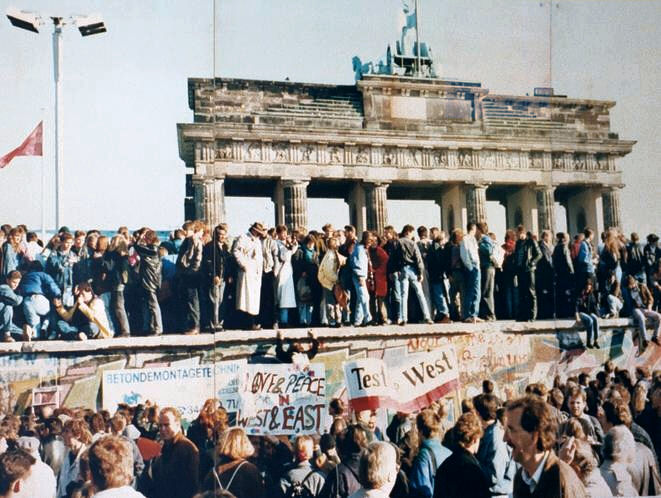
November 9, 1989 The Fall of the Wall
Twenty years ago tomorrow, and I still hold my breath in wonder.
I was doing a very untypical thing for me – I was headed for the Czech border with three military-wife friends, to buy crystal. There was an unusual amount of traffic, all coming from the border, and the cars – not the normal beautiful cars you find on the German autobahns, but the fiberglass cars coming out of the Soviet Union and Eastern Bloc – miles and miles and miles on end, all headed West.
When it happened, we didn’t have a clue. There had been rising signs of unrest in the East, but that happens, and has always been ruthlessly put down.
The US had been in Germany forty years. In the most recent years, all the posts and all the military housing had undergone significant updatings – significant and expensive. If you asked anyone about the possibility of the wall coming down (Berlin Wall, for those of you who were not alive) they would just laugh.
“We’ll be here forever,” they would say.
So too, would Germans say.
“We’ve been divided for too long. We think differently,” they would say “We could never be re-united.”
In one joyful night, that all changed. As we reached our stop and went for dinner in our Gasthaus, the television showed the cars flowing over the borders, and the young dancing on the wall in Berlin. It was one of those rare occasions when the world held it’s breath in wonder and amazement; we did not know this was a possibility. Such joy!
Germany has struggled to make the reunification work. Even now, in the west, Germans will gripe about how all their tax monies are going to the east, and those from the east are taking their jobs, but in essence, the reunification has been a success, and the greater Germany is an amazing fact-of-life I never thought I would see in my life.
I still celebrate November 9th in my heart. Twenty years! It seems like yesterday.
Harvest Festival Bazaar, Kuwait NEC
This year the Lighthouse Church has its annual Harvest Festival on Nov. 14 (Sat) from 9:30am-4pm.
It takes over the entire Evangelical Church compound in the city (next to the Legislative Bldg where they are doing all the construction) and is a huge indoor/outdoor bazaar.
There are many things for sale including clothing & shoes, books, household and electronic items. There is live music all day by our various church bands and children’s groups plus games and other activities for children There are also food stalls from many different nations so you could snack all day if you like. Basically, there is something for everybody.
Driving in Qatar
You probably think I am cursing when I am talking to you on the road.
I am not.
I am saying “Your poor father! He told you about turn signals! Weren’t you listening???”
I am saying “If your mother could see your bad manners, she would be so ashamed of you!”
I am saying “Hahahahahahaha! You got your picture taken!”
Moving into my lane when I am already in it, is bad manners. Honking at me to make me let you in is WORSE manners. Didn’t you see me? Oh! Here’s a thought – did you check your side mirrors before you thought to change lanes??
Have you noticed? I let the guys in who USE THEIR TURN SIGNALS! They are communicating in a polite way. I let them in in front of me. I am nice about it.
Changes in Qatar Rent Laws
From today’s Gulf Times Qatar
New rent law seen a victory for tenants
By Sarmad Qazi
In a major victory for tenants, rent disputes can now be taken up with the Rental Dispute Resolving Committee (RDRC) regardless of whether the contract was registered or not, a senior official said yesterday.
This follows amendments in the rental law.
Law number 20 of 2009 sees changes to some provisions of the previous law number 4 of 2008 issued by HH the Emir Sheikh Hamad bin Khalifa al-Thani on October 25, the official said adding it further protected the rights of tenants in Qatar.
“There are two things in the new rule: you can come here, whether or not your contract is registered and speak to a judge, and secondly the landlord must now give at least six months notice of eviction,” the official said.
The law number 4 of 2008 was aimed at regulating the market by making registration of rental contracts mandatory and by establishing the RDRC with its own jurisdiction to take up grievances at a time of near-record inflation in the country.
“But we know the law missed out on rental contracts made prior to the 2008 law or based on goodwill and word only. In these cases we weren’t able to address any complaint,” the official at the RDRC’s headquarters in Muntazah (now Rawdat al-Khail) said.
“This amendment changes all that,” he added.
However, according to him, with the rents showing declining trends, the number of disputes is also falling; currently only 15 new cases are being filed at the RDRC every day.
The nature of cases varies from landlords wanting to hike the rent despite a two-year freeze since 2008, to non-payment claims and eviction notices.
A year ago the RDRC was registering 1,500 cases a month.
The official also dismissed questions about the effectiveness of RDRC saying so far this year its five committees have addressed and closed 1,205 cases. Only “600 or so are ongoing,” he said.
The committees have three members and one judge each.
“Yes it is true that 50% of RDRC decisions are later challenged in the appeal court (in Dafna), but 90% of the time the judge there upholds the rulings,” the official said.
Veteran lawyer Ala’a Hamad, a partner at the Arab Law Forum, yesterday said every new law requires takes time to prove its effectiveness.
“This was a new law and the more it’s practiced, it will prove its effectiveness.
“The tweaking is an ongoing process just as with foreign investment and other laws,” Hamad said.
Update on Animal Market in Kuwait
From the Kuwait edition of the Arab Times today:
Confusion on closure of animal market, need seen to set minimum standards
KUWAIT CITY, Nov 2: Conflicting reports to the Arab Times caused confusion about the shut down of Al Rai animal market. News reports said that the animals were kept as hostages within the stalls to “starve to death”.
Ayesha Al-Humaidhi, from Animal Friends League of Kuwait, assured that shopkeepers do have access to the shops and tend to their animals. “They do enter their shops and do conduct their business, but they can’t run their business openly until they settle the rent dispute with the Municipality,” she said. Al-Humaidhi explained that a number of her friends have gone to Al Rai area and had either purchased animals or animal related products. “It’s logical that if proprietors can access their shops to serve customers, they can enter the same shops to feed their animals,” she explained. She, however, pointed out that if animals kept in the stalls are lacking anything, it would be a proper flow of air.
“My friends told me that birds were the main sufferers, and that is only because of the way they are kept by the shopkeepers. “Up to 50 birds are put in one small cage which causes a relatively higher death rate amongst birds compared to other animals under normal conditions. Slower air flow had cast its toll on the poor birds,” she added.
Al-Humaidhi affirmed that the conditions in which these animals are kept were “hellish to start with”. “The shutting down of these stalls has made it worse. “However, there is a dire need to set minimal standards for shopkeepers to abide by when tending to their animals. “It’s inevitable from the reckless way these shopkeepers tend to their animals that they would not even feed them if they had no market,” she said.
Meanwhile Abu Sulaiman Al-Hadad, one of the shopkeepers, claimed that he, along with other proprietors, have not accessed their shops since these were shut down on Oct 15. “My animals have been imprisoned for more than two weeks and have all died from starvation,” he complained. Asked if he had entered his shop at all during this period he said it’s “impossible”. “If any of us is caught entering a shop we’d be obliged to pay a fine of KD 500, along with other legal action,” Al-Hadad said.
Al-Hadad said that shopkeepers have been selling some of their shop items which they managed to pick before the Municipality shut the shops. Asked about measures taken by him and or other proprietor to “rescue” their businesses and animals, Al-Hadad informed the Arab Times that a law suit has been filed to the Administrative Court. “No one knows how long it will take to be finalized. Our animals have long since choked to death,” he said.
By Dahlia Kholaif
Arab Times Staff
It seems some of the shopkeepers are keeping this story going.
Barbaric. Animals Left to Starve to Death
It’s hard to believe that this could be happening. This article is from Kuwait’s Al Watan and I learned about it from Mark, at 248am.com. Unbelievable. Unthinkable.
KUWAIT: It only happens in Kuwait. No other country would demand money from people already paying rent.
Initially, those renting stalls at the animal market in AlـRai thought it was a mistake, but when their shops were shut down “because of rent arrears,” business owners went berserk. In addition, the animals displayed in the stalls were left inside the locked stalls, with the proprietors unable to tend to or remove then, thereby what was a municipal disagreement has ballooned into an animal rights fiasco.
It remains unfathomable to many where the decision to charge a second “Municipality rent” arose from, when the proprietors were already paying rent to the owners of the commercial space, the Ministry of Finance. With the Municipality shutting down the stalls, and the Ministry of Finance staying silent ـ only to say: “this is not our issue” ـ the business owners are helpless as the animals howl and cry for food, with every passing day the stench of death growing ever stronger.
Al Watan Daily went to the animal market in Al Rai area and witnessed the disaster first hand.
Shopkeepers told Al Watan Daily that the Municipality had closed all the stalls over two weeks ago, “and they haven”t opened the doors even once till now. All the animals are inside the stalls, and most of them have died due to lack of water, food and air. These animals have been in cages within the stalls for 15 days and they have not seen any light, nor eaten anything.”
Ridha Ashkanani told Al Watan Daily: “We signed contracts with the State Properties Department; we pay them 300 Kuwaiti dinars per year, and we also have been paying KD 60 per year to the Municipality as for the cleaning of the area. We were forced to pay this sum although the Municipality is not taking care of the area and the place is not clean at all. The problem now is that the Municipality is asking us to pay another rent for the stalls themselves. They want KD 3 per every square meter within the shop per month. They also want the money to be paid in arrears from 1995. We can”t afford to pay all this, and there isn”t any law that requires us to pay a second rent to the Municipality.”
The situation is this: according to the traders, they have been paying a normal rental fee since 1997, which continued when the Ministry of Finance relocated their businesses to the current location, but in 2004, a Municipal inspector came and asked them to pay a “Municipality rent.”
The proprietors explained to the inspector that they were not aware of any second “Municipality rent,” and that according to the contract with the Ministry of Finance, the rent was to be paid to the ministry, and the ministry only.
After receipts were shown to the inspector that payments were being made to the ministry, he quietly withdrew and disappeared.
However, in 2006, another inspector came demanding “Municipality rent.” The traders explained, once again, to the new inspector the same story, to which he accepted their argument but demanded a KD five monthly surcharge for cleaning.
The traders saw no qualms with the demand and agreed to the nominal fee, but then some months later, the inspector returned, requiring that the cleaning fees be paid in lump sum six months in advance. After some grumbling, they acquiesced.
Oddly, some weeks later, traders were informed that instead of 6 months, it would have to be 12 months in advance. Again, they reluctantly agreed.
Now you have the current situation, where the Municipality has shut all the stalls with the animals locked inside, and is demanding the “Municipality rent,” in arrears as far back as 1995.
“Our major issue is that the animals are trapped inside the stalls, and most of them died. We are losing our business and losing the animals we have in the shops, and we are not allowed to open the shops at least to feed the animals, which have not eaten any food for 15 days,” explained Ashkanani
Ahmed, another proprietor, said: “I lost all the gold fish I had in the shop, worth KD 5,000. We want the animal rights societies to help us in our problem. We went to the State Properties Department and they didn”t help us, and stated that it”s not their responsibility. We then went to the Cabinet and they told us to go to the minister, and he also refused to help us. We finally went to the Municipality, (which refused to open the doors until they are paid), and now we are filing a case at the court and we are waiting to see what will happen.”
ـ
Last updated on Monday 2/11/2009
Garden Saga
This has provided us with an ongoing burble of amusement, every time we drive into our compound.
Someone wants the name of the compound in the garden. It seemed a simple enough request, doesn’t it?
The first try I saw, was a perfect ‘A’ followed by a second ‘A’. I started laughing. It was being put in by laborers who are probably illiterate in their own language, much less have any idea about western letters. To them, these are just meaningless shapes, not symbols for sounds. The second ‘A’ was gone the next day, torn out, and replaced with the appropriate letter.
But concrete blocks are big and unwieldy. When the name was finished, it was big, with no spaces between words, and no ‘s’ on the end.
They tore it out, too.
Now, working with smaller bricks, working with templates, working with a diagram, the name is finally being completed accurately. It is actually lovely, so we can’t laugh anymore.
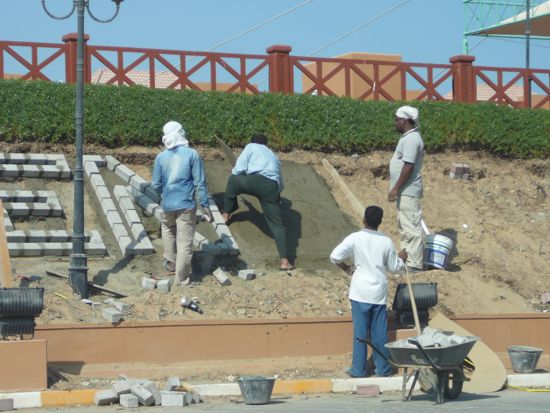
I wonder how we would do, trying to lay out the same in Arabic . . .
Kuwait Headscarf in Qatar souks
I can only imagine this was sent to the wrong country. Qatar’s colors are a blood-brownish marron red and pure white; these are Kuwait colors on a traditional headscarf:

I found it in the Suq al Waqif.
Recent Comments
ExpatAlien on What Country am I Living … intlxpatr on Yellowstone: Old Faithful to C… Michelle on Yellowstone: Old Faithful to C… Cathy on No Grown-Ups in Charge intlxpatr on Waiting for Snow Wikipedia Donate Button

Amazina


Early Voting in Florida


 Here There and Everywhere