Happy Heidelberg
My high school stomping grounds; this video makes my heart flutter seeing all those wonderful sights with wonderful memories:
Empowerment
I’m working with a group, one of whose goals is empowerment. They are all from the same country, but not the same parts of the country, nor the same ethnicities, but they all get along well with one another and the group does fine. I admire each of them, and even better, I like these women.
(Photo removed 17 Aug 2021 due to potential political impact on participants)
Here’s the LOL, empowered people have ideas and opinions. We have a format to adhere to, and empowered people come up with other ideas and alternatives. Here’s the problem: other ideas and alternatives, especially good ones, mean a lot of extra focus, it creates more work for facilitators and program managers. Sometimes you need permissions, sometimes you need transportation arrangements, and always, you need to assure a delegate’s safety. All this on top of the changes that will have to be made because of this unusual weather.
First, yesterday as I met the group, I had to apologize for the weather – usually mild, sunny Pensacola was having a howling storm; sheets of water being blown by a raging wind, tree limbs falling, the sky grim and dark and grey the entire day. In the midst of this, I was with one delegate on a tour of the Port of Pensacola, where it was like being in the middle of a huge storm at sea, with squalls. The man giving the tour carried on, they had a great discussion while the wind howled around us and at times the rain fell so hard on the tin roof that we couldn’t hear one another.
 (Those lines you see coming in through the door are wind blown rain. The drops on the camera lens – ditto)
Here is what I truly admire about this group, all their empowerment is for the good, their suggestions are making this visit even more productive and helping them exceed their goals. Their alternatives were doable, and will be accomplished. I can also tell you that at the end of a day dealing with a lot of good ideas and changes, my brain is happily fried. Guess the LOL is on me.
I’m Screwed

It runs in my family – I can remember my Dad on the phone for hours, booking our hotels for Italy, especially, making sure everything was perfect. We like to be in control of the details, we like to make sure everything will run smoothly. We like to have records to back us up and to insure our trips will not run into any snags.
Oh well.
Yesterday, on the way to our son’s house to take care of the sweetest little baby in the world, I got a phone call from Alaska Airlines that my carefully crafted reservations, all paid for, were not going to work now that there had been a schedule change.
For a minute, it was like my brain went on hold. I had worked SO HARD to make those reservations, with just the right routing and just the right amount of connecting time and everything was PERFECT and now it wasn’t going to work? She was offering me alternatives, but all I could think of was having to change our cat’s reservations, having to re-arrange all my PERFECT arrangements.
Hmmm. . . Even at the time, I could laugh at myself and my horror that now it wasn’t going to be PERFECT. Even at the time, I could hear God laughing and saying “maybe I have something better in store for you.” I could hear him, but getting off that hamster wheel in my brain is like trying to make a steaming locomotive make a 90 degree turn. I need a few minutes for the gears to shift, for the impetus to slack; change does not happen quickly, it happens in stages.
She had an idea, but had to call me back. That gave me the time I needed to take a deep breath and roll with it. When she called back, I was ready for her suggestion, which involved switching to an airline I never fly, a route I avoid, etc. but I was ready. The timing achieved the goal I wanted, which was to fly from Pensacola to Juneau in one day.
Then, as it turned out, there was also a problem with the return, same deal, something about being or not being a code share flight, or being or not being an Alaska Airways flight. Here is what I am experiencing with all my flights – these airlines might SAY they are a team, but when I call Air France to use my frequent flyer miles, they always want me to fly Air France, and they have these routes that will take me from say Atlanta to Paris to Kenya to Johannesburg, rather than putting me on the partner flight that goes directly from Atlanta to Johannesburg. And here is the line I hate: They haven’t released any seats on that flight for us to use.
Here is the truth as I see it: anything is possible. I have seen it happen. There are phrases bureaucrats use to put up barriers, but if they want to help you, those barriers can fall.
OK, OK, back to the subject. I am grateful to Alaska Airlines for calling me and sorting out the problem with ME. At the same time I just happened to check on some other reservations I have only to discover, online, that the reservations had changed from something I loved to something I hated, and when was Delta going to tell me? There is a disclaimer at the top saying I can try to change the changed portion or I can cancel my trip. If I hadn’t checked, how would I know??
I admire Alaska Airlines for stepping up to the plate. It can’t be easy for their people to face the wrath of people like me who don’t want their plans changed, who liked their plans just the way they are.
When these things happen, once I have a chance to cool down, I think about some changes and disappointments as being a protection. I don’t always understand why something didn’t work out, but I believe it was for the good. There was a house I did not buy on a slippery, landslide prone area in Seattle, a house with a magnificent view. I still think about that house now and then, and now, with the tragedy in Oso, I am thankful I did not buy it. I had put an offer on the house, then changed my mind, knowing I would worry all the time I was overseas about it slipping down the hill. It was enough to deter me, knowing I would worry too much about it, and always be looking for signs of instability, that I would become anxious when it would rain – and if you know Seattle, you know that rain is a given.
The screwed part is really that no matter how carefully we plan our trips, if we are flying we are at the mercy of large bureaucratic airlines who really don’t care about our comfort or convenience. They don’t care about the hundreds of thousands of miles on my frequent flyer card; I am just a logistic to them. Within the US, most ‘business class’ isn’t that much better than economy, and ‘economy comfort’ is still squished three abreast in seats that are too narrow and so you are touching shoulders with your neighbors. That is just wrong. A shift in reservations should trigger at least an e-mail, so people to whom it matters can make necessary changes. It’s not just me, we are all screwed.
Ladysmith Black Mombazo Live in Niceville
My co-Mother-in-Law leaned over and said “I don’t think they could have done this twenty-five years ago.”
I think she’s right. Northwest Florida is still one of the most conservative societies in America, and yet, in spite of all probabilities, we are in the Mattie Kelly Cultural Center, in Niceville, Florida, surrounded by a HUGE and enthusiastic audience, all of whom have shelled out big bucks to hear this talented group out of South Africa.

As soon as we saw the initial ads, AdventureMan marked his calendar, so we could call the very first day tickets were available. I don’t really believe in bucket lists, but I do believe in grabbing an opportunity when it presents itself; we have loved the sounds of Ladysmith Black Mombazo forever.
Last night was a thrill. I was astonished at how wildly enthusiastic the audience was; it was a mix of all walks of the population, academics, retired folk, groups of school children, and . . . fans. Wildly enthusiastic fans. A group knows when it is treasured, and it feeds on the positive response. Ladysmith Black Mombazo thrilled our hearts.
Here is one of my favorites, expecially the introduction:
“Double French Fries, Please”
I was taking a group of International Visitor Leadership Program delegates around town, to their meetings, and they wanted to eat at a very nice local restaurant where they could have Southern Food, Soul Food, with some atmosphere. I discussed several options (Woooo HOOOO Pensacola, with an outsized selection of truly good restaurants for a town of 50,000) and they decided on Five Sisters.

We were so lucky. It was Friday, and just after noon. I walked in, there was a line. Looking past the line, however, I could see some empty tables, so I took a chance, asked for a table to be put together and it was just a few minutes before we were seated. I’ve waited a lot longer for a table at Five Sisters, so I felt God was smiling at me.
The women knew what they wanted, but when it came to sides, they were unfamiliar with the offerings, and several were automatically excluded, and they don’t like cole slaw, it’s just cultural. Finally, the perfect solution. The first one says “Double French Fries, please” and several others follow suit.
It’s actually not a bad choice from a taste point of view. Five Sisters french fries are tasty. I just had to keep my face straight, because everyone is so health conscious these days, and I have never heard anyone order “double french fries” before.
Only in Kuwait: The Original
Sigh. These are, sadly, true. I have seen them myself. I used to make people mad; I always carried a camera, and when I would see able bodied young men park in the handicapped spots, I would take their photos. They would get really mad. I knew I might be risking my life, so I tried to be careful, but I was also hoping they would feel shame, and stop doing it.

Talal Al-Ghannam is a very brave Kuwaiti for printing these “Only in Kuwait . . . ” columns.
Only In Kuwait
These are the things you won’t find in other modern countries or even ones that are poorer, but only in Kuwait.
1. Only in Kuwait people APPEAL to the government to apply the law.
2. Only in Kuwait handicapped parking places are seized by ordinary people.
3. Only in Kuwait many people like to park on the pavement and on green landscapes.
4. Only in Kuwait you could get killed for a parking space.
5. Only in Kuwait you could get beaten if you did not let a maniac driving behind you to pass.
6. Only in Kuwait policemen are beaten by mobs.
7. Only in Kuwait many policemen play with their smart phones rather than monitor the roads.
8 .Only in Kuwait many police stations have only one policeman.
9. Only in Kuwait you need a fancy car on the road to be respected.
10. Only in Kuwait you need three months to get an appointment in a hospital unless you are really sick.
11. Only in Kuwait the majority of Kuwaitis travel out of town when there is a two-day holiday.
12. Only in Kuwait the majority of employees get sick suddenly when there is a holiday coming up.
13. Only in Kuwait we see people spitting or urinating in the streets.
14. Only in Kuwait we see maniacs driving on the shoulder of the road, throwing up gravel to break your car’s windshield.
15. Only in Kuwait some Kuwaitis say ‘kaifi ana Kuwaiti’, meaning I am a Kuwait, I can do whatever I want.
16. Only in Kuwait you see many Kuwaitis able to deport expatriates. I will rest my pen for now until the next article.
By Talal Al-Ghannam
local@kuwaittimes.net
Queries Which Bring You to Here There and Everywhere
I always love to see what brought people in. I get people from all over the world, and sometimes I just wonder why? Here are some of the questions that brought you here today. I am happy to see that there was no one in the top ten questions asking about Mongolian Porn 🙂

Only in Kuwait 2
This is what I love about reading Kuwait newspapers. It is a society full of contradictions, and a population not afraid to point out and comment on those contradictions. I remember the first time AdventureMan yelled at me for stopping at a stop sign; he was not being abusive, he was afraid someone would hit me from behind because NO ONE stops at the stop sign. It was LaLa Land driving:
Only in Kuwait – 2
 This is the second episode of the things you see happening in Kuwait even though our country is considered a “modern state”.
Maybe the honorable reader thinks I am being pessimistic, of course when I compare Kuwait with other countries in the region.
1- Only in Kuwait you could be run over when you cross the road on the pedestrian crossing. Always wait till there are no cars because they don’t care.
2- Only in Kuwait please, please don’t stare at anyone even if you admire him or her otherwise you could put yourself in trouble and end up in a fight.
3- Only in Kuwait the stop sign means GO. If you stop you could be hit from behind or encounter angry faces from maniacs who do not respect the law.
4- Only in Kuwait you see public bus drivers race and compete on the roads and they may not stop for you.
5- Only in Kuwait when many people see a sign saying ‘do not enter’, they do the opposite.
6- Only in Kuwait doctors are beaten just because they want to organize the queue.
7- Only in Kuwait you see people who had been fighting outside continue their contest inside the hospital.
8- Only in Kuwait policemen guard hospitals.
9- Only in Kuwait housemaids get kidnapped when they go out to throw the garbage.
10- Only in Kuwait teachers who don’t help students pass get their cars damaged by paint, punctures or even fire.
11- Only in Kuwait when you approach the traffic light you must be extra careful if your side of the light is green because some maniacs run the red light from the other corner.
12- Only in Kuwait our soaps are full of crying and beatings in order to prove it is real drama.
13- Only in Kuwait public bus passengers have to wait under the searing sun for their bus ride without having a decent shade or bus stop.
14- Only in Kuwait many Kuwaiti plays and soaps put down other nationalities and make fun of them, not knowing that people from those countries possess nuclear weapons and we only use what other nations invent for us.
15- Only in Kuwait we call the tea boy sharekah, meaning company, without even respecting his name. I have seen this a lot in police stations and at various state institutions.
16- Only in Kuwait drivers ride their cars close to 200 km per hour thinking this speed will take them to heaven fast.
17- Only in Kuwait we build apartment buildings without adequate parking.
18- Only in Kuwait we enjoy parking on the yellow/black zone and occupy the bus stop area.
19- Only in Kuwait a 400 sq m empty land is worth KD 300,000 while in Khafji in Saudi Arabia, it’s KD 20,000 only for a 500 sq m piece of land.
20- Only in Kuwait contractors do projects inefficiently and once these are done, they find out that something is missing and have to do it all over again
By Talal Al-Ghannam
local@kuwaittimes.net
Iraqis Draft Law Allowing 9 Year Old “Women” to Marry
From AOL News:
BY SAMEER N. YACOUB AND SINAN SALAHEDDIN
BAGHDAD (AP) — A contentious draft law being considered in Iraq could open the door to girls as young as nine getting married and would require wives to submit to sex on their husband’s whim, provoking outrage from rights activists and many Iraqis who see it as a step backward for women’s rights.
The measure, aimed at creating different laws for Iraq’s majority Shiite population, could further fray the country’s divisions amid some of the worst bloodshed since the sectarian fighting that nearly ripped the country apart after the U.S.-led invasion. It also comes as more and more children under 18 get married in the country.
“That law represents a crime against humanity and childhood,” prominent Iraqi human rights activist Hana Adwar told The Associated Press. “Married underage girls are subjected to physical and psychological suffering.
Iraqi law now sets the legal age for marriage at 18 without parental approval. Girls as young as 15 can be married only with a guardian’s approval.
The proposed new measure, known as the Jaafari Personal Status Law, is based on the principles of a Shiite school of religious law founded by Jaafar al-Sadiq, the sixth Shiite imam. Iraq’s Justice Ministry late last year introduced the draft measure to the Cabinet, which approved it last month despite strong opposition by rights groups and activists.
The draft law does not set a minimum age for marriage. Instead, it mentions an age in a section on divorce, setting rules for divorces of girls who have reached the age of 9 years in the lunar Islamic calendar. It also says that’s the age girls reach puberty. Since the Islamic calendar year is 10 or 11 days shorter than the Gregorian calendar, that would be the equivalent of 8 years and 8 months old. The bill makes the father the only parent with the right to accept or refuse the marriage proposal.
Critics of the bill believe that its authors slipped the age into the divorce section as a backhanded way to allow marriages of girls that young. Already, government statistics show that nearly 25 percent of marriages in Iraq involved someone under the age of 18 in 2011, up from 21 percent in 2001 and 15 percent in 1997. Planning Ministry spokesman Abdul-Zahra Hendawi said the practice of underage marriage is particularly prevalent in rural areas and some provinces where illiteracy is high.
Also under the proposed measure, a husband can have sex with his wife regardless of her consent. The bill also prevents women from leaving the house without their husband’s permission, would restrict women’s rights in matters of parental custody after divorce and make it easier for men to take multiple wives.
Parliament must still ratify the bill before it becomes law. That is unlikely to happen before parliamentary elections scheduled for April 30, though the Cabinet support suggests it remains a priority for Prime Minister Nouri al-Maliki’s administration. Al-Maliki is widely expected to seek a third term.
Baghdad-based analyst Hadi Jalo suggested that election campaigning might be behind the proposal.
“Some influential Shiite politicians have the impression that they should do their best to make any achievement that would end the injustice that had been done against the Shiites in the past,” Jalo said.
The formerly repressed Shiite majority came to power after the 2003 U.S.-led invasion that ousted Saddam Hussein’s Sunni-led regime. Since then, Shiite religious and political leaders have encouraged followers to pour in millions into streets for religious rituals, a show of their strength.
Iraqi Justice Minister Hassan al-Shimmari, a Shiite, has brushed off the criticism of the bill. His office introduced a companion bill that calls for the establishment of special Shiite courts that would be tied to the sect’s religious leadership.
Al-Shimmari insists that the bill is designed to end injustices faced by Iraqi women in past decades, and that it could help prevent illicit child marriage outside established legal systems.
“By introducing this draft law, we want to limit or prevent such practices,” al-Shimmari said.
But Sunni female lawmaker Likaa Wardi believes it violates women’s and children’s rights and creates divisions in society.
“The Jaffari law will pave the way to the establishments of courts for Shiites only, and this will force others sects to form their own courts. This move will widen the rift among the Iraqi people,” Wardi said.
New York-based Human Rights Watch also strongly criticized the law this week.
“Passage of the Jaafari law would be a disastrous and discriminatory step backward for Iraq’s women and girls,” deputy Middle East director Joe Stork said in a statement. “This personal status law would only entrench Iraq’s divisions while the government claims to support equal rights for all.”
It is unclear how much support the bill enjoys among Iraqi Shiites, but Jalo, the analyst, believes that it would face opposition from secular members of the sect.
Qais Raheem, a Shiite government employee living in eastern Baghdad, said the draft bill contradicts the principles of a modern society.
“The government officials have come up with this backward law instead of combating corruption and terrorism,” said Raheem who has four children, including two teenage girls. “This law legalizes the rape and we should all reject it.”
500,000 in Kuwait Banned from Travel
From the Kuwait Times:
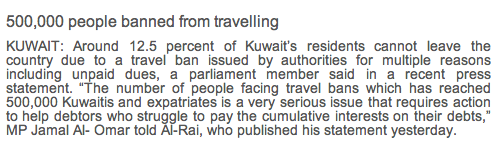
Mostly for people who have not paid interest on their loans? The banks have that much power, that they can put a travel ban on their customers?
Recent Comments
intlxpatr on Shampoo Ginger tigerbutterya0c5ff1d… on Shampoo Ginger intlxpatr on British Soldier Kidnapped, Esc… John on British Soldier Kidnapped, Esc… intlxpatr on British Soldier Kidnapped, Esc… Wikipedia Donate Button

Amazina


Early Voting in Florida


