Wooo HOOO the New Q8 Books!
Brava! Brava, Fajer! What a great gift to the children and the community, to make Q8Books more accessible and family friendly. Woooo HOOOOO!
Reading and literacy are key to civilization. Brava!
From the Kuwait Times:
Kuwait’s community bookshop gets new life

Finding quality English books in Kuwait is a challenge as any book lover here knows. Local lawyer Fajer Ahmed, 26, recently took up the challenge when she acquired the small but well-loved bookshop, Q8 Books. She moved Q8 Books from downtown Kuwait City into a renovated space in Bayt Lothan, the non-profit arts and culture center located next to Marina Mall in Salmiya. Home to more than 15,000 titles of all genres including literature, general fiction, history, romance, thrillers and mysteries, westerns, classics, cook books, true crime, self help and motivation, family and lifestyle, business and philosophy and arts and crafts, Q8 Books has something to suit every reader’s taste.
By adding sofas, tables, chairs and beanbags, Q8 Books created a cozy, relaxed atmosphere along with free WiFi that invites customers to come and hang out. “We want to encourage reading, writing and communication in Kuwait, “Fajer explained. “As one example, we provide local writers with a place to display and sell their books free of charge, we also do all the administrative work for them.”
A community bookshop
Q8 Books also holds a free weekly story time for children, offers 50% store credit for trade ins, encourages book clubs and other responsible community groups free space to hold meetings and has an outreach project to support a library in Gambia. “We thank Bayt Lothan for giving Q8 Books a home,” Fajer said. “Without them none of this would have been possible.” Q8 Books’ erudite former owner, Jacob, started the bookshop almost a decade ago with only a handful of books. During his travels, he would browse used bookstores and markets to find quality titles that would be appreciated by the book-loving community in Kuwait. Jacob continues to help out at Q8 Books along with a group of dedicated volunteers and support from the Kuwait Writing Club.
Fajer also organizes regular events in order to build Q8 Books as a community space. On the first of November, Q8 Books hosted a Spooky Book night for kids, which included a story telling by local street artist Monstariam dressed in a bunny costume, a crafts and arts table, coloring and glitter, a costume contest and a chance for parents to browse and chat.
Kid and family friendly
“We really enjoyed Spooky Books night,” said Umm Sara, a mother of three children who attended the event all wearing ‘scary’ costumes. “The kids loved the story telling and we got several books. Much better than going to a mall and they got to draw and color and dress up.” The Kuwait Writing Club also took part, judging over 80 submissions for the writing competition. The winning submission will be published in Kuwait Times. “We also had a cover design competition for children to draw covers for the age appropriate horror story, Goosebumps, and every kid that took park received a free book of their choice,” Fajer explained.
Q8 Books will offer monthly events for children and parents with the goal of encouraging reading. “When kids come in playing games on electronic devices, we try to find books with the same characters and get them interested in reading,” Fajer noted. “Welovekuwait.com Children’s Bookshop has also donated coloring and reading books to give for free for every child that walks in.” Q8 Books encourages Kuwait’s community of readers to share their love of reading. They accept donations and offer store credit for traded in books. They also invite anyone to email ask@q8bookstore.com if they are interested in volunteering, donating or just want to talk to someone about suggestions for what to read.
Q8 Books is located in Bayt Lothan, next to Marina Mall. Store Hours: Weekdays 9am- 1pm and 5pm-9pm. Weekends 11am-9pm. Follow them on Instagram @q8bookstore
By Jamie Etheridge
The Most Expensive Soap in the World Made in Qatar
There is nothing so lovely not so luxurious as a really good soap. My niece introduced me to my very favorite, an Iris scented soap from Santa Maria Novella in Florence which she brought me as a house gift when she visited in Germany.

This (below) is not the Florentine soap made by nuns. This soap is not for sale; it’s for promotion and for royals only – From Qatar’s Gulf Times:

Al-Sherif shows off the soap as Dr Hassoun (second right) and other guests look on at the unveiling yesterday. PICTURS: Jayaram
The “most expensive soap in the world,” made of pure gold dust, olive oil and virgin honey and embedded with diamonds, was unveiled by Khan Al-Saboun Bader Hassoun and Sons at the Qatar Pool and Spa 2013 at the Doha Exhibition Centre yesterday.
Weighing around 100gm and with a price tag of $3,800, the soap dubbed ‘Qatar Royal Soap’ with the word ‘Qatar’ in Arabic inscribed on it, is being dedicated to Qatar and its great achievements in many fields, especially in winning the bid to host the FIFA 2022 World Cup.
Khan Al-Saboun Bader Hassoun and Sons chairman Dr Bader Hassoun explained that the soap was specially made for royalty aside being beneficial for the skin due to its natural and organic contents.
“Our company, based in Lebanon, has been known for specialising in natural and organic beauty products for years and we have very committed patrons due to this specialisation,” said Dr Hassoun, whose family has been in the soap making business for over eight centuries.
He said that the soap, though highly valued, has not been produced for commercial purposes, though it was earlier reported that it will be available for sale in Al-Saboun City Center – one of the company’s six branches in Qatar.
“We have made only this one piece in order to showcase our capabilities for inventions in soap making and just to express our respects for royalty. So, the soap will not be for sale,” he maintained. Lebanese singer Reem al-Sherif was present at the launch.
“Mind Your Own Business”
You can be married for a long time and still be surprised. 🙂
I was thinking about other cultures, and then I thought about growing up in Alaska. Alaska is one of those kind of end-of-the-line places. Maybe it’s changed, but except for the native Americans, most people had come from somewhere else. Very few were second generation.
People at end-of-the-line places often have backstories they don’t want to talk about – bad divorces, or worse – bad marriage – no divorce, criminal records, or a million other situations they don’t want to talk about. From an early age, you learn not to ask. There were also a lot of laconic Scandinavians around; they talk about fishing and hunting but are seriously tongue-tied if asked a personal question. So again – you learn not to ask.
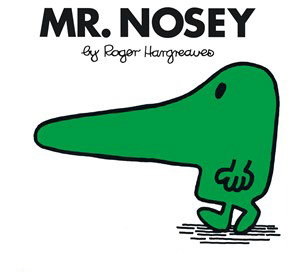
“Mind your own business,” I can remember my own mother saying, so I thought it was a rule. “Don’t be a Nosey-Parker.”
All my life I thought that was the rule. It was the way I was raised. Every now and then that curtain of pre-conceptions parts and a light gleams through. I was thinking about other cultures and it occurred to me to ask AdventureMan if he grew up with the same rule.
He just laughed. He looked at me in utter amazement, and laughed.
“I grew up in a town of 3,000,” he laughed, “and some of those were relatives, aunts, uncles, grandparents, cousins – everyone knew everything!”
“There’s no such thing as ‘mind your own business’ when your entire life is known by every single person in town!”
He hooted with laughter at the very thought.
“Everyone knew everything!” he repeated.
It’s expat world right here in my own house. This is a whole new way of thinking about things. I’ve always thought personal privacy was sort of universal, but not so.
One of the many times we lived in Germany, we lived in a small village where people told us everything. It was amazing, a whole different world, being on the inside, but not really being a part of it all. People seemed to feel we needed to be filled-in. One family didn’t speak to another family in the village, and it was awkward, because there were only like 300 people in the village, but many years ago someone’s grandmother had a terrible disagreement with the other family’s grandmother and no one in the families speak to one another now, even though no one can remember the reason.
I’ve escaped a lot of that being an expat, not sticking around longer than five years max, not long enough to develop a reputation you can’t shake. 🙂 But it makes me wonder if things are looser these days, if you can grow and change and be allowed to outlive your mistakes in small places where everything is everyone’s business . . .
Happy Islamic New Year
My good friend and commenter, Daggero, left this comment for us yesterday announcing the new Islamic year:
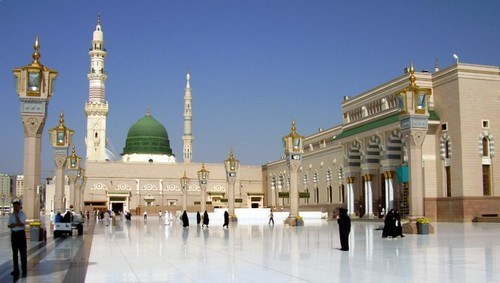
For your information yesterday we entered the Islamic year 1435 Hijri ( hijri = immigration ) which marks the year the prophet Muhammad peace be upon him, emigrated after 13 years of calling people to Islam from Mecca to Medina, ( where he is burried in his Mosque , Masjid an Nabawi, the second holliest mosque in Islam after the Mecca )
So total Islam time from begining to now is 1448 years, and on this auspicious occasion i wish you , AdventureMan and your family and the little ones a happy and a blessed New Islamic year.
We wish you the same, Daggero, and I smiled as I read that you discussed the topic we were discussing with your daughter on the drive to school in the morning. I remember those days so well, as young people begin to draw off into their own lives and the time we spend with them in cars can be so precious. Happy New Year to you and your family.
We had a friend from Libya whose family name meant “from Madina;” before we had ever lived in any Middle East country, he had told us a little about Madina, and what a beautiful city it is. The mosque is very beautiful. I think the tradition is that green was the prophet Mohammed’s favorite color?
Happy New Year, too, to all our Moslem friends.
Expat Teacher Murdered In Qatar After Night of Clubbing?
Qatar expats shocked after UK teacher’s suspected murder
 By Yolande KnellBBC News, Doha, Qatar
 Lauren Patterson had gone to a nightclub with a friend before she went missing
The suspected murder of a young primary school teacher from south-east London has deeply upset British expatriates living in the Gulf state of Qatar.
However, two weeks after Lauren Patterson disappeared following a night out in the capital, Doha, officials have given few details about her disappearance.
DNA tests have been carried out on the remains of a body found in a remote area of desert but the results have not yet been released.
At the Newton British School, where Ms Patterson worked, one mother paid tribute to a talented teacher who she said had been a favourite of her little son.
However, staff refused to comment, saying they had been advised not to.
“We’re a small, close-knit community and we’re all in deep shock,” explained headteacher Katherine Dixon. “We are dealing with small children here.”
Security camerasWhen 24-year-old Ms Patterson went out on 11 October she had just returned from a trip home to the UK for her grandmother’s funeral.
She and a female friend decided to go to Club 7 on the seventh floor of the luxury La Cigale Hotel.
It is a popular venue where all nationalities mingle on the dance floor as DJs play ambient house music.
Groups sip cocktails around low tables decorated with colourful, illuminated ice buckets.
Everyone entering the club has their ID checked and they are watched by burly bouncers and security cameras.
It is believed that in the early hours of the morning, the two women left with two local men they knew who had offered to drive them home.
Ms Patterson’s companion was dropped off safely but she went missing.
The alarm was raised by her friend who called the police the next day.
Arrests
Reports say a falconer found a badly burnt corpse shortly afterwards. Two suspects were detained although no details about them have been confirmed.
 Public prosecutor Mohammed Rashed al-Binali says violent crime is “very rare” in Qatar
The case has been referred to the attorney general.
“Violent crime is very rare in Qatar,” public prosecutor, Mohammed Rashed al-Binali told me in his smart office surrounded by shining skyscrapers in central Doha.
“We are continuing to investigate the case. We cannot give more details at the moment but the Ministry of Interior did arrest the suspects within 24 hours.”
Alison Patterson has flown to Doha and is awaiting further news about her daughter.
She told the BBC she would only make a statement “when I feel the time is right and I have received all the information concerning Lauren”.
Meanwhile, the British Foreign Office says it is providing the family with consular assistance.
Qatar, which will host the 2022 World Cup, is generally considered one of the safest places in the Middle East for Westerners.
The tiny, but very wealthy Gulf state, which is the biggest exporter of natural gas in the world, relies heavily on its growing foreign workforce.
It now has some 17,500 British residents. Most are attracted by the high living standards and high tax-free salaries.
Yet work permits can be easily revoked and this makes employees from overseas very wary of upsetting the authorities.
While Qatar has recently supported opposition movements pushing for greater freedom across the Arab world, the nation itself remains very conservative and tightly controlled.
Saudi Women Drive, No Problem
For your delight of the day, please go to YouTube and watch this hilarious Saudi video, No Woman, No Drive! Click on the blue type above 🙂

From The Guardian:
Dozens of Saudi Arabian women drive cars on day
of protest against ban
-
Staff and agencies
- theguardian.com, Saturday 26 October 2013 12.03 EDT
Activists say at least 60 joined call to allow female drivers – making it country’s biggest ever demonstration against the ban
More than 60 Saudi women got behind the wheels of their cars as part of a protest against a ban on women driving in the kingdom, activists have claimed.
A Saudi professor and campaigner, Aziza Youssef, said the activists have received 13 videos and another 50 phone messages from women showing or claiming they had driven, the Associated Press reported.
She said it had not been not possible to verify all of the messages. But, if the numbers are accurate, they would make Saturday’s demonstration the biggest the country has ever seen against the ban.
Despite warnings by police and ultraconservatives in Saudi Arabia, there have been no reports from those who claimed to have driven of being arrested or ticketed by police.
A video clip of a protest by May al-Sawyan, a 32-year-old economics researcher and mother of two, was uploaded on the YouTube channel of the October 26 driving for women group, along with several other videos of women purportedly driving in defiance of the ban in Riyadh, al-Ahsa and Jeddah. It was not possible to verify when they were filmed. Another video to feature on YouTube was the spoof No Woman, No Drive.
“I am very happy and proud that there was no reaction against me,” she told AP. “There were some cars that drove by. They were surprised, but it was just a glance. It is fine. They are not used to seeing women driving here.”
Sawyan said she had obtained a driver’s licence from abroad. She said she was prepared for the risk of detention if caught but added that she was far enough from a police car that she was not spotted.
“I just took a small loop. I didn’t drive for a long way, but it was fine. I went to the grocery store,” she said.
Her husband and family waited at home and called her when she arrived at the shop to check on her, she said. She drove with a local female television reporter in the car. They were both without male relatives in the vehicle.
“I know of several women who drove earlier today. We will post videos later,” one of the campaign organisers told Reuters.
The Associated Press reported that a security official said authorities did not arrest or fine any female drivers on Saturday.
Youssef said she and four other prominent women activists received phone calls this week from a top official with close links to Interior Minister Prince Mohammed bin Nayef, warning them not to drive on Saturday, the day the campaign set for women’s driving.
She also said that “two suspicious cars” have been following her everywhere all day. “I don’t know from which party they are from. They are not in a government car,” she said.
Activists said they have 16,600 signatures on an online petition calling for change. Efforts to publicise the issue have been described as the best-organised social campaign ever seen in Saudi Arabia, where Twitter has millions of users and is used to circulate information about the monarchy and official corruption.
Previous attempts to promote change fizzled out in arrests for public order offences and demoralisation. In 2011, the activist Manal al-Sharif made a YouTube video urging women to drive their own cars, and was imprisoned for more than a week. But the signs are far more positive now.
Three female members of the shura (advisory) council – among 30 appointed by the 90-year-old King Abdullah – recommended this month that the ban be rescinded, though no debate has yet taken place.
Latifa al-Shaalan, Haya al-Mani and Muna al-Mashit urged the council to “recognise the rights of women to drive a car in accordance with the principles of sharia and traffic laws”.
The three – praised by supporters for “stirring the stagnant water” – framed their argument with careful references to religious edicts banning women from being in the company of an unrelated male driver. Other ideas designed to reassure critics are appointing female traffic police and driving instructors. Cost is another big factor, with families having to employ chauffeurs, as is convenience.
Though no specific Saudi law bans women from driving, women are not issued licenses. They mostly rely on drivers or male relatives to move around.
Powerful clerics who hold far-reaching influence over the monarchy enforce the driving ban, warning that breaking it will spread “licentiousness.” A prominent cleric caused a stir when he said last month that medical studies show that driving a car harms a woman’s ovaries.
El Tenampa in Kissimmee
“So where are you eating tonight? asked Alessandro, and we told him El Tenampa. His face lit up with a huge smile. “You’re going to love it!” he said. “Do you like spicy food?”
Oh yes. Yes, we do.
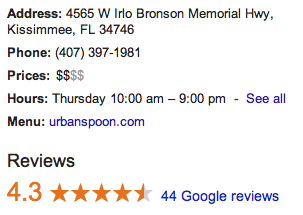
El Tenampa is a challenge. It is the highest rated Mexican restaurant in the Kissimmee/Disney/Lake Buena Vista area, but commenters on Google and Urban Spoon have complained about the service, the waiting time to be seated, the long wait for dinner, not understanding what was on the menu . . . as good as the food is, there were a lot of complaints.
It’s Orlando. Running a restaurant in Orlando must be a nightmare. Thousands of people from all over the world, and everyone wants service. What incentive is there to provide top-notch customer service when you know these people are passing through and you will never see them again? What incentive is there to be first-rate when many of them are poor tippers – by US standards – or just plain cheap? We went to El Tenampa fully aware that it might be problematic.
It was anything but.
It is hard to find, even though it is right on the main drag, it has poor signage. It shares a building with La Hacienda Meat Market and is next door to the India Diner and the Rodeway Motel . . . it all kinda looks low rent.
“Don’t mind how it looks from the outside,” Alessandro warned us. “It’s different inside.”

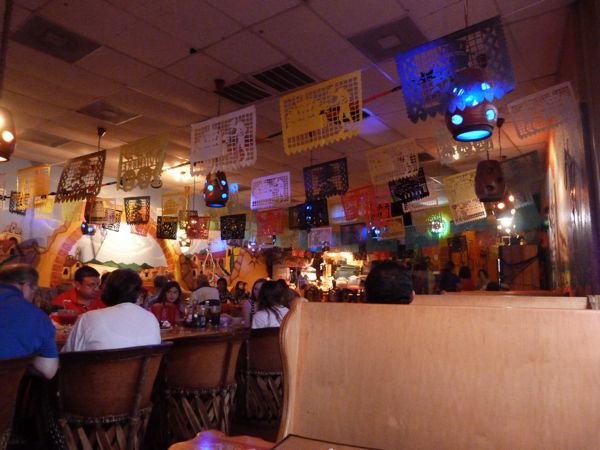
Marco, at the door, greeted us warmly and sat us right away. There was a lot going on, family parties, one of nearly twenty people, several large groups, but lots of booths and tables. The place LOOKS chaotic, but we got our drinks and menus right away, chips, salsa and guacamole very shortly and our dinners within a reasonable time. The wait staff was hopping – very busy – but we never felt slighted or neglected.
The menu was inclusive, and the food was fabulous. Marco told us it was a slow night, which meant that you could walk right in and have a table, no waiting.
AdventureMan ordered a la carte, a carnitas tostado and a tamale and salad; I had the pescado Veracruz, steamed in foil with spices and vegetables, oh wow.
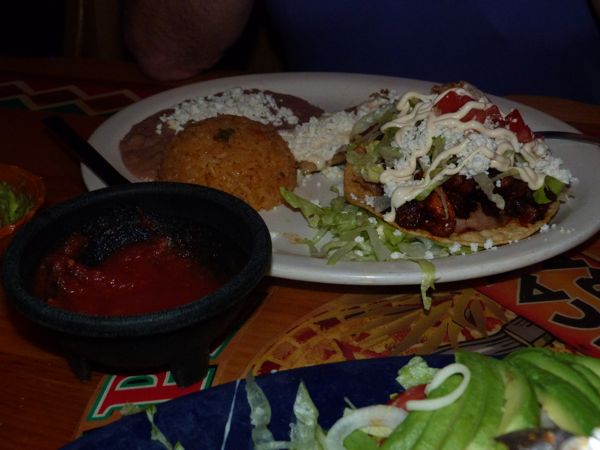
Well worth the trip. Great food, great service and a great atmosphere, all decorated for the day of the dead/Halloween.
Our bill was a shock. All that great food, and the bill was under $25. Amazing.

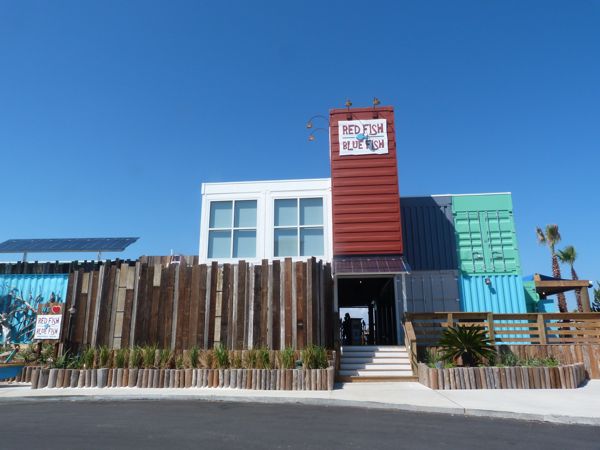
. . . Red Fish, Blue Fish on Pensacola Beach
I remember reading the book, One Fish, Two Fish, Red Fish, Blue Fish to my son – maybe about a hundred thousand times, you know how kids love Dr. Seuss. This was a restaurant people started talking about months before it ever opened. Great location. New concept, re-using metal shipping containers, very environment-friendly – what’s not to like?
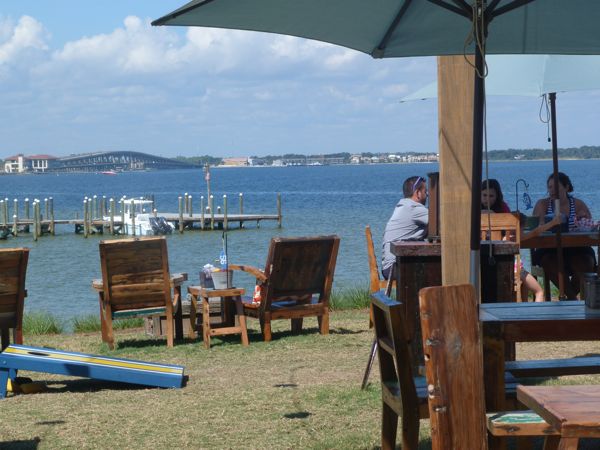
Our son and his wife got there first, not too long after it opened. Their experience was less than stellar. They loved the ambiance, sitting out by the lapping waves on Quietwater Sound (except when hit by an errant bean-bag, one of the risks you take sitting near the bean-bag toss section, but hey – when you’ve already waited 45 minutes for a table, you take what you get.) They loved the food – when they got it. It took them fifteen minutes, and tracking down a waitress themselves just to get a menu, more time to get their orders placed. All in all, they said, a great evening with some annoyances. That is not a stellar recommendation.
We tried it a week or so later, at lunch. No crowd, but neither was there a hostess, people just kind of wandered in looking around, a little lost, and some waiter or waitress would holler “just seat yourself!”
No sooner had we seated ourselves – every table has a great view – than our waitress appeared. We have NO complaints about the service; the service at lunch time the day we were there was great. It was one of those perfect Fall days in Pensacola, temperature maybe 75° with blue blue skies, a Blue Angel takes a whirl over us as we are sipping our iced teas, the waves are lapping, breezes breezing – lovely.
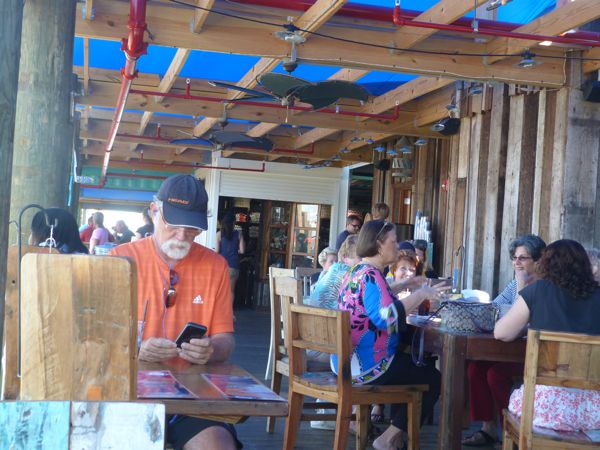
The wait staff wear Tshirts indicating they are “CREW”

AdventureMan ordered the BLATT, bacon lettuce avocado tomato and tilapia, which came hot and fresh and tasted . . . OK. Fine. Nothing special. Sort of small by Pensacola standards.

Fries are a side. You pay extra for fries, they don’t come with the meal.

I ordered Asian Slaw with fish on top. When it came, I was delighted that the fish was not deep fried, but grilled. The fish was delicious. I was not delighted that the Asian slaw was barely there, and had a Caribbean lime flavor. The waitress brought me some soy sauce. Not the same. Tiny portion – by Pensacola standards.

Great location. Nice, beachy, casual ambiance. Lots of local groups trying the place, having a good time. We had great service, but date nights you might experience slow service.
Here’s the thing. Just a short walk up the walk is Flounders, with great french fries, truly superb, so crispy delicious that people who are not supposed to eat fries have to succumb to the temptation to try a fry or two or three or . . .
Beach food isn’t cheap, but at Flounders, fries are included with the meals. Service is almost always pretty good. You rarely have to wait longer than 20 minutes at a really really busy time to get seated. Larger menu, more entrees than Red Fish Blue Fish.
It’s a tough comparison, but it’s a reality,and inevitable, especially when you are almost next door neighbors. Red Fish Blue Fish is going to have to step up its game.
Recent Comments
ExpatAlien on What Country am I Living … intlxpatr on Yellowstone: Old Faithful to C… Michelle on Yellowstone: Old Faithful to C… Cathy on No Grown-Ups in Charge intlxpatr on Waiting for Snow Wikipedia Donate Button

Amazina


Early Voting in Florida


 Here There and Everywhere