Prohibited For Travel in Kuwait
LOL, the have you been to the web page of all the items that are banned for traveling in and out of Kuwait? It’s all in Arabic, but you can understand the photos.
My last move to Kuwait, I was allowed several hundred pounds to take on the airplane. I packed an entire set of flatware, and all my good kitchen knives, and lots of scissors. . . like, who can live without scissors???
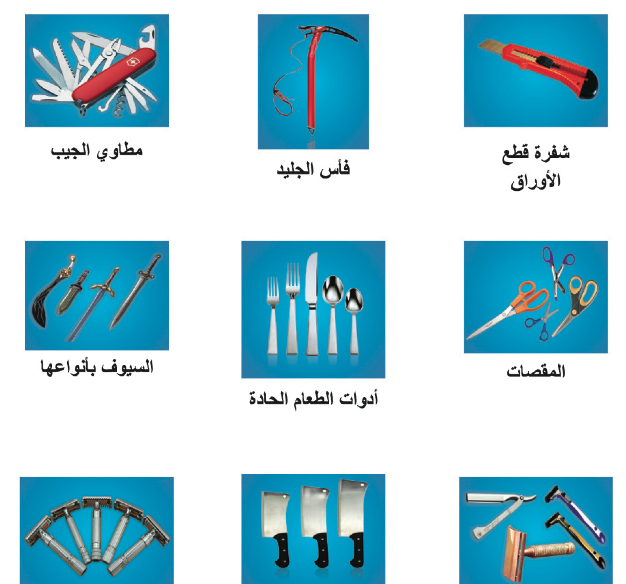
Honest Judge, so sorry, I had NO idea! No one asked me if I was carrying dangerous flatware in my baggage!
What Are Kuwait Traffic Laws?
You all know me – I am a law and order kind of gal. I like order, I like laws, especially those voted on by the people. I like laws which can be enforced, and are enforced, equally, for all people equally in the country. Oh? I did? I said EQUALLY twice?
We are all equal before the law.
Now here is the tricky part. Have you ever seen a listing of traffic laws in Kuwait? Can you find a listing of laws, violations, and their charges? When we apply for driver’s licenses in almost any country, we get a little booklet to memorize, with the laws written inside it. The laws are clear. Clear laws are enforceable.
I’ve looked at the MOI website. I see something that looks like it might be a traffic code in Arabic. I have looked everywhere; I cannot find one in English. I find no reference to any handbooks for people applying for their driver’s license.
How can you enforce a law if the law is not published? Is there a code somewhere listing violations and fines? I published one many years ago, something that all the expats were sending around as ‘the new Kuwait traffic rules’ but IF it was, there was never anything in the paper about it to confirm its validity.

If you are going to have a major campaign to enforce traffic codes, you might want to publish the laws . . . in all major languages use today in Kuwait.
From the Kuwait Times:
Ali vows to rid traffic ‘disease’
Interior Ministry Assistant Undersecretary Maj Gen Abdulfattah Al-Ali
KUWAIT: Interior Ministry Assistant Undersecretary Maj Gen Abdulfattah Al-Ali stressed that all traffic violation-related deportations are in accordance with the law. Speaking at a press conference at the Kuwait Journalists Association (KJA) headquarters, Ali said that deporting people for traffic violations was also adopted by the US and other countries worldwide. “The problem is that we were very tolerant with violators and this does not mean that law violation is a right for motorists,” he underlined, urging all human rights organizations who have criticized Kuwait’s traffic police to examine human rights in their respective countries before talking about Kuwait.
“We have filed over 70,000 traffic citations including 43,000 serious ones such as running red lights, driving under the influence of alcohol, driving on the wrong side and many others,” he elaborated, pointing out that those already deported did not want to respect the traffic laws they had repeatedly violated. Ali added that the results of studies of traffic problems revealed many and that once one problem was solved, another emerged immediately.
“We have various problems… including the fact that motorists speak many languages and dialects which requires a large number of specialists to develop their traffic awareness,” he explained, noting that the traffic remedy strategy started by diagnosing the “disease” by studying random “specimens” at different times of the day at places with heavy traffic flows such as Jleeb Al-Shuyoukh, Shuwaikh Industrial Area, Amman Street, Bnaid Al-Gar, Khaitan, Farwaniya and Fahaheel.
“The specimens showed some major problems such as domestic drivers using private vehicles as taxis, taxi and large vehicle drivers who do not hold general driver’s licenses and people driving without licenses at all,” he said, adding that this called for strict law enforcement.
“Traffic in Kuwait is like an old sick man who once treated for one aliment develops another,” he noted, adding that 18 traffic inspection teams dressed in civilian clothes had been formed and deployed in various places. “Fortunately, traffic police only file 100 daily citations in Jleeb compared to 1,000-1,500 in the past”, he concluded.
The Festival of BERNARD MIZEKI
(Play the video of the Soweto Gospel Choir as you read this summary from today’s Lectionary Readings How I would love to be able to attend this festival!)
BERNARD MIZEKI
CATECHIST AND MARTYR IN AFRICA (18 JUNE 1896)
Bernard Mizeki was born in Portuguese East Africa (Mozambique) in about 1861. When he was twelve or a little older, he left his home and went to Capetown, South Africa, where for the next ten years he worked as a laborer, living in the slums of Capetown, but (perceiving the disastrous effects of drunkenness on many workers in the slums) firmly refusing to drink alcohol, and remaining largely uncorrupted by his surroundings. After his day’s work, he attended night classes at an Anglican school.
Under the influence of his teachers, from the Society of Saint John the Evangelist (SSJE, an Anglican religious order for men, popularly called the Cowley Fathers), he became a Christian and was baptized on 9 March 1886. Besides the fundamentals of European schooling, he mastered English, French, high Dutch, and at least eight local African languages. In time he would be an invaluable assistant when the Anglican church began translating its sacred texts into African languages.
After graduating from the school, he accompanied Bishop Knight-Bruce to Mashonaland, a tribal area in Southern Rhodesia (now Zimbabwe), to work there as a lay catechist. In 1891 the bishop assigned him to Nhowe, the village of paramount-chief Mangwende, and there he built a mission-complex. He prayed the Anglican hours each day, tended his subsistence garden, studied the local language (which he mastered better than any other foreigner in his day), and cultivated friendships with the villagers. He eventually opened a school, and won the hearts of many of the Mashona through his love for their children.
He moved his mission complex up onto a nearby plateau, next to a grove of trees sacred to the ancestral spirits of the Mashona. Although he had the chief’s permission, he angered the local religious leaders when he cut some of the trees down and carved crosses into others. Although he opposed some local traditional religious customs, Bernard was very attentive to the nuances of the Shona Spirit religion. He developed an approach that built on people’s already monotheistic faith in one God, Mwari, and on their sensitivity to spirit life, while at the same time he forthrightly proclaimed the Christ. Over the next five years (1891-1896), the mission at Nhowe produced an abundance of converts.
Many black African nationalists regarded all missionaries as working for the European colonial governments. During an uprising in 1896, Bernard was warned to flee. He refused, since he did not regard himself as working for anyone but Christ, and he would not desert his converts or his post.
On 18 June 1896, he was fatally speared outside his hut. His wife and a helper went to get food and blankets for him. They later reported that, from a distance, they saw a blinding light on the hillside where he had been lying, and heard a rushing sound, as though of many wings. When they returned to the spot his body had disappeared. The place of his death has become a focus of great devotion for Anglicans and other Christians, and one of the greatest of all Christian festivals in Africa takes place there every year around the feast day that marks the anniversary of his martyrdom, June 18.
Ramadan in Kuwait Starts July 9


Ramadan on July 9
KUWAIT: The fasting month of Ramadan is forecast to begin on July 9 on the basis of astronomical calculations, said astronomer Adel Al-Saadoun yesterday. Saadoun told KUNA the crescent will be visible on July 8 at 10:14 am and disappear some four minutes after sunset.
He added the sighting of the crescent would not be possible at any spot throughout the Muslim world, but would be seen through telescope in southern America. However on July 9, it would be visible in some countries including Kuwait.
Ramadan is a yearly month of fasting observed by millions of Muslims throughout the world. Kuwaitis observe and celebrate its advent and Eid Al-Fitr marking its end. People fast from dawn to dusk, and public eating, drinking or smoking is punishable by law.
My very first year blogging, I wrote a post which has become one of my all time statistical highlights, Ramadan for Non-Muslims. It was a rich time for blogging in Kuwait, lots of interchange of ideas. If you want to know more about Ramadan, be sure to read the comments by clicking on ‘comments’ at the end of the article.
The Hummus Wars
WARNING! This article is long, and will take some time to read! Found it in the AOL/Huffpost:
I wish they would start a Muhammara war; I love the stuff!
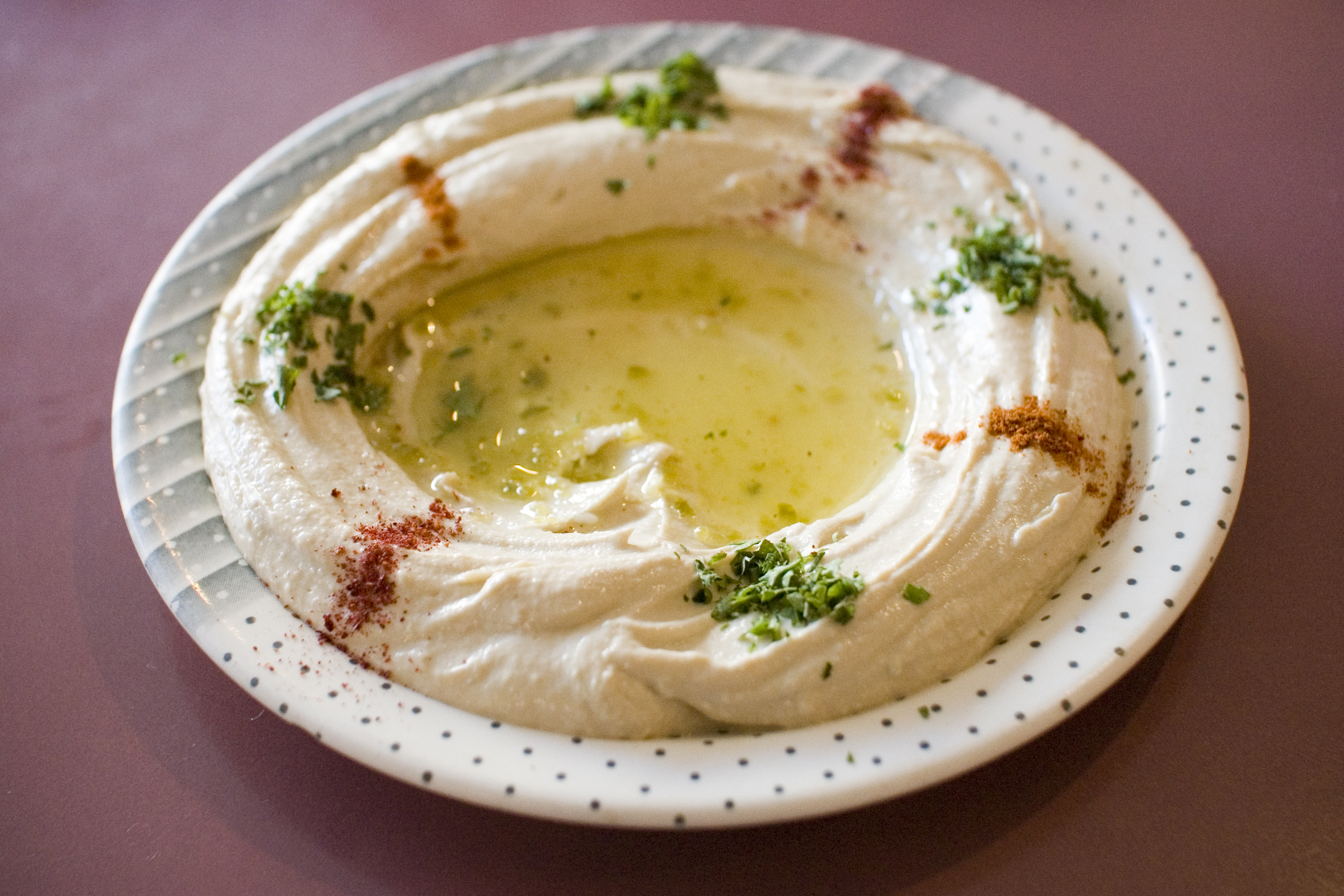

Sabra’s Quest To Push Hummus Mainstream Is About Much More Than Chickpeas
Posted: 06/10/2013 8:04 am EDT | Updated: 06/10/2013 5:01 pm EDT
Last winter, executives from the snack-food empire Frito-Lay invited Ronen Zohar, the Israeli head of America’s biggest hummus company, to watch the Super Bowl from a luxury suite at the Superdome in New Orleans.
For the snack-food industry, the Super Bowl amounts to something like Christmas and every kid’s birthday party wrapped into one, a day on which the average American consumes the caloric equivalent of 20 servings of Utz’s sour cream and onion dip. For Sabra, whose red-rimmed tubs of hummus are increasingly found inside American refrigerators, the stakes were particularly high.
“People are dipping in Super Bowl,” Zohar said. “They are looking for what to dip. Unfortunately they are dipping in the wrong product. But we try to change this. And we are doing okay.”
Around Sabra’s offices just outside New York City, employees are fond of saying that they hope to put their Middle Eastern chickpea dip “on every American table.” Though that mission is far from achieved, the company is off to an impressive start. In the last half-decade, overall sales of hummus have climbed sharply in the United States, with Sabra capturing about 60 percent of the market, according to the Chicago-based market research firm Information Resources, Inc. This spring, Sabra announced an $86 million dollar expansion of its Virginia factory, a move that the company says will create 140 jobs.
As the company’s leader during this stretch, Zohar has overseen a wide-ranging publicity effort aimed at simultaneously coaxing Americans to open their minds to a new taste of foreign origin while downplaying controversial aspects of the product’s provenance. In an age of significant spending by America’s pro-Israel lobby, even chickpeas have been swept into the debate over Israel’s occupation of Palestinian lands, its attitude toward its Arab neighbors and its reliance on American support.
Pro-Palestinian activists have in recent years organized boycotts of Sabra’s Israeli parent company, Strauss, for providing care packages to the Golani Brigade, a branch of the Israeli army that has allegedly committed human-rights abuses in the West Bank and Gaza. Groups in Lebanon have criticized Sabra for reaping the spoils of what they say is an intrinsically Lebanese dish. To quote a saying that has surfaced on the Internet, “First our land, then our hummus.”

Zohar, a blunt-spoken man of 52 who rose through the industry by persuading more Israelis to consume American corn products, dismisses both groups of critics as irrelevant. The Palestinian boycott amounts to mere “noise,” he says. As for the argument that hummus belongs to Lebanon: “I am very happy if Lebanon is going to fight about the hummus and not about anything else.”
Like any businessman, Zohar likes to talk about his product’s promising future. But hummus has a long history. And in the Middle East, history has a way of intruding upon the present, shaping questions about the legitimacy of what Sabra has been adding to the American table.
“The history of this food is that of the Middle East,” writes Claudia Roden, an Egyptian-Jewish cookbook author who has been credited with introducing Middle Eastern food to the West. “Dishes carry the triumphs and glories, the defeats, the loves and sorrows of the past.”
HUMMUS WARS
No one knows for sure how far back the history of hummus goes, but traces of chickpea, the key ingredient, have turned up in Middle Eastern archeological sitesdating to 7,500 B.C. In his bestselling book, Guns, Germs, And Steel, the anthropologist Jared Diamond identifies the chickpea as one of several hardy, nutrition-packed food crops that grew in the Fertile Crescent and enabled its people to develop agriculture and, in turn, cities, armies, systems of taxation and governments.
As civilization spread outward, chickpeas did, too, becoming garbanzos in Spain and chana in India. In the Middle East, they were boiled, mashed and mixed with the sesame paste known as tahini, becoming “hummus bi tahini,” more commonly known as hummus.
In recent years, the growing popularity of hummus has made the dip an object of controversy. Sabra instigated one of the fights at a publicity event in New York in 2007, where it served several hundred pounds of hummus on a plate the size of an above-ground swimming pool, prompting its executives to boast that they had produced the largest dish of hummus in the history of the world.
A year later, an Israeli competitor, Osem, responded by serving 881 pounds of hummus at an outdoor market in Jerusalem. The event took place on Israeli Independence day, or as Palestinians call it, Al Nachbar, The Disaster. A Guinness representative was there to document the victory.
Lebanon entered the fray about a year after that, doubling Osem’s record at a cook-off in Beirut. The chefs, who had been convened by a pair of Lebanese business associations, used spices to decorate what was now the world’s largest hummus plate with a picture of the Lebanese flag. While they were at it, they also broke Israel’s record for the largest bowl of of tabouli, a bulgur and parsley dish. According to The Daily Star of Lebanon, the groups that organized the event had a more grandiose goal than merely notching a volume record: They hoped to promote the idea that the Lebanese had invented both tabouli and hummus.
In the months after that feat, Lebanon and Israel traded shots, with Lebanon delivering what has so far proved the victorious blow, serving 23,042 pounds of chickpea dip at a weekend-long gathering in 2010. On the eve of the event, Ramzi Nadim Shwaryi, a Lebanese TV chef and one of the festival’s coordinators, told the Lebanese press that he and his allies were in it for Lebanon’s honor.
“We will stand together against this industrial and cultural violation and defend our economy, civilization and Lebanese heritage,” he said.
At about the same time the hummus wars were playing out in Lebanon, a group of Palestinian-sympathizers in the United States tried to call attention to Israel’s military activities in the West Bank and Gaza by pressing for boycotts of two Israeli-owned hummus companies — Sabra, and one of its larger competitors, Tribe.
The boycotters identified themselves as supporters of a broader movement called Boycott, Divest and Sanctions. Launched by Palestinian activists in 2005 following failed peace negotiations, the organization aimed to apply economic pressure on the Israeli government to end its 46-year occupation of Palestinian territories.
A YouTube video produced by protesters in Philadelphia who were part of the movement caught the attention of student activists at Princeton and DePaul universities in 2010. They tried to persuade their schools’ dining services to stop offering Sabra. Although they didn’t succeed, activists in the movement are still trying to garner support for their anti-Sabra efforts.
Still, Zohar does not seem particularly distressed by the potential implications for Sabra’s sales.
“The protesters make noise, but they make noise to themselves,” he said. “It doesn’t have any influence on our business.”
THE HUMMUS RELIGION
As the protests played out in the margins, Sabra aimed its product at the American mainstream. It deployed volunteers in trucks to hand out free samples of hummus in cities around the country, and expanded its product line to include more familiar dips, including guacamole and salsa.
It launched a national television ad campaign, exhorting people to “taste the Mediterranean,” and moved its staff in 2011 from an old industrial building across the street from a Queens cemetery to a sleek suburban office park, where the company heads plotted the conquest of the American marketplace in conference rooms named after touristy, exotic destinations like Madagascar and Morocco. (Perhaps unsurprisingly, none of the rooms were named after Lebanon or Israel.)
At the root of Sabra’s success was an influx of corporate money and resources. Strauss, an Israeli snack-food giant, bought half of Sabra in 2005, and Frito-Lay, the snack-food division of Pepsico, entered a joint-partnership agreement with Strauss in 2008. Zohar worked closely with the Frito-Lay people, who had scored a big victory for a foreign dip in the early ’90s, when Tostito’s salsa beat Heinz Ketchup to becomeAmerica’s best-selling condiment.
With Frito-Lay and Strauss’ investments, Sabra built its Virginia factory, where it developed flavors intended to appeal to the average American consumer: Spinach and Artichoke, Pesto, Buffalo Style. As Arabs and Israelis quarreled over the origins of hummus, Sabra was putting out a product that bore about as much resemblance to the authentic dish as a Domino’s BBQ Meat Lovers pie does to a genuine Italian pizza.
In Israel, meanwhile, yet another hummus debate was raging, and although it was the least overtly political of the controversies, it was no less capable of provoking feelings of hostility and anger. As the celebrated British-Israeli chef and food writer Yotam Ottolenghi and his Palestinian-born business partner and co-author Sami Tamimi wrote in the 2102 cookbook Jerusalem, “Jews in particular, and even more specifically Jewish men, never tire of arguments about the absolute, the only and only, the most fantastic hummusia.”
A hummusia is the Israeli equivalent of a New York pizza parlor, a cheap establishment that usually serves only hummus and a few other dishes. But the debates about hummusias are more intense than even the most impassioned pizza threads on Yelp.
“The hummusia fetish is so powerful that even the best of friends may easily turn against each other if they suddenly find themselves in opposite hummus camps,” Ottolenghi and Tamimi wrote. The arguments “can carry on for hours,” they noted, with the debaters delving into the minutia of whether hummus is better served warm or at room temperature, smooth or chunky, topped with fava beans or cumin and paprika, or nothing at all.
In a letter to The New York Times at the height of the hummus wars, Israeli food writer Janna Gur went even further, calling Israel’s fascination with hummus a “religion.” She noted that the most treasured restaurants are invariably owned by Arabs, a phenomenon she traced to the early Zionist settlers who arrived in the Holy Land determined to put the customs of the Diaspora behind them, while embracing a new identity in the Levant. They traded Yiddish for Hebrew, yeshivas for plowshares, and matzoh balls and tsimmis for falafel balls and hummus. “This love affair, that has been going on for decades, shows no signs of dying,” Gur wrote.
Last summer, while traveling in Israel, I visited as many of the hummusias as I could, hoping to come to my own conclusions about the craze. I was joined in this mission by my father, who moved from Israel to New York in the early 1970s and has griped about the quality of America’s hummus offerings ever since. Like many Israelis, he looks down not just on corporate hummus brands like Sabra and Tribe, but also on local shops that package their own hummus in take-out containers. As far as he is concerned, the religion of hummus forbids packaging of any kind.
In the Middle East, hummus is served fresh from the pot, on a big communal plate dripped with olive oil and sprinkled with paprika and cumin. The plate has to be big enough and flat enough so that you can comfortably wipe up the hummus with a pita, an activity that my father refers to as “swiping.” He insists that hummus should have a subtle, earthy flavor, and disdains spicy hummus, lemony hummus, hummus with chipotles, hummus with artichoke, hummus with basil, sun-dried tomato or spinach, and most of all, the dip referred to as “black bean hummus.”
As he has pointed out many times, hummus is the Arabic word for chickpea; by definition, hummus made of black beans isn’t hummus.
In Israel, my father and I ate at Abu Hassan, a bare-tabled hummus den in the seaside town of Jaffa, where the staff starts serving early in the morning and shuts down the shop after the pot runs out, often in the early afternoon. We wandered the narrow streets of Jerusalem’s Old City, past the pilgrims crowding into the Church of the Holy Sepulcher, until we reached a tiny hummus shrine adorned with black-and-white pictures of people sharing a meal at the shop sometime in the 1930s.
One day we drove to a city in Palestine’s West Bank known for its tahina factories and uprisings. By law, Israelis are forbidden from entering the Palestinian territories, except to travel to the Jewish settlements, but we felt that no hummus pilgrimage would be complete without a trip to Nablus.
At the checkpoint, an Arab cab driver pulled over and said he hoped, for our own sake, that we wouldn’t enter the city in our Israeli rental car. We thanked him and drove past the Israeli guards, through the rounded hills studded with olive trees. My father grew quiet. When he’d first traveled those hills, in 1967, he was in a tank, pushing forward toward the Jordan River as thousands of Palestinian refugees streamed down the sides of the road. The Six-Day War had broken out and the Israeli army had conquered the Palestinian villages.
After a while we reached the outskirts of Nablus, parked and made our way through the maze-like casbah, to a dim, windowless hummus restaurant with electrical wires hanging from the ceiling. A teenage boy strolled into the room with an unmarked bottle of olive oil, tipping it onto people’s plates. After a few minutes of “swiping,” my father announced that this was the best hummus he’d tasted on the trip — though he also remarked that the excitement of entering forbidden territory had enhanced the flavor. By that point I knew that my hummus palate wasn’t refined enough to discern the subtle differences between the various hummusia offerings, but I liked them all better than any hummus I’d ever had in America.
Toward the end of our stay, we traveled to the fertile hills of the Galilee region, where an Arab chef named Husam Abbas had been garnering praise for his gourmet take on Arab food, defying a number of Israeli assumptions about Palestinian culture.
Abbas, who has been described as a leading figure of Israel’s Slow Food movement, broke ground at his chain of high-end restaurants by showing Israelis that Arab cuisine isn’t just hummus and kebab. His specialties include a spicy watermelon salad with diced mustard stems and stuffed summer squash in a tomato bisque, and he uses produce grown in fields that his family has tended, by his account, for 1,700 years.
Abbas met us by the side of the road in his pickup truck and led us into his fields. A gruff man with a leathery face, he tramped down the leafy aisles with a cigarette lodged in his mouth, stooping to gather purple-tipped string beans, young cantaloupes that looked more like cucumbers, several kinds of summer squash, and beautifully misshapen heirloom tomatoes.
Later, in the dining room of one of his restaurants, he explained that when the growing season ends, he and his children go into the hills to gather wild herbs with names like “olesh” and “aqab” and “hobeza.” The herbs grow only locally and only in the winter.
“But because hummus is dry, it can be used throughout the year,” he said.
When I asked how he accounted for the dip’s popularity, he kept his answer short: “Low cost, high calorie.” He seemed a little annoyed at the need to deliver this dictum.
FLAVOR HOUSE
As Sabra strives to make its chickpea dip as popular as bagels, burritos and other foreign-born fixtures of the American diet, it is employing a flavor palette that would test the limits of acceptability in the Middle East.
One recent day, Mary Dawn Wright, Sabra’s executive chef, stood before an array of hummus containers at the company’s Virginia factory, discussing these techniques. She popped open a tub labeled Asian Fusion.
“Israelis would never ever think it’s considered to be hummus,” she admitted.
A glistening spoonful of some brightly colored carrot and ginger mixture distinguished the dip from anything you’d find in a hummusia. Sabra collaborates with outside “flavor houses,” whose scientists also help develop classic American products like Doritos, she explained.
Asian Fusion is just one of more than a dozen flavors that Sabra has invented in its effort to convert more Americans to hummus, and Wright was almost certainly correct in her frank assessment of what Israelis might think of them. Even Zohar didn’t bother to feign enthusiasm for Sabra’s Buffalo Style flavor. “I detest it,” he said.
But for Zohar, and presumably for the rest of Sabra’s executives, personal feelings about the flavors are as irrelevant as hummus’ place of origin. What matters are the cravings of the average American consumer, and Zohar seems to think that no American is beyond the company’s reach.
At the Superbowl, he noticed that many of the tailgaters were eating Louisiana fare — “all kinds of crabs and shrimps, whatever it is.”
He didn’t see any hummus containers amid the jambalaya and gumbo.
“Maybe in New Orleans they are eating hummus not as much as people in New York are eating hummus,” he said recently. “But give us two years. They are trying it, and when they try it they become a lover.”
11,800 Deported: Kuwait Deportations Continue “Without an End Date”
I still have a large contingent of loyal readers from Kuwait, but by early this morning, I could see something was up:
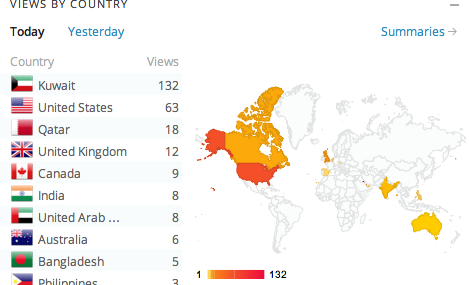
It’s not often that I have 132 Kuwait hits before noon.
So I checked the Kuwait Times:
Expat deportations will continue: Traffic chief – 11,800 deported in two-and-a-half months
KUWAIT: Major General Abdulfattah Al-Ali’s name has become synonymous with extensive traffic campaigns, aimed at enforcing the law at all costs, including implementation of mass deportations. The senior Interior Ministry official, who takes pride in deporting 11,800 people and impounding 3,000 vehicles during his tenure as head of the Ahmadi Security Department over the past two and a half years, told a local daily that deporting expatriates for serious violations will continue without an end date. “Administrative deportation of violating expatriates is not going to stop, especially of those carrying passengers illegally, in which case a person would be in violation of traffic and labor regulations,” Maj Gen Al-Ali, the Interior Ministry’s Assistant Undersecretary for Traffic Affairs, told Al-Rai on Friday.
He added that any ticket can be disputed “by a request to refer the case for traffic department investigations”. In the series of crackdowns that started late April, at least 2,000 traffic violations were registered, including 1,000 tickets issued directly on the street, while thousands of people were reportedly deported. Moreover, Maj Gen Al-Ali revealed that the ministry collected KD4 million, out of the KD24 million owed in traffic fines, during the same period. In that regard, the senior official pointed out that only KD8 million worth of fines are registered against individuals, while the rest are against companies and state departments. Out of the KD8 million, KD6 million is registered against expatriates, Maj Gen Al-Ali said. “Cases are soon to be filed with the traffic court in order to issue travel ban orders against people with more than KD80 in fines owed to the ministry,” he added.
Al-Rai published Maj Gen Al-Ali’s statement yesterday, along with a transcript of an interview with Al- Watan TV during which he defended the ongoing campaigns. “Our procedures are necessary to save lives, with average statistics indicating that 450 people are killed and 3,000 are injured annually due to traffic accidents,” he explained. During the interview, Maj Gen Al-Ali insisted that all drivers are equal when it comes to implementation of the law. “There have been doctors among the people deported, including a surgeon caught driving without a license for three years,” he said, before confirming news reports that he had taken a decision to impound a vehicle owned by Minister of Cabinet Affairs Sheikh Mohammad Al-Abdullah Al-Sabah on grounds of repeated violations committed by his personal driver. Meanwhile, the senior official urged any person who had obtained a license through illegal means to dispose of it “because once caught, they are going to be charged with forgery”. —Al-Rai, Al-Watan
Pensacola: Fiesta of Five Flag Parade
I’ve never lived anywhere with so many parades, and as Pensacola cools down a little and an offshore breeze blows away the heat of the day, a parade sounds like fun. Tonight is the Fiesta of Five Flags Parade. I can’t think of a parade since Lent, so maybe this is the kick off of the new season. Pensacola has an active and lively social scene, with all these Mardi Gras Krewes, and the older our grandson gets, the more of the parade we get to see! I think we got through three quarters of the parade tonight, and oh what fun.
The people on the floats are having a great time. They have these great alter-egos, get to wear elaborate costumes, and there may be some alcohol involved, LOL. The people on the ground are having a great time, you can really get into the waving and trying to catch the beads. Some of the beads are prettier than others, but as AdventureMan says, it’s all plastic. Having said that, you should see him scramble! He is good at catching beads.
And oh my, they are so good to the kids, with stuffed toys, beads, ice cream bars, frisbees, trinkets, including pieces of eight!
Honestly, there are some things in life I will never get tired of – parades and fireworks. I feel so blessed to live in Pensacola.
These photos are not in the right order because I just did a group dump into the photo gallery, and it scrambled them when they were inserted into the blog entry.
The parade always starts with the Pensacola motorcycle police, with flashing lights and roaring engines!

I love that they decorate the horses tails:

And then AdventureMan pointed out they also rubbed glitter into the horses haunches to make them pretty 🙂

So many beads! We got to the parade a mere ten minutes before it began, but it was more lightly attended, and we were able to be right up front. Our little grandson had a great view, and people were so kind giving him beads, throwing him beads, toys, etc.


Look at all those beads they plan to throw! There was a throne on this float with King Tut!


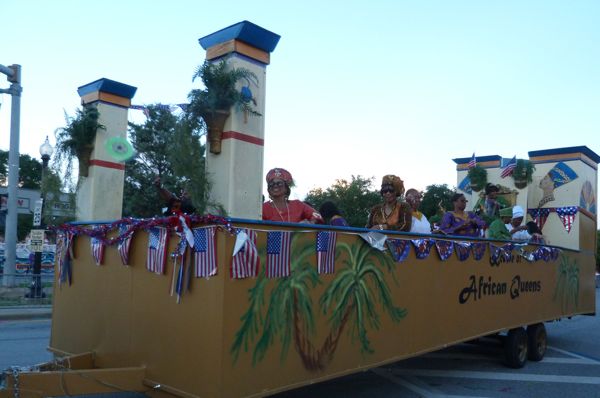
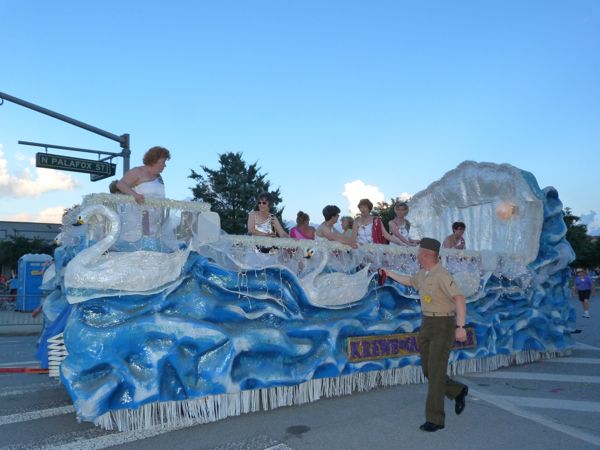
These ladies were having a grand time!


The Mayoki Indians seemed to be the Krewe having the best time of all, with two floats loaded with beads, and more ‘foot Indians’ handing and throwing beads into the crowds:





The flame throwing baton twirler got lots of applause:


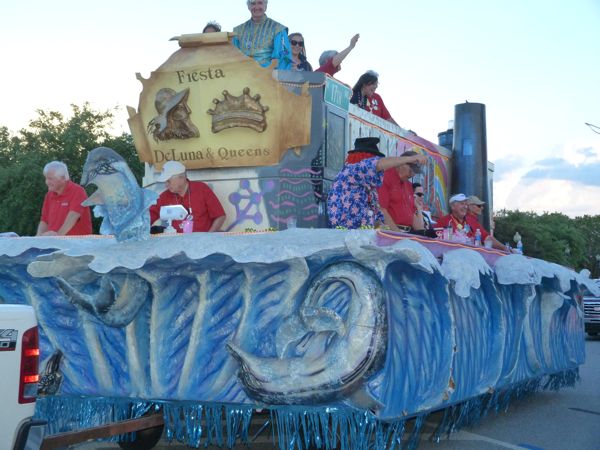





We saw our little grandson rubbing his eyes and asked if he was ready to go home, and he was. One of these days he will be old enough we will see an entire parade. I had a minor concern that Tropical Storm Andrea would blow in bad weather and make the parade unlikely, but nothing of the sort, we had great weather, a lovely evening and a wonderful time making good memories with our little grandson.
Forty Years Wedding Anniversary

“You’re going to celebrate your anniversary for three days?” my friend asked incredulously.
“No, no, actually, it’s in two parts, we are celebrating the entire weekend, three days, but it’s because it is too hot to walk around New Orleans; so this is just part one, and in December we will celebrate part two with a trip to New Orleans when we can walk around and enjoy all the Christmas decorations and stay somewhere nice.”
It’s what we do.
There have been some years, particularly years with moves, or new positions, or new contracts in them, when anniversaries have sort of fallen by the wayside. We are enjoying making up for all the missed anniversaries, now that we have the great luxury of time.

We have all kinds of fun plans, a hotel stay, a dinner in a fine restaurant, star gazing out at Ft. Pickens, maybe a dolphin cruise, and a trip up in the very large beach ferris wheel, while it is still at Pensacola Beach. We plan a day in several pools with our son and his wife and our little grandson. All. or part, or some of this may really happen, depending on what the weekend weather looks like. Ft. Pickens has already evacuated all the campers with concerns over this Tropical Storm Andrea coming in, and a dolphin cruise or a trip up on the great wheel may not be such a hot idea at 40 – 50 mph winds, LOL.

AdventureMan and I knew when we married that we were in it for the long haul. We also knew it wouldn’t be easy. We come from different cultures, different life styles. We both had independent lives and responsibilities. We moved a lot. It wasn’t always easy, but then whose life is, when you know that life from the inside? We’ve had some great adventures, and some fabulous, astounding experiences. We’ve met extraordinary people and made very special life-long friends.

When I told AdventureMan our weekend might not be as exciting as planned, he laughed and said “we can bring our books.” He always knows how to make me laugh, and taking books is exactly what we did when we first got married, and would take weekend trips to a lakeside resort called Chiemsee; it would be snowing and cold and we would go into this large old lodge with it’s double doors and double shuttered windows, with it’s eiderdown comforters and huge fireplace, and we would pack books. We would sleep and read, and sometimes go eat. If that’s how this anniversary turns out, it’s a very comfortable and familiar way to celebrate.:-)

AdventureMan loves this blog. He always looks for his name. 🙂 Happy Anniversary, dear husband.
Your Calls – Every One – Reported to the Government
I found this on AOL News/Tech Crunch this morning. Post 9/11, did we know that the Homeland Security legislation would give the government so much power? To gather so much information on individual citizens who are not remotely suspected of committing a crime against the United States seems excessive to me.

Report: NSA Secretly Collecting Phone Records Of All U.S. Verizon Calls
Gregory Ferenstein
The National Security Administration is secretly collecting phone record information for all U.S. calls on the Verizon network. “Under the terms of the blanket order, the numbers of both parties on a call are handed over, as is location data, call duration, unique identifiers, and the time and duration of all calls,” reports The Guardian, which broke the story of the top-secret project after it obtained record of a court order mandating Verizon hand over the information.
The contents of the call are not recorded and it is also not known whether Verizon is the only cell-phone carrier complying with the massive spying project. The court order concerns all calls to, from, and within the United States.
With this so-called “metadata,” the government knows “the identity of every person with whom an individual communicates electronically, how long they spoke, and their location at the time of the communication,” explains the Guardian.
The Senate’s tech-savviest member, Ron Wyden (CrunchGov Grade: A), has been discretely warning citizens of these kinds of secretive government projects. “There is now a significant gap between what most Americans think the law allows and what the government secretly claims the law allows,” wrote Wyden and Senator Mark Udall to embattled Attorney Eric Holder.
The order apparently draws from a 2001 Bush-era provision in the Patriot Act (50 USC section 1861). The revelation dovetails similar exposes on massive government spying projects, including one project to combine federal datasets and look for patterns on anything which could be related to terrorism.
Recent Comments
ExpatAlien on What Country am I Living … intlxpatr on Yellowstone: Old Faithful to C… Michelle on Yellowstone: Old Faithful to C… Cathy on No Grown-Ups in Charge intlxpatr on Waiting for Snow Wikipedia Donate Button

Amazina


Early Voting in Florida


 Here There and Everywhere