Arabs wary of expressing their opinions online
Fascinating study results published in Qatar’s Gulf Times:

Northwestern University in Qatar has released new findings from an eight-nation survey indicating many people in the Arab world do not feel safe expressing political opinions online despite sweeping changes in the aftermath of the Arab Spring.
From over 10,000 people surveyed in Lebanon, Tunisia, Egypt, Saudi Arabia, Bahrain, Qatar, Jordan and the UAE, 44% expressed some doubt as to whether people should be free to criticise governments or powerful institutions online.
Over a third of Internet users surveyed said they worry about governments checking what they do online.
According to the report, “The implied concern (of governments checking what they do online) is fairly consistent in almost all countries covered, but more acute in Saudi Arabia, where the majority (53%) of those surveyed expressed this concern.”
The study – titled ‘Media Use in the Middle East – An Eight-Nation Survey’ – was undertaken by researchers at NU-Q to better understand how people in the region use the Internet and other media. It comes as the university moves towards a more formalised research agenda and is the first in what will be a series of reports relating to Internet use.
The survey includes a specific chapter on Qatar, the only country where those surveyed regarded the Internet as a more important source of news than television. “We took an especially close look at media use in the State of Qatar – a country with one of the highest Internet penetration rates in the Arab world—and internationally,” said NU-Q dean and CEO Everette Dennis.
These findings follow a preliminary report NU-Q released last April that showed web users in the Middle East support the freedom to express opinions online, but they also believe the Internet should be more tightly regulated. “While this may seem a puzzling paradox, it has not been uncommon for people the world over to support freedom in the abstract but less so in practice,” Dennis explained.
Among other findings, the research shows: 45% of people think public officials will care more about what they think and 48% believe they can have more influence by using the Internet.
Adults in Lebanon (75%) and Tunisia (63%) are the most pessimistic about the direction of their countries and feel they are on the ‘wrong track.’
Respondents were far more likely to agree (61%) than disagree (14%) that the quality of news reporting in the Arab world has improved in the past two years, however less than half think overall that the news sources in their countries are credible.
Online transactions are rare in the Middle East, with only 35% purchasing items online and only 16% investing online.
The complete set of results from the survey is available online at menamediasurvey.northwestern.edu. The new interactive pages hosting the survey on the website have features that allow users to make comparisons between different countries, as well as between different demographics within each country.
Dennis confirmed that the research report is the first in an annual series of reports produced in collaboration with the World Internet Project; one of the world’s most extensive studies on the Internet, in which NU-Q is a participating institution.
NU-Q and WIP signed an agreement earlier in the year, providing a global platform for the current research.
Lamborghini Aventador: Qatari Royal’s £350k supercar towed in Knightsbridge
LLOOOLLLLL! Great story, thanks John Mueller!
Little cross cultural problem going on . . . no license? No registration? No problem, you know my uncle, right, the Amir of Qatar . . . LOL!
Batman wouldn’t stand for it: Police peer inside the garish car’s doors (Picture: SWNS)

It’s hard not to notice a bright purple Lamborghini with orange trim. So the driver of this £350,000 supercar was asking for trouble when he went for a spin without a front numberplate.
Police spotted the infringement and impounded the vehicle after its 24-year-old owner – thought to be a member of the Qatari royal family – was unable to produce evidence that he had a driving licence or insurance.
Crowds gathered as the 220mph Aventador was towed away in London’s Knightsbridge.

Arab playboys descend on the wealthy neighbourhood each summer in costly cars flown from home and often hit trouble for lacking the correct papers.
The mean machines are a draw for petrolheads but the roaring engines annoy residents.
Off we tow: The Lamborghini Aventador is loaded onto a truck (Picture: SWNS)
Dozens of onlookers gathered to photograph the scissor-doored supercar, which has been customised by a Japanese tuning company.
One fan said: ‘It is great when the wealthy foreign tourists come over to London every summer as you always see these amazing supercars.
‘The Lamborghini looked like something out of Tron, it was absolutely stunning.
‘Hopefully there was just some confusion over the correct paperwork and it will be back on the road
UPDATE:
First it was carted off on the back of a truck, then it faced the crusher, now glow-in-the dark Lamborghini is ticketed in Mayfair
- Police impounded £350k supercar after owner failed to produce documents
- But he was slapped with ticket just hours after retrieving it from police
- Purple Lamborghini Aventador customised to glow in the dark
- Owner believed to be Nasser Al-Thani, 24, of Qatar’s ruling family
PUBLISHED: 04:49 EST, 5 July 2013 | UPDATED: 14:32 EST, 5 July 2013
He was only a hair’s breadth away from seeing his beloved £350,000 supercar crushed to a pulp after it was seized by police for driving offences.
So you might think the owner of this glow-in-the-dark Lamborghini would be a bit more careful next time.
But within hours of retrieving his purple sports car from the Metropolitan Police, he found himself on the wrong side of the law again after being slapped with a parking ticket.
Americanah and Chimamanda Ngozi Adichie
Rushing from one meeting to another yesterday, I had just an hour – but during that hour, Terry Gross was interviewing one of my favorite authors, Chimamanda Ngozi Adichie, and Chimamanda Ngozi Adichie does GREAT interviews. She is funny, and educated and insightful; she can talk about painful topics and make you laugh and cry with her. That interview was a blessing on my day.
I started reading Chimamanda Ngozi Adichie when I was in Kuwait. A good friend approached me and asked me to form a book club. LOL. This is a friend I can’t say no to. Every introverted bone in my body was screaming “NO! NO!” and I smiled at her and said “Yes.”
God is good. He laughed when I said “yes” and through the book club, introduced me to authors I might never otherwise read. The club was made up of many nationalities, and we read books from everywhere, unforgettable books. We read Chimamanda Ngozi Adichie “Half of a Yellow Sun.” Once you read Chimamanda Ngozi Adichie, there is no going back. I wonder if I will be able to hold out on Americanah until it comes out in paperback?
This is from the National Public Radio website, so you can actually listen to the interview yourself, should you want to get to know this delightful author a little better.
‘Americanah’ Author Explains ‘Learning’ To Be Black In The U.S.

When the novelist Chimamanda Ngozi Adichie was growing up in Nigeria she was not used to being identified by the color of her skin. That changed when she arrived in the United States for college. As a black African in America, Adichie was suddenly confronted with what it meant to be a person of color in the United States. Race as an idea became something that she had to navigate and learn.
The learning process took some time and was episodic. Adichie recalls, for example, an undergraduate class in which the subject of watermelon came up. A student had said something about watermelon to an African-American classmate, who was offended by the comment.
“I remember sitting there thinking, ‘But what’s so bad about watermelons? Because I quite like watermelons,’ ” Adichie tells Fresh Air‘s Terry Gross.
She felt that her African-American classmate was annoyed with her because Adichie didn’t share her anger — but she didn’t have the context to understand why. The history of the trans-Atlantic slave trade was not taught to students in Nigeria. Adichie had yet to learn fully about the history of slavery — and its continuing reverberations — in the U.S.
“Race is such a strange construct,” says Adichie, “because you have to learn what it means to be black in America. So you have to learn that watermelon is supposed to be offensive.”
Adichie is a MacArthur Fellowship winner and author of the novels Purple Hibiscusand Half of A Yellow Sun. Her new novel, Americanah, explores this question of what it means to be black in the U.S., and tells the story of a young Nigerian couple, one of whom leaves for England and the other of whom leaves for America.
The title, she says, is a Nigerian word for those who have been to the U.S. and return with American affectations.
“It’s often used,” she says, “in the context of a kind of gentle mockery.”
Saudi Arabia Welcomes Friday-Saturday Weekend
From Doha News:
Saudi Arabia’s King Abdullah has issued a royal decree to change the country’s weekend to Friday-Saturday, effective June 29, state news agency SPA reports.
The move, which puts KSA in line with the rest of the GCC countries, was made “for the sake of putting an end to the negative effects and the lost economic opportunities” due to the difference in workdays between the nation and the rest of the world, Riyadh Bureau reports.
It will apply to all government bodies and monetary agencies, including the central bank and stock exchange, SPA said. But schools and educational institutions will maintain the Thursday-Friday weekend until the beginning of the new academic year.
According to Riyadh Bureau:
The change will align banking and business days with most other countries in the region, as well as being closer to the workweek of international financial markets and businesses. Oman was the latest GCC country to shift its weekend to a Friday start last May.
KSA, Qatar’s giant neighbor the west, has been mulling a shift for more than five years, but didn’t move forward previously due to resistance from religious leaders.
“So There We Were, Two Naked Guys in the Shower and . . . . “
LOL, no, no, this is not going where you think it might go, but it got my attention, too!
AdventureMan was in the locker room with one of his exercise/aerobics buddies, cooling down from his water aerobics class when this story started, and was sharing the story with me later, at lunch, as we exchangin details of our mornings.
“. . . And he asked ‘do you know what today is?’ and I said ‘Yes! It’s the 63th anniversary of the beginning of the Korean War,” AdventureMan responded.
Guy talk. Guys discuss their combat experience in different wars. Combat is so intense, it imprints memories the way childbirth does in women, or a huge traumatic event, like the Iraqi invasion of Kuwait, or 9-11, or the Kennedy assassination, or the Tsunamis that hit Japan and washed entirely over the Maldives – experiences when the earth beneath your feet shifts, and things you once took for granted are shaken forever.
Who said guys don’t connect? AdventureMan has another old friend he needs to get in touch with today, to tell him he is thinking of him; Korean War veterans are largely forgotten in the tallying of combat in our country.
Pensacola is a wonderful place to be a military veteran. There is a Veteran’s hospital, and veteran-friendly policies at the clinics, commissaries and BX/PXx. Today we had lunch at Mellow Mushroom, where every Tuesday they give 20% off to all active duty and retired servicemen and women. Home Depot and Lowe’s give 10% off on every purchase, even plumbers, electricians, contractors, banks, theaters and many stores often give military discounts. And they thank us for our service. :0
To those of you who served in the Korean conflict: Thank you for your service.
St. John the Baptist and the Holy Spirit

This entry is a totally Here There and Everywhere moment; the impetus of which is today’s reading from Luke about the birth of John the Baptist, or as he is known in the Moslem world, the Prophet Yahya. We visited his tomb in Damascus; at our church in Kuwait on the Feast of the Nativity of St. John the Baptist, one of the readings was from the Quran. I love it when our worlds intersect and we can discover what we can learn from one another, to the advantage of all.
I also love it that each meditation from Forward Day by Day lists at the bottom the area of the world we are to include in our daily prayers. I love praying for Nigeria. I have old friends from my Kuwait church living there, and also a neighbor from Doha, a sweet book-club friend who lived across the street, who now lives in Lagos.
When I pray for Nigeria, I see the tiny flame of the holy spirit entering into each heart, and then I see God blowing lightly on each person, so that the flame grows. The flame helps them reach out and encourage one another, and others see, and are attracted, and thus the holy spirit spreads. I imagine it covering Nigeria, all believers, seeing one another as fellow believers, not as Ibo or Christian or village or . . . you get the drill. I pray that the light spreads through all Africa, and tiny embers spread out to join, and then further, so that sparks unite all over the world.
I pray, too, for Damascus, and for Syria, and all our friends there; I think of all the wonderful adventures and times we have shared in Syria, and I know and trust with all my heart that our good and loving God can bring good out of this horror. I pray for it to happen sooner rather than to allow this suffering to endure.
. . . And that was just ONE synapse connecting early on a Monday morning, LOL. Have a great day. 🙂
MONDAY, June 24 The Nativity of Saint John the Baptist
Luke 1:57-80.
On the eighth day they came to circumcise the child, and they were going to name him Zechariah after his father. But his mother said, “No; he is to be called John.”
Most of us don’t receive such pointed visions that show us the fork in the road—“this way, not that way”—but all of us are constantly cultivating either a disposition of “my will be done” or of “thy will be done” that will suddenly show up in those crossroads moments. It may appear like divine intervention, but it is long-term divine cultivation.
Living into a larger pattern is both exciting and terrifying, because it means letting go of convention and stepping into new territory. Like Elizabeth and Zechariah, we do not step forward blind but with a promise: God remembers, and God is gracious.
Countdown
“We’ve started the count-down calendar,” said my beautiful and very pregnant daughter-in-law, “We have so many things we want to get done before the baby comes.”
We were gathered at one of our favorite casual lunch places, a place where we could eat well and our 3 year old could be both free to roam a little, and safe to roam, while the grown-ups talked.
“We’ve started, too,” I smiled at her, “I need to finish up her baby quilt, and two quilts for the homeless project I have due in September. And of course, we will be out of the loop the last two weeks before she is born, so I need to keep motivated now.” I know she will call on me once the new baby is here; I am the back-up, the “can you fix dinner / wash the dishes / hold the baby while I shower / clean up the baby spit / run to the grocery store/ feed the cats” person. I love it. It’s why we moved here, to be here when they need us, when they need the help. Being close to family, being there to help when they need the help – this is one of the great lessons we learned from our friends in Amman, in Kuwait, in Doha, in Tunis.
We also have an Alaska adventure in store, planned before any of us knew the new baby was en route. It’s not Africa, but we aren’t up for another of those 17 hour rides from Atlanta to Johannesburg this year. Alaska will be fun, a sentimental journey back to my origins for me, and a whole new environment for AdventureMan.
“We’ll also have the school break to cover,” beautiful D-I-L added, “but I know there is going to be a cousin’s camp; I just don’t know when it is going to be.”
Cousins camp – oh what fun. All the little like-aged cousins get together for a week of hell-bent-for-leather activities, from water parks to fire departments to scavenger hunts, they keep those little rascals so busy that they just fall into bed at night. It’s all good.
“I know it’s all going to fall into place,” she sighed, smiling at our son, “but we need that calendar to keep us on track.”
Yeh. Us too!
And The Mountains Echoed by Khaled Hosseini
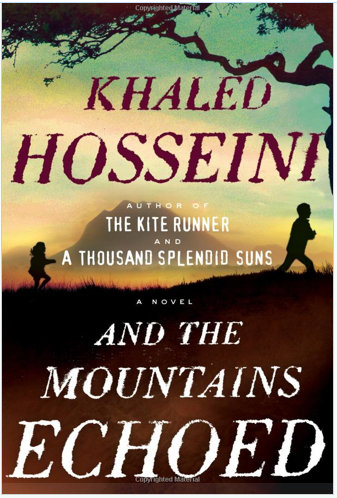
I danced when I saw the Amazon box; rarely do I buy hardcover (hurts too much when they fall over if I fall asleep reading, too bulky to carry on planes) but this one I was on the waiting list for, mail it as soon as it is published! Khaled Housseini, author of Kite Runner and A Thousand Splendid Suns has a new runaway best-seller; thanks to him I’ve just spent three days in Afghanistan, Paris and Los Angeles.
As the book opens, I am big brother to a baby sister whose Mom died in childbirth, living in a remote village in Afghanistan. Life is tough, but through the eyes of these children, life is idyllic, even though food is scarce and winters are cold. We have a huge oak tree with a swing, we play with the other children, and we have each other. Our father’s new wife is kind enough, but is busy with her own children, and the drudgery of cooking, cleaning and making do in a very small, poor Afghan village.
Later, I am Pari, living in Paris with an alcoholic, self-absorbed mother, making a life for myself, but always with a nagging feeling of something just outside my peripheral vision, another life . . .
The tale is told through the eyes of many, and on the way to the end of the tale we meet a wide spectrum of humanity, suffer the ills of war, callousness and unintended cruelties. We find that the man with superficial charm also saves and changes the lives of many, we find a doctor who finds fulfillment serving in the poorly resourced hospitals of Afghanistan, and we feel the agonies of a dutiful daughter watching her father fade into the world of Alzheimer’s.
It’s a wonderful, wild ride, richly textured, and when it finishes, you are not ready for it to end.
Recent Comments
intlxpatr on Shampoo Ginger tigerbutterya0c5ff1d… on Shampoo Ginger intlxpatr on British Soldier Kidnapped, Esc… John on British Soldier Kidnapped, Esc… intlxpatr on British Soldier Kidnapped, Esc… Wikipedia Donate Button

Amazina


Early Voting in Florida


