AdventureMan called as I was booting up the laptop. “Did you hear that?” he exclaimed!
“I’m booting up now,” I laughed.
“What an opportunity for a scam!” he continued.
“Yes, like who does the official weigh in? Can they tell Fatma from Jamila in their abayas and niqab? Does this apply only to Emiratis, or also to guest-workers? Can they tell one laborer from another as they exchange cards?
In truth, paying people to lose weight works. I don’t know how well people are able to keep the weight off; that is always the big problem, no matter what the diet plan. Unless you commit to long term changes in the way you think about food and life-style activities, the weight is hard to keep off long term. But BIG BRAVO to Dubai for this inventive and bold challenge. 🙂
From Arab News
DUBAI: KT ABDURABB
Thursday 18 July 2013
Last Update 18 July 2013 2:26 am
Need some motivation to cut that flab? If you live in Dubai, you can win gold to do just that. A new campaign “You are Worth … Your Weight in Gold” is aimed at promoting a healthy lifestyle and achieving optimal body weight. The contest is open for public.
The winner will be the one who loses maximum weight during the program period of 30 days from its inception on Friday this week. The top three winners will get a gold coin equivalent to AED 20,000. Other participants will get a gram of gold for each kilo reduced from their body weight. However, the minimum weight to lose for the eligibility is two kilograms.
Addressing a press conference on Tuesday, Dubai Municipality officials said the winners will get two grams of gold if they could reduce at least two kilograms within one month.
Hussain Nasser Lootah, director-general of Dubai Municipality, said the initiative comes after the grand success of ‘Yallah Walk’ campaign launched in 2011.
“It is also aimed at introducing walking tracks in different parks in the city of Dubai. Walking is an easy and economic way to stay fit and healthy. The municipality has provided residents with safe and accessible walking tracks in urban and rural areas,’ Lootah said.
“Currently Dubai has a total of 91 places where one can practice sport activities. These include residential parks, public parks, jogging track and beaches. In addition to this, every year the civic body opens new parks in more areas and adds sports equipments and tools for the public to promote a healthy community, he said.
“Ramadan is the most appropriate season to launch such initiatives as it reminds us about many health benefits of reducing weight and encourages us to take strong steps to change our bad lifestyles,’ he added.
The weight of each participant will be measured during registration and at the end of program. Participants can register at the event sites any day during the period. Participants must have excess weight to reduce and stay away from unhealthy methods to lose weight.
The final weight will be measured after the Eid holidays on Aug. 16.
Ahmed bin Sulayem, executive chairman of Dubai Multi Commodities Center (DMCC), said the DMCC is proud to support this health awareness drive to encourage society to change their daily routines in return for a healthier lifestyle.
‘We would highly encourage everyone from all walks of life to take part in this great initiative and hope DMCC’s contribution of AED 100,000 worth of gold coins will help motivate individuals reach the final target of improving and sustaining a healthy lifestyle and consequently a better quality of life,’ he said.
“I am sure Dubai can be the role model and astonish the world by its innovative ideas and initiatives,” said Anil Dhanak, general manager of Dubai Gold & Jewelry Group.”
July 19, 2013
Posted by intlxpatr |
Bureaucracy, Community, Cross Cultural, Cultural, Diet / Weight Loss, Eid, ExPat Life, Food, Fund Raising, Health Issues, Living Conditions, Ramadan | "You Are Worth Your Weight in Gold", Dubai, Weight loss |
1 Comment
This morning, as I was praying for Panama – there is always a diocese listed in the daily lectionary to be prayed for somewhere in the world – I was thinking how I know where Panama is. When we are praying for Nigeria, there are names I haven’t heard of. I now Lagos, and Port Harcourt, but where is Abuja? Owerri? I go to GoogleEarth and look them up.
I struggle with how little the average American knows about geographical location. It’s just embarrassing. Through all the years I lived abroad, most of the time, unless it was Germany, people couldn’t quite place where I was living. Many had heard of Tunisia; we had troops there in World War II, and Saudi Arabia, because they had seen it often enough on the news, but the rest of the Arab Gulf, Jordan, Syria, North Africa – beyond them.
Then, on the first night of one of my grad classes, the professor handed us this map and gave us ten minutes to put in the appropriate country names. He did not, thanks be to God, ask us to put in capitals. Not a single one of us got them all, and this was a class full of nation-oriented people.
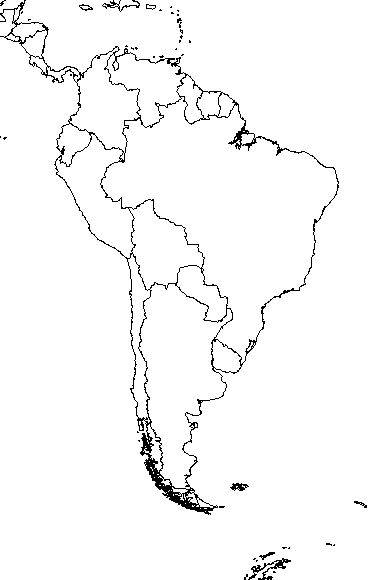
It was also on the final exam, three months later, and most of us got them all right – thanks to some fervent cramming and study groups.
Here are a couple more maps, in case you are feeling cocky. See if you can accurately fill in the name of each country:

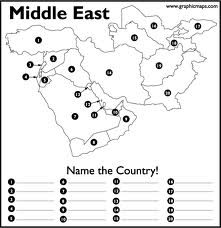
Bonne chance!
July 16, 2013
Posted by intlxpatr |
Africa, Cultural, Education, Entertainment, ExPat Life, Experiment, Geography / Maps, Germany, GoogleEarth, Interconnected, Jordan, Lectionary Readings, Middle East, Pet Peeves, Random Musings, Travel, Tunisia | South America |
Leave a comment
It doesn’t matter how enlightened the legislation – if the law is not enforced, the rules on the book are laughable. It gives the illusion of a lawful society, but if citizens know that they will not be penalized for breaking the law, they will scoff at the law and do as they please. People who came to the country expecting to make a fair wage and be treated decently and with dignity find themselves without proper paperwork due to the corruption of their employer or recruiter.
If the MOI in Qatar enforces this law, a terrible situation will be slightly better. This, from The Qatar Gulf Times:
By Ramesh Mathew/Staff Reporter
| With the Ministry of Interior (MoI) taking a firm stand on ID cards, residents believe that this will safeguard the interests of workers as their employers will now be forced to abide by the rules. |
A report in the Tuesday edition of Gulf Times had quoted a senior official as saying that residents should always carry their residence permit ID cards and produce the same whenever asked by the authorities concerned. Those failing to do so would be fined up to QR10,000, the report had said, adding that the MoI could also transfer the sponsorship of expatriates if they proved that they were abused by sponsors under Law No 4/2009.
Welcoming the MoI’s decision, legal expert and rights activist Nizar Kochery said this would make employers more accountable as any long delay or failure on their part to stamp the visas of their staff would invite a hefty fine.
“There have been cases of companies refusing to stamp visas for long periods and workers being picked up by the law-enforcing agencies for failing to produce valid residence proof,” said Kochery, adding that the ministerial reaffirmation would force employers to stamp visas promptly.
Reacting to the report, an Asian diplomat said his country’s mission frequently received complaints from people alleging that their employers had not stamped their visas even months after their arrival in Qatar.
“The embassy receives such complaints from expatriates every week though there has been a drastic fall in their numbers in recent times due to strict enforcement of the rules by the local authorities,” he added.
Kochery said there should also be stringent implementation of the rules pertaining to expatriates’ passports. “Though the ministry issued guidelines more than three years ago on the issue of custody of passports, complaints of violation of this norm continue,” the legal expert said.
The ministry had instructed employers to hand over the passports of employees after the completion of formalities. However, there have been cases of some employers retaining the passports in violation of the local rules.
“A similar fine (like the one for not carrying IDs) should be imposed on erring employers for illegally keeping their workers’ passports,” he said.
A few years ago, this newspaper had reported about a theft in a manpower company’s office in Musheireb. More than 150 passports of workers, which the firm had kept in its custody in violation of rules, went missing in the incident. Meanwhile, residents have also said similar penalties were required to curb violations regarding exit permits as well. A social activist in the Indian community said there have been complaints of employers failing to arrange exit permits for their workers on time even during emergencies.
There have also been reports of residents, mainly drivers, lodging complaints with embassies, alleging that their sponsors take away their licences when they go on vacation.
“The MoI should consider imposing hefty fines on such employers as well. Like a passport, a driving licence is not only the property of an individual, but is also a proof of identification under the local rules,” said Kochery.
July 11, 2013
Posted by intlxpatr |
Bureaucracy, ExPat Life, Interconnected, Kuwait, Law and Order, Leadership, Lies, Living Conditions, Pet Peeves, Qatar, Relationships, Scams, Social Issues, Transparency, Work Related Issues | exit permits, Ministry of Interior, passports, resident IDs |
Leave a comment
It looks like rather than investing in better highways, Qatar will follow in Kuwait’s footsteps to restrict driver’s licenses. This is another example of a law that invites unequal enforcement. “Ambiguous” implies that the rule will not be applied to everyone, but will be subject to bribery and connections to the right people.
Why do I even care, you might ask. As a white Western woman, this rule won’t apply. I won’t be stopped in traffic stops; if I am, and can’t show a valid license, I will politely be told I need to get one. But I publish this because it isn’t fair. It applies to my fellow expat wives, as well as to the hairdresser who would come to my home to cut my hair, or the carpenter with his own little business who wants to deliver the new couch he made for me. And, if the traffic doesn’t get better by eliminating catagories of employment, the next step considered is often eliminating licenses for WOMEN.
If the taxi situation in Doha were not so abysmal, it could be bearable not to have a license, but once the state took over the taxi business and ruthlessly clamped down on independently owned and operated taxis, taxi transportation was no longer the blessing it once was. Even at the most posh hotels in town, you might wait an hour for a taxi to show up. Or maybe things have radically improved in the time since I have been gone, but I somehow doubt it.
From the Qatar Gulf Times:
Driving schools in Qatar have started “implementing” the Traffic Department’s decision to make certain categories of expatriate workers ineligible for driving licences but there was some ambiguity in the whole exercise as the plan is in its initial phase, sources yesterday said.
According to an unofficial list those who are eligible include sales representatives, accountants, administrators, representatives, sales supervisors, receptionists, clearance agents and fitness trainers. Also, professionals like doctors, engineers, pilots, architects and lawyers will find no problem in getting a licence.
However, people who work as clerks, stewards, cashiers, salesmen, foremen, tailors, blacksmiths, masons, cooks, carpenters, plumbers, painters, electricians, mechanics, computer technicians, waiters, barbers, beauty saloon workers, store keepers, photographers and secretaries will not be issued driving licences.
People who are brought to the country on driver visas, whether they are sponsored by companies or individuals, will not find it difficult to get a licence, the source said.
An employee of a driving school said the Traffic Department had yet to issue an official and final roster of categories that will be allowed to apply for a licence.
“Right now, they are in the process of implementing the new rule and so there is some ambiguity,” he said.
The licensing section of the Traffic Department had earlier issued a circular limiting the issuance of driving licences to certain categories of expatriate workers. The move is aimed at easing traffic congestion on Qatar roads.
The source also referred to another change in policy where students who failed the road test four times might not be given a fifth chance anymore.
He disclosed that there was a plan to ban old cars on Qatar’s roads. “The new rules will be implemented very strictly.”
Earlier reports said that the Central Municipal Council (CMC) members had welcomed the move, saying it would significantly contribute to reducing the growing number of new vehicles on roads, which was cited as one of the major causes of traffic jams.
The source said the Traffic Department will also study the impact of the new rule in the coming months.
July 11, 2013
Posted by intlxpatr |
Bureaucracy, ExPat Life, Living Conditions, Political Issues, Qatar, Social Issues, Survival, Technical Issue, Transparency, Values, Women's Issues, Work Related Issues |
Leave a comment
From the Kuwait Times, a fascinating comparative analysis of the influence of Saudi Arabia and Qatar on Islamic countries in transitions:
Qatar losing ground to Saudi diplomacy

DUBAI: Qatar, a key supporter of Islamists who rose to power in Arab Spring countries, is losing ground in regional politics to Saudi Arabia which appears to have seized the reins on key issues, notably Egypt and Syria. The decline in Qatar’s regional diplomacy comes as its powerful emir Sheikh Hamad bin Khalifa Al-Thani unexpectedly abdicated in favor of his son Tamim last month.
The wealthy Gulf state had transformed itself into a key regional player but began to retreat as heavyweight Saudi Arabia re-entered the political arena after lagging behind in the immediate period following the eruption of the Arab Spring uprisings in December 2010. The ouster of Egypt’s Islamist president Mohamed Morsi last week by the army and the election by the Syrian opposition of Saudi-linked Ahmad Assi Jarba as new leader stripped Qatar of strong influence in both countries.
“Qatar had tried to take a leading role in the region but overstepped its limits by openly backing the Muslim Brotherhood in Egypt, Syria, and other Arab Spring states,” said Kuwaiti political analyst Ayed Al-Manna. Jonathan Eyal, head of international relations at Britain’s Royal United Services Institute, argued that Qatar’s regional politics have failed.
“Qatar’s Middle Eastern diplomacy now lies in ruins: it failed to produce dividends in Libya, backfired in Syria and has now collapsed in Egypt,” local Emirati daily The National quoted him on Tuesday as saying. Realizing the damaging effects of their policies, Manna noted, “the Qataris sought to cut down on their commitments” which were already affected by the emir’s abdication and the sidelining of the influential prime minister Sheikh Hamad Bin Jabr Al-Thani.
As a result, “Saudi Arabia, a historical regional US ally, regained its role” in coordination with other oil-rich Gulf monarchies, said Manna. Saudi Arabia’s King Abdullah was the first foreign head of state to congratulate Egypt’s interim president Adly Mansour, hours after he was named to replace Morsi. And on Tuesday, the kingdom pledged $5 billion in assistance to Egypt. The United Arab Emirates, which has cracked down on the Muslim Brotherhood in the past few months, offered Egypt an aid package of $3 billion.
“Saudi Arabia wants to ensure stability in Arab Spring countries, regardless of its ideological interests,” said analyst Abdel Aziz Al-Sagr, head of the Gulf Research Centre. “It had supported the Muslim Brotherhood in Egypt but reconsidered this support after the Brotherhood failed to run the country wisely,” he argued. But the Saudi researcher downplayed the rivalry between Saudi Arabia and Qatar, both of which have been looking to expand their influence during the Arab Spring uprisings and prevent any potential revolt against their own autocratic regimes.
“The Saudi-Qatari harmony still exists and there is no battle for influence between the two countries,” said Sager. And as proof, “Riyadh was the first to be informed of the political change in Qatar, six months before it took place. And it welcomed it.” But the two countries, whose relations have been historically tense or at least marked by mistrust, support two different approaches of political Islam that emerged strongly in the wake of the Arab Spring.
Qatar sides with political parties linked to the Muslim Brotherhood, whose experience was cut short despite the strong media support they enjoyed from the influential Doha-based Al-Jazeera news channel. Meanwhile, Saudi Arabia promotes Salafist groups that focus less on politics and more on implementing Shariah Islamic law on daily life matters such as forcing women to wear a veil and prohibiting the mixing between sexes. Saudi King Abdullah has reiterated his country’s stance against using Islam for political purposes.
“Islam rejects divisions in the name of one party or another,” he said in a statement marking the start Wednesday of the Muslim holy month of Ramadan. The kingdom will never accept” the presence of political parties, that “only lead to conflict and failure.” But regardless of the political agendas of Saudi Arabia or Qatar, the people who rose up during the Arab Spring revolts will have the final word on their own political futures, argued former Bahraini cabinet minister Ali Fakhro. “It is the Arab people, not Qatar nor Saudi Arabia, who will determine the political future of the region.” – AFP
July 11, 2013
Posted by intlxpatr |
Cultural, Doha, ExPat Life, Interconnected, Kuwait, Leadership, Living Conditions, Political Issues, Saudi Arabia, Women's Issues | Arab Spring, Egypt, Muslim Brotherhood, Salafi, Sharia Law, Syria |
Leave a comment
“I miss the highs. . . ” my friend said – just before she went off her meds.
I totally understood what she was saying. We belonged to a quilting group, and when she was beginning a manic phase, she produced knock-out quilts, quilts combining colors in unusual ways, and she could stay up all night to finish one. She was a lot of fun to be around, totally up and enthusiastic and creative. As the phase progressed, however, she got thinner and thinner, fell in love with the wrong men, and I always knew when she was just about to crash because she looked fabulous – new clothes, lots of shoes, and she talked a mile a minute.
Then the crash. Her biggest fear was the credit card bills; when she was on a high, she felt like it didn’t matter. When she slid into depression, it was complicated by the fact that she had real things to be depressed about – STDs, huge bills, and concerns at her workplace and her security clearance.
As long as she was on her meds, she was fine, but the medications made her feel sluggish; she said even colors were less colorful on her meds. She said it was like spending your life underwater, where things were not so clear. She said it was dull.
It’s easy, when you are not bi-polar, to say “stay on your meds.” It’s really hard to do it when the meds can make you feel like you are living in a prison.
My friend recommended a book by Kay Redfield Jamison called An Unquiet Mind. It was one of the most helpful books I have ever read, helping me to understand just how hard it is to give up the mania in spite of the huge price you pay for it with the depressions.
I hope my friend is still alive.
This article is from AOL Health News:
4 Surprising Signs of Bipolar Disorder
Fewer than half of Americans with bipolar disorder are properly diagnosed and treated, recent research shows. Could you spot bipolar symptoms – in yourself or in someone close to you?
Many people with bipolar disorderdon’t even know they have it.
Fewer than half of people in the United States who show classic signs of bipolar disorder actually get diagnosed and treated, says a recent Archives of General Psychiatry report on a survey of more than 61,000 adults in 11 countries — the United States, Mexico, China, Japan, Brazil, Colombia, India, Lebanon, Bulgaria, Romania, and New Zealand. Bipolar patients in lower-income nations get even less treatment — in some cases, as few as 25 percent receive help.
Compared to the other 10 countries studied, the United States had the highest rate of bipolar disorder (4.4 percent of those surveyed fell somewhere on the bipolar spectrum). India had the lowest (0.1 percent). Overall, about 2.4 percent of those interviewed in the face-to-face survey could be classified as having bipolar disorder.
Bipolar Disorder’s Most Surprising Symptoms
It may be buzz-worthy these days, but many people don’t fully understand bipolar disorder and the symptoms that can lead to proper diagnosis and treatment. Bipolar, also sometimes called manic-depressive disorder, is characterized by shifts from extreme highs (known as mania) to emotional lows (depression), with “normal” moods in between.
It’s bipolar disorder’s manic phase that most sets it apart from other common mental health issues, such as depression and anxiety. While many people associate mania with high energy and exaggeratedly good moods, these other key symptoms are more subtle:
- Reckless spending. If a friend is blowing her paycheck on shopping sprees she can’t afford, watch out. A person in a manic phase of bipolar disorder is more likely to take big risks, including spending splurges that can lead to mountains of unmanageable debt.
- Super-charged sex drive. A sudden revving up of a person’s sex drive, obsessively thinking or talking about sex, or engaging in sexual encounters he otherwise wouldn’t (like a one-night stand or sex with someone he doesn’t know well) are all symptoms of hypersexuality, another less-obvious mania clue.
- Alcohol or drug abuse. These often go hand-in-hand with manic episodes: As many as 60 percent of people with bipolar disorder have abused alcohol or drugs at some point in their lives. Depressants such as alcohol or pain pills can send a person with mania straight into depression, while stimulants like cocaine can have the opposite effect.
- Skimping on shut-eye. Little need for sleep is another red flag that a person may be having a manic episode.
Keep in mind that bipolar disorder can vary greatly in severity, and not everyone experiences every symptom. In fact, some patients experience hypomania, a less mild form of mania. But even hypomania, if left untreated, could spin into depression or develop into full-blown mania.
One important takeaway from the Archives study is that across all countries, patients with bipolar disorder faced challenges in their daily lives and were at increased risk of such health problems as panic attacks, substance abuse, and suicide. Untreated bipolar disorder can also lead to troubled relationships with friends and family and problems at work. If you’re concerned about yourself or a friend or loved one, get more information here on the best treatments for bipolar disorder.
Last Updated: 08/08/2012
July 9, 2013
Posted by intlxpatr |
Arts & Handicrafts, Character, ExPat Life, Financial Issues, Germany, Health Issues, Relationships | bipolar disorder, manic-depression, Mental health issues |
3 Comments

My first Ramadan was in Tunisia. It was summer, it was hot, and the days were long. The days dragged by, and then, in the evenings, our neighbors would send over huge platters of lamb and couscous, hot and spicy, to share with us. Our neighbors had ten children, all around our age, some older, some younger, and cars would arrive endlessly, bringing and taking people. They often included us in the family gatherings, out of the kindness and generosity of their hearts.

I didn’t understand how it all worked, Ramadan and fasting, and they would explain it to me. It’s a lot to take in. It took me a long time, many years, many Muslem countries, many Muslim friends. I still don’t think I understand all of it, but I understand enough of it to know this – it’s like a month of Christmas Eves.
A good Muslim won’t just fast from sunrise to sundown. A good Muslim circumcises his or her heart in this time. A good Muslim will read through the entire Quran at least once during Ramadan. The whole point of the sacrifice is to purify the soul.
I wish for my Muslim friends a joyful Ramadan, full of blessings. May God our Creator and Heavenly Father receive your sacrifice and bless your fasting. May your Mama prepare all your favorite foods for the breaking of the fast. 🙂
July 8, 2013
Posted by intlxpatr |
Community, Cross Cultural, Cultural, ExPat Life, Faith, Ramadan, Tunisia |
Leave a comment
When you read this article from the Kuwait Times, you will see that the requirements for obtaining a Kuwait driver’s license are not new, but enforcing the requirements – if it happens – will be new. It will make Kuwait more like Saudi Arabia for expat wives, where women cannot drive their own car to pick up the laundry or drop the kids off at school or go grocery shopping – unless, in the case of Kuwait, she has a university degree AND has lived in Kuwait for two years AND is employed earning 400KD. No mere expat wife will have a driver’s license under these guidelines.
But these are the same guidelines that were in effect when I arrived in Kuwait. When I was in Kuwait on a house hunting trip before moving there, I asked how this would work, with me not being able to have a license, according to the rules. I was asking Kuwaiti officials. They said that the rules did not apply to me. (This answer still stuns me.) So where is it written to whom the law applies? The office of the Interior Ministry for Traffic Affairs will have a great deal of leeway making their approvals – will they apply this law equally to all peoples of all nationalities?
No licenses without traffic chief’s nod
KUWAIT: The Interior Ministry’s Assistant Undersecretary for Traffic Affairs Maj Gen Abdulfattah Al-Ali issued a decision yesterday to stop the acceptance of applications for driving licenses from non-Kuwaitis (expatriates and bedoons) unless they are approved by his office. The decision number 61/2013 went into effect from July 1, 2013, and allows the undersecretary’s office to inspect every application forwarded by foreigners and stateless residents in order to verify whether they meet the conditions to apply for a driving license. Ali reportedly threatened traffic department officials with retribution if they fail to abide by the new instructions.
According to security sources who spoke to a local daily, the decision came after cases were discovered in which manipulations were found in some departments where licenses were issued to expatriates who do not meet the requirements. A foreign resident in Kuwait must have a university degree, a minimum monthly salary of KD 400 and have been residing in Kuwait for at least two years among other conditions to apply for a driving license.
The sources also argued that the new decision does not take away the authority of traffic departments around Kuwait. “The departments’ main role is to issue licenses to Kuwaitis, while issuing licenses to expatriates is the exception,” they said, adding the decision means transferring the exception to the assistant undersecretary’s office so that traffic department officials can focus on their jobs of serving citizens and putting more traffic police officers on the streets.
“Any decision – even if it’s for the safety and organization of traffic regulations in the country – issued suddenly without informing the public in advance will surely create hostility,” said attorney Labeed Abdal, a Kuwaiti columnist. “I advise the good undersecretary to hold a press conference to explain to the people why such a regulation is needed. In this way you send the message correctly to people who will not be angry or surprised,” he added. Abdal agreed that the decision is directed to ease traffic jams in the country blamed on reckless drivers. “I think the decision is good. Be informed that he (Ali) did not stop it completely – he said he will give a chance, under his ultimate mercy. He did this to avoid license forgery and wasta (influence),” he stressed.
Another Kuwaiti was not very happy about the new decision. “(A driving license) is the right of every human being…why can’t they understand this. This decision is short of saying ‘just terminate all the services of expatriates in Kuwait’. Why are expats here if you cannot provide the facilities they need. I ask the official (Ali) to try at least once to ride in a bus or even wait for a taxi. If he can stay for one minute under the scorching heat of the sun, then OK, cancel the licenses of expats. If not, forget about your decision – it’s inhuman and cannot be accepted,” he fumed.
I do not agree that a driving license is a right of every human being. I do believe that those under 18 should not be driving on the roads of Kuwait – I don’t mind them learning how to drive out in the desert, but save the testosterone driving for way out there where you can’t endanger the rest of us. I don’t believe people who don’t know the laws should have a license. I think there should be a test that every person can study for and must pass to have a driver’s license, otherwise you are simply saying that every human being has a right to a license to kill! I believe that every driver must be adequately insured to be licensed, and that the police must be impartial when determining fault in an accident. These are the rules that hold those responsible enough to drive the wild roads of Kuwait to be held accountable for their driving.
I applaud the sincerity with which Maj Gen Abdulfattah Al-Ali is striving to make the roads in Kuwait safer for all, and enforcing the law equally against all nationalities, even Kuwaitis. I hope he will remember transparency and accountability as he builds a truly modern and enforceable traffic system in Kuwait.
July 6, 2013
Posted by intlxpatr |
Cross Cultural, Cultural, Customer Service, ExPat Life, Family Issues, Financial Issues, Kuwait, Law and Order, Satire, Saudi Arabia, Social Issues, Transparency, Women's Issues, Work Related Issues | Driving in Kuwait, Maj Gen Abdulfattah Al-Ali |
Leave a comment
Alternate title: Every man needs a Kubota
As we were listening to the news and weather Tuesday night before going to bed, the weather woman was talking about a ‘retrograde’ storm system. She showed us on the map; normally our weather blows from west to east, but this storm was going to blow east to west, and then reverse and go west to east again. Going counter to the normal flow is ‘retrograde.’
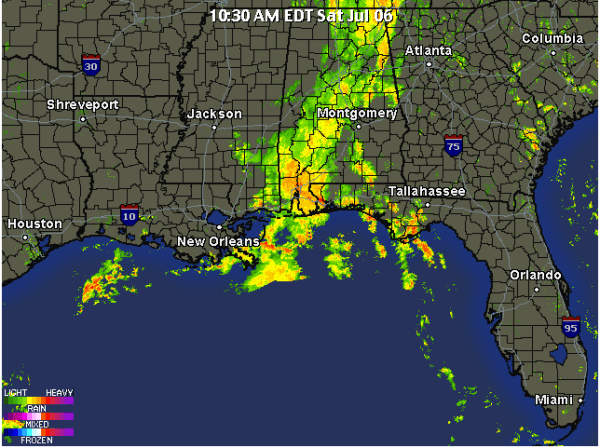
Our entire holiday was retrograde. Which, for people like AdventureMan and I, is not too bad. It’s a good thing we married one another; we are not to good with same-same all the time, if things get too tame, we shake things up a little bit. It’s not good or bad, it’s just the way we are wired.
One of the first differences was that we weren’t leaving early in the morning to drive down Highway 98 along the beach road; we were picking up our adorable grandson, going to his house, and as soon as our daughter-in-law got off work we would hit the interstate.
It all went well; cloudy skies but light traffic, all was well until we left the highway headed south . . . and started hitting the “Roads Under Water” signs. We didn’t see any roads under water until the car in front of us hit what looked like a shiny spot on the road and went almost a foot deep. AdventureMan cooly slowed and drifted steadily through the lake in the road – and we thanked God to be in a vehicle a little higher off the ground than a sedan.
After the lake in the road, it started raining, a little sprinkling, and then a steady rain.
The temperatures dropped.
Here is what we had planned – dinner with family and friends, a day of fun and heading out for sun downers on the boat to watch the fireworks on the 4th. Heavy applications of insect repellant and sunscreen.
Here is what happened – the deluge.
Here is what was cool about the deluge – the temperatures were the coolest, 24 hours around the clock – that we’ve seen in a month. We could sit out on the screened porch looking at the bayou, listening to the rain fall – it was heavenly! No insect repellent needed. No sun screen needed.


Our hostess is a wonderful and creative cook; unafraid to try new recipes. Dinner after our rainy drive in: Red snapper, baked in a crust of crumbs with butter and parsley, so delicious. Green beans and mushrooms; so good I had them for breakfast another day 🙂 Holy smokes, desserts. The best pound cake ever, topped with peaches in their own juice and whipped cream, or chocolate red velvet brownies.
It was a fabulous lazy day. In the afternoon, our friend got an emergency call; friends whose husband was out of town were facing a flooding situation. Loading up his Kubota, he and AdventureMan went over and (manly manly) DUG A DITCH! getting all dirty and wet in the process, coming home with those grins that only activities like a good hunting trip, a successful fishing trip or digging a good ditch can create.
We had great plans that night to visit The Blue Fig (“They have mohammara!” my hostess said, knowing my weakness) but when we got there, it was closed . . . and, oddly every restaurant along that strip seemed to be closed. And side roads were flooded, more big lakes of water in the roads. It had rained so much and for so long that the runoff had no where to go.

Our little grandson fell asleep while we were searching for a restaurant that was open, and slept in my arms through dinner. I know this might be the last time; he is getting to be such a big boy, so I just treasured the time and listened to him breathe.
I know it may not seem like such a great holiday to you, but it was fun. We focused on conversations and laughed a lot. AdventureMan thinks every man might need a Kubota. We listened to the rain fall on the leaves, the roof, the bayou. We listened to the frogs celebrate the 4th of July. We really had a great time.
July 6, 2013
Posted by intlxpatr |
Adventure, Cooking, Cultural, ExPat Life, Florida, Food, Friends & Friendship, Holiday, Road Trips, Travel, Weather | 4th of July, Fourth of July |
Leave a comment

My Mom was concerned; the temperatures are approaching 90°F in Seattle, and most of Seattle does not bother with air conditioning. At night, the temperatures go down into the fifties, cooling everything off, but the day time highs can be more than a little uncomfortable.
“How do you manage?” she asks. “I see the temperatures in (nearby) Mobile are in the 90’s almost every day.”
“It’s not that hard; it’s like living in Alaska – or Kuwait,” I tell her. “When it gets cold in Alaska, you dress warmly, you turn on the heat, you stay inside, and when you need to go out, you get into your car in the heated garage, go in your heated car to a heated store, and you come back home. You don’t spend a lot of time outside.”
I do pretty much the same thing I did in Qatar and Kuwait. I get up and do my devotional readings, and on some days I go to my aqua-aerobics class. on other mornings I volunteer. If I need something, I stop at a store on the way home. Sometimes, I clean house, or do laundry. We often go out for lunch, from the air conditioned car to the air conditioned restaurant and back 🙂 In the afternoons, I quilt or I read, or I quilt and I read.
AdventureMan grew up in the South, he is comfortable with the heat and the humidity. He works out in his gardens; once the temperatures go over 80° I rarely even visit the gardens, maybe when October comes and the temperatures drop. Yesterday morning I looked out as the sun was rising over the gardens and all I could see was swarms of insects rising. I don’t think they were mosquitoes, they looked like little no-see-up kind of things, all speeding around in the rising sun. I don’t do insects, the same way I really don’t do heat and humidity.
The Qatari Cat loves the heat. Part of his daily routine is to eat, then to go into the garage and sleep on one of the cars. It’s like an oven in the garage; it must remind him of living on the streets of Qatar when he was just a tiny thing. He is no longer a tiny thing. When we have international guests over for dinner, they always ask to take photos of him; he has grown to be a very long, tall cat, kingly but gracious.
Yesterday morning, as I headed out, there was a hint of – well, it was not coolness, but it was just not blasting me with heat. It was a respite from the relentless heat. I don’t begin to think it was a hint of winter to come; the summer torment has really just begun and is unlikely to end before late October, but I treasure even a hint of “not a blast of heat.”
AdventureMan asks me if I miss Seattle. Not so much, really, traffic has gotten so bad there, but I miss the climate. I feel energized by the cool mornings, even rain doesn’t bother me. I love the sound of the wind whistling around, I love taking a walk along the waterfront after lunch or dinner. I don’t find it at all surprising that diabetes is associated highly with countries with hot climates; heat makes you lethargic, inactive, all the things that encourage sloth.
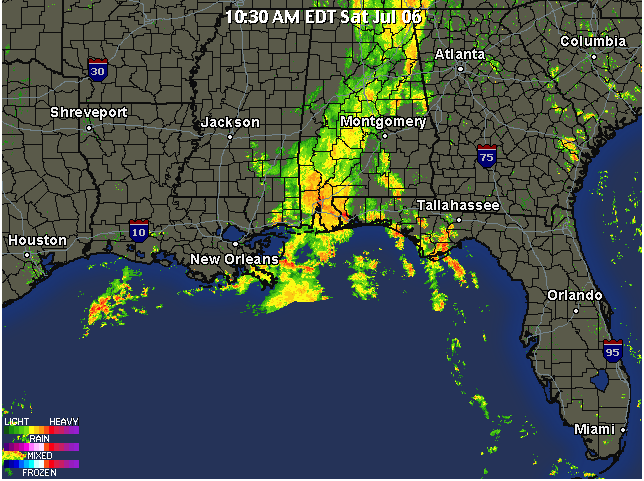
Torrential rains are forecasted for this 4th of July weekend; in Pensacola there is a possibility they will diminish just in time for the fireworks. Hmmm. Heat. Humidity. Mosquitoes . . . I love fireworks . . . weighing my options 🙂
July 3, 2013
Posted by intlxpatr |
Alaska, Cross Cultural, Cultural, Exercise, ExPat Life, Health Issues, Kuwait, Living Conditions, Pensacola, Qatar, Qatteri Cat, Random Musings, Weather |
Leave a comment