Western Diet Killer:
From the UK Daily Mail Online:
The Western diet really IS a killer: People who eat white bread, butter and red meat are most likely to die young
- Those who ate fried and unhealthy food had doubled risk of early death
- Key culprits include red meat, white bread, butter, cream and sweet foods
- Findings ‘help explain’ why heart disease is still the UK’s biggest killer
PUBLISHED: 13:20 EST, 16 April 2013 | UPDATED: 02:08 EST, 17 April 2013
The typical Western diet, high in fat and sugar, really does lead to an early grave, new research suggests.
A study of more than 5,000 civil servants found those who ate the most fried and sweet food, processed and red meat, white bread and butter and cream doubled their risk of premature death or ill health in old age.
It adds to evidence that ‘Western style food’ is the reason why heart disease claims about 94,000 lives a year in the UK – more than any other illness.
The findings published in The American Journal of Medicine are based on a survey of British adults and suggest adherence to the diet increases the risk of premature death and disability later in life.
 People who ate the most fried and sweet food, processed and red meat, white bread, butter and cream doubled their risk of premature death or ill health in old age
Lead researcher, Dr Tasnime Akbaraly, of the National Institute of Health and Medical Research in France, said: ‘The impact of diet on specific age-related diseases has been studied extensively, but few investigations have adopted a more holistic approach to determine the association of diet with overall health at older ages.’
She examined whether diet, assessed in midlife, using dietary patterns and adherence to the Alternative Healthy Eating Index (AHEI), is associated with physical ageing 16 years later.
The AHEI is an index of diet quality, originally designed to provide dietary guidelines with the specific intention to combat major chronic conditions such as heart disease and diabetes.
More…
Dr Akbaraly added: ‘We showed that following specific dietary recommendations such as the one provided by the AHEI may be useful in reducing the risk of unhealthy ageing, while avoidance of the “Western-type foods” might actually improve the possibility of achieving older ages free of chronic diseases.’
The researchers analysed data from the British Whitehall II cohort study and found following the AHEI can double the odds of reversing metabolic syndrome, a range of disorders known to cause heart disease and mortality.
 The research adds to evidence that Western style food is the reason why heart disease claims about 94,000 lives a year in the UK – more than any other illness
They followed 3,775 men and 1,575 women from 1985-2009 with a mean age of 51 years.
Using a combination of hospital data, results of screenings conducted every five years, and registry data, investigators identified death rates and chronic diseases among participants.
At the follow up stage, just four per cent had achieved ‘ideal ageing’ – classed as being free of chronic conditions and having high performance in physical, mental and mental agility tests.
About 12 per cent had suffered a non-fatal cardiovascular event such as a stroke or heart attack, while almost three per cent had died from cardiovascular disease.
About three quarters were categorised as going through ‘normal ageing’.
The researchers said participants who hadn’t really stuck to the AHEI increased their risk of death, either from heart disease or another cause.
Those who followed a ‘Western-type diet’ consisting of fried and sweet food, processed food and red meat, refined grains, and high-fat dairy products, lowered their chances for ideal ageing.
Worst Drivers in the World: Traffic Fatalities by Country
Driving in the Middle East is a whole other world, a world of chaos until you realize that the rules are different, no matter what the published rules are. To drive in Qatar, I started at 0430 on a Friday morning, when there was little or no traffic (things have changed) and would drive until traffic began to thicken. Eventually, I knew the city and gained confidence that I could drive without getting killed. In Kuwait, for months, I would only drive to relatively nearby shopping areas, or drive only on back roads carefully plotted on the map during low traffic hours. After a while, you begin to get a sense of things, and the sensation of imminent death lessens.
Adventures in Qatar: a radiator dropping off a truck in front of me, being hit on purpose by a man who didn’t like women driving, being pushed into a round about by a Hummer, being nearly assaulted by two young Qataris who believed we had insulted them by being in the lane where they wanted to be, watching men drive up the wrong side of the ring roads because they were too important to wait in line, later standing and laughing at their crashed cars – Daddy would buy them another. It sounds crazy, but you get used to it.

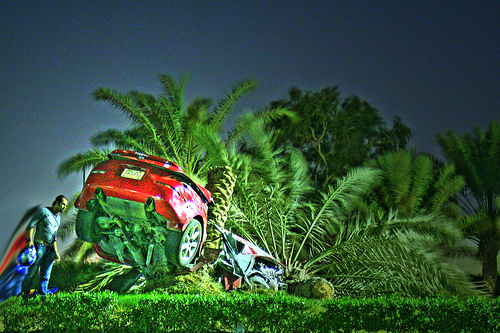
Kuwait was a whole different ball game, controlled chaos at high speeds. Adventures in Kuwait: the sleeping elderly man driving in the lane next to me who almost hit me, watching drivers drive through red lights as if they were green, sparks off the fenders of SUVs on Highway 30 as people wove quickly in and out of traffic, the dramatic crashed and burned out cars on the sides of the highways, the car impaled on a palm tree – 10 feet above the road. Kuwait was so surreal that I couldn’t even begin to imagine how some of the accidents happened; I learned to be a very prayerful driver.
So out of idle curiosity, today I looked up highest rate of traffic fatalities per country, and found this on Wikipedia. So here’s a surprise . . . Kuwait’s fatalities statistic is roughly equal to that of the United States. Qatar’s is significantly higher, and many countries are even double or triple Kuwaits fatality rate. I’m having trouble wrapping my mind around this.
List of countries Fatalities per 100,000 inhabitants
World 20.8
Afghanistan 39.0
Albania 13.9
Angola 37.7
Argentina 13.7
Armenia 13.9
Australia 5.71
Austria 8.2
Azerbaijan 13.0
Bahamas 14.5
Bahrain 12.1
Bangladesh 12.6
Barbados 12.2
Belarus 10.9
Belgium 10.1
Belize 15.6
Benin 31.2 1
Bhutan 14.4
Bolivia 16.7
Bosnia and Herzegovina 10.9
Botswana 33.8
Brazil 19.9
British Virgin Islands 21.7
Brunei Darussalam 13.8
Bulgaria 8.8
Burkina Faso 31.1
Burundi 23.4
Cambodia 12.1
Cameroon 28.1
Canada 9.2
Cape Verde 25.1
Central African Republic 32.2
Chad 34.3
Chile 13.7
China 5.1
Colombia 11.7
Comoros 30.3
Republic of the Congo 28.8
Cook Islands 45.0
Costa Rica 15.4
Croatia 9.1
Cuba 8.6
Cyprus 10.4
Czech Republic 10.4
Denmark 3.1
Dominican Republic 17.3
Ecuador 11.7
Egypt 42.0
El Salvador 12.6
Eritrea 48.4
Estonia 7.5
Ethiopia 35.0
Fiji 7.0
Finland 6.5
France 5.5
The Gambia 36.6
Georgia 16.8
Germany 4.5
Ghana 9.32
Greece 14.4
Guatemala 14.7
Guinea-Bissau 34.4
Guyana 19.9
Honduras 13.5
Hungary 9.9
Iceland 3.8
India 11.1
Indonesia 16.2
Iran 35.8
Iraq 38.1
Republic of Ireland 3.51
Israel 3.7
Italy 8.7
Jamaica 12.3
Japan 3.85
Jordan 34.2
Kazakhstan 30.6
Kenya 34.4
Kiribati 7.4
Republic of Korea 11.3
Kuwait 16.9
Kyrgyzstan 22.8
Laos 18.3
Latvia 8.7
Lebanon 28.5
Lesotho 26.7
Liberia 32.9
Libya 40.5
Lithuania 14.8
Luxembourg 9.0
Madagascar 33.7
Malawi 26.0
Malaysia 24.1
Maldives 18.3
Mali 32.1
Malta 3.4
Marshall Islands 7.4
Mauritania 35.5
Mauritius 11.1
Mexico 20.7
Federated States of Micronesia 14.4
Mongolia 14.5
Montenegro 14.6
Morocco 28.3
Mozambique 7.0
Myanmar 23.4
Namibia 28.6
Nauru 9.9
Nepal 15.1
Netherlands 3.9
New Zealand 8.6
Nicaragua 14.2
Niger 37.7
Nigeria 32.3
Norway 5.4
Oman 21.3
Pakistan 25.3
Palau 14.8
Palestinian territories 5.6
Panama 12.7
Papua New Guinea 14.2
Paraguay 19.7
Peru 21.5
Philippines 20.0
Poland 10.7
Portugal 7.9
Puerto Rico 12.8
Qatar 23.7
Republic of Macedonia 6.9
Republic of Moldova 15.1
Romania 9.4
Russia 19.5
Rwanda 31.6
Saint Lucia 17.6
Saint Vincent and the Grenadines 6.6
Samoa 12.8
San Marino 0
Sao Tome and Principe 33.0
Saudi Arabia 29.0
Senegal 32.5
Serbia 9.8
Seychelles 18.5
Sierra Leone 28.3
Singapore 4.8
Slovakia 7.1
Slovenia 10.4
Solomon Islands 16.9
South Africa 33.2
Spain 6.9
Sri Lanka 13.5
Sudan 34.7
Suriname 15.8
Swaziland 26.3
Sweden 2.9
Switzerland 4.7
Syrian Arab Republic 32.9
Tajikistan 14.1
Thailand 19.6
Timor-Leste 16.1
Togo 28.1
Tonga 7.0
Trinidad and Tobago 15.5
Tunisia 34.5
Turkey 13.4
Turkmenistan 18.6
Tuvalu 9.5
Uganda 24.7
Ukraine 11.2
United Arab Emirates 37.1
United Kingdom 3.59
United Republic of Tanzania 34.3
United States of America 12.3
Uruguay 12.8
Uzbekistan 9.7
Vanuatu 18.6
Venezuela 21.8
Vietnam 16.1
Yemen 29.3
Zambia 25.6
Zimbabwe 27.5
Like all statistics, I think some are honest, and some need to be taken with a grain of salt. I found reading through them fascinating. You can get more information, accidents per thousand cars, total accidents, etc.
This is Your Boston Marathon First Victim – SHAME
This is on AOL News – information on the first victim from the first blast in the Boston Marathon. This is your victim, bomber, an eight year old boy. His mother is also hospitalized. Hang your head in shame.

Martin Richard was standing near the finish line, waiting for his father to complete the grueling Boston Marathon on Monday, when an explosion took his life.
He was 8 years old and in the third grade.
Neighbor Jane Sherman told WCVB that Martin was a typical little boy, who loved to ride his bike and play baseball.
Martin’s mother, Denise, was hospitalized with “grievous injuries,” The Times of London reported. She reportedly underwent surgery late Monday for an injury to her brain.
His 6-year-old sister, a first grader whose name was not made public, lost her leg in the blast, WHDH reported.
The status of his father, William, has not been released. A third child was reportedly unharmed in the explosion.
Boston Marathon Winners, lost in the aftermath of the explosions:

This is the face of America – welcoming all nations and all races to compete in the Boston Marathon. The winners were Ethiopian and Kenyan, and we celebrate their victories, year after year. Their nationality doesn’t concern us, their race is irrelevant, their politics are their own – they are all welcome to race, runners from all nations.
BOSTON — The Kenyans finally face a challenge to their dominance of the Boston Marathon, and it’s from their East African neighbors.
Ethiopia’s Lelisa Desisa took the title in the 117th edition of the world’s oldest marathon on Monday, winning a three-way sprint down Boylston Street to finish in 2 hours, 10 minutes, 22 seconds and snap a string of three consecutive Kenyan victories.
“Here we have a relative newcomer,” said Ethiopia’s Gebregziabher Gebremariam, who finished third. “Everything changes.”
In just his second race at the 26.2-mile distance, Desisa finished 5 seconds ahead of Kenya’s Micah Kogo to earn $150,000 and the traditional olive wreath. American Jason Hartmann finished fourth for the second year in a row.
“It was more of a tactical race, the Ethiopian versus the Kenyans. That fight played out very well,” defending champion Wesley Korir, a Kenyan citizen and U.S. resident, said after finishing fifth.
Undoing Public Disclosure, One Small Move at a Time
I am appalled. I have scoured the TV News, have looked through newspapers – not a word! I steam at corruption in Kuwait and Qatar and Saudi Arabia, and then a small NPR Report on yesterday’s news alerts me to a measure, passed in Congress, WITHOUT A WHISPER!
(oh? I was shouting? Sorry. Carried away. Outraged) You can access the NPR station and listen to the entire repulsive report by clicking here.
Congress Repeals Financial Disclosure Requirements For Senior U.S. Officials
by EYDER PERALTA

A tourist takes cover underneath an umbrella while snapping a photo of the U.S. Capitol on March 6, 2013 in Washington, DC.
Chip Somodevilla/Getty Images
Joining the Senate, the House of Representatives approved a measure today that repeals a requirement that top government officials post financial disclosures on the Internet.
The House, like the Senate, acted quietly without a vote. Instead, they sent the measure to the president’s desk by unanimous consent.
The provision was part of the Stop Trading on Congressional Knowledge Act (Stock), which became law in March of 2012. The act was intended to stop members of congress from profiting from nonpublic information.
As NPR’s Tamara Keith reported, at the time, Sen. Joe Lieberman called the law “the most significant congressional ethics reform legislation to pass Congress in at least five years.”
“That law mainly addressed conflict-of-interest policies for members of Congress and their staffs, but it also included a requirement that the financial disclosure forms filed by some 28,000 high-ranking federal employees be posted online.
“While those forms are public records, they must be requested individually from employing agencies. The Stock Act envisions online posting first on agency sites and later in a central, searchable database.
“The posting requirement was delayed three times out of concerns about the potential for identity theft and other crimes against career employees, as well as security risks to the government.”
The Sunlight Foundation, which advocates for a more open government,called today’s repeal an “epic failure.”
The foundation explained that instead of addressing specific security concerns, Congress has acted broadly.
For instance, they note, the president, vice president, members of Congress, congressional candidates and individuals subject to Senate confirmation are still required to make their financial disclosures public. But the change in law now makes the posting of those disclosures on the Internet optional.
Sunlight adds:
“Not only does the change undermine the intent of the original bill to ensure government insiders are not profiting from non-public information (if anyone thinks high level congressional staffers don’t have as much or more insider information than their bosses, they should spend some time on Capitol Hill) but it sets an extraordinarily dangerous precedent suggesting that any risks stem not from information being public but from public information being online.
“Are we going to return to the days when the public can use the Internet to research everything exceptwhat their government is doing? Will Congress, in its twisted wisdom, decide that information is public if journalists, academics, advocates and citizens are forced to dig through file cabinets in basements in Washington, DC to find it? And does anyone think that makes us safer?
“As my colleague Tom Lee noted, ‘This approach is known as ‘security through obscurity.’ Essentially, the idea is that rather than fixing a system’s flaws, you can just make the system opaque or unusable or unpopular enough that those flaws never surface.'”
Update at 5:35 p.m. ET. 30 Seconds:
NPR’s Tamara Keith tells us the House procedure took exactly 30 seconds.
Correction at 5:29 p.m. ET. An earlier version of his post said the House followed the Senate. In fact, the Senate voted Thursday and the House voted today.
Shadrach, Meshach and Abednigo Survive the Test of Fire
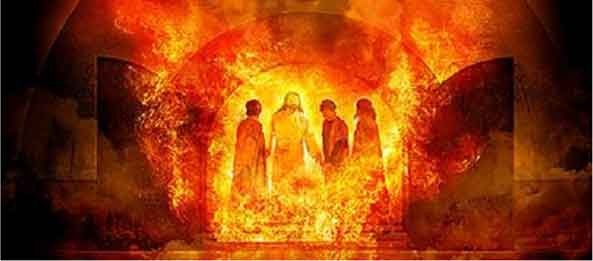
Some of the stories you come across in the Bible are so horrifying – and so human – that they still have a compelling immediacy. People do the most horrible things to one another, it mystifies me. This King, Nebuchadnezzar, is so incensed that his Jewish bureaucrats won’t bow down and worship his statue that he orders them cast into a furnace, which he heats seven times hotter than normal. That’s pretty angry!
Daniel 3:19-30
19 Then Nebuchadnezzar was so filled with rage against Shadrach, Meshach, and Abednego that his face was distorted. He ordered the furnace to be heated up seven times more than was customary, 20and ordered some of the strongest guards in his army to bind Shadrach, Meshach, and Abednego and to throw them into the furnace of blazing fire. 21So the men were bound, still wearing their tunics,* their trousers,* their hats, and their other garments, and they were thrown into the furnace of blazing fire.
22Because the king’s command was urgent and the furnace was so overheated, the raging flames killed the men who lifted Shadrach, Meshach, and Abednego. 23But the three men, Shadrach, Meshach, and Abednego, fell down, bound, into the furnace of blazing fire.
24 Then King Nebuchadnezzar was astonished and rose up quickly. He said to his counsellors, ‘Was it not three men that we threw bound into the fire?’ They answered the king, ‘True, O king.’
25He replied, ‘But I see four men unbound, walking in the middle of the fire, and they are not hurt; and the fourth has the appearance of a god.’* 26Nebuchadnezzar then approached the door of the furnace of blazing fire and said, ‘Shadrach, Meshach, and Abednego, servants of the Most High God, come out! Come here!’
So Shadrach, Meshach, and Abednego came out from the fire. 27And the satraps, the prefects, the governors, and the king’s counsellors gathered together and saw that the fire had not had any power over the bodies of those men; the hair of their heads was not singed, their tunics* were not harmed, and not even the smell of fire came from them.
28Nebuchadnezzar said, ‘Blessed be the God of Shadrach, Meshach, and Abednego, who has sent his angel and delivered his servants who trusted in him. They disobeyed the king’s command and yielded up their bodies rather than serve and worship any god except their own God. 29Therefore I make a decree: Any people, nation, or language that utters blasphemy against the God of Shadrach, Meshach, and Abednego shall be torn limb from limb, and their houses laid in ruins; for there is no other god who is able to deliver in this way.’ 30Then the king promoted Shadrach, Meshach, and Abednego in the province of Babylon.
When I read this, I think of the recent legislation proposed in Kuwait against insulting God or his prophets. Let men insult. Let them build their gods, their statures, let them pursue their little gods of vanity, power and wealth. The one true God laughs. He holds all the true power. He doesn’t need our protection; he is in charge.
In Florida, some friends complain about “the law that says our kids can’t pray in school.” There is no law that says kids can’t pray in school. Kids pray in school all the time! I did, specially when I had a really hard test I hadn’t prepared adequately for 🙂 What the law says is that no one can make all pray together, using the same words, as we did at one time. It’s not such a bad thing; even as Christians, we don’t all share the same beliefs. You might not want your children praying a prayer I might compose 🙂 because I might have a dogmatic belief a little different from your own. Our job is to teach our children to pray; the Holy Spirit will be with them, and put the words in their hearts.
Kuwait Media Legislation Harms Standing in Transparency?
When I lived in Kuwait, many reporters self-censored, but there was still a lively – and, in relative terms, relative to the rest of the Gulf, free press. The Kuwait Legislature is going loony tunes with this proposed legislation. This, from the Kuwait Times:
Media draft law under fire for stiff penalties
KUWAIT: Former opposition MPs, writers, journalists and activists have strongly lashed out at a new media draft law that stipulates unprecedented hefty penalties against violators. The new draft law was approved earlier this week by the Cabinet but must pass the National Assembly to be effective. The 99-article draft law stipulates a 10 year sentence for insulting the Almighty, prophets, companions, relatives and wives of Prophet Muhammad (PBUH). It also stipulates a fine of between KD 50,000 and KD 300,000 for those convicted of insulting the Amir.
The draft law gives the Information Ministry the right to shut down with an administrative decision any publication for up to three years even without a court ruling, a key article in the current law. Former liberal opposition MP Abdulrahman Al-Anjari described the draft legislation as a “stigma” for the government which is “suffering from psychological disorders”. Former MP Obaid Al-Wasmi described it as the “capital punishment law” while former MP Jamaan Al-Harbash said it belongs to the old ages and will send too many people to jail.
Meanwhile, the criminal court yesterday issued a two-year jail term against opposition tweeter Hijab Al-Hajeri for writing tweets deemed offensive to HH the Amir in yet another verdict targeting activists. But the court asked the convict to pay a bail of KD 100 to suspend the implementation of the imprisonment until the appeals court issues its verdict on the case. Like several opposition tweeters, Hajeri was charged of insulting the Amir and undermining his status. Several tweeters and former opposition MPs have been handed several years in prison over the same charge and some of them have been sent to jail.
In another case, the criminal court postponed the case of Al-Youm Television to May 8. Two announcers for the pro-opposition station, its chairman and a director are facing charges of violating the law by reading a statement issued by the opposition several weeks ago. Another court also set May 1 as the date to issue its verdict on opposition tweeter Abdulaziz Al-Mutairi on charges of insulting the Amir.
In a related development, the public prosecution released well-known Islamist thinker and university professor Abdullah Al-Nafisi on a KD 5,000 bail after interrogating him on accusations of threatening national unity. Nafisi had reportedly undermined Shiites at a diwaniya meeting about two weeks ago which was held to highlight the dangers Iran was posing against the Gulf states including Kuwait. During the speech, Nafisi was cited as saying that some of the 17 Shiite MPs in the Assembly have links with Iran and claimed that one of them had taken part in a suicide car bombing on the life of the late former Amir Sheikh Jaber Al-Ahmad Al-Sabah in May 1985. He also claimed that another MP was involved in the hijacking of a Kuwaiti passenger plane in 1988 that was blamed on Shiite militias.
Meanwhile, Islamist MP Hamed Al-Dossari called yesterday on the ministries of interior and foreign affairs to follow the footsteps of Bahrain and treat the Lebanese Shiite militia Hezbollah as a terrorist organisation. He also charged that Iran has ambitions in the Gulf and is inciting discord in Bahrain and the rest of the Gulf Arab states.
By B Izzak, Staff Writer
Daniel and the Vegetarian Diet
Most people I know these days are trying to eat less meat. In the readings for today, we start the story of Daniel, a story every Christian child learns in Sunday School, but when you read as an adult, you see different things. This morning, doing the readings from the Lectionary, I smiled to see that Daniel and his companions wanted only vegetables; they were working very hard not to violate their food laws.

I also wonder if not eating meat was helpful in the den of lions; maybe they smelled less interesting as vegetarians? Then again, lions eat impalas, wildebeest, all sorts of vegetarians, so that probably was not a factor . . . 🙂
Daniel 1:1-21
1In the third year of the reign of King Jehoiakim of Judah, King Nebuchadnezzar of Babylon came to Jerusalem and besieged it. 2The Lord let King Jehoiakim of Judah fall into his power, as well as some of the vessels of the house of God. These he brought to the land of Shinar,* and placed the vessels in the treasury of his gods.
3 Then the king commanded his palace master Ashpenaz to bring some of the Israelites of the royal family and of the nobility, 4young men without physical defect and handsome, versed in every branch of wisdom, endowed with knowledge and insight, and competent to serve in the king’s palace; they were to be taught the literature and language of the Chaldeans. 5The king assigned them a daily portion of the royal rations of food and wine. They were to be educated for three years, so that at the end of that time they could be stationed in the king’s court. 6Among them were Daniel, Hananiah, Mishael, and Azariah, from the tribe of Judah. 7The palace master gave them other names: Daniel he called Belteshazzar, Hananiah he called Shadrach, Mishael he called Meshach, and Azariah he called Abednego.
8 But Daniel resolved that he would not defile himself with the royal rations of food and wine; so he asked the palace master to allow him not to defile himself. 9Now God allowed Daniel to receive favour and compassion from the palace master. 10The palace master said to Daniel, ‘I am afraid of my lord the king; he has appointed your food and your drink. If he should see you in poorer condition than the other young men of your own age, you would endanger my head with the king.’
11Then Daniel asked the guard whom the palace master had appointed over Daniel, Hananiah, Mishael, and Azariah: 12‘Please test your servants for ten days. Let us be given vegetables to eat and water to drink. 13You can then compare our appearance with the appearance of the young men who eat the royal rations, and deal with your servants according to what you observe.’ 14So he agreed to this proposal and tested them for ten days. 15At the end of ten days it was observed that they appeared better and fatter than all the young men who had been eating the royal rations. 16So the guard continued to withdraw their royal rations and the wine they were to drink, and gave them vegetables. 17To these four young men God gave knowledge and skill in every aspect of literature and wisdom; Daniel also had insight into all visions and dreams.
18 At the end of the time that the king had set for them to be brought in, the palace master brought them into the presence of Nebuchadnezzar, 19and the king spoke with them. And among them all, no one was found to compare with Daniel, Hananiah, Mishael, and Azariah; therefore they were stationed in the king’s court. 20In every matter of wisdom and understanding concerning which the king inquired of them, he found them ten times better than all the magicians and enchanters in his whole kingdom. 21And Daniel continued there until the first year of King Cyrus.
The Baboon Coughed
We’ve had three sets of houseguests in a very short time span, and today is our first day of ‘normal.’ We saw our friends off at 0430 (we used to call it oh-dark-hundred) and I couldn’t get back to sleep, so by the grace of God (and I mean that literally) I got up and walked.
I know I need to walk. I’ve always walked. I used to run, but I suffered for it – the knees – and decided I didn’t want to pay that price. But when my sister was here, we decided to take a walk and I said “don’t worry, I walk fast” and she said “I don’t, I am so slow now, my body has to warm up.” Confidently I started – and starting is uphill from my house. Very shortly, I discovered my fast was her slow, and I was HUFFING and puffing, and so embarrassed because I guess it’s been a while since I did this walk . . . but we did it. It felt good. And I was happy for a nice cool morning so I could do it again.
I ran into a neighbor, ignored that she was in her nightgown, we both pretended she was as fully dressed as I, had a brief conversation and she went inside with her newspaper and I carried on. About halfway through my walk, as I puffed along, I heard it.
The baboon coughed.
I could even smell a faint drift of wood burning fire. I could hear the doves. But it was only very briefly, very intangential, and I quickly realized it must have been a dog barking distantly; I could still hear him. For one brief moment I was back in Zambia, and while I love the magic of Zambia, I would not be out for a mile long hike early in the morning while the lions prowl for a last meal before they settle down for their day-long snooze.
We are off this morning to a grand plant sale across the bay in Milton. Symphony tonight. Back to “normal” for Pensacola.
A Woman Scorned
I subscribe to a website called GoodReads.com, where I keep track of the books I read and get great recommendations from seeing what my GoodReads friends are reading. They also send me a newsletter a couple times a month, one a general newsletter, and one customized based on authors it sees me reading regularly. This morning, I got the general newsletter (which I actually do skim) and when I reached the end, I read this chilling poem.
Chilling?
When we lived in Kuwait, the first two lines of the poem were a reality. A first wife whose husband was taking a second wife set fire to the celebration tent where the women were celebrating. While the bride escaped, several lives were lost in a horrifying fire, fed by an accelerant.
Joan Colby captures the power and rage of the woman, scorned, in every culture.
A Woman Scorned
by Joan Colby (Goodreads Author)
A woman scorned sets fire to the tent
Where the new wife is celebrating.
Carves her name and yours into a tree
Then chops that tree down with her nail file.
Cages a bird and teaches it to speak
In a language where every verb is an obscenity.
Combs her hair with broken glass until
It glitters like a million diamonds
That you stroke until your hands bleed rubies.
Watches how you sit quietly near the water
While she poisons the tea she is about to serve.
Drives a team of black horses down the avenue
Of your lovers whipping them white as judges.
Climbs through the window that you forgot to secure
Wearing a burglar suit sewn of her eyelashes.
Picks a bouquet of jimson weed, hydrangea,
Lily of the valley, poison ivy, rhododendron
To prove the base and beautiful can both be lethal.
Paints graffiti on the wall of your Facebook
And for good measure stamps a letter with your heartsblood.
Enters your dream unbidden
Wearing the scarlet dress you once admired.
Paces up and down, up and down
Before your place of business.
Removes all the signposts pointing to
The street you used to live on when you were happy.
Sunset Dolphin Cruise with Olin Marler in Destin
We did this same cruise with the same house guests two years ago, and . . . we never get tired of it. We don’t do it that often, and it is always fresh and relaxing.
We booked with Olin Marler Charters out of Destin. Fortuitously, we had a Groupon. It was so easy, buy the tickets online, call for a reservation, be at the dock at 5 p.m. for boarding.
Yes, it can be a crowd. Yes, you always have to know where you want to be and head directly there so you will have a good view, although people do wander. Yes, you have to hope that people who take young children aboard will be responsible and watch them like hawks. Other than that, these cruises are fun and easy.
There are other cruises. The others that we saw were all very crowded, people packed like sardines on little barge-like boats. We like a boat with a couple levels and lots of places where you can take photographs without having to crawl over anyone – or having people crawl over us! – to get a photo. This is our second time with Olin Marler, and I expect it will not be our last – it’s just so much fun.
We saw lots of dolphins. Dolphins are not so easy to photograph as they surface and dive, oh aaargh. If you want to see dolphins from our last trip, click on the blue hypertext in the first paragraph.
Also lots of seagulls and lots of sunset 🙂 Great times with special old friends from Germany, our sons have been best of friends for years, too.
This is the boat they took us out on, the yellow one:

Sunset is nearing:

Can’t get a good shot of the dolphins so might as well see if I can get something interesting with the seagulls and sunset:

When the sun actually sets, it gets cold quickly. We had a very warm day, maybe 80 degrees F. and it dropped almost immediately by 30 degrees. Fortunately, we knew this happens and came prepared this time 🙂

Great way to end a day, followed by dinner with the same good friends.
Recent Comments
intlxpatr on Shampoo Ginger tigerbutterya0c5ff1d… on Shampoo Ginger intlxpatr on British Soldier Kidnapped, Esc… John on British Soldier Kidnapped, Esc… intlxpatr on British Soldier Kidnapped, Esc… Wikipedia Donate Button

Amazina


Early Voting in Florida


