PGM: Proud Grandmama Moment
I took a wonderful photo at Easter, wonderful because I have the same exact photo at the same exact age of my son, holding up his Easter Egg exactly (or, oh pardon me, I can’t resist, eggsactly) the same way. There are just some little things that make a Grandmama’s (and Mama’s) heart sing 🙂

Because AdventureMan has worked so hard with him, little Q has been moved up to a more advanced class, and we are all excited about that. I know there are some who prefer to be the BEST in their group, but we always learn and achieve more when surrounded by people a little more accomplished and skilled than we are. We are happy he will be pushing himself to be a really GOOD swimmer!

When we pick Q up at school, all his little school friends say “Q – your BaBa is here!” LOL @ all these little kids speaking Arabic!

Stranger in a Stranger Land
. . . . And the land I am talking about is utility bills, water and sewage bills to be specific.

This month we got a very low water-related utilities bill. I say this in relative terms, for about a year, we have been paying huge bills, bills which, to my perception, seemed out of proportion with the water we have been using. AdventureMan called the utilities company and they explained that the averages are measured in certain winter months, and then you are charged for that usage.
So this time, I called, because I didn’t understand the explanation. A very patient, very kind customer service representative explained it again to me. They send notices, she explained, saying they are about to monitor the water usage, and your sewage will be charged accordingly. “We can measure how much water you are receiving,” she explained, “but we don’t really know what is going down the pipes as sewage or waste water (laundry, etc) or going into the ground, which is not sewage. So we measure intake during three – four winter months when people are NOT watering, and guesstimate (my word, not hers, this is a sort of paraphrase, even with the quotes) what your sewage rate is.”
It’s still a little vague to me, but just clear enough for me to understand that just when we should have been NOT watering the year before, we installed a large new planted area and watered generously while the plants settled in. We watered generously during the exact time we were to be not watering at all and using water conservatively.
For a year, I have been calling in plumbers and asking them to look for a leak, fixing every kind of water problem I could find, not understanding how we were being charged so much.
We saw a program on 60 minutes, a follow up to the “Lost Boys” segment they did years ago on groups of Sudanese men who came to the US as the Janjaweed marauded through there villages, killing, raping, destroying everything in sight. It showed their disorientation as they learned how things are done here; I feel their pain. I can identify with their confusion. My next monster to tackle is COX cablevision; they keep raising my rates, it is all totally arbitrary, and I want to find an alternative. Our son – and many others – have explained different avenues, but until you actually do it, it seems complicated. I like to understand what I am doing, and I am not ready to just throw up my hands and give up; I insist on understanding! There must be some rationality (except for Cox’s mendacious billing) and we will prevail!
But for now, through no understanding on our part, we did not water during the measuring months this last year, and now have a very reasonable water bill. Ahhhhhhh. Life is sweet.
“In the beginning was the Word . . .”
He is risen!
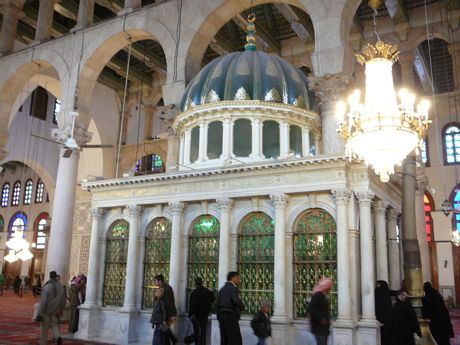
In today’s Lectionary readings, Saint John explains the coming of the light (Jesus Christ) into the world. On this day, when we celebrate that he is risen from the dead, it is a most fitting and wonderful verse to read. Below is the tomb of John-the-Baptist (Yahyah,) in the Umayyad Mosque in Damascus, one of my favorite cities on earth. On this wonderful day of new beginnings, I pray for the peace and prosperity of Syria and all mankind, that we might set aside all the pettiness and grubbing for small things, and look to the larger and harder issues of how to love one another.
John 1:1-18
1In the beginning was the Word, and the Word was with God, and the Word was God. 2He was in the beginning with God. 3All things came into being through him, and without him not one thing came into being. What has come into being 4in him was life,* and the life was the light of all people. 5The light shines in the darkness, and the darkness did not overcome it.
6 There was a man sent from God, whose name was John. 7He came as a witness to testify to the light, so that all might believe through him. 8He himself was not the light, but he came to testify to the light. 9The true light, which enlightens everyone, was coming into the world.*
10 He was in the world, and the world came into being through him; yet the world did not know him. 11He came to what was his own,* and his own people did not accept him. 12But to all who received him, who believed in his name, he gave power to become children of God, 13who were born, not of blood or of the will of the flesh or of the will of man, but of God.
14 And the Word became flesh and lived among us, and we have seen his glory, the glory as of a father’s only son,* full of grace and truth. 15(John testified to him and cried out, ‘This was he of whom I said, “He who comes after me ranks ahead of me because he was before me.” ’) 16From his fullness we have all received, grace upon grace. 17The law indeed was given through Moses; grace and truth came through Jesus Christ. 18No one has ever seen God. It is God the only Son,* who is close to the Father’s heart,* who has made him known.
“You’re Not Southern – You’re Arab!”
My mind works in quirky ways, and yesterday as I was setting up for the hands-on Heirloom Feathers workshop with Cindy Needham, one of the good local Pensacola quilters was telling her how you can tell a Southerner from a Northerner.
“If you go to a Southerner’s house, they’ll ask you first thing if you’d like a drink of water, or iced tea or something, but if you go into a Northerner’s house, you can sit there for five hours and they won’t offer you ANYTHING!”
I grinned to myself, no, I have learned to censor these thoughts. But I couldn’t help it.
“You’re not a Southerner,” I am thinking, “You’re ARAB!”
I thought about a long ago trip through Morocco, we have a rental car and on our way from Ouazazarte to Marrakesh, on an isolated stretch of the road, we see a car in trouble. We stop and ask if we can help, if the man would like a lift to the next town. He tells us no, he wants to stay with the car, but asks if we would go to such and such service station and tell his uncle he needs help, and where he is.
Of course.

We drive into town, find the service station, and find the young man’s uncle, who is the owner. He sends help.
Did I mention it was Ramadan? No eating or drinking in public from dawn to dusk?
The owner insisted we come into his house, and seated us in his diwaniyya, and sent in mint tea and luscious almond-filled dates to refresh us. We said “No! No! It’s Ramadan!” but he told us it was his honor. He sat while we drank and ate.
Such enormous hospitality. Such grace. We only stayed a very short time; we still had a long drive, but I’ve never forgotten his hospitality.
Then again, it was Southern Morocco. 🙂 Maybe he was Southern.
The ExPat Verses from Jeremiah
In our Old Testament reading from the prophet Jeremiah this morning, in the Lectionary, I read these old familiar verses, and they bring a smile to my face. I always thought of these as my instructions, living in alien lands, to pray for the welfare of the land in which I was living, to be a blessing there, and to live my life fully, trusting I would one day be living once again in my own land.
Jeremiah 29:1,4-13
29These are the words of the letter that the prophet Jeremiah sent from Jerusalem to the remaining elders among the exiles, and to the priests, the prophets, and all the people, whom Nebuchadnezzar had taken into exile from Jerusalem to Babylon. 4Thus says the Lord of hosts, the God of Israel, to all the exiles whom I have sent into exile from Jerusalem to Babylon: 5Build houses and live in them; plant gardens and eat what they produce. 6Take wives and have sons and daughters; take wives for your sons, and give your daughters in marriage, that they may bear sons and daughters; multiply there, and do not decrease. 7But seek the welfare of the city where I have sent you into exile, and pray to the Lord on its behalf, for in its welfare you will find your welfare. 8For thus says the Lord of hosts, the God of Israel: Do not let the prophets and the diviners who are among you deceive you, and do not listen to the dreams that they dream,* 9for it is a lie that they are prophesying to you in my name; I did not send them, says the Lord.
10 For thus says the Lord: Only when Babylon’s seventy years are completed will I visit you, and I will fulfil to you my promise and bring you back to this place. 11For surely I know the plans I have for you, says the Lord, plans for your welfare and not for harm, to give you a future with hope. 12Then when you call upon me and come and pray to me, I will hear you. 13When you search for me, you will find me; if you seek me with all your heart,
Reports of Sexual Assault Increasing in India: Warning Issued
Another Woman Who Should Have Known She Was in the Wrong Place? She’s in her hotel room – near the Taj Mahal . . . is this another case of being in the wrong place in India? You’re not safe in your own hotel room? The manager of the hotel comes to your room to wake you for a wake-up call???
20 March 2013
Tourist balcony jump: Hotel manager and guard in court
A hotel manager and guard accused of sexually harassing a British tourist who jumped from a hotel balcony to escape have appeared in court in Agra.
A lawyer acting for hotel manager Sachin Chauhan said his client denied the charge and he had been trying to wake the woman up because she had asked for an early morning call.
The 31-year-old British woman was injured after jumping on Tuesday.
The Briton has been giving her statement at the court.
Initial reports suggested the woman told police she asked for a wake-up call at 04:00 local time and was offered a massage by the hotel owner when he knocked on her door.
She said the man would not leave so she locked the door and jumped from her balcony to the level below, injuring her leg, before fleeing the hotel.
On Tuesday, a spokesman for the British High Commission in India said UK consular officials in Delhi had spoken to the woman and local police.
The Foreign Office recently updated its advice for women visiting India, saying they should use caution and avoid travelling alone on public transport, or in taxis or auto-rickshaws, especially at night.
It added that reported cases of sexual assault against women and young girls were increasing and recent sexual attacks against female visitors in tourist areas and cities showed that foreign women were also at risk.
Police arrested six people following an alleged gang rape of a Swiss tourist in Madhya Pradesh state last week.
The woman was attacked with her husband as they camped in woodland near a village in Datia district.
The arrests came as India’s politicians prepared to debate a new law against rape, following the outcry over the fatal assault on a female Delhi student last year.
Mobile Botanical Garden Plant Sale: Plantasia
AdventureMan and I had one of the sweetest days of the year – nice cool sunny morning, heading into a warm afternoon as we got up early to head over to the Mobile Botanical Gardens Annual Plant Sale.
They do a GREAT job. Starting with publicity, ads in the Pensacola News Journal and information sent out to all the regional gardening clubs and extension centers raising the level of awareness and creating a buzz. Everyone wants to go.

You get there, and parking is well organized and handy to the sales area. Signage is great – ENTER HERE! EXIT ONLY! PERRENIALS! ROSES! SHADE PLANTS! TREES! And great signs telling you how each plant is color coded and you know immediately what the price is:
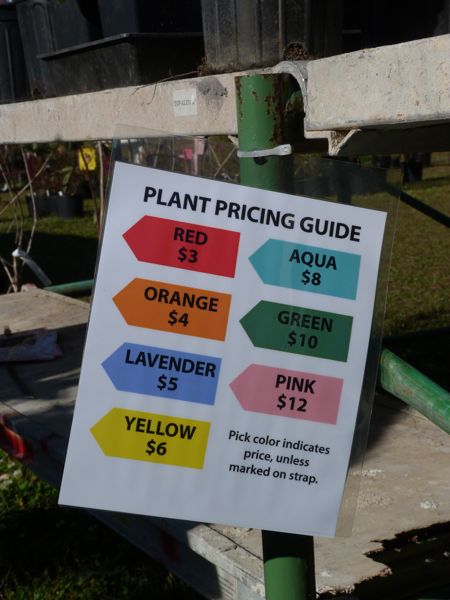
Lots and lots of healthy looking plants. We knew what we wanted and found it quickly, except for the ones that were already sold out. Check-out was friendly – and fast. There was an exit strategy; people with large purchases could leave plants, drive into a pick up zone and have them loaded up. It was an amazingly efficient and well-run operation. Perfect weather, great selection of healthy plants, well-organized and efficient – it doesn’t get much better.
Well done, Mobile.
It’s Your Fault if You Assume You Are Safe: Indian Officials
Horrifying. Disgusting. At the very least, if you are an official and tourists are gang raped in your area, keep your mouth shut. If you must say something, tell the visitors how sorry you are this happened to them. Never, never, never suggest that they should have ASKED if they were safe, NEVER blame the victim for being in the wrong place at the wrong time. You just look really, really ignorant.
These crimes will keep happening as long as there is such a preference for male children that there are not enough mates for the males once they mature. They will keep happening as long as men are not taught, as children, that women are to be equally respected.
Swiss Gang Rape Victim, Husband Partially To Blame For Attack, Indian Officials Suggest
The Huffington Post | By Cavan Sieczkowski
Posted: 03/18/2013 12:13 pm EDT
Officials in India suggested that a Swiss tourist and her husband are partially to blame for an alleged attack and gang rape in a remote wooded area in Madhya Pradesh last week. They said the couple did not inquire about the safety of the region.
On Friday, a Swiss woman and her husband pitched a tent in a forest in Madhya Pradesh while on a three-month cycling excursion, according to the Associated Press. Around 9:30 p.m. a group of men attacked the couple, beat up the husband, tied him to a tree, gang raped the wife and robbed the pair, police said.
During a press conference on Sunday, police spokesperson Avnesh Kumar Budholiya suggested the tourists are partially to blame for the assault because they chose to travel that area without speaking to local police, the Independent reports.
“No one stops there,” Budholiya said. “Why did they choose that place? They were in the wrong place at the wrong time. They would have passed a police station on the way to the area they camped. They should have stopped and asked about places to sleep.”
Another official also appeared to place blame on the victim and her husband.
“The rape of the Swiss national is unfortunate but foreign travelers should inform the police about their movement so they can be provided with adequate protection,” said Umashankar Gupta, the Home Minister of Madhya Pradesh, according to The Times. “They often don’t follow the state’s rules.”
Madhya Pradesh reportedly has one of the highest rates of crimes against women in the country, a fact the Swiss tourists were unaware of, according to the Times of India.
“They apparently lost track and took a wrong turn and decided to halt for the night by the side of a village brook little realizing that the district with 85:100 men to women ratio is not the safest place for women,” a senior official from the region told the newspaper.
Six men have been arrested in connection with the most recent reported gang rape, CNN reports. The victim, who was hospitalized after the attack, claims four of the men raped her. The other two reportedly robbed her and her husband. All six appeared in court Monday.
The most recent attack comes just three months after a 23-year-old woman was gang raped and beaten on a public bus by five men in New Delhi. The defense lawyer for three of the accused placed some of the blame on the now-deceased victim, saying a “respected lady” does not get raped.
Blaming a female victim of a sex crime is common in India because of a woman’s role in society, according to the Sydney Morning Herald.
“This is the mentality which most Indian men are suffering from unfortunately,” Ranjana Kumari, director for the New Delhi-based Centre for Social Research, told the newspaper. “That is the mindset that has been perpetrating this crime because they justify it indirectly, you asked for it so it is your responsibility.”
Scam from Marina Parma
Urgent Reply.
Greetings to you and your family, I am the manager of bill and exchange in THE
BANK, I have a business of 5.5 Million
United State Dollars to be transfer to your account for investment in your
country, if you are ready to assist me get
back to me, I will give you full details on how the fund will be transfer to
you.
Be rest assured that everything will be handled confidentially because, this is
a great opportunity we cannot afford to
miss, as it will make our family profit a lot.
It has been 6 years go, that most of the greedy African Politicians used our
bank to launder money overseas through the
help of their Political advisers.
Most of the funds which they transferred out of the shores of Africa were gold
and oil money that was supposed to have
been used to develop the continent.
The Political advisers always inflated the amounts before transfer to foreign
accounts so I also used the opportunity to
divert part of the fund worth five million five hundred united state dollars I
told you about and I am aware that there
is no official trace of how much was transferred as all the accounts used for
such transfers of fund at that particle
time were closed after transfer.
I am the account officer to most of the politicians and when I discovered that
they were using me to succeed in their
greedy act, I also cleaned some of their banking records from the Bank files and
no one cared to ask me for the money
was too much for them to control, as I am sending this message to you, I was
able to divert five point five Millions
Dollars ($5.5M) which is in an escrow transit account belonging to no one in the
bank, and now my bank is very anxious
to know the real beneficiary of the funds is for they have made a lot of profits
with the fund.
It has been more than five years ago and most of the politicians are no longer
in power again and they don’t use our
bank to transfer funds overseas anymore since their tenure had expired.
The $5.5 Million United State Dollars has been lying in the bank as unclaimed
fund and i will soon retire from the bank
immediately the fund is transfer into your account over there.
Immediately the fund has been successfully transfer into your account i will
come to your country for the sharing of the
fund, the fund will be shared 50% for me and 40% for you, and the other 10% for
the orphanages home and poor with
less-privilege people.
Please know that there is no one that is going to question you about the fund if
you will comply with me and follow my
instruction which will help us a lot to achieve this goal for everything is well
secured.
Please indicate your interest in this transaction my replying back and if you
are not interested do not waste your time
to reply kindly delete my message from your box ok.
Waiting to hear from you soon.
Yours Faithfully,
Mrs Marina Parma
parmamarina@voila.fr
Women’s Rights a Threat to Society?
Society changes. Cable television has had a huge influence, travel to other countries changes perceptions, education gives a wider perspective, The genie is out of the bottle; women are equal people. No woman should need someone else’s permission to travel, work, or to use contraception.
Egypt’s Muslim Brotherhood: Women’s Rights Could Destroy Society, Countries Should ‘Reject And Condemn’ UN Declaration
Reuters | Posted: 03/14/2013 5:40 pm EDT


By Michelle Nichols
UNITED NATIONS, March 14 (Reuters) – Egypt’s ruling Muslim Brotherhood warns that a U.N. declaration on women’s rights could destroy society by allowing a woman to travel, work and use contraception without her husband’s approval and letting her control family spending.
The Islamist party of President Mohamed Mursi outlined 10 reasons why Muslim countries should “reject and condemn” the declaration, which the U.N. Commission on the Status of Women is racing to negotiate a consensus deal on by Friday.
The Brotherhood, which was elected to power in June, posted the statement on its website, http://www.ikhwanweb.com, on Thursday.
Egypt has joined Iran, Russia and the Vatican – dubbed an “unholy alliance” by some diplomats – in threatening to derail the women’s rights declaration by objecting to language on sexual, reproductive and gay rights.
The Muslim Brotherhood said the declaration would give “wives full rights to file legal complaints against husbands accusing them of rape or sexual harassment, obliging competent authorities to deal husbands punishments similar to those prescribed for raping or sexually harassing a stranger.”
U.S. Ambassador Susan Rice last week touted at the commission – a global policy-making body created in 1946 for the advancement of women – progress made by the United States in reducing the rate of violence against women by their partners.
“All 50 states in our union now have laws that treat date rape or spousal rape as just as much of a crime as rape by a stranger,” Rice said. “We cannot live in truly free societies, if women and girls are not free to reach their full potential.”
The contrasting views show the gap that needs to be breached in negotiations on the declaration, which this year is focused on urging an end to violence against women and girls. The commission failed to agree a declaration last year on a theme of empowering rural women due to similar disagreements.
WORLD IS WATCHING
Egypt has proposed an amendment, diplomats say, that would allow countries to avoid implementing the declaration if it clashed with national laws, religious or cultural values. But some diplomats say this would undermine the entire declaration.
The Muslim Brotherhood warned the declaration would give girls sexual freedom, legalize abortion, provide teenagers with contraceptives, give equality to women in marriage and require men and women to share duties such as child care and chores.
It said the declaration would allow “equal rights to homosexuals, and provide protection and respect for prostitutes” and “equal rights to adulterous wives and illegitimate sons resulting from adulterous relationships.”
A coalition of Arab human rights groups – from Egypt, Lebanon, the Palestinian Territories, Jordan and Tunisia – called on countries at the Commission on the Status of Women on Thursday to stop using religion, culture, and tradition to justify abuse of women.
“The current positions taken by some Arab governments at this meeting is clearly not representative of civil society views, aspirations or best practices regarding the elimination and prevention of violence against women and girls within our countries,” said the statement issued by the Coalition for Sexual and Bodily Rights in Muslim Societies.
Michelle Bachelet, a former president of Chile and head of U.N. Women, which supports the commission, said the commission was unable to reach a deal a decade ago when it last focused on the theme of women’s rights and ending violence against women.
“Ten years later, we simply cannot allow disagreement or indecision to block progress for the world’s women,” Bachelet told the opening session of the commission last week. “The world is watching … the violence needs to stop.” (Editing by Mohammad Zargham)
Recent Comments
intlxpatr on Shampoo Ginger tigerbutterya0c5ff1d… on Shampoo Ginger intlxpatr on British Soldier Kidnapped, Esc… John on British Soldier Kidnapped, Esc… intlxpatr on British Soldier Kidnapped, Esc… Wikipedia Donate Button

Amazina


Early Voting in Florida


