Pensacola Christmas Parade 2012
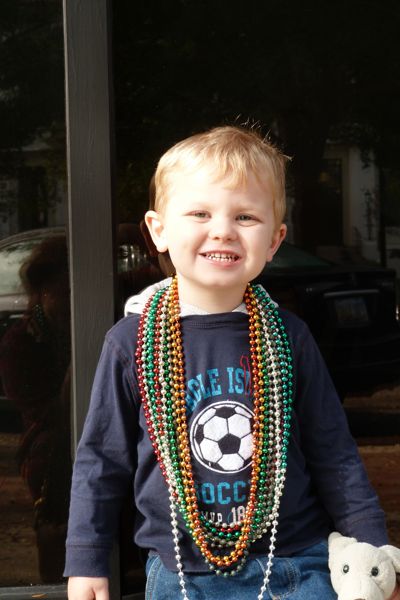
A perfect evening. Got there minutes before the one mile runners came by, parking at our church and walking to our favorite spot, meeting up with our son, his wife, and the adorable little boy who truly gets everything that is happening. This is his third parade; he always loved the lights and loud noises, but this year, he GETS it, gets the floats and the bands and the BEADS!
“I love this tradition,” my daughter-in-law says, leaning over to kiss me as we meet up to watch the parade and do a little-boy-transfer. He is coming to spend the night with us. He has his own room in our house.
ZOOOOOMMMMM! the motorcycle police accompany the runners, EEERRRRRRRROOOOOOOOOWWWWWWWW the fire engine, all lights and noise comes by at the beginning of the parade, and then a high school band from New Orleans with a killer beat leads the parade. Wooooo HOOOOOOOO, shouts Intlxpatr, totally into another cultural experience. 🙂
One of the optical shops had running eyeballs, totally hilarious!

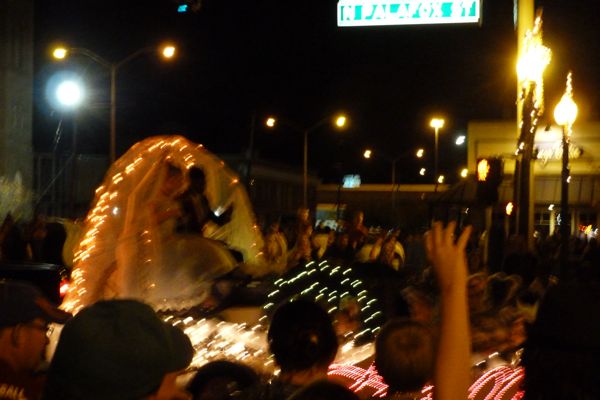
“Beads! Beads!”

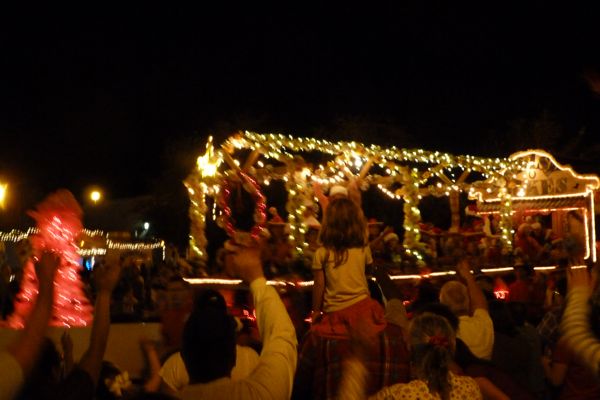
This float was giving out Chobani yoghurt

“Beads! Beads! More beads!” People taller than I were catching beads – and then passing them on to the little children. So kind, so generous.

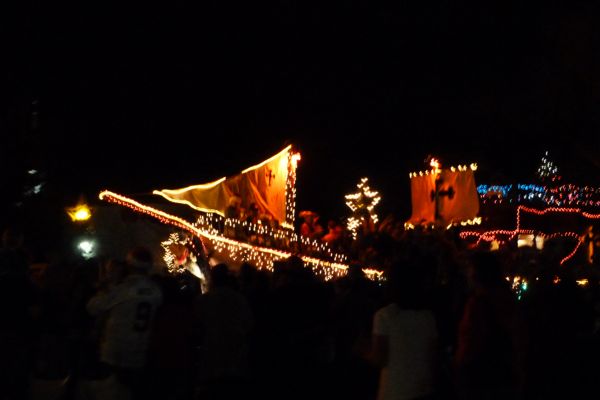
My favorite, of course, a pirate ship:
This parade is great fun. Here is a thing I love about Pensacola. About 50,000 people attend. Many walk from nearby neighborhoods, others drive down and park – there is still plenty of parking in Pensacola. People gather peacefully. There is no fighting over great spots; there are a lot of great spots from which you can watch the parade. At the end of the parade, everyone disperses peacefully – no fighting. In fifteen – twenty minutes the crowd is GONE, 50,000 people gone home, peacefully. It is a great community, all walks of life, all having a great time watching this home town Christmas parade.
Early this morning, the morning after, we started a new tradition – we got a long stick with a hook, and went after some of the beads stuck up in the trees. AdventureMan and Q got started while I went to church, meeting up with some experts who gave them tips – and beads. Such is the kindness of strangers, and the brotherhood of bead chasers. 🙂
The Monarch Caterpiller Ornament
Only a friend can know you so well as to send you a gift like this. When I arrived home from Seattle, this was waiting, and we had to unwrap it right away. When I saw it, I laughed, and ran to show AdventureMan, and we nearly danced for joy, it is so perfect for our tree.
AdventureMan loves butterflies, is creating gardens to attract butterflies, and my sweet Doha friend was looking for a Monarch butterfly ornament, but instead, she found the caterpillar.

How perfect for Advent! We love the season of expectation, waiting for the birth of this dear little babe who will make all the difference. The caterpillar is the form of the Monarch before it goes into the caccoon and transforms into the Monarch. Perfect for the season of waiting expectantly 🙂
Indian Village Bans Cell Phones – For Women
LOL – what about those cheating, eloping MEN? Ban only women from using cell phones? What about calls from mothers who need you to run an errand? What about calls from the children’s school? Women – and man – who are going to cheat are going to cheat, whether or not you take their cell phone away. Found this on AOL/Huffpost via Reuters:
PATNA, India – (Reuters) – A village council in the eastern Indian state of Bihar has banned the use of mobile phones by women, saying the phones were “debasing the social atmosphere” by leading to elopements – a move that set off outraged protests from activists.
In addition to the ban, the Sunderbari village council in a Muslim-dominated area some 385 kilometers (239 miles) east of Patna, the capital of Bihar, has also imposed a fine of 10,000 rupees ($180) if a girl is caught using a mobile phone on the streets.
Married women would have to pay 2,000 rupees ($36.60).
“It always gives us a lot of embarrassment when someone asks who has eloped this time,” said Manuwar Alam, who heads a newly-formed committee tasked with enforcing the ban, referring to queries from neighboring villages.
He said the number of elopements and extramarital love affairs had risen in the past few months, with at least six girls and women fleeing their homes.
“Even married women were deserting their husbands to elope with lovers. That was shameful for us,” Alam said. “So, we decided to tackle it firmly. Mobile phones are debasing the social atmosphere”.
Local officials have begun investigations, saying that such bans cannot be allowed in a healthy society, while women’s rights activists called it an assault on freedom that could potentially end up harming women by stripping them of one source of protection from trouble, such as unwanted advances by men.
“Girls and women are capable enough to protect themselves,” said activist Suman Lal during a debate on local television. “Technology is meant to be used, not to be banned…The order is nauseating.”
Fellow activist Mohammad Islam said it was “disappointing” that the village council ignored the many advantages of mobile phones before placing a ban on them for one reason.
“I want every girl to be given a mobile phone so that she could call up family members if she has a problem”, he said. ($1 = 54.6400 Indian rupees)
(Reporting by New Delhi newsroom, editing by Elaine Lies)
John of Damascus
This morning, as I read my Lectionary readings, I noticed I had skipped the Saint yesterday (I was trying to get a lot done) and it was John of Damascus. Checking the blog, I can see I printed this several years ago – 6 years! – but because it was new to me all over again, I am printing it again for you.
It is fascinating to me. John of Damascus defended the use of icons in worship. He distinguished between using an icon as an aide, and worshipping an icon. He was defended by his powerful position with a khalif, a Moslem who believes that images are forbidden. And we think WE live in interesting times . . . 🙂
JOHN OF DAMASCUS
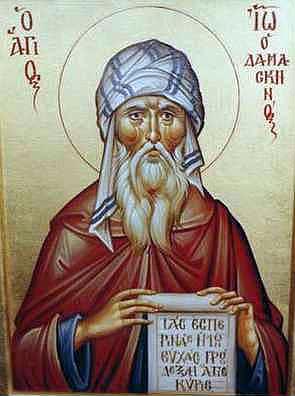
(I love this photo because he is wearing a gutra 🙂 )
HYMN-WRITER, DEFENDER OF ICONS (4 DEC 750)
John is generally accounted “the last of the Fathers”. He was the son of a Christian official at the court of the moslem khalif Abdul Malek, and succeeded to his father’s office.
In his time there was a dispute among Christians between the Iconoclasts (image-breakers) and the Iconodules (image-venerators or image-respectors). The Emperor, Leo III, was a vigorous upholder of the Iconoclast position. John wrote in favor of the Iconodules with great effectiveness. Ironically, he was able to do this chiefly because he had the protection of the moslem khalif (ironic because the moslems have a strong prohibition against the religious use of pictures or images).
John is also known as a hymn-writer. Two of his hymns are sung in English at Easter (“Come ye faithful, raise the strain” and “The Day of Resurrection! Earth, tell it out abroad!”). Many more are sung in the Eastern Church.
His major writing is The Fount of Knowledge, of which the third part, The Orthodox Faith, is a summary of Christian doctrine as expounded by the Greek Fathers.
The dispute about icons was not a dispute between East and West as such. Both the Greek and the Latin churches accepted the final decision.
The Iconoclasts maintained that the use of religious images was a violation of the Second Commandment (“Thou shalt not make a graven image… thou shalt not bow down to them”).
The Iconodules replied that the coming of Christ had radically changed the situation, and that the commandment must now be understood in a new way, just as the commandment to “Remember the Sabbath Day” must be understood in a new way since the Resurrection of Jesus on the first day of the week.
Before the Incarnation, it had indeed been improper to portray the invisible God in visible form; but God, by taking fleshly form in the person of Jesus Christ, had blessed the whole realm of matter and made it a fit instrument for manifesting the Divine Splendor. He had reclaimed everything in heaven and earth for His service, and had made water and oil, bread and wine, means of conveying His grace to men. He had made painting and sculpture and music and the spoken word, and indeed all our daily tasks and pleasures, the common round of everyday life, a means whereby man might glorify God and be made aware of Him. (NOTE: I always use “man” in the gender-inclusive sense unless the context plainly indicates otherwise.)
Obviously, the use of images and pictures in a religious context is open to abuse, and in the sixteenth century abuses had become so prevalent that some (not all) of the early Protestants reacted by denouncing the use of images altogether. Many years ago, I heard a sermon in my home parish (All Saints’ Church, East Lansing, Michigan) on the Commandment, “Thou shalt not make a graven image, nor the likeness of anything in the heavens above, nor in the earth beneath, nor in the waters under the earth — thou shalt not bow down to them, nor worship them.” (Exodus 20:4-5 and Deuteronomy 5:8-9) The preacher (Gordon Jones) pointed out that, even if we refrain completely from the use of statues and paintings in representing God, we will certainly use mental or verbal images, will think of God in terms of concepts that the human mind can grasp, since the alternative is not to think of Him at all.
(Here I digress to note that, if we reject the images offered in Holy Scripture of God as Father, Shepherd, King, Judge, on the grounds that they are not literally accurate, we will end up substituting other images — an endless, silent sea, a dome of white radiance, an infinitely attenuated ether permeating all space, an electromagnetic force field, or whatever, which is no more literally true than the image it replaces, and which leaves out the truths that the Scriptural images convey. (One of the best books I know on this subject is Edwyn Bevan’s Symbolism and Belief, Beacon Press, originally a Gifford Lectures series.[note – now out of print])
C S Lewis repeats what a woman of his acquaintance told him: that as a child she was taught to think of God as an infinite “perfect substance,” with the result that for years she envisioned Him as a kind of enormous tapioca pudding. To make matters worse, she disliked tapioca. Back to the sermon.) The sin of idolatry consists of giving to the image the devotion that properly belongs to God. No educated man today is in danger of confusing God with a painting or statue, but we may give to a particular concept of God the unconditional allegiance that properly belongs to God Himself. This does not, of course, mean that one concept of God is as good as another, or that it may not be our duty to reject something said about God as simply false. Images, concepts, of God matter, because it matters how we think about God. The danger is one of intellectual pride, of forgetting that the Good News is, not that we know God, but that He knows us (1 Corinthians 8:3), not that we love Him, but that He loves us (1 John 4:10).
(Incidentally, it was customary in my parish in those days for the preacher to preach a short “Children’s Sermon,” after which the children were dismissed for Sunday School, and the regular sermon and the rest of the service followed. What I have described above was the Children’s Sermon. I remained for the regular sermon, but found it a bit over my head — a salutary correction to my intellectual snobbery.)
In the East Orthodox tradition, three-dimensional representations are seldom used. The standard icon is a painting, highly stylized, and thought of as a window through which the worshipper is looking into Heaven. (Hence, the background of the picture is almost always gold leaf.) In an Eastern church, an iconostasis (icon screen) flanks the altar on each side, with images of angels and saints (including Old Testament persons) as a sign that the whole church in Heaven and earth is one body in Christ, and unites in one voice of praise and thanksgiving in the Holy Liturgy.
At one point in the service, the minister takes a censer and goes to each icon in turn, bows and swings the censer at the icon. He then does the same thing to the congregation — ideally, if time permits, to each worshipper separately, as a sign that every Christian is an icon, made in the image and likeness of God, an organ in the body of Christ, a window through whom the splendor of Heaven shines forth.
My prayer for us all for today is that we may each be that window through which the splendor of Heaven shines forth.
“Do You Think You Would Move To Seattle?”
“If anything happened to me, do you think you would move to Seattle?” AdventureMan asked, knowing the heat and long humid summers in Pensacola are hard on me. What are the clues? Maybe my grumbling and complaining, maybe that I won’t walk in the garden with him because of the heat and humidity, the snakes, the mosquitoes, the red ants, LOL.
I really love Seattle. I love it that women of all ages can wear jeans and look comfortable in their own skin. So many of those stoic Scandinavian women don’t even bother with make-up anymore, so secure are they. They don’t color their hair. They are comfortable to be exactly who they are. They walk. They are like the French; they get their exercise in their daily life by walking and keeping active. They read books and discuss them. They make interesting political choices. Yes, I really like Seattle.
On the other hand . . . this is one of only two times I saw the sun when I was in Seattle:

It rained. Sometimes it rained more lightly, sometimes it drizzled, and now and then it poured. It rained particularly hard and cold one night as I was trying to get my Mom into a restaurant and we had to park far away. And here is the weather forecast for Seattle today from Weather Underground:
Weather Underground Forecast for Tuesday, December 04, 2012. Another strong Pacific storm will slam into the West Coast Tuesday, renewing rain and high elevation snow for areas that were hit hard by three storms in the past week. This storm will be slightly farther north than the previous storms, bringing areas of heavy rain and high elevation snow from Washington through the San Francisco Bay Area. The heaviest precipitation is expected to fall in Washington and Oregon, but heavy rain is possible in the far northern part of California.
Pensacola is truly lovely from October to March . . . yesterday was in the 70’s. It was wonderful to see the sun 🙂
Flannel Sheets: Not Just a Seattle Thing
In Seattle, which was not so much cold as grim and grey and rainy rainy rainy, there were flannel sheets everywhere. In the cold draftiness and the winter damp cold of Seattle, flannel sheets are definitely useful.

We thought we would retire in Seattle, and one trip in the middle of winter when I was back in Seattle, I stocked up on flannel sheets. Just months later, everything changed, a grandchild was coming, and suddenly, Pensacola sounded like just where we wanted to be.
The Qatari Cat is delighted we have those flannel sheets. He thinks Pensacola gets cold sometimes, compared to his birth country, Qatar (although the desert in Qatar can also be VERY cold in January) and he snuggles right down during a Pensacola cool spell.

Thanksgiving on the Bayou
The Thanksgiving venue changed this year. We all have families, families have struggles, and one of those struggles meant that the Thanksgiving celebration would shift to another home. Same cast of characters, same fabulous food, just a different location.
The organization is superb. Everyone has a part to play. Nieces and nephews arrive to assist in preparations, clearing the grounds, putting out tables and chairs, helping wherever they can. Cousins get to spend time together, catching up, as they work together. The aunts are all busy in the kitchens, cutting, chopping, baking, cooking, stewing, putting their best efforts into making the dishes everyone loves.
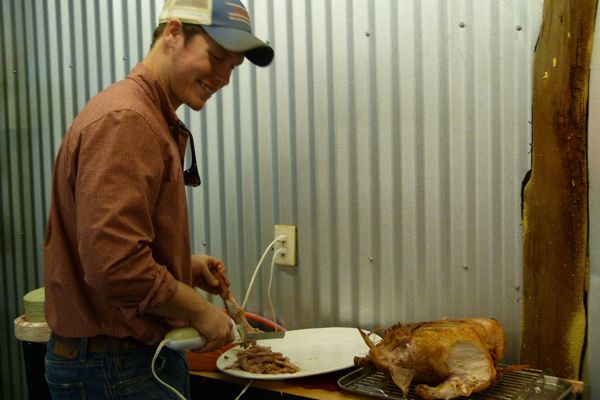


The guys do the turkeys. They may have help, but the turkeys seem to be the guys prerogatives. They also carry in the hams.
There are so many desserts that they won’t fit on one table. They won’t fit on two tables! When all the desserts are put on the tables, there are still back-up pies and cakes in the pie-safe behind the table!
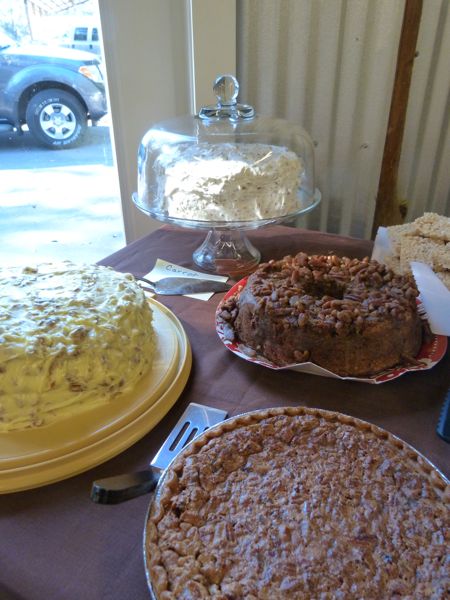
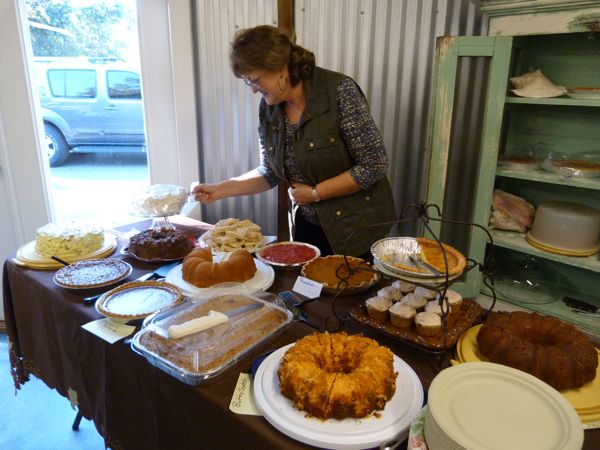
Cousins fill glasses with ice; guest can choose lemonade, sweet tea or “un”

The tables groan with turkeys, hams and side dishes – beans and peas from the garden, corn bread, sweet potato casseroles, and more, much, much more:

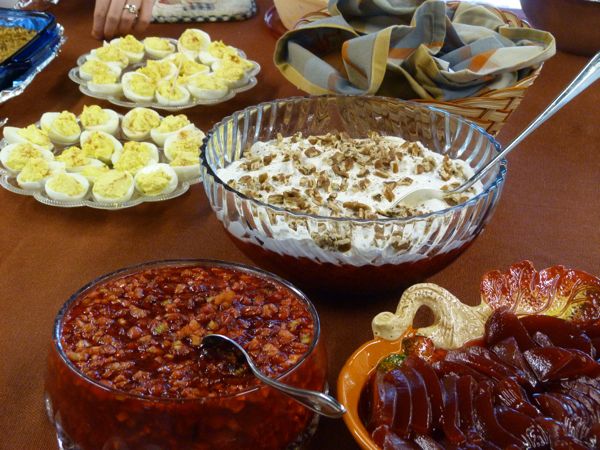

There is fun for everyone – kayak rides, tractor rides, and ring toss:



There’s always a special room where babies can nap – this is a very child friendly celebration. This family loves babies and little ones, and encourages all the cousins to stay close. It’s always a full day, Thanksgiving, with much for which to give thanks. 🙂 When the great meal is over, people play, visit, walk, chat . . . and then sneak back for another taste of their favorite dish!
Sunsets at the Sunset Inn, Panama City Beach, Florida
“I love this place,” I sighed, as AdventureMan and I sat out on our balcony at the Sunset Inn, a little Mom and Pop motel hidden between the towering condos of Panama City Beach. We were watching the sun go down. Little does it matter that as I sat out on the balcony watching the sun go down, or watching the pelicans in the morning, I was probably increasing my quota of mosquito bites, mais tant pis.

“I know you do,” AdventureMan replied, sipping on a cup of hot Christmas punch and sharing the moment with me. We’ve always loved sunsets. Or sunrises. We think of them as one of those great gifts, so wonderful that it is hard to believe they are free.
For some reason, some of the best sunsets we’ve ever seen have been from this motel. Here is the first sunset, the day we got there, Tuesday:

I am not kidding, I haven’t done a thing to that photo. I haven’t cropped it or enhanced it in any way. Who can improve on a sunset like that? I liked it so much I will show you another, again, untouched. This is using the telephoto, but no enhancements:

The next morning, we were greeted by pelicans. I adore pelicans, those throwbacks to prehistoric times, so primitive, and so dramatic, plunging beak first down into the waters and then flying back up with a fish in their beak. These ones aren’t plunging, just floating around letting breakfast come to them:

We missed one sunset, and here is what we caught on Thanksgiving after the feast:

Here in sunset on Friday night, our last night at the beach:

Drama drama drama!

All quiet at the Sunset Inn . . . .
Saudi Government Informing ‘Responsible Male’ When Women Leave Saudi Arabia
Thank you, John Mueller, for this fascinating article from FRANCE 24:
Electronic tracking: new constraint for Saudi women – FRANCE 24
AFP – Denied the right to travel without consent from their male guardians and banned from driving, women in Saudi Arabia are now monitored by an electronic system that tracks any cross-border movements.
Since last week, Saudi women’s male guardians began receiving text messages on their phones informing them when women under their custody leave the country, even if they are travelling together.
Manal al-Sherif, who became the symbol of a campaign launched last year urging Saudi women to defy a driving ban, began spreading the information on Twitter, after she was alerted by a couple.
The husband, who was travelling with his wife, received a text message from the immigration authorities informing him that his wife had left the international airport in Riyadh.
“The authorities are using technology to monitor women,” said columnist Badriya al-Bishr, who criticised the “state of slavery under which women are held” in the ultra-conservative kingdom.
Women are not allowed to leave the kingdom without permission from their male guardian, who must give his consent by signing what is known as the “yellow sheet” at the airport or border.
The move by the Saudi authorities was swiftly condemned on social network Twitter — a rare bubble of freedom for millions in the kingdom — with critics mocking the decision.
“Hello Taliban, herewith some tips from the Saudi e-government!” read one post.
“Why don’t you cuff your women with tracking ankle bracelets too?” wrote Israa.
“Why don’t we just install a microchip into our women to track them around?” joked another.
“If I need an SMS to let me know my wife is leaving Saudi Arabia, then I’m either married to the wrong woman or need a psychiatrist,” tweeted Hisham.
“This is technology used to serve backwardness in order to keep women imprisoned,” said Bishr, the columnist.
“It would have been better for the government to busy itself with finding a solution for women subjected to domestic violence” than track their movements into and out of the country.
Saudi Arabia applies a strict interpretation of sharia, or Islamic law, and is the only country in the world where women are not allowed to drive.
In June 2011, female activists launched a campaign to defy the ban, with many arrested for doing so and forced to sign a pledge they will never drive again.
No law specifically forbids women in Saudi Arabia from driving, but the interior minister formally banned them after 47 women were arrested and punished after demonstrating in cars in November 1990.
Last year, King Abdullah — a cautious reformer — granted women the right to vote and run in the 2015 municipal elections, a historic first for the country.
In January, the 89-year-old monarch appointed Sheikh Abdullatif Abdel Aziz al-Sheikh, a moderate, to head the notorious religious police commission, which enforces the kingdom’s severe version of sharia law.
Following his appointment, Sheikh banned members of the commission from harassing Saudi women over their behaviour and attire, raising hopes a more lenient force will ease draconian social constraints in the country.
But the kingdom’s “religious establishment” is still to blame for the discrimination of women in Saudi Arabia, says liberal activist Suad Shemmari.
“Saudi women are treated as minors throughout their lives even if they hold high positions,” said Shemmari, who believes “there can never be reform in the kingdom without changing the status of women and treating them” as equals to men.
But that seems a very long way off.
The kingdom enforces strict rules governing mixing between the sexes, while women are forced to wear a veil and a black cloak, or abaya, that covers them from head to toe except for their hands and faces.
The many restrictions on women have led to high rates of female unemployment, officially estimated at around 30 percent.
In October, local media published a justice ministry directive allowing all women lawyers who have a law degree and who have spent at least three years working in a lawyer’s office to plead cases in court.
But the ruling, which was to take effect this month, has not been implemented.
Celebrating Diwali in Pensacola
A friend shared a flyer with us and said “I thought you might be interested in this.” He was right – it was a celebration of Diwali, and it would take place in a nearby Presbyterian church.
First, though, we had to buy tickets, which meant finding the Indian grocery store. This was a really good thing, as AdventureMan wanted some good hot chutneys, and I was hoping I could find some of the dark chana dal that I used to buy so inexpensively in Doha and Kuwait, but found myself ordering from Amazon.com because I couldn’t fine them in Pensacola. I knew it! I just wasn’t looking in the right place!
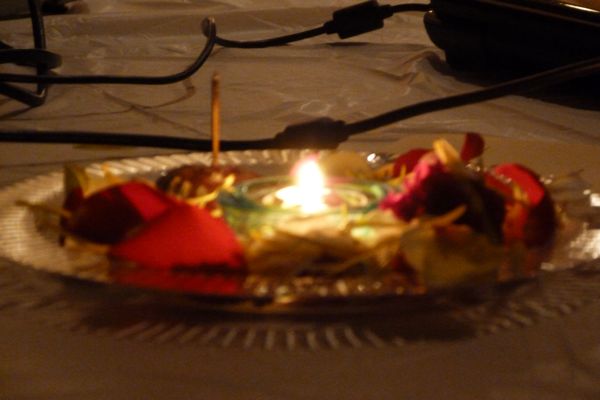
My first Diwali was magical. It was held on Al Fardan Gardens, in Doha, and all the Indian families strung thousands of white lights and lined the sidewalks with votives, so it was like a fairy land. By this late in the year, it can cool down enough to make the thought of walking inviting. To walk among the lights and to stop here and there for some truly divine cooking was delightful.
Diwali in Pensacola? Whoda thunk it?
As it turns out, Pensacola has a substantial Indian population, tightly woven together and cooperating in times of celebration and times of sorrow. Last night was a little of both – the Diwali celebration had been planned and organized for several months, but a sudden death of one of the long time members on the day of the Diwali celebration saddened the day somewhat.
While all grieved, the show went on. Lots and lots of lively traditional dances, a few Bollywood numbers, and a wonderful sword dance that reminded us of similar sword dances we had seen in the Gulf, performed only by men, while these were performed by women.
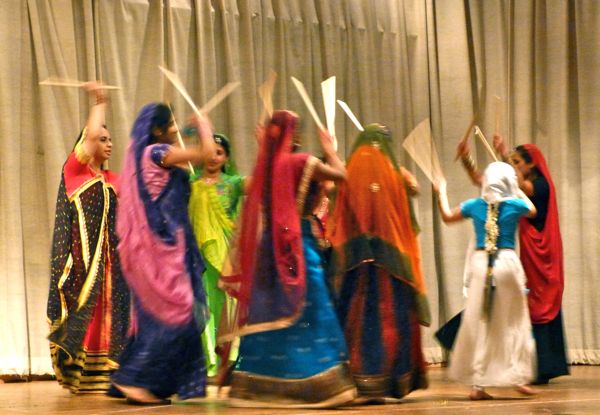

After all that energetic dancing, we were ready to eat. Butter Chicken, chicken korma, dal, rice, all kinds of good things provided by one of the newer Indian restaurants in town, the India Palace.
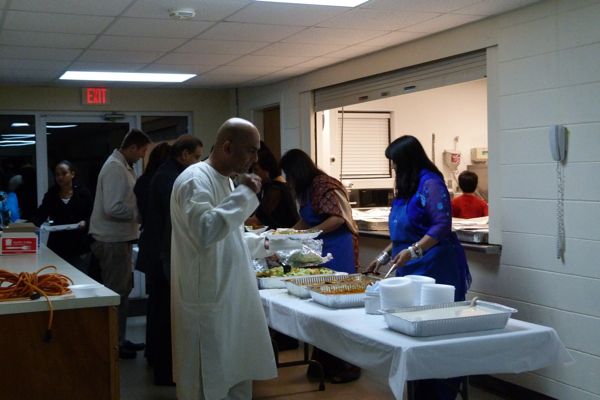
I never dreamed when we came to Pensacola that there would be an opportunity to celebrate Diwali. 🙂
Recent Comments
ExpatAlien on What Country am I Living … intlxpatr on Yellowstone: Old Faithful to C… Michelle on Yellowstone: Old Faithful to C… Cathy on No Grown-Ups in Charge intlxpatr on Waiting for Snow Wikipedia Donate Button

Amazina


Early Voting in Florida


 Here There and Everywhere