Pork with Roasted Apples and Onions
“Where did you get this recipe? What gave you the idea?” AdventureMan asked as we feasted on a meal I wasn’t even sure we were going to like when I started it.
“Ken Follett,” I said slowly, trying to remember which book. I think it was A Column of Fire. The characters serve a meal of pork and apples, and it’s not anything I have cooked before, that combination, so down the rabbit hole I went. I have my Kindle on my laptop, I can check maps of where books are set, I can look up obscure words, and when something intrigues me, I can take a few minutes and follow that path.
I wasn’t sure how these ingredients would go, I wasn’t sure we would like fennel seeds, I wasn’t sure this was really a good recipe for us, but it sounds so good on a cold winters day and I had a pork tenderloin in the freezer. I pulled it out early in the day, read through the recipe, discovered my tenderloin was larger so I increased the amount of apples and onions by half. Actually, when I made the recipe, I didn’t really measure that closely; you can sort of tell from the instructions that this is another of those very forgiving recipes.
AdventureMan had some tiny potatoes left from his Bourride with Aioli, so he roasted them up with oil and garlic, salt and parsley, we put together a small green salad, and a feast was on the table. One bite and we agreed we have had such things on winter nights in France – and in Germany. These ingredients are so simple and the preparation, while a little fiddly, goes very quickly and easily. The combination is yummy.

Pork Tenderloin with Roasted Apples and Onions
Makes 4 servings
1 large pork tenderloin (about 14 ounces) (ours was 24 oz.)
3 tablespoons olive oil, divided
2 tablespoons whole grain Dijon mustard
2 teaspoons fennel seeds
1 large onion, sliced
2 medium Granny Smith apples, peeled, cored, sliced 1/4 inch thick
1/2 cup dry white wine or apple cider
PREPARATION
Preheat oven to 450°F. Season pork with salt and pepper.
Heat 2 tablespoons oil in large nonstick ovenproof skillet over medium-high heat. Add pork and sear until all sides are brown, turning occasionally, about 5 minutes.
Transfer pork to plate. Cool slightly. Spread mustard over top and sides of pork; press fennel seeds into mustard.
Add remaining 1 tablespoon oil to skillet. Add onion slices and apples; sauté over medium heat until golden, about 5 minutes. Spread evenly in skillet and sprinkle with salt and pepper. Place pork atop apple-onion mixture.
Transfer skillet to oven and roast until apple-onion mixture is soft and brown and meat thermometer inserted into center of pork registers 150°F, about 15 minutes. Transfer pork to platter and tent with foil. Let stand 5 minutes.
Meanwhile, pour white wine over apple-onion mixture in skillet. Stir mixture over high heat until slightly reduced, about 2 minutes. Cut pork on diagonal into 1/2-inch-thick slices. Spoon apple-onion mixture onto plates. Top with pork and serve.
From Epicurious who credits Bon Appetite February 2004
Thank you, Epicurious, and thank you Ken Follett!
Never Fail Appetizers: Sausage Cheese Puffs and Artichoke Cheese Dip
These two recipes are so easy that even a ten year old and a seven year old can make them – as we did last night to say farewell to 2020 (and good riddance!) and to welcome 2021. The kids love these, and so do most adults. At one party, I watched a shy man eat almost the entire recipe of cheese dip, he loved it so much. We are trying to give our grandchildren tools for living, tools for self-reliance and confidence in themselves and their skills.
They are both from an old cookbook from my military wife days – The Fort Leavenworth Cookbook. Things change; I don’t know if military wives still have the same expectations, but we needed fool-proof, quick recipes we could prepare from the pantry in a heartbeat. These two fit the bill, and are great crowd pleasers.
Sausage Cheese Puffs
1 pound hot or sweet bulk sausage
1 pound sharp cheddar cheese
3 cups biscuit mix
3/4 cup water
Brown sausage, drain and cool. Add cheese, biscuit mix and water. Mx with fork – or fingers, until it sticks together. Roll into 1 inch balls. Bake at 400 degrees for 12 – 15 minutes, until lightly browned. Makes about 80.
Artichoke Cheese Dip
1 14 ounce can artichoke hearts, drained and chopped (or one jar marinated artichoke hearts, drained and chopped)
1 small jar chopped red pimentos
(optional: chopped up pickled jalepeno pieces, to taste, one or two tablespoons)
1/2 cup grated Parmesan cheese
1/2 cup Monterey Jack cheese
2 cups grated sharp Cheddar
(I use 16 ounce bags of Mexican mix cheese in place of cheddar + Monterey Jack; they keep in the freezer)
1/8 teaspoon cumin powder
1 cup mayonnaise (we use 1/2 cup mayonnaise, 1/2 cup sour cream)
Combine all ingredients, turn into baking dish (we use a quiche dish) and bake at 350 degrees until bubbling hot. Serve with corn chips.
Both of these recipes are very forgiving. Christmas Eve, I made the Sausage Cheese Puffs, only to discover I had forgotten to put in the sausage, cooked and cooling on the stove. I added it to the remainder of the dough, and we had two kinds of puffs, Cheese and Sausage-Cheese, and both were delicious.
The Artichoke Cheese Dip can use various kinds of cheese, and the extra cup of cheese I add doesn’t impact on the results. Nor does cooking it at 400 degrees, while I am also cooking Sausage Cheese Puffs. We need more of these fool-proof, flexible and delicious kinds of recipes!
Happy New Year and happy cooking 🙂
Elizabeth Peratrovich

Sometimes I can get a little paranoid, and today was one of those times. Look at that gorgeous Google doodle for today. I spend a certain amount of time looking at Alaskan legend as a source of art images for my quilting, so when I saw the Google doodle, I thought it was one of those targeted things.
Not so.
As it turns out, it is a doodle honoring an Alaskan Tlingit woman, Elizabeth Peratrovich. I’ve taken the following from Wikipedia (to which I donate, so I am comfortable sharing what they have to say. I love that it is updated to show today’s doodle.) This woman was something special:
Elizabeth Jean Peratrovich (Tlingit name: Kaaxgal.aat; July 4, 1911 – December 1, 1958) was an American civil rights activist and member of the Tlingit nation who worked for equality on behalf of Alaska Natives.[1] In the 1940s, her advocacy was credited as being instrumental in the passing of Alaska’s Anti-Discrimination Act of 1945, the first state or territorial anti-discrimination law enacted in the United States in the 20th century. In 1988, the Alaska Legislature established February 16 as Elizabeth Peratrovich Day “for her courageous, unceasing efforts to eliminate discrimination and bring about equal rights in Alaska” (Alaska Statutes 44.12.065).[2] In March 2019, her obituary was added to The New York Times as part of their “Overlooked No More” series.[3]
Early life and education
Elizabeth Peratrovich, whose name at birth was Kaaxgal.aat[4], was born on July 4, 1911, in Petersburg, Alaska,[5] as a member of the Lukaax̱.ádi clan in the Raven moiety of the Tlingit nation. When she was young, she was adopted by Andrew and Jean Wanamaker (née Williams), who gave her the name “Elizabeth Jean”.[6][7] Andrew was a fisherman and Presbyterian lay minister. The Wanamakers raised Elizabeth in Petersburg, Klawock, and Ketchikan, Alaska. Elizabeth graduated from Ketchikan High School, and then attended Sheldon Jackson College in Sitka, and the Western College of Education in Bellingham, Washington (now part of Western Washington University).[a] In 1931, Elizabeth married Roy Peratrovich (1908-1989), who was also Tlingit, as well as of Serbian ancestry.[9]
Activism
In 1941, while living in Juneau, Alaska, Elizabeth and Roy Peratrovich encountered discrimination in their attempts to secure housing and gain access to public facilities. They petitioned the territorial governor, Ernest Gruening, to prohibit public places from posting the “No dogs or Natives allowed” signs that were common in Alaska during this time.[citation needed]
The Anti-Discrimination Act was proposed by the Alaska Native Brotherhood and the Alaska Native Sisterhood, but the first attempt to pass this legislation failed in 1943.[citation needed] However, in 1945, Roy and Elizabeth Peratrovich became the Presidents of the Alaska Native Brotherhood and the Alaska Native Sisterhood, respectively, and lobbied the territory’s legislators and Governor Gruening to pass the act.[citation needed]
Before the territorial Senate voted on the bill in 1945, Elizabeth Peratrovich, representing the Alaskan Native Sisterhood, was the last to testify, and her impassioned speech was considered decisive.[10] Responding to territorial senator Allen Shattuck of Juneau, who had earlier asked “Who are these people, barely out of savagery, who want to associate with us whites, with 5,000 years of recorded civilization behind us?,” she stated:[11]
I would not have expected that I, who am barely out of savagery, would have to remind gentlemen with five thousand years of recorded civilization behind them, of our Bill of Rights.[12]
Fran Ulmer, who represented Juneau in the Alaska House of Representatives (and who later became lieutenant governor of Alaska), in 1992 said the following about Peratrovich’s testimony:
She talked about herself, her friends, her children, and the cruel treatment that consigned Alaska Natives to a second-class existence. She described to the Senate what it means to be unable to buy a house in a decent neighborhood because Natives aren’t allowed to live there. She described how children feel when they are refused entrance into movie theaters, or see signs in shop windows that read “No dogs or Natives allowed.”[12]
The Senate voted 11-5 for House Resolution 14, providing “…full and equal accommodations, facilities, and privileges to all citizens in places of public accommodations within the jurisdiction of the Territory of Alaska; to provide penalties for violation.”[11] The bill was signed into law by Governor Gruening in 1945, nearly 20 years before the US Congress passed the Civil Rights Act of 1964. Acts of the territorial legislature required final approval from the U.S. Congress, which affirmed it (Bob Bartlett, Alaskan delegate, was known for his efficiency in passing legislation). Alaska thus became the first territory or state to end “Jim Crow” since 18 states banned discrimination in public accommodations in the three decades following the Civil War; not until 1955 would two more states, New Mexico and Montana, follow suit.[13]
The Peratrovich family papers, including correspondence, personal papers, and news clippings related to the civil rights work done by Elizabeth and Roy Peratrovich, are currently held at the Smithsonian National Museum of the American Indian.[14]
Personal facts
On December 15, 1931, Elizabeth married Roy Peratrovich (1908–1989), also a Tlingit, of mixed native and Serbian descent who worked in a cannery.[citation needed] They lived in Klawock, where Roy was elected to four terms as mayor.[citation needed]
Looking for greater opportunities for work and their children, they moved to Juneau, where they found more extensive social and racial discrimination against Alaska Natives. They had three children: daughter Loretta, and sons Roy, Jr. and Frank.[11]
The Peratrovich family later moved to Antigonish, Nova Scotia, Canada, where Roy pursued an economics degree at St. Francis Xavier University.[citation needed] From there they moved to Denver, Colorado, where Roy studied at the University of Denver.[citation needed] In the 1950s, the Peratroviches moved to Oklahoma, and then back to Alaska.[citation needed]
Elizabeth Peratrovich died after battling breast cancer on December 1, 1958, at the age of 47.[15] She is buried at Evergreen Cemetery, Juneau, Alaska, alongside her husband Roy.[citation needed]
Her son, Roy Peratrovich, Jr., became a noted civil engineer in Alaska. He designed the Brotherhood Bridge in Juneau, which carries the Glacier Highway over the Mendenhall River.[16]
Legacy and honors
- On February 6, 1988, the Alaska Legislature established February 16 (the day in 1945 on which the Anti-Discrimination Act was signed) as “Elizabeth Peratrovich Day,” in order to honor her contributions: “for her courageous, unceasing efforts to eliminate discrimination and bring about equal rights in Alaska” (Alaska Statutes 44.12.065).[17]
- The Elizabeth Peratrovich Award was established in her honor by the Alaska Native Sisterhood.[citation needed]
- In 1992, Gallery B of the Alaska House of Representatives chamber in the Alaska State Capitol was renamed in her honor.[12] Of the four galleries located in the respective two chambers, the Peratrovich Gallery is the only one named for someone other than a former legislator (the other House gallery was named for Warren A. Taylor; the Senate galleries were named for former Senators Cliff Groh and Robert H. Ziegler).
- In 2003, a park[18] in downtown Anchorage was named for Elizabeth and Roy Peratrovich. It encompasses the lawn surrounding Anchorage’s former city hall, with a small amphitheater in which concerts and other performances are held.[19]
- In 2009, a documentary about Peratrovich’s groundbreaking civil rights advocacy premiered on October 22 at the Alaska Federation of Natives convention in Anchorage. Entitled For the Rights of All: Ending Jim Crow in Alaska, the film was scheduled to air as a PBS documentary film in November 2009. The film was produced by Blueberry Productions, Inc. and was primarily written by Jeffry Lloyd Silverman of Anchorage.[20]
- In 2017, the theater in Ketchikan’s Southeast Alaska Discovery Center was named in honor of Elizabeth Peratrovich, and a companion exhibit exploring her role in the struggle for Alaska Native civil rights was unveiled.[21]
- In 2018, Elizabeth Peratrovich was chosen by the National Women’s History Project as one of its honorees for Women’s History Month in the United States.[22]
- On October 5, 2019, United States Mint Chief Administrative Officer Patrick Hernandez announced that Peratrovich would appear on the reverse of the 2020 Native American $1 Coin, making her the first Alaska Native to be featured on U.S. currency.[23][24][25]
- In December 2019, a 4-story apartment building called Elizabeth Place, named after Peratrovich, opened in downtown Anchorage.
- In July 2020, a new mural was unveiled in honor of Peratrovich in Petersburg Alaska.[26]
- On December 30, 2020, a Google Doodle in the United States and Canada honored Elizabeth Peratrovich. The Doodle was drawn by Tlingit artist Micheala Goade.[27]
“Oh, He’ll Blame Obama”
I laughed as I read the following headline to AdventureMan:
China will achieve major landmark this decade: Report
“Trump is going to hate that this is part of his legacy,” I laughed. Our infantile, petulent soon-to-be-gone President throws temper tantrums over this kind of news. Anything he doesn’t like he determines to be “fake news.”
AdventureMan just snorts. “He’ll just blame it on Obama,” he says.
Americans are addicted to cheap goods, and plenty of them. China feeds that need. No need to look for a conspiracy. It’s all classic supply and demand. No nefarious plots. Take a look at your furniture, your plasterboard, your wooden floors, look in your cupboard at your canned goods, in your closets at your clothing. China is building the largest economy in the world by providing what people want at a lower price.
I Can’t Look

Today is election day in the United States of America, following four of the nastiest years in our history.
I try to be objective.
We served our country, AdventureMan and I, for many years, most of them outside the United States, sometimes in dangerous circumstances, not always agreeing with the official policies of our country but always, always, supporting them, as we were sworn to do. That is the nature of the “dark” bureaucracy. We serve our country, and we obey the laws.

To see the bureaucracy derided, dismissed and destroyed breaks my heart. To see all the painstaking hard work taken over years and years of persistent policy making tossed aside, along with our faithful allies, enrages me.
Oops. Enraged?
One of the things we learn along the road is not to take things personally. We learn to suffer disappointment and watch for opportunities to get back on track. Anger doesn’t help. Name-calling doesn’t help. Confrontation may be useful, but you have to choose your timing, and your battles.
I was raised to be competitive. I have had to dial it back. I learned that focusing on the win all the time drove bad decisions, and an unhealthy attitude – in me, I am not judging anyone else here, I just learned that to be effective in my own life, I had to lay competitiveness aside.
Tonight we will learn the design of our next four years. I can’t help it; I am emotionally involved. I spent the day NOT watching the news, not watching for signs and portents. I took care of business, I quilted, I went to the dentist, all great diversions. I prayed, frequently, throughout the day as I have been praying for four years. I try not to give God advice, I try to remember always to keep in mind “Thy will be done” and yet . . . I have my private opinion of how things would work out best.
Tonight, once the polls close, I will watch.
Whatever happens in the next few hours, or days, or even weeks – or months – I will try to stay level, stay focused, stay the course. No matter how bad it has been, there have been minor celebrations along the way, and I can persevere, I know I can. It would be nice, however (God? are you there? are you listening?) to have a break, to have some normality restored, and to begin to have a longer news cycle, and rest between crises, and even, God willing, some peace on earth, good will toward mankind.
Maskmaker, Maskmaker, Make Me a Mask
When I headed to the YMCA on Wednesday, it was with a heavy heart. I have loved the reservation only swimming; I have actually felt fairly safe with so few people, and the respect for protecting one another through keeping safe boundaries. Already rumors are abounding that the Governor is about to move rapidly forward with his “evidence based phase-in” headed toward the new normal, and will open gyms.
The same day, I received my word that my sister, who was very sick this winter and was told over and over by her doctor that it was only severe bronchitis, has tested positive for the corona virus antibodies. She had it all along. She kept asking. They told her no.
That, along with my mother’s death from the virus, makes me cautious. We come from long-lived people. We are no match for this virus.
So I headed into the Y knowing that once the gym gets back into full swing, I may have to withdraw until I am certain the virus has diminished in our area, and that the “evidence” is supported by full transparency of the medical examiner’s reports (currently being censored / withheld by executive decision of the very governor who is telling us we will go forward making decisions on these unavailable statistics, nationally reported to be underreported in the state of Florida.)
Excuse me, but WTF??
So I wear my mask into the Y, but I take it off to swim, all that chlorine and I feel safe enough. One of the lifeguards gasps and says “I LOVE your mask! Did you make it?” and I told her I did, that I had made about 150 and given them all away.
“Would you make me one just like it?” she asked.

The mask is made from some fabric I found in the souks in Tunis, when we lived there forty years ago. It is a deep sea blue, and purple, with some black and white for drama, with Berber jewelry motifs, triangles with five pendants, crescents, hands of Fatima. I bought ten yards of the fabric when I saw it, and have used it through the years in projects and quilts, a little here and a little there. I loved it that she had the same immediate emotional response to the fabric that I had.
“I don’t know if I have any of that fabric cut for masks,” I told her honestly, “but I will look.”
I swam my mile and headed home, feeling lighter. I had my tasks outlined for the day, but I am nearing a point where I can’t go further – I’ve already packed items we need, like that spare tube of toothpaste, and my vitamin C serum. I got a little carried away with the packing . . .
So I scurried the rest of the morning, full of energy, and in the afternoon I rewarded myself by allowing myself to go back to mask-making, a place I haven’t been for nearly a month. Masks aren’t hard; I figured out a way I like to do them, and I really like to do them, I like the process, and I love working with the fabrics. Even better, my young friend asking me to make her a mask just like mine breathed new life and hope into my spirit; I was able to finish about fifteen masks and offer them to other staff members and life guards when I went in this morning. As I was working with them, I found just one piece of the fabric she loved, that I love, and it was enough to make her a mask, just like mine.
People around here are more reluctant to wear masks than people in places like Seattle. When I walked in with a selection of masks in lovely fabrics, people were delighted to be able to choose something that pleased them. One lady, when I offered, didn’t hesitate, she said “Oh, I know exactly what I want, I can see it!” and chose a dark blue batik with turquoise stars. Another woman chose a Florentine style ivory print with cranberry and green, and gilt highlights. It was fun for me to see them choose, and I can only hope they will like them well enough to wear them as we work to protect one another from this lurking virus.
No, No, I Won’t Let Go!
AdventureMan and I make a great team. He is making sure the outside and the garage sparkle, and I am taking care of the inside, except for his office and his personal clothing. He likes to manage those himself, and I can’t blame him.
There are mornings I can barely face another day of packing, and then I remember Fort Leavenworth, when my riding boots arrived, packed without wrapping, in a box with my evening dresses. There was a part of me that felt outraged, dishonored. Who would do such a thing? And another part that empathized with the worker at the end of a long day, packing for a privileged woman who had riding boots, and evening gowns, and saying “what the hell.”
I learned a good lesson. If it matters to you, pack it yourself. If you can’t pack it yourself, have a special crate built for it.
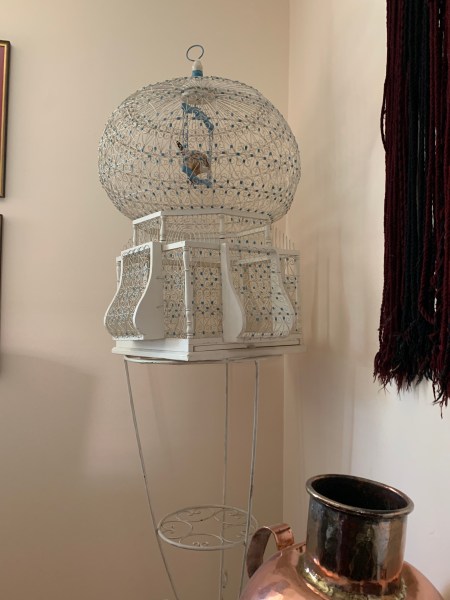
We were so young, but we saved our money and bought a bird cage from Monsieur Samouda, in Sidi bou Said, Tunisia, and had a crate built for it. We’ve had it for forty years now with many moves and no damage.
I have packed a lot of boxes in my life.
I’m finding that there are some things I can part with easily. And then some things I can’t let go.


We met and spent our early married years in Germany. This was our wedding candle, lo, those many years ago. I had to stop burning it on our anniversaries when it started to collapse. It still makes me smile. I can’t let go.
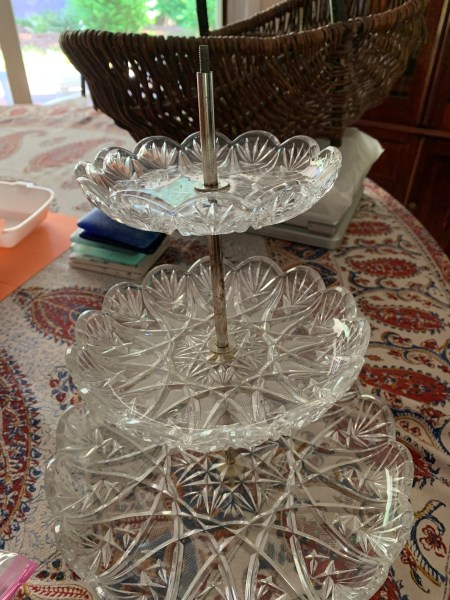
My Mother and Father were in the Wednesday night bowling league in Germany, and they were very good bowlers. They were also on the admin board of the league, and were in charge of the prizes, which they often won. Texting back and forth with my sisters today, I learned that they served on that committee to insure that each of the daughters received an identical crystal cookie tree, which my Mother won each year in the final tournament. Post-war Germany was a wonderland for Americans who lived there. I’m not ready to let this go. One sister let hers go long ago, the other is using hers to hold her jewelry.

I know I should let this pot go – I think it is a fish poacher – and I can’t. We bought it in the Souk al Hammadiyya in Damascus. I can tell I have cooked in it once or twice in the forty years I have owned it, not enough to make it valuable for its utility. The reason I can’t let it go is because of the artistry of the handle. Not even that it looks so beautiful, but the bird handle fits perfectly in your hand. It feels GOOD. I’ve never had any pot or pan that had such a sensuously lovely handle. Someone who made this handle really knew what he was doing, and created it with heart.
When my husband came home today, the first thing that happened when he saw the pot was that he reached for the handle, and then asked “are you thinking of parting with this?” I said “No, I can’t.”
I wish you could put your hand on this bird handle. It’s that special.

We have a family message thread with my son and his wife, who are moving to a larger home as we move to a smaller home. I often take photos and say “would you like this?” maybe with an explanation, and they say yes or no.
This time, AdventureMan texted back immediately: “Not the Kuwait Teapot from the Blue Elephant!” and I immediately packed it to take with us. When we first got to Kuwait, he planned to take me out for Valentine’s dinner, not realizing that it was one of the hugest date nights of the year in Kuwait. On Valentine’s Day, he called everywhere looking for reservations, but there were none to be had.
Being American, we like to eat earlier than Kuwaiti people, so I suggested we dress and go to the Blue Elephant, a favorite restaurant at the Hilton Hotel on the beach, where we were known. When we got there, there were only a few other couples.
“So go in there and beg,” I suggested with a grin, “Tell them we will eat quickly and be out in an hour.” I think he did exactly that. I don’t know what he said, maybe a little money changed hands, but very soon we were ushered to a table, and reminded that we needed to be out by eight, when the table was reserved.
We had a lovely dinner, at the end of which he bought me the little elephant teapot. What I love is that I am not the only one who can’t let go. 🙂
Confronting My Demons
I was showing the handy man a place under my sink which had flooded a while back and needs repair. It looks worse than it is, but it still needs fixing.
“Got enough dish detergent?” he asked with a twinkle in his eye.
I had hoped he hadn’t noticed. I had been pulling things out from under the sink so he could better see the damage. I hadn’t realized how many bottles of Dawn I had, it was embarrassing. I counted as I packed them away for the move. Nine bottles.
I am really uncomfortable about it, and I know where it comes from.
Growing up in Alaska, things would disappear. I remember my mother measuring us around August and ordering snowsuits. I remember her saying that the last boat would come in and after that it would be too late. People down the road had a cellar where every carrot, every potato, every home-canned tin of salmon or halibut would be toted up on a blackboard to get them through the long winter.
Later, when I married, I had a short overlap in Heidelberg with one of my sisters, whose one word of advice was “When you see something come in to the commissary or the PX and you think you might need it, buy it.”
Living in my early married years in Tunisia and Jordan, I always had to have plenty of some things with me – shoes in graduated sizes for my growing, American footed little son (yes, shoes vary by country, and German shoes are too wide for me, and French shoes are just right), books bought ahead to encourage his love of reading, chocolate chips because they just weren’t available, underwear that fit, things like that which impacted on quality of life.
It became a habit.
Every now and then as I go through the pantry, throwing out expired foods, I get a laugh. One year it might be an excess of mustard, another year I have a load of chicken broth, another year pickle relish, and always, a good supply of chocolate chips. Old habits die hard.
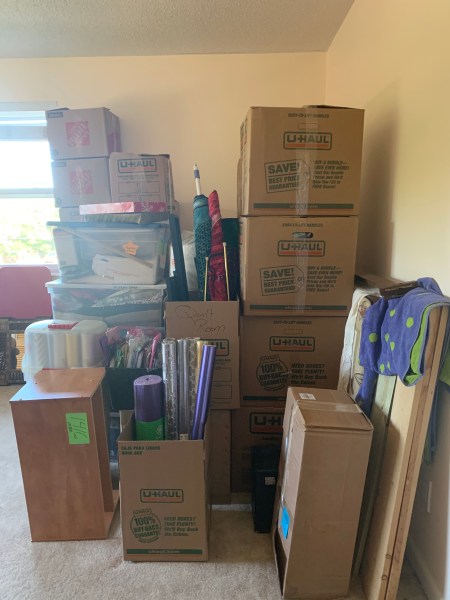
So now it comes to downsizing. I have too much of so many things. I have too many clothes, some from twenty or thirty years ago which I still wear. Too many swimsuits, because when they go on sale, I stock up. Too many towels (but some old ones I keep in case of hurricane, or flooding), too many sheets. We have too many books, and I am getting rid of bags and boxes full, too many fabrics (I got rid of a lot at the beginning of the year, before I even knew I was moving). As I pack boxes, I can hear the Afghani mover at my Kuwait apartment overlooking the Arab Gulf who said “Madame, you have too many things.”
He was right, and his words have echoed through the years, “you have too many things.”
Too many fabrics, too many threads, too many books, too much furniture, too much art. I haven’t even tackled the kitchen yet. I have beautiful brass trimmed copper pots and pans I bought in Damascus forty years ago, how can I give them up? Who will give them a good home? Who will love them just for being beautiful, and hand made?
I have old French things, from the antique fairs and flea markets, lovingly gathered through the years – old copper bedwarmers, a French cavalry trumpet, old tin milk containers. I won’t have space for all these old friends who have brought me so much pleasure, just by their existence, all these years.
My newest strategy is when I have a problem getting rid of something, I will move it. I expect this will be a continuing process, that in our new smaller digs I will look at things differently, more callously, and that necessity will give me some necessary ruthlessness.
Anyone need an extra Christmas tree . . . ?
Amazing Women Visiting Pensacola
When I first came to Pensacola, a woman at our church who is very welcoming and kind to newcomers told me she “wanted to find just the right place for me to plug in.” A couple of her suggestions were not exactly what I wanted, but then she introduced me to Jena Melancon, the founder and director of the Gulf Coast Citizens Diplomacy Council, and I found my niche.
Jena is an amazing woman. She has created this organization. She has a data base of resources that allow her to tailor visits for foreign delegates so that they can meet the needs of their missions – Election Transparency, Entrepreneurship, Environmental Protection, Leading an NGO, Military and Civilian Community Cooperation, Domestic Violence, Creating Fair Policies, Programs for Enriching Disadvantaged Children – you name it, Jena can create a program that will enrich their understanding from an American perspective.
At the same time, Pensacolians who come into contact with the delegates sent by the Department of State find that their lives are also enriched. Many times they, too, learn something new and unexpected. Both groups benefit.
Jena also has a group in GCCDC that studies Great Decisions, and creates events throughout the year for membership participation. Members of the Gulf Coast Citizens Diplomacy Council can volunteer in Jena’s office, can host dinners for delegates and have some one-on-one time learning about customs in another part of the world, can sponsor a Pensacola child in an international exchange, can host teenagers here on an international exchange, or attend the famous Mint Julep party in Spring. Many in the GCCDC are also resources; the exchange of ideas bringing inspiration to both sides.
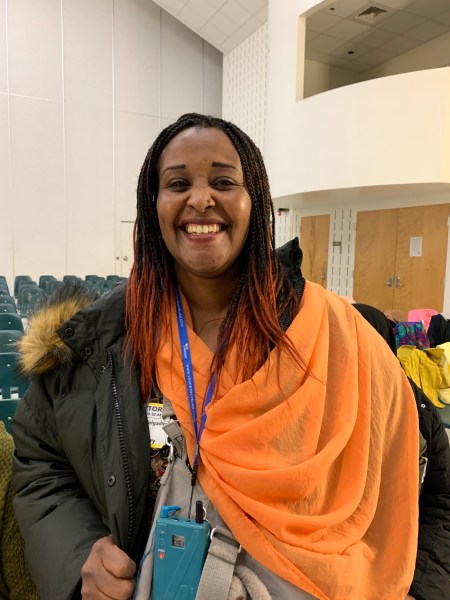
This week, I was honored to be able to work with a group of Women in Leadership, women from Chad, Iraq, Jordan, Saudi Arabia, Egypt and the Sudan. Each and every one of the women was a hero in her own right, making life better in their communities by stepping into leadership roles. Rehab, above, from the Sudan, works to empower women and to make the laws show greater equality in the treatment of men and women.

CPT Aseel is a police chief in Iraq.

Maki, from Chad, works to prohibit child marriages and female genital mutilation.

Mariam, from Saudi Arabia, is a high level journalist in the Saudi media industry, accepting honorary citizenship from the City of Pensacola city council chair Sherri Myers.
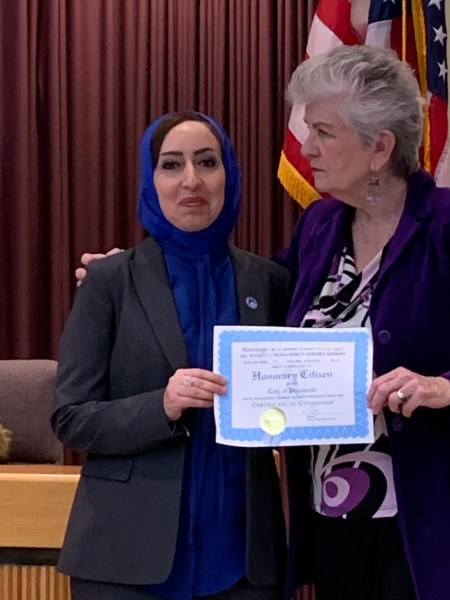
Wasfiya is a minister of parliament in Iraq.

Ola is the delegate from Jordan.
I was honored to spend three days of my life with these women, and with Jena, and with other inspirational women of Pensacola at the Women in Leadership conference at UWF.
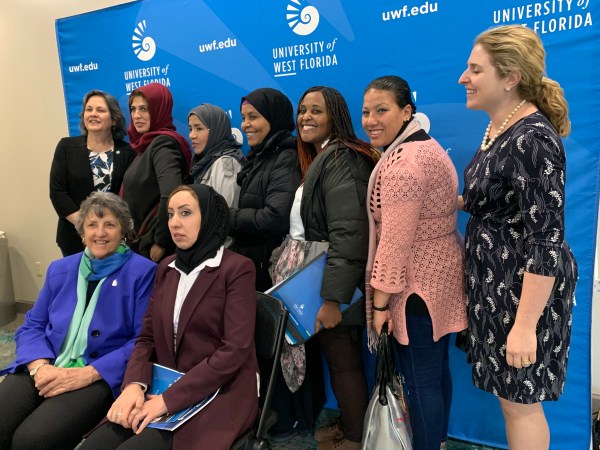
Here is most of the group with Judy Bense, President Emeritus of UWF, at the closing of the Women in Leadership conference, 2020. Life can be amazing when so many women of talent and confidence gather together to inspire one another.
Christmas Interlude
Starting to post my trip through the Bordeaux and Dordogne was ambitious, overly ambitious. Usually, I say I’m going to do something, and I do it. This time, no matter how well intentioned I was, life just got in the way. I knew I could continue to blog the trip, and do a half-good job, or I could devote the time and attention my real life needed.
We had a truly lovely Christmas, and for that, it takes care and attention. There are things that are not so necessary, but help to set the stage – decorating the house, preparing special meals, buying presents and wrapping packages, and then, best of all, spending time with the family you love.

The angels – I think they are Rosenthal – are from an earlier life in Germany. I don’t bring them out every year, I sort of rotate things so they don’t get stale.

The Christmas plates came from the old East Germany. Good friends took us to “the other side” in Berlin, as Christmas neared and I found these in a market. We only use them for Christmas breakfast, and we hand wash them, as I don’t know for sure how sturdy or dishwasher proof they might be.
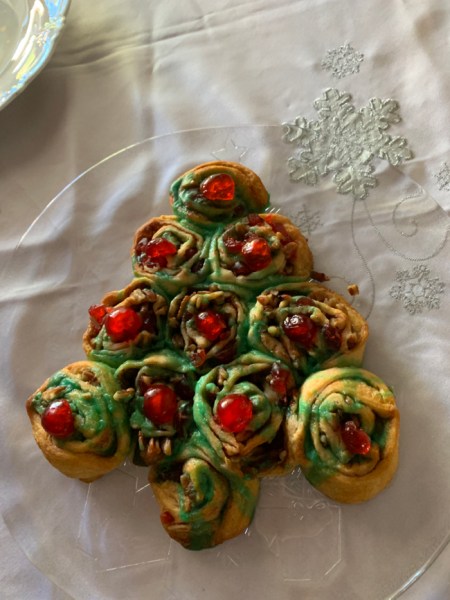
This Christmas tree made of cinnamon rolls is always a big hit, and so easy. I use the little cans that make croissants, just use the dough, put in candied cherries and cinnamon sugar and melted butter and roll it up, cut into slices, and bake as you see above. More candied cherries for decoration, icing made of powdered sugar, milk and food coloring. It looks complicated, but it is easy.
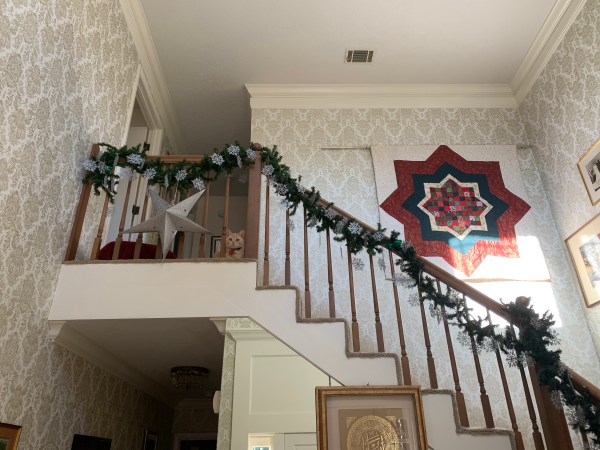
I used to use thousands of lights in my house at Christmas, and now I use none, thanks to two wire-chewing cats who have turned my rational life upside down.

Thanks be to God for the great gift of caffein, in the form of coffee, which powers me through it all.

And the highlight of our Christmas – the Christmas pageant at Christ Church, Pensacola, as the children tell, and act out the story of Christmas, and we sing songs to punctuate the different movements – Away in a Manger, We Three Kings, Hark the Heralds – and more. It is both light, often funny, and enormously moving.

Happy Christmas to all!
Recent Comments
intlxpatr on Yellowstone: Old Faithful to C… Michelle on Yellowstone: Old Faithful to C… Cathy on No Grown-Ups in Charge intlxpatr on Waiting for Snow intlxpatr on Waiting for Snow Wikipedia Donate Button

Amazina


Early Voting in Florida


 Here There and Everywhere
