Antarctic Ice Melting Faster Now than Last 1,000 Years
Found this morning on AOL News; this is not good news.

Summer Ice Melt In Antarctica Is At The Highest Point In 1,000 Years, Researchers Say
Reuters | Posted: 04/15/2013 2:39 am EDT | Updated: 04/15/2013 6:36 pm EDT
CANBERRA (Reuters) – The summer ice melt in parts of Antarctica is at its highest level in 1,000 years, Australian and British researchers reported on Monday, adding new evidence of the impact of global warming on sensitive Antarctic glaciers and ice shelves.
Researchers from the Australian National University and the British Antarctic Survey found data taken from an ice core also shows the summer ice melt has been 10 times more intense over the past 50 years compared with 600 years ago.
“It’s definitely evidence that the climate and the environment is changing in this part of Antarctica,” lead researcher Nerilie Abram said.
Abram and her team drilled a 364-metre (400-yard) deep ice core on James Ross Island, near the northern tip of the Antarctic Peninsula, to measure historical temperatures and compare them with summer ice melt levels in the area.
They found that, while the temperatures have gradually increased by 1.6 degrees Celsius (2.9 degrees Fahrenheit) over 600 years, the rate of ice melting has been most intense over the past 50 years.
That shows the ice melt can increase dramatically in climate terms once temperatures hit a tipping point.
“Once your climate is at that level where it is starting to go above zero degrees, the amount of melt that will happen is very sensitive to any further increase in temperature you may have,” Abram said.
Robert Mulvaney, from the British Antarctic Survey, said the stronger ice melts are likely responsible for faster glacier ice loss and some of the dramatic collapses from the Antarctic ice shelf over the past 50 years.
Their research was published in the Nature Geoscience journal.
(Reporting by James Grubel; Editing by Paul Tait)
Top Porn Sites Install Malware
Surprise, surprise, you go to porn sites, you get malware. The entire story, which comes from BBC News, can be read by clicking here.
Top porn sites ‘pose growing malware risk’ to users
By Dave Lee
Technology reporter, BBC News
Some advertisements were found to be installing harmful software on users’ machines without consent
Browsing some of the internet’s most popular pornography websites is increasingly putting visitors at risk, research has found.
Advertisements displayed by the sites, which are visited by millions every day, were found to be installing harmful files without users’ knowledge.
Daniel and the Vegetarian Diet
Most people I know these days are trying to eat less meat. In the readings for today, we start the story of Daniel, a story every Christian child learns in Sunday School, but when you read as an adult, you see different things. This morning, doing the readings from the Lectionary, I smiled to see that Daniel and his companions wanted only vegetables; they were working very hard not to violate their food laws.

I also wonder if not eating meat was helpful in the den of lions; maybe they smelled less interesting as vegetarians? Then again, lions eat impalas, wildebeest, all sorts of vegetarians, so that probably was not a factor . . . 🙂
Daniel 1:1-21
1In the third year of the reign of King Jehoiakim of Judah, King Nebuchadnezzar of Babylon came to Jerusalem and besieged it. 2The Lord let King Jehoiakim of Judah fall into his power, as well as some of the vessels of the house of God. These he brought to the land of Shinar,* and placed the vessels in the treasury of his gods.
3 Then the king commanded his palace master Ashpenaz to bring some of the Israelites of the royal family and of the nobility, 4young men without physical defect and handsome, versed in every branch of wisdom, endowed with knowledge and insight, and competent to serve in the king’s palace; they were to be taught the literature and language of the Chaldeans. 5The king assigned them a daily portion of the royal rations of food and wine. They were to be educated for three years, so that at the end of that time they could be stationed in the king’s court. 6Among them were Daniel, Hananiah, Mishael, and Azariah, from the tribe of Judah. 7The palace master gave them other names: Daniel he called Belteshazzar, Hananiah he called Shadrach, Mishael he called Meshach, and Azariah he called Abednego.
8 But Daniel resolved that he would not defile himself with the royal rations of food and wine; so he asked the palace master to allow him not to defile himself. 9Now God allowed Daniel to receive favour and compassion from the palace master. 10The palace master said to Daniel, ‘I am afraid of my lord the king; he has appointed your food and your drink. If he should see you in poorer condition than the other young men of your own age, you would endanger my head with the king.’
11Then Daniel asked the guard whom the palace master had appointed over Daniel, Hananiah, Mishael, and Azariah: 12‘Please test your servants for ten days. Let us be given vegetables to eat and water to drink. 13You can then compare our appearance with the appearance of the young men who eat the royal rations, and deal with your servants according to what you observe.’ 14So he agreed to this proposal and tested them for ten days. 15At the end of ten days it was observed that they appeared better and fatter than all the young men who had been eating the royal rations. 16So the guard continued to withdraw their royal rations and the wine they were to drink, and gave them vegetables. 17To these four young men God gave knowledge and skill in every aspect of literature and wisdom; Daniel also had insight into all visions and dreams.
18 At the end of the time that the king had set for them to be brought in, the palace master brought them into the presence of Nebuchadnezzar, 19and the king spoke with them. And among them all, no one was found to compare with Daniel, Hananiah, Mishael, and Azariah; therefore they were stationed in the king’s court. 20In every matter of wisdom and understanding concerning which the king inquired of them, he found them ten times better than all the magicians and enchanters in his whole kingdom. 21And Daniel continued there until the first year of King Cyrus.
Green Tea and Coffee Really Do Cut Stroke Risk!
I found the report of this newest survey on National Public Radio’s The Salt:
A Daily Habit Of Green Tea Or Coffee Cuts Stroke Risk
by ALLISON AUBREY
March 15, 2013

Whether it’s green tea that warms you up, or coffee that gives you that morning lift, a new study finds both can help cut the risk of suffering a stroke.
The study, published in the American Heart Association journal Stroke, included 82,369 men and women in Japan.
Researchers found that the more green tea a person drank, the more it reduced the risk of suffering a stroke.
“It’s almost a 20 percent lower risk of stroke in the green tea drinkers” who drank four cups a day, compared with those who rarely drank green tea, explains Dr. Ralph Sacco of the University of Miami. (He’s the past president of the American Heart Association, and we asked him to review the study for us.)
And with coffee, researchers found just one cup per day was also associated with about a 20 percent decreased risk of stroke during a 13-year follow-up period.
“I was still feeling rather surprised” about the findings, Dr. Yoshihiro Kokubo, the study’s lead author, tells The Salt in an email. Kokubo is a researcher at the Department of Preventive Cardiology, National Cerebra and Cardiovascular Center in Osaka, Japan.
Kokubo says that green tea contains compounds known as catechins, which help regulate blood pressure and help improve blood flow. The compounds also seem to promote an anti-inflammatory effect. Kokubo says coffee, which contains caffeine and compounds known as quinides, likely influences our health through different mechanisms.
It’s not just the Japanese who seem to benefit from drinking coffee and green tea. Over the past few years, researchers in the U.S. have documented similar reductions in heart disease risk among Americans.
“The accumulating evidence from a variety of studies is suggesting that green tea and coffee may be protective,” says Sacco.
And, in addition, recent studies have linked a regular coffee habit to a range of benefits — from a reduced risk of Type 2 diabetes to a protective effect against Parkinson’s disease.
It’s interesting to note how much the thinking about caffeine and coffee has changed.
In the 1980s, surveys found that many Americans were trying to avoid it; caffeine was thought to be harmful, even at moderate doses.
One reason? Meir Stampfer of the Harvard School of Public Health says back then, coffee drinkers also tended to be heavy smokers. And in early studies, it was very tough to disentangle the two habits.
“So it made coffee look bad in terms of health outcomes,” says Stampfer.
But as newer studies began to separate out the effects of coffee and tea, a new picture emerged suggesting benefits, not risks.
Researchers say there’s still a lot to learn here — they haven’t nailed down all the mechanisms by which coffee and tea influence our health. Nor have they ruled out that it may be other lifestyle habits among coffee and tea drinkers that’s leading to the reduced risk of disease.
And experts say when it comes to preventing strokes and heart attacks, no food or drink is a magic bullet. It’s our overall patterns of eating and exercise that are important.
“It’s a whole lifestyle approach, and we need to remember that,” says Sacco.
So if you are already in the habit of drinking coffee or green tea, this study is one more bit of evidence that you can go ahead and enjoy it.
Thought While Not Moving
We’ve been in Pensacola three years this month, or anyway, I have. AdventureMan retired, but went back twice to help out and to start things up on a major contract. He was retired, but useful.
The longest we’ve ever stayed in any one place was 6 years. The second longest was 4.5 years. There were some 6 month places, 10 month places, and three years was a long posting. I feel the internal clock ticking; I am cleaning out closets and drawers. No, I am not packing. No, I am not moving, but the habits are still there and don’t go away. Go through everything. Weed and cull. Pass along. Give away. Evaluate.
AdventureMan is fully engaged in a very different life from before, and it requires some adjustment – for both of us. You’d think my life wouldn’t be that different, I still do aqua aerobics, I spend time doing volunteer work, serving the church, meeting up with other quilters, etc., same life, different location, right? No No Noooooooooooooooooooo!
Take the spice drawers. AdventureMan still tells the story of when we first got married and I did my first big grocery shopping, setting up household. As he lugged bags and bags into the house, he jokingly asked if I had everything (his bachelor refrigerator kept beer cold; there was nothing else in it!) and I said no, that I had groceries, but I would have to go back for spices.
When I got back with two bags full of herbs and spices and cooking things like baking powder and baking soda, he was wide-eyed. He was thinking “salt . .. pepper . . . what else is there?” He still laughs about it, lo, these forty years later.
Three years in Pensacola has given me time to think about the spice drawers. They frustrated AdventureMan, and he offered to re-arrange them more logically, which almost started a nuclear war in our family dynamics. Logically, he is now doing more cooking and he should have more input, but it is really, really hard for me to give up territory in the kitchen, and, well, AdventureMan can be a little bit aggressive in amassing his territory.
But, after three years, I agree, the spice drawers are not working, and one reason is I got this state-of-the-art rubberized drawer liner, but it crept back and made the spices rise up and then the drawers got stuck open or closed and it really was frustrating.
Yesterday, I had the house to myself and because I hadn’t planned it, it wasn’t something I dreaded, I just started fiddling with the spice drawers, just editing, getting rid of some really old stuff, combining duplicates and . . . well, because I hadn’t put it on the “To Do List” it was fun. So much fun I decided to go all the way, take out the annoying rubberized liner and have some fun.
I’ve always loved great drawer liners. Good thing, huh? I’ve lined a LOT of drawers. There are some wonderful liners out there, but I love to use wrapping paper. Every now and then I’ll see a design I love, or something that thrills my heart. Because I moved so often, I knew it wasn’t a lifetime commitment, so I just had fun with it. And that is what I did yesterday.
I have some great wrapping paper I brought back that I went to a lot of trouble to get, flying down from Kuwait to Doha to go to the American Women’s Bazaar in November, where I knew there would be the vendor from Saudi Arabia who makes and sells these quirky, whimsical Arabic-themed wrapping papers that I loved to use for all the Christmas gifts and house-guest gifts I would take back three or four times a year. I hand carried several rolls of this paper back to Kuwait, then shipped it back to Doha when we moved back there, then shipped it again, carefully protected, to Pensacola when we retired.
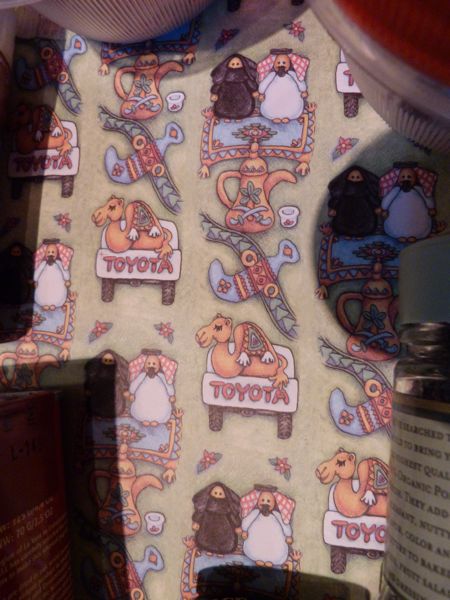
Here in Pensacola, however, it seems less and less relevant. I don’t use it to wrap my Christmas gifts like I used to because the gifts are no longer exotic surprises from the Middle East. And I still have a lot of this paper, paper which delights me, but for which I have no real purpose . . .
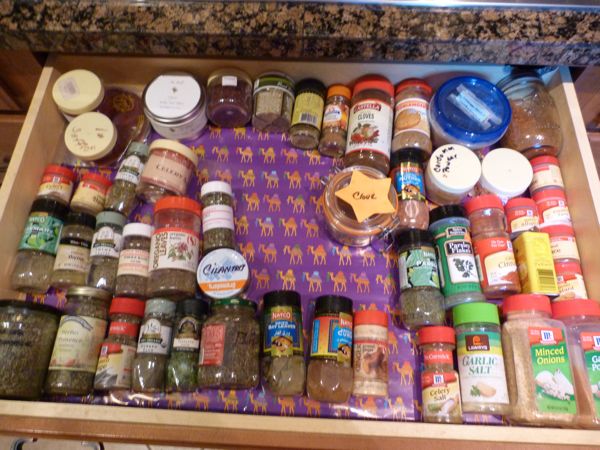
So I decided I would use it to line my spice drawers. I can see it every day and smile. It is making itself useful, and two or three years down the road when it is worn and needs replacing, I can find something else that delights my heart.
When AdventureMan comes in, I am just finishing up. I warn him, because he, like me, likes to know where things are.
“What’s the logic?” he asks, and I think “this is one of the reasons I married him; he knows to ask the most pertinent question.”
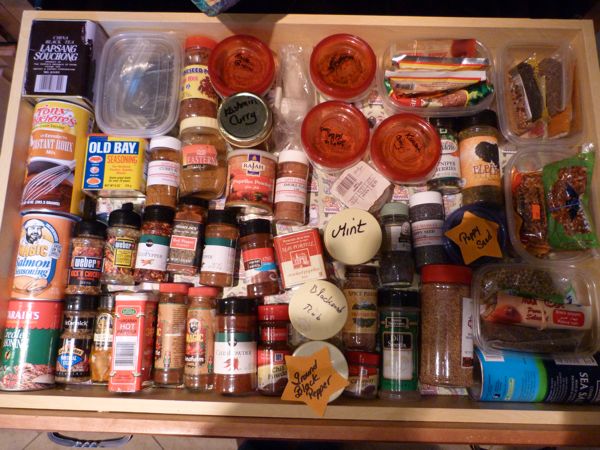
“Here are whole spices, seeds, peppers,” I tell him as I indicate a section, “and here are exotics, spices from the Gulf and Jordan and Tunisia. This section is grill mixtures and all kinds of chili powders and Creole mixes. Over here you have aromatics and baking spices, and here are the Italian and French herbs. The last section is onion and garlic powders and salts, flavored salts of all kinds, and frequently used multi-use herbs.”
He totally got it. 🙂
Processed Food vs Real Food Experiment
LOL, this is hilarious, and also frightening when you think what might be in the preserved sandwich.
There are four videos showing food non-deterioration, by Melanie Warner, author of Pandora’s Lunchbox: How Processed Foods Took Over the American Meal
Putting TEETH into Anti-Rape Solutions :-)
Thank you, Hayfa, you always find the most amazing articles. What I love about this one is that if everything is where it is supposed to be, nobody gets hurt. Only invasive behavior results in . . . .lets hope excruciating pain 🙂 It also gives an attacker something else to focus on. This invention is a public service.
Rape-aXe: The Anti-Rape Condom
This is so brilliant! An anti-rape female condom invented by Sonette Ehlers.… A South African woman working as a blood technician with the South African Blood Transfusion Service, during which time she met and treated many rape victims. The device, known as The Rape-aXe, is a latex sheath embedded with shafts of sharp, inward-facing microscopic barbs that would be worn by a woman in her vagina like a tampon. If an attacker were to attempt vaginal rape, their penis would enter the latex sheath and be snagged by the barbs, causing the attacker pain during withdrawal and (ideally) giving the victim time to escape. The condom would remain attached to the attacker’s body when he withdrew and could only be removed surgically, which would alert hospital staff and police. This device could assist in the identification and prosecution of rapists.

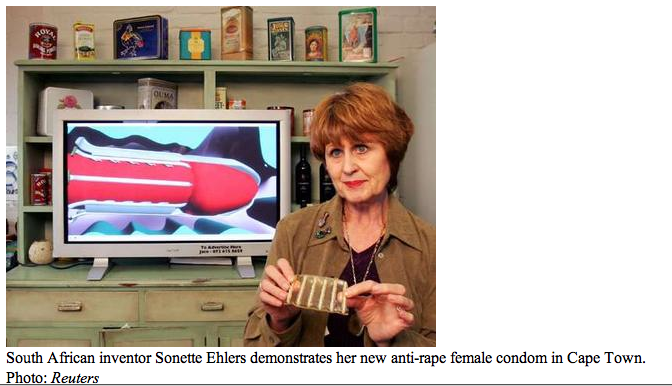
A medieval device built on hatred of men? Or a cheap, easy-to-use invention that could free millions of South African women from fear of rape, in a country with the world’s worst sexual assault record?
Dubbed the “rape trap”, trademarked “Rapex”, the condom-like device bristling with internal hooks designed to snare rapists has re-ignited controversy over South Africa’s alarming rape rate, even before plans for its production were announced in Western Capethis week.
Some say the inventor, Sonette Ehlers, a former medical technician, deserves a medal, others that she needs help.
The device, concealed inside a woman’s body, hooks onto a rapist during penetration and must be surgically removed.
Ms Ehlers said the rape trap would be so painful for a rapist that it would disable him immediately, enabling his victim to escape; but would cause no long-term physical damage and could not injure the woman.
Some women’s activists call the device regressive, putting the onus on women to address a male problem.
Charlene Smith, an anti-rape campaigner, said it “goes back to the concept of chastity belts” and would incite injured rapists to kill their victims.
“We don’t need these nut-case devices by people hoping to make a lot of money out of other women’s fear,” Ms Smith said.
But Ms Ehlers contends that South Africa’s rape problem is so severe women cannot wait for male attitudes to improve.
“I don’t hate men. I love men. I have not got revenge in mind. All I am doing is giving women their power back,” Ms Ehlers said. “I don’t even hate rapists. But I hate the deed with a passion.”
The United Nations says South Africahas the world’s highest per capita rate of reported rapes – 119 per 100,000 people. Analysts say the total, including unreported rapes, could be nine times higher.
Ms Ehlers sees her invention as particularly attractive to poorer black women, because they often walk long distances through unsafe areas to and from work. She foresees women inserting the device as part of a daily security routine.
She said a majority of women surveyed said they were willing to use the device, which will go into production next year and sell for one rand (20 cents).
Ms Ehlers said she was inspired after meeting a traumatised rape victim who told her, “If only I had teeth down there.”
New Study Shows Taking Folic Acid Cuts Autism Risk 40%
I heard this yesterday on NPR and found this article today on the Huffpost/AOL News. The critical factor is that a woman needs to be taking folic acid supplements BEFORE she gets pregnant:
With autism now affecting one in 88 children in the U.S., many parents are searching for any step they can take to help lower their child’s risk of developing the disorder. A new Norwegian study joins a small but growing body of research that suggests a simple, low-cost option already exists: Taking folic acid during the earliest stages of pregnancy could lower a child’s odds of developing autism by nearly 40 percent.
“This is a relatively inexpensive way that parents can take action to possibly prevent risk of tube birth defects and autism,” Alycia Halladay, senior director for environmental and clinical Sciences for the advocacy group Autism Speaks, told The Huffington Post. Halladay did not work on the new study, which was published online in the Journal of the American Medical Association on Tuesday.
Researchers analyzed a sample of more than 85,000 children born in Norway between 2002 and 2008 to study the effect of taking a folic acid supplement — typically between 200 and 400 micrograms per day — from one month before a woman got pregnant to two months after. Some .10 percent of children whose moms took folic acid supplements were diagnosed with autism, compared to .21 percent of those whose moms did not — which is equal to 39 percent lower odds.
The study does not establish a cause and effect relationship between the vitamin and subsequent autism, and its authors do not know why folic acid may have a protective effect. Study researcher Pal Suren of the Norwegian Institute of Public Health told HuffPost that folic acid is critical to the synthesis of DNA, which could play some role in the connection. Folic acid may also affect how certain genes are turned on and off in the body, he hypothesized, saying it was “not biologically implausible” that folic acid supplementation has certain epigenetic effects.
The new study also raises questions about how much folic acid may be needed to lower autism risk, as well as what form it must come in.
“We do not know how other dosages would have affected the risk of autism, or whether it matters if folic acid is taken as single tablets or as part of a prenatal multivitamin supplement,” Suren said.
The researchers took steps to ensure that the decreased risk was not just because women who took folic acid were also engaged in other healthy behaviors. To control for that, they looked at fish oil use (assuming women who took fish oil were also likely to be healthy in other ways) and found no link between lower autism risk.
Since the early 1990s, groups like the Centers for Disease Control and Prevention and the U.S. Public Health Service have recommended that all women of childbearing age take 400 micrograms of folic acid daily to help prevent neural tube defects — birth defects of the brain and spinal cord including spina bifida and anencephaly. Since folic acid was added to the grain supply in 1998, the U.S. has seen a 26 percent decrease in those neural tube disorders, according to figures compiled by the March of Dimes.
The possibility of a link between folic acid consumption and lower autism risk is far more preliminary. A 2011, California-based study in the journal Epidemiology found that mothers of children with autism were less likely to have taken a prenatal vitamin in the three months before pregnancy or in the first month after getting pregnant, suggesting that so-called “periconceptional” use of prenatal vitamins may reduce autism risk. In the U.S., prenatal vitamins typically include between 400 and 800 micrograms of folic acid.
But folic acid is by no means a magic pill, experts caution. The fact that rates of autism diagnosis have skyrocketed in the past several decades despite more and more women taking folic acid shows how complex the origins of autism are. The exact causes of the disorder, which is characterized by social and communication difficulties and repetitive behaviors, are still unknown.
“This is one way that risk may be reduced, but this isn’t the only way,” said Halladay. “It’s an inexpensive way to potentially reduce the risk of autism, but there are a number of risk factors — genetics and other environmental factors — that solidly contribute to risk.”
Green Tea Fights Dementia
Green Tea Could Aid Fight Against Dementia, Study Suggests
PA | Posted: 06/02/2013 11:18 GMT | Updated: 06/02/2013 11:18 GMT

Chemicals in green tea and red wine may block the brain damage caused by Alzheimer’s disease, an early study suggests.
Scientists targeted a process that allows harmful clumps of protein in the brain to kill off neurons.
Using purified extracts of the chemicals EGCG in green tea and resveratrol in red wine, they were able to stop nerve cells from being harmed.
The findings, published in the Journal of Biological Chemistry, could pave the way for new drugs to treat Alzheimer’s, say the researchers.
Lead scientist Professor Nigel Hooper, from the University of Leeds, said: “This is an important step in increasing our understanding of the cause and progression of Alzheimer’s disease.
“It’s a misconception that Alzheimer’s is a natural part of ageing; it’s a disease that we believe can ultimately be cured through finding new opportunities for drug targets like this.”
Alzheimer’s is characterised by a build-up of amyloid-beta protein in the brain which clumps together to form toxic, sticky balls.
The amyloid balls latch on to molecules called prions on the surface of nerve cells. As a result, the nerve cells start to malfunction and eventually die.
“We wanted to investigate whether the precise shape of the amyloid balls is essential for them to attach to the prion receptors, like the way a baseball fits snugly into its glove,” said Dr Jo Rushworth, another member of the Leeds team.
“And, if so, we wanted to see if we could prevent the amyloid balls binding to prion by altering their shape, as this would stop the cells from dying.”
Previous research had shown that the red wine and green tea compounds are able to reshape amyloid proteins.
When they were added to amyloid balls in a test tube, the toxic clumps of protein no longer harmed human and animal brain cells.
“We saw that this was because their shape was distorted, so they could no longer bind to prion and disrupt cell function,” said Prof Hooper.
“We also showed, for the first time, that when amyloid balls stick to prion, it triggers the production of even more amyloid, in a deadly vicious cycle.”
The next step for the team is to uncover exactly how the amyloid-prion interaction destroys neurons.
Prof Hooper added: “I’m certain that this will increase our understanding of Alzheimer’s disease even further, with the potential to reveal yet more drug targets.”
Dr Simon Ridley, from the charity Alzheimer’s Research UK which part-funded the study, said: “Understanding the causes of Alzheimer’s is vital if we are to find a way of stopping the disease in its tracks.
“While these early-stage results should not be a signal for people to stock up on green tea and red wine, they could provide an important new lead in the search for new and effective treatments. With half a million people affected by Alzheimer’s in the UK, we urgently need treatments that can halt the disease. That means it’s crucial to invest in research to take results like these from the lab bench to the clinic.”
Music Brings Alzheimer’s Patients Into the Moment
I saw this video over the Christmas holiday, and I can’t forget it. I know one of the reasons I love water aerobics is that they play all this rock music of my generation, and it gets us working hard, some even sing along, belting out the lyrics, LLOOLLL, I’m sure we look ridiculous, but oh, we have a great time and it makes exercise time pass more quickly.
This video shows the dramatic effect familiar music has on Alzheimer’s patients, bringing them out of their fog, however briefly, and animating them once again:
Recent Comments
ExpatAlien on What Country am I Living … intlxpatr on Yellowstone: Old Faithful to C… Michelle on Yellowstone: Old Faithful to C… Cathy on No Grown-Ups in Charge intlxpatr on Waiting for Snow Wikipedia Donate Button

Amazina


Early Voting in Florida


 Here There and Everywhere