Pouring Rain and a Herd of Sheep
Our first day in Seville, and we are so excited. We are READY. This trip is rated as having a lot of walking, so in addition to my prettier shoes, I packed my Alaska shoes, a pair of black leather New Balance shoes, and a bunch of brand new socks. I am wearing a dress and tennis shoes, and feeling a little ridiculous, but I don’t care. We are given these “whisper” things, receivers you wear around your neck and earbuds you keep in your ears. Your guide can talk to you without causing a commotion, and you are supposed to always stay within hearing of your guide.
As we head outdoors, the heavens open and the rain pours down. No problem, in my purse I have a brand new sort of mini umbrella I found, so I open it up, and something is not quite right. It doesn’t stay open, as I am walking along it will pop close all by itself now and then, and besides, everyone else is popping out umbrellas and it is congested, and umbrellas are dripping on me. I am miserable.
For a few minutes, I actually contemplate skipping this tour altogether, but when else will I get a chance to tour the Alcazar? The Seville Cathedral? With someone who knows and can tell us what we are seeing? I decide to have a good time, and, for the most part, I do.
Who could not love the Alcazar, the Royal Palace, even in the gloom and the rain? The Alcazar is full of groups, but far fewer than if it were not pouring down rain, sheets of rain.
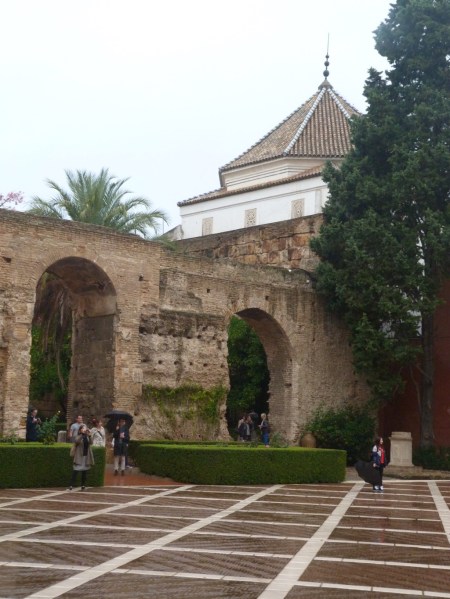
The amount thought and precision that went into the process of creating the Alcazar boggles my mind. What does a little rain matter when contemplating such beauty? So many media; tiles, wood, plaster, stone, and all used with precision and an eye for the overall effect. It is stunning.


And in the middle of all this artistry, one woman works to capture – herself.

I’ve given up totally on the worthless umbrella and decided to just avoid rain if I can, and if I can’t, oh well. Visiting the gardens, it’s worth getting wet. These gardens, even in the rain, are gorgeous, lush, and I can imagine summer concerts and strolling.


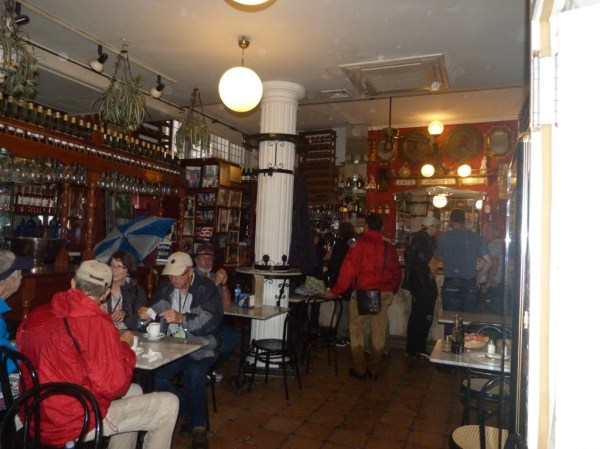
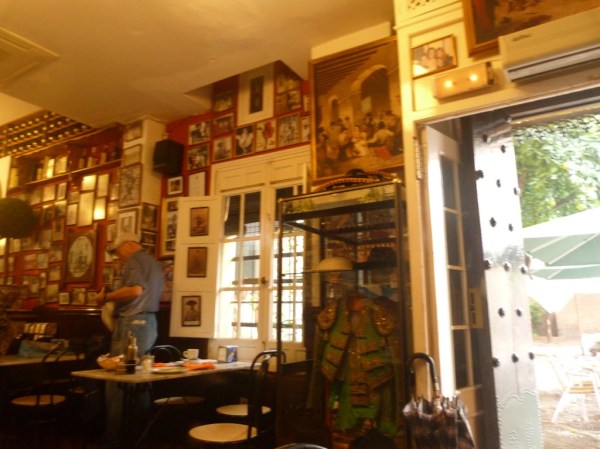
We spend a good long time in the Alcazar, and it is time to head to the Cathedral, but not quite our group’s scheduled time, so we head to a cafe for churros and chocolate, a local specialty. The cafe is so cozy we almost rebel when it comes time to leave. The guide tells us that leading seniors is as bad as leading teen-agers; we argue and think we know what we want to do. We are a small group, twenty people, but similar in goals and values.
It is warm and dry in the cathedral, but my dress is soaked. My shoes, however, are great, my feet aren’t tired, my socks are dry and I have already walked 10,000 steps! The hard floors of the cathedral tire me, though, so I wasn’t paying as close attention as I meant to. It was beautiful. King Ferdinand and Queen Isabella . . .. something. Beautiful altarpiece by . . . someone. A big gold thing called a montrance which is close enough to French for me to think it was for showing something, probably sacred relics, bones or pieces of the cross? I am ready to be warm and dry and my attention is definately wandering.
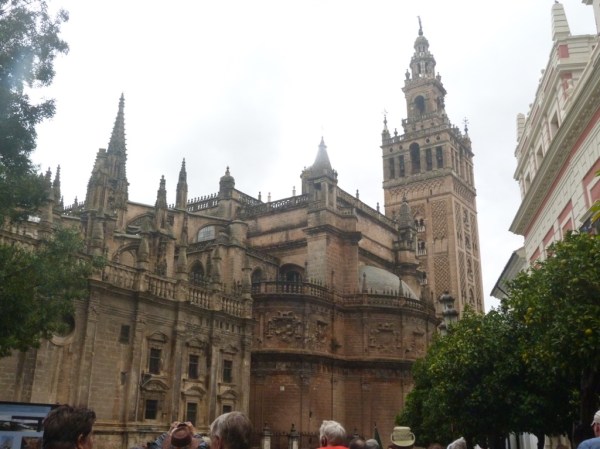


As we leave the Cathedral to head back to our hotel, just a short walk, the sun breaks through. The rain is gone. It’s a whole different day. We walk back in good cheer, change our clothes, and head out for lunch.
Today is the first day we have heard two dates: 711, when the Moslem Tariq invaded near Gibraltar (Jebal Tariq) and burned his ships, telling his men they had to fight because there was no way back. The second date is 1492, which every American associates with “Columbus sailed the ocean blue in fourteen hundred ninety-two” but we learned is the date when the Moslems were forced out of Al-Andalus. We saw paintings of people weeping as they left, and who wouldn’t weep, leaving such beauty and luxury? The same year, the Jews were also forced out, forced into North Africa, Italy, Eastern Europe, forced to seek safety elsewhere. Some converted and were allowed to stay, and are there to this day.
“But where is the herd of sheep?” you ask. This is an experiment for us, to see how well we can handle group travel. We are finding we like our fellow Smithsonian travelers very well, but because we are like cats (more than sheep) we do not herd well. We like to take our time where we wish to stay longer, and to hurry past that which doesn’t much interest us. We were trained, long ago, not to be in large groups of Americans, and here we are, a herd of sheep. It becomes a continuing theme; there are so many things we like, but walking in a group we don’t like.
Expendables; Pray for Paris

I have to take a break from my trip stories to express an opinion.
We are The People of the Book. Suicide is not an option. The most precious gift we are given, of the many gifts, is the gift of life. One of the most heinous crimes against God / Allah is to shed innocent blood.
A callous theocracy sends “inspired” martyrs, testosterone-hopped-up jihadists to kill themselves, and to take as many victims as they can with them.
By what stretch can they claim to do God’s will? Where is the submission to the word of God? Where is the peaceful Islam of the Prophet Mohammed?
Science and Entanglements
It’s been so long since I’ve last talked with you. I’ve been off on a great adventure, and I want to tell you all about it, but I’ve been recovering from a bug I caught the last day of our trip (I was so generous; I shared it with AdventureMan). Today is the first day I could really face blogging, and I was inspired by a reading I received this morning from Richard Rohr, whose religion and spirituality seem to hit me where I live.
Quantum Entanglement
Thursday, November 12, 2015
Just as different ways of interpreting scripture and various types of truth (e.g., literal vs. mythic) are valuable for different purposes, so scientific theories have different applications while seeming to be paradoxical and irreconcilable. For example, we have the Newtonian theory of gravity, Einstein’s theory of relativity, and quantum theory. Physicists know that each of them is true, yet they don’t fit together and each is limited and partial. Newtonian mechanics can’t model or predict the behavior of massive or quickly moving objects. Relativity does this well, but doesn’t apply to very, very small things. Quantum mechanics succeeds on the micro level. But we don’t yet have an adequate theory for understanding very small, very energetic, very massive phenomenon, such as black holes. Scientists are still in search of a unified theory of the universe.
Perhaps the term “quantum entanglement” names something that we have long intuited, but science has only recently observed. Here is the principle in layperson’s terms: in the world of quantum physics, it appears that one particle of any entangled pair “knows” what is happening to another paired particle–even though there is no known means for such information to be communicated between the particles, which are separated by sometimes very large distances. Could this be what is happening when we “pray” for somebody?
Scientists don’t know how far this phenomenon applies beyond very rare particles, but quantum entanglement hints at a universe where everything is in relationship, in communion, and also where that communion can be resisted (“sin”). Both negative and positive entanglement in the universe matter, maybe even ultimately matter. Prayer, intercession, healing, love and hate, heaven and hell, all make sense on a whole new level. Almost all religions have long pointed to this entanglement. In Paul’s letter to the Romans (14:7) he says quite clearly “the life and death of each of us has its influence on others.” The Apostles’ Creed states that we believe in “the communion of saints.” There is apparently a positive inner connectedness that we can draw upon if we wish.
Ilia Delio says, “If reality is nonlocal, that is, if things can affect one another despite distance or space-time coordinates, then nature is not composed of material substances but deeply entangled fields of energy; the nature of the universe is undivided wholeness.” [1] I’ve often described this phenomenon as an experiential “force field” or the Holy Spirit. In Trinitarian theology, the Holy Spirit is foundationally described as the field of love between the Father and the Son. One stays in this positive force field whenever one loves, cares, or serves with positive energy. I know that when people stand in this place, when they rest in love as their home base, they become quite usable by God, and their lives are filled with “quantum entanglements” that result in very real healings, forgiveness, answered prayers, and new freedom for those whom they include in the force field with them. I have too many examples here to list or to even remember. Jung called these events “synchronicities”; secular folks call them coincidences; the Sisters of Charity of Leavenworth, who taught me, called them Divine Providence.
On the other end of the spectrum there are people who carry death wherever they go, toward all those they can pull into their negative force field. (Is this hell?) I know that when I regress into any kind of intentional negativity toward anything or anybody, even in my mind, I am actually hurting and harming them. Etty Hillesum, a young imprisoned Jew in Nazi-occupied Amsterdam, says straightforwardly, “Each of us moves things along in the direction of war every time we fail to love.” And if so, it would surely follow that each of us moves things along in the direction of healing each time we choose to love. Each time it is a conscious choice and a decision, at least to some degree. Grace and guilt both glide on such waves of desire and intention.
Consciousness, desire, and intentionality matter. Maybe they even create and destroy worlds. We cannot afford to harbor hate or hurt or negativity in any form. We must deliberately choose to be instruments of peace–first of all in our minds and hearts. Such daring simplicity is quantum entanglement with the life and death of all things. We largely create both heaven and hell. God is not “in” heaven nearly as much as God is the force field that allows us to create heaven through our intentions and actions. Once quantumly entangled, it seems we are entangled forever, which is why we gave such finality and urgency to our choices for life (heaven) or death (hell).
This is such a “WOW” for me; I feel I can feed and nourish myself on this meditation for a long time. Google Richard Rohr’s Daily Meditation to sign up to receive his daily e-mail meditation.
Bureaucracy With a Heart
Did I tell you we’ve been stationed with two embassies, and at the second, I worked as a Foreign Service Officer? I know how busy and how harried the diplomats are, and I know how beleaguered the consular offices are with requests for visas and tourists who have lost their passports. They see it every day.
I lost my passport. My bad. Totally on me. I can’t expect anyone to feel obligated to help me out, but fortunately, there are mechanisms in place to expedite. You have to pay extra, but it’s worth it when you have a trip booked.
I told you about our run to New Orleans to submit paperwork and my delight to learn I would have a new passport soon.
I told you about the phone call telling me they needed a RECENT photo, not the same one that was on my last (never used, bright shiny new never used) passport.
I’ve been on edge all day. I’m away this weekend on a religious retreat, and I wasn’t feeling very religious. I was feeling nervous. I wonder if my passport reached New Orleans, or did it fall somewhere between the cracks? I wonder if Fridays are even work days at the passport center? What if it doesn’t get there and I don’t even know?
A short time ago, I got a phone call, from the same bureaucrat who called me about the photo. She was just calling to tell me that the passport is ready and will go out expedited this afternoon. She knew I would be concerned, and just wanted me not to worry.
I almost cried in gratitude. Who thinks of compassion when dealing with a bureaucracy? It was pure grace.
In the lifetime of our nation, we have elected some real doozies in high public office. Presidents, Senators, Representatives, Governors – some real characters. I don’t worry too much when lunatics run for high office, I thank God we have a solid bureaucracy, rarely corrupted; a bureaucracy that keeps plugging along when things get crazy. And thank God for this one particular officer who had a heart to reassure me that my passport is on the way. God bless her mightily.
“It’s Not Enough to Say ‘Hang in There” says Pope Francis
From the Associated Press
VATICAN CITY (AP) — The Vatican will shelter two families of refugees who are “fleeing death” from war or hunger, Pope Francis announced Sunday as he called on Catholic parishes, convents and monasteries across Europe to do the same.
Francis cited Mother Teresa, the European-born nun who cared for the poorest in India, in making his appeal in remarks to pilgrims and tourists in St. Peter’s Square.
“Faced with the tragedy of tens of thousands of refugees who are fleeing death by war and by hunger, and who are on a path toward a hope for life, the Gospel calls us to be neighbors to the smallest and most abandoned, to give them concrete hope,” Francis said.
It’s not enough to say “Have courage, hang in there,” he added.
It’s not enough to say “Have courage, hang in there,” he added.
In Pensacola, we have several top level Syrian doctors. Syria has been a crossroads of civilization for longer than the United States has been in existence. We can benefit by welcoming the Syrians and the Iraqis and the Afghanis into our own communities.
Four Reasons Why You Shouldn’t Worry – Rick Warren
I used to worry. It was in my bones. I learned to control my anxieties by running, and now, with water aerobics or a good run on my trampoline, and of course, with faith. Worry changes nothing, worry impedes finding solutions.
This is the message Rick Warren sends out today on worry:
Four Reasons Why You Shouldn’t Worry
By Rick Warren — Aug 10, 2015
“Do not worry about your life, what you will eat or drink; or about your body, what you will wear. Is not life more than food, and the body more than clothes?” (Matthew 6:25 NIV)
Worry is essentially a control issue. It’s trying to control the uncontrollable. We can’t control the economy, so we worry about the economy. We can’t control our children, so we worry about our children. We can’t control the future, so we worry about the future. But worry never solves anything! It’s stewing without doing.
Jesus actually gives four reasons you don’t need to worry in his Sermon on the Mount.
Worry is unreasonable. Matthew 6:25 says, “Do not worry about your life, what you will eat or drink; or about your body, what you will wear. Is not life more than food, and the body more than clothes?” (NIV) Jesus is saying, if it’s not going to last, don’t worry about it. To worry about something you can change is stupid. To worry about something you can’t change is useless. Either way, it’s unreasonable to worry.
Worry is unnatural. Jesus gives us an illustration from nature in Matthew 6:26: “Look at the birds of the air; they do not sow or reap or store away in barns, and yet your heavenly Father feeds them. Are you not much more valuable than they?” There’s only one thing in all of God’s creation that worries: human beings. We’re the only things God has created that don’t trust him, and God says this is unnatural.
Worry is unhelpful. It doesn’t change anything. Matthew 6:27 says, “Can any one of you by worrying add a single hour to your life?” When you worry about a problem, it doesn’t bring you one inch closer to the solution. It’s like sitting in a rocking chair — a lot of activity, energy, and motion, but no progress. Worry doesn’t change anything except you. It makes you miserable!
Worry is unnecessary. Matthew 6:30 says, “If God cares so wonderfully for flowers that are here today and gone tomorrow, won’t he more surely care for you, O men of little faith?” (TLB) If you trust in God, you don’t need to worry. Why? Because he has promised to take care of all your needs: “God will meet all your needs according to the riches of his glory in Christ Jesus” (Philippians 4:19 NIV).
Does that include bills? Yes. Does that include relational conflicts? Yes. Does that include your dreams and goals and ambitions? Yes. Does that include the health issues you don’t know what to do with? Yes. God will meet all your needs in Christ.
Don’t worry about it!
Praying for Ruaha
Today in the Anglican Cycle of Prayer, we pray for the Diocese of Ruaha, in Tanzania.
We have such happy memories of exploring the Ruaha, and Selous. Many people visit the more famous sites in northern Tanzania, but fewer go to the more remote south. Wonderful people, we learned so much there.

Celebration at the Seville
“I think we ended up exactly where we were meant to be,” AdventureMan said as we drove away, and I love him for thinking that, and saying that. I think so, too.
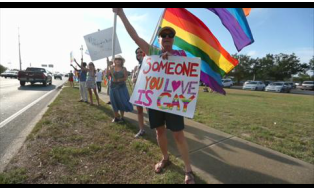
It’s been an amazing week.
I’m tempted to say, about so many of the subjects, “I don’t have a dog in that fight,” and yet, somehow, I do.
Our Supreme Court is been so greatly conservative that I had no hopes that so many decisions would come down on the side of what I consider human dignity.
We have great medical coverage, thanks to what is truly socialized medicine – life time medical care through career military service coupled with the medicare that United States citizens receive when we turn 65. So when people complain about “socialized medicine,” I just laugh and say I love my socialized medicine. It pays almost all my medical bills.
So why does it matter to me that others have affordable health care?
I worked with the homeless for a year, with homeless families. It was a program; we provided housing, some food, and counseling, and guided our residents into degree programs, assistance programs that would lead them to an ability to self-sustain.
What I learned, over and over, was stunning. Many women with children are one man away from homelessness. Women with children are exceedingly vulnerable. When a child gets sick, unless you are protected by family, the child cannot go to day care and Mama has to stay away from work to take care of them. Too many absences and that job disappears. No insurance, and the costs are those hugely exaggerated sums you see on your reconciliation sheets your insurance sends – what the cost is, what insurance pays, what your share is. IF you have insurance, your insurance company has negotiated the costs, and those costs are considerably less than if you don’t have insurance. The least able to pay are charged the most. Is that fair? I thank God for affordable care, so that all people have access to decent health care for themselves, and for their children.
It was teetering on the balance. Which way would the Supreme Court decide on this technicality? By the grace of God, the majority opinion was that law is tough enough to write and often mis-written and corrected before the ultimate wording is finalized. This was no exception; it needed refinement but the intent was clear. Affordable care is the law.
The poor and the minorities are not to be discriminated against in housing, either, the Supreme Court decided. Again, it’s not my fight, no one has ever discriminated against us, except for being military (and the implication was that military was riff raff). The significance here was that even if the discrimination was not clearly intentional, if it was discrimination, it was not allowed. It levels the field; makes life more fair for all of us.
And last. That people who want to marry will have the dignity of that right. That those people will have the same legal rights, rights that guarantee inheritance, rights that guarantee access to the partner that becomes hospitalized, rights to make legal decisions as a legal married couple. Again, AdventureMan and I, one man and one woman, are married, so we don’t have a dog in the fight – except that as human beings, we want the laws to be fair, and humane, and applicable to all. We have no say over how we are wired or who we love, and, as we see it, no right to restrict others from what we have chosen for ourselves.
We’ve had a great day. We went to early service, where Father Goldsborough spoke as a Southerner, and how his views have changed, and how he believes that if the Confederate flag is a cause of grief and horror to those whose family were once enslaved, that that flag should be retired. Yes, keep it as history, display it in museums, but not as a part of a public, governmental display. He is a courageous man.
And while I agree that it is time for the flag to be retired, the flag is just a symbol.
It is a kid that killed the bible study participants in South Carolina. It was a kid with a powerful GUN. So why are we not talking about gun control? I have the feeling that a lot of people are willing to pull down the Confederate flag in hopes that it will keep the attention off the fact that people with problems who have access to guns are the problem. Sure, you can kill with a knife, or a car, or a hundred other ways, but nothing beats a gun for killing efficiently, and no gun beats an automatic weapon for super efficient killing.
I headed straight for the commissary to do some weekly grocery shopping, while AdventureMan spent time in the garden. I got the groceries unloaded, and dinner started. AdventureMan came in and invited me to lunch at my favorite place, Five Sisters.
When we got to Five Sisters, every table was full and lines and groups of people were scattered around waiting. We headed to the Fish House for some fish and grits, but it was the same story. So we headed for Saville, where we found a parking place and while it was crowded, very crowded, we got a place in the Palace Bar, which we like anyway, and we liked that it was away from the music and we could talk.
After we ordered, I said “I think we are in the middle of a celebration,” and he agreed. We were surrounded by a very large group of guys about our age, but we had to guess they were gay, and they were all very celebratory. In fact, much of the restaurant was moving from table to table, hugging and exchanging greetings and congratulations.
The last time I remember feeling this way was in Alaska, last year, for The Celebration, where all the tribes gather to share culture and dances.
On our way out, I leaned over and said “Congratulations! We wish you happiness!” and they thanked us and we left.
Except, LOL, I had dropped my sunglasses, and we had to go back in. “Stop, stop!” our friends at the next table asked us, and thanked us again for our ‘kind words.’ But they needed to talk. It wasn’t about the right to get married, they explained, each jumping over the other in speech in eagerness to explain, “it is about legal rights in hospitals” said one “the right to be who we are” said another. These were men about my age, and they needed to be heard. I told them that I remember Juneau, Alaska, and I don’t remember any gay people. I said there must have been, but I never knew of any, and one man said “that was me! Imagine growing up knowing you are seriously different, that you like boys and not girls, and who do you talk to? There was NO-ONE!”
These guys had been married for varying amounts of time, but this weeks Supreme Court decision eliminated the anxiety that things could change, that a change in president could signal a cascade of change in state laws and the hard-won battles would have to be fought again. “The only person left in my family who would have the right to say whether to take me off life-support or not is a person who would likely say “pull the plug!” and my husband would have no say at all, before this decision!” one said, and the husband added “and she could keep me out of his hospital room, even though we’ve been married for years!”
I would have loved to hear more, but this was their celebration. It was like one huge wedding celebration, so much love, so much happiness, so much joy.
“I can be who I am!” one said to me, with such emotion. “I can be who I am!”
I almost cried with joy for him, for all of them. They have seen such change, from living their lives in hiding to being able to live legally, freely, as who they are. We were moved by their joy, moved beyond words. We felt so honored to have been able to share a little of their joy, even though – this isn’t our dog, this isn’t our fight, it isn’t our win.
Except, except that as human beings, maybe it all IS our dog, and is our fight. Maybe it is our win. Maybe, as Jesus says, we are all connected, we are all meant to love one another, and as weird as we are, as eccentric, as different, maybe we are all meant to love one another and to live in peace with one another. Maybe the dignity of every human being is relevant to my own . . .
It’s a heady thought for a celebratory Sunday.
Ramadan Kareem and Pope Francis
“God bless the work of your hands!” was one of the Moslem sayings I most loved as I lived my daily life in various countries in the Middle East. So, Pope Francis, God bless the work of your hands yesterday in your encyclical saying we are all responsible for the price we pay for progress. You are a brave man, and you don’t hesitate to name corruption when you see it, and to do your best to correct us, and straighten the path of the Lord.
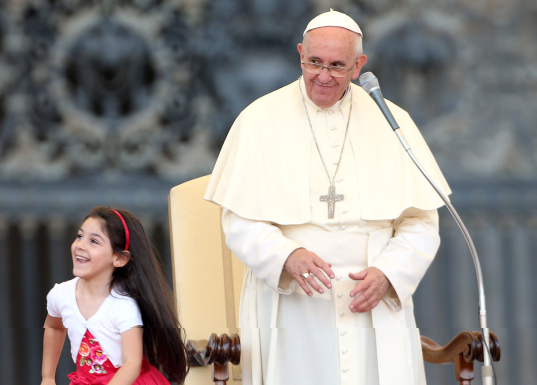
“Everything is related, and we human beings are united as brothers and sisters on a wonderful pilgrimage, woven together by the love God has for each of his creatures and which also unites us in fond affection with brother sun, sister moon, brother river and mother earth,” he writes.
It is not entirely a happy message for me. One of the items he castigates is air conditioning, and as Pensacola hits the nineties every day, I hate to think of how I would live without air conditioning. I think I would turn into a slug, swinging in my hammock for hours every day reading a book. My house would be full of dirty dishes and dust. And I remember living in Tunis, and in Jordan, without air conditioning. We managed, by the grace of God.
Meanwhile, during the hottest months of the year, yesterday, our Moslem brothers and sisters began Ramadan, the holy month of fasting and personal purification. Imagine, going all day without water and without food, breaking the fast only as the sun goes down. I wonder if the Pope made his world-changing address on the eve of Ramadan on purpose, as he clearly made it to all mankind, not only to his Catholic followers.
Ramadan Kareem, my Moslem brothers and sisters, whom I cherish, and who taught me so much. May your fasting bring you great insights and purity of spirit.
“A Bribe Blinds the Eyes of the Wise”
i will confess Deuteronomy, with all it’s rules and admonitions, is not my favorite book in the bible, and yet I love the words about bribery found in today’s Old Testament reading from the Lectionary:
Deuteronomy 16:18-20,17:14-20
18 You shall appoint judges and officials throughout your tribes, in all your towns that the Lord your God is giving you, and they shall render just decisions for the people. 19 You must not distort justice; you must not show partiality; and you must not accept bribes, for a bribe blinds the eyes of the wise and subverts the cause of those who are in the right. 20 Justice, and only justice, you shall pursue, so that you may live and occupy the land that the Lord your God is giving you.
14 When you have come into the land that the Lord your God is giving you, and have taken possession of it and settled in it, and you say, ‘I will set a king over me, like all the nations that are around me’, 15 you may indeed set over you a king whom the Lord your God will choose. One of your own community you may set as king over you; you are not permitted to put a foreigner over you, who is not of your own community. 16 Even so, he must not acquire many horses for himself, or return the people to Egypt in order to acquire more horses, since the Lord has said to you, ‘You must never return that way again.’ 17 And he must not acquire many wives for himself, or else his heart will turn away; also silver and gold he must not acquire in great quantity for himself.
18 When he has taken the throne of his kingdom, he shall have a copy of this law written for him in the presence of the levitical priests. 19 It shall remain with him and he shall read in it all the days of his life, so that he may learn to fear the Lord his God, diligently observing all the words of this law and these statutes, 20 neither exalting himself above other members of the community nor turning aside from the commandment, either to the right or to the left, so that he and his descendants may reign long over his kingdom in Israel.
Recent Comments
intlxpatr on Shampoo Ginger tigerbutterya0c5ff1d… on Shampoo Ginger intlxpatr on British Soldier Kidnapped, Esc… John on British Soldier Kidnapped, Esc… intlxpatr on British Soldier Kidnapped, Esc… Wikipedia Donate Button

Amazina


Early Voting in Florida


