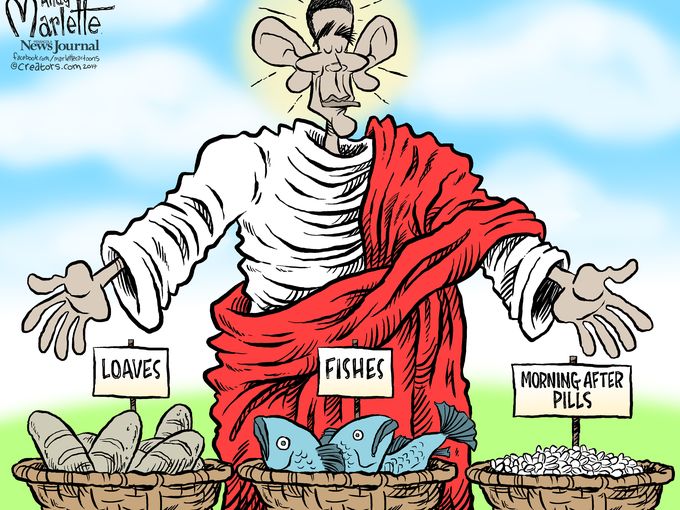
They sign up for Hunger Games and get domestic drudgery and uber-control:
From Associated Press via Huffpost
PARIS (AP) — When three British schoolgirls trundled across the Syrian border; when a pregnant 14-year-old ran away from her Alpine home for the second time; when a sheltered girl from the south of France booked her first trip abroad — they were going to a place of no return.
Only two of the approximately 600 Western girls and young women who have joined extremists in Syria are known to have made it out of the war zone. By comparison, as many as 30 percent of the male foreign fighters have left or are on their way out, according to figures from European governments that monitor the returns.
In interviews, court documents and public records, The Associated Press has compiled a detailed picture of European girls and young women who join extremists such as the Islamic State group — a decision that is far more final than most may realize.
The girls are married off almost immediately, either in Turkey or just after crossing into Syria. With an estimated 20,000 foreign fighters — among them 5,000 Europeans — in Syria, there is no shortage of men looking for wives. That number is expected to double by the end of the year. Once among the jihadis, the women are not permitted to travel without a male chaperone or a group of other women and must remain fully covered outside, according to material published by Islamic State and researchers who follow the group. Otherwise, they risk a lashing or worse.
European women who blog about their lives under Islamic State tend to be chipper about the experience, but reading between the lines of an e-book of travel advice shows a life that will be radically circumscribed, with limited electricity, lack of even the most basic medicine, and practically no autonomy. Women do not fight, researchers say, despite the Hunger Games-like promises of recruiters.
“The lives of those teenage girls are very much controlled,” said Sara Khan, a British Muslim whose group Inspire campaigns against the dangers of extremist recruiters. “I don’t think that discussion ever comes up. It’s so romanticized, the idea of this utopia. I don’t even think those young girls have necessarily considered that there’s no way back now.”
The two exceptions to the rule of no return are perhaps most revealing in the very paucity of details about their journey — driving home how murky life is behind the Islamic State curtain.
Sterlina Petalo is a Dutch teenager who converted to Islam, and came to be known by the name Aicha. She traveled to Syria in 2014 to marry a Dutch jihadi fighter there and managed to return months later — apparently making her way to the border with Turkey, where her mother reportedly picked her up and brought her back to the Netherlands. Back home, she was immediately arrested on suspicion of joining a terror organization.
Her family, lawyers and prosecutors refuse to discuss the case. She was released from custody last November and has not been formally charged.
The second woman known to have made it out of the grip of Islamic State reconsidered after just a few weeks. The 25-year-old Briton, whom police have not named, had taken her toddler son all the way to Raqqa, the group’s stronghold, when she decided she had made a mistake and called home. She made her way back into Turkey and her father met her there. How she was able to travel the 250 kilometers (150 miles) from Raqqa to the Turkish border city of Gaziantep is not clear. Back in Britain, she was detained and is now free on bail pending formal charges.
Without knowing how the two escaped, it is difficult to say whether other girls and women could follow their path out of Syria, said Joana Cook, a researcher at King’s College London who studies the links between women and jihad.
“There are clearly many human smugglers working within Syria right now, helping Syrian civilians escape the violence, and I wonder if there is a similar, perhaps even growing market, for those trying to escape after joining ISIL,” Cook told The Associated Press in an email, using one of the acronyms for the Islamic State group. “There is great disillusionment for many who have traveled to Syria to join ISIL and you’ll find many stories of those who went abroad noting ‘this isn’t what we signed up for.'”
The question is whether the girls understood from the beginning how limited their choices would be once they crossed the frontier.
The case of a 15-year-old Avignon girl exemplifies such doubts. The girl hid her second Facebook account and Islamic veil from her moderate Muslim family, thereby managing to join a jihadi network, according to the family’s lawyer. Once within a unit of the al-Qaida offshoot Nusra Front, she was not permitted to leave, according to her brother, who went into Syria to fetch her and was turned away by the extremists. A French boy who joined the group around the same time was allowed to go home.
“I think they understand the premise of that, but not that they understand it in reality,” said Melanie Smith, another researcher at King’s College ICSR.
The networks that bring the women into Syria are increasingly organized around the extremists’ dream of building a nation of multinational jihadis, meaning European girls are particularly prized. Each new Facebook post, each new cheerleading Twitter account — and they pop up by the hour — helps them subvert government efforts to prevent young people from radicalizing and leaving.
The doggedness of jihadi methods for recruiting girls can be seen in the case of Amelia, a 14-year-old girl from France’s Alpine Isere region.
Amelia was first contacted on Facebook by a French fighter on Jan. 14, 2014 and within a month agreed to go to Syria and marry the man, who identified himself as “Tony Toxiko.” After she was turned back by airport border police in Lyon on her first attempt, “Tony Toxiko” persuaded another French adolescent girl to join him in Syria.
Amelia, meanwhile, ran away from home to Belgium, where an imam performed a religious ceremony that wed her to a different man, an Algerian jihadi. She returned to France homesick and pregnant, just long enough to speak to investigators building a case against a middleman who helped her run away. This winter, Amelia managed to deceive her family and left again — making it to Syria with the Algerian fighter, who is more than twice her age.
“It’s particularly difficult for these families. For them, radicalization is happening on the Internet and outside the family sphere,” said Sebastien Pietrasanta, a French lawmaker working on a program to de-radicalize young people. “For a girl of 14, I believe we can clearly save her from herself and save her from these barbarians.”
A French journalist got dangerously close to jihadi recruitment methods by creating a fake Facebook account that attracted a marriage proposal from a fighter in Syria.
Under the pseudonym Melodie, the journalist shared a video on the account, almost immediately getting a message from a man identified as Bilel, who asked how she’d liked the montage of him showing off in a 4X4 and with his weapons.
“I passed myself off as a 20-something, not stupid but a little lost, who suddenly found a huge response from a man in Syria,” said the journalist, who wrote a book “In the Skin of a Jihadist” under a pseudonym.
Bilel’s doubts about her began to grow as her reluctance to join him became clear. She ended up getting threats that she said would likely frighten a bewildered young woman into submission. As it was, the journalist, who never met Bilal in person, remains under constant police protection a year later.
“We’ll find you, we have the best operators here, you don’t know what you’re getting into, you’re messing with a terrorist group, you and your family will pay,” the woman said, recounting the litany of threats she received after returning to France. “If they were speaking to a 20-year-old, it would be very hard for her.”
___
Associated Press writer Mike Corder in Amsterdam contributed.
May 28, 2015
Posted by intlxpatr |
Adventure, Bureaucracy, Community, Cultural, ExPat Life, Faith, Family Issues, Generational, Living Conditions, Marriage, Mating Behavior, Middle East, Political Issues, Social Issues, Women's Issues | IS, ISIL, ISIS |
Leave a comment
We have guests in town from another country who are living with Americans and visiting many others.
One of them asked her host “Do all Americans worship idols?” and the host was flummoxed.
We have been in private houses of the most religious Muslims, and their houses look very different from ours. They have nothing on the walls, except perhaps a picture of the Kaaba in Mecca, or a beautiful calligraphy in Arabic with one of the Surahs. To us, the houses look very plain, but they are being careful to observe carefully the word of the Lord.
We don’t consider the objects in our homes idols because we don’t worship them. When I read today’s Lectionary reading from Deuteronomy, I have to rethink what God might thing idols are.
Deuteronomy 4:15-24
15 Since you saw no form when the Lord spoke to you at Horeb out of the fire, take care and watch yourselves closely, 16 so that you do not act corruptly by making an idol for yourselves, in the form of any figure—the likeness of male or female, 17 the likeness of any animal that is on the earth, the likeness of any winged bird that flies in the air, 18 the likeness of anything that creeps on the ground, the likeness of any fish that is in the water under the earth. 19 And when you look up to the heavens and see the sun, the moon, and the stars, all the host of heaven, do not be led astray and bow down to them and serve them, things that the Lord your God has allotted to all the peoples everywhere under heaven. 20 But the Lord has taken you and brought you out of the iron-smelter, out of Egypt, to become a people of his very own possession, as you are now.
21 The Lord was angry with me because of you, and he vowed that I should not cross the Jordan and that I should not enter the good land that the Lord your God is giving for your possession. 22 For I am going to die in this land without crossing over the Jordan, but you are going to cross over to take possession of that good land. 23 So be careful not to forget the covenant that the Lord your God made with you, and not to make for yourselves an idol in the form of anything that the Lord your God has forbidden you. 24 For the Lord your God is a devouring fire, a jealous God.
May 26, 2015
Posted by intlxpatr |
Cross Cultural, Cultural, ExPat Life, Faith, Friends & Friendship, Interconnected, Lectionary Readings, Saudi Arabia, Spiritual, Venice | Idols |
Leave a comment
Today the church prays for the diocese in Mbeere, in Kenya. It is north of Nairobi, mountainous, farming area.

March 3, 2015
Posted by intlxpatr |
Africa, Faith, Geography / Maps, Lectionary Readings, Lent | Kenya |
2 Comments
Last week, we were in Atlanta, and stayed near a small town called Smyrna. We wondered several times where ancient Smyrna was, guessing Greece or Turkey. We were both right.
Today, the church remembers Polycarp, Bishop and Martyr of Smyrna. It is timely. There is a saying, the more things change, the more they stay the same (“plus ça change, plus c’est la même chose” – Alphonse Kerr) – and today, too, we are seeing people killed for what they believe, when they do not fall into step with the specific style of belief of the crowd. Oh, the things we do in God’s name!
The Liturgical Calendar: The Church Remembers
Today the church remembers Polycarp, Bishop and Martyr of Smyrna, 156.
Polycarp, Bishop of Smyrna in what is now called Turkey, did not seek martyrdom and did not encourage others to do so. When persecution broke out, Polycarp made every honorable effort to protect his flock and himself. He even hid in the country but, eventually, the authorities found him.Since Christians worshiped Jesus Christ, an “unauthorized god,” and since they refused to worship the Roman gods or the “Divine Caesar,” they were considered atheists and subversives.
At a great public festival in the arena in Smyrna, Polycarp was presented to the governor amid cries of “Kill the atheist!” from the excited and unruly mob. The governor admonished Polycarp to swear by Caesar and to revile Christ and thereby save himself. The old bishop’s famous reply was, “For eighty-six years I have been his servant and he has done me no wrong; how can I blaspheme my King who has saved me? . . . You pretend not to know who I am; let me tell you plainly, I am a Christian. If you want to learn the doctrine of Christianity, set a day and hear me.”
Polycarp was publicly burned to death.The Christians in Smyrna who escaped death in this wave of persecution wrote a letter describing the execution of their great bishop and sent it to other churches. We still have this famous letter, “The Martyrdom of Polycarp.”
May we always share the tidings of the King who has saved us. Amen.Read the
Wikipedia article here.
O God, the maker of heaven and earth, you gave your venerable servant, the holy and gentle Polycarp, boldness to confess Jesus Christ as King and Savior, and steadfastness to die for his faith: Give us grace, following his example, to share the cup of Christ and to rise to eternal life; through Jesus Christ our Lord, who lives and reigns with you and the Holy Spirit, one God, now and for ever. Amen.
February 23, 2015
Posted by intlxpatr |
Character, Circle of Life and Death, Civility, Community, Faith, Interconnected, Lectionary Readings, Living Conditions, Quality of Life Issues, Spiritual | Polycarp, Smyrna |
Leave a comment
Today the church prays for the troubled and sometimes controversial diocese of Manicaland, in Zimbabwe.

February 16, 2015
Posted by intlxpatr |
ExPat Life, Faith, Interconnected, Lectionary Readings, Zimbabwe |
Leave a comment
A Saudi Arabian historian trying to justify the nation’s ban on female drivers sayswomen who drive in other countries such as the United States don’t care if they’re raped and that sexual violence “is no big deal to them.”
Saleh al-Saadoon claimed in a recent TV interview that women can be raped when a car breaks down, but unlike other countries, Saudi Arabia protects its women from that risk by not allowing them to drive in the first place, according to a translation posted online by the Middle East Media Research Institute.
“They don’t care if they are raped on the roadside, but we do,” al-Saadoon said on Saudi Rotana Khalijiyya TV.
“Hold on. Who told you they don’t care about getting raped on the roadside?” asked the host, a woman who is not named in the transcript.
“It’s no big deal for them beyond the damage to their morale,” al-Saadoon replied. “In our case, however, the problem is of a social and religious nature.”
Two other guests on the show — a man and a woman — appeared to be in shock over his comments. Al-Saadoon said they were out of touch.
“They should listen to me and get used to what society thinks,” al-Saadoon said.
Since the rape argument didn’t seem to be convincing anyone, al-Saadoon tried another approach, claiming that women are treated “like queens” in Saudi Arabia because they are driven around by the men of the family and male chauffeurs. That led the host to ask if he wasn’t afraid that women might be raped by their chauffeurs.
Al-Saadoon agreed.
“There is a solution, but the government officials and the clerics refuse to hear of it,” he said. “The solution is to bring in female foreign chauffeurs to drive our wives.”
That caused the female host to laugh and cover her face with her palm.
“Female foreign chauffeurs?” she said. “Seriously?”
Saudi women face serious penalties if they are caught driving, including lashing. Two women who defied the ban on driving last year, Loujain al-Hathloul and Maysa al-Amoudi, are being tried in a court that handles terror cases.
February 15, 2015
Posted by intlxpatr |
Bureaucracy, Character, Civility, Communication, Cultural, ExPat Life, Faith, Generational, Interconnected, Leadership, Lies, Living Conditions, Mating Behavior, Quality of Life Issues, Saudi Arabia, Social Issues, Values, Women's Issues | female chauffeurs, Saleh al-Sadoon, Saudi women, women drivers |
4 Comments
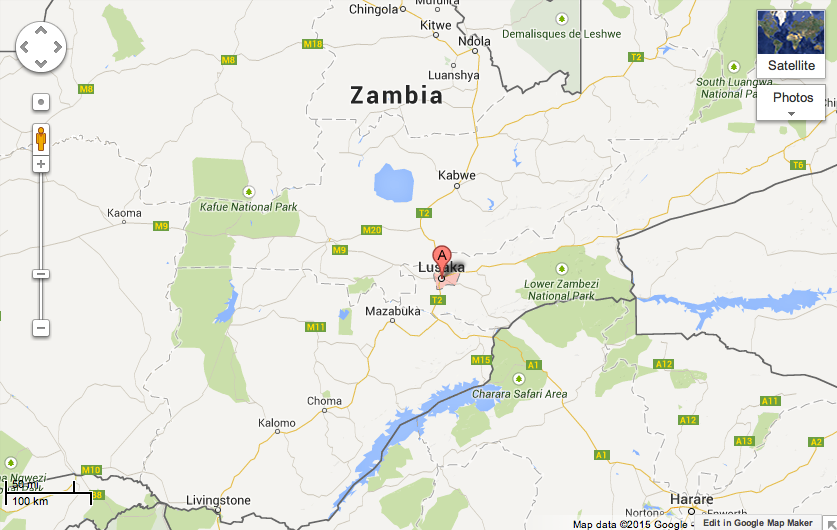
Today the church prays for the diocese of Lusaka, and I smile as I pray for my Zambian friends. We have stayed in Lusaka several times, and visited schools and clinics in remote parts of Zambia. Zambia is an amazing country – something like 70 different peoples and languages, and training in all the schools to help them learn how to live together.
One young Zambian told us that when they come into contact, it is normal to feel strange; the “other” doesn’t speak the same dialect, may be a traditional enemy, is just different, uncomfortable. They are trained to ask “What is it like where you live?” and to listen to the response.
I have used that phrase so many times; it is so useful. When you listen to an “other” talk about his or her life, you connect. You find similarities, and differences, and you learn the joys and challenges of this different life. It is a wonderful question. I used it the first time in Zambia, at a dinner with a lot of people we didn’t know. The woman next to me seemed stuffy, but sometimes that can be shy, so I asked “What is it like where you are from?” and she looked at me with concern and said, very sharply, “What do you mean?” I said “what is your life like, tell me about what you do in a day?” and she said “That is a very odd question!” but she went on to tell me about her life, her country house and her passion for riding. By the end, we were having a great conversation.
May God bless you richly, Zambia. May your peoples live together in God’s peace!

January 31, 2015
Posted by intlxpatr |
Adventure, Africa, Character, Civility, Communication, Community, Cross Cultural, ExPat Life, Faith, Geography / Maps, Interconnected, Lectionary Readings, Living Conditions, Relationships, Social Issues, Travel, Values, Zambia |
Leave a comment
I’ve been looking for this line forever, but it is no wonder that I couldn’t find it, I remembered it wrong, or I was using a different translation. When Father Ian at Church of the Epiphany in Doha would begin the prayers, he began with that invocation, reminding us that we, too, are tribal in our passions and affiliations. He used that word, tribal, instead of family. It is probably more true to the original intent.
Once people start drawing and adhering to lines between them and us, things get ugly in a hurry. I liked what Pope Francis said about Freedom of Speech being fine but it had to include respect for the religions of others, and self restraint. We all need to remember that it is the one true God who is the father of us all, and he will be the only one to judge us in the end.
We all get a lot of things wrong. Let’s hope He is truly the all-merciful and all-compassionate.
Ephesians 3:14-21
14 For this reason I bow my knees before the Father,* 15 from whom every family* in heaven and on earth takes its name. 16 I pray that, according to the riches of his glory, he may grant that you may be strengthened in your inner being with power through his Spirit, 17 and that Christ may dwell in your hearts through faith, as you are being rooted and grounded in love. 18 I pray that you may have the power to comprehend, with all the saints, what is the breadth and length and height and depth, 19 and to know the love of Christ that surpasses knowledge, so that you may be filled with all the fullness of God.
20 Now to him who by the power at work within us is able to accomplish abundantly far more than all we can ask or imagine, 21 to him be glory in the church and in Christ Jesus to all generations, for ever and ever. Amen.
January 17, 2015
Posted by intlxpatr |
Civility, Communication, Community, Counter-terrorism, Cross Cultural, Doha, ExPat Life, Faith, Interconnected, Lectionary Readings, Qatar, Spiritual |
Leave a comment
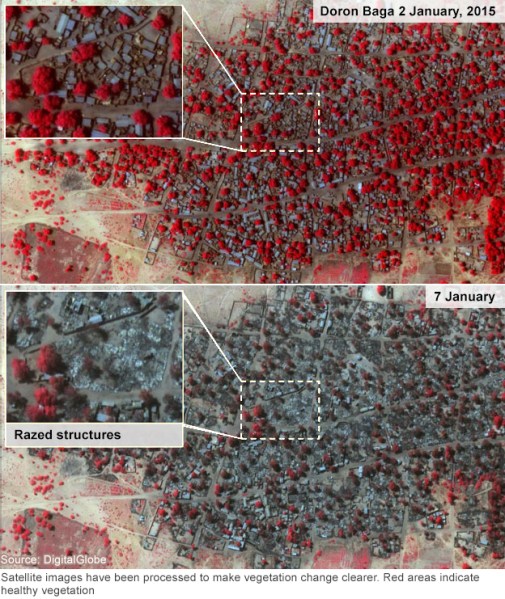
Today, on AOL News, a report on the ravaging of two villages in Nigeria by Boko Haram, with satellite images showing the carnage and destruction as survivors tally more than 2,000 dead. The craven Nigerian Army claims the losses are more like 200.
Meanwhile, of the almost 300 girls kidnapped a year ago by Boko Haram, 219 are still missing. Those who returned, returned by escaping. No one rescued them. The remainder are likely “married” to their captors, slaves to the household and many of them are probably pregnant. To be pregnant by a Boko Haram soldier creates a severe social problem if they are ever freed or rescued – the family cannot marry off an impure daughter. The children of these unions face a desolate future, wherever they are.
The world watches when terrorists wreak havoc in Paris, thousands crush the cretins who kill in the name of God, but no-one lifts a finger to help these small villages in Northeast Nigeria, beset by destructive vermin.
JOHANNESBURG (AP) — Large areas of Nigerian towns attacked by Islamic extremists were razed to the ground in a widespread campaign of destruction, according to satellite images released Thursday by Amnesty International.
Amnesty International said the detailed images of Baga and Doron Baga, taken before and after the attack earlier this month, show that more than 3,700 structures were damaged or completely destroyed.
The images were taken Jan. 2 and Jan. 7, Amnesty International said. Boko Haram fighters seized a military base in Baga on Jan. 3 and, according to witnesses, killed hundreds of civilians in the ensuing days.
Daniel Eyre, Nigeria researcher for the human rights group, said in a statement that the assault on the two towns was the largest and most destructive of all the Boko Haram assaults analyzed by Amnesty International.
The group said interviews with witnesses as well as local government officials and human rights activists suggest hundreds of civilians were shot; last week, the human rights group noted reports of as many as 2,000 dead. The Nigerian military has cited a figure of 150 dead, including slain militants.
Nigeria’s home-grown Boko Haram group drew international condemnation when its fighters kidnapped 276 schoolgirls from a boarding school in northeast Chibok town last year. Dozens escaped but 219 remain missing.

You can find much more information in this article on BBC News/Africa.
January 15, 2015
Posted by intlxpatr |
Africa, Bureaucracy, Community, Counter-terrorism, Crime, Cultural, ExPat Life, Faith, Family Issues, Interconnected, Living Conditions, Nigeria, Political Issues, Rants, Social Issues, Values, Women's Issues | Baga, Boko Haram, Doron Baga |
Leave a comment
In our country, in the West, open discussion is a part of life. Your point of view may be ignorant, or repugnant to me, but I will defend to the death your right to express your opinion. One of the great weapons of freedom of speech is humor. It’s hard to maintain a dignified moral high-ground when one of the cartoonists piques with a cartoon showing the emperor has no clothes. Or at least the emperor has flaws, as do we all.
Pensacola is blessed with such an editorial cartoonist, Andy Marlette. Andy Marlette is controversial, and in a state with lax gun laws and pistol-packin-mamas, he risks his life daily, skewering the pomposity of us all. Occasionally, he is outrageous. Occasionally, he is offensive. That’s OK. If an editorial cartoonist isn’t skewering someone, or all of us at once, he isn’t doing his job. His job is to elicit discussion.





I have lived for so long in Moslem world that I take a risk now, offending my Moslem friends, by printing the cartoon of Mohammed weeping. It’s the cartoon that touched me to the bone. I have listened and learned in the Moslem world, and I have never met with hatred. The Mohammed I have read about in the Qu’ran and in hadith, and heard about in legend and stories from my Moslem friends portrayed a prophet who, like Jesus, was all about loving and serving the one true God. He would weep at what has been done in his name, as Jesus weeps for us, when we kill others in his service.

January 8, 2015
Posted by intlxpatr |
Afghanistan, Africa, Arts & Handicrafts, Bureaucracy, Character, Circle of Life and Death, Communication, Community, Counter-terrorism, Cross Cultural, Cultural, Doha, ExPat Life, Faith, Free Speech, Humor, Interconnected, Kuwait, Language, Law and Order, Living Conditions, Pensacola, Political Issues, Quality of Life Issues, Social Issues, Spiritual, Values | Andy Marlette, Charlie Hebdo, Je Suis Charlie, Pensacola News Journal |
2 Comments