ISIS War Against Women
I was told – by Saudi women, Qatari women and Palestinian women of faith, that Allah wants women to be educated. The first wife of Muhammed was a businesswoman and a prominent leader in her time. Perhaps the ISIS extremists need to spend a little more time reading the Qu’ran and hadith.
From today’s AOL News/ Huffpost
BAGHDAD (AP) — Militants with the Islamic State group tortured and then publicly killed a human rights lawyer in the Iraqi city of Mosul after their self-proclaimed religious court ruled that she had abandoned Islam, the U.N. mission in Iraq said Thursday.
Gunmen with the group’s newly declared police force seized Samira Salih al-Nuaimi last week in a northeastern district of the Mosul while she was home with her husband and three children, two people with direct knowledge of the incident told The Associated Press on Thursday. Al-Nuaimi was taken to a secret location. After about five days, the family was called by the morgue to retrieve her corpse, which bore signs of torture, the two people said, speaking on condition of anonymity because of fears for their safety.
According to the United Nations Assistance Mission in Iraq, her arrest was allegedly connected to Facebook messages she posted that were critical of the militants’ destruction of religious sites in Mosul. A statement by the U.N. on Thursday added that al-Nuaimi was tried in a so-called “Sharia court” for apostasy, after which she was tortured for five days before the militants sentenced her to “public execution.” Her Facebook page appears to have been removed since her death.
“By torturing and executing a female human rights’ lawyer and activist, defending in particular the civil and human rights of her fellow citizens in Mosul, ISIL continues to attest to its infamous nature, combining hatred, nihilism and savagery, as well as its total disregard of human decency,” Nickolay Mladenov, the U.N. envoy to Iraq, said in a statement, referring to the group by an acronym. The statement did not say how she was killed.
Among Muslim hard-liners, apostasy is thought to be not just conversion from Islam to another faith, but also committing actions that they believe are so against the faith that one is considered to have abandoned Islam.
Mosul is the largest city held by the Islamic State group in the self-declared “caliphate” it has carved out, bridging northern and eastern Syria with northern Iraq. Since overrunning the once-diverse city in June, the group has forced religious minorities to convert to Islam, pay special taxes or die, causing tens of thousands to flee. The militants have enforced a strict dress code on women, going so far as to veil the faces of female mannequins in store fronts.
In August, the group destroyed a number of historic landmarks in the town, including several mosques and shrines, claiming they promote idolatry and depart from principles of Islam.
Al-Nuaimi’s death is the latest in a string of attacks by the militant group to silence female activists and politicians. In July in the nearby town of Sderat, militants broke into the house of a female candidate in the last provincial council elections, killed her and abducted her husband, the U.N. said. On the same day, another female politician was abducted from her home in eastern Mosul; she remains missing.
Hanaa Edwer, a prominent Iraqi human rights activist, said at least five female political activists have been killed in recent weeks by the Islamic State group in Mosul, including al-Nuaimi, who Edwer said was also running for a seat on the provincial council.
“But it is not just women being targeted,” Edwer said. “They will kill anyone with a voice. It is terrifying.”
The Gulf Center for Human Rights said Wednesday that al-Nuaimi had worked on detainee rights and poverty. The Bahrain-based rights organization said her death “is solely motivated by her peaceful and legitimate human rights work, in particular defending the civil and human rights of her fellow citizens in Mosul.”
The Islamic State extremists’ blitz eventually prompted the United State to launch airstrikes last month, to aid Kurdish forces and protect religious minorities in Iraq.
This week, the U.S. and five allied Arab states expanded the aerial campaign into Syria, where the militant group is battling President Bashar Assad’s forces as well as Western-backed rebels. Despite making gains in some of the country’s more isolated areas, where airstrikes have paved the way for successful ground operations by Kurdish and Iraqi forces, the cities of Mosul and Fallujah remain major strongholds of the group, which has buried itself among large civilian populations.
The militant group recently killed 40 Iraq soldiers and captured 68 near Fallujah and then paraded their captives through the city in a show of brawn.
Nearly a dozen countries have also provided weapons and training to Kurdish peshmerga fighters, who were strained after months of battling the jihadi group.
In other developments Thursday, German Defense Minister Ursula von der Leyen visited northern Iraq for talks with Kurdish leaders about the fight against Islamic State extremists and Berlin’s efforts to help with arms deliveries.
Thursday also marked the start of German arms deliveries to the semi-autonomous Kurdish region, with the ultimate goal of supplying 10,000 Kurdish fighters with some 70 million euros ($90 million) worth of equipment.
“We are involved with relief shipments and the airlift, but we know that this is not sufficient,” said von der Leyen. “Much more is needed to get these (millions of people) through the winter.”
___
Associated Press writer David Rising in Berlin and Bram Janssen in Irbil and an Associated Press reporter in Mosul contributed to this report.
Bringing Great Good from the Evil of 9/11

A reading from today’s Forward Day by Day helps us to cope with the resonating horrors of that monstrous day. We are living in a world where we are more and more inextricably interconnected. Where I am living, I often hear people talk about how “Moslems are killing Christians all over the world!” and my heart breaks, thinking of the wonderful friends I have lived among is so many Moslem countries, their kindness, their hospitality, our long pleasant conversations. I learned so much.
I am glad we believe in a God who knows our hearts. I am thankful for grace, and forgiveness. When we talk about killing, we also need to take account for all the civilians we have killed, trying to bring about peace, trying to eradicate Al Qaeda, Al Shebaab, those who would harm us.
God asks us to love one another. He doesn’t say “Christians, you love just the Christians.” He shows us how to love the Samaritans, the lame, the blind, the mentally ill, the “other”. He tells us, clearly, to love our enemies. The Gospel that speaks the loudest is the gospel of our lives lived to honor him.
THURSDAY, September 11
Acts 15:8-9 [Peter said], “And God, who knows the human heart, testified to them…and in cleansing their hearts by faith he has made no distinction between them and us.”
Thirteen years ago, this day became one of those days that divide time into what life was like before, and after; one of those days when you will remember, always, where you were, what you were doing—this time when you heard the news that airplanes had crashed into the World Trade Center and thousands of people had died.
Job asks, “Does not calamity befall the unrighteous?” (31:3), but we learned, vividly, on September 11, 2001, that the righteous and the innocent suffer too.
Psalm 59:6 exhorts God to “show no mercy to those who are faithless and evil.” The terrorists who flew the planes on 9/11 forced us to confront the power of evil and challenged us to find a way to respond with forgiveness. Perhaps we can learn something about that in Peter’s response to the heated discussions about Jews and Gentiles, about who could be saved, and how: “God, who knows the human heart…has made no distinction between them and us” (Acts 15:8-9).
Then, as now, there were good people and evildoers on all sides, religions, and races. Now, as then, judgment and salvation comes only through the mercy and grace of God.
Pensacola Drug Sweep Arrests 13 with Warrants for 20 More
Wooo HOOOO Pensacola, getting those dealers off the streets. It’s not like its permanent, but it’s a start. There is one funny thing you will spot in this write-up in the Pensacola News Journal, that the next to last man named had charges that include selling cocaine within 1000 feet of a place of worship.
If you’ve ever been to Pensacola, you will understand how hilarious that is. You can’t go 1,000 feet away from one house of worship and not be within 1,000 feet of the next. It’s just like the mosques in Qatar and Kuwait, if you are lost, you can’t call someone and when they ask where you are, you can’t say “I’m by the big mosque/church on the corner!” because there are mosques/churches on EVERY corner! Pensacola has churches everywhere! I just think that’s interesting, that it seems to be an additional charge on the sheets in Pensacola.
An approximate 4-month-long investigation targeting street-level drug dealers resulted in the arrests of 13 people for selling crack cocaine to undercover Pensacola Police officers Friday.
Warrants for selling cocaine also have been issued for an additional 20 people, said Sgt. Marvin Miller, who supervises the department’s Vice & Narcotics Unit. Miller said the investigation targeted areas notorious for narcotics sales.
All of the charges are third-degree felonies punishable by up to five years in prison. Additional prison time can be added for selling within 1,000 feet of a specified area such as convenience stores, schools, and places of worship, or if the person is a repeat offender.
Officers from various units within the Pensacola Police Department spent approximately 12 hours today making the arrests.
Arrested today and charged with sale of cocaine and conspiracy to sell cocaine were:
Alfred Peasant, 34, of 1300 block of North Sixth Avenue, Pensacola
Sharon Pickett, 49, of 100 block of North J Street, Pensacola.
David Jones, 24, of 3600 block of Swan Lane, Pensacola.
Demarko Weathers, 21, of 2000 block of West Chase Street, Pensacola.
Minnie Mae Sapp, 54, of 100 block of South N Street, Pensacola.
Terry Crenshaw, 28, of 1000 block of West Hillary Street, Pensacola.
Larry Dornall Knight, 52, of 3600 block of North Ninth Avenue, Pensacola.
Antoine Booker, 34, of 1100 block of West Hope Drive, Pensacola.
Also arrested today were:
Donte A. Brazile, 36, of 3000 block of Torres Avenue, Pensacola. Charged with sale of cocaine.
Dominique Blackwell, 19, of 600 block of North B Street, Pensacola. Charged with possession of cocaine with intent to sell within 1,000 feet of a place of worship.
Kernist Ferrell, 57, address unavailable; Robert Lee Watts, 23, address unavailable; and Michael Coleman, 33, of 600 block of North A Street, Pensacola.
All three, who are currently in jail, were charged with sale of cocaine.
Psalm 75; A Psalm For Today
After a month like July, with all it’s tragedy, all its self-inflicted injuries, all the blood and the death of innocents, I thank God that he is holding the pillars steady.
Psalm 75
To the leader: Do Not Destroy. A Psalm of Asaph. A Song.
1 We give thanks to you, O God;
we give thanks; your name is near.
People tell of your wondrous deeds.
2 At the set time that I appoint
I will judge with equity.
3 When the earth totters, with all its inhabitants,
it is I who keep its pillars steady.
Selah
4 I say to the boastful, ‘Do not boast’,
and to the wicked, ‘Do not lift up your horn;
5 do not lift up your horn on high,
or speak with insolent neck.’
6 For not from the east or from the west
and not from the wilderness comes lifting up;
7 but it is God who executes judgement,
putting down one and lifting up another.
8 For in the hand of the Lord there is a cup
with foaming wine, well mixed;
he will pour a draught from it,
and all the wicked of the earth
shall drain it down to the dregs.
9 But I will rejoice* for ever;
I will sing praises to the God of Jacob.
10 All the horns of the wicked I will cut off,
but the horns of the righteous shall be exalted.
Al this turmoil over boundaries, people not sharing. All the blood shed, and horrific acts, all so wasteful in the greater scheme of things. Lord God, hold the pillars steady.
Eid Mubarak 2014
To all my Muslim friends, may your celebration be full of family and all good things with which God may bless you!

Pope Meets With Sudanese Woman Condemned for Apostasy
I am not Catholic, but what I love about this humble Pope shines through in these photos – the Pope, the revered leader of the Christian world, is standing, while the family sits in his presence. His loving actions speak loudly. You can see all the photos on AOL News by clicking here.
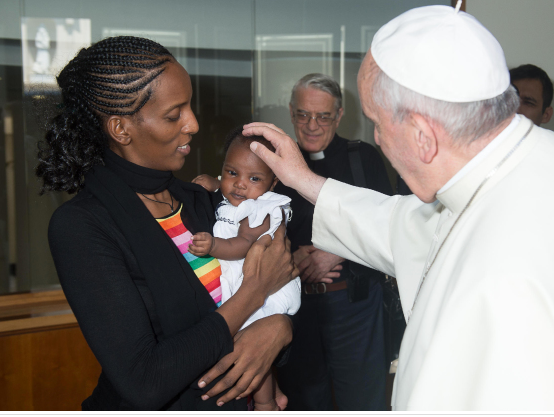
ROME (AP) – Pope Francis met privately Thursday with a Sudanese woman who refused to recant her Christian faith in the face of a death sentence, blessing the woman as she cradled her infant born just weeks ago in prison.
The Vatican characterized the visit with Meriam Ibrahim, 27, her husband and their two small children as “very affectionate.”
The 30-minute encounter took place just hours after the family landed at Rome’s Ciampino airport, accompanied by an Italian diplomat who helped negotiate her release, and welcomed by Italy’s premier, who hailed it as a “day of celebration.”
Vatican spokesman the Rev. Federico Lombardi said the pope “thanked her for her faith and courage, and she thanked him for his prayer and solidarity” during the half-hour meeting Thursday. Francis frequently calls attention to the suffering of those persecuted for their religious beliefs.
Lombardi said the presence of “their wonderful small children” added to the affectionate tone of the meeting. Ibrahim was presented with a rosary, a gift from the pope.
Ibrahim held her sleeping infant as she stepped off the plane from Sudan, which had blocked her from leaving the country even after the country’s highest court overturned her death sentence in June. An Italian diplomat carried her 18-month-old son and they were followed by her husband, Daniel Wani, who is a citizen of the United States and South Sudan.
Ibrahim and her family are expected to spend a few days in Rome before heading to the United States.
Ibrahim, whose father was Muslim but whose mother was an Orthodox Christian from Ethiopia, was sentenced to death over charges of apostasy. She married her husband, a Christian, in a church ceremony in 2011. As in many Muslim nations, Muslim women in Sudan are prohibited from marrying non-Muslims, though Muslim men can marry outside their faith.
The sentence was condemned by the United States, the United Nations and Amnesty International, among others, and both the United States and Italy – a strong death penalty opponent with long ties to the Horn of Africa region – worked to win her release.
Sudan’s high court threw out her death sentence in June, but she was then blocked from leaving the country by authorities who questioned the validity of her travel documents.
Lapo Pistelli, an Italian diplomat who accompanied the family from Sudan, said Italy was able to leverage its ties within the region. “We had the patience to speak to everyone in a friendly way. This paid off in the end,” he said.
Celebrating Sainte Mary Magdalene
From today’s Forward Day by Day:
TUESDAY, July 22 Saint Mary Magdalene
John 20:18. Mary Magdalene went and announced to the disciples, “I have seen the Lord.”
The information about Mary Magdalene tantalizes the imagination. A Jesus groupie in an age when decent women did not leave home to follow itinerant men. One from whom seven demons, by Luke’s count, were exorcised. A woman of such low status that she was free to stand unchallenged at the crucifixion site. It is no wonder that, like other women who do not fit into boxes of conventional understanding, she is defined in terms of sex. By declaring her a prostitute, imagination satisfies the Bible’s thin facts and the human desire for predictability. She has become a sex symbol in every sense of the word.
In seeing her this way, we miss the single piece of information that connects Mary to us all: gratitude. She followed Jesus because he cast out the seven demons. Jesus gave her new life and hope, a fact she never forgot and carried as her banner through thick and thin. If one or more of the demons in her had a sexual manifestation, it does not matter to the bottom line. Mary Magdalene is witness to the power of gratitude, a power available to our lives as well as hers.
PRAY for the Church of Jerusalem and The Middle East and the Diocese of Egypt with North Africa and the Horn of Africa
Today the Church remembers Saint Mary Magdalene.
When Is Eid Al Fitr 2014?
Today as I checked WeatherUnderground, I saw that the new moon is expected July 26th. However, when I checked About.com, it says that Eid al Fitr will start around July 28.
Maybe even though the moon is new, it cannot be seen as early as the 26th?

Question: When is Eid Al-Fitr 2014?
Eid Al-Fitr is a holiday marking the end of Ramadan, the month of fasting which is one of the greatest religious observance in Islam. What is the date for Eid Al-Fitr in 2014?
Answer: Eid Al-Fitr is expected to be on or around July 28, 2014.
Note: The exact dates of Islamic holidays cannot be determined in advance, due to the nature of the Islamic lunar calendar. Estimates are based on expected visibility of the hilal (waxing crescent moon following a new moon) and may vary according to location.
Rehab, An Unlikely Hero
I love this story. When you start reading the bible, you come across the most human of our race, you have the dramas of sibling rivalry, disobedience, and murder, the heartbreak of childlessness, slavery, and terrible loss, you have marriages and wars . . . the full spectrum of human behavior is there. And you have Rehab, a prostitute, who has heard of this God, but is not a Hebrew. She will help them in return for safety for her family. All who shelter in her small apartment, protected by a red ribbon (or rope), live.

In a later chapter of the bible, we learn how Rehab figures in the family line of Jesus.
Joshua 2:1-14
2Then Joshua son of Nun sent two men secretly from Shittim as spies, saying, ‘Go, view the land, especially Jericho.’ So they went, and entered the house of a prostitute whose name was Rahab, and spent the night there. 2The king of Jericho was told, ‘Some Israelites have come here tonight to search out the land.’ 3Then the king of Jericho sent orders to Rahab, ‘Bring out the men who have come to you, who entered your house, for they have come only to search out the whole land.’
4But the woman took the two men and hid them. Then she said, ‘True, the men came to me, but I did not know where they came from. 5And when it was time to close the gate at dark, the men went out. Where the men went I do not know. Pursue them quickly, for you can overtake them.’ 6She had, however, brought them up to the roof and hidden them with the stalks of flax that she had laid out on the roof. 7So the men pursued them on the way to the Jordan as far as the fords. As soon as the pursuers had gone out, the gate was shut.
8 Before they went to sleep, she came up to them on the roof 9and said to the men: ‘I know that the Lord has given you the land, and that dread of you has fallen on us, and that all the inhabitants of the land melt in fear before you. 10For we have heard how the Lord dried up the water of the Red Sea* before you when you came out of Egypt, and what you did to the two kings of the Amorites that were beyond the Jordan, to Sihon and Og, whom you utterly destroyed. 11As soon as we heard it, our hearts failed, and there was no courage left in any of us because of you. The Lord your God is indeed God in heaven above and on earth below. 12Now then, since I have dealt kindly with you, swear to me by the Lord that you in turn will deal kindly with my family. Give me a sign of good faith 13that you will spare my father and mother, my brothers and sisters, and all who belong to them, and deliver our lives from death.’ 14The men said to her, ‘Our life for yours! If you do not tell this business of ours, then we will deal kindly and faithfully with you when the Lord gives us the land.’
No matter who we are, no matter what we have done, the love of God follows us everywhere, with the free gift of salvation, if only we see it, as Rehab did, and ask for it. God is great!
“The Love of Many Will Grow Cold”
Towards the end, as Jesus talks about the end-of-times, he says that because of lawlessness, the love of many will grow cold. (Deep sigh) We even have a name for it now, compassion fatigue, where good people get tired of trying and giving in the face of so much need. In Pensacola, we have children dying from negligence, young men dying from street violence, many dying from car accidents, and many suicides. It is stunning and it is discouraging.
Jesus tells us to hang in there, not to give up. Only with his help can we hope to do this.
This is from our Lectionary Readings for today:
Matthew 24:1-14
24As Jesus came out of the temple and was going away, his disciples came to point out to him the buildings of the temple. 2Then he asked them, ‘You see all these, do you not? Truly I tell you, not one stone will be left here upon another; all will be thrown down.’
3 When he was sitting on the Mount of Olives, the disciples came to him privately, saying, ‘Tell us, when will this be, and what will be the sign of your coming and of the end of the age?’ 4Jesus answered them, ‘Beware that no one leads you astray. 5For many will come in my name, saying, “I am the Messiah!”* and they will lead many astray. 6And you will hear of wars and rumours of wars; see that you are not alarmed; for this must take place, but the end is not yet. 7For nation will rise against nation, and kingdom against kingdom, and there will be famines* and earthquakes in various places: 8all this is but the beginning of the birth pangs.
9 ‘Then they will hand you over to be tortured and will put you to death, and you will be hated by all nations because of my name. 10Then many will fall away,* and they will betray one another and hate one another. 11And many false prophets will arise and lead many astray. 12And because of the increase of lawlessness, the love of many will grow cold. 13But anyone who endures to the end will be saved. 14And this good news* of the kingdom will be proclaimed throughout the world, as a testimony to all the nations; and then the end will come.
Recent Comments
intlxpatr on Shampoo Ginger tigerbutterya0c5ff1d… on Shampoo Ginger intlxpatr on British Soldier Kidnapped, Esc… John on British Soldier Kidnapped, Esc… intlxpatr on British Soldier Kidnapped, Esc… Wikipedia Donate Button

Amazina


Early Voting in Florida


