A King is Given

It is the sweetest, quietest morning in the year; the Qatari Cat awoke me early – well actualy, he awoke me often as the temperatures have dropped dramatically and he wanted my body heat. He is a BIG cat, and takes up a lot of room wherever he stretches out, so I end up sleeping cramped much of the night, LOL. He is such a sweet cat, who can complain?
Yesterday, our church started a new service, a noon service, to help drain off some of the 4:00 and crush of good Episcopalians wanting to start Christmas with a moment of holiness and order before the chaos. Noon was a perfect time for me, and it was a perfect service, full of great readings and music, a goodly crowd, many people I know, and cold enough to wear one of my vintage German coats, coats I considered ‘investments’ when I thought we would be living in Seatte after retirement. If I get to wear them one day each year, they still look new at the end of this century.
A little later in the day, the festivities began, friends arriving from out of town, a family gathering and Christmas Eve dinner where my beloved daughter in law made some of the best crab cakes with Remoulade sauce I have ever eaten, the children were adorable, and the conversation full of laughter and memories. This morning has dawned clear and cold, the Qatari Cat is fed, AdventureMan still snoozing, and I have a few minutes to share a Psalm from today’s lectionary with you. Life is sweet.
Happy, happy Christmas to all!
Psalm 2
1 Why do the nations conspire,
and the peoples plot in vain?
2 The kings of the earth set themselves,
and the rulers take counsel together,
against the Lord and his anointed, saying,
3 ‘Let us burst their bonds asunder,
and cast their cords from us.’
4 He who sits in the heavens laughs;
the Lord has them in derision.
5 Then he will speak to them in his wrath,
and terrify them in his fury, saying,
6 ‘I have set my king on Zion, my holy hill.’
7 I will tell of the decree of the Lord:
He said to me, ‘You are my son;
today I have begotten you.
8 Ask of me, and I will make the nations your heritage,
and the ends of the earth your possession.
9 You shall break them with a rod of iron,
and dash them in pieces like a potter’s vessel.’
10 Now therefore, O kings, be wise;
be warned, O rulers of the earth.
11 Serve the Lord with fear,
with trembling 12kiss his feet,*
or he will be angry, and you will perish in the way;
for his wrath is quickly kindled.
Happy are all who take refuge in him.
Doubt and Faith
I have fellow students who consider doubt “double-mindedness” and yet today, we have the Feast Day of Saint Thomas, the Apostle who doubted that Jesus had risen until he could touch his wound. His reaction – “My Lord and My God!” is the reaction of a searcher.
Doubt doesn’t imply lack of belief; doubt is hope that looks for evidence. A doubter is a person who is seeking; my greater concern is those who treat their beliefs with complacency – lacking self-examination – or the worst, indifference.
Jesus chose those who will follow him specifically. He chose St. Thomas for a reason, knowing how deeply skepticism runs in our hearts, and knowing there is no belief so deep as that of one who has sought and found.
SATURDAY, December 21 Saint Thomas the Apostle Ember Day
John 20:28. Thomas answered him, “My Lord and my God!”
Today the church remembers Saint Thomas, often called Doubting Thomas. It seems to me he has gotten a bad reputation for doing something that I actually admire. Thomas had questions—and he dared to ask them. If I were creating his nickname, I’d call him “Good Question Thomas.” Doubt is the companion of faith, and it’s time for doubt to come out from under the carpet.
You see, I think every thoughtful Christian has moments of wondering about faith or God’s place in our lives. Alas, we too often keep quiet about our uncertainties, suffering with them alone. But there is great value to sharing our questions and our struggles. When that happens, a community can share them together and inspire one another. Every time I have shared a doubt or question with another, it has been a blessing.
When we raise our questions with sincerity, we are opening ourselves for God to enter our minds. Like Thomas, we might move past doubt to a place of confident faith. “My Lord and my God!”
Today the church prays for the diocese of Yirol, in the South Sudan:

Where is the Diocese of Yei, Central Equatoria, Sudán do Sur – South Sudan?
We don’t always see the timeliness of our prayers, but as we pray for Yei, in the South Sudan, we pray with increased vigor, as the country faces unrest and internal turbulence.

We pray for our friend David, and all the people of South Sudan who have suffered so much for so long. The Lord has blessed them with oil, let them use their resources wisely, for the greater good, and may they enjoy the wealth of their nation in peace with one another.
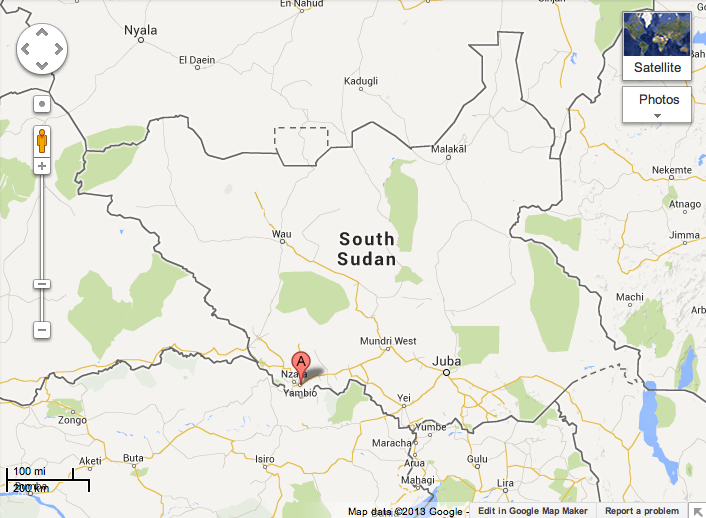
David, and Where is Yambio, South Sudan?
A year ago, we had an extraordinary experience. We often entertain delegates visiting from other countries, and this time we had three African journalists, and, strictly by chance, they all turned out to be Christian. Most of our gatherings are strictly ecumenical, but these were joyful, praying Christians, and the evening took a turn we never anticipated.
“So how did you find Jesus?” one woman asked David, from the newest country in the world, South Sudan. Inside, I was shocked, and when I am shocked, my tendency is to laugh, I don’t know why, it is just the way I am wired. Every culture is so different. In the South, people might ask that of one another, particularly if you worship in a fundamental sect, but our sect is more formal, and to inquire into another’s spiritual life can be perceived as intrusive.
David, however, was not taken aback. “It’s a long story,” he said, and we all settled into comfortable chairs to listen better. It was Christmas, the decorations were up, the lights all twinkling and we had eaten. A good time for a story.
It was a long story. It started with a little boy in a happy family, who one day was told to run! Run! Run into the forest and hide! The riders were coming! His family grabbed a very few things and ran.
His family ran for years. His family ran into forests, across borders, into dry arid spaces. Sometimes some of the children would get separated from their parents for a while, but they would keep asking, and eventually meet up again, only to face separation again. Their whole lives were running, from the Janjaween, from border police, from robbers.
At one point, he and a brother stayed in a church, and a priest taught them about Jesus. Simple stories, simple songs, and he drew letters and numbers in the dirt – that was his early schooling. It was a haven of peace for him.
Many years later, the family was reunited in their village in the new country of South Sudan. Miraculously, every member of his family survived, indeed, most of his village survived. They had maintained lines of communication through all those years of running and separation, and were so thankful. Most of all, now, they were thankful – they had a church in their village. David had learned to love learning, and had completed his education and had found a wonderful job.
“I don’t know the book like you do,” he told us, “I only know it like a little child sitting at the feet of that priest, but I am learning.”
I can’t help but think that David knows more than he thinks. David holds his belief in Jesus like a child, simple and direct. His testimony is powerful and unforgettable. I am in awe, even a year later, of his story and testimony.
Today the church prays for the diocese of Yambio, in the South Sudan:
Zabbaleen Cave Church in Cairo
My friend Hayfa sends me the most amazing things. Her mind is another Here, There and Everywhere Kind of mind. 🙂
This article resonates with me because when we moved to Tunis, the garbage collectors would fight over our trash. I felt horrible, we had an infant, and there were diapers in the trash. 😦 Our maid would take cans and jars and especially jars with lids out of the trash, and ask if she could take them. We learned before throwing anything away to see if she wanted it first. They used, and re-used, everything. We learned to look at our consumption in a whole new way. It was one of the best things about living in an ‘alien’ community; we learned to see ourselves with different eyes.
Thank you, Hayfa, for this fascinating article.
The Cave Church of the Zabbaleen in Cairo
The Monastery of Saint Simon, also known as the Cave Church, is located in the Mokattam mountain in southeastern Cairo, Egypt, in an area that is known as ‘garbage city’ because of the large population of garbage collectors or Zabbaleen that live there. The Zabbaleen are descendants of farmers who started migrating from Upper Egypt to Cairo in the 1940s. Fleeing poor harvests and poverty they came to the city looking for work and set-up makeshift settlements around the city. Initially, they stuck to their tradition of raising pigs, goats, chickens and other animals, but eventually found collecting and sorting of waste produced by the city residents more profitable.
The Zabbaleen would sort through household garbage, salvaging and selling things of value, while the organic waste provided an excellent source of food for their animals. In fact, this arrangement worked so well, that successive waves of migrants came from Upper Egypt to live and work in the newly founded garbage villages of Cairo.
For years, the makeshift settlements of the Zabbaleen were moved around the city trying to avoid the municipal authorities. Finally, a large group of Zabbaleen settled under the cliffs of the Mokattam or Moquattam quarries at the eastern edge of the city, which has now grown from a population of 8,000 in the early 1980s, into the largest garbage collector community in Cairo, with approximately 30,000 Zabbaleen inhabitants. Egypt is a Muslim-majority country, but the Zabbaleen are Coptic Christians, at least, 90 percent of them are. Christian communities are rare to find in Egypt, so the Zabbaleen prefer to stay in Mokattam within their own religious community even though many of them could afford houses elsewhere.
The local Coptic Church in Mokattam Village was established in 1975. After the establishment of the church, the Zabbaleen felt more secure in their location and only then began to use more permanent building materials, such as stone and bricks, for their homes. Given their previous experience of eviction from Giza in 1970, the Zabbaleen had lived in temporary tin huts up till that point. In 1976, a large fire broke out in Manshiyat Nasir, which led to the beginning of the construction of the first church below the Mokattam mountain on a site of 1,000 square meters. Several more churches have been built into the caves found in Mokattam, of which the Monastery of St. Simon the Tanner is the largest with a seating capacity of 20,000. In fact, the Cave Church of St. Simon in Mokattam is the largest church in the Middle East.
 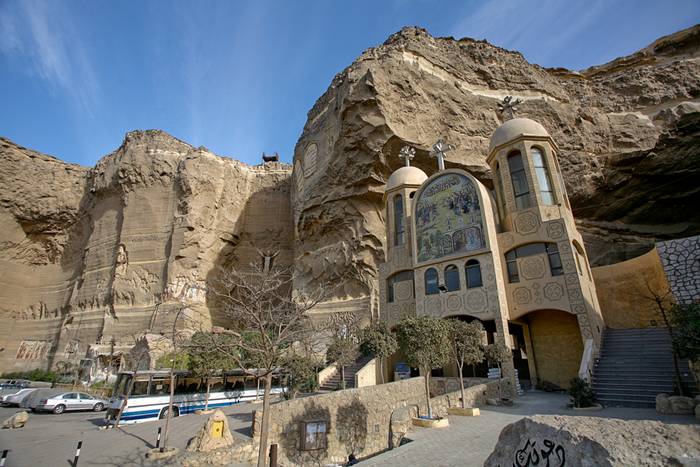 Photo — Link
 Photo — Link
 Photo — Link
 Photo — Link
 Photo — Link
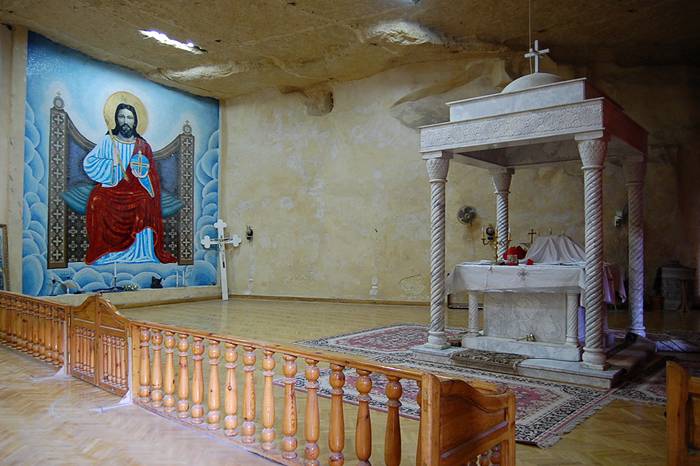 Photo — Link
 Photo — Link
 Photo — Link
 Photo — Link
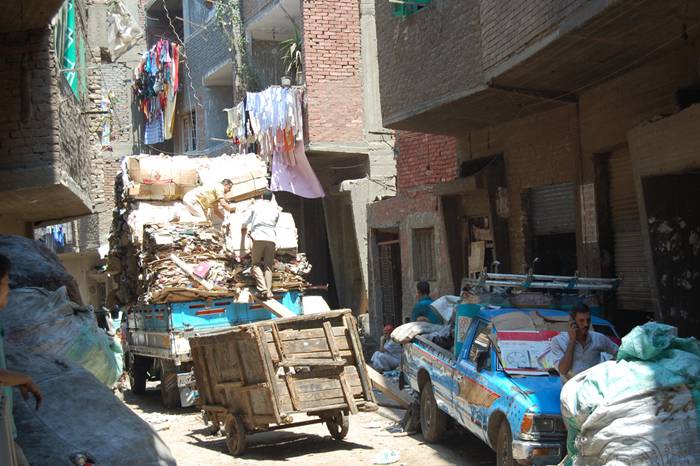 Photo — Link
|
Jesus Discloses Signs of the End of Times
Because we are also reading Revelations at this time of the Lectionary readings, I thought at first that is what I was reading, but no, these are the words of Jesus, talking about the signs leading to the end of times – wars and rumors of wars, lawlessness, famine, nations rising against nations, oh yikes. Sounds a whole lot like today.
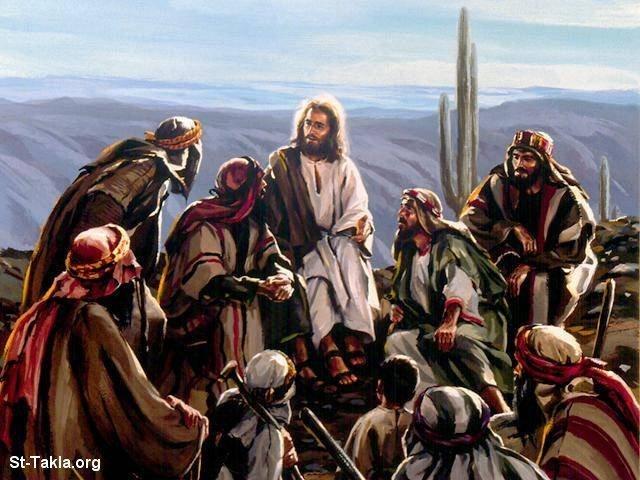
(I love that this image has Jesus and his disciples looking like people of the Middle East 🙂 You find the most amazing things on the internet, and I found this on an Egyptian Coptic website, where you can also hear all kinds of Coptic Christian music and chants. St. Takla.org )
Matthew 24:1-14
3 When he was sitting on the Mount of Olives, the disciples came to him privately, saying, ‘Tell us, when will this be, and what will be the sign of your coming and of the end of the age?’ 4Jesus answered them, ‘Beware that no one leads you astray. 5For many will come in my name, saying, “I am the Messiah!”* and they will lead many astray. 6And you will hear of wars and rumours of wars; see that you are not alarmed; for this must take place, but the end is not yet. 7For nation will rise against nation, and kingdom against kingdom, and there will be famines* and earthquakes in various places: 8all this is but the beginning of the birth pangs.
9 ‘Then they will hand you over to be tortured and will put you to death, and you will be hated by all nations because of my name. 10Then many will fall away,* and they will betray one another and hate one another.11And many false prophets will arise and lead many astray. 12And because of the increase of lawlessness, the love of many will grow cold.13But anyone who endures to the end will be saved. 14And this good news* of the kingdom will be proclaimed throughout the world, as a testimony to all the nations; and then the end will come.
The Toughest Commandment
It should be so simple, shouldn’t it? Love God and put him first, love your neighbor as yourself? And then you run into the one who is hard-t0-love . . . A challenging meditation for the day from Forward Day by Day:
Matthew 22:39. You shall love your neighbor as yourself.
I wish we could keep the two Great Commandments—to love God and our neighbor—at the forefront of our minds. Too often, I fear that we have equated loving our neighbor with being nice to those around us. Even a cursory glance at the gospels reminds us that it’s much harder than that, although the commandment is simplicity itself.
The massive wealth imbalance in the United States belies our adherence to this simple yet difficult commandment. If we really loved our neighbors, would we support a society in which a few people control so much wealth while millions go without enough food? Would we permit some of us to enjoy the best health care on the planet while millions more have no regular health care?
If I have read the gospels right, there is no way of saying their problems are not my problems. Rather, we are obligated to share of our abundance with those who have less. Jesus tells us to care for the last, the lost, and the least. Token gifts are a mockery of the Great Commandment. We are called to care for those around us with reckless abandon. Love is not sentimental here; it is hard work.
The Church Remembers John of Damascus
Today the church remembers John of Damascus, our good friend who once was the American Consul in Damascus is visiting with us, and we mourn the loss of peace and security in Damascus, and Syria, and the heartless loss of so many lives, the destruction of beautiful Homs, and so many other villages, named and unnamed, and the use of nerve gas on Syrian people.
I love it that he is most often shown wearing a keffiye

The Liturgical Calendar: The Church Remembers
Today the church remembers John of Damascus, Priest, c. 760.
The son of an important official in the court of the Muslim Caliph of Damascus, John had an easy rapport with the Muslims among whom he was reared, and readily succeeded to his father’s office in the Caliph’s court. Later, he abandoned the wealth and comfort of the fashionable life of Damascus and joined a religious community in Palestine.
As he lived the rigorous life of a monk in the stark wilderness near the Dead Sea, his own strong personality began to emerge. He soon distinguished himself as a theologian and scholar. His chief published work extant is The Fount of Knowledge. He is recognized as a “Doctor of the Universal Church.”
However, John of Damascus is most widely remembered for his contributions to Christian worship. He wrote many fine hymns, including two Easter ones that are still popular today: “Come ye faithful raise the strain…” and “The Day of Resurrection, earth tell it out abroad!” He effectively defended the doctrine of the Real Presence in the Eucharist, the veneration of the Lord’s Mother, and use of icons. He became involved in an international religio-political struggle called the “Icononclastic Controversy” which reached violent proportions and shook the Byzantine world. His life was saved in this controversy by his powerful Muslim friends.
We give thanks for John and for all those who have upheld the truth of our faith and the glory of our worship. Amen.

Recent Comments
ExpatAlien on What Country am I Living … intlxpatr on Yellowstone: Old Faithful to C… Michelle on Yellowstone: Old Faithful to C… Cathy on No Grown-Ups in Charge intlxpatr on Waiting for Snow Wikipedia Donate Button

Amazina


Early Voting in Florida


 Here There and Everywhere