For a Sunny Cold Day in Pensacola

Normally, I sleep my best in cold weather, but last night the Qatari Cat decided sleeping closely snuggled up to me was preferable to the snug heated bed we bought him, and which he normally loves.
The Qatari Cat is a large cat. When we have our delegate dinners for the GCCDC, we keep him in another room. Most often, delegates will hear him complaining and ask if we would let him out. I am willing to bet that there are more photos of delegates with the Qatari Cat in circulation than with us! All that aside, when he snuggles up, he takes up a lot of room. When you want to change positions, he is a snoring, uncooperative lump, and you have to arrange yourself around him. I did not sleep so well as I like to sleep on cold November nights.
Yes, he is a spoiled cat.
Today’s Psalm from the Lectionary Readings is a delight for a chilly, early November day, warms things right up:
Psalm 34
Of David, when he feigned madness before Abimelech, so that he drove him out, and he went away.
1 I will bless the Lord at all times;
his praise shall continually be in my mouth.
2 My soul makes its boast in the Lord;
let the humble hear and be glad.
3 O magnify the Lord with me,
and let us exalt his name together.
4 I sought the Lord, and he answered me,
and delivered me from all my fears.
5 Look to him, and be radiant;
so your* faces shall never be ashamed.
6 This poor soul cried, and was heard by the Lord,
and was saved from every trouble.
7 The angel of the Lord encamps
around those who fear him, and delivers them.
8 O taste and see that the Lord is good;
happy are those who take refuge in him.
9 O fear the Lord, you his holy ones,
for those who fear him have no want.
10 The young lions suffer want and hunger,
but those who seek the Lord lack no good thing.
11 Come, O children, listen to me;
I will teach you the fear of the Lord.
12 Which of you desires life,
and covets many days to enjoy good?
13 Keep your tongue from evil,
and your lips from speaking deceit.
14 Depart from evil, and do good;
seek peace, and pursue it.
15 The eyes of the Lord are on the righteous,
and his ears are open to their cry.
16 The face of the Lord is against evildoers,
to cut off the remembrance of them from the earth.
17 When the righteous cry for help, the Lord hears,
and rescues them from all their troubles.
18 The Lord is near to the broken-hearted,
and saves the crushed in spirit.
19 Many are the afflictions of the righteous,
but the Lord rescues them from them all.
20 He keeps all their bones;
not one of them will be broken.
21 Evil brings death to the wicked,
and those who hate the righteous will be condemned.
22 The Lord redeems the life of his servants;
none of those who take refuge in him will be condemned.
“Great is Your Faith!”
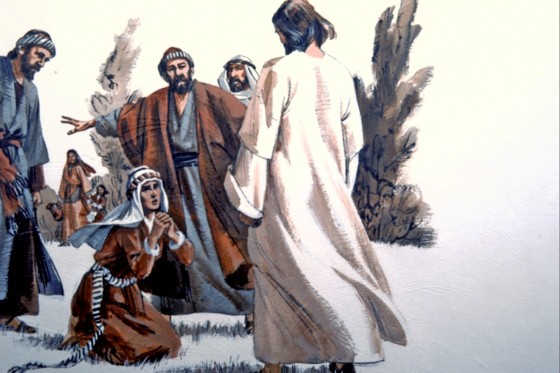
Jesus only commented positively on a person’s faith three times, and two of those times the supplicant was not Jewish, but other, in this case, a Canaanite woman. All she cared about was her daughter. He even says no, he won’t help her, he is there for the Jews. As she persists, as she argues with Jesus and makes her case, he relents, he feels enormous compassion for this woman in her plight, and as he heals her daughter, he makes this extraordinary statement calling attention to her belief. No legalistic requirements, he just heals.
Matthew 15:21-28
21 Jesus left that place and went away to the district of Tyre and Sidon.22Just then a Canaanite woman from that region came out and started shouting, ‘Have mercy on me, Lord, Son of David; my daughter is tormented by a demon.’ 23But he did not answer her at all. And his disciples came and urged him, saying, ‘Send her away, for she keeps shouting after us.’ 24He answered, ‘I was sent only to the lost sheep of the house of Israel.’ 25But she came and knelt before him, saying, ‘Lord, help me.’ 26He answered, ‘It is not fair to take the children’s food and throw it to the dogs.’ 27She said, ‘Yes, Lord, yet even the dogs eat the crumbs that fall from their masters’ table.’ 28Then Jesus answered her, ‘Woman, great is your faith! Let it be done for you as you wish.’ And her daughter was healed instantly.
Clean or Unclean?
This is one of my favorite readings in the Lectionary. People often ask where it is that Jesus declared all foods “clean” and this is one of the scriptures. To me, it is the why of it that makes it interesting – and convicting. There is enough in my heart to make me unclean without worrying about food rules.
Matthew 15:1-20
15 Then Pharisees and scribes came to Jesus from Jerusalem and said,2 ‘Why do your disciples break the tradition of the elders? For they do not wash their hands before they eat.’ 3 He answered them, ‘And why do you break the commandment of God for the sake of your tradition?4 For God said,* “Honour your father and your mother,” and, “Whoever speaks evil of father or mother must surely die.” 5 But you say that whoever tells father or mother, “Whatever support you might have had from me is given to God”,* then that person need not honour the father.* 6 So, for the sake of your tradition, you make void the word* of God. 7You hypocrites! Isaiah prophesied rightly about you when he said:
8 “This people honours me with their lips,
but their hearts are far from me;
9 in vain do they worship me,
teaching human precepts as doctrines.” ’
10 Then he called the crowd to him and said to them, ‘Listen and understand: 11 it is not what goes into the mouth that defiles a person, but it is what comes out of the mouth that defiles.’ 12 Then the disciples approached and said to him, ‘Do you know that the Pharisees took offence when they heard what you said?’ 13 He answered, ‘Every plant that my heavenly Father has not planted will be uprooted. 14 Let them alone; they are blind guides of the blind.* And if one blind person guides another, both will fall into a pit.’ 15 But Peter said to him, ‘Explain this parable to us.’ 16 Then he said, ‘Are you also still without understanding?17 Do you not see that whatever goes into the mouth enters the stomach, and goes out into the sewer? 18 But what comes out of the mouth proceeds from the heart, and this is what defiles. 19 For out of the heart come evil intentions, murder, adultery, fornication, theft, false witness, slander. 20 These are what defile a person, but to eat with unwashed hands does not defile.’
Where is Umzimvubu, South Africa?
Today we pray for the Diocese of Umzimvubu, in South Africa:

Matthew 5: 44-46
|
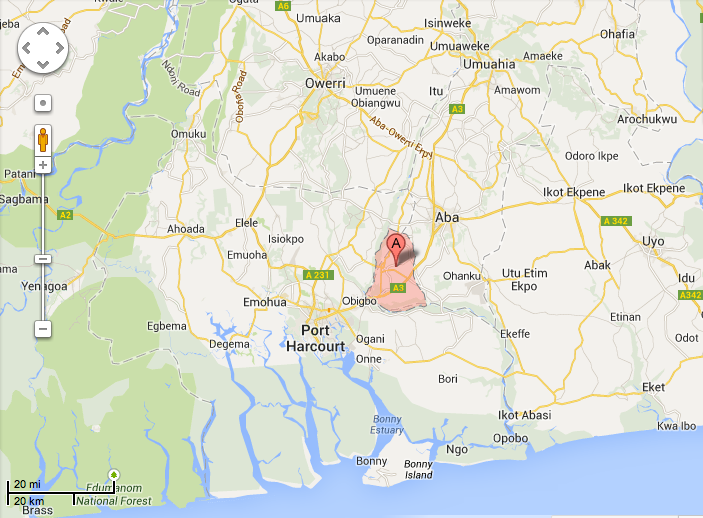
Where Are Dioceses of Ukwa and Umuahia (Aba, Nigeria)?
Every day our church prays for a different part of the world. Today it is Ukwa and Umuahia in Aba, Nigeria. I had to look it up:
Happy Islamic New Year
My good friend and commenter, Daggero, left this comment for us yesterday announcing the new Islamic year:
For your information yesterday we entered the Islamic year 1435 Hijri ( hijri = immigration ) which marks the year the prophet Muhammad peace be upon him, emigrated after 13 years of calling people to Islam from Mecca to Medina, ( where he is burried in his Mosque , Masjid an Nabawi, the second holliest mosque in Islam after the Mecca )

So total Islam time from begining to now is 1448 years, and on this auspicious occasion i wish you , AdventureMan and your family and the little ones a happy and a blessed New Islamic year.
We wish you the same, Daggero, and I smiled as I read that you discussed the topic we were discussing with your daughter on the drive to school in the morning. I remember those days so well, as young people begin to draw off into their own lives and the time we spend with them in cars can be so precious. Happy New Year to you and your family.
We had a friend from Libya whose family name meant “from Madina;” before we had ever lived in any Middle East country, he had told us a little about Madina, and what a beautiful city it is. The mosque is very beautiful. I think the tradition is that green was the prophet Mohammed’s favorite color?
Happy New Year, too, to all our Moslem friends.
Where is Terekeka, South Sudan?

Today the church prays for the diocese of Terekeka, in the South Sudan. I have never heard of Terekeka – have you?
When I looked for it on Google Maps, it didn’t have any information. When I went to The South Sudan and then googled Terekeka, it came up with a reference, and I had to go to this website to find it – they had a map.
The organization who put up the map, Harvesters Reaching Nations, has two locations in the southernmost part of South Sudan, the newest nation on earth. They are building hospitals, and taking in orphans. If I hadn’t gone looking, I would never have heard of the good works they are doing, saving lives, changing lives.
This is what they say:
We currently serve more than 190 orphans in two locations in South Sudan – Yei and Terekeka. Our school in Yei provides a Christian education to more than 500 students. In addition to our school-age orphans, more than 400 children from surrounding villages attend our school.
The Harvesters campus in Yei consists of 90 acres of land donated by the South Sudan government. Since our beginning in 2001, we have built homes, dorms, classrooms and other facilities within a fenced-in campus. We use the land we own beyond the fencing for planting and growing corn, tomatoes and other vegetables for use in the orphanage.
Harvesters’ campus in Terekeka, South Sudan opened in 2010. At this campus, we currently provide care for 44 orphans, but will grow to 80 in the near future. We have built homes, dorms and a clinic within a five acre, fenced-in campus. Additional facilities, including a church and school classrooms, will be built in the near future as the needs and resources dictate.
To do this, they sold everything they owned, and moved to the South Sudan, and used the proceeds from selling everything to build the hospitals and schools. I bet they are the happiest they have ever been, and the most thoroughly engaged in life they have ever been.
Taliban Says Malala ‘Has Done Nothing To Earn Prize’
Mr. Taliban, did you see Jon Stewarts interview with Malala? (See below) All she wants is an education. She wants an education for herself, but also for all children in Pakistan. Your children, too! She wants them to have that opportunity, that’s all. And she has paid the price for her courage speaking out, and she bravely continues to state the obvious – there is nothing in Islam against educating women.
MIRANSHAH, Pakistan: The Pakistani Taliban Thursday said teenage activist Malala Yousafzai had done “nothing” to deserve a prestigious EU rights award and vowed to try again to kill her.
The European Parliament awarded the Sakharov human rights prize to the 16-year-old, who has become a global ambassador for the right of all children to go to school since surviving a Taliban murder attempt.
Malala survived being shot in the head by a TTP gumnan on October 9 last year and is seen as a leading contender for the Nobel Peace prize, to be announced on Friday.
“She has done nothing. The enemies of Islam are awarding her because she has left Islam and has became secular,” Tehreek-e-Taliban Pakistan (TTP) spokesman Shahidullah Shahid told AFP by telephone from an undisclosed location.
“She is getting awards because she is working against Islam. Her struggle against Islam is the main reason of getting these awards.”
He repeated the TTP’s threat – made numerous times in recent months -try again to kill Malala, “even in America or the UK”.
Malala and moved to Britain in the wake of the shooting for treatment and to continue her education in safety.
Feted by world leaders and celebrities for her courage, Malala has addressed the UN, this week published an autobiography, and could become the youngest ever Nobel Peace Prize laureate on Friday.
Her autobiography “I am Malala”, written with journalist Christina Lamb, has gone on sale in Pakistan and Shahid warned the Taliban would target bookshops stocking it.
“Malala is the enemy of Islam and Taliban and she wrote this book against Islam and Taliban,” he said. (AFP)
God Vs. Worry; God Wins
One of the things that adds texture to my life, and helps keep me on the straight and narrow (and that takes a LOT) is reading the daily lectionary every single morning of the year, before I do anything else. Normal days, I access it from my computer, traveling or appointment days, I can access it from my iPad or iPhone. It’s like a little extra fence that helps keep me safe from myself and my own creativity when it comes to evil.
There is another side, the blessing side. In one of the bible studies I attend, we learn, over and over that God blesses the believer. You don’t have to be perfect – and it’s a good thing, because none of us are. If you want to see how much God can love a sinner, just read your bible. Sin is one of the main characters, right along side Abraham and Sarah, Job, Lot, and especially King David.
But in my life, I have seen wondrous things, and I have had some totally WOW moments when God has blessed me beyond any prayer I could have raised. One of those moments was showering under a waterfall near an oasis in the Tunisian desert. Two others happened this year, and these were blessings that stopped me in my tracks with their timing and aptness. First, we got an unexpected tax refund which arrived in our account just in time to cover the big expensive air conditioning system on the main floor when it broke and had to be replaced.
Second, when we were looking for the last few thousand dollars to help us buy a new car (we prefer to pay cash) we got another tax refund – we had asked that they re-look taxes for a move, and they allowed the moving expenses. We had waited almost a year for that decision; we had waited so long we had pretty much forgotten and given up on it. I mean tax refunds – it’s a never-never land, it all seems so arbitrary. You can have a perfect case, and it can be denied for a reason you’ve never heard of.
God’s timing is perfect. His sense of humor is breath-taking. The funds we needed poured into our hands just when we needed them, in just the right amount.
Matthew 6:25-34
25 ‘Therefore I tell you, do not worry about your life, what you will eat or what you will drink,* or about your body, what you will wear. Is not life more than food, and the body more than clothing? 26Look at the birds of the air; they neither sow nor reap nor gather into barns, and yet your heavenly Father feeds them. Are you not of more value than they? 27And can any of you by worrying add a single hour to your span of life?* 28And why do you worry about clothing? Consider the lilies of the field, how they grow; they neither toil nor spin, 29yet I tell you, even Solomon in all his glory was not clothed like one of these.
30But if God so clothes the grass of the field, which is alive today and tomorrow is thrown into the oven, will he not much more clothe you—you of little faith? 31Therefore do not worry, saying, “What will we eat?” or “What will we drink?” or “What will we wear?” 32For it is the Gentiles who strive for all these things; and indeed your heavenly Father knows that you need all these things. 33But strive first for the kingdom of God* and his* righteousness, and all these things will be given to you as well.
34 ‘So do not worry about tomorrow, for tomorrow will bring worries of its own. Today’s trouble is enough for today.
“Open His Eyes That He May See”
Some of the historical books of the bible have the most amazing stories. What I love about this one is that when the servant’s eyes are opened, he sees the unseen heavenly beings which surround us. Imagine, too, the King of Israel preparing a feast for the warrior force sent against him, and sending them peacefully on their way back after eating and drinking. This is the old testament reading from today’s Lectionary:
2 Kings 6:1-23
6Now the company of prophets* said to Elisha, ‘As you see, the place where we live under your charge is too small for us. 2Let us go to the Jordan, and let us collect logs there, one for each of us, and build a place there for us to live.’ He answered, ‘Do so.’ 3Then one of them said, ‘Please come with your servants.’ And he answered, ‘I will.’ 4So he went with them. When they came to the Jordan, they cut down trees. 5But as one was felling a log, his axehead fell into the water; he cried out, ‘Alas, master! It was borrowed.’ 6Then the man of God said, ‘Where did it fall?’ When he showed him the place, he cut off a stick, and threw it in there, and made the iron float. 7He said, ‘Pick it up.’ So he reached out his hand and took it.
8 Once when the king of Aram was at war with Israel, he took counsel with his officers. He said, ‘At such and such a place shall be my camp.’ 9But the man of God sent word to the king of Israel, ‘Take care not to pass this place, because the Arameans are going down there.’ 10The king of Israel sent word to the place of which the man of God spoke. More than once or twice he warned such a place* so that it was on the alert.
11 The mind of the king of Aram was greatly perturbed because of this; he called his officers and said to them, ‘Now tell me who among us sides with the king of Israel?’ 12Then one of his officers said, ‘No one, my lord king. It is Elisha, the prophet in Israel, who tells the king of Israel the words that you speak in your bedchamber.’ 13He said, ‘Go and find where he is; I will send and seize him.’ He was told, ‘He is in Dothan.’ 14So he sent horses and chariots there and a great army; they came by night, and surrounded the city.
15 When an attendant of the man of God rose early in the morning and went out, an army with horses and chariots was all around the city. His servant said, ‘Alas, master! What shall we do?’ 16He replied, ‘Do not be afraid, for there are more with us than there are with them.’ 17Then Elisha prayed: ‘O Lord, please open his eyes that he may see.’ So the Lord opened the eyes of the servant, and he saw; the mountain was full of horses and chariots of fire all around Elisha. 18When the Arameans* came down against him, Elisha prayed to the Lord, and said, ‘Strike this people, please, with blindness.’ So he struck them with blindness as Elisha had asked. 19Elisha said to them, ‘This is not the way, and this is not the city; follow me, and I will bring you to the man whom you seek.’ And he led them to Samaria.
20 As soon as they entered Samaria, Elisha said, ‘O Lord, open the eyes of these men so that they may see.’ The Lord opened their eyes, and they saw that they were inside Samaria. 21When the king of Israel saw them he said to Elisha, ‘Father, shall I kill them? Shall I kill them?’ 22He answered, ‘No! Did you capture with your sword and your bow those whom you want to kill? Set food and water before them so that they may eat and drink; and let them go to their master.’ 23So he prepared for them a great feast; after they ate and drank, he sent them on their way, and they went to their master. And the Arameans no longer came raiding into the land of Israel.
Recent Comments
intlxpatr on Shampoo Ginger tigerbutterya0c5ff1d… on Shampoo Ginger intlxpatr on British Soldier Kidnapped, Esc… John on British Soldier Kidnapped, Esc… intlxpatr on British Soldier Kidnapped, Esc… Wikipedia Donate Button

Amazina


Early Voting in Florida


