Slander
The first reading today in The Lectionary is from Ecclesiasticus, one of the Apocrypha, books which are used by Catholics, Episcopalians, Lutherans and a few other liturgical sects in addition to the books of the bible selected at the Council of Trent used by most Protestant Christians.
We don’t think like God. God used flawed men, murderers, Moses and David, to further his goals for his people. Jesus was gentle with the fornicators and taxmen, and reserved his greatest wrath for those who thought they were holy, but who washed the outside of the cup, and were unclean on the inside. In the Final Judgement, we really don’t know who will stand. We do know, if we read scripture, that lying and slander are considered heinous.
Sirach 28:14-26
14 Slander* has shaken many,
and scattered them from nation to nation;
it has destroyed strong cities,
and overturned the houses of the great.
15 Slander* has driven virtuous women from their homes,
and deprived them of the fruit of their toil.
16 Those who pay heed to slander* will not find rest,
nor will they settle down in peace.
17 The blow of a whip raises a welt,
but a blow of the tongue crushes the bones.
18 Many have fallen by the edge of the sword,
but not as many as have fallen because of the tongue.
19 Happy is one who is protected from it,
who has not been exposed to its anger,
who has not borne its yoke,
and has not been bound with its fetters.
20 For its yoke is a yoke of iron,
and its fetters are fetters of bronze;
21 its death is an evil death,
and Hades is preferable to it.
22 It has no power over the godly;
they will not be burned in its flame.
23 Those who forsake the Lord will fall into its power;
it will burn among them and will not be put out.
It will be sent out against them like a lion;
like a leopard it will mangle them.
24a As you fence in your property with thorns,
25b so make a door and a bolt for your mouth.
24b As you lock up your silver and gold,
25a so make balances and scales for your words.
26 Take care not to err with your tongue,*
and fall victim to one lying in wait.
By Secret Ballot
I hear people talking back and forth; feeling one another out. Most assume their friends will vote Republican; it’s Republican country up here in the westernmost part of Florida. Yards are littered with Romney – Ryan signs, with a few timid Obama signs here and here in a yard or on a car fender.

My Dad taught us, when we were very young, that the only appropriate answer when asked how one would vote is “I am voting by secret ballot.” He taught us how precious the right is to cast your vote and to know that no one can intimidate you into voting for someone else, because we vote by secret ballot. No husband can command his wife, no father can command his family, no minister can command his church. We each vote our individual conscience.
So we have the luxury of worrying whether we will vote the right candidates into office. We can only do the best we can with the information we have. I don’t want opinions, I want to see where a candidate stands on the issues that are important to me. And, in the end, I trust in the Lord:
Psalm 20
Now this I know:
The Lord gives victory to his anointed.
He answers him from his heavenly sanctuary
with the victorious power of his right hand.
7 Some trust in chariots and some in horses,
but we trust in the name of the Lord our God.
8 They are brought to their knees and fall,
but we rise up and stand firm.
9 Lord, give victory to the king!
Answer us when we call!
When I hear people moaning in the locker room, or jeering in the parking lot, I walk right by. It’s not my problem. I vote my conscience, and I leave the outcome in the Lord’s hands.
Eid Mubarak! Blessings of Eid 2012
There is one God, and he created us all. May your worship draw you close to God, and may his blessings abound for you and for your families.

Arian or Athanasian?
Remigius, today’s saint written up in The Lectionary, has so many interesting facets. Kiefer starts out explaining that the common Cajun name Remi is short for the French saint Remigius, who converted Clovis, one of the earliest kings of France, to Christianity. Not just to Christianity, however, but to Athanasian Christianity, the branch that believes Christ is of the same substance with God, and is one with God, as opposed to Arianism, a predominant belief at the time, which proposed Jesus was not the same as God.
REMIGIUS OF RHEIMS
BISHOP, APOSTLE OF THE FRANKS (1 OCTOBER 530)
by James Kiefer

(This photo cracks me up because one of the demons looks a lot like Ronald Reagan. I don’t know where it is, but it may be the Cathedral in Strassbourg)
St. Remi (or Remigius)
A 1987 motion picture, “The Big Easy” (a nickname for the city of New Orleans), and a current (1996) television series of the same name based on it, have as the male lead a Cajun police detective named Remy McSwaine. In the first episode of the series (I am not sure of the film) we are informed that “Remy” is short for “Remington.” I fear that this shows that the scriptwriters have not troubled to research Cajun culture. Remi is one of the three great national saints of France (the others are Denis (Dionysius) of Paris and Joan of Arc, or Joan the Maid (Jeanne la Pucelle)), and it is thoroughly natural for a Cajun to be named Remi. How is that for a topical introduction?
Remi (Latin Remigius) was born about 438 and became bishop of Rheims about 460, at the remarkably young age of 22. (Both he and the city were named for his tribe, the Remi.) In his time, the Roman Empire and the Christian church were jointly faced with a serious practical problem — the barbarian invasions. A series of droughts in central Asia had driven its inhabitants out in all directions in search of more livable territory. This brought the Goths, for example, across the Danube in the early 300’s.
Now the Emperor Constantine had died in 337, and during his lifetime the Church had debated the question of whether the Logos, the Word who was made flesh for our salvation in the person of Jesus of Nazareth, was (as Arius taught) the first and greatest of the beings created by God, but nevertheless not eternal, and not God; or was (as Athanasius taught) fully God, co-eternal and co-equal with the Father. At the Council of Nicea in 325, the Athanasian position had been endorsed by an overwhelming majority of the bishops assembled from throughout the Christian world. But the Arians refused to accept the decision, and there were attempts to re-negotiate and find a compromise that would make everyone happy.
Then Constantine died, and his Empire was divided among his sons, with Constantius Emperor of the East, and eventually of the whole Empire. And Constantius was an Arian, and made a serious attempt to stamp out the Athanasian position by banishing its leaders and pressuring churches into electing or accepting Arian bishops. During his reign, missionaries, led by one Bishop Ulfilas, were sent to convert the Goths. And naturally, Ulfilas was an Arian. He preached with great vigor and eloquence among the Goths, and translated the Bible into their language (omitting, we are told, the wars of the Hebrews, on the grounds that the Goths were quite warlike enough without further encouragement). In fact, the portions of his translation that have survived are the only material we have in the Gothic language, and as such are highly valued by students of the history of languages. So the Goths became Arian Christians, and so did the Vandals. And these two highly warlike peoples were most of the time either making war on the settled peoples of the Empire or hiring out as mercenaries to defend the borders of the Empire from the next wave of invaders.
You may remember that Ambrose, bishop of Milan (died 397, remembered 7 December), was commanded by the Empress Mother to hand over a church for the use of her soldiers, who were Goths and Arians, and that Ambrose refused, and filled the church with members of his congregation, who sang hymns composed by Ambrose for the occasion, and the soldiers did not attack. You may also remember that when Augustine lay on his deathbed in his town of Hippo in North Africa (near Carthage or modern Tunis), the city was under attack by Vandal troops, who had come into Africa out of Spain, and who captured and vandalized (that is where we get the term) the cities of North Africa, and Sicily and Sardinia and Corsica (which they made into bases for piracy) and the southern part of Italy. Long after Arianism had died out elsewhere, it was the religion of the Goths and Vandals and related peoples, and being an Arian was the mark of a good Army man.
Now a new people appeared on the scene, a pagan warrior tribe called the Franks. In the late 400’s, they were led by a chief called Clovis, a pagan but married to a Christian wife, Clotilda. His wife and Bishop Remi (remember him?) spoke to him about the Christian faith, but he showed no particular signs of interest until one day when he was fighting a battle against the Alemanni, and was badly outnumbered and apparently about to lose the battle. He took a vow that if he won, he would turn Christian. The tide of battle turned, and he won. Two years later, he kept his vow and was baptized by Remi at Rheims on Christmas Day, 496, together with about 3000 of his followers. (Rheims became the traditional and “proper” place for a French king to be crowned, as we learn from the story of Joan of Arc. It remained so until the French Revolution.)
Now Clovis was converted to the Athanasian (or orthodox, or catholic) faith rather than the Arian, and this fact changed the religious history of Europe. The clergy he brought to his court were catholic, and when the Franks as a whole became Christians, which did not happen overnight, they became catholic Christians, meaning in this context that they were Athanasian rather than Arian, and accepted the belief that it was God himself, and not a particularly prominent angel, who came down from heaven and suffered for our salvation.
During the preceding century, the Arians had had a near-monopoly on military power, and now this was no longer true. The conversion of the Franks brought about the conversion of the Visigoths, and eventually (about 300 years later) the empire of Charlemagne and the beginning of the recovery of Western Europe from the earlier collapse of government and of city life under the impact of plague, lead poisoning, currency inflation, confiscatory taxation, multiple invasions, and the assorted troubles of the Dark Ages.
As noted above, Clot(h)ilda, a Christian princess of Burgundy, married the pagan Clovis, King of the Franks, thus preparing the way for his baptism by Remi in 496, and for the conversion of the Franks. Their great-grandaughter, Bertha, married the pagan Ethelbert, King of Kent, thus preparing the way for his baptism by Augustine of Canterbury in 601, and for the eventual conversion of southeast England. Bertha and Ethelbert’s daughter, Ethelburga, married the pagan Edwin, King of Northumbria, thereby preparing the way for his baptism by Paulinus in 627, and for the eventual conversion of many in the North of England.
Feast of Saint Michael and All the Angels
Underneath our daily readings in The Lectionary, there are readings for special days, feast days of the saints, written by James Kiefer. Today’s is very long and full of information, so I will only tempt you by printing the beginning, and you can read the entire article by clicking on the blue type here.
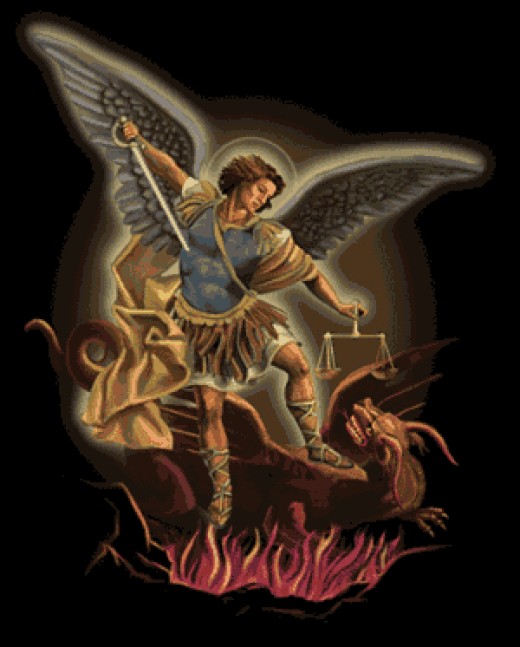
On the Feast of Michael and all Angels, popularly called Michaelmas, we give thanks for the many ways in which God’s loving care watches over us, both directly and indirectly, and we are reminded that the richness and variety of God’s creation far exceeds our knowledge of it.
The Holy Scriptures often speak of created intelligences other than humans who worship God in heaven and act as His messengers and agents on earth. We are not told much about them, and it is not clear how much of what we are told is figurative. Jesus speaks of them as rejoicing over penitent sinners (Lk 15:10). Elsewhere, in a statement that has been variously understood (Mt 18:10), He warns against misleading a child, because their angels behold the face of God. (Acts 12:15 may refer to a related idea.)
In the Hebrew Scriptures, it is occasionally reported that someone saw a man who spoke to him with authority, and who he then realized was no mere man, but a messenger of God. Thus we have a belief in super-human rational created beings, either resembling men in appearance or taking human appearance when they are to communicate with us. They are referred to as “messengers of God,” or simply as “messengers.” The word for a messenger in Hebrew is malach, in Greek, angelos, from which we get our word “angel” [Digression: angelion means “message, news” and euangelion means “good news = goodspell = gospel,” from which we get our word “evangelist” used to mean a preacher of the Good News of salvation, and, more narrowly, one of the four Gospel-writers: Matthew, Mark, Luke, and John.]
By the time of Christ, Jewish popular belief included many specifics about angels, with names for many of them. There were thought to be four archangels, named Michael, Gabriel, Raphael, and Uriel. An alternative tradition has seven archangels (see Tobit 12:15 and 1 Enoch 20). Sometimes each archangel is associated with one of the seven planets of the Ptolemaic system (the moon, Mercury, Venus, the Sun, Mars, Jupiter, Saturn). Michael is associated with Saturn and Uriel with the Sun. The other pairings I forget, but I believe that you will find a list in the long narrative poem called “The Golden Legend,” by Henry Wadsworth Longfellow. (I believe that a pairing is also offered in the opening chapters of the Proof of the Apostolic Preaching, by Irenaeus of Lyons, but I have not the work at hand.)
Michael (the name means “Who is like God?”) is said to be the captain of the heavenly armies. He is mentioned in the Scriptures in Daniel 10:13,31; 12:1 (where he is said to be the prince of the people of Israel); in Jude 9 (where he is said to have disputed with the devil about the body of Moses); and in Revelation 12:7 (where he is said to have led the heavenly armies against those of the great dragon). He is generally pictured in full armor, carrying a lance, and with his foot on the neck of a dragon. (Pictures of the Martyr George are often similar, but only Michael has wings.)
Gabriel (the name means “God is my champion”) is thought of as the special bearer of messages from God to men. He appears in Daniel 8:16; 9:21 as an explainer of some of Daniel’s visions. According to the first chapter of Luke, he announced the forthcoming births of John the Baptist and of our Lord to Zachariah and the Virgin Mary respectively.
Raphael (the name means “God heals”) is mentioned in the Apocrypha, in the book of Tobit, where, disguised as a man, he accompanies the young man Tobias on a quest, enables him to accomplish it, and gives him a remedy for the blindness of his aged father.
Uriel (the name means “God is my light” — compare with “Uriah”, which means “the LORD is my light”) is mentioned in 4 Esdras.
Brave Church Features Moslem Call to Prayer
Thank you, Hayfa; this is beautiful! He is singing “God is Great! God is Great! I testify there is no God but God, and Mohammed is his messenger.”
The Jews, the Christians and the Moslems all worship the one true God. The Kingdom of Heaven arrives when we all learn, as we are commanded, to live in peace with one another.
Libyans Say “Sorry” In Counter-Protests
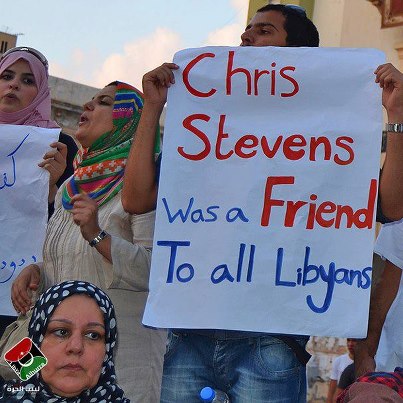
I was living in Qatar, and the Libyan ambassador’s wife had invited me, along with several other women, to morning coffee. It’s what people did. I was sitting between one of my Libyan friends and my good Iranian friend, and I started laughing. I said “Oh, what is this good little American girl doing sitting between a Libyan and an Iranian?” and then we all laughed. We weren’t Libyan, or American, or Iranian, we were just women who liked each other; we got along.
We were all religious women. Not the same religion, but all believers in the Abrahamic tradition. I felt more comfortable with them than I felt around non-religious women. We had a lot of fun together, and we liked each other.

It breaks my heart when bad things happen, and I know how good these people are, and that the people on the attack have their own agenda which has nothing to do with Islam, or Christianity, and everything to do with power. If they prevail, I fear for my good friends.

This article from USA Today made me cry this morning. Ambassador Stevens was loved, and these brave people are risking their futures to tell us so.

Libyans express sorrow over killing of Americans
by Donna Leinwand Leger, USA TODAY
Hours after learning of Ambassador Chris Stevens’ death, the Libyan Youth Movement transformed its Facebook page into a tribute to the slain diplomat. It changed its cover photo from “Free Libya” graffiti sprayed on a Tripoli wall to a somber photo of Stevens with the tag “RIP Christopher Stevens1960-2012.”
“As North America wakes up, dread washes over me. What a rough night. I’m sorry for the horrible day the world is about to face,” the administrator of the Shabab Libya page wrote. “We are sorry.”
As anti-American protests swept across North Africa and the Persian Gulf, a counter-protest of apology emerged. Photos of Libyans carrying hand-lettered signs condemning the violence and expressing contrition for their countrymen appeared on Facebook. “Sorry” became the trending mantra of Libyans on Twitter.
At one counter-protest, an unidentified man carried a crude sign phonetically written in English with blue marker on lined notebook paper, “Sorry People of America this not the Pehavior of our ISLAM and Profit.”
Another sign in red, white and blue read: “Chris Stevens wasa friend to all Libyans.”
On Facebook, one group formed The Sorry Project, designed to collect thousands of personal, written apologies from Libyans. Its profile photo is a man holding a sign, “USA. We are sorry. We are sad.”
“We Are Sorry,” the group wrote on the page created Sept.11. “We would like show that as Libyans we do not support on the actions committed by these criminals. USA, we are sorry and we will say it one thousand times over. Our apologies will never be enough, but the Libyan people will always be grateful for you since you were the first to stand by us in our fight for freedom and hopefully you will continue supporting us.”
One commenter, Hajer Sharief, vowed to avenge Stevens’ death by rebuilding a “new civilized democratic Libya.”
“We promise, we will not tire, we will not falter, and we will not fail,” Sharief wrote. “This is the way real Libyans will pay you back Mr. Ambassador Chris Stevens.”
At the ceremony Friday outside Washington to repatriate the remains of the four American victims, President Obama acknowledged Libya’s internal conflict.
“I know that this awful loss, the terrible images of recent days, the pictures we’re seeing again today, have caused some to question this work. And there is no doubt these are difficult days. In moments such as this — so much anger and violence — even the most hopeful among us must wonder,” Obama said. “But amid all of the images of this week, I also think of the Libyans who took to the streets with homemade signs expressing their gratitude to an American who believed in what we could achieve together. I think of the man in Benghazi with his sign in English, a message he wanted all of us to hear that said, ‘Chris Stevens was a friend to all Libyans.’ “
Psalm 55; Old Wisdom for Today
I’ve always liked this Psalm, from today’s readings in the Lectionary. It captures the worst betrayal, that of a friend, with whom you have shared meals and confidences. It captures the dichotomy of diplomacy, when one speaks with words ‘soft as butter’ which are, in truth, as steely as drawn swords. It captures the curse of the violent, those who cause strife and bloodshed and who die young.
Psalm 55
To the leader: with stringed instruments. A Maskil of David.
1 Give ear to my prayer, O God;
do not hide yourself from my supplication.
2 Attend to me, and answer me;
I am troubled in my complaint.
I am distraught 3by the noise of the enemy,
because of the clamour of the wicked.
For they bring* trouble upon me,
and in anger they cherish enmity against me.
4 My heart is in anguish within me,
the terrors of death have fallen upon me.
5 Fear and trembling come upon me,
and horror overwhelms me.
6 And I say, ‘O that I had wings like a dove!
I would fly away and be at rest;
7 truly, I would flee far away;
I would lodge in the wilderness;
Selah
8 I would hurry to find a shelter for myself
from the raging wind and tempest.’
9 Confuse, O Lord, confound their speech;
for I see violence and strife in the city.
10 Day and night they go around it
on its walls,
and iniquity and trouble are within it;
11 ruin is in its midst;
oppression and fraud
do not depart from its market-place.
12 It is not enemies who taunt me—
I could bear that;
it is not adversaries who deal insolently with me—
I could hide from them.
13 But it is you, my equal,
my companion, my familiar friend,
14 with whom I kept pleasant company;
we walked in the house of God with the throng.
15 Let death come upon them;
let them go down alive to Sheol;
for evil is in their homes and in their hearts.
16 But I call upon God,
and the Lord will save me.
17 Evening and morning and at noon
I utter my complaint and moan,
and he will hear my voice.
18 He will redeem me unharmed
from the battle that I wage,
for many are arrayed against me.
19 God, who is enthroned from of old,
Selah
will hear, and will humble them—
because they do not change,
and do not fear God.
20 My companion laid hands on a friend
and violated a covenant with me*
21 with speech smoother than butter,
but with a heart set on war;
with words that were softer than oil,
but in fact were drawn swords.
22 Cast your burden* on the Lord,
and he will sustain you;
he will never permit
the righteous to be moved.
23 But you, O God, will cast them down
into the lowest pit;
the bloodthirsty and treacherous
shall not live out half their days.
But I will trust in you.
“I Am The Good Shepherd”
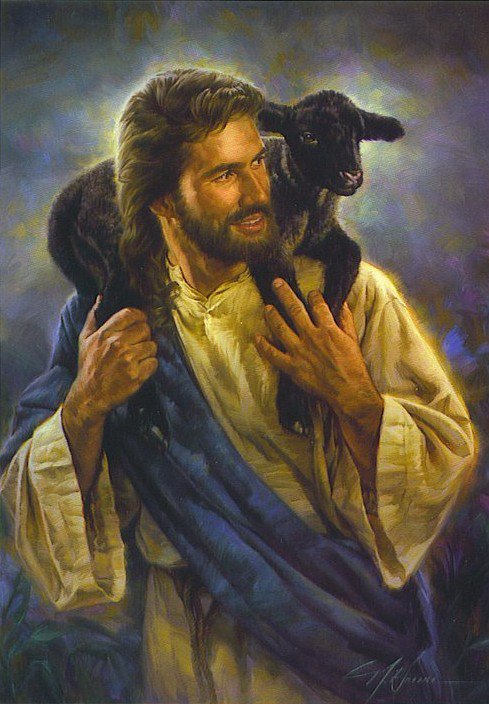
Every time I read those words from the Gospel of John, I am transported back to our first tour in Jordan, sitting outside our little villa near fourth circle, watching the shepherd and the sheep go by. Dusk is falling, you can hear multiple calls to prayer issuing from nearby mosques, and the shepherd is crossing back to their night time pastures.
But there is a ditch, a deep ditch, for new sewer and water lines, and there is only a thin board by which to cross.
One by one, he carries the sheep across. It takes a long time. The sheep are restless, but with a few words, he calms them. They don’t stray, they wait for him to lift and carry them across. Once across, they wait for the rest to follow before they all head on their way. The shepherd is grimy and dusty, covered with mud from ferrying the sheep across the ditch.
The sheep know the shepherd’s voice, and when faced with a new threat, they trust that he will deliver them safely. Sheep are pretty stupid. On their own, they can get into all kinds of trouble. If they have a good shepherd, they are safe.
This is today’s Gospel reading from John:
John 10:1-18
10‘Very truly, I tell you, anyone who does not enter the sheepfold by the gate but climbs in by another way is a thief and a bandit. 2The one who enters by the gate is the shepherd of the sheep. 3The gatekeeper opens the gate for him, and the sheep hear his voice. He calls his own sheep by name and leads them out. 4When he has brought out all his own, he goes ahead of them, and the sheep follow him because they know his voice. 5They will not follow a stranger, but they will run from him because they do not know the voice of strangers.’ 6Jesus used this figure of speech with them, but they did not understand what he was saying to them.
7 So again Jesus said to them, ‘Very truly, I tell you, I am the gate for the sheep. 8All who came before me are thieves and bandits; but the sheep did not listen to them. 9I am the gate. Whoever enters by me will be saved, and will come in and go out and find pasture. 10The thief comes only to steal and kill and destroy. I came that they may have life, and have it abundantly.
11 ‘I am the good shepherd. The good shepherd lays down his life for the sheep. 12The hired hand, who is not the shepherd and does not own the sheep, sees the wolf coming and leaves the sheep and runs away—and the wolf snatches them and scatters them. 13The hired hand runs away because a hired hand does not care for the sheep. 14I am the good shepherd. I know my own and my own know me, 15just as the Father knows me and I know the Father. And I lay down my life for the sheep. 16I have other sheep that do not belong to this fold. I must bring them also, and they will listen to my voice. So there will be one flock, one shepherd. 17For this reason the Father loves me, because I lay down my life in order to take it up again. 18No one takes* it from me, but I lay it down of my own accord. I have power to lay it down, and I have power to take it up again. I have received this command from my Father.’
The Problem with Interpretation of Holy Scriptures
Who foresakes the fear of the Lord?
Job 6:14
‘Those who withhold* kindness from a friend
forsake the fear of the Almighty.*
I like that thought. We are all interconnected. One of our major purposes for our creation is to connect with one another, to show kindness to one another. But others translate this verse differently:
New International Version (©1984)
“A despairing man should have the devotion of his friends, even though he forsakes the fear of the Almighty.
New Living Translation (©2007)
“One should be kind to a fainting friend, but you accuse me without any fear of the Almighty.
English Standard Version (©2001)
“He who withholds kindness from a friend forsakes the fear of the Almighty.
New American Standard Bible (©1995)
“For the despairing man there should be kindness from his friend; So that he does not forsake the fear of the Almighty.
King James Bible (Cambridge Ed.)
To him that is afflicted pity should be shewed from his friend; but he forsaketh the fear of the Almighty.
GOD’S WORD® Translation (©1995)
“A friend should treat a troubled person kindly, even if he abandons the fear of the Almighty.
King James 2000 Bible (©2003)
To him that is afflicted pity should be shown from his friend; even though he forsakes the fear of the Almighty.
American King James Version
To him that is afflicted pity should be showed from his friend; but he forsakes the fear of the Almighty.
American Standard Version
To him that is ready to faint kindness’should be showed from his friend; Even to him that forsaketh the fear of the Almighty.
Douay-Rheims Bible
He that taketh away mercy from his friend, forsaketh the fear of the Lord.
Darby Bible Translation
For him that is fainting kindness is meet from his friend; or he forsaketh the fear of the Almighty.
English Revised Version
To him that is ready to faint kindness should be shewed from his friend; even to him that forsaketh the fear of the Almighty.
Webster’s Bible Translation
To him that is afflicted pity should be shown from his friend; but he forsaketh the fear of the Almighty.
World English Bible
“To him who is ready to faint, kindness should be shown from his friend; even to him who forsakes the fear of the Almighty.
Young’s Literal Translation
To a despiser of his friends is shame, And the fear of the Mighty he forsaketh.
(These translations are compiled on the website Biblos)
To me, this is why we need the Holy Spirit, to help us discern what the words are intended to mean. The bad part is that we often choose the meaning which supports what we want to believe, we re-inforce our own distortions and misunderstandings with scriptures.
Recent Comments
ExpatAlien on What Country am I Living … intlxpatr on Yellowstone: Old Faithful to C… Michelle on Yellowstone: Old Faithful to C… Cathy on No Grown-Ups in Charge intlxpatr on Waiting for Snow Wikipedia Donate Button

Amazina


Early Voting in Florida


 Here There and Everywhere