For the Letter Kills, but the Spirit Brings Life
In one of my Baptist-oriented bible study classes, one of my classmates once said “You don’t make converts by running after people and hitting them over the head with a bible!” As People of the Book, we struggle to find ways to carry the message without bludgeoning our intended recipient with it.
Have you ever been on the receiving end? I lived for so many years in the Middle East, where my truly believing Moslem friends would tell me about the Prophet Mohammed and all the good he did, and would look at me expectantly, hoping I would have that blinding flash that Paul experienced on the road to Damascus, and come over from the dark side to the one true religion. It made a believer out of me, not a Moslem, but a believer in the goodness and sincerity of all who are holy, and of the near impossibility of convincing anyone with words.
So this morning, the reading in the Lectionary from Paul’s letter to the Corinthians sings to my soul:
2 Corinthians 2:14-3:6
14 But thanks be to God, who in Christ always leads us in triumphal procession, and through us spreads in every place the fragrance that comes from knowing him. 15For we are the aroma of Christ to God among those who are being saved and among those who are perishing; 16to the one a fragrance from death to death, to the other a fragrance from life to life. Who is sufficient for these things? 17For we are not peddlers of God’s word like so many;* but in Christ we speak as persons of sincerity, as persons sent from God and standing in his presence.
3Are we beginning to commend ourselves again? Surely we do not need, as some do, letters of recommendation to you or from you, do we? 2You yourselves are our letter, written on our* hearts, to be known and read by all; 3and you show that you are a letter of Christ, prepared by us, written not with ink but with the Spirit of the living God, not on tablets of stone but on tablets of human hearts.
4 Such is the confidence that we have through Christ towards God. 5Not that we are competent of ourselves to claim anything as coming from us; our competence is from God, 6who has made us competent to be ministers of a new covenant, not of letter but of spirit; for the letter kills, but the Spirit gives life.
We carry the Spirit, and our lives are the message.
Philosophy in a Fortune Cooky

So on our way home from lunch today, at the Siam Thai, AdventureMan and I are talking about his fortune cookie. (Mine said “learn Chinese” on one side and I can’t even remember what on the other side, something so non-interesting.) AdventureMan’s fortune said “Good people learn wisdom by making mistakes,” or something like that.
Off we went. So if you are not good, can you learn from making mistakes? Do you just keep making the same mistakes? Does making the same mistakes mean that you are not a good person? Can you make a mistake and not learn wisdom? Are all wise people good? Can you be evil and be wise? Like is the devil wise? He is said to be sly, and crafty, so how do those vary from being wise? Is Satan wise? Can you be evil and wise?
Segue’ to Mother Jessica’s sermon at Christ Church Pensacola yesterday, and It’s Not About the Chocolate as she explained that giving up chocolate or coffee or meat was not what Lent was really all about as we walk the path to become better worshippers of God and followers of Jesus. At the end of the service, as we exited, they passed out little chocolates. AdventureMan still had his chocolate (which he ate in front of me) and told me he had never negotiated with God. “Never??” I asked, in a tone which really meant “I call bulls#!t” and he said, no, never; never said “Please please, if you will only do this, I will do that.”
“OK,” I continued, as I can be relentless, “what about in Vietnam, was there never a time you said ‘Please, Please, Please’ about anything?”
“Yes, but I was never bargaining,” he explained, ‘I was begging. I had nothing to bargain with.”
So is begging, with no leverage, is that still negotiating? I think it is, Mother Jessica said bargaining, and isn’t begging bargaining with no leverage? We couldn’t agree. He says that is not bargaining, and we had to agree to disagree.
And the real point is, none of us have anything to bargain with. God laughs at our pathetic attempts to bargain. He likes the honest ones, like AdventureMan, who just cower in his magnificence and power and trust in his ability, and so beg, “please! Please!” We have to trust in his mercy and his compassion.

The worst and most memorable Lent I ever observed was in Kuwait. I became aware that I had started swearing in the car as another car would nearly side-swipe me, or some arrogant idiot would park in four spaces (yes, yes, I promise you, one car CAN occupy four spaces) and I was giving people rides and really, really needed to not curse, not just to protect their ears, but also for my own soul. Calling people names is worse for me than it is for them. I devised a strategy of elaborate politeness. When someone was going to bump me out of the way, I would gesture “Tfadl!” (“YOU are to be preferred! or “after you”) with a grand gesture and a big smile like it was My idea. After a while, elaborate politeness became my mode, and I got a lot of pleasure out of it, and mostly, I stopped cursing at the idiot drivers. Actually, I got so good at it that I didn’t even say “Idiot!”, but I could not control it popping into my mind from time to time . . .
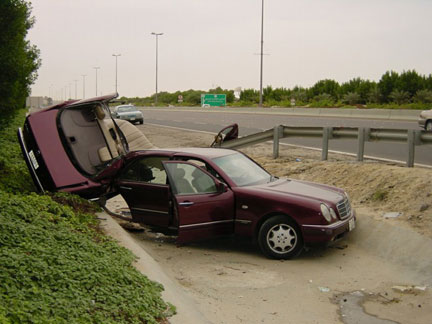
And, sadly, we have some of those same . . . umm . . . idiots . . . here in Pensacola, so perhaps I need to redo my Lenten sacrifice and work on my attitude toward inattentive and /or aggressive drivers, especially those in great big trucks with bad eyesight.
Did you know the word for ‘honey’ in Arabic is ‘asel?’ 😉
Love the Cockroach

Happy New Year! Thank you for continuing to visit and read here all these years, and thank you for your comments and e-mails.
Today, reading my morning meditations, the Lectionary and my daily e-mail from Dr. Richard Rohr, I come across this paragraph in Father Rohr’s message:
| The Christian vision is that the world is a temple. If that is true, then our enemies are sacred, too. Who else created them but God? The ability to respect the outsider is probably the litmus test of true seeing. And it doesn’t stop with human beings and enemies and the least of the brothers and sisters. It moves to frogs and pansies and weeds. Everything becomes enchanting with true sight. One God, one world, one truth, one suffering, and one love. All we can do is participate. I hope you enter the New Year with this awareness and an intention to join in with all your heart, mind, and body! |
 |
Trying to be a Christian is so hard. To learn to love the stranger, I was sent to strange countries. Many countries. Many years. Until I could see that the commonality of humanity was greater than the differences in our dogma, I was sent. It didn’t have to do with carrying a message. It had to do with keeping my eyes and ears open, and most of all, keeping my heart open, to learn what I was meant to learn.
When I finally “got” it, our years of living overseas stopped. Now I have a new challenge, living in my own culture and feeling like “the other.”
I get the part about seeing God in all humanity. It’s not like I can do it, but it is important to God that I try. Today Father Rohr has also mentioned frogs and pansies and seeds, and then he says EVERYTHING. Ummm. Everything includes cockroaches.
I have no control over my reaction to cockroaches. They are dirty, and they skitter. One time, we had one in the house that flew – and HISSED! (I disabled him with a spray of Pledge, then disposed). We have a pest control man who makes sure my visitors are far and few between, but . . . this is Florida. Florida has cockroaches. The secret is to keep them to a minimum. Unfortunately, they just give me the creeps, and I can’t rest comfortably until the world has one less cockroach.
My first thought when I read today’s message, seeing God in his infinite glory in EVERYTHING, is that I have a huge challenge. The cockroach. The slug. The mosquito. The snake. There are so many creations that give me the creeps. How am I going to practice this? Is giving them space enough?
Cordoba, The Mezquita, and Sharing Sacred Spaces
(Yes, it is Christmas Eve, and my part of the preparations are all done. AdventureMan is cooking a duck for the family dinner tonight, the Gulf Coast jumbo shrimp is all cooked and shelled and de-veined, the Rotkohl spicing up the kitchen, the salads and side dishes ready to go. 🙂 I have time, oh, the great luxury of time, to write . . . )
When we lived in Amman, we often went to Syria. I went once with an archaeological group, visiting several sites in the bleak cold of the Syrian winter. One site I didn’t see a lot of hope for, the site of St. Simon the Stylite, a hermit who sat atop a pillar and was considered holy. In truth . . . I scoffed.
I scoffed until I reached that isolated hilltop, and saw the giant pillar, and felt how very cold it was as the icy wind blew. We were there two or three hours. I had to confront my unwillingness to believe and the fact that with every zinging atom in my body, I could feel that this was a sacred place. Saint Simon chose a weird sort of sacrificial life, but in God’s eyes, I suspect it mattered. I know visiting that site changed me, and changed my ideas about sacred spaces.
Today, I get to write about a visit to another sacred space, a space you can feel resonating from the moment you enter, the Mezquita.
* * * * * * * * *
It’s early breakfast for the Smithsonian group, and then we check our whisper guides and board our bus en route to Cordoba.
Traveling with a group is a novelty for us. It means using an alarm clock to be at scheduled breakfast and getting on a bus for a 2 hour drive. On our own, we wake when we wish – usually early, but not so early as with this group. We are not usually at a breakfast with a lot of people looking for food at the same time. We are not used to coffee makers that make one cup of coffee at a time while a 100 people line up for coffee. These are things that are not normal in our experience. We might find a local small store, pick up some water and some small snacks, and hit the road, stopping here and there to take a photo or just savor a view, have some water, soak in the fresh air. On the other hand, these bus drivers know where to go and there is no getting lost trying to find the right route out of town.
En route to Cordoba, most of the jet lagged Smithsonian group slept. Wide awake, I watched as acres and acres of olive groves and wind farms passed by. We saw an ancient fortification on the side of a hill that had a view to die for – 270 degrees plus of visibility.
It is raining once again as we arrive in Cordoba, but almost immediately it stops, and by the time our group has walked up the hill by the Mezquita, the sun is out and the day shows great promise. Cordoba is beautiful. Everywhere you look is some exquisite detail. Cordoba is a treat for the eyes.
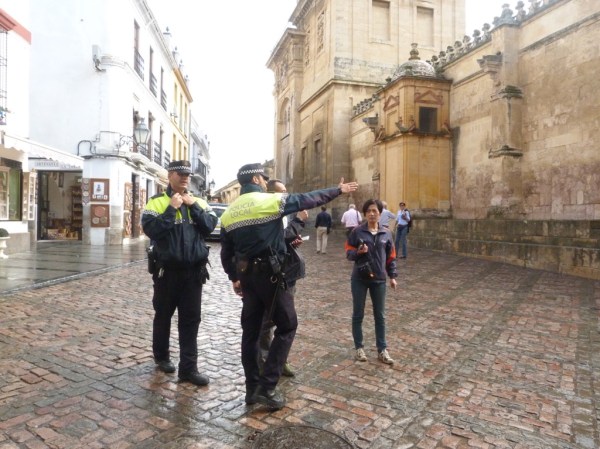
Even the police are polite and helpful, directing tourists to where they need to go:
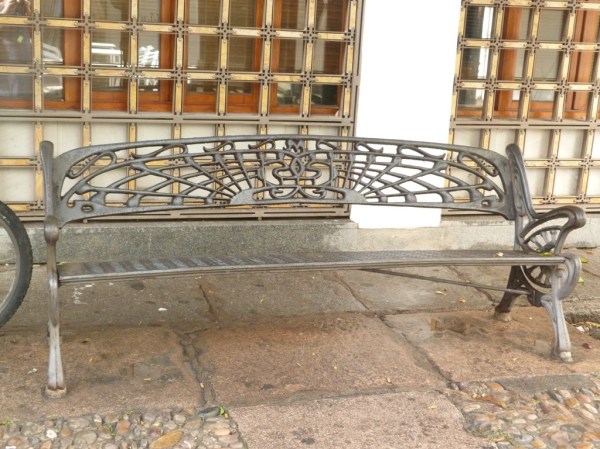
Art Nouveau bench:
Flower pots on the stucco walls:

Tourists coming up to The Mezquita:

Masques in a local art shop:

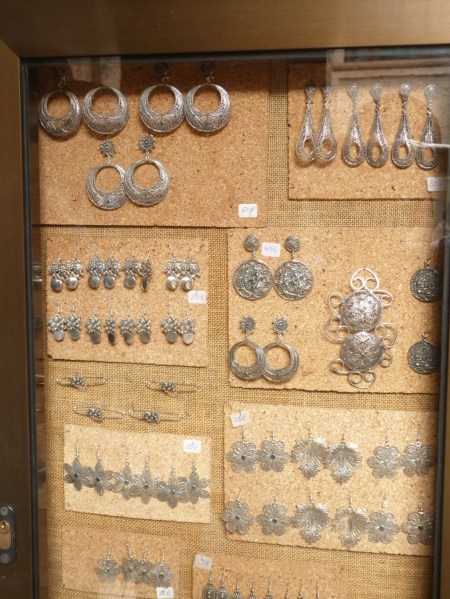
Finely wrought silver filigree jewelry:

At one point, we had a choice: Do we go shopping or do we have lunch in a highly rated local place? I bet we could do both, and we opted for lunch – more on that to come. At the end of lunch, we had only ten minutes to shop and not enough time to get back to this wonderful shop. I won’t call it a regret; lunch was a wonderful experience . . . and I do love filigree, and this artisan had beautiful silver filigree . . .
Ben Maimonaides, a Jewish scholar and ethicist, with wide influence. This was a continuing theme on the entire trip, that the interaction between Jew, Christian and Moslem in this period led to a great leap in ideas and artistry. The interaction was like pollination; science and the arts and mathematics and medicine bloomed.
I wonder if this is happening today, as Moslems, Jews and Christians study together in universities, to they interact and inspire one another? Is it possible that in spite of dire political headlines, under the radar, people are learning to cooperate and collaborate in the interest of a better world?
(Wikipedia: Aside from being revered by Jewish historians, Maimonides also figures very prominently in the history of Islamic and Arab sciences and is mentioned extensively in studies. Influenced by Avicenna (c. 980 – 1037), Averroes (1126–1198) and Al-Farabi (ca. 872–950/951), he in his turn influenced other prominent Arab and Muslim philosophers and scientists. He became a prominent philosopher and polymath in both the Jewish and Islamic worlds.
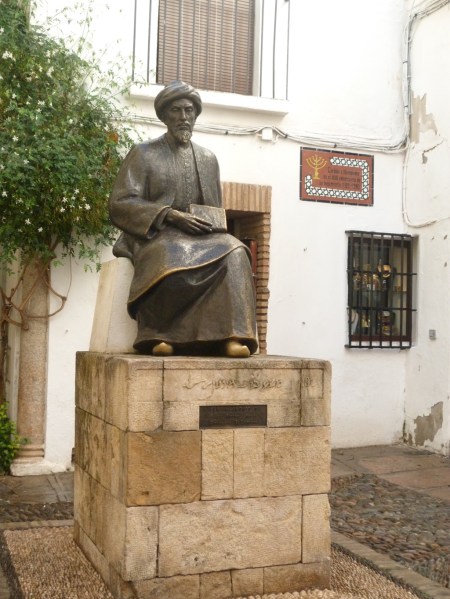
Bulls everywhere, LOL

An artistic courtyard
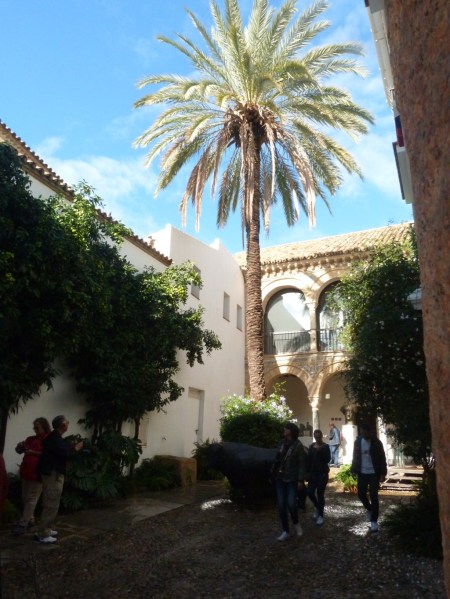
Love the little blue pots, and love the people who take care of them!

After our walking tour of Cordoba central, we gather in the gardens while our guide goes to pick up our tickets to take us inside the Mezquita, built as a mosque, becoming a cathedral after 1492.
Did I mention we learned two major dates on this trip: 711, when Tariq crosses into Spain (Jebal Tariq . . . Gibraltar) and 1492? Americans know 1492 as the year “Columbus sailed the ocean blue in fourteen hundred ninety two, but 1492 is the year that the Moslems were driven out of Spain, weeping at the loss of Andalusia, Al-Andalus.
When the Moslems were driven out of Cordoba, the huge, beautiful mosque, Al Mesquite, was not destroyed, but recycled, repurposed, space holy to one faith became holy to another. I love it that the original mosque, with its spectacular soaring arches and inspirational proportions, was recognized, and re-utilized. Holy space is holy space. We worship the same God. We saw the shrine to John the Baptist in the Grand Ummayad Mosque in Damascus; why should we not share holy spaces?


This is what you see immediately upon entering the Mezquita – a gorgeous kind of meshrabiyya covering the windows, patterning the light as it enters, keeping the harsh heat out and shrinking light in star like patterns across the floor.

The interior of this mosque/cathedral takes my breath away. It was crowded with tourists, but it just swallowed them up and maintained its sacred integrity. We could wander off and still hear our guide, thanks to this whisper-technology, where we all had headphones and our guide could broadcast. This was a place where I needed to wander off and experience it on my own, but felt some responsibility not to get too far afield from the group. I didn’t want to be a pain in the neck for the guide. And I also didn’t want to be a part of the group within this structure. It’s a problem.
Just look at these spaces:

I’ve always had a thing about light fixtures, LOL, I probably should own a lamp show except I would only stock what I like and I would have a hard time selling anything in the shop. Guess it’s just a good thing for me to admire light fixtures and not to have to manage them.

The beautiful Mihrab (points you in the direction of worship in a mosque) from the original mosque:

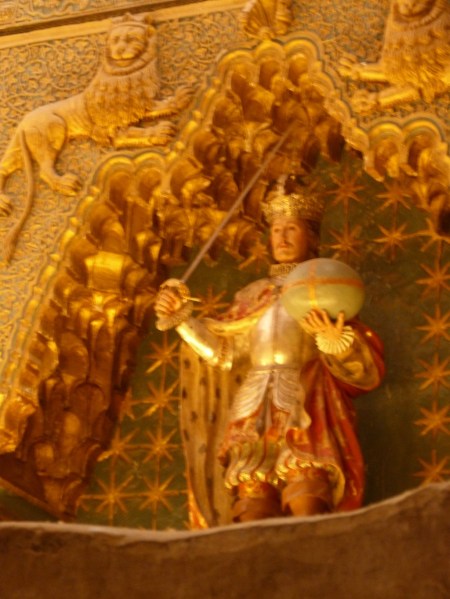
The Christian altar built in a structure added to the original mosque:

With a piece depicting King Ferdinand holding a globe:
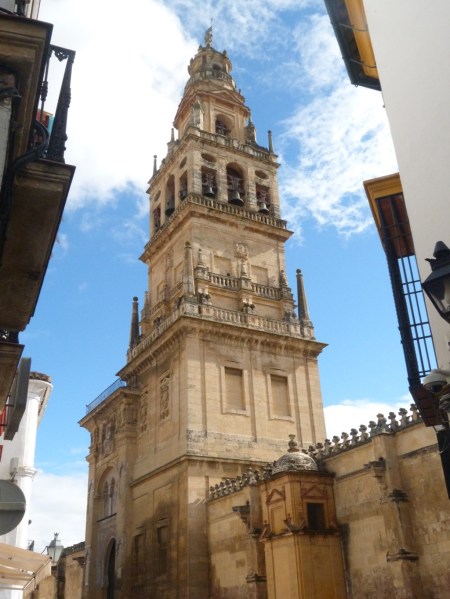
As the tour ended, our tour guide warned us that we had only an hour and a half for lunch, so not to go to a restaurant, just find something quick, or shop, and BE BACK ON THE MEETING PLACE AT TWO!
We had seen a restaurant we wanted to try, so raced to it. We hate being rushed, and part of the fun of traveling is trying new kinds of food in new places!


Play Station, Romeo and Juliet, ISIS, and Syrian Refugee Discussions
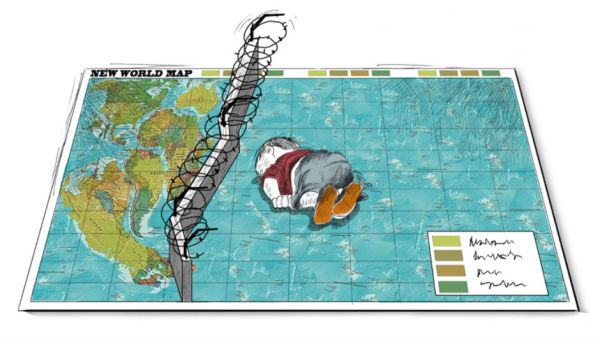
I belong to a group that I can only describe as “thoughtful” Christians; it’s a church-related study group, and as everywhere else in the US of A, people are discussing recent events in Paris, and the related issue of resettling Syrian (and not only Syrian) refugees in the United States.

The same discussions are taking place on FaceBook. I’m inclined to think that those who are thinking lime me are measured, and thoughtful, and that those who disagree with me are overly emotional, even rabid, and that their attitudes might be Un-Christian as well as Un-American.
I am not so blind as to not see that they may see the exact same thing, in reverse. It’s the times, and the issues.

One very smart woman communicated something I haven’t heard anywhere else, that investigators believe these Paris murderers might have been communicating by creating a Play Station group, so you can message your group members, and your message disappears seconds later.

One neuron sparks, synapses connect and the outline of a picture emerges. Of course. This plot was not that complex. My major focus would be on how they got the weapons, but other friends tell me that now weaponry can be had very inexpensively on the dark market in Europe.
But what has puzzled me, until now, was the kind of thinking that would put this scenario together, and I have concluded that we did. By our entertainment technology, we have taught them to strategize. We have trained them to think through scenarios, and to have branching options. We have taught them to join forces. We have taught them to work in teams. Some may have had some training to operate the weapons so accurately, but this was the equivalent of a canned hunt, shooting fish in a barrel. They had rapid fire weapons, and rooms full of people expecting no more than a pleasant night out. Before they knew what was happening, the event had come and gone.
They are young. The so called “master-mind” (I really don’t like that label; I don’t think this took masterful planning, and they did not accomplish their major goal, which was terrorizing the soccer game) escaped, but not for long. They calculatedly and callously used expendables to accomplish their mission. There was no escape planned for most; give them suicide belts. Give them death. Did they know that the one pulling the strings had no intention of dying with them? So why on earth didn’t they question this plan?
When you are playing games on a Play Station, and you lose, you get another life. Hey, just like jihad! They are young, death means little, and they are easily manipulated. A glorious death, if you don’t look too closely. As I was in water aerobics this morning, we danced along to an old ditty called “Just Like Romeo and Juliet” and I thought how appropriate it was to these times and circumstances – a tradition of hatred between two groups, two young people who cross the lines, and then, their death rather than the hard work of trying to make changes in the real world.

Death isn’t romantic, and the God we share, the God of Father Abraham, hates the shedding of innocent blood, no matter by what name you call him. He tells us that only he knows the intentions of the human heart. When he chooses someone to do his work, it tends to be leaving this country and walking to another, leading a people out of slavery, bearing a child, or memorizing the words of an angel, not bombing, or shooting, or forcing others to worship in the way you believe everyone must worship.

The one true God also tells us, all of us, that we are to love our neighbor, and that our neighbor is that naked, helpless, beaten man lying by the side of the road that the fastidious religious men crossed the street to avoid helping. We are to take him in, pay for his care at the inn, tend to his wounds, not for any hope of gain, but because it is the right thing to do, the decent thing to do, for our fellow human being, our neighbor.

One final note, when we use the Statue of Liberty coming to the rescue of France, showing the colors of France, noting her origins in France to honor our own “Liberte” we most not fail to take note of the words at her base: Give me your tired, your poor; The huddled masses yearning to breathe free; The wretched refuse of your teeming shores; send these – the homeless, tempest tossed to me! I lift my lamp beside the golden door!”
Pouring Rain and a Herd of Sheep
Our first day in Seville, and we are so excited. We are READY. This trip is rated as having a lot of walking, so in addition to my prettier shoes, I packed my Alaska shoes, a pair of black leather New Balance shoes, and a bunch of brand new socks. I am wearing a dress and tennis shoes, and feeling a little ridiculous, but I don’t care. We are given these “whisper” things, receivers you wear around your neck and earbuds you keep in your ears. Your guide can talk to you without causing a commotion, and you are supposed to always stay within hearing of your guide.
As we head outdoors, the heavens open and the rain pours down. No problem, in my purse I have a brand new sort of mini umbrella I found, so I open it up, and something is not quite right. It doesn’t stay open, as I am walking along it will pop close all by itself now and then, and besides, everyone else is popping out umbrellas and it is congested, and umbrellas are dripping on me. I am miserable.
For a few minutes, I actually contemplate skipping this tour altogether, but when else will I get a chance to tour the Alcazar? The Seville Cathedral? With someone who knows and can tell us what we are seeing? I decide to have a good time, and, for the most part, I do.
Who could not love the Alcazar, the Royal Palace, even in the gloom and the rain? The Alcazar is full of groups, but far fewer than if it were not pouring down rain, sheets of rain.
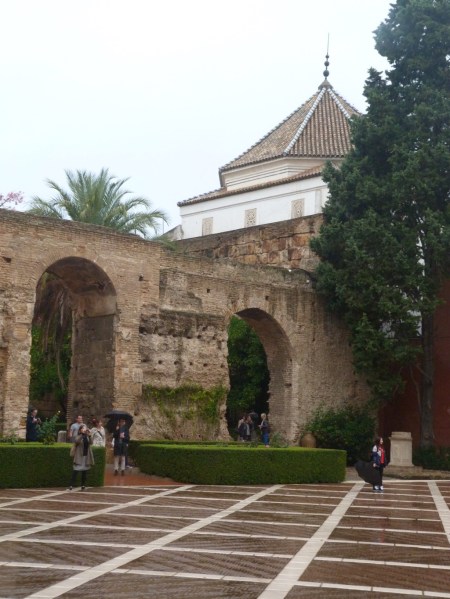
The amount thought and precision that went into the process of creating the Alcazar boggles my mind. What does a little rain matter when contemplating such beauty? So many media; tiles, wood, plaster, stone, and all used with precision and an eye for the overall effect. It is stunning.


And in the middle of all this artistry, one woman works to capture – herself.

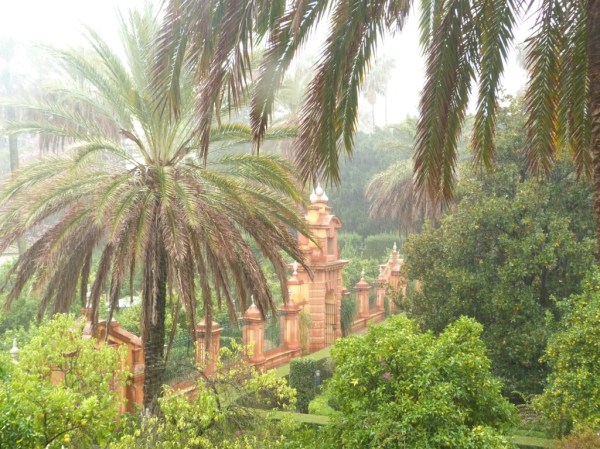
I’ve given up totally on the worthless umbrella and decided to just avoid rain if I can, and if I can’t, oh well. Visiting the gardens, it’s worth getting wet. These gardens, even in the rain, are gorgeous, lush, and I can imagine summer concerts and strolling.

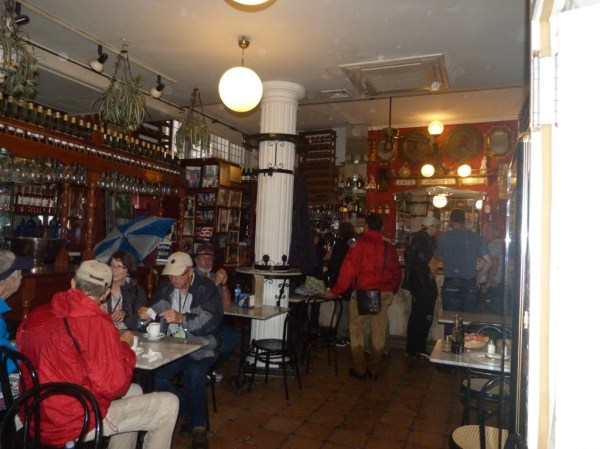
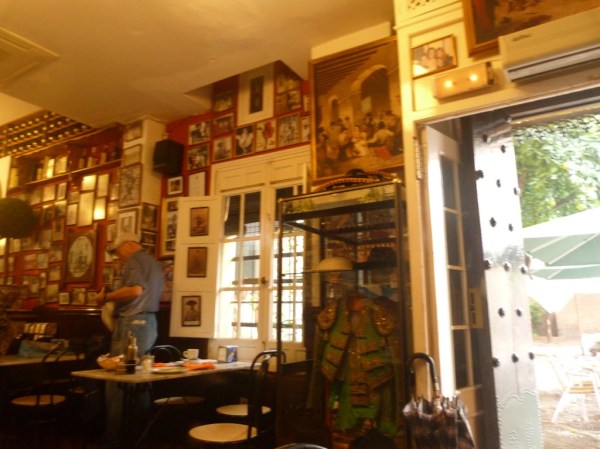
We spend a good long time in the Alcazar, and it is time to head to the Cathedral, but not quite our group’s scheduled time, so we head to a cafe for churros and chocolate, a local specialty. The cafe is so cozy we almost rebel when it comes time to leave. The guide tells us that leading seniors is as bad as leading teen-agers; we argue and think we know what we want to do. We are a small group, twenty people, but similar in goals and values.
It is warm and dry in the cathedral, but my dress is soaked. My shoes, however, are great, my feet aren’t tired, my socks are dry and I have already walked 10,000 steps! The hard floors of the cathedral tire me, though, so I wasn’t paying as close attention as I meant to. It was beautiful. King Ferdinand and Queen Isabella . . .. something. Beautiful altarpiece by . . . someone. A big gold thing called a montrance which is close enough to French for me to think it was for showing something, probably sacred relics, bones or pieces of the cross? I am ready to be warm and dry and my attention is definately wandering.
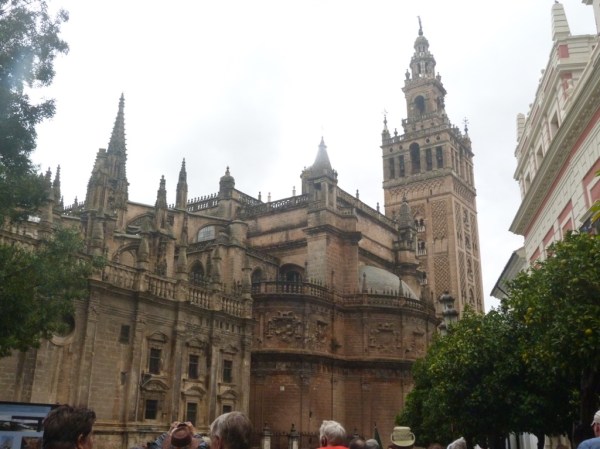


As we leave the Cathedral to head back to our hotel, just a short walk, the sun breaks through. The rain is gone. It’s a whole different day. We walk back in good cheer, change our clothes, and head out for lunch.
Today is the first day we have heard two dates: 711, when the Moslem Tariq invaded near Gibraltar (Jebal Tariq) and burned his ships, telling his men they had to fight because there was no way back. The second date is 1492, which every American associates with “Columbus sailed the ocean blue in fourteen hundred ninety-two” but we learned is the date when the Moslems were forced out of Al-Andalus. We saw paintings of people weeping as they left, and who wouldn’t weep, leaving such beauty and luxury? The same year, the Jews were also forced out, forced into North Africa, Italy, Eastern Europe, forced to seek safety elsewhere. Some converted and were allowed to stay, and are there to this day.
“But where is the herd of sheep?” you ask. This is an experiment for us, to see how well we can handle group travel. We are finding we like our fellow Smithsonian travelers very well, but because we are like cats (more than sheep) we do not herd well. We like to take our time where we wish to stay longer, and to hurry past that which doesn’t much interest us. We were trained, long ago, not to be in large groups of Americans, and here we are, a herd of sheep. It becomes a continuing theme; there are so many things we like, but walking in a group we don’t like.
Expendables; Pray for Paris

I have to take a break from my trip stories to express an opinion.
We are The People of the Book. Suicide is not an option. The most precious gift we are given, of the many gifts, is the gift of life. One of the most heinous crimes against God / Allah is to shed innocent blood.
A callous theocracy sends “inspired” martyrs, testosterone-hopped-up jihadists to kill themselves, and to take as many victims as they can with them.
By what stretch can they claim to do God’s will? Where is the submission to the word of God? Where is the peaceful Islam of the Prophet Mohammed?
Science and Entanglements
It’s been so long since I’ve last talked with you. I’ve been off on a great adventure, and I want to tell you all about it, but I’ve been recovering from a bug I caught the last day of our trip (I was so generous; I shared it with AdventureMan). Today is the first day I could really face blogging, and I was inspired by a reading I received this morning from Richard Rohr, whose religion and spirituality seem to hit me where I live.
Quantum Entanglement
Thursday, November 12, 2015
Just as different ways of interpreting scripture and various types of truth (e.g., literal vs. mythic) are valuable for different purposes, so scientific theories have different applications while seeming to be paradoxical and irreconcilable. For example, we have the Newtonian theory of gravity, Einstein’s theory of relativity, and quantum theory. Physicists know that each of them is true, yet they don’t fit together and each is limited and partial. Newtonian mechanics can’t model or predict the behavior of massive or quickly moving objects. Relativity does this well, but doesn’t apply to very, very small things. Quantum mechanics succeeds on the micro level. But we don’t yet have an adequate theory for understanding very small, very energetic, very massive phenomenon, such as black holes. Scientists are still in search of a unified theory of the universe.
Perhaps the term “quantum entanglement” names something that we have long intuited, but science has only recently observed. Here is the principle in layperson’s terms: in the world of quantum physics, it appears that one particle of any entangled pair “knows” what is happening to another paired particle–even though there is no known means for such information to be communicated between the particles, which are separated by sometimes very large distances. Could this be what is happening when we “pray” for somebody?
Scientists don’t know how far this phenomenon applies beyond very rare particles, but quantum entanglement hints at a universe where everything is in relationship, in communion, and also where that communion can be resisted (“sin”). Both negative and positive entanglement in the universe matter, maybe even ultimately matter. Prayer, intercession, healing, love and hate, heaven and hell, all make sense on a whole new level. Almost all religions have long pointed to this entanglement. In Paul’s letter to the Romans (14:7) he says quite clearly “the life and death of each of us has its influence on others.” The Apostles’ Creed states that we believe in “the communion of saints.” There is apparently a positive inner connectedness that we can draw upon if we wish.
Ilia Delio says, “If reality is nonlocal, that is, if things can affect one another despite distance or space-time coordinates, then nature is not composed of material substances but deeply entangled fields of energy; the nature of the universe is undivided wholeness.” [1] I’ve often described this phenomenon as an experiential “force field” or the Holy Spirit. In Trinitarian theology, the Holy Spirit is foundationally described as the field of love between the Father and the Son. One stays in this positive force field whenever one loves, cares, or serves with positive energy. I know that when people stand in this place, when they rest in love as their home base, they become quite usable by God, and their lives are filled with “quantum entanglements” that result in very real healings, forgiveness, answered prayers, and new freedom for those whom they include in the force field with them. I have too many examples here to list or to even remember. Jung called these events “synchronicities”; secular folks call them coincidences; the Sisters of Charity of Leavenworth, who taught me, called them Divine Providence.
On the other end of the spectrum there are people who carry death wherever they go, toward all those they can pull into their negative force field. (Is this hell?) I know that when I regress into any kind of intentional negativity toward anything or anybody, even in my mind, I am actually hurting and harming them. Etty Hillesum, a young imprisoned Jew in Nazi-occupied Amsterdam, says straightforwardly, “Each of us moves things along in the direction of war every time we fail to love.” And if so, it would surely follow that each of us moves things along in the direction of healing each time we choose to love. Each time it is a conscious choice and a decision, at least to some degree. Grace and guilt both glide on such waves of desire and intention.
Consciousness, desire, and intentionality matter. Maybe they even create and destroy worlds. We cannot afford to harbor hate or hurt or negativity in any form. We must deliberately choose to be instruments of peace–first of all in our minds and hearts. Such daring simplicity is quantum entanglement with the life and death of all things. We largely create both heaven and hell. God is not “in” heaven nearly as much as God is the force field that allows us to create heaven through our intentions and actions. Once quantumly entangled, it seems we are entangled forever, which is why we gave such finality and urgency to our choices for life (heaven) or death (hell).
This is such a “WOW” for me; I feel I can feed and nourish myself on this meditation for a long time. Google Richard Rohr’s Daily Meditation to sign up to receive his daily e-mail meditation.
Bureaucracy With a Heart
Did I tell you we’ve been stationed with two embassies, and at the second, I worked as a Foreign Service Officer? I know how busy and how harried the diplomats are, and I know how beleaguered the consular offices are with requests for visas and tourists who have lost their passports. They see it every day.
I lost my passport. My bad. Totally on me. I can’t expect anyone to feel obligated to help me out, but fortunately, there are mechanisms in place to expedite. You have to pay extra, but it’s worth it when you have a trip booked.
I told you about our run to New Orleans to submit paperwork and my delight to learn I would have a new passport soon.
I told you about the phone call telling me they needed a RECENT photo, not the same one that was on my last (never used, bright shiny new never used) passport.
I’ve been on edge all day. I’m away this weekend on a religious retreat, and I wasn’t feeling very religious. I was feeling nervous. I wonder if my passport reached New Orleans, or did it fall somewhere between the cracks? I wonder if Fridays are even work days at the passport center? What if it doesn’t get there and I don’t even know?
A short time ago, I got a phone call, from the same bureaucrat who called me about the photo. She was just calling to tell me that the passport is ready and will go out expedited this afternoon. She knew I would be concerned, and just wanted me not to worry.
I almost cried in gratitude. Who thinks of compassion when dealing with a bureaucracy? It was pure grace.
In the lifetime of our nation, we have elected some real doozies in high public office. Presidents, Senators, Representatives, Governors – some real characters. I don’t worry too much when lunatics run for high office, I thank God we have a solid bureaucracy, rarely corrupted; a bureaucracy that keeps plugging along when things get crazy. And thank God for this one particular officer who had a heart to reassure me that my passport is on the way. God bless her mightily.
“It’s Not Enough to Say ‘Hang in There” says Pope Francis
From the Associated Press
VATICAN CITY (AP) — The Vatican will shelter two families of refugees who are “fleeing death” from war or hunger, Pope Francis announced Sunday as he called on Catholic parishes, convents and monasteries across Europe to do the same.
Francis cited Mother Teresa, the European-born nun who cared for the poorest in India, in making his appeal in remarks to pilgrims and tourists in St. Peter’s Square.
“Faced with the tragedy of tens of thousands of refugees who are fleeing death by war and by hunger, and who are on a path toward a hope for life, the Gospel calls us to be neighbors to the smallest and most abandoned, to give them concrete hope,” Francis said.
It’s not enough to say “Have courage, hang in there,” he added.
It’s not enough to say “Have courage, hang in there,” he added.
In Pensacola, we have several top level Syrian doctors. Syria has been a crossroads of civilization for longer than the United States has been in existence. We can benefit by welcoming the Syrians and the Iraqis and the Afghanis into our own communities.
Recent Comments
ExpatAlien on What Country am I Living … intlxpatr on Yellowstone: Old Faithful to C… Michelle on Yellowstone: Old Faithful to C… Cathy on No Grown-Ups in Charge intlxpatr on Waiting for Snow Wikipedia Donate Button

Amazina


Early Voting in Florida


 Here There and Everywhere