Moab to Tropic, Bryce Canyon And a Wonder-Filled Detour through Capitol Reefs
We are still on Pensacola time, so early rising is a piece-of-cake. Quick breakfast, quick departure. We had looked at the options the night before, we could go directly to Zion via fast roads, or take a southern route which would take considerably longer. AdventureMan had looked at the map and suggested a third route, which took longer, but not so long as the southern route, and took us through a place I have never even heard of, Capitol Reefs.
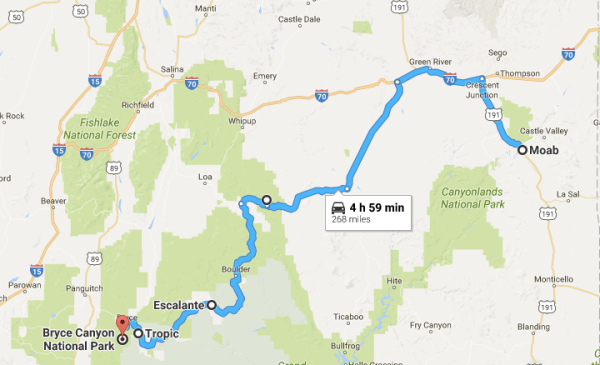
We’ve lived in so many wonderful places, and, because AdventureMan’s job was always so demanding, I took care of trip-planning, finding places to stay, creating routes to travel and choosing sights to see. This way is so much better, AdventureMan has the leisure to look at the maps, and he has good instincts. This day was another best day of the trip. 🙂
(Yes, I know, technically, they can’t all be best days. Toward the end we had some more boring days, but each day brought wonders and joys, and this is one of those best days, honest.)
One thing we never want is to find ourselves miles from a gas station in a remote location. As we are filling our tank, leaving Moab, I see one of our contemporaries loading up for his own adventure. This is what I love about Moab, you are free to pursue your own adventure.

If you are thinking about taking this trip, or a trip like it, you need to know that our phones had no service much of the time. Fortunately, we had maps and are good at reading them, mostly. It is really important to have some kind of back up when you are in remote locations. If you rely on your phone, and there is no service, you will have a harder time.
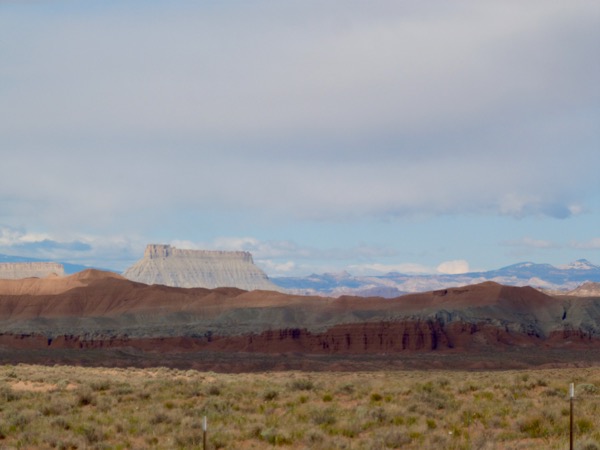
The scenery, even along the major highways, can be distractingly spectacular. This is, I believe, along I-70, which we take for a short time to get to the scenic road we want to be on to get to Capitol Reefs.



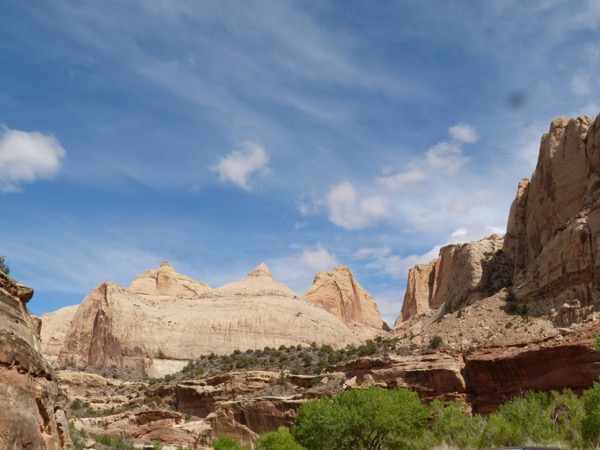
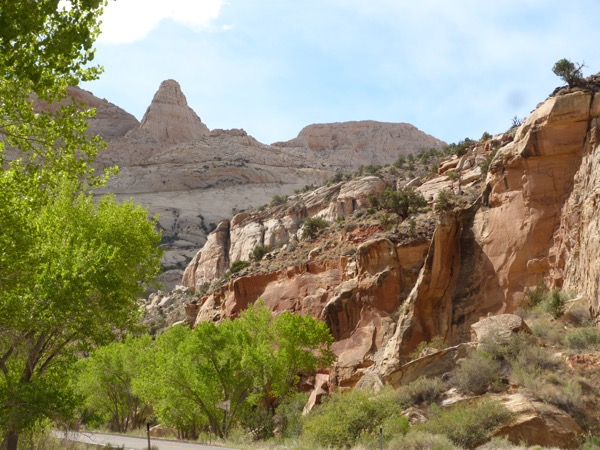
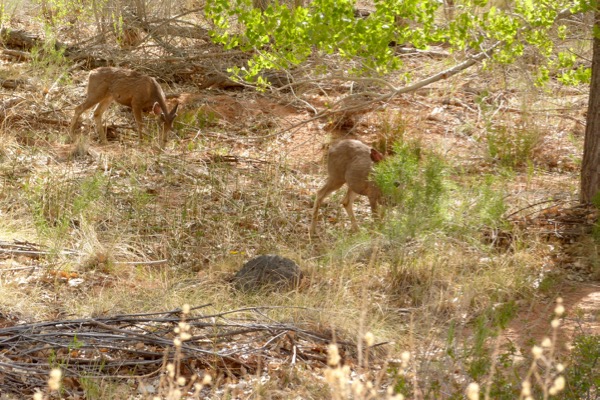
What we didn’t realize was that the greenery near the cliffs in Capitol Reefs indicated a river. I discovered it as I was making a pit-stop. I was headed to a private spot when all of a sudden, I realized I was not alone. By a stroke of luck, I had my camera in my hand. I whispered to the Mule Deer that I meant them no harm, and they calmly grazed as I took a couple photos.
Can you see why I am considering this another of the best days? I love happy surprises, and this day is full of happy surprises, even a few flakes of short-lived snow.

Good thing we stopped where we did. Just another quarter of a mile down the road is a major stop, with a beautiful walkway, so people can view Petroglyphs!

So, can you see the petroglyphs? I bet your eyes are getting better at it. You learn to look a little higher than you would think.
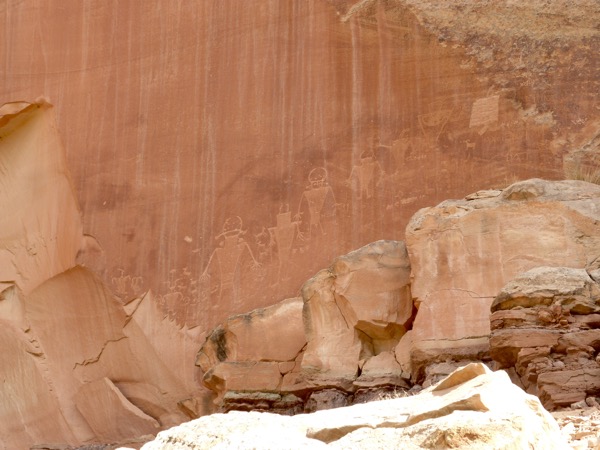
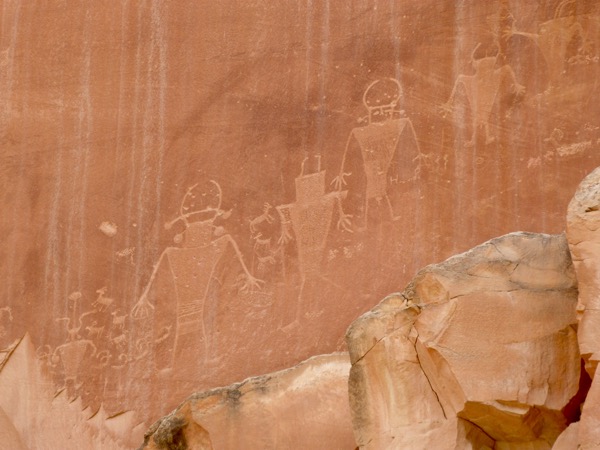
There are so many places where petroglyphs have been lost to natural breaking off and erosion.
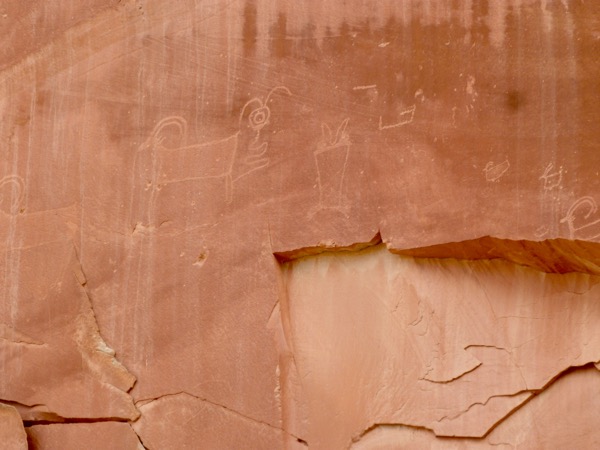


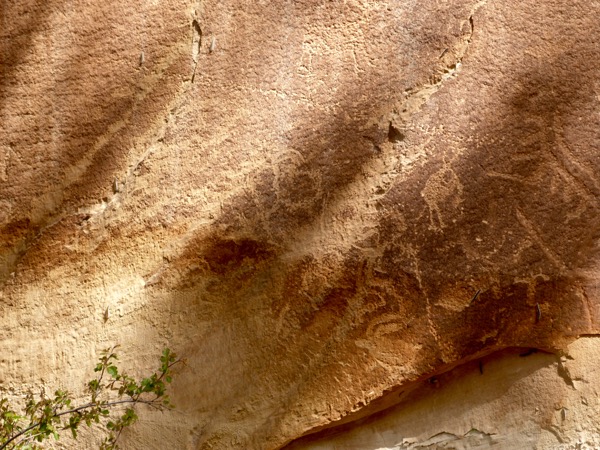
This is a piece that has broken off, but remnants of the original petroglyphs remain.

This is the beautiful walkway they built.

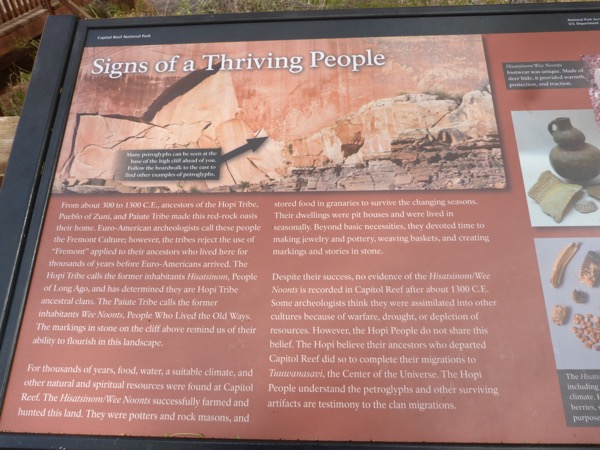
This is the sign. It is a little obscured, but we are always thankful for good signage.

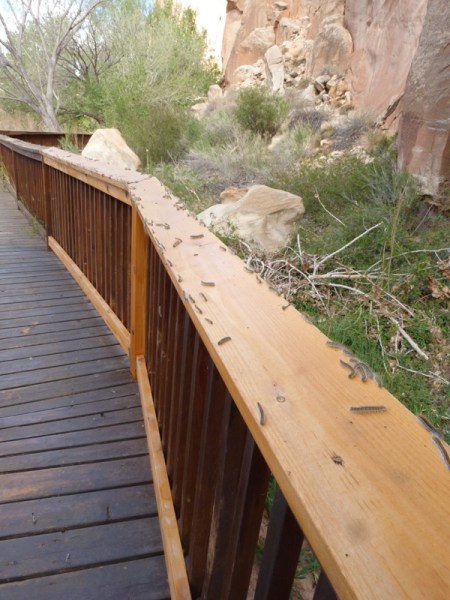
I want you to know how very brave I was. I was about to lean on the railing to steady a shot when AdventureMan said “You’ll want to look before you do that,” and when I did, I saw a thousand creeping caterpillars. They were falling out of the trees, and covered the walkway. I made AdventureMan check my hair, and my hoodie, then I covered my hair completely; I looked like a total dork. Back in the car, I made him check me again, to make sure I wasn’t carrying an unwelcome guest with me. But no matter how much I was creeped out, it didn’t stop me from taking these photos 🙂

“This is the day that the Lord has made! Let us rejoice and be thankful in it!”
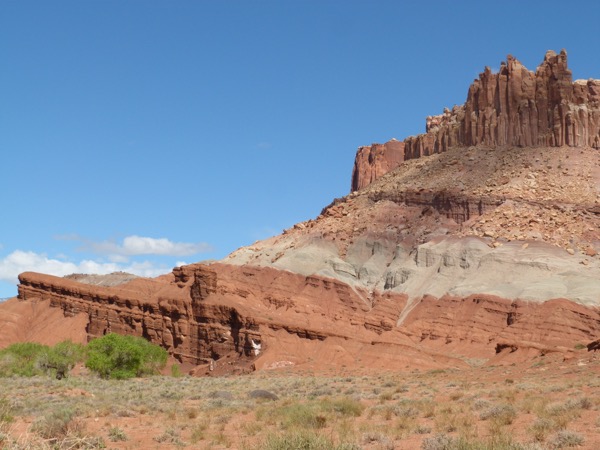
Shortly after finding a gas station, and looking for a restaurant that was open and might serve more than hamburgers and beer, we found the Capitol Reefs Cafe and Restaurant, which suited us perfectly. It had a unique gift store – I found the only petroglyph soap, black with etched petroglyphs – of the entire trip, perfect for a three year old, or even in the tip of AdventureMan’s Christmas stocking. Alas, there was only one, and I gave it to the three year old.


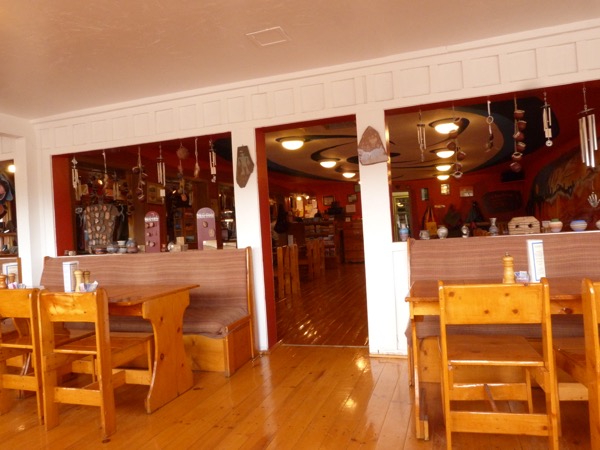

Look at that! Cloth napkins, and in a beautiful local textile.

AdventureMan had a fabulous corn chowder, and these Shrimp Tostadas.

I had a smoked trout salad, the only one I have ever had in my life. It was unique, and wonderful.

At Larb Hollow overlook, you could see for miles, maybe hundreds of miles. We could see Lake Powell. In the highlands, it was still very cold, and we had occasional flakes of snow.

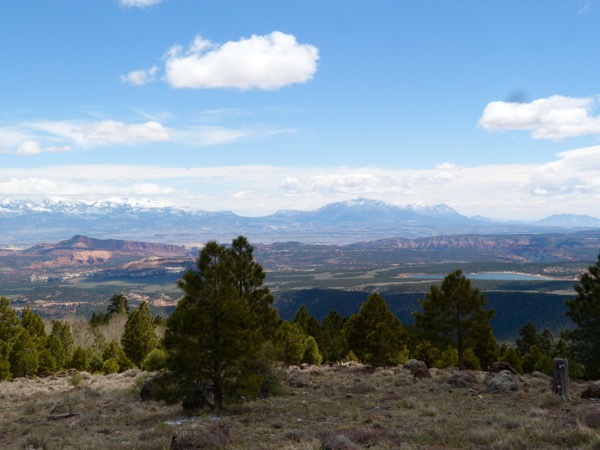
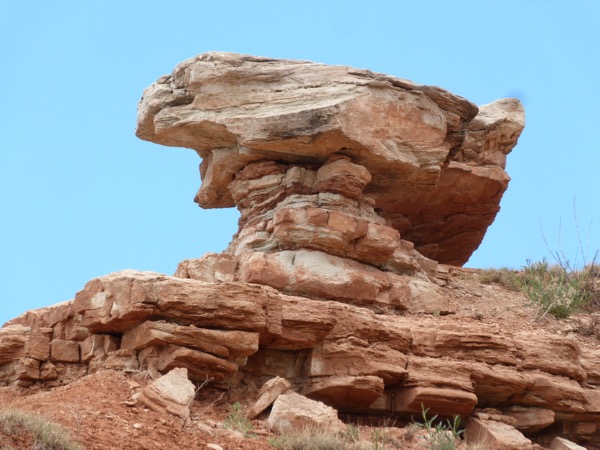

This stop was hilarious. We thought it was some kind of big deal but it was a very little deal. It reminded us very much of Germany, with a rural forest feel, a walk around a large lake, people with those walking picks that give me the shivers – “No! Don’t point that pick at me!”
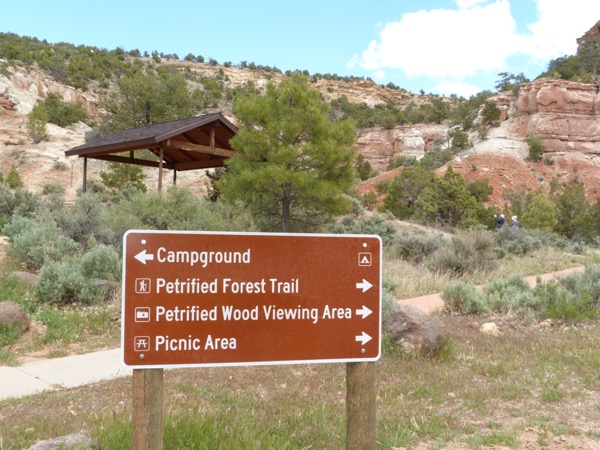
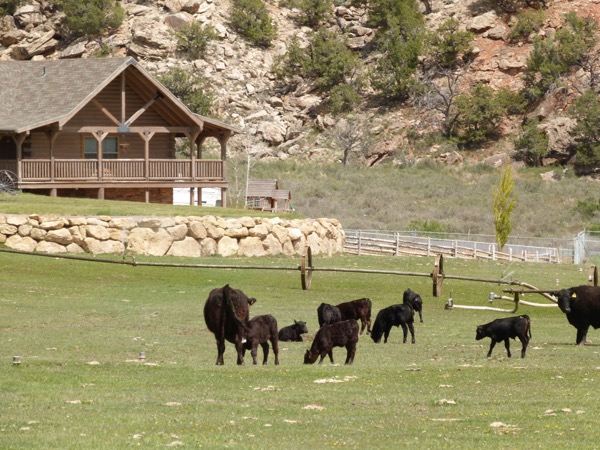
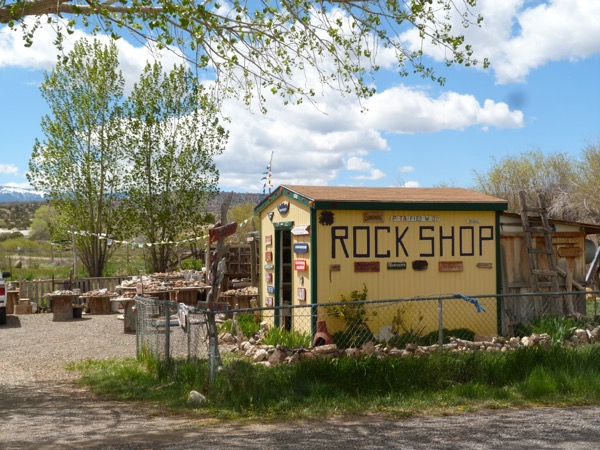
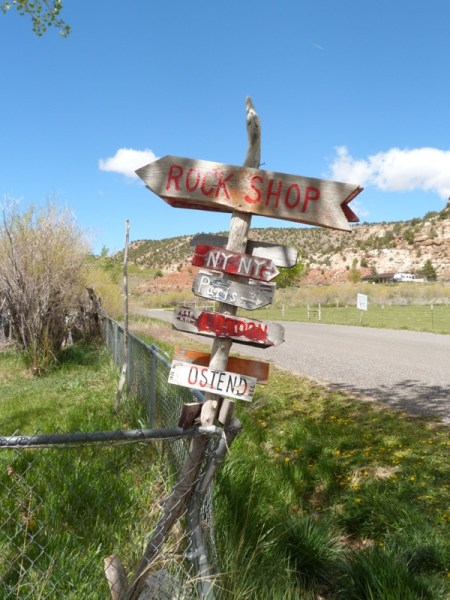
We stopped at a rock shop, where I bought a T-shirt I loved. He said it was last year’s color, and gave me a great discount, but it was a much more subtle color, a desert deep rose color, and it has a 70’s peace sign in gold, so elaborate that you don’t necessarily even see what it is. I love it. Then I went to take a photo of these cows, which AdventureMan thought was hilarious. “You’d be surprised how many people stop to take photos of those cows,” the owner of The Rock Shop told him.
Arriving in Tropic, we are assigned to this cabin. Of all the places we stayed on the trip, we loved this cabin the best. It was a lot of fun, spacious, clean, very private, great beds, and the least expensive place we stayed. This was the Bryce Canyon Inn, in Tropic, which also has a coffee shop and a pizza restaurant in the same complex.




We took a short rest, then headed out to do a reconnaissance of Bryce Canyon, finding one of the major sights on our way. I think it was called Mossy Grotto, or something like that. Honestly, they give names to all these hikes, and while the hikes are great, I can’t remember the exact names. These are all late in the day, some times the sunlight is perfect and some times it has already disappeared due to landscape features. We needed a good hike after spending so much of the day with our only exercise getting in and out of the car.
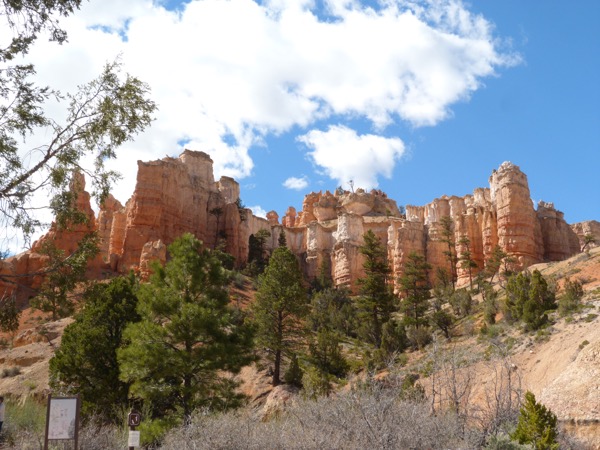
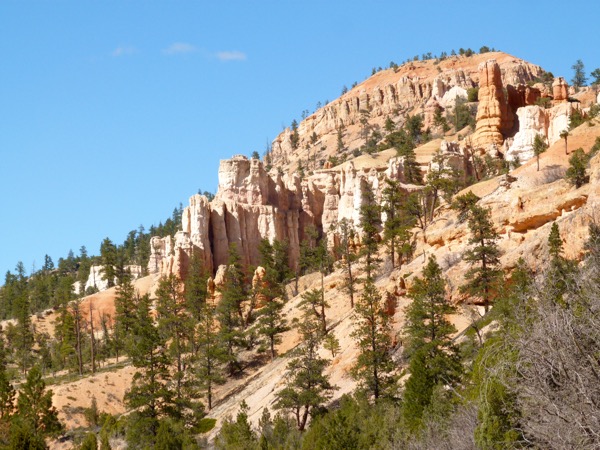


This is one of the features, and I couldn’t really figure out why. I think in winter it has huge icicles hanging from it. It is moist and water weeps from it. I think it is the mossy grotto.
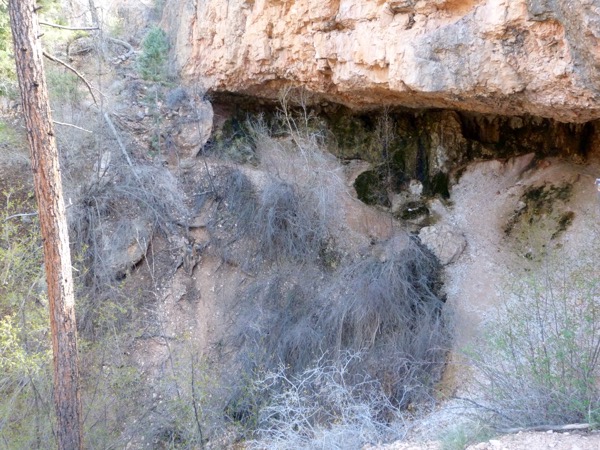
It looks like these rocks are kissing 🙂

We headed back to Tropic around dinner time, ate at the pizza restaurant. AdventureMan did the smart thing, he ordered a pizza. I saw halibut and chips on the menu and the Alaska-girl instincts kicked in, oh, halibut and chips! I got two small heavily breaded pre-frozen little lumps of fish, tasteless, what a waste of halibut. 😦 Learned – re-learned a lesson: if you’re in a pizza restaurant, order pizza.
We slept wonderfully in this cabin 🙂 Every day so far exceeds 10,000 steps 🙂
“You Shall Also Love the Stranger”
In this morning’s lectionary readings from Deuteronomy, I find words of hope this morning:
Deuteronomy 10: 17 – 18
17For the Lord your God is God of gods and Lord of lords, the great God, mighty and awesome, who is not partial and takes no bribe, 18who executes justice for the orphan and the widow, and who loves the strangers, providing them with food and clothing. 19You shall also love the stranger, for you were strangers in the land of Egypt.
I often tell my friends that I encountered very good Christians as I lived among the Moslems; they believe in Christ, and as we differ among ourselves as Christians, they also differ from us. Some of the differences are significant, and at the same time, I am aware that Christians did not agree – and still do not agree – on Christ’s divinity. So I look at the fruits of the spirit, I look at actions, and I look at being faithful to God’s intentions for us as his creation. I welcome the stranger as the stranger so often welcomed us.
Right now, it shames me that our very Christian country is no longer hospitable to the stranger. We were the shining light of hope in the world. Now we are led by a me-first bully, who will rob the poor even of their access to affordable health care to fill his pickets and those of his cronies. He forgets we are all strangers in a strange land, and will have to answer for our misdeeds.
I take courage in the spiritual renewal of resistance; there are those who continue to welcome, clothe and feed the stranger, who are fighting against injustice in the criminal and legal system, who are fighting for a woman’s equal place in this country, who are protecting the widows and orphans, the very things we are called to do. For the first time in my life, I am a member of the ACLU. I continue to receive training as a spirit warrior. We use our increased investments to fund Planned Parenthood. We strive to feed the hungry and clothe those without clothing.
We laugh, as we discuss issues in our classes, at our activities, over lunch, that at this later stage in life, we could be so reactivated 🙂
Grieving for Damascus
“This is a place I would love to retire,” I once told AdventureMan, as we wandered the streets. “It has all the things I love. Beautiful architecture and a rich history. It’s on a river. It gets cold in the winter. You can walk to local stores.”
Today, with great sadness, I read that Damascus is now rated the #1 Most Unlivable City in the World, beating out Douala, Cameroon; Harare, Zimbabwe; Karachi, Pakistan; Algiers, Algeria; Dhaka, Bangladesh; Lagos, Nigeria; and Tripoli, Libya. This is what the report summarized about Damascus:
Damascus has forgotten more than your city will likely ever know-and it has been a battleground for almost its entire existence. The City of Jasmine is a UNESCO World Heritage Site and, according to The Economist Intelligence Unit, the least livable city in the world-for good reason. More than 13 million Syrians require humanitarian aid, 6.5 million have been displaced, and almost half a million have been killed on all sides of the conflict there-government soldiers, opposition soldiers, and civilians. It’s scores are predictably abysmal, with a 15 (out of 100) for stability at the bottom end and a mere 43.3 for culture and environment at the top end.
This is a city which has been at the crossroads of civilization about as long as civilization has been around. This is a city which was refined, and tolerant, a city which was once full of caravans carrying spices, silks and riches to the West.
We were last there in 2007, and we are so glad we went when we did. Damascus was revitalizing, building up a tourism business with grand hotels, and lovely, intimate boutique hotels.
We stayed at the Talisman. We grieve for the fine people we met there, and for all the losses they have suffered.
AdventureMan said “why don’t you do a photo-share, like you did with Doha?” At first, I didn’t want to, but then, I looked at the photos – and once again, I was smitten. I pray for a miracle for Syria, for new, enlightened, tolerant leadership and opportunities for the good Syrian people. For renewed vigor in churches and mosques and synagogues there. (The Talisman is in the old Jewish quarter, where the Greek Orthodox also have their headquarters.)
This is the majlis – sitting area – at the Talisman.


A restaurant nearby the Talisman:
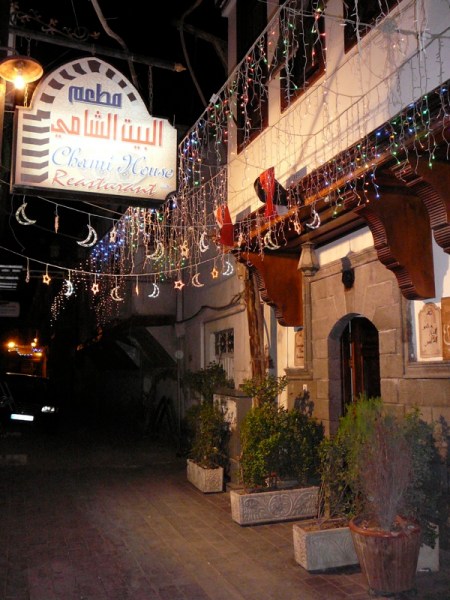
Breakfast at the Talisman:

The historical nearby Bab, or gate:
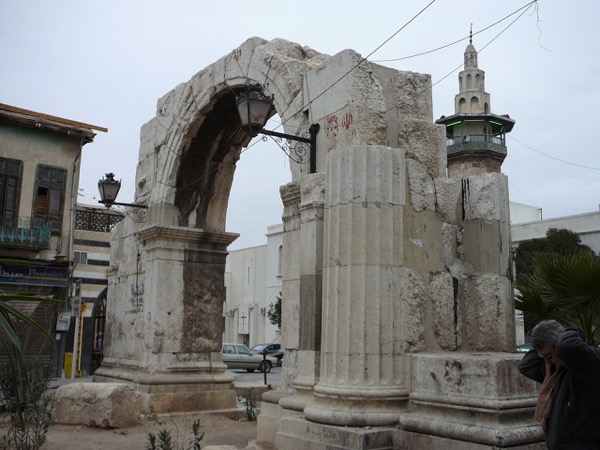
A nearby Tabak and the friendly operator:

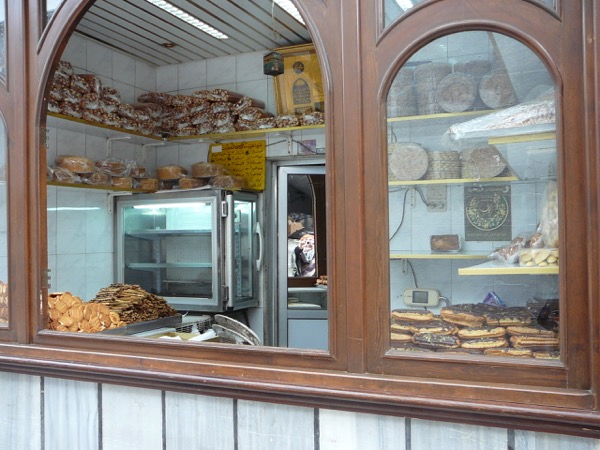
Streetside bakery:
A courtyard restaurant, with lovely dishes. And note the Christmas tree; Christmas decorations and greenery everywhere!

A Christian Shop near Bab Thoma:

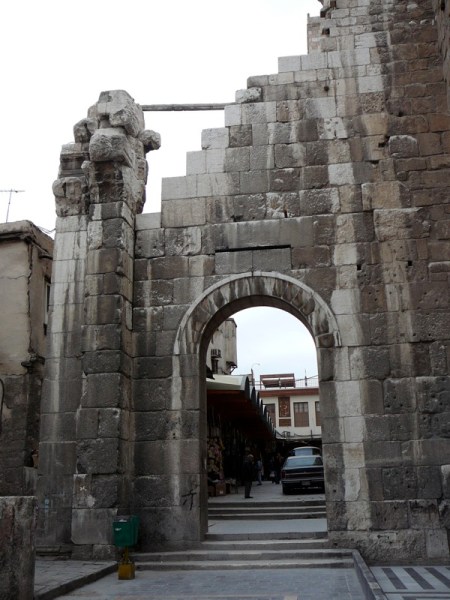


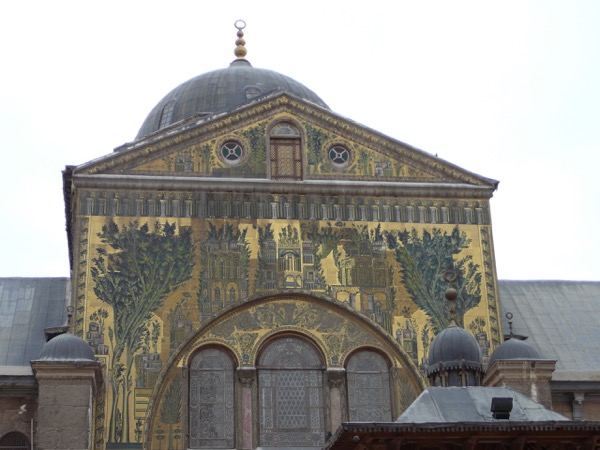
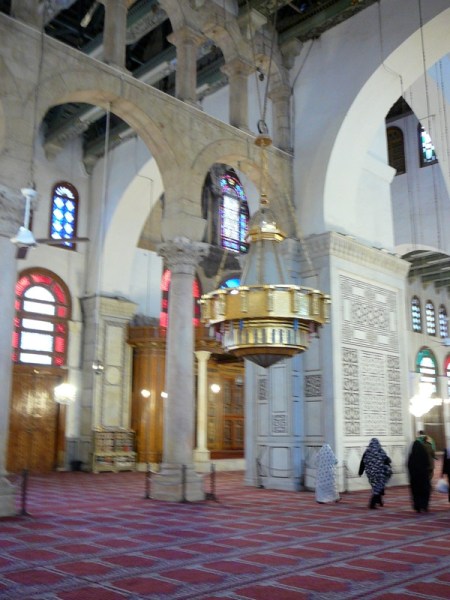
Interior at Umayyad Mosque, all are welcome and abayas provided. You leave your shoes at the door. This is the rear of the Tomb of John the Baptist:


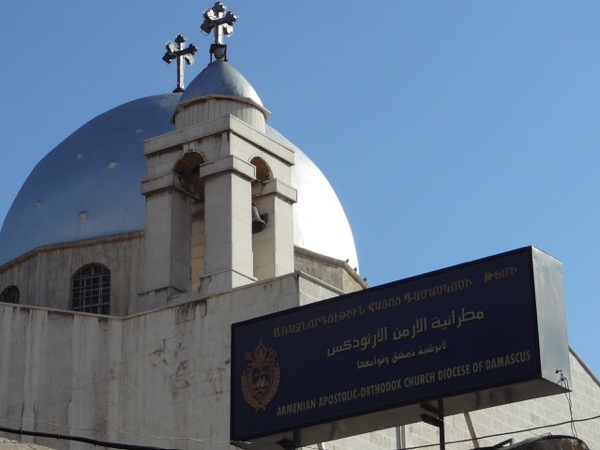


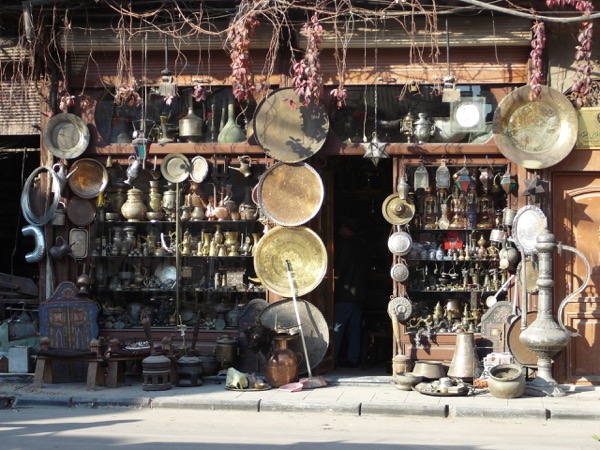
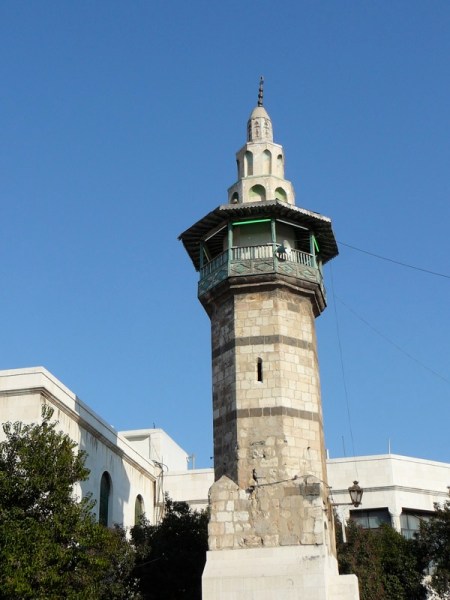
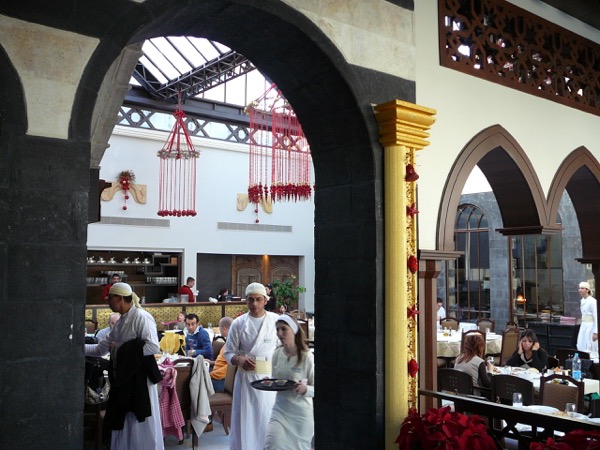
Naranj, our favorite restaurant. I understand branches of Naranj have opened in Gulf Countries, Qatar, Kuwait, as wealthier Syrians take their money out of Syria and wait for more peaceful times. I am betting they will return to Syria as soon as they can.

Inside Naranj


A merchant in the Souk al Hamidiyya

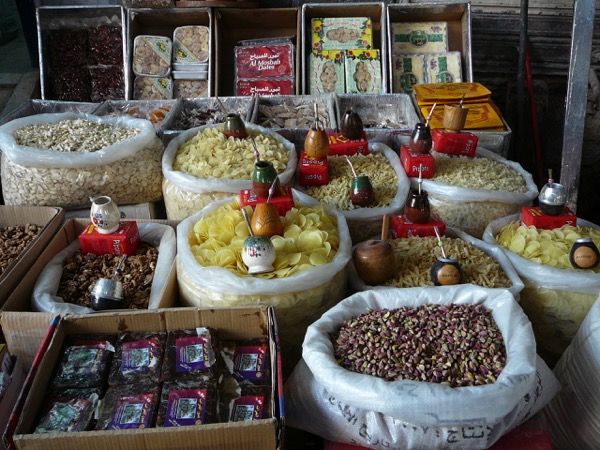
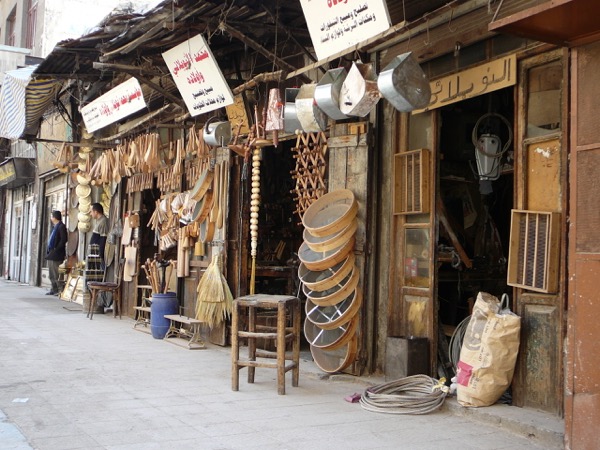


A courtyard restaurant set up for Christmas dinners:


I’ve never met a Syrian who wasn’t educated and working hard to make a good life for his/her family. We wonder if we will ever be able to visit Syria again in our lifetime?
For more photos of Damascus, you can visit my 2007 posts, Walking Old Damascus, by clicking here.
If God Wills It
I’ve always listened to the voice of James carefully, as he is brother to Jesus Christ, or half-brother, and you would think he would be wise in the truth. Finding his particular reading when I was living in the Middle East was like a bolt of lightning. We of the West say “I will do this!” “I will do that!” with never a doubt that we will, but our Islamic hosts would always start or finish “I will do this (or that)” with “InshAllah,” if God wills it.
That’s pretty much precisely what James is saying here.
Living in Jordan, Tunisia, Saudi Arabia, Qatar and Kuwait helped me see my own religion in a new light, shed understanding on our scriptures. I treasure the expat experience having yanked me out of my cultural circle and given me a fresh perspective.
The second part of the reading has a line about held back wages; I remember that the Qur’an also has a line about not letting the sweat dry on the backs of laborers before paying them. Our books have a lot in common.
James 4:13-5:6
13 Come now, you who say, ‘Today or tomorrow we will go to such and such a town and spend a year there, doing business and making money.’14Yet you do not even know what tomorrow will bring. What is your life? For you are a mist that appears for a little while and then vanishes.15Instead you ought to say, ‘If the Lord wishes, we will live and do this or that.’ 16As it is, you boast in your arrogance; all such boasting is evil.17Anyone, then, who knows the right thing to do and fails to do it, commits sin.
5Come now, you rich people, weep and wail for the miseries that are coming to you. 2Your riches have rotted, and your clothes are moth-eaten. 3Your gold and silver have rusted, and their rust will be evidence against you, and it will eat your flesh like fire. You have laid up treasure*for the last days. 4Listen! The wages of the labourers who mowed your fields, which you kept back by fraud, cry out, and the cries of the harvesters have reached the ears of the Lord of hosts. 5You have lived on the earth in luxury and in pleasure; you have fattened your hearts on a day of slaughter. 6You have condemned and murdered the righteous one, who does not resist you.
Deborah: Not a Childrens’ Story
Following the nomination of Hilary Clinton, the first female nominee of a major political party, we have this reading in the Lectionary from Judges. As I read it, I am thinking “I wonder why we don’t have more daughters named Deborah? Or Jael? And I am also thinking this is not – yet – a story for our 6 year old grandson and almost three year old granddaughter.
Love it that the Lord’s general was Barak, blessing in both Aramaic and Arabic, brother languages, brother cultures, divided by a dismal and long lasting fight about inheritance. Alas, there is no fight as bitter as a family fight.
Judges 4:4-23
4 At that time Deborah, a prophetess, wife of Lappidoth, was judging Israel. 5She used to sit under the palm of Deborah between Ramah and Bethel in the hill country of Ephraim; and the Israelites came up to her for judgement. 6She sent and summoned Barak son of Abinoam from Kedesh in Naphtali, and said to him, ‘The Lord, the God of Israel, commands you, “Go, take position at Mount Tabor, bringing ten thousand from the tribe of Naphtali and the tribe of Zebulun. 7I will draw out Sisera, the general of Jabin’s army, to meet you by the Wadi Kishon with his chariots and his troops; and I will give him into your hand.” ’ 8Barak said to her, ‘If you will go with me, I will go; but if you will not go with me, I will not go.’ 9And she said, ‘I will surely go with you; nevertheless, the road on which you are going will not lead to your glory, for the Lordwill sell Sisera into the hand of a woman.’ Then Deborah got up and went with Barak to Kedesh. 10Barak summoned Zebulun and Naphtali to Kedesh; and ten thousand warriors went up behind him; and Deborah went up with him.
11 Now Heber the Kenite had separated from the other Kenites,* that is, the descendants of Hobab the father-in-law of Moses, and had encamped as far away as Elon-bezaanannim, which is near Kedesh.
12 When Sisera was told that Barak son of Abinoam had gone up to Mount Tabor, 13Sisera called out all his chariots, nine hundred chariots of iron, and all the troops who were with him, from Harosheth-ha-goiim to the Wadi Kishon. 14Then Deborah said to Barak, ‘Up! For this is the day on which the Lord has given Sisera into your hand. The Lord is indeed going out before you.’ So Barak went down from Mount Tabor with ten thousand warriors following him. 15And the Lord threw Sisera and all his chariots and all his army into a panic* before Barak; Sisera got down from his chariot and fled away on foot, 16while Barak pursued the chariots and the army to Harosheth-ha-goiim. All the army of Sisera fell by the sword; no one was left.
17 Now Sisera had fled away on foot to the tent of Jael wife of Heber the Kenite; for there was peace between King Jabin of Hazor and the clan of Heber the Kenite. 18Jael came out to meet Sisera, and said to him, ‘Turn aside, my lord, turn aside to me; have no fear.’ So he turned aside to her into the tent, and she covered him with a rug. 19Then he said to her, ‘Please give me a little water to drink; for I am thirsty.’ So she opened a skin of milk and gave him a drink and covered him. 20He said to her, ‘Stand at the entrance of the tent, and if anybody comes and asks you, “Is anyone here?” say, “No.” ’ 21But Jael wife of Heber took a tent-peg, and took a hammer in her hand, and went softly to him and drove the peg into his temple, until it went down into the ground—he was lying fast asleep from weariness—and he died. 22Then, as Barak came in pursuit of Sisera, Jael went out to meet him, and said to him, ‘Come, and I will show you the man whom you are seeking.’ So he went into her tent; and there was Sisera lying dead, with the tent-peg in his temple.
23 So on that day God subdued King Jabin of Canaan before the Israelites.
Eid Mubarak 2016

Eid Mubarak to all my Muslim friends who have come through one of the hottest Ramadan’s ever, refined by God’s holy fire. I wish you peace, peace with your family, peace in your country, and peace on earth, good will towards all mankind.
Cross Culture at the Y: Hawaiian Heart
For a year now, I have taken this class next to Leilani, who stands just a little shallower in the pool than I. Today, as we were warming up, one topic led to another. We were talking about getting rid of “things” and she told me a niece had asked for her lighthouse collection, and how was she going to mail them all to her, some of them were almost two feet high?

“Easy-peasy,” I said, “You know those storage tubs people buy at Target? You can use bubble wrap and ship them in those containers. They give fragile items a lot of protection.”
Leilani laughed and said how funny it was she didn’t know that because her husband had been a postman after his retirement from the military.
“Nice!” I said. “Two pensions!”
“Not really,” she said, “The day he retired he came home and handed me divorce papers. He’d been planning this for a long time. ”
“Another girl?” I asked.
“No,” she laughed sadly, “He was greedy. He said ‘You’ll never see a penny of my money.”
“I hope you got a good lawyer” I said.
“I did.” She didn’t look happy. “I had raised the four children, so I got parts of both pensions AND alimony. I don’t need a lot. I was happy.”
I asked if he had been the kind of man who had planned to walk out on her and leave her with nothing, if he had also been mean and stingy during their marriage, and if a part of her found peace when he left. She said because of the four children she would never have left him, but that yes, her life was better when he was no longer there.
“Money doesn’t make a person happy,” she said. “Things don’t make a person happy. You know he went and got a beautiful luxury apartment, and died just a few years later. He had emphysema from smoking all the time. No one to help him. So I went there every day, took him a meal because he couldn’t do for himself. I sat with him at night. I was there when he took his final breath.”
“And you know what he would do while I was out of the room? He would take out his money and count it. It never brought him any happiness.”
My pool friend is one of the sweetest hearted women I have ever met. In all this time, she has never said a bad word about her husband, and she was there by his side as he died. There is no bitterness in her, no anger; she didn’t resent him, she let all those feelings go and did the kind thing for a dying man.
I call this cross-cultural, because she is Hawaiian, and I have seen this kind of serenity in my Hawaiian friends and acquaintances. They are willing to let go of grudges, they are willing to move on. They have generous hearts. I feel like I learned something from her today.
Cross Culture at the Y
It’s a day I like in Pensacola; it may be summer and still hot and humid, but a little cooler today, with a cloud cover. I woke up refreshed, relaxed, having slept well, and actually, I sort of hoped for thunder so I could skip going to the YMCA for Water Aerobics, and stay home and finish up some quilting.
No such luck – no thunder. The skies were threatening, and leaky, but without the drama of thunder and lightning. No matter. The truth is, I don’t just go because I want to stay fit and strong, I also go because I feel better and more energetic after I’m done.
In retrospect, I would have missed a lot if I had missed today. In the fifteen or twenty minutes before the class, I heard some powerful messages, and I knew I was meant to be there. So my next three posts are about my cross-generational, cross-cultural experiences at my water aerobics class this morning.
God Shows No Partiality

Who can help but think of “wickedness, evil, covetousness, malice” as we listen to the daily news?
In today’s readings from the Lectionary, the first reading has to do with one of the earliest manifestations of the Holy Spirit, and this second reading ends with how the glory of God is for everyone, the Jew and also the Greek (of you might add, the American, and also the Moslem, or the Republicans, and also the Democrats), that God shows no partiality.
We all seem to shout “Go God!”, our own particular interpretation of God, and think that only we have it right.
What I do love, is that when a demented one kills in the name of God, the one true God rallies his true followers, whether in Syria, or Orlando, or Paris, or Nairobi, he rallies the hearts of his true followers to love one another, and to show that love by helping and serving one another, brother and sister, people of all colors and all nations and all religions and all sexes. God tells us to love him and to serve one another, and to leave all judgement to Him/Her.
Romans 1:28-2:11
28 And since they did not see fit to acknowledge God, God gave them up to a debased mind and to things that should not be done. 29They were filled with every kind of wickedness, evil, covetousness, malice. Full of envy, murder, strife, deceit, craftiness, they are gossips, 30slanderers, God-haters,* insolent, haughty, boastful, inventors of evil, rebellious towards parents, 31foolish, faithless, heartless, ruthless. 32They know God’s decree, that those who practise such things deserve to die—yet they not only do them but even applaud others who practise them.
2Therefore you have no excuse, whoever you are, when you judge others; for in passing judgement on another you condemn yourself, because you, the judge, are doing the very same things. 2You say,* ‘We know that God’s judgement on those who do such things is in accordance with truth.’ 3Do you imagine, whoever you are, that when you judge those who do such things and yet do them yourself, you will escape the judgement of God? 4Or do you despise the riches of his kindness and forbearance and patience? Do you not realize that God’s kindness is meant to lead you to repentance? 5But by your hard and impenitent heart you are storing up wrath for yourself on the day of wrath, when God’s righteous judgement will be revealed. 6For he will repay according to each one’s deeds: 7to those who by patiently doing good seek for glory and honour and immortality, he will give eternal life; 8while for those who are self-seeking and who obey not the truth but wickedness, there will be wrath and fury. 9There will be anguish and distress for everyone who does evil, the Jew first and also the Greek, 10but glory and honour and peace for everyone who does good, the Jew first and also the Greek.11For God shows no partiality.
Enter another bible reference:

biblemail@oremus.org
v 2.2.7
10 February 2011
Saint Ephraim, the Syrian
Today the church remembers St. Ephraim, a very good man, a solid contributor to the early church. At a time when many seem to be in fear that Syrians are coming to our shore, I think a reading about Saint Ephraim is timely. He wrote some of the earliest church hymns. He very likely contributed some of the verbiage in our Nicene creed.
I also smile; I remember my Arabic instructors at the Qatar Center for the Presentation of Islam, truly gentle women who knew the bible better than I did, and inspired me to know it better in self defense. While they didn’t expect me to cover, i.e. to wear a scarf over my hair, or to wear an abaya, they could point out to me verses in the bible where women are instructed to cover, and they could show me biblical pictures in which the women were cloaked and their hair covered.
They also pointed out the many places in the Bible where praying was done by prostrating oneself face down before God, as Ephraim instructs in the prayer at the bottom of the reading.
I never felt pressured. They were like my Mormon sisters, my Baptist sisters; they only wanted me to have what they had found, the best way to worship.
EPHREM OF EDESSA
DEACON AND HYMN-WRITER (10 JUNE 373)
 Ephrem (or Ephren or Ephraim or Ephrain) of Edessa was a teacher, poet, orator, and defender of the Faith. (To English-speakers, the most familiar form of his name will be “Ephraim.” It is the name of the younger son of Joseph, son of Jacob (see Genesis 41:52), and is thus the name of one of the largest of the twelve tribes of Israel.) Edessa (now Urfa), a city in modern Turkey about 100 kilometers from Antioch (now Antakya), was a an early center for the spread of Christian teaching in the East. It is said that in 325 he accompanied his bishop, James of Nisibis, to the Council of Nicea. Certainly his writings are an eloquent defense of the Nicene faith in the Deity of Jesus Christ. He countered the Gnostics’ practice of spreading their message through popular songs by composing Christian songs and hymns of his own, with great effect. He is known to the Syrian church as “the harp of the Holy Spirit.”
Ephrem retired to a cave outside Edessa, where he lived in great simplicity and devoted himself to writing. He frequently went into the city to preach. During a famine in 372-3 he worked distributing food to the hungry, and organizing a sort of ambulance service for the sick. He worked long hours at this, and became exhausted and sick, and so died.
Of his writings there remain 72 hymns, commentaries on the Old and New Testaments, and numerous sermons.
Several hymns are available at:
http://www.voskrese.info/spl/XefremSyria.html
Among Orthodox he is best known for a fasting prayer:
THE PRAYER OF ST EPHRAIM THE SYRIAN
O Lord and Master of my life, do not give me the spirit of laziness, meddling, self-importance and idle talk. (prostration)
Instead, grace me, Your servant, with the spirit of modesty, humility, patience, and love. (prostration)
Indeed, my Lord and King, grant that I may see my own faults, and not condemn my brothers and sisters, for You are blessed unto ages of ages. Amen. (prostration)
(Twelve deep bows, saying each time: O God, be gracious to me, a sinner.)
[Translation by Fr James Silver, Drew University; posted on the Orthodox list]
by James Kiefer
Recent Comments
intlxpatr on Shampoo Ginger tigerbutterya0c5ff1d… on Shampoo Ginger intlxpatr on British Soldier Kidnapped, Esc… John on British Soldier Kidnapped, Esc… intlxpatr on British Soldier Kidnapped, Esc… Wikipedia Donate Button

Amazina


Early Voting in Florida


