Bullying and 19 Minutes; Jodi Picoult
When my blogging friend Chirp makes a recommendation, I have learned to order the book and read it. She reads books that make you think! The latest book is Jodi Picoult’s 19 Minutes, a book about a kid who is sensitive and kind and funny, and plays by the rules – he is good at sharing, and listening and all the things we try to teach our children to be good at.
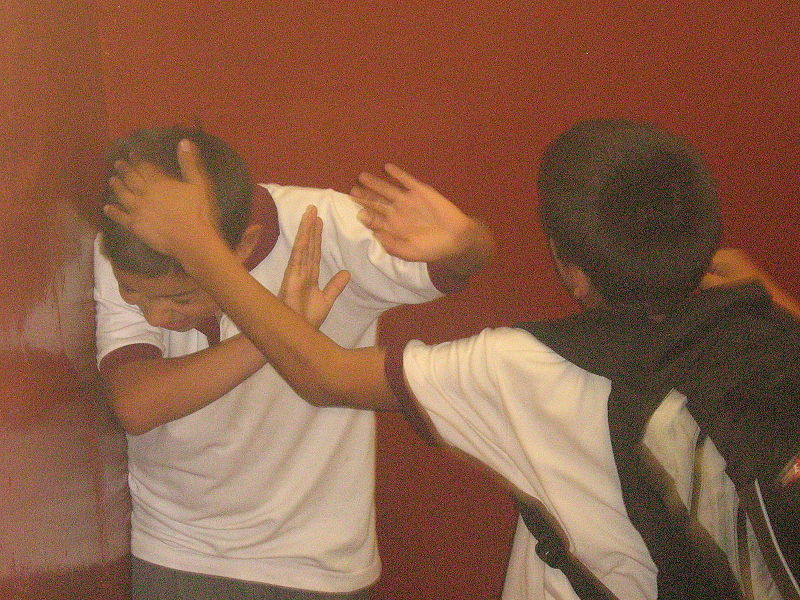
He gets bullied. From the time he starts school, he is bullied physically and mentally and emotionally. He does the right thing – he reports it. The schools do nothing, or so little that it only makes things worse for him. Pushed too far, one day snaps, he goes ballistic. He walks into the school and shoots 19 of his classmates.
One problem is access to weapons. Literally, physically teenagers have not yet developed the judgement areas of the brain. I am guessing in males it takes even longer, and I only guess that because of all the traffic fatalities and physical damage adolescent boys inflict upon themselves – and their victims. Maybe it is that fatal combination of poor judgement and testosterone that pushes them too far. Access to weapons – guns, knives, fast cars – makes them even more lethal.
Before I wrote this review, however, I had to do a lot of thinking. This book is about bullying, and even as adults we come across bullies. Our household helpers are terrified of the police – those who are here to protect us. The police use their position to try to bully phone numbers out of pretty Kuwaiti girls, and to exact sexual favors from the Asian domestics. Not all police are bullies, but if a person has that tendency, the position allows him/her to use that power wrongly.
And bullying doesn’t stop with graduation from high school. We are seeing the same kinds of behavior at universities – Virginia Tech – and in the workplace – “going postal” and GMAC just to name two. People who are bullied sometimes turn, they go out in a blaze of glory.
I’ve been bullied. People who are raised to have good manners are often victims of those who are willing to overstep the boundaries. We make excuses for them – we say they are oblivious. I am beginning to think that many a bully is NOT oblivious, but has learned to push to get his or her own way.
With men, the bullying is more physical, and it’s all about jockying for position – number one in the pecking order, the next promotion, the boss’s golf partner, etc. If you think women are gossips – you oughta hear the men! When I hear men “bantering” it’s all about who’s got the “biggest.” Or maybe, the devil whispers in my ear, it’s about who can make you THINK his is the biggest.
With women, in my experience, most of the bullies are physically bigger. They are women who – literally – throw their weight around. They are women who will interrupt anyone and override their suggestion with a loud voice. They are women who have temper tantrums, and hurt feelings, who go from person to person forming alliances that dissolve with the next disagreement. That’s the sad truth – a bully wants his or her own way – all the time. Once you go against them, you have to watch your back.
Picoult has done her homework. Bullies are often likeable enough people! A bully carries his/own burden, however – and that is a desperate need for popularity. You can see this in animal behavior; once a creature has achieved dominance, it takes enormous energy to maintain that position, so much energy that the rest of your life shrinks as your focus must be on maintaining dominance.
The UK, Canada, and the US all have websites about bullying, trying to put a stop to it in the schools. What do they define as bullying?
People calling you names
Making things up to get you into trouble
Hitting, pinching, biting, pushing and shoving
Taking things away from you
Damaging your belongings
Stealing your money
Taking your friends away from you
Posting insulting messages on the internet or by IM (cyberbullying)
Spreading rumours
Threats and intimidation
Making silent or abusive phone calls
Sending you offensive phone texts
Bullies can also frighten you so that you don’t want to go to school, so that you pretend to be ill to avoid them
What can people with manners do against a bully?
In general, the first thing to do is tell an adult – it doesn’t have to be your parents. Additonal suggestions suggest creating your own support network – create a wide network of friends. Join interest groups, in our out of school.
When our son was bullied in school, he worked hard and earned a black belt in karate, and then went on to earn further degrees, and to teach karate – while still in high school. Just knowing that he had a lethal skill made him walk differently, made the bullies afraid to target him. He went to a magnet school, where there was a high degree of chaos, and he sought out and made friends with the biggest people he could find. He used his head. He made it through. Of all his accomplishments, one of the things that made us most proud of him was his ability to stick it out and to prevail.
I worked in a high school. My office was a safe haven for many kids, kids who found high school dynamics pure hell. Most of them were emotionally years ahead of the crowds roaming the hallways, the cruel kids, for whom high school will probably be the highlight of their lives.
“You’re going to love being an adult,” I would tell them. “Hang in there. For them, this may be as good as it gets, but your life is going to get better and better.”
Geeks don’t always get a lot of respect. The two guys that graduated high school at the bottom of the class with my son already had a flourishing computer networking business going. If you haven’t noticed, most of the people who are making it big financially are people who have learned how to use their heads.
I have learned something else. You can beat a bully at his or her own game. Bullies usually rely on instilling fear in others, but rarely do they do their homework.
Choose your battles. Bullying hurts everyone. If you see someone being bullied and you can do something about it then and there, stand up for the person being bullied. All you have to do is say “that’s not funny, just stop.” Many times bullies are so shocked at being challenged, they will stop! If your judgement tells you it would be unsafe to say anything, quickly tell an adult, a supervisor, a manager, what you have seen.
If a bully is trying to push through something you believe is wrong, you can quietly discuss things one on one with others, and make a plan. You can call for a vote! You can quietly stand up to a bully. You can tell a bully “it’s my turn to talk” and they have to shut up! (When you do this, you have to be very careful to listen when the bully is speaking so that everyone knows it really IS your turn to talk.) You can use a little gentle humor – bullies usually only like humor when it is aimed at someone else. They haven’t a clue what to do when it is aimed at them!
If it is annoying, but not something worth fighting over, let the bully get his or her own way. They usually end up shooting themselves in the foot, self-destructing. The adult bully ends up driving people away, and then wondering why he/she has no friends?
Living your own life well is your best revenge!
Thank you, Chirp, for another book that really made me think!
Election Year Joke
Lord Have Mercy
An old country preacher had a teenage son, and it was getting time the boy should give some thought to choosing a profession.
Like many young men, the boy didn’t really know what he wanted to do, and he didn’t seem to concerned about it.
One day, while the boy was away to school, his father decided to try an experiment. He went into the boy’s room and placed on his study table four objects.
A bible
A silver dollar
A bottle of whisky
And a playboy magazine.
‘I’ll just hide behind the door’, the old preacher said to himself.
‘When he comes home from school this afternoon, ‘I’ll see which object he picks up.
If it’s the bible, he’s going to be a preacher like me and what a blessing that would be!
If he picks up the dollar, he’s going to be a business man, and that would be okay, too.
But if he picks up the bottle. he’s going to be a no-good drunkard, and Lord, what a shame that would be.
And worst of all if he picks up that magazine he’s going to be a skirt-chasing bum.
The old man waited anxiously, and soon heard his son’s foot-steps as he entered the house whistling and headed for his room.
The boy tossed his books on the bed, and as he turned to leave the room he spotted the objects on the table.
With curiosity in his eye, he walked over to inspect them.
Finally, he picked up the Bible and placed it under his arm.
He picked up the silver dollar and dropped into his pocket.
He uncorked the bottle and took a big drink while he admired this months centerfold.
‘Lord have mercy.’ the old preacher disgustedly whispered.
‘He’s gonna run for Congress.’
Home Schooling Muslims in America
The New York Times has this fascinating article:
LODI, Calif. — Like dozens of other Pakistani-American girls here, Hajra Bibi stopped attending the local public school when she reached puberty, and began studying at home.
Her family wanted her to clean and cook for her male relatives, and had also worried that other American children would mock both her Muslim religion and her traditional clothes.
“Some men don’t like it when you wear American clothes — they don’t think it is a good thing for girls,” said Miss Bibi, 17, now studying at the 12th-grade level in this agricultural center some 70 miles east of San Francisco. “You have to be respectable.”
Across the United States, Muslims who find that a public school education clashes with their religious or cultural traditions have turned to home schooling. That choice is intended partly as a way to build a solid Muslim identity away from the prejudices that their children, boys and girls alike, can face in schoolyards. But in some cases, as in Ms. Bibi’s, the intent is also to isolate their adolescent and teenage daughters from the corrupting influences that they see in much of American life.
About 40 percent of the Pakistani and other Southeast Asian girls of high school age who are enrolled in the district here are home-schooled, though broader statistics on the number of Muslim children being home-schooled, and how well they do academically, are elusive. Even estimates on the number of all American children being taught at home swing broadly, from one million to two million.
No matter what the faith, parents who make the choice are often inspired by a belief that public schools are havens for social ills like drugs and that they can do better with their children at home.
“I don’t want the behavior,” said Aya Ismael, a Muslim mother home-schooling four children near San Jose. “Little girls are walking around dressing like hoochies, cursing and swearing and showing disrespect toward their elders. In Islam we believe in respect and dignity and honor.”
Still, the subject of home schooling is a contentious one in various Muslim communities, with opponents arguing that Muslim children are better off staying in the system and, if need be, fighting for their rights.
Robina Asghar, a Muslim who does social work in Stockton, Calif., says the fact that her son was repeatedly branded a “terrorist” in school hallways sharpened his interest in civil rights and inspired a dream to become a lawyer. He now attends a Catholic high school.
“My son had a hard time in school, but every time something happened it was a learning moment for him,” Mrs. Asghar said. “He learned how to cope. A lot of people were discriminated against in this country, but the only thing that brings change is education.”
Many parents, however, would rather their children learn in a less difficult environment, and opt to keep them home.
You can read the rest of the article HERE
Kuwait Driver’s License

“oh, I can’t,” I was telling my friend, “I have to go get my driver’s license today.”
“I had a funny thing happen,” she responded. “When I went, I didn’t understand the guy too well and he said something like ‘how long do you want it for?’ and I said ‘three years’ and I got one for three years!”
“You’re kidding!” I said. “I’ve been having to go every year!”
It doesn’t make sense, but you just never know in Kuwait. Every year for two years now I have had to go get my eyes tested and get a new license. But you never know, maybe her company has some other agreement, and she gets a three year license. Some things you just can’t worry too much about or it will drive you crazy.
So I went and took the 30 second eye test and later that same day my husband brought home my new driver’s license – good for TEN years.
If I had known I was going to get a ten year driver’s license, I sure would have made sure they used a better photo than the one my sponsor provided them. AAAARRRRGGGHHH.
Peacekeeping in Dharfur
From the New York Times
Peacekeeping in Darfur Hits More Obstacles
By LYDIA POLGREEN
Published: March 24, 2008
ABU SUROUJ, Sudan — As Darfur smolders in the aftermath of a new government offensive, a long-sought peacekeeping force, expected to be the world’s largest, is in danger of failing even as it begins its mission because of bureaucratic delays, stonewalling by Sudan’s government and reluctance from troop-contributing countries to send peacekeeping forces into an active conflict.
The force, a joint mission of the African Union and the United Nations, officially took over from an overstretched and exhausted African Union force in Darfur on Jan. 1. It now has just over 9,000 of an expected 26,000 soldiers and police officers and will not fully deploy until the end of the year, United Nations officials said.
Even the troops that are in place, the old African Union force and two new battalions, lack essential equipment, like sufficient armored personnel carriers and helicopters, to carry out even the most rudimentary of peacekeeping tasks. Some even had to buy their own paint to turn their green helmets United Nations blue, peacekeepers here said.
The peacekeepers’ work is more essential than ever. At least 30,000 people were displaced last month as the government and its allied militias fought to retake territory held by rebel groups fighting in the region, according to United Nations human rights officials.
For weeks after the attacks, many of the displaced were hiding in the bush nearby or living in the open along the volatile border between Sudan and Chad, inaccessible to aid workers. Most wanted to return to their scorched villages and rebuild but did not feel safe from roaming bandits and militias.
A week spent this month with the peacekeeping troops based here at the headquarters of Sector West, a wind-blown outpost at the heart of the recent violence, revealed a force struggling mightily to do better than its much-maligned predecessor, but with little new manpower or equipment.
Despite this, the force is managing to project a greater sense of security for the tens of thousands of vulnerable civilians in the vast territory it covers, mounting night patrols in displaced people’s camps and sending long-range patrols to the areas hardest hit by fighting. But these small gains are fragile, and if more troops do not arrive soon, the force will be written off as being as ineffective and compromised as the one before.
You can read the rest of the article HERE
A Long Way Gone: Ishmael Beah
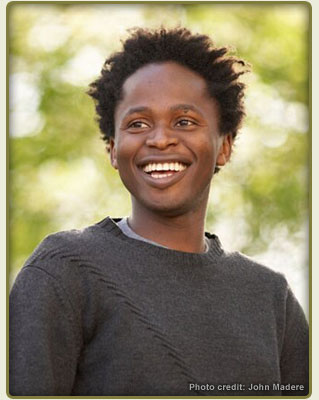

Back when I wrote an update on Dharfur, my blogging friend Chirp recommended a book, A Long Way Gone; Memoirs of a Boy Soldier by Ishmael Beah. I ordered it that very day, and read it this last week.
It is a truly heartbreaking autobiographical book about a young mischievous boy growing up in Sierra Leone, leading a relatively simple and carefree life in his village with his family. It is very African. He talks about the games he and his friends play, his fascination with rap music and the simple joys of the life he is leading.
Then the rebels come. The invade the villages, hopped up on dope, their dead eyes with no pity, raping, killing, chopping off limbs, stealing all the village food and burning the village behind them, often with people locked inside their huts.
Ishmael escapes once with friends, eventually returning to the village to find his entire family gone. Most of the book has to do with what he has to do to survive. Many villages are very afraid of groups of boys, even boys as young as these are – in their early adolescence – and will hurt them. At the very least, most of the villages hurry them along. At one point Ishmael is hiding out in the jungle forest on his own, hiding from lions, giant feral pigs, sleeping up in trees and looking for the rare fruit or grass that he can eat without getting sick.
Finally, after meeting up with some other boys and continuing to try to find his family, a village takes him in, a village run by the state soldiers. As they are attacked by rebels, the boys are forced to make a choice – go out on their own again (where the rebels will also try to recruit them, and if they refuse, will kill them) or agree to be soldiers. These are kids 12, 13, 14 carrying AK 47’s. As part of their training they are given drugs on a regular basis which keep them hopped up, full of energy, and not sleeping for days. The young boys learn to kill without pity. He becomes the very people he was fleeing.
This is a book about redemption. At the center where the boy soldiers are taken, they are constantly told “none of this was your fault.” It is a very African approach, a very human and loving approach to redemption of lives that might have been totally lost to the horrors they have witnessed and inflicted. The author is now nearly 30, and sounds – unlikely as it might be – happy.
Thank you, Chirp, for recommending this wonderful book.
Anything but Pedestrian
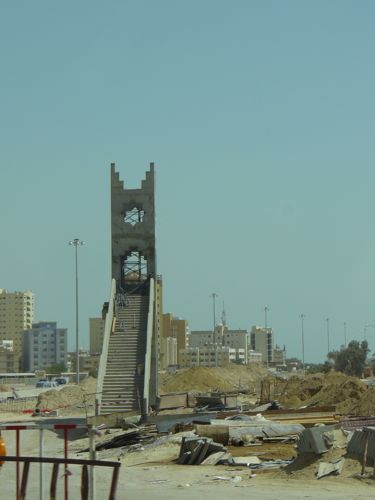
Yesterday on 5th ring, we saw the beginnings of the new pedestrian overpasses, which are anything but pedestrian in their design.
Look at that! Not only do they honor the architectural element of the wind tower tradition in Kuwait, but they will also allow pedestrians to cross safely to the other side. For all the derision we heap on highway planners here, they deserve a big pat on the back for these.
From Wikipedia on Windcatchers: A Wind Tower (Persian: badgir, Arabic: “barjeel” or badghir(from Persian)) is a structure seen on ancient buildings of the Middle East, particularly Iran and Bahrain. This acted like a natural air conditioner creating a soothing effect in the harsh conditions of the desert.
Education and No Child Left Behind
One of the most cynical education programs ever put into place, in my opinion, is the No Child Left Behind program. It’s impact, while claiming lofty goals, in actuality forced schools to exclude students who would fail, so as not to have them on their statistical base.
Quote from article: If low-achieving students leave school early, a school’s performance can rise.
In this story from the New York Times you can read how US schools fudge statistics to have a respectable high school graduation rate for federal funding purposes, while the truth is far less positive.
JACKSON, Miss. — When it comes to high school graduation rates, Mississippi keeps two sets of books.
One team of statisticians working at the state education headquarters here recently calculated the official graduation rate at a respectable 87 percent, which Mississippi reported to Washington. But in another office piled with computer printouts, a second team of number crunchers came up with a different rate: a more sobering 63 percent.
The state schools superintendent, Hank Bounds, says the lower rate is more accurate and uses it in a campaign to combat a dropout crisis.
“We were losing about 13,000 dropouts a year, but publishing reports that said we had graduation rate percentages in the mid-80s,” Mr. Bounds said. “Mathematically, that just doesn’t work out.”
Like Mississippi, many states use an inflated graduation rate for federal reporting requirements under the No Child Left Behind law and a different one at home. As a result, researchers say, federal figures obscure a dropout epidemic so severe that only about 70 percent of the one million American students who start ninth grade each year graduate four years later.
California, for example, sends to Washington an official graduation rate of 83 percent but reports an estimated 67 percent on a state Web site. Delaware reported 84 percent to the federal government but publicized four lower rates at home.
The multiple rates have many causes. Some states have long obscured their real numbers to avoid embarrassment. Others have only recently developed data-tracking systems that allow them to follow dropouts accurately.
The No Child law is also at fault. The law set ambitious goals, enforced through sanctions, to make every student proficient in math and reading. But it established no national school completion goals.
“I liken N.C.L.B. to a mile race,” said Bob Wise, a former West Virginia governor who is president of the Alliance for Excellent Education, a group that seeks to improve schools. “Under N.C.L.B., students are tested rigorously every tenth of a mile. But nobody keeps track as to whether they cross the finish line.”
Furthermore, although the law requires schools to make only minimal annual improvements in their rates, reporting lower rates to Washington could nevertheless cause more high schools to be labeled failing — a disincentive for accurate reporting. With Congressional efforts to rewrite the law stalled, Secretary of Education Margaret Spellings has begun using her executive powers to correct the weaknesses in it. Ms. Spellings’s efforts started Tuesday with a measure aimed at focusing resources on the nation’s worst schools. Graduation rates are also on her agenda.
You can read the rest of the story HERE.
Our young people are the leaders and decision makers of tomorrow. My generation thought we were going to change the world, and here the world continues on it’s merry way to pollution, desolation and degradation. I hope the young people of today can do what we have failed to do – create a better world.
Saudi Women Only Hotel
From today’s BBC News:
Saudis open hotel for women only
The Middle East’s first women-only hotel has opened in Saudi Arabia.
It will cater primarily to businesswomen, who work completely covered from head to toe in public and have to observe strict segregation.
The hotel, in Riyadh, has 25 rooms and boasts fine dining and conference facilities, as well as a range of health and beauty treatments.
Its executive director said the response to the idea of a hotel just for women had been overwhelming.
The Luthan Hotel & Spa is owned by a group of 20 Saudi princesses and businesswomen.
It hopes to attract expatriates from the nearby diplomatic quarter as well as local women.
It is the first spa hotel in the kingdom available to women all the time – pools in other hotels are only open to women on certain fixed days or hours.
You can read more about the hotel HERE
5KD = LLLOOOLLLL
I have seen opinions, and heard people talking about how Kuwait has more important things to do than to penalize people who are using their mobile phones. They are outraged! Clean up the highways first, they say, give us better schools, enforce the laws already on the books (but leave our cell phones alone!)
I am sorry. I know I am going to get killed for this opinion, but have you ever followed someone driving while talking on a cell phone? Do you watch them wobble out of their lane, try to steer the car with their knee because they have the phone in one hand and they need to adjust the volume of the radio? In countries where mobile phone use has been monitored and statistics kept, they attribute a huge rise in inattentive driving to cell phone use. They have statistics. They can prove that cell phone use is linked to a rise in accidents.
Brave Qatar brought in a team of experts who interviewed seriously injured accident victims. Every single one of them was on a cell phone when involved in the accident.
My rant is this: a 5KD fine? In Kuwait, that is just laughable. A 5 KD fine (about $20 with the dollar diving into the cellar) is not a deterrent. I want to see a sliding scale: start at 50KD for the first incidence, double it for the second, double it again for the third, etc. Make it hurt.
There are too many drivers for the roads, even with the ongoing improvements. The drivers are ill experienced, and careless. Driving in Kuwait is lethal enough without the additional factor of cell phones. If you need to ask directions, pull over. It’s not that hard, you’re smart, you can figure it out.
Recent Comments
Kitchen on Isiais: Winding Down intlxpatr on Shampoo Ginger tigerbutterya0c5ff1d… on Shampoo Ginger intlxpatr on British Soldier Kidnapped, Esc… John on British Soldier Kidnapped, Esc… Wikipedia Donate Button

Amazina


Early Voting in Florida


