Porn For Women
My son and I were chatting in the Barnes and Noble when he got a weird grin on his face, stood up, and plucked a book from the shelf opposite where we were sitting.
Porn for Women was the title, and the book is authored and published by the Cambridge Women’s Pornography Cooperative and Susan Anderson (Paperback – Mar 1, 2007)
Here is the cover – for all my women friends – isn’t that a total turn on???

I flipped through the book – available through Amazon.com for $11.01, but could you get it through Kuwaiti customs with a title like that? – and found this second shot that nearly made me swoon . . .
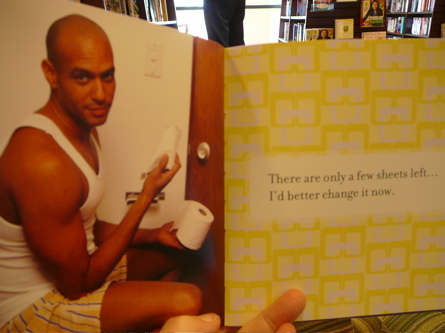
Women are SO clever! And no one knows better than women what turns women on!
In Passing
“Uhm, Mom, I have to sit there” said my son as I slid into a booth in our favorite Vietnamese restaurant and prepared to order some of those tasty salad rolls with peanut sauce that we love.
“Why is that?” I ask territorially, unwilling to move.
“I like to see who’s coming in,” he states flatly.
“So do I” I argue back.
“But I’m the prosecutor,” he says with a sigh.
I move. His need trumps my preference.
He has to watch his back. It’s not one of the happier realities in life. People you “put away” don’t always stay there. And they’re not always happy to see you when they run into you in the gym, or in the Target, or in the grocery store.
My son laughs and tells stories of running into former associates, usually when you are unarmed, and vulnerable in some way. Most of the time it is OK. We’re glad he is careful.
Roadhouse Grill
You’ve all been wondering what Adventure Man looks like. I finally was able to take a photo of him on a recent trip. This is what he looks like:

We parked next to a special parking spot and I took this photo, which I think is a total hoot:

Adventure Man’s Blog
“If I had a blog, I’d blog about this!” Adventure Man gasped as I held my hand over my mouth in shock.
That is, between whoops of laughter.
Adventure Man asked me if we were going to be on the flight out of Kuwait on which we had been booked. I had just talked with the KLM office in Dubai, seeking a little wasta, and I had been graciously but firmly turned down.
“We’re forked” I said, using a very vulgar word instead of ‘fork.’
“I thought you gave up saying any of those words for Lent?” he hooted.
“No, my goal was no swearing on the roads!” I countered.
And he just gave me that long look that said it all. It said “hypocrite.” It said “I think you’re missing an important point.” It said “bad words are bad words no matter where you use them.”
Adventure Man can get a lot of meaning into one long look. We’ve been married for a long time. He gets the same look from me now and then, the long look.
He had me; he was right, I was wrong.
I started snickering. He started hooting. I laughed out loud. He laughed louder. Soon I was writhing on the floor and he was gasping for breath. It’s good to laugh like that every now and then.
And he’s right. It’s not just on the road. Bad language is bad language and I want to clean up the entire act. I am really really glad Adventure Man doesn’t have his own blog.
Play Eggy Easter.
Help the Easter Bunny! Play Eggy Easter, download here.
The Important Messenger
In most ways, my husband, Adventure Man, is a very kind man. He is a big-picture kind of guy. Most of us attend to the details, but he is good at seeing how to get from A to Z, even when everyone else is saying it isn’t possible. I love that about him – most of the time he can see possibilities.
He is VERY unkind about my Arabic.
For example, I would be telling him how we learned such and such in Arabic, and he will interrupt me and correct my pronunciation.
So I would go back to my teacher and say “Adventure Man says we are supposed to say it like this!” and she would laugh and say “oh those Lebanese men say it that way but we Qatteris say it like this.”
So when he would correct me, not being as submissive as I ought to be, I would say “Oh you Lebanese men say it like that” (but he is not Lebanese) “but we Qatteri’s say it like this.” (I am not Qatteri) and I could make him fall out of his chair laughing.
But he really hurt my feelings. I was telling him about my problems on the road and how this “important man” who must have been in a big hurry was driving so rudely and he started laughing at me which totally annoyed me.
“What is so funny?” I demanded.
“I think you mean ‘rajul muuhim'” he gasped out, between spasms of laughter.
“That’s exactly what I meant and that is what I said!”
“No, you keep talking about some rude ‘important messenger'” he croaked, and rolled over on the floor because he is laughing so hard he can’t stand up.
Razool sounds a lot like rajool to me . . .
Adventure Man is SO rude. He thinks he is so rajul muhim!
Drinking Green Tea Might Prevent Absorption of Cholesterol
Found this fascinating and hopeful article on drinking green tea at E-zine articles.com.
There are many studies being conducted on the effects of drinking green tea and how it can benefit the body. Along with its possible antioxidant qualities, there are also studies pointing to the possibility that green tea can help you maintain and even lower your cholesterol levels.
Cholesterol comes in two forms, ‘good’ or HDL-cholesterol and ‘bad’ or LDL-cholesterol. Doctors are very concerned about the balance of these two types of cholesterol. Ideally, there should be more good cholesterol than bad. Also, there should only be very small amounts of the bad cholesterol in your blood.
Imbalances in your levels of cholesterol can lead to many diseases, one of which is atherosclerosis. Atherosclerosis is a hardening of the arteries caused by damage caused by high levels of bad cholesterol and other factors.
Studies revealed that green tea consumption in rats appears to lower their levels of bad cholesterol and even prevents them from getting high cholesterol when they are on high cholesterol diets. This has significant implications for the use of green tea in humans to prevent high cholesterol and heart disease. There are still more studies and research to be done before researchers can confirm that green tea indeed has such benefits.
Now here’s the rub:
The author of this article is John Stout.
Jon M. Stout is the Chairman of the Golden Moon Tea Company.
You can read more about how the study was conducted, and the positive results it found to drinking green tea and lowering cholesterol here, and keep in mind, the author sells green tea.
Mouth Guard
Last summer, my dentist told me I needed a mouth guard to wear at night to keep me from clenching or grinding my teeth.
I’m a little cynical about what I think of as “dental fundraising”. There always seems to be something beyond teeth cleaning now that my teeth no longer develop cavities. Whitening? Special electric toothbrush? Gum treatments? Hey, lets dig out all those old fillings and replace them with gold? And then let’s replace the gold with porcelain? He is always pushing for something new.
And I think my husband would have said something if I were grinding or clenching my teeth.
But on my way down seventh ring the other day, as one guy whooshed by me doing 40 km/hr over the speed limit and the guy on my right zipped right through the RED light as if it weren’t there, and the Gucci sunglassed dame got right on my bumper even though the passing lane was clear as could be and I had a cement truck on my right, I noticed I was clenching my teeth.
For one thing, although I have not succeeded in my Lenten goal of not saying ANY swear words on the road, I am down to only about one per long trip. For example, I hardly ever swear on the way to go grocery shopping, just a short trip to the co-op.
It is only on the ring roads or the speedways that sometimes a bad word pops out before I can stop it. The exercise in NOT swearing has been good for me in that now I am very aware, even alone in the car, when a word just popped out or almost pops out. And down to one per trip and holding back the others – hey! – all this is good. The goal is still zero-defects. But I have to applaud my progress.
So I am thinking I should probably wear my mouth guard while I am driving, because that is where I am clenching my teeth. But I wish they also made one that would guard my mouth from those very bad words that want to come out.
April Fool’s Craziness
When I was a little girl, April Fool’s Day was both a lot of fun, and a day to Watch Out! One year, my mother made eggs for breakfast, but she had put cotton balls in the egg, so they were chewy and didn’t break down. We caught on as she dissolved into a puddle of laughter in the kitchen.
The Museum of Hoaxes has published a list of the top 100 April Fool’s hoaxes, ever. These are the top 10, but you can click on the blue letters above to read the rest.
#1: The Swiss Spaghetti Harvest
In 1957 the respected BBC news show Panorama announced that thanks to a very mild winter and the virtual elimination of the dreaded spaghetti weevil, Swiss farmers were enjoying a bumper spaghetti crop. It accompanied this announcement with footage of Swiss peasants pulling strands of spaghetti down from trees. Huge numbers of viewers were taken in, and many called up wanting to know how they could grow their own spaghetti trees. To this question, the BBC diplomatically replied that they should “place a sprig of spaghetti in a tin of tomato sauce and hope for the best.” Check out the actual broadcast archived on the BBC’s website (You need the RealVideo player installed to see it, and it usually loads very slowly).
#2: Sidd Finch
In its April 1985 edition, Sports Illustrated published a story about a new rookie pitcher who planned to play for the Mets. His name was Sidd Finch and he could reportedly throw a baseball with startling, pinpoint accuracy at 168 mph (65 mph faster than anyone else has ever been able to throw a ball). Surprisingly, Sidd Finch had never even played the game before. Instead, he had mastered the “art of the pitch” in a Tibetan monastery under the guidance of the “great poet-saint Lama Milaraspa.” Mets fans everywhere celebrated at their teams’s amazing luck at having found such a gifted player, and Sports Illustrated was flooded with requests for more information. But in reality this legendary player only existed in the imagination of the writer of the article, George Plimpton.
#3: Instant Color TV
In 1962 there was only one tv channel in Sweden, and it broadcast in black and white. The station’s technical expert, Kjell Stensson, appeared on the news to announce that thanks to a newly developed technology, all viewers could now quickly and easily convert their existing sets to display color reception. All they had to do was pull a nylon stocking over their tv screen, and they would begin to see their favorite shows in color. Stensson then proceeded to demonstrate the process. Reportedly, hundreds of thousands of people, out of the population of seven million, were taken in. Actual color tv transmission only commenced in Sweden on April 1, 1970.
#4: The Taco Liberty Bell
In 1996 the Taco Bell Corporation announced that it had bought the Liberty Bell from the federal government and was renaming it the Taco Liberty Bell. Hundreds of outraged citizens called up the National Historic Park in Philadelphia where the bell is housed to express their anger. Their nerves were only calmed when Taco Bell revealed that it was all a practical joke a few hours later. The best line inspired by the affair came when White House press secretary Mike McCurry was asked about the sale, and he responded that the Lincoln Memorial had also been sold, though to a different corporation, and would now be known as the Ford Lincoln Mercury Memorial.
#5: San Serriffe
In 1977 the British newspaper The Guardian published a special seven-page supplement in honor of the tenth anniversary of San Serriffe, a small republic located in the Indian Ocean consisting of several semi-colon-shaped islands. A series of articles affectionately described the geography and culture of this obscure nation. Its two main islands were named Upper Caisse and Lower Caisse. Its capital was Bodoni, and its leader was General Pica. The Guardian’s phones rang all day as readers sought more information about the idyllic holiday spot. Few noticed that everything about the island was named after printer’s terminology. The success of this hoax is widely credited with launching the enthusiasm for April Foolery that then gripped the British tabloids in the following decades.
#6: Nixon for President
In 1992 National Public Radio’s Talk of the Nation program announced that Richard Nixon, in a surprise move, was running for President again. His new campaign slogan was, “I didn’t do anything wrong, and I won’t do it again.” Accompanying this announcement were audio clips of Nixon delivering his candidacy speech. Listeners responded viscerally to the announcement, flooding the show with calls expressing shock and outrage. Only during the second half of the show did the host John Hockenberry reveal that the announcement was a practical joke. Nixon’s voice was impersonated by comedian Rich Little.
#7: Alabama Changes the Value of Pi
The April 1998 issue of the New Mexicans for Science and Reason newsletter contained an article claiming that the Alabama state legislature had voted to change the value of the mathematical constant pi from 3.14159 to the ‘Biblical value’ of 3.0. Before long the article had made its way onto the internet, and then it rapidly made its way around the world, forwarded by people in their email. It only became apparent how far the article had spread when the Alabama legislature began receiving hundreds of calls from people protesting the legislation. The original article, which was intended as a parody of legislative attempts to circumscribe the teaching of evolution, was written by a physicist named Mark Boslough.
#8: The Left-Handed Whopper
In 1998 Burger King published a full page advertisement in USA Today announcing the introduction of a new item to their menu: a “Left-Handed Whopper” specially designed for the 32 million left-handed Americans. According to the advertisement, the new whopper included the same ingredients as the original Whopper (lettuce, tomato, hamburger patty, etc.), but all the condiments were rotated 180 degrees for the benefit of their left-handed customers. The following day Burger King issued a follow-up release revealing that although the Left-Handed Whopper was a hoax, thousands of customers had gone into restaurants to request the new sandwich. Simultaneously, according to the press release, “many others requested their own ‘right handed’ version.”
#9: Hotheaded Naked Ice Borers
In its April 1995 issue Discover Magazine announced that the highly respected wildlife biologist Dr. Aprile Pazzo had discovered a new species in Antarctica: the hotheaded naked ice borer. These fascinating creatures had bony plates on their heads that, fed by numerous blood vessels, could become burning hot, allowing the animals to bore through ice at high speeds. They used this ability to hunt penguins, melting the ice beneath the penguins and causing them to sink downwards into the resulting slush where the hotheads consumed them. After much research, Dr. Pazzo theorized that the hotheads might have been responsible for the mysterious disappearance of noted Antarctic explorer Philippe Poisson in 1837. “To the ice borers, he would have looked like a penguin,” the article quoted her as saying. Discover received more mail in response to this article than they had received for any other article in their history.
#10: Planetary Alignment Decreases Gravity
In 1976 the British astronomer Patrick Moore announced on BBC Radio 2 that at 9:47 AM a once-in-a-lifetime astronomical event was going to occur that listeners could experience in their very own homes. The planet Pluto would pass behind Jupiter, temporarily causing a gravitational alignment that would counteract and lessen the Earth’s own gravity. Moore told his listeners that if they jumped in the air at the exact moment that this planetary alignment occurred, they would experience a strange floating sensation. When 9:47 AM arrived, BBC2 began to receive hundreds of phone calls from listeners claiming to have felt the sensation. One woman even reported that she and her eleven friends had risen from their chairs and floated around the room.
Fat scan shows up ‘true’ obesity
From BBC Health News.
Given that obesity is becoming a world wide epidemic, and kills more people than the bird flu, this can be a helpful tool.
Scientists say they have developed a 3D scanner that can accurately determine if a person is truly obese.
Currently, doctors gauge fatness with a calculation of body mass index (BMI). But BMI is flawed – people with lots of muscle are considered overweight.
Instead of relying on weight and height measurements, as BMI does, the scan takes into account body shape and how much fat a person carries.
Birmingham’s Heartlands Hospital has been testing this Body Volume Index.
Muscle or fat?
One human guinea pig who has tested the BVI scanner is 19-year-old rower Ashley Granger.
He is 6ft 2ins (1.88m) tall and according to his BMI of 28 is at the top end of the overweight category, borderline obese.
Muscle weighs more than fat does. And you can hide away fat but be quite thin looking
Fitness trainer Matt Roberts
His BVI scan correctly showed that he carries very little fat and that his weight is largely down to muscle.
Fitness trainer Matt Roberts said: “Muscle weighs more than fat does. And you can hide away fat but be quite thin looking.
“So it’s important that we don’t just use BMI alone.”
Dr Asad Rahim, a consultant in the obesity and endocrinology department at Heartlands Hospital, explained the work they had done with the BVI scanner over the last two years.
“We have completed the patient evaluation stage and are currently assessing the results.
“The scanner has certainly helped motivate some patients to manage their weight more effectively but there are also patients who were not scanned who lost weight.”
The next phase of testing has now been launched – the plan is to scan at least 20,000 people over the next two years as part of the Body Benchmark Study.
Select Research, the company which makes the scanners, said it hoped to make them available to GP surgeries at an “affordable” cost.
Recent Comments
intlxpatr on Shampoo Ginger tigerbutterya0c5ff1d… on Shampoo Ginger intlxpatr on British Soldier Kidnapped, Esc… John on British Soldier Kidnapped, Esc… intlxpatr on British Soldier Kidnapped, Esc… Wikipedia Donate Button

Amazina


Early Voting in Florida


