“I’m A Third Culture Kid, Are You?”
Most of those who read my blog are not Kuwaiti, and it is for you that I am writing this post. So many of you who read me are also “Third Culture Kids.” My blogging friend Amer just wrote a post by the above title, and whoa! The responses will blow you away! Please go to I am a Third Culture Kid, Are You? and check in with your story – where you came from and where you are today.
And how being a third culture kid has affected your life. This is one of the best blog entries I have read.
The book from which the term Third Culture Kids comes from is mentioned in an earlier blog entry of mine, Chicken Nuggets and Big Macs and is by David C. Pollock and Ruth E. Van Reken. You can find it at Amazon.com. If you are a third culture kid, you might want to buy two or three – you will keep giving them away. The book is that good.
Please Be Careful Out There
In Seattle, rain is common. Just a little rain, like today, is no big deal. In Seattle, we don’t have air full of sand, and then just a little rain, so it’s a whole new ball game.
I didn’t think it would be dangerous out driving today. I had two meetings; I had no idea I would see so many accidents. This one scares me. I hope the people got to the hospital OK.
Please, friends, be careful out there today. Get home safely.

Germany’s culture of shopping slowly changing
Little Diamond forwarded this to me from the Chicago Tribune. The battle to extend shopping hours in Germany has been going on for years. As the hours increase, the annual birthday celebrations described in the preceding blog entry will pass into “olden day traditions.”
By Tom Hundley
BERLIN – Unlike America, Germany has not yet adopted the shop-till-you-drop lifestyle, but things are starting to change.
Even in bustling cities like Berlin and Frankfurt, retailers used to roll up the sidewalks at 6:30 p.m. On weekends, Germans had to scramble to get their shopping done by 2 p.m. on Saturday. Sunday shopping was strictly verboten.
But a long battle over longer store hours is slowly being won by retailers who believe that more hours mean more money in the cash register. They are opposed by Germany’s powerful trade unions whose leaders say workers’ rights must be protected.
The gradual loosening of strict rules governing store hours also reflects a larger battle to loosen up a German economy that suffers from sluggish growth and 9.6 percent unemployment. Chancellor Angela Merkel’s government says it is eager for reform, but it has decided to leave the issue of store hours to local governments.
These days, the Galeria Kaufhof, a newly renovated department store in the heart of the former East Berlin’s shopping district, is crowded with customers until 10 p.m.
“Seven years ago we started a small revolution here in Berlin when we said we are opening on Sundays,” said Detlef Steffens, the store manager.
“We discovered a loophole: according to the law, you could open on Sunday if you were selling souvenirs, so we put stickers that said `souvenirs’ on all the merchandise,” he said.
“We were sued by other store owners. But that started an avalanche.”
Steffens’ store took its case to Germany’s federal constitutional court. The court rejected its arguments but said the particulars of Sunday shopping hours should be regulated by local authorities.
The Berlin city government decided to allow stores to open on six Sundays a year. Last year, it extended the number to 10, plus three extra Sundays during the World Cup soccer tournament.
Last November, Berlin threw caution to the wind and adopted a modified version of America’s 24/7 consumer ethos. Call it 24/6 – non-stop shopping for six days of the week and 10 Sundays.
The Galeria has opted to stay open until 8 p.m. Monday through Wednesday and until 10 p.m. Thursday through Saturday. The extra hours have increased revenue and enabled the store to hire 50 more employees, for a total of 1,080.
Steffens says his employees have generally been supportive of the longer hours.
“It’s an East-West thing,” he said, referring to the lingering psychological divide that still separates Germans who grew up in prosperous West Germany from those who experienced communist East Germany.
Almost all of Steffens’ employees are from the East. Those from the West, he said, are more likely to resist changes proposed by management.
“The trade unions are not so different from East to West, but worker councils in the East are more realistic. Here there’s more of a collective mentality: We are one team; it means our jobs,” he said.
Cornelia Hass, a spokeswoman for Ver.di, a large trade union that represents service employees, says the union’s position is that “everyone should have the liberty to work (non-traditional hours), but nobody has to work these hours.”
Hass disputes the argument that more hours mean more revenue and more jobs.
“People don’t buy more just because they can do it 24 hours a day. You can only spend the euro in your pocket once,” she said.
While acknowledging that store hours have to reflect people’s changing lifestyles, she said Germany already has “more square meters of shopping opportunity per consumer than Europe or the United States” and that fierce competition among retailers was forcing them to trim personnel.
There’s also a quality-of-life issue.
“I really believe that Sunday is the day when everyone who doesn’t need to work, shouldn’t work,” Hass said. “Society needs to lay back for one day, to find time for friends and family.” She also noted that of the 3 million retail workers represented by Ver.di, 80 percent were women, and most had families.
“They need their Sundays,” she said.
The union is supporting three retail workers who have filed a lawsuit challenging Berlin’s new Sunday opening hours.
But most of Germany’s 16 federal states appear to be following Berlin’s example and extending store hours.
Some small merchants are worried, fearing that extended hours by large retailers will force them to attempt the same.
“It’s a problem for us,” said Michael Turberg, who owns a Berlin toy store famous for model trains.
“We are rather specialized and we need staff of high quality. When you are open longer, you need more staff of high quality. It’s not easy to find staff, and it’s not easy to pay them.”
That’s not a problem for Mohamed Wehbe and his family. Immigrants from Lebanon, they run a small shop that sells snacks, groceries, cigarettes and newspapers. It’s open 365 days a year.
When they started their business a few years ago, and kept it open until midnight, they got a polite letter from Berlin authorities advising them to observe the legal opening hours.
“We didn’t know about such laws,” said Wehbe.
Under the new law, the shop is open from 6 a.m. until midnight.
For Wehbe and many other immigrant entrepreneurs, there are scarcely enough hours in a day for earning money.
“This summer,” he said, “we’re going 24/7.”
A Special Birthday in Germany
Birthdays aren’t my favorite days, and in spite of that, I’ve had some really good ones. The best birthday I can remember, ever, came as a gift of sharing that totally blew me away.
I was living in a small German village. Little by little, I mastered enough German to be able to interact with the villagers, who were very kind to me. They included my husband and I in the village events, including private birthday parties, which in Germany, are a BIG deal.
Birthdays are YOUR day. Every woman in the village brings a cake – or two. Competition to provide the fanciest, most lucious cake is keen. The cakes are not overly sweet, but are incredibly full of fresh cream. And of course, it is rude not to try a little of everyone’s cakes . . . all eyes are all watching.
The two women in the village who took care of me were my landlady and her mother-in-law, who lived in a house just across the courtyard. My landlady sang in the village choir, which performed at a variety of locations throughout the year – festivals, local events, schools – and at 50th birthday parties. The 50th Birthday Party was very special. The whole choir would sing JUST for the birthday girl.
It was a very small village. Everyone knew everyone. Some people didn’t speak because their grandmother didn’t speak to someone else’s grandmother. People carried grudges for a long time. Memories were long, and tongues were longer. My landlady’s protection was very valuable to me, an outsider in the village, who might, from time to time, violate customs without even knowing about it.
My husband and I were leaving Germany, after four years in the village. It was around this time of the year, the cold cold of winter in Germany. One evening my landlady came down and asked us to come to her birthday party the next night – our birthdays are only two days apart, and we had often celebrated together. We were delighted for the invitation, as we knew the choir would be seranading our landlady.
There was a lovely catered sit-down dinner. Everyone was in dress-up clothing, and the wine and beer were flowing. We knew it would be our last dinner in the village, and we felt so honored to be included.
And then the choir arrived. The choir master made a speech to our landlady, congratulating her on her special birthday and giving her a long list of good wishes. And then he turned to us, and said that tonight our landlady was sharing her birthday with me, and they would sing two songs for us on our departure.
This was her special day. Her 50th birthday is the day the whole village would honor her. It only happens once in your lifetime. And she shared it with me.
The choir sang “The Gypsy Wanderers”, and truly, it was appropriate for my husband and I, departing for our next life in Doha. From the first notes, I cried. I’ve never minded my vagabond life, but for that brief moment, I regretted not having the kind of deep roots that kept me anchored in one place. I would never have a village singing for my 50th birthday; I had never earned that honor. And my landlady gave it to me, simply, without fanfare, sharing the honors she had earned day by day, living in the village. She gave it expecting nothing in return for it, sheerly for the joy of sharing.
What Happens Next?
I love reading the paper in a foreign country. It often reveals a different way of thinking. Often I am mystified; there is a context in which the article is written that you may “get” while I do not. As I read the Kuwait Times there are many times I wonder “what happens next?” Rarely do we get any follow up, rarely do we know the ultimate outcome of these incidents. These are all from today’s paper(24 Jan 2007):
1. The ‘Other’ Woman
A woman after suspecting her husband of infidelity, decided to keep tabs on him, and followed him to a spring camp in the Jdailiyat area and was shocked when she found her fears had turned into reality when she caught him red-handed in the arms of the ‘other’ woman. The wife immediately summoned police who rushed to the camp and also found out that he was under the influence of alcohol. In a fit of rage, he also smashed the police car’s windowpane to smithereens. He was referred to the relevant authorities.
My comment/questions: Infidelity is a painfully personal kind of behavior. Why would the police be called? Would you call the police if you want to salvage a relationship, or bury it? Does involving the police help in a divorce settlement? Will the husband normally be shamed and repentant, or angry and defiant? Are there processes to help a husband and wife save their marriage? And what happens to the other woman? Does it depend on who she is and what her nationality is? And wouldn’t a wife be afraid to confront her husband in that situation, would she be placing herself in physical danger?
2. Daughter Reveals Affair
A 47-year old Kuwaiti woman lodged a complaint with Mubarak Al Kabeer police that another Kuwaiti who works for the National Guard had several sexual intercourses with her 16 year old daughter in her own room, whenever she went out on errands. She said that her daughter confessed to her and revealed her affair our of her fear that she might be pregnant after which her lover might dump her. The man is being summoned for further interrogation.
My comment/questions: Why does it matter how old the woman is making the complaint? Why is that on the public record? If the girl is pregnant, what happens next? Can she raise her child as a single mother here in Kuwait? Is there a possibility that the girl will marry her National Guard lover? If not, what are her chances for marriage? Can she continue school if she is pregnant?
3. Mother Accused of Kidnapping
A 60 year old Arab lodged a complaint with Jabriya police that his 55 year old Iraqi divorcee had kidnapped their two sons. He produced a court order that authorized him custody of the boys and that their divorced mother showed up in his absence, along with her older sons from an earlier marriage and took the boys away. The father filed a kidnap case against his ex-wife althought Kuwaiti family laws do not under any circumstance permit accusing a mother of kidnapping her own children, even if the father had the legal custody rights.
My comment/questions: Why list the ages of the complaintant and his wife, but not the ages of the boys? How can the father file a case, if Kuwaiti law specifically states a mother cannot kidnap her own children? Do the boys have any choice of which parent they would want to live with? If the wife is 55, isn’t it likely that the youngest “boy” is around 15? (I would think it’s pretty hard to kidnap teenage boys.) Do parents often have heated contests over their children in Kuwait? Does shared custody work here?
Weather Underground

We all have routines that get us through the things we do every day, things we do almost without thinking. You get up, you take care of your morning ablutions, fix some coffee, and then, in my case, you check e-mails, read the day’s selections from the lectionary, check the blog, and check the weather.
Part of my routine is Weather Underground. I like it so much, I added it to my blogroll, over there to the right. When I click, I get Kuwait Weather, first thing, but over on the left are all my favorite cities where I have family and friends – Seattle, Pensacola, Doha (Qatar), Mfuwe (Zambia), Colorado Springs, Zanzibar . . . all at a glance. With one click, I can see what the weather will be there, too.
And for any other city I’m travelling to, I can just type it in and it will take me there.
When my son was getting married, I could check the weather for many years back to see how hot it generally gets on that day in that city – it gave me a range for which to pack.
I’ve tried a lot of other weather sites, but this one has the things I need. It’s part of my daily routine. You can find it here.
BBC: Dog Owners Lead Healthier Lives
(See Statistics: “Lies, Damn Lies and Statistics” below for perspective. Ask “who did the study? What was the purpose of the study? Who profits?”)
This article is from today’s BBC News online. You can read the whole report here.
Dogs can provide companionship
If you want to live a healthier life get a dog, research suggests.
The companionship offered by many pets is thought to be good for you, but the benefits of owning a dog outstrip those of cat owners, the study says.
A psychologist from Queen’s University, Belfast, said dog owners tended to have lower blood pressure and cholesterol.
Writing in the British Journal of Health Psychology, she says that regular ‘walkies’ may partly explain the difference.
Dr Deborah Wells reviewed dozens of earlier research papers which looked at the health benefits of pet ownership.
In some cases, the social support offered by an animal is greater than the support than another human could offer
Dr June McNicholas
Health psychologist
She confirmed that pet owners tended in general to be healthier than the average member of the population.
However, her research suggested that dog ownership produced more positive influence than cat ownership.
As well as lower blood pressure and cholesterol, she said dog-owners suffered fewer minor ailments and serious medical problems.
There was also the suggestion that dogs could aid recovery from serious illnesses such as heart attacks, and act as ‘early warning’ to detect an approaching epileptic seizure.
Stress-busting
Dr Wells said the precise reason for the benefits was not totally clear.
“It is possible that dogs can directly promote our well-being by buffering us from stress, one of the major risk factors associated with ill-health.
read the rest here.
My comment: I hate a study that says dog owners are healthier than cat owners, but they say that the regular walking might be a factor. Have to admit, that is true. I have a leash for my cat. When I tried to put the body harness on him, some primitive switch deep inside switched on, and the Qatteri Cat went bat-crazy, clawing, biting, twisting, hissing . . . never tried it again.
We tried walking a cat once – we’ve been told it can be done. Our experience we called “taking the cat for a drag.” I’ve never met a cat who would happily take to a leash.
And I never met a dog who wouldn’t go for a walk with great enthusiasm. They wiggle with uncontrollable delight when they see the leash, wiggle so hard you can barely get the leash attached. They bolt out the door, sniff the air, and prance as you race to keep up.
You see life differently when you walk a dog. It’s all “go! go! go!” and then all of a sudden it’s “Hey! What’s this? Some dog peed here! Woooof!” You really do see the world in a blade of grass, when you are a dog, or a hedge, or a pile of cat poop. (“No! No! You can’t eat that!! No!”) Their love of life is infectious, and probably even the stop and go kind of walking you do with a dog is better than no walking at all.
Taking “Normal” for Granted
Today a good friend sent a story about a guy driving a very expensive car and a kid hitting the car by throwing a brick. The guy stops his car, ready to kill, and the kid cries and says it was the only way he had to get his attention, he needs help getting his brother back into his wheelchair. The guy instantly goes from raging anger to compassion, and keeps the dent in the side of his car to remind himself that it shouldn’t take a brick to get his attention.
In the story, it says sometimes God uses a brick to get our attention.
I know, I know, you wonder where I am going with this.
It brings two very simple things to my mind. First, I have bored you more than once with my woes of jet lagging. Right now, I am sleeping great, although I am still falling asleep around nine at night, I am sleeping through the night. Thanks be to God! I wake up in the morning thankful for something so simple – a good night’s sleep.
Sleep isn’t so simple for those who suffer sleep deprivation – and their name is legion. My heart especially goes out to young mothers with their first baby . . . no one tells you how sleep deprivation can change your life. You think you can handle anything. Sleep deprivation is a big brick thrown into your life – it really gets your attention. Without adequate high quality sleep, life loses its lustre, and the simplest thing can be overwhelming.
Second, this is the time of year when many blogs feature colds and flu and lingering illnesses. I rarely get sick, but when I do – oh, I am such a baby. I don’t want concerned people around, I just want to be left alone to suffer. I just want the sickness to be OVER. And then, one day when it is gone – oh! how good it feels, just to be NOT sick! And I thank God for the every day blessing of good health!
We take so much for granted as we go through our daily lives. We forget how really good just being “normal” can be.
But maybe these are the bricks being thrown into our lives to get our attention, to help us to be thankful for our blessings?
Maybe slowing us down helps us to see things we might otherwise speed right by in the busy-ness of our active lives?
Maybe this is all a part of being thankful for the bad things that come into our lives, as well as the good? Alhamd’allah!
I think this is the first day of the Islamic New Year. If so, wishing my Moslem friends all the blessings of a new and, God willing, abundant and peaceful year.
Qatteri Cat’s Babies
Last night, we had just gotten to sleep, when we could hear the Qatteri Cat crying. We know that cry. It’s his “rounding up the babies” cry. He got a new baby yesterday, a small white bear, and now he is responsible for four babies. This is what we found on our bed this morning:
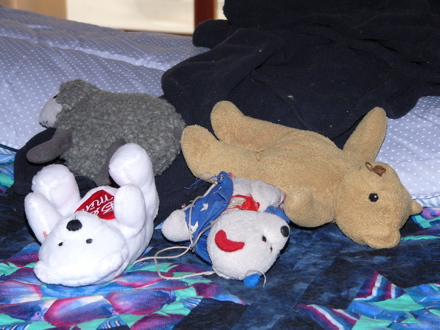
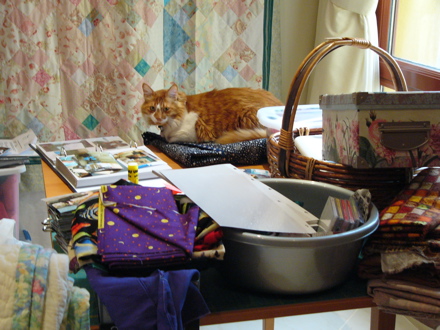
He has had a very busy week, helping me with my projects, and keeping track of all the goings-ons in the neighborhood.
Outrage: Rape Reporting from Monrovia and Iran
My energy is back. I felt so blessed – today I started my photo albums. I had it all organized, but just couldn’t make myself DO it. Today was a new day, woke up at a reasonable hour with energy! Alhamdallah!
Back in my workshop, Qatteri Cat helping, BBC on to keep me company . . . and two separate reports come on BBC News (radio). I can sit, or I can share my outrage with you. Here I am . . .
The report from Monrovia is about the continuous rape of children, even infants under one year. They are only now documenting it is happening, and to what extent. Before, it was deny, deny, deny.
Here is a direct quote from the program: “Rape is so entrenched in the society.” They haven’t begun to study WHY it is happening, only documenting that it IS happening. To children, the weakest, least powerful segment of society. And in other African countries, societal studies have shown that there is a belief that having sex with virgins, uncontaminated, can cure AIDS. So ignorant. So selfish. And as the virgins become fewer, the victims get younger. Who would rape an infant? Who would be so desperate and so depraved? It makes me shake, it makes me so angry, this violation of the most innocent.
The second case is about an Iranian woman, Norouzi, who killed a man who was attempting to rape her. Convicted of murder, and given the death penalty, the court said she had used “too much force” in defending herself.
So, in your experience, what happens if you defend yourself but leave your attacker still capable? Your self-defense only makes him/her more angry, more lethal, and raises your probability of ending up dead yourself. Hmmmmm. . . . experience rape and likely death, or kill my attacker?? I know, in a heartbeat, which I would choose.
The family has forgiven her IF she pays the blood money of nearly $63,000 dollars. Pay $63,000 for the SCUM that tried to rape her??
Share my outrage. You can read the entire story on the BBC website, here.
A quote from this newsarticle:
Women’s rights activist and lawyer Sara Irani told The Associated Press news agency she welcomed the resolution of the case.
“Norouzi’s freedom will give new breath to women to find the courage to stand up for their rights and defend themselves,” she said.
In Iran, a married woman who is raped risks the death penalty for adultery if she cannot prove she was violated.
If she kills her attacker, she may also face the death sentence for murder.
You may wonder why I tag this a political issue. Politics is all about power. This woman, and these children are victims because 1) they are physically weaker than their attackers and 2) their attackers don’t believe there will be any repercussions; they believe they are entitled to what they take and that there will be no penalty. It’s about power. It’s political until there are laws strong enough to protect the weak and innocent against their attackers, and those laws are enforced.
Recent Comments
intlxpatr on Shampoo Ginger tigerbutterya0c5ff1d… on Shampoo Ginger intlxpatr on British Soldier Kidnapped, Esc… John on British Soldier Kidnapped, Esc… intlxpatr on British Soldier Kidnapped, Esc… Wikipedia Donate Button

Amazina


Early Voting in Florida


 Here There and Everywhere