Bullying and Community
I found this on AOL/Huffpost Parenting: it contains a line – I italicized it – that I need to think about. In America, we tend to think of the individual over the community. For the most part, we don’t encourage our children to continue with an activity they don’t like ‘for the good of the group,’ we tend to take them out of the activity. I’ve lived in cultures where obligations to the group are much stronger, and I’ve always felt confined and constricted by the burden of those expectations, but it does make for a more peaceful situation when we consider the needs of others and the needs of the group.
Preventing Bullying Begins With Us
Richard Weissbourd and Stephanie M. Jones
On Feb. 29, Lady Gaga will launch a foundation dedicated to creating caring communities and stopping bullying. Hosted by the Harvard Graduate School of Education and Harvard’s Berkman Center, Lady Gaga will be joined by Oprah and other celebrities. A powerful new film, “Bully,” will be widely released at the end of March, and many Americans in recent years have been galvanized by a blizzard of tragic bullying stories.
Yet too often in the past a problem plaguing children like bullying has received huge waves of public attention that simply never translates into any positive changes in kids’ lives. What will it take to capitalize on this attention? How can we curb this problem once and for all?
We can start by recognizing where the main solution lies. There is a tendency to simply blame bullying on “bad” kids or peer groups or destructive media. But bullying often has deep roots in parents’ attitudes and behavior, and stopping bullying begins with us.
How can parents prevent bullying? Parents in recent years have been flooded with articles and books that guide them in shielding, or “bully-proofing,” their own child. But just protecting our own kids won’t stop bullying, and this guidance reinforces the damaging tendency of many parents to just focus on their own children. The best way to prevent bullying — and many other forms of cruelty and harassment — is to encourage and enable children to care for and take responsibility for each other. Research indicates that bullying is greatly reduced in particular when children who witness bullying stand up for the victim. Bullying brings home to parents our fundamental moral responsibilities. How can we help our children widen their circle of concern and stand up for other children? How can we help our children build more just and caring communities?
Bullying, unlike more typically developmental teasing and hurtful remarks, is commonly defined as prolonged or frequent cruelty to others, often characterized by imbalances of power. This kind of cruelty can produce intense and often lasting feelings of shame in children, a sense that they are defective in some core way. About 30 percent of children are bullied each year on school property alone. Adults’ understandable reflex is to curb this kind of bullying by punishing perpetrators. Yet this strategy alone usually fails to stop bullying, and sometimes it backfires.
On the other hand, bystanders — especially a friend of the bully — tend to be far more effective. A bystander is present in 85 percent of bullying situations, and bystanders who intervene appear to prevail over half the time. Yet in the vast majority of cases bystanders elect not to intervene.
What can we do as parents to help our children stand up for others? Research suggests that parents bolster their children’s ability to act independently and to withstand disapproval when they respect their children’s capacity as independent thinkers from early ages and give them input into family decisions. All the things parents do to build in their children a sturdy sense of self make it easier for children to hold their ground against a powerful peer. As parents we strengthen the self, for example, when we praise appropriately, know and appreciate who our children are and maintain their trust and respect. Nurturing empathy in children from early ages certainly matters as well. That means in part helping children appreciate people who may not be on their radar, whether a bus driver, a custodian or a new child in class. It means helping children consider the perspectives of those they’re in conflict with as well as people who are different from them in customs or background or other characteristics.
While it’s vital that we convey high moral expectations and underscore the importance of sticking up for others, we also must listen carefully to our children and understand the complexity of their social worlds and ethical decisions. We as parents will be more real and valuable to children if we pay careful attention to their perceptions and experiences of bullying and discuss when and how to stand up for someone else. We need to talk to them about the complexities of balancing our needs with others and what consequences are worth and not worth bearing. We need to help them figure out how to challenge someone else constructively.
But perhaps most important, stemming bullying will require us to seriously examine our parenting priorities. As a good deal of research now indicates, we live in an era when many parents are intensely focused on their children’s self-esteem, happiness and achievements, not on how well they care for others. And in all sorts of subtle ways we can prioritize happiness over taking responsibility for others. Too many of us, for example, don’t push our children to fulfill obligations that might distress them. We let our children write off friends they find annoying, or fail to reach out to a friendless child on the playground, or quit a team or chorus without asking them to consider what it means for the group. How many of us simply tell our children that their classrooms, schools and neighborhoods are communities to which they have obligations?
Just as worrisome, many of us as parents are failing to model for our children a sense of responsibility for others. Over and over we have heard from teachers that many parents are occupied with their own child and care little about other children in the classroom. “It’s a dog fight,” one recently retired teacher says, driven out of the profession in part by his fatiguing battles with parents. “Parents are out of control. They’re always seeking an advantage for their own kid… they lobby for a gifted class or they want their kid to get extra attention… and they don’t care how they might be hurting other kids.” Some parents say they want kids with behavior problems immediately removed from the classroom because they believe their own child’s learning is compromised. But that message certainly doesn’t convey responsibility for others and the community. At least for some period of time, we as parents ought to encourage teachers to work with that child and ask our own child how she/he might support the struggling child.
It is, of course, a great deal easier and tidier for us as parents to simply wrap our attention around our own child or to periodically remind our child to respect others. But such bland reminders will never get us where we need to go. Our children’s moral development is deeply interwoven with our own. If we want our children to be fair, courageous and humane, we have to take a close, hard look at whether those values are priorities in our parenting, and whether we are living those values day to day.
Depends Who Writes the Obituary . . .
I am sorry, but this totally cracks me up. I found in on AOL Huffpost and it is about a Tampa family, where the one writing the obituary gets to insert his point of view. We all have families; they each have their points of view.
When I am reading the obituaries, the ones that crack me up are the ones who have clearly written their own obituaries and had them ready to go when their time is up. Many of the ones written by men are a little grandiose, the ones written by women are more matter-of-fact. You can usually tell what they found most important about the life they lived. Now and then, you find someone original, with a sense of humor and proportion about themselves, who talk about hunting, or their dogs, or sailing. There are people I wish I had met when I read their obituaries; maybe we should all publish pre-death summaries of our lives so far . . . Oh wait . . . that’s a blog, LOL!
When AdventureMan says “that’s not how I remembered it!” I always say (you’ve heard it before, you can say it along with me) “Get your own blog, AdventureMan!” But it is true, the one who is doing the blog gets to skew the history, LLOOLL!
By Laura Rowley
One of my first assignments in my first real job in journalism was writing obituaries for The Milwaukee Journal. I found it a little daunting at first, this job of writing about the dead. But that changed after a phone call with a woman whose daughter had died in a car crash overseas with her husband and toddler.
It was my job to call the family for the story, and I assumed the mother would hang up on me. Instead she spoke for an hour, sobbing, telling me stories about her extraordinary daughter and son-in-law, and the grandchild she had barely gotten to know. At the end of the call she said, “Thank you, my husband won’t talk with me about this.”
In every call I made after that I had a different attitude. I realized that the obituary is a place where ordinary people have the opportunity to honor the people they love in a very public way.
That is, unless the survivor is self-centered enough to believe the obituary is about him, as appears to be the case with Angelo “A.J.” Anello of Florida. Anello placed an obituary for his mother Josie, who died on February 11, taking the opportunity to insult his siblings Ninfa and Peter with the following line:
“She is survived by her Son, ‘A.J.’, who loved and cared for her; Daughter ‘Ninfa’, who betrayed her trust, and Son ‘Peter’, who broke her heart.”
The source of this rivalry between these post 50 siblings? Money. Ninfa Simpson told the Tampa Bay Times that her brother A.J. became more controlling over their mother once their father died, which A.J. denied. The two told the paper that the third sibling, Peter, has been estranged from the family for more than 25 years. The Tampa Bay Times also reported that:
Simpson says Anello drained the mother’s savings and maxed out her credit cards. Anello says Simpson and her husband used their mother’s Social Security checks to go on vacations to Branson, Mo., and Alaska.
Both siblings deny the other’s allegations.
A.J. told the Tampa Bay Times that he was merely conveying what his mother said through the obituary; nevertheless, an alternative version of Josie Anello’s obituary — which does not include evidence of the siblings’ feud — has also been published.
What do you think about Josie Anello’s obituary? Let us know in the comments, and watch the below video to hear more about this unbelievable family rift.
Just a Little Less Alien

It’s great having friends who all returned to the USA after our years of living in Qatar (and Kuwait) so we can share our experiences, our frustrations, our challenges. It’s been two years for me since AdventureMan and I made the big decision to retire, and in Pensacola, not Edmonds, WA.
Pensacola is a pretty cool place to be retired. One of the best things, after living in Kuwait especially, is the traffic. People might complain, but the traffic here is laughable. It’s very calm. Traffic might be waiting two lights at a stoplight, but hey – people wait, don’t just drive right through. No one has ever pushed me into a round about, or anywhere else, unlike Qatar, when I got in some young man’s way, and he pushed me out of his way (!)
When you go to the symphony, or to church, or to aqua aerobics, in the worst traffic it might take ten minutes. There are restaurants everywhere, many of them pretty good. The worst restaurants are usually better, cleaner, faster than most of the restaurants in Kuwait and Qatar. The only cuisine we have not been able to find here is Ethiopian, and we can drive to Atlanta or New Orleans and get that.
It’s been two years . . . there is something in me that starts getting a little restless, starts looking at my household goods with an eye to getting rid of, giving away, cutting down on weight. At the very least I might have to paint something, or change the furniture around . . .
My friends are suffering many of the same challenges, the challenge of being an expat back in the USA. What was formerly comfortable is not such a good fit anymore; we have changed, and we are trying to cobble together lives that can accomodate the changes.
I had a minor triumph; I realized that after two years, I am starting to have people I can go sit with when I walk into a crowded venue. It may sound like a small thing, but the fear of having to sit alone in a crowd where everyone is visiting and sharing is a little daunting. Who wants to look pathetic?
But my expat friends and I laugh; in expat world two years makes you an old-timer. When new people come in, you are expected to show them around, show them where (and how) to shop for things, where to get things fixed, altered, where to go to pay your bills and how to pay them. Two years makes you and old hand, often with one foot out the door, getting ready for the next posting or contract.
Three of my friends went back to their home locations, only AdventureMan and I settled in a new place. While I am making some progress, two years in, I still wonder who my friends will be? Will I ever feel at home in Pensacola?
Scanning Obituaries
Who knew? I certainly didn’t, and yet I find that I’m not alone. AdventureMan does it, too, and other friends. One friend says she thinks she scans the obituaries to celebrate the fact that she is still alive. That may be it for most of us, but in addition, I find that there are people living among us with amazing histories, and we don’t even know. Sometimes when you read an obit, you can tell that the person wrote it himself or herself, and what that person considered important in his/her life. Sometimes the obituary is not very loving.
Southern newspapers, in my experience, are much richer in extraordinary detail that newspapers in bigger cities, like Seattle. In bigger cities, only the rich and famous or notorious get much space; it may be that the space is far more expensive in the bigger cities, or that families are less willing to shell out from the estate for the bigger coverage. Southerners value family, and history; it’s a part of the culture.
Yesterday, when I took the Pensacola News Journal in to AdventureMan, I had circled something in one of the obituaries, knowing that he, like me, only reads them now and then. I didn’t want him to miss this line:
(Name) was a Past Mighty Chosen One of the Zelica Daughters of Mokanna, Ladies Auxiliary to the Grotto.
Holy smokes! I thought it might be one of the Mardi Gras Krewe things, but AdventureMan googled, and discovered that is a Masonic offshoot, and their larger groups are called Cauldrons. (!)
In America of the early 1900’s, social affiliation groups were important. People belonged to religious groups like Knights of Columbus, Ladies of the Church, etc, quasi-religious groups like Masons and Shriners, and social groups like the Elks and Moose and Lions Club. Some groups still exist, and are still going strong, like Rotary Club, and special interest groups. In Pensacola, there is a Tea Party AND a Coffee Party. There is a Philipino-American Republican Club. When people gather together regularly to share something in common, they can form a group. All of these groups help people be connected in their communities and in their lives, and help people to look after one another.
I belonged to a group once that called ourselves the Aqua-Babes. To be perfectly honest, we might not be total babes, but hey – it’s our group, we can call ourselves what we want, right?
But oh, my, to be a Mighty Chosen One . . .
Happy Two Years Old
I remember when they were called the Terrible Twos . . . but, at two, our little Happy Toddler is a delight: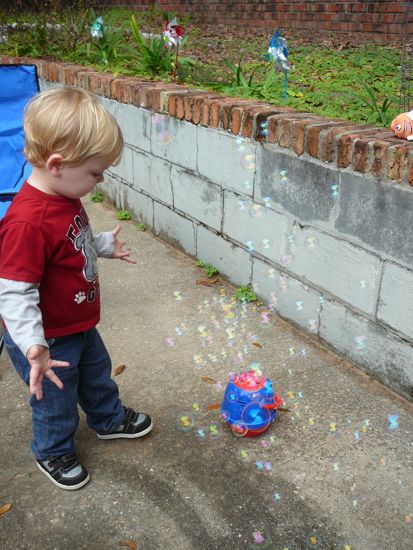
He is so delighted to be able to communicate. We can hear him in his car seat, practicing his pronunciation, so people will understand what he says. Two weeks ago, he was patiently trying to communicate something to us, and we thought he was asking about the garbage can, but he was asking about his car blanket. Now “car blanket” is clear, and daily he gathers more and more vocabulary. “Stuck!” he chortles! “Bubbles!” “Tractor!” “Door OPEN!”
We laugh with glee to see his delight at our comprehension.
There are other times he cracks us up. “What color is this?” we ask, and he says “Lello,” but he isn’t even looking. He doesn’t really care much what color it is. If we say “no, it isn’t yellow” he might say “red” or “geen” or “boo” but he isn’t looking and he doesn’t care. The-Grandmother-who-lives-on-color hopes that this is just a passing phase, and that one day he will care whether it is carmine or flaming or blood or cherry or claret . . .
He walks boldly, he runs exuberantly, he skips, he dances, he climbs; he is a very all-boy boy. He has a dignity all his own, and a confidence that he is greatly loved. We thank God for this little grandson.
Scam Letter
You know how I hate lying and deception, sneaking and peeping, all manner of pretending rather than keeping it real. I have a real thing about scams, and I want to pour the light of day on each and every one of them, so that the vulnerable will be forewarned.
This is a letter I got this week. Many times, I won’t even open junk mail, just throw it away, but this one looked like it MIGHT be official, even though my gut told me it wasn’t:

Looks a little like a W-2 form, doesn’t it, or something governmental?
Inside:
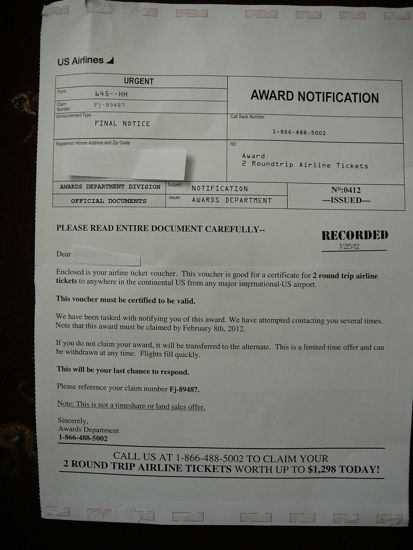
Still looks official, doesn’t it, but it isn’t a government form, it’s a form telling me (using my name) that this is my FINAL notification that I have to claim the two round-trip tickets on any American airline that I have won.
In a separate attachment is this “flight coupon”:

I passed it along to AdventureMan, in case he wanted to call the number and mess with them a little, but neither of us really wanted to waste the time – or to give them any idea what our phone number is: we hate scam phone calls, too. Yes, it is a scam, even if it may not be an illegal scam, it is a deception and not what it appears to be. SCAM!
Abraham Buys a Cave and a Field
When I was an undergrad in college, I was majoring in political science, and there weren’t a lot of women in the field. You’d think that would be heaven for a young woman, but many of these political scientists had political aspirations, or an ax to grind, and were constantly standing up and making speeches. It was annoying; I needed some balance, so I took on another major, in English Literature, to give my academic life some balance.
It’s not like that was without its own problems; English Lit was full of these really OLD women, like in their thirties, who had come back to school to earn or finish up a degree, and they took it seriously. Aarrgh! Didn’t they know that this was university? This was supposed to be fun? Having those women in class competing for grades forced the rest of us to work harder . . . not such a bad thing.
One of the things you learn in studying Lit is that there are things that are important, or the author wouldn’t include them. As I read today’s Old Testament reading from The Lectionary, I found myself reading as literature, asking “where is the significance?” “why was this story included?” The Hittites are so very gracious to grieving Abraham; they sound like loving friends. Abraham insists on paying for the land, the cave where Sarah would be buried. Why was it so important to pay for the land? Was it so that there would be no question later as to whether the land was his?

Genesis 23:1-20
23 Sarah lived for one hundred and twenty-seven years; this was the length of Sarah’s life. 2And Sarah died at Kiriath-arba (that is, Hebron) in the land of Canaan; and Abraham went in to mourn for Sarah and to weep for her. 3Abraham rose up from beside his dead, and said to the Hittites, 4‘I am a stranger and an alien residing among you; give me property among you for a burying-place, so that I may bury my dead out of my sight.’ 5The Hittites answered Abraham, 6‘Hear us, my lord; you are a mighty prince among us. Bury your dead in the choicest of our burial places; none of us will withhold from you any burial ground for burying your dead.’ 7Abraham rose and bowed to the Hittites, the people of the land. 8He said to them, ‘If you are willing that I should bury my dead out of my sight, hear me, and entreat for me Ephron son of Zohar,9so that he may give me the cave of Machpelah, which he owns; it is at the end of his field. For the full price let him give it to me in your presence as a possession for a burying-place.’ 10Now Ephron was sitting among the Hittites; and Ephron the Hittite answered Abraham in the hearing of the Hittites, of all who went in at the gate of his city, 11‘No, my lord, hear me; I give you the field, and I give you the cave that is in it; in the presence of my people I give it to you; bury your dead.’ 12Then Abraham bowed down before the people of the land. 13He said to Ephron in the hearing of the people of the land, ‘If you only will listen to me! I will give the price of the field; accept it from me, so that I may bury my dead there.’ 14Ephron answered Abraham, 15‘My lord, listen to me; a piece of land worth four hundred shekels of silver—what is that between you and me? Bury your dead.’ 16Abraham agreed with Ephron; and Abraham weighed out for Ephron the silver that he had named in the hearing of the Hittites, four hundred shekels of silver, according to the weights current among the merchants.
17 So the field of Ephron in Machpelah, which was to the east of Mamre, the field with the cave that was in it and all the trees that were in the field, throughout its whole area, passed 18to Abraham as a possession in the presence of the Hittites, in the presence of all who went in at the gate of his city. 19After this, Abraham buried Sarah his wife in the cave of the field of Machpelah facing Mamre (that is, Hebron) in the land of Canaan. 20The field and the cave that is in it passed from the Hittites into Abraham’s possession as a burying-place.
Canadian Family Found Guilt of Honor Killing
From today’s AOL / Huffington Post: World:
KINGSTON, Ontario — A jury on Sunday found an Afghan father, his wife and their son guilty of killing three teenage sisters and a co-wife in what the judge described as “cold-blooded, shameful murders” resulting from a “twisted concept of honor.”
The jury took 15 hours to find Mohammad Shafia, 58; his wife Tooba Yahya, 42; and their son Hamed, 21, each guilty of four counts of first-degree murder in a case that shocked and riveted Canadians from coast to coast. First-degree murder carries an automatic life sentence with no chance of parole for 25 years.
After the verdict was read, the three defendants again declared their innocence in the killings of sisters Zainab, 19, Sahar 17, and Geeti, 13, as well as Rona Amir Mohammad, 52, Shafia’s childless first wife in a polygamous marriage.
Their bodies were found June 30, 2009, in a car submerged in a canal in Kingston, Ontario, where the family had stopped for the night on their way home to Montreal from Niagara Falls, Ontario.
Prosecutors said the defendants allegedly killed the three teenage sisters because they dishonored the family by defying its disciplinarian rules on dress, dating, socializing and going online. Shafia’s first wife was living with him and his second wife. The polygamous relationship, if revealed, could have resulted in their deportation.
The prosecution alleged it was a case of premeditated murder, staged to look like an accident after it was carried out. Prosecutors said the defendants drowned their victims elsewhere on the site, placed their bodies in the car and pushed it into the canal.
Defense lawyers said the deaths were accidental. They said the Nissan car accidentally plunged into the canal after the eldest daughter, Zainab, took it for a joy ride with her sisters and her father’s first wife. Hamed said he watched the accident, although he didn’t call police from the scene.
After the jury returned the verdicts, Mohammad Shafia, speaking through a translator, said, “We are not criminal, we are not murderer, we didn’t commit the murder and this is unjust.”
His weeping wife, Tooba, also declared the verdict unjust, saying, “I am not a murderer, and I am a mother, a mother.”
Their son, Hamed, speaking in English said, “I did not drown my sisters anywhere.”
But Judge Robert Maranger was unmoved, saying the evidence clearly supported their conviction for “the planned and deliberate murder of four members of your family.”
“It is difficult to conceive of a more despicable, more heinous crime … the apparent reason behind these cold-blooded, shameful murders was that the four completely innocent victims offended your completely twisted concept of honor … that has absolutely no place in any civilized society.”
Hamed’s lawyer, Patrick McCann, said he was disappointed with the verdict, but said his client will appeal and he believes the other two defendants will as well.
But prosecutor Gerard Laarhuis welcomed the verdict.
“This jury found that four strong, vivacious and freedom-loving women were murdered by their own family in the most troubling of circumstances,” Laarhuis said outside court.
“This verdict sends a very clear message about our Canadian values and the core principles in a free and democratic society that all Canadians enjoy and even visitors to Canada enjoy,” he said to cheers of approval from onlookers.
The family had left Afghanistan in 1992 and lived in Pakistan, Australia and Dubai before settling in Canada in 2007. Shafia, a wealthy businessman, married Yahya because his first wife could not have children.
The prosecution painted a picture of a household controlled by a domineering Shafia, with Hamed keeping his sisters in line and doling out discipline when his father was away on frequent business trips to Dubai.
The months leading up to the deaths were not happy ones in the Shafia household, according to evidence presented at trial. Zainab, the oldest daughter, was forbidden to attend school for a year because she had a young Pakistani-Canadian boyfriend, and she fled to a shelter, terrified of her father, the court was told.
The prosecution said her parents found condoms in Sahar’s room as well as photos of her wearing short skirts and hugging her Christian boyfriend, a relationship she had kept secret. Geeti was becoming almost impossible to control: skipping school, failing classes, being sent home for wearing revealing clothes and stealing, while declaring to authority figures that she wanted to be placed in foster care, according to the prosecution.
Shafia’s first wife wrote in a diary that her husband beat her and “made life a torture,” while his second wife called her a servant.
The prosecution presented wire taps and cell phone records from the Shafia family in court to support their honor killing theory. The wiretaps, which capture Shafia spewing vitriol about his dead daughters, calling them treacherous and whores and invoking the devil to defecate on their graves, were a focal point of the trial.
“There can be no betrayal, no treachery, no violation more than this,” Shafia said on one recording. “Even if they hoist me up onto the gallows … nothing is more dear to me than my honor.”
Defense lawyers argued that at no point in the intercepts do the accused say they drowned the victims.
Shafia’s lawyer, Peter Kemp, said after the verdicts that he believes the comments his client made on the wiretaps may have weighed more heavily on the jury’s minds than the physical evidence in the case.
“He wasn’t convicted for what he did,” Kemp said. “He was convicted for what he said.”
Grandparents Move Near Children and Grandchildren
Fascinating article published this week in the AOL News Huffpost section on Life and Style on a growing trend for people in the grandparent stage of their lives to uproot, sell the family home and move to be near their children and grandchildren while the grandchildren are little.
Karin Kasdin, Author, ‘Oh Boy, Oh Boy, Oh Boy: Confronting Motherhood, Womanhood and Selfhood in a Household of Boys’
Grandparents Uprooting Their Lives to Move Near Grandchildren
Edye was the first to leave. In her late 50s, she sold her home, packed her belongings and her cats, and left her close circle of friends to pursue a relationship and a job three states away from those who love her most. My inelegant and somewhat selfish response was, “Seriously? In late middle age you’re going to LEAVE ME AND START ALL OVER?”
Apparently her answer was “yes,” because she lives in Chicago, and I live near Philadelphia. She owns a house that she renovated from the floorboards up, and she has meaningful work she loves. It’s been a decade since the big move, so it’s almost time for me to accept the fact that this could be a permanent situation. And I would accept it, if it weren’t for another fact … the fact that she now has a grandson on the East Coast. She’s talking about how nice it would be to live near him. Grandchildren trump everything else, even best friends.
I know this because Elayne moved next. She moved to California permanently in order to enjoy her grandchildren’s formative years. After managing a bicoastal relationship with the kids for nine years, she simply could not bear the distance any longer. So off she went, leaving me bereft and confused.
“I suddenly realized I have very few years to spend with the kids before they become teenagers,” she explained to me one day as I sat in her kitchen crying into my tea. “When that day comes, they will prefer to spend time with their friends and I will become irrelevant.”
She was right. The frequency of her grandchildren’s visits had dwindled considerably over the years as the kids became engaged in school and neighborhood activities.
Gathering the fragments and memories of one’s entire adult life to begin anew in an unfamiliar place is not on most middle-agers’ to-do lists. But those lists were most likely compiled before we thought about grandchildren, and today baby boomer grandparents are moving in droves.
A recent AARP study revealed that 80 percent of adults 45 and older believe it is important to live near their children and grandchildren.
Nancy and Harm Radcliffe are among this number. After spending much of their adult lives living abroad, they returned to the United States and established a happy home in Bethesda, Maryland. In the 13 years they resided in Bethesda they made lifelong friends, became very involved in their church, and looked forward to spending their retirement years there.
Their plans were discarded in the blink of an eye when their daughter and son-in-law called from Philadelphia and hinted that they could use some help with their 7-year-old special needs son and his two siblings.
For Nancy, the decision was a no-brainer. She said, “As soon as I was off the phone, I asked myself, ‘Why am I here in Maryland when my daughter and three kids need me in Philadelphia?'”
Convincing her husband, Harm, to leave the Washington, DC area, was a bit challenging. He was retired and had fashioned a contented life for himself in Bethesda. Reluctantly, he agreed to the move and now says he has no regrets.
For the first two months the Radcliffes babysat 12 hours a day, five days a week. Their daughter, Laurel, works fulltime as a doctor. Today the Radcliffes spend three days a week engaged with their grandchildren. They like to give each child one full day alone with them.
Friends have been plentiful in their new neighborhood. “I don’t wait for people to come to me,” Nancy said. “I extend invitations to the neighbors. You have to be proactive with regard to making new friends.”
Sally Fedorchek followed her grandchild from Yardley, Pennsylvania to Austin, Texas when her son-in-law’s job took him there. It was a move she never expected to make, and it happened so quickly that she and her husband had little time to find a house.
“We found something reasonable. It’s not the perfect house, but the longer I’m in it, the more I like it,” she said. “At first it felt like this was just an extended visit. I had to keep reminding myself that I’m here permanently. I miss my friends back home, but not as much as I missed the kids when I was living in Yardley. I’m not worried about a new life. So far the kids have included us in everything. I’m well aware that won’t last and I’ve already made a list of activities I’d like to try.”
We boomers encouraged our kids to be independent. In many cases we sent them to college far from home. Our children have traveled more than we ever did at their age. Cellphones, Skype and email have made it possible for them to feel close to us even when they live a continent or two away. Sometimes the price we pay for the independence we granted our children is the disappointment we feel when they decide to leave the homestead for other adventures. If we want major roles rather than cameo appearances in our grandchildren’s lives, it becomes our burden to make that happen. Some of us choose to move. Others practically live on airplanes and manage their lives around their frequent flyer miles.
Susan Newman, PhD, a social psychologist and author of 13 books about family life, asks grandparents to consider the following questions before making the big move:
Is your child or his/her spouse likely to relocate in a year or two? Will you continue to follow them if their careers involve living in several different places?
How jarring would it be for you to move in terms of your own social network? Do you make friends easily? Can you give up the friends you already have?
Remember your adult children will have lives of their own. When they have commitments that don’t include you, will you feel cut off?
If you’re still working, what does the employment picture look like in the new location?
If you’re single, what activities will be available to you?
I am no longer confused by Elayne’s move. Still sad, but not confused. I know exactly why she did it. At the moment, I have a 6-month-old granddaughter and a one-month lease on an apartment in California. We’ll see how it goes.
We did this. After carefully planning our retirement, when our son told us they were going to have a baby, suddenly all our former plans paled in comparison to being near our son, his wife and coming baby. Within months, we had bought a house in an area we had never considered living, and had begun a life totally different from that we had envisioned.
There are risks. Especially in this economy, things can change. For us, it was a calculated risk – we kept our house in Seattle, because it’s there, if we ever want to live in Seattle, and meanwhile brings in income as a rental house. We calculated that while our son and his wife have adventuresome spirits, that she also has a lot of family in this area, and the odds are, at least in the early years of marriage and child-bearing, that they will stay put long enough for our investment in living here to pay off in terms of growing a solid relationship with our son as an adult, his wife, and our grandchild(ren), before he/they hit(s) those independent pre-teen and teenage years.
We had actually spent some time in Pensacola, through the last five years, visiting our son. We knew there was a church here we liked, and I knew there was a quilting group. We knew the cost of living was within our means, and that there were military resources nearby. There were a lot of factors to consider, which we did, but the deciding factor was our commitment to being a part of an extended family.
My next younger sister and her husband recently made a similar decision, and I know they are as happy with their decision as we are with ours. Time passes so quickly, and we want to know our grandchildren, and to be a part of their lives. We are thankful that they feel the same way. 🙂 I find it interesting to know that we are part of a growing trend; we thought it was the influence of the Arab world on us, but it appears to be a part of a generational shift in paradigm.
Men Things
Last night, we had such a fun evening. Our son called, we talked about weekend happenings and he said “Hey, why don’t you and Dad come over and hang out, maybe we can order out or something” so we did.

We figured out what to order, ordered, and then while the guys were sitting on the couch (AdventureMan, our son, and our grandson) watching Thomas the Train films (LOL) the daughter-in-law and I drove over and picked up dinner. We always have a lot to talk about.
When we got back, the men were everywhere. Train parts were everywhere. Tractors, cars, fire engines, were everywhere. The chairs from the chair and table set were carefully placed on their back, each in it’s proper place. It was bedlam!
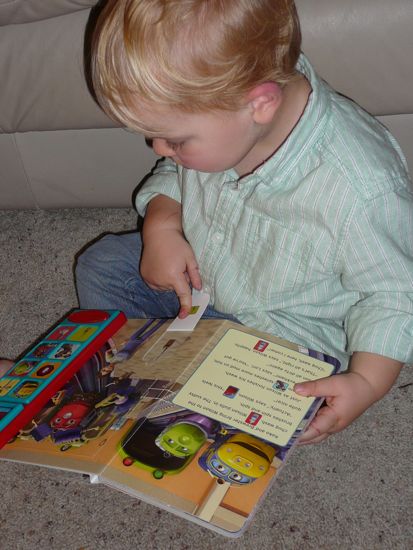
And hilarious! The Happy Toddler is catching on to so many things. He can feed the cats, he can imagine, he is better able to say what he wants. His ideas are, for the most part, unfettered by our conventions. Playing trains is not just making trains go around the track, it can also be making them go around the track and crash! Why can’t he take his ‘motorbike’ (Big Wheel) up the stairs? Why don’t the cats want to play with him? Why is Mommy sleeping when she could be up and playing with him? The world is a wonderful place when seen through the eyes of an almost-two year old. 🙂

It is also amazing to me how even as a tiny baby, this little boy was conventionally all boy – loves mechanics, loves anything with wheels, loves to make things go, loves to make things crash. Loves to rumble, loves to run, loves to jump and doesn’t much get why anyone would want to sleep, even at bedtime. He also knows how cute he is, and exploits it shamelessly. 🙂 He’s already a little man, into men things.
I suddenly realize how while I am talking about how active he is, all my photos show him sitting and doing a quiet activity. . . but have you ever tried to shoot a two-year-old in action? ? ?
Recent Comments
ExpatAlien on What Country am I Living … intlxpatr on Yellowstone: Old Faithful to C… Michelle on Yellowstone: Old Faithful to C… Cathy on No Grown-Ups in Charge intlxpatr on Waiting for Snow Wikipedia Donate Button

Amazina


Early Voting in Florida


 Here There and Everywhere