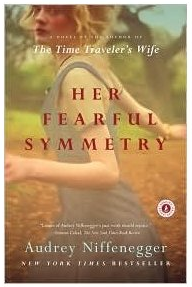
Her Fearful Symmetry by Audrey Niffenegger
This was another find passed along by either Big Diamond or Little Diamond, via my Mom, and oh, what a find. Audrey Niffenegger wrote The Time Traveler’s Wife, a highly unusual book which hit the best seller list like a hurricane. This book, Her Fearful Symmetry, solidifies the perception that this author has real talent, thinks way outside the box, and creates characters and situations that, while unlikely, are likable and who become real enough for us to identify with them.
The title is based on a poem by William Blake, a poem I have always liked:
The Tiger
TIGER, tiger, burning bright
In the forests of the night,
What immortal hand or eye
Could frame thy fearful symmetry?
In what distant deeps or skies 5
Burnt the fire of thine eyes?
On what wings dare he aspire?
What the hand dare seize the fire?
And what shoulder and what art
Could twist the sinews of thy heart? 10
And when thy heart began to beat,
What dread hand and what dread feet?
What the hammer? what the chain?
In what furnace was thy brain?
What the anvil? What dread grasp 15
Dare its deadly terrors clasp?
When the stars threw down their spears,
And water’d heaven with their tears,
Did He smile His work to see?
Did He who made the lamb make thee? 20
Tiger, tiger, burning bright
In the forests of the night,
What immortal hand or eye
Dare frame thy fearful symmetry?
While this tale is a great yarn, it helps to know this poem, there are a lot of literary references in the novel and the title is just one of them.
As the story begins, there is a death, a will, and a set of mirror-image twins who inherit a flat in London overlooking a famous cemetery. The flat is in a building and has an upstairs neighbor, a man succumbing to obsessive-compulsive disease, and a downstairs neighbor, an aging bachelor, all a little eccentric in the nicest, English sort of way. The twins, Valentina and Julia, are twenty years old, and waif-like, still dressing alike, doing almost everything together.
There is also a ghost. No, wait! Two ghosts, and a kitten ghost. No, wait! I forgot! Lots of ghosts!
What I love about Audrey Niffenegger is that she takes what we perceive as reality and gives it a twist, and once you buy the twist, you are off on a wild ride. This book is a wild ride, with unforgettable characters and some unexpected kinks and thrills, as well as more than a couple shudders and chills.
The Book Thief by Markus Zusak
Until I sat down to write these reviews (so I can pass these along to friends in Kuwait who I know will read and discuss them 🙂 ) I didn’t realize that the books had so much in common. They both take place in the WWII time frame, and both are told from the point of view of children coming of age in this time. Both are love stories, romantic, parental, community – they have many of the same elements. They both have bullies, and children who steal. They both have wise adult conspirators, mentors and guides.

In The Book Thief, right off you get a chill. One of the main characters in a personification of Death, a tired, weary, cynical Death, but a Death who is fascinated by his humans. When the opening pages are written by Death, you get a feeling that this can’t be good.
And, in the beginning, it is not good. Liesel is on her way . . . somewhere, we don’t know where, on a long train ride, during which her brother dies. They are forced off the train, and her brother is buried in some small village where they are unknown; the grave will probably never be visited. Shortly after, they re-board another train, and when they arrive, Liesel is turned over to a government foster family agency, and she is placed with a rough, uneducated couple in a small village on the outskirts of Germany.
Not far from Dachau.
So many similar elements . . . people at the mercy of their government, and the madness of the politicians and mass hysteria. Bullies, but not just in the schoolyards, here there is also a nationally encouraged group of bullies, the Nazis, and people in every village are encouraged to join the party. The kids join Hitler Youth and practice to become good Nazis.
Except inside each one of us resides a spirit of humanity, and if you let that spirit dominate, you can come into conflict with the party, even if you appear to comply most of the time. Liesel’s foster parents turn out to be a very humane sort. They feel compassion for the Jews marched through their village on the way to the camps, and attempt to give them a little bread, for although they have little to share, they can see that these Jews are starving.
And then, a stranger arrives on the doorstep, the son of a man who saved Liesel’s Papa’s life in the first world war. He is Jewish. He needs a place to be hidden. Liesel’s foster parents take him in and hide him in the basement.
Only after I read the book and read the afterword did I discover this is a book written for young adults, and that makes me laugh, because I am not a young adult, and I enjoyed the book so much. I love books about the triumph of the human spirit, the triumph of good over evil, and the triumph of hope and life over hopelessness. Even Death has a heart, in this book.
I know that there will be one copy of this book in Kuwait; I am leaving it with a friend I know will read it, and I know she will pass it along, because this is a book worth discussing. I hope you are friends with my friend, and that you will get a chance to read it, too!
Hotel at the Corner of Bitter and Sweet by Jamie Ford
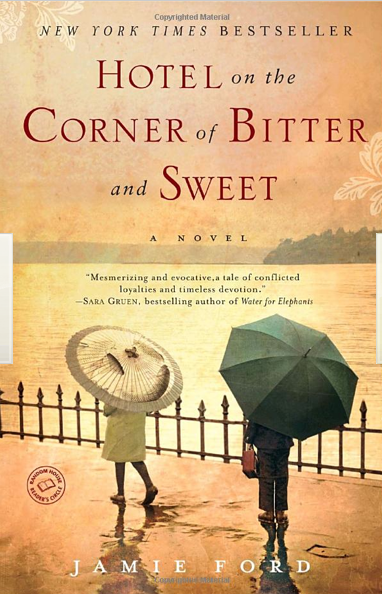
This book had everything going for it, and still I had a hard time getting into it. The book was given by Little Diamond to my Mom – Little Diamond often passes along the very best, thought-provoking books, and in our family we pass the best along, so I knew it would be good. I love the title. The book is set in a part of Seattle now called – euphemistically – The International District, but as I was growing up, and among older Seattle-ites, it is called Chinatown, even though that is not politically correct, or geographically correct. Chinatown was never Chinatown, it was a group of distinct populations – Chinese, Japanese, later Vietnamese, Korean, even later Ethiopian, Sudanese, Somali, Pakistan . . . you could call it immigrant-ville, I suppose, if you were really, really politically incorrect. My Chinese friends still call it Chinatown.
Last, but not least, Jamie Ford started this book as a short story at a camp run by Orson Scott Card, one of my favorite authors, especially to recommend to young people. Orson Scott Card knows how to capture the painful contradictions of being teens and young adults, the conflicts with parents, the loves, requited and un, and most of all, he understands how the young see things clearly as unfair; it’s only later when we start seeing shades of grey.
In spite of all those positives, I hated his voice. I hated the smug little Chinese boy he started as, a scholarship student, first generation born in the US, mocking his parents, fighting off bullies. . . Here is what I hated the most. He had a girlfriend, and he didn’t understand chivalry, like walking her home. He protected her, but he was a pretty self-absorbed little boy.
I kept reading because he had some interesting friends. I liked his friend the jazz player, and I liked the gruff lunchroom lady, and I liked his friend Keiko. I understood his parents pushing him to excel, and their not understanding the struggles this caused Henry; I liked his parents. Because the book jumps around in time, I also liked his wife, and felt annoyed that Henry was all caught up in this old romance when he had a perfectly good wife, but I kept reading.
I am so glad I did. About a third into the book, we begin to see Henry transform into the man he will become. He gets help, he gets mentoring from unexpected people, and he becomes more likable.
The book also deals with a terrible time in US history, a time when we turned on our own citizens and sent our citizens of Japanese descent to concentration camps right here in the USA. The Japanese were a class act; most of them were hurt and outraged, but compliant. Many men volunteered to fight in the war in spite of this slap in the face, this accusation of potential treason. It is a shameful time in our own history, and particularly so for Henry, who loves a Japanese girl, Keiko.
By the end, I loved this book. I hope you will, too.
What’s Really Hood: A Collection of Tales from the Streets by Wahida Clark, et al
Sometimes do you pick up a book and you don’t really know why you did? I saw this book in Target, and picked it up on an impulse. I read the cover and thought “you know, this is way out of my culture and out of my comfort zone” but then I thought hey – it’s a sub-culture in my own country, and like isn’t it hypocritical to be so interested in other cultures and then to ignore this sub-culture in my own country? Plus, I had a friend called Wahida, . . . well, it doesn’t have to make sense. It’s just the way it was.

I read the whole book. Some of what I read was frankly repellant. Some of the sex was so implausible that I can’t tell if my ideas are just way out of step with the changing times (and there are clues that this may be the problem) or that this sub-culture just has constant, earth-shaking sex.
The book contains five very different stories, but there are threads of similarity that appear in all five. Drugs are rampant, and destructive to individuals, couples, families, children, friendships, marriages, and the social context. Parenting skills are often fragile or non-existent. The male-female relationships are mostly exploitive.
And they all dream of a better life.
I think that’s what kept me reading. The stories are raw. You might not even like them at all, you might wish you had never heard of this book, but there is an honesty in the rawness, and a yearning to escape. The goal of all the easy money in the drug trade is mostly to GET OUT, to run away to some place safe, to live in a place where gunshots aren’t heard, and where kids can safely go to school.
I learned a lot from reading this book, but it was not an easy read. It is gritty, and characters you find yourself liking get killed off. It’s also stuck with me; I find myself thinking about things it brought to my attention. I’d love for you to read it too, and tell me what you think.
I Don’t Know Which was Worse
I had to take the Qatteri Cat to a boarding facility today, and I had a really hard time with it. First, when I got home, he was all stretched out in his heated bed. I had unplugged it earlier, and I had not filled his bowl at noon, and I figured the combination of hunger and not-warm bed would encourage him to come downstairs, where I waited for him with his cage. I had brought the carrying cage out several days ago, because he always freaks out when he sees it, so I leave it out until he gets so he can walk past it without running.
But this time, I kept going upstairs to check on him, and even though his bed was no longer heated, he just kept stretching and turning over.
Finally, I took his bird/stick toy, and teased him a little, at which point he was wide awake, and chased me merrily down the stairs and around the house until we got to the cage, where I scooped him up and popped him in.
As we drove to the inn, he complained a little, but he was lying down in the cage and looked pretty relaxed. I had a big pit in my stomach. I felt bad about tricking him out of his bed and turning his toy into a manipulation to get him into the cage. I know, I know, I am over-thinking this and feeling bad over not much.
So we get to the inn, and QC goes right into his upper berth, a two room suite with a special covered area for his litter. He steps right out of the carry-cage and into his room, and doesn’t even look back. We fill his dish with lunch, and shut the door. The tech brings out the kitty-treats and QC’s eyes light up.

I don’t know which was worse, feeling bad about bringing him to the boarding place, or feeling bad because QC didn’t appear to mind it that much, LOL.
The Glass Rainbow by James Lee Burke
“Here’s the book,” Sparkle said, sliding into the restaurant seat as we all poured over the menu, wafts of garlic, white wine and butter drifting our way. “I’m getting kind of tired of Dave and Clete.”
“What, you mean not just bending the envelope but tearing right through it?” I asked “Or all the gratuitous violence?”
“Mostly the scorn for official procedures,” she started, two little lines between her eyes as she took in all the delicious possibilities, “How about some of that Montepulciano?”
She passed the book along to me. I was in the middle of another book, but oh, the temptation to drop it and get on with a new James Lee Burke.

The book opens with Dave Robicheaux, our recovering alcoholic detective, meeting up with a convict on a work crew whose sister has disappeared and who was found murdered. Bernadette Latiolais’s remains are thought to be the work of a serial killer working the area who targets prostitutes, but Bernadette was an honor student, graduating with a full scholarship promised to a Louisiana university. She was also an heiress, in a small way, to some property at the edge of a swamp. She doesn’t fit the profile, and her brother wants justice – not for himself, he’s doing his time, but for his sister, who never did anything to anyone, and who wanted to create a conservation area to preserve bears.
Right off the top, Robicheaux is outside of his parish, investigating a case nobody cares about in an area out of his jurisdiction.
OK, OK, my sister is right, this is pretty much another formulaic James Lee Burke. There are the corrupt rich families, the amoral women, the voiceless victims. Instead of the old Italian organized crime families, this time there are hired mercenaries, equally creative in killing, but way more efficient in cleaning up afterwards.
I’m just a sucker for James Lee Burke’s writing. Here’s one sample, from his interview with a very rich old man who goes a long way back with Robicheaux’s family:
“Don’t get old, Mr. Robicheaux. Age is an insatiable thief. It steals the pleasures of your youth, then locks you inside your own body with your desires still glowing. Worse, it makes you dependent upon people who are half a century younger than you. Dont’ let anyone tell you that it brings you peace, either, because that’s the biggest lie of all.”
Burke’s Dave Robicheaux and his private-investigator friend Clete are flawed men, prone to violence, but I cut them a lot of slack because in each novel they are bright shining avengers of all the wrongs done to the weak and helpless. They are Quixotic. They fight the rich and powerful for the rights of the common man. They know the risks they take, and they are too old to think they are going to survive every bad guy they go after. It’s a good thing the law of averages doesn’t hold true in novels; they should have been dead a long time ago.
What keeps me coming back are the lyrical descriptions of life along the Atchafalaya Bayou, community life in New Iberia, Louisiana, and Robicheaux’s family life, wife Molly, daughter Alifair (now grown to young womanhood) and Snuggs their cat and Tripod their raccoon, as well as the knowledge that at the end of the book, in spite of every evidence to the contrary, Dave and Clete will emerge alive, if damaged, and their indirect and violent path will have achieved some semblance of justice.

(I ordered the spaghetti with a white-wine mussel sauce, and Sparkle ordered the chicken marsala. Mom had seafood diablo.)
Room by Emma Donoghue
Hardly ever do I order a book in hardcover; they weigh too much, I do a lot of reading when flying, I prefer paperbacks so I can pass them on when I am finished (and no, I do not yet have a Kindle, because I like to pass my books along.) I made an exception for Room when I heard a review on National Public Radio. It sounded so different, and I wondered how it could be written without it being so horrible I couldn’t read it.
The story is told from the point of view of a five year old boy who lives in Room, an 11 x 11 foot space. He was born there, he has never been out of there.
As you read, you gain such huge admiration for the human spirit. Jake’s mother was abducted off the streets and kept in this room, which is totally soundproofed, surrounded by a chain metal cage, and can be entered and exited only by a door with a code entry lock. She raises Jake as best she can, keeping him hidden from her abductor. She teaches him reading and math, she tries to raise him eating nutritious foods, they have hygiene rules and daily physical education. Every now and then, she has a day when she is “gone”, when Jake wakes up and his mother won’t ‘switch on’ and just stays in her bed, sleeping all day. On those days, he feeds himself and plays quietly, knowing that his Mom will be back ‘on’ the next day – or so. He doesn’t understand his Mother’s despair, and she shelters him from it as best she can.
And then comes the time when she realizes that life is only going to get more and more difficult as Jake gets older. She makes a plan, a plan that relies on Jake, a desperate plan.
The book is fascinating. I have already passed it along; once I read it, I wanted to share it. In many ways, it is a cross-cultural book, because the culture Jake spends his first five years in is so insular, so enclosed. Emma Donoghue did a great job describing his world from his point of view, and dealing with the aftermath. I can’t tell you much more without spoiling the book for you in a major way. 🙂
There is a Reader’s Guide section at the back, and this book would be an excellent selection for a book club.
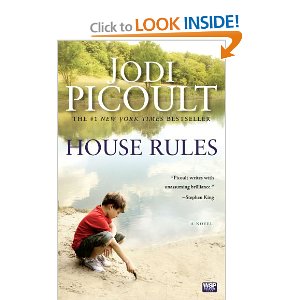
House Rules by Jodi Picoult
I got it all done – two days before Christmas. Wooo HOOOO, I get the reward, a new book! One I had been eager to read, House Rules by Jodi Picoult. (You can read reviews of other Picoult books by doing a blog search, enter Jodi Picoult in my blog’s search window.)
What I really like about Jodi Picoult is that she writes about really tough situations and exposes our ignorance and ambivalence to us. In this book, she writes about a single mother who is raising two sons, one of whom has Asperger’s Syndrome. He is extremely bright, but lives in a world where he is bombarded by too much sensation. He cannot block out sensory input that we learn to ignore, and some of it – noise, colors – in his case, the color orange – or any change in routine can cause him to spin out of control. Imagine a two year old having a tantrum in a grocery store . . . now imagine an eighteen year old young man having the same tantrum. It helps you see what the Mom is dealing with.
Dad left when the second son was born. “It’s too hard,” he said, and left her to cope with all of it.
She gets child support, while her husband is raising his new family a continent away. She free lances as an advice columnist, and edits from her home to supplement the bare bones family existence. She learns to cope with Jacob’s needs, and she advocates for him fiercely, to be mainstreamed in the school system AND to have some special supports to soothe him when he becomes over-stimulated.
Jacob isn’t a burden, although his need for routine – certain colors for different days of the week, including meals – can be burdensome. Jacob is also very very bright, and obsessed with crime scene forensics. He loves setting up “crime scenes” for his mom to solve and the one bright spot in his daily life is the Crime Busters show which comes on every day at 4:30.
And then, suddenly, a life which is already wobbling turns upside down. Jacob is implicated in the murder of his tutor, a young woman Jacob loved working with, who helped him develop an understanding of how people interact and behave. Those who know Jacob understand his quirks and eccentricities are due to his wiring, but Jacob looks very odd, very threatening and even violent to the outside observer – a nightmare client as a defendant.
It is a GREAT read. Picoult keeps her secrets up to the very end; the book is tightly wired and we are given clues all along the way. The edition I read had both a reader’s guide and an interview with the author at the end. It is NOT cheating to read those first! It gives you good guidance on what the author is trying to say, and what may be significant, while not appearing particularly so.
It gave me a great appreciation for parent’s of children outside the realm of ‘normal.’ It gave me an appreciation for the work and persistence and dedication it takes to try to get a more level playing field for their children.
It the book Jacob has some self-awareness, and compares Asperger’s Syndrome to seasonings, and he believes we all have a dose of Asperger’s Syndrome in our wiring, but that some children get a little extra.
‘Lost Boy’ Casts Vote for Independence
I found this today on NPR News and it delights me for a number of reasons. For one thing, I didn’t know David Eggars (you remember him from Zeitoun) had helped with the writing of ‘What Is The What?’. Second, who knew that any of these kids would survive? Survive, write a book, thrive, go back to the Sudan, give to the country – and vote. Every now and then in this sad world you hear a good story. This is one.
January 10, 2011
During Sudan’s civil war, in which some 2 million people died, Valentino Achak Deng fled to Ethiopia on foot. Separated from his family for 17 years, Deng is one of Sudan’s so-called Lost Boys, children who were orphaned or separated from their families during the brutal war.
Now, voting is under way in Southern Sudan in a referendum that is expected to split Africa’s largest country. Among those voting this week are the Lost Boys, including Deng, whose life became a best-selling novel in America and who has returned to his homeland to build a school.
After a peace agreement between north and south, Deng returned to Juba, the capital of Southern Sudan, in 2006. He says when he got there, the place was still a wreck.
“On some of these roads, you could see old war tanks. On some of these roads, in some neighborhoods you could see the bones and skulls of dead people,” he recalls now, driving around Juba.
Now, as Southern Sudan appears headed for independence, Deng is optimistic — and Juba looks a lot better. Paved roads, now lined with hotels and restaurants, arrived for the first time in 2007.
Juba is a booming city, one of incredible contrast: Barefoot women selling piles of gravel by the side of the road sit next to a Toyota dealership.
Peace is spurring investment and consumer demand. Juba’s growth is driven by Southern Sudan’s oil revenue as well aid from foreign governments and nongovernmental organizations.
Deng grew up in a tiny village called Marial Bai. In the 1980s, northern bombers and Arab militias came.
“They bombed Marial Bai, destroyed it, killed everything, burned crops and livestock,” he says.
Deng was there when the fighting came. He says he “ran away with the rest.” He was 9 years old.
Deng joined thousands of Lost Boys, who spent months trekking across Sudan to refugee camps in Ethiopia. His experience is captured in What Is the What, a novel by Dave Eggers, which reads like a modern-day story of Job.
The boys, some naked, march across an unforgiving landscape, facing Arab horsemen, bombing raids, lions and crocodiles.
Deng eventually resettled in the U.S., where he attended college and was mentored and sponsored by ordinary Americans.
In 2007, he returned to start a high school in Marial Bai, where there was none.
“We have 250 students. Our annual budget now stands at about $200,000 because the school is free,” he says.
The school is funded by Deng’s private foundation. He says most donations come from Americans touched by his story and the plight of Southern Sudan.
Deng, now 32, has just cast his vote for independence. He says that for a Sudanese child of war, his life’s journey is almost inconceivable.
“I never imagined I would be the person I am right now,” he says.
A Reliable Wife by Robert Goolrick
You know how wonderful it is when you start a book, and immediately you are hooked? This is not that kind of book. This is a book you start reading and you think “Why am I reading this? I don’t like ANY of the characters!”
And yet, somehow, I kept reading. And slowly, slowly, the hook was set, I could not stop reading.
Actually, I read the book several months ago, and I am still thinking about it. That’s a good book. 🙂
We meet one of the main characters as he stands waiting for a train to arrive, carrying his bride-to-be. As we stand waiting with the man, we discover that he is not very likable. We also learn that winters in his part of the country are long and hard, and very strange things happen to people cooped up together during these long, hard winters. It is a very bleak beginnning.
Then we are riding in the train with a woman who is answering an ad placed by the first man who was advertising for a wife. We get a few clues that she is misrepresenting herself, but . . . isn’t a little misrepresentation part of the mating process? Do we really show all our less attractive features to the person to whom we want to be married? And does she know what she is getting in for with this rather cold and distant man?
Do you really want to read this book?
It gets better. So much better. People are complicated, and they lead complicated lives. Sometimes evil leads only downward, and to more evil, and from time to time, there is a gleam of hope and the slim promise of redemption. It gives a clear slice of time from the early 1900’s, and a much earlier time in America. For anyone with the illusions that life in that turn-of-the-century America was a better, simpler, more moral time, this book is a reality check.
Nothing in the beginning of this book is quite what it seems, and yet every word is finely crafted to give a clue as to where the book is going. Will you be able to figure it out before you get there?
(I did not.)
There are so many good books out there. This one is slow to start, but builds steadily to an unforgettable ending. It is worth a read.
Recent Comments
ExpatAlien on What Country am I Living … intlxpatr on Yellowstone: Old Faithful to C… Michelle on Yellowstone: Old Faithful to C… Cathy on No Grown-Ups in Charge intlxpatr on Waiting for Snow Wikipedia Donate Button

Amazina


Early Voting in Florida


 Here There and Everywhere