Elderly Women Prime Targets for Cons
Found this fascinating article this morning on AOL News/finance There was a time when I worked with transitional homeless people, helping them to find ways to re-enter the mainstream. A percentage of them didn’t want to enter the mainstream, they didn’t like rules, and they were looking for an easier way. One of the paths was by being part of the elder-worker force. I would watch them take a job and then work their way into a position of dominance in an elderly person’s life. Partly, the elderly were lonely, and thrived on the new attention, and interpreted it as caring.
Then would come the sob stories. School starting and not enough money to buy shoes and books for the children. A broken-down car, and funds needed to get it fixed so she can get to her job. Once it starts, it never ends.
The key to prevention is staying engaged with friends, neighbors and family who are paying attention, and can give perspective to this new relationship. The one question I asked is “if there were not money involved, would this relationship exist?”
Elder Abuse: How to Protect Grandma From Con Men and Thieves
By Sheryl Nance-Nash Posted 9:00AM 06/03/11 Retirement, People, MetLife
See full article from DailyFinance: http://srph.it/lXHooJ
Who would pick the pocket of your grandma or grandpa? Apparently, any number of people. Older Americans are losing $2.9 billion annually to elder financial abuse, a 12% increase from the $2.6 billion estimated in 2008, according to The MetLife Study of Elder Financial Abuse: Crimes of Occasion, Desperation, and Predation Against America’s Elders, released Wednesday.
According to the study, 51% of these abusers are strangers, but 34% of the perpetrators were family, friends and neighbors. As for “trusted advisers,” exploitation from the business sector accounted for 12% of reported cases. Medicare and Medicaid fraud accounts for 4% of reported cases. As a subset, the percentage of robberies and crimes classified as “scams perpetrated by strangers” increased from 9% to 28% from 2008 to 2010.
Who’s on the top of the target list? Women. The study, produced by the MetLife (MET) Mature Market Institute in collaboration with the National Committee for the Prevention of Elder Abuse and the Center for Gerontology at Virginia Polytechnic Institute, shows women were nearly twice as likely to be victims of elder financial abuse as men.
Also prime for the picking were people between the ages of 80 and 89 who lived alone and required some help with either health care or home maintenance. Primarily, men were the menace: Nearly 60% of perpetrators were males, mostly between ages 30 and 59.
Predators lie in wait, watching: In the most common scenarios, strangers targeted victims who were out shopping, driving or managing the financial affairs, and often looked for particular flags of vulnerability like handicapped tags on cars, canes or displays of confusion. Crimes included cons, purse snatchings and associated physical assaults.
But that even those closest to an elderly person can give in to temptation or desperation. In cases involving a person known to the victim, trusted helpers like caretakers, handymen, friends, “sweethearts,” children, lawyers and others seized upon opportunities to forge checks, steal credit cards, pilfer bank accounts, transfer assets and generally decimate elders’ finances, the study revealed. The holidays apparently bring out the worst in people: At that time of year, overall dollar losses due to family and friends were higher than any other category.
Married to the Con Job
People can get quite creative with abuse. One unusual method — caregivers secretly marrying their elderly charges, says Susan Slater-Jansen, an attorney at Kurzman Eisenberg Corbin & Lever.
There have been numerous lawsuits over cases in which a caregiver married a mentally incapacitated older patient and the patient’s family didn’t learn about it until after the patient had died. Once a person is dead, it’s too late — in all but three states, you can’t void a marriage if one spouse has died, says Slater-Jansen. To help lower the odds of such a thing happening to your parent, adult children should make sure they receive duplicate monthly statements from all bank and brokerage accounts; install nanny cams; carefully and thoroughly check references for all caregivers; visit parents often, both while the caregiver is there and when they are not; and discuss with your parents the treatment they are receiving from caregivers.
If you discover such a fraudulent marriage has taken place, act quickly to get it annulled.
After the parent dies, heirs can sue to recover money from the “spouse.” More and more, courts have found ways to deny spouses if the marriage was fraudulent, says Slater-Jansen.
“The most flagrant abuse is perpetrated on the elder by the hired caregiver, neighbor, or ‘new’ friend,” warns Karen Maarse Fitzgerald, a principal in her own elder law practice. “A simple power of attorney signed by the elder can give to the “agent” broad and sweeping powers over the elder’s life savings. I have seen bank accounts drained within days, the money and perpetrator vanishing to another country.”
Protection Yourself and Your Relatives
The worst forms of elder abuse go beyond money: There can be physical abuse and sexual violence as well. “The vigilance of friends and family can help protect elders from those who are predatory, which may, unfortunately, include strangers or even other loved ones,” said Sandra Timmermann, Ed.D., director of the MetLife Mature Market Institute, in a prepared statement.
What can the elderly do to protect themselves? Among the guidance offered by the report’s authors:
“Stay active and engage with others; socialize with your family members and friends. Avoid isolation, as it can lead to loneliness, depression, and make you more vulnerable to financial abuse or exploitation.”
“Use direct deposit for Social Security and other payments to prevent mail theft. Sign your own checks whenever possible.”
“Stay organized and keep important papers and legal documents in a safe, secure location.”
“Review your legal documents (i.e., wills, trusts, and power of attorney), as well as other important documents (i.e., insurance policies) at least annually, to make certain they continue to represent your wishes.”
Ted Sarenski, who chairs the American Institute of Certified Public Accountants’ Elder Planning Task Force, would add to that list. His tips:
Subscribe to national and state Do Not Call lists;
Keep Social Security cards in a safe place;
Remove mail promptly from the mailbox;
Shred all confidential and financial information prior to discarding.
“Consider allowing the bank to send a duplicate copy of your bank statement to a trusted family member,” advises attorney Andrew Stoltmann, who has a large client base of seniors. “Usually, most financial elder exploitation cases are only reported or discovered six to 12 months after the initial losses have occurred.”
Elders whose sight is failing are at even greater risk because they may rely upon the very person who is stealing from them to ensure that their financial transactions are in order, says Stoltmann. “An independent pair of eyes that is able to review bank statements every 30 days will be able to catch suspicious activities in the early stages and cut it off. This is crucial.”
Advance Planning Can Help Dodge Dangers
When you are the responsible caregiver, know too, that your prudence can go a long way in preventing financial abuse.
Have some tough conversations. You need to know whether there is a will or a durable power of attorney, and where such documents are. Does your parent have a living will? If so, does it give you clarity about what your loved one’s wishes are? A health care power of attorney would permit a trusted individual make medical decisions if your elderly relative was unable to.
It’s important not to wait until the eleventh hour to have these talks. Ideally, those documents should be drawn up when your relative is of sound mind and body. It’s not a bad idea either, to have a trusted adviser, not only know where the documents are kept, but be able to get to them if needed.
Beware of the appearance on the scene of the “trusted new friend.” If mom and dad have a neighbor, caregiver or other outsider who is suddenly their best pal, running errands, going to the bank, and generally being around all the time when they never were before, it can be a warning sign that someone is taking advantage, warns Sarenski.
“Elder financial abuse invariably results in losses of human rights and dignity,” said Karen A. Roberto, Ph.D., director of the Center for Gerontology, at Virginia Polytechnic Institute. ” Despite growing public awareness from a parade of high-profile financial abuse victims, it remains under reported, under-recognized, and under-prosecuted. The 2010 Passage of the Elder Justice Act may bring more attention and resources to this crime leading to prevention among the expanding older population.”
The bottom line, says Maarse Fitzgerald: “Protect elders from isolation, which allows the perpetrators to take control of our elder’s lives.”
See full article from DailyFinance: http://srph.it/lXHooJ
Storm Damage
We’ve taken a brief trip to be with friends for a wedding and reunion, and en route, passed through the areas of Georgia and Tennessee where there was so much storm damage.

The damage was shocking. Entire areas just flattened, with people’s lives, their accumulations, scattered to the winds. It looked like a tsunami hit.
There was one room at the inn, and it wasn’t cheap.
“Why are all the hotels so full?” I asked. “They’re never this full!”
“We’re full with families whose homes were destroyed,” the clerk explained quietly. “They’re trying to figure out what to do, what the insurance will cover, what it won’t.”
Oh. Oh. Oh. We saw this in Pensacola, too, after the stunning Hurricane Ivan. Hotels were full of people trying to get back into their houses, and also full of builders and roofers and carpenters and finishers, there to try to help people put their lives back together.
It puts things back into perspective, quickly, when you are surrounded by those whose lives changed in a heartbeat, and who are trying to figure out where to go from here. We’re just glad to have a room. And a home.
Did you Tell Him We’re Going Dancing?

I was laughing as I heard AdventureMan talking with his Saudi friend, making a time when they could get together. I knew he had called about tonight.
“Did you tell him we were going dancing?” I laughed as I asked him.
“Uhhh . . . no,” he said.
This is new to us. We are taking dancing lessons, ballroom dancing, at the YMCA. We both had those lessons you take in eighth grade, but we’ve forgotten most of what we learned. I don’t care about going dancing, or fancy dresses, or competitions. I don’t even watch dance stuff on TV; I just don’t care that much. These classes are something we’ve wanted to do for a long time, and it really takes us out of our comfort zones.
We really are having fun. The first lesson – not so much. It is hard work! It doesn’t come naturally, it comes with PRACTICE! Lots of PRACTICE! It’s like fencing lessons, or horseback riding, or karate, or gymnastics – After a while, your body knows what to do, but at the beginning, it can be a little excruciating. As for AdventureMan and I, we mess up a lot, but we laugh a lot too. We are getting better, but best of all we are having a lot of fun. These kinds of things rewire your brains; it may not be easy, but it is good for us.
And I am still laughing, thinking of AdventureMan not telling his friend that he was going dancing with his wife, LOL!
Yelling For Help
I don’t often have bad dreams, and this one was a doozy. I was in my house – or office – and it was a large, clear white space. I noticed a lot of fine black dust in places on the white carpet, like toner from copy machines, and then it gathered and swirled, but sometimes it was white. Then I saw a man – or something with a skull – sitting on a white slab couch like my Mom used to have in turquoise back a long time ago.
I kept looking – sort of like a cat does when he sees something he is not sure of, looking for motion or some sign of threat, very alert. When the skull creature started to move, I started to yell.
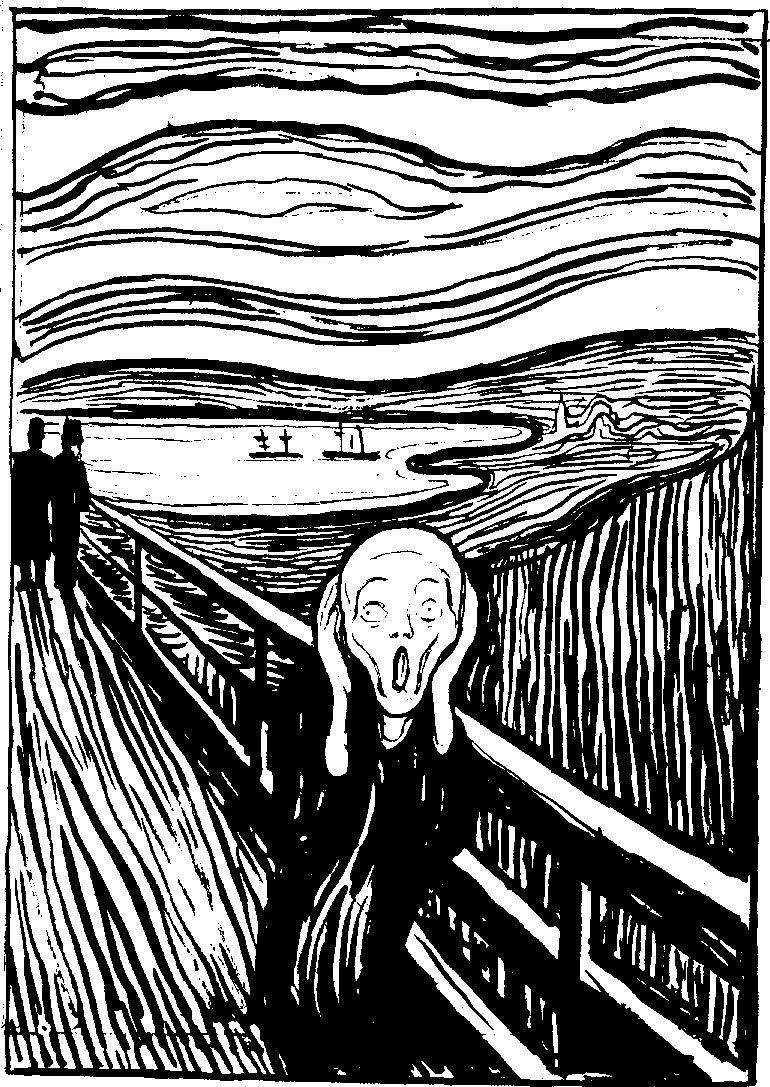 (Lithograph by Munch)
It’s hard to yell when you are scared, but I kept at it. “Help!” It sounded weak and tentative. “HELP!” “HELP!”
AdventureMan was there to help, calling my name, asking if I was OK. “I thought it was the Qatteri Cat,” he told me, “It sounded kind of strangled and yowly.”
I just laughed. I felt good. The skull man didn’t get me, AdventureMan was right here, my trusted knight, and I had broken through my fear – or the sleep barrier – and yelled really loud. I don’t know why, but it made me feel powerful and like I had survived something and that made me feel good. 🙂
(It could also be related to the series I am reading, on which the current HBO series Game of Thrones is based, and maybe it disturbs me on some deep level.)
Happy Mother’s Day
There is this thing on FaceBook where for Mother’s Day you put a photo of your own mother as your profile photo. I don’t do a lot on FaceBook, but I did this one, and I thought I would share an early photo of my mother with you:

I just love that mischievous little smile that says “Don’t you want to come play with me?”
Happy Mother’s Day, Mom.
Hissing on Easter and other Rambles
The 0815 service this morning was glorious. We got there early, because those who had gone to the early-early service and had stayed on for breakfast would be leaving, and this is Easter – we needed a parking place. The front of the church was laden with flowers, so many flowers it looked like a private garden, and the flowers scented the entire church, an odor of sanctity.
Getting there early was a really good thing – just after we entered, the brass trio started serenading us, exultant music, full of joy and triumph, perfect way to start an Easter morning service. It’s a special treat, having music and the full choir at the 0815 service, but a member of the choir told me earlier that this is the only Sunday of the year that they sing at all three services. If you like music, oh, what a treat!
The church filled up quickly. I couldn’t help it, I had to look around to see if there were any Easter bonnets. I remember being a kid – a girl kid, that is. We always had hats for Easter. Being kind of a snotty kid, I was often critical of the one I got and somewhere along the line that tradition was discontinued. I guess it must have been discontinued widely, as there were only six ladies wearing hats (we couldn’t help it, we counted), but very nice hats they were. The little girls were all dressed in lovely dresses, some even with chiffon and lots of ribbons.
As we reached the offering, people behind us were criticizing the parents whose children were making noise.
“They should know better! Why don’t they just take them out, so they won’t bother the rest of us?”
“It’s SO disrespectful!”

There is child care available, but I personally love having the children in the service. Maybe it’s a little disruptive, but you know – we’ll live. And I just thank God they are there! I want them to be welcome! I want the parents not to have to leave, but to know their children – and their antics – are welcome! I miss our noisy services in Doha and in Kuwait, with the babies, the children. Even though they left, there was always a little serendipitous bedlam in the service to keep us from taking ourselves too seriously.
As we left, we also sighed – we miss the gorgeous colorful displays of all the saris on the high holy days, the saffrons and fuschias and peacock blues and greens and golds.
Later this afternoon, when the Happy Baby wakes up from his nap, we’ll be having Easter Dinner. He got going too fast this morning and split his lip when he fell. I remember our son at that age, and the doctor who looked at me meaningfully and asked “does your son often have bruises?” I was so offended, but all I could do was laugh – when they start running, they fall down. Once, I was right there when he tripped – inches away from me – and fell against a sharp edged table. It all happened so fast there was nothing I could do (except take him to the emergency room for stitches).
Actually, we were at a school friend’s house in Jordan, his father owned the hospital, his driver drove us, he Dad-the-doctor put in the stitches and we were back at the party before ice-cream and cake were served.
We try to protect them. We do our best. We try to teach them how to behave at public gatherings, like parades, like church, like change-of-command ceremonies, things we are not born knowing. It takes practice. Like parenting. 🙂
Oral Sex More Lethal to Men than Women
This article from AOL Health News makes the point that while all females in the USA are encouraged to be vaccinated against HPV, young men, who are statistically more vulnerable, have not been vaccinated. Many women find themselves unexpectedly at risk when they are exposed to HPV by an unfaithful husband or boyfriend who has picked it up during oral sex.
Research: Oral Sex Puts Men at Risk for Oral Cancer
Mara Gay
Contributor
Rates of oral cancer are on the rise among men, and researchers say the culprit isn’t the devil you might think.
The rising rates of oral cancer aren’t being caused by tobacco, experts say, but by HPV, the same sexually transmitted virus responsible for the vast majority of cases of cervical cancer in women.
Millions of women and girls have been vaccinated against HPV, or human papillomavirus, but doctors now say men exposed to the STD during oral sex are at risk as well and may have higher chances of developing oral cancer.
About 65 percent of oral cancer tumors were linked to HPV in 2007, according to the National Cancer Institute. And the uptick isn’t occurring among tobacco smokers.
“We’re looking at non-smokers who are predominantly white, upper middle class, college-educated men,” Brian Hill, the executive director of the Oral Cancer Foundation, told AOL News by phone.
Tobacco use has declined over the past decade, but rates of HPV infections have risen and affect at least 50 percent of the sexually active American population, according to the Centers for Disease Control.
HPV-16, the strain of the virus that causes cervical cancer in women, has become the leading cause of oral cancer in non-smoking men, Hill said, citing research in the New England Journal of Medicine.
“When the No. 1 cause of your disease goes down [tobacco use], you would expect that the incidence of disease would go down, but that hasn’t happened,” he said. “In our world, this is an epidemic.”
Dr. Jennifer Grandis, the vice chairwoman for research at the University of Pittsburgh and an expert on head and neck cancers, said doctors have been seeing the HPV virus in most oral cancer tumors. She said the massive push to vaccinate girls and women between the ages of 11 and 26 against HPV should have included boys and men from the beginning. Gardasil, one of the two major vaccines used to prevent HPV, wasn’t approved for use in males in the United States until 2009, three years after it was approved for women.
“The thinking is changing,” Grandis told AOL News in a phone interview. “But at the time [the vaccine] was licensed, there wasn’t such an awareness about head or oral cancers or a willingness to accept that males played a part in the transmission of the virus,” she said. “I think this idea that we only protect our daughters with the vaccine is nuts anyway, particularly because they’re having sex with our boys.”
Men have a greater chance of contracting the HPV virus from oral sex than women do from the same behavior, though researchers aren’t exactly sure why. Oral cancer has a low survival rate because it is generally not discovered until it has spread to other areas, according to the CDC. Only half of people who’ve been diagnosed with oral cancer will live longer than five years.
Holy Week Evensong at Christ Church, Pensacola
My favorite service of all, Evensong. Everything is just moving along, peacefully, penitentially, as we enter Holy Week, when all of a sudden, the choir is singing Gounod, the Jerusalem anthem from Gallia. Oh, WOW! Gounod makes me grin, and he moves me. Gounod . . . Gounod ROCKS!

And here you can here the anthem:
I was introduced to Gounod in Doha. Our priest, Ian Young, led a group called the Doha Singers, and he chose challenging music. We learned Gounod’s Mass for St. Cecelia, and the music is the kind that gets into your blood. I couldn’t get enough of it. I never get sick of it. Gounod is music with a sense of drama and a sense of humor about itself. I think it is his sense of timing, how you hold a note just a little longer than you would expect, and then rollick on to the next. I had never heard this piece before, but Gounod is so individual, so unique – it had to be Gounod.
It was a perfect evening, a lovely service, and the sun shone in through the cross as it set:

At the end, we sang one of my very favorite hymns, The Day Thou Gavest Lord, is Ended:
I admit it, I am pretty tough, but these words make me weak and weepy:
The day Thou gavest, Lord, is ended,
The darkness falls at Thy behest;
To Thee our morning hymns ascended,
Thy praise shall sanctify our rest.
All in all, a lovely day. Our son joined us for the first episode of The Game of Thrones on HBO. He’s read all the books, I am on book 2, and AdventureMan is reading the first book, the one on which this series is based. Great way to begin our week. 🙂
Happy Five Year Anniversary
“How did he sound?” AdventureMan asked about our son.
I smiled.
“Actually, he sounded fine. He sounded like there is nothing in the world he wants to do more than to stay home with his sick baby.”
Everything was planned. Our son and his wife were on their way out to a special dinner, to celebrate five years of successful marriage. We were signed on to babysit, something we do with gladness. We knew how the evening would go. We arrive, HappyBaby runs shrieking with joy to AdventureMan, running right around me if I get in the way. I fix dinner, feed the HappyBaby, AdventureMan takes him down to play, then bathtime, then bed.
Not this time.
Our son called us about an hour before we were scheduled to arrive.
‘It’s all off” he said. “HappyBaby is sick, fever, lethargic. We’re just going to stay home. You can come by if you just want to hang out.”
“Oh! I’m so sorry!” I said, a little in shock. HappyBaby has been having a long spell of wellness. “I’m making spaghetti for us and HappyBaby,” I replied, “but there’s a lot. Can I bring dinner?”
He said yes. We made a salad, AdventureMan found a really good bottle of wine, we headed down. AdventureMan held HappyBaby – not so happy, very tired and a little fussy – while we dished up; I finished and held him so AdventureMan could eat. HappyBaby was fine with coming to me, his arms went around me, his little head went down on my shoulder, and it was like when he was little little, except he is so big now that I can’t sit down, or I can’t easily get up again. He’s a big boy now.
I always joke that I am the grandmother who can bore her grandson to sleep. We stood outside for a while, watching the cars go by, watching the sun set over the Bayou, and when the cool breeze started blowing I took him inside. He was so sleepy, he didn’t complain. We rocked, and I put him down in his crib, fast asleep.
It wasn’t the evening we expected. It was, for us, even better, having a relaxed time with our son and his wife, getting to put HappyBaby to sleep once again. It turned out to be a very sweet evening.
We’ve signed up to do the babysitting again when HappyBaby is well and our son and his wife can go out for that dinner. Five years of marriage is worth celebrating. We are so proud of them and the way they handle life, it’s joys and disappointments, struggles, challenges and triumphs. They are a good team, and we celebrate that they found one another and work so well together.

Recent Comments
intlxpatr on Shampoo Ginger tigerbutterya0c5ff1d… on Shampoo Ginger intlxpatr on British Soldier Kidnapped, Esc… John on British Soldier Kidnapped, Esc… intlxpatr on British Soldier Kidnapped, Esc… Wikipedia Donate Button

Amazina


Early Voting in Florida


