Shutting Down
Yes, I’ve been busy. Yes, it involves movers, and bureaucracy, and parties, and the normal getting-ready-for-summer activities.
But the reason I’m not blogging a lot is that I’ve been shutting down, emotionally.
Here is a truth about me. I handle bad situations by shutting down. If I feel too much, I just get overwhelmed and don’t function. When I was packing boxes – and sighing – I could only pack a couple boxes and I would have to go lie down. It wasn’t physical so much as emotionally draining, packing up a life. I can’t really even begin to think about starting up a new one; I just need to get through finishing up this one.
So I just pack away all my grief with my household goods. Honestly, it works for me. I probably appear cold and unfeeling. The unfeeling part is true – I can make myself not feel, or at least postpone the feeling part. It gets me through the tough parts. I think it helps me survive. You go on automatic pilot. You go through the motions. You are only half there.
For me, the hardest part is being around people. Keeping all the feelings shut away is hard work! It’s exhausting! Or maybe it’s the scorching heat, but I come home and cannot stay awake, I have to take a nap. I wake up feeling better. I read late into the night – late for me. It’s OK, when I count up the nap sleeping with my night sleeping, I am getting enough sleep.
I have a very few good friends who know exactly where I am emotionally, and they shield me. We talk as if life were not going to change drastically, and for us, it won’t, there will still be the e-mails and visits. When I make a good friend, she/he is a friend for life. They don’t ask too much of me right now, but they are there to protect me when I need it. They are getting me through the tough times, and these are tough times.
When I get to Doha, I will start feeling again. I will allow the grief to seep in slowly, I will cry a little when no one is around to see, and slowly, slowly, as I grieve, I will also be engaging in a new life – slowly, slowly.
The Qatteri Cat is going through the same thing. He has built himself a little hidey-hole back in my old project room / Little Diamond’s room. He crawls into a pile of pillows and comforter until he is invisible, safe, warm, and sleeps. When he is awake, it is too depressing for him – his territory has changed so dramatically, none of the old reliable places are there.
So we comfort one another.
What Would You Take?
As I say farewell to all my current earthly possessions (I say current, because an entire other life has been in storage for the last 11 years, with all my European collection, early Tunis, early Amman, early Damascus – looking forward to retiring is kind of like heaven, I will be re-united with old friends, some of whom I’ve even forgotten. 🙂 ) which will be packed for the move to Doha, AdventureMan and I have a few things which we always take with us.
Of course, our first concern is the Qatteri Cat. He walks around crying as his environment changes daily, pieces disappear, rooms are re-arranged. He will go on the plane with us.
AdventureMan has a quilt, which takes almost one entire suitcase all by itself. His clothes, of course, his computers, and his camera equipment. He has already taken a suitcase full of my hobby gear down to Qatar, and it is waiting for me in his new office.
I will have my computer and Airport, my favorite clothes, my favorite shoes, my favorite jewelry, my small cameras – and my earring tree.
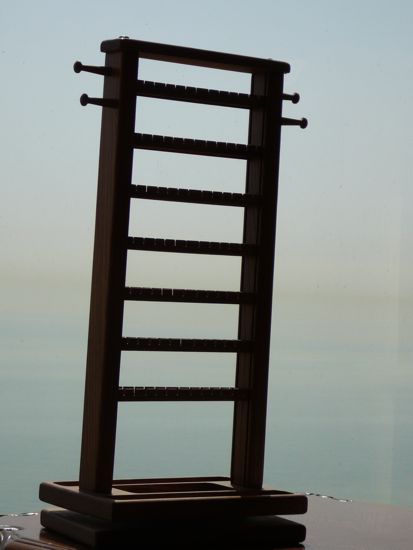
I think being mildly obsessive/compulsive doesn’t hurt me. I like order. Moving to a new place, being able to unpack my earring tree and place my earrings in careful order (stones together, gold together, pearls together, dangles together, etc.) gives me a small illusion of control over my environment.
I found this earring tree at the annual Street Fair at the University of Washington about 15 years ago – there were many larger, more glorious ones, and this one was on the sales table. It is made of oak, swivels on its base, is very finely made and has served me well all these years. It doesn’t even take up that much room in the suitcase, it is so flat.
If you knew that life, being what it is, is all about the unexpected, and if you knew you might never see most of your worldly goods again, what would you take with you? (Photos welcome :-), send to Intlxpatr@aol.com.)
Family Suitcase Culture
Yesterday was one of those “deja-vu all over again” kinds of days as AdventureMan and I hit a store and bought suitcases. We will take extra baggage with us to Doha, to carry us over until our shipment arrives, and had been tizzying a little over just how best to do it. I remembered down in the souks they have cheap rolling suitcases, that, even if you just use one time before they break, are worth the price.
Then our good friend mentioned – just in time – that Carrefour was having a sale on luggage, and it was a truly incredible price, like three pieces for KD5.500. We went, we checked, we found the bags – marked at $80. with K-Mart tags. We each bought one set.
As we were pulling them out, I started laughing – we didn’t get such a hot deal. The tag said 6 pieces for $80. so that would mean the 3 pieces we got were worth – full price – about $40. We paid about $20 – so it was as if we bought suitcases at K-Mart for half price.
Suitcases – buying suitcases – are a part of our family culture. I can’t count the number of times my sisters and I have been someplace and we’ve made a run to TJMaxx to pick up another suitcase to carry unexpected purchases. We’ve always had loads of bags, when a friend visits and needs an extra bag going home, they are welcome to take one of ours. We had some friends, long ago, visiting from Moscow, and they took a bag with them to fill with fresh vegetables, something they had been craving in February in Soviet era Moscow. The bag came back the next year, filled with a beautiful Russian samovar they brought as a guest gift, and then the bag returned with them, once again, filled with fresh vegetables.

Some of my favorite suitcases have been great buys – but where are they now? I know a couple are in our storage locker, with collected linens and finds from faraway places. One of my husband’s best bags is in a closet in Pensacola, where we left it in case we needed it some time in the future. Slowly but surely, our collection of baggage has diminished.
Thus, the trip to Carrefour. AdventureMan groaned, hitting Carrefour around 4:30, as the teeming hoards arrived. To our amazement, a car left just where we needed parking. We were in Carrefour, found the bags prominently displayed, quickly decided they would do just fine since we only need them for one trip, and out again in under 30 minutes – how amazing is that? As it turned out, they were instantly useful as AdventureMan cleared some things from his office; the empty suitcase was soon filled.
It’s amazing what comfort 4 – 6 extra cubic feet of packing space can bring. 🙂
(I found the wonderful suitcase photo on Sister’s Choice, a delightful blog.
Alexander McCall Smith: Tea Time for the Traditionally Built
This brand new book in the No. 1 Ladies’ Detective Agency series could not have come at a better time for me. Sorting through, giving away, selling my car – it all takes a toll. It’s a little like dying, this moving. I know I will be “resurrected” in another life, but in the meanwhile, I have so much grief, and I just stuff it away and keep going. These books are my carrots; they are my reward at the end of the day.

I have a stack of books and I am going through them like a locomotive – just chugging along.
Mma Precious Ramotswe and her totally different world in Botswana sweep me away totally. I love the sweetness of the way she thinks, her love for her country, and her tolerance. In Tea Time for the Traditionally Built, several things are going on at once, not the least of which is that she, also, must part with her dearly loved little white van, which has gone as far as it can go, and can go no further. The engine cannot be revived, not even one more time, by her dear husband, mechanic J.L.B. Matekoni.
Just in time, just when they need a new customer, comes Mr. Molofololo, the owner and manager of the Kalahari Swoopers, who hires Mma Ramotswe to find the traitor who is causing the Swoopers to lose their games.
Last, but not least, Mma Makutsi’s fiancee (she is the Assistant Detective now, remember?) Phuti Radiphuti, is being assaulted by Makutsi’s old rival from the secretarial school, Violet Sephotho, who is looking for a rich husband, and would love to steal Grace’s fiancee away, for all the worst reasons. How can plain Grace, with her big glasses and her unfortunate complexion, compete with the glamorous and seductive Violet? Can Phuti resist her wiles?
When I reached the last ten pages of the book, none of these crises had been resolved, and I thought “Oh no! How can the book end with all these loose ends out there?” but in a deft drawing together, McCall vanquishes the devils, finds simple solutions, and leaves us with Mma Ramotswe and Mma Makutsi having tea together at the President Hotel.
This book is a great way to end the day with a smile on your face. 🙂 I bought this book for $21 in a bookstore, but Amazon has it for $14.37 plus shipping. I don’t buy a lot of hardcover books, but this one was worth every penny.
Susan Wittig Albert: Nightshade
In her ongoing China Bayles mystery series, China and her husband investigate the death of China’s father, with some amazing outcomes.
These are not heavy reading. This series features a burned-out criminal defense lawyer, who, sick of the slime and the jockying for power and position, cashes in her retirement plans and buys a shop in the small fictional town of Pecan Springs, Texas, where she opens an herbal shop, Thyme and Seasons, which sells live potted herbs, but also herbal wreaths, herbal soaps, herbal bath bombs, herbal teas, herbal shampoos, etc – and shares space with a new age shop called The Crystal Cave, a tea shop called Thyme for Tea, a catering company called Party Thyme and a personal chef service called Thymely Gourmet. She and her girlfriends have a lot of fun.
And, somehow, even in this idyllic life, mysteries seek out China, and she is often involved in crime-solving outside of her normal business. This time, her brother – the brother she never knew she had, the brother her father had with his secretary while China was growing up, wondering where her father was all the time – is murdered, in what appears to be a hit-and-run accident, but is no accident at all. Her brother was trying to get China involved with finding out how and why their father died – another apparent accident, which was no accident. When China isn’t interested (she is still very angry with her dad for what she perceives as a betrayal of her and her mother), her brother hires China’s husband as a private detective to examine the evidence. Then – her brother is killed. China gets involved.
It’s great escape reading, but you often end up learning something, too. China is an idealist, fighting crime and corruption, and God knows, there is enough of that, all the world around, to keep a legion of fictional crime fighters busy.
“After I grew up and joined the Houston legal fraternity, I began to understand what was common knowledge in that gossip-driven oil company town: Robert Bayles and his partner Ted Stone had built their legal practice on dubious oil and energy deals, questionable land transactions, and political dirty work. Their clients included polluters, looters and influence peddlers. Both Ted Stone and my father were frequent guests of the Suite 8F crowd, the group of influential conservatives who met on the eighth floor of Houston’s Lamar Hotel and collectively decided who was going to run for what political office, at the state level and beyond. To ensure that their picks – LBJ had been one of them – made it to the winner’s circle, Suite 8F slipped wads of campaign cash into the necessary pockets. Their contributions decided which politicians moved into positions of power and influence.
Just as important, their money brought them preferential treatment when the bidding opened on lucrative government contracts for dams, ships and shipyards, oil pipelines, military bases at home and abroad, NASA’s Johnson Space Center in Houston. The Lamar Hotel was demolished in 1983 to make room for a skyscraper, but the political influence of 8F lingers like a foul odor, a dirty fog. It’s the subject of books, of doctoral dissertations, of documentaries. It’s common knowledge.”

Reading Albert is a great escape. Even knowing that sweet little Pecan Springs is a microcosm of the rest of the world, not untouched by human frailty, it is a sweet place with a culture all its own. China’s life, surrounded by her loving husband, her stepson, all their pets, their friends, the places they eat, it’s all comfortable, an herbal scented different world.
Dean Koontz: The Face
Dean Koontz writes a lot of books with children in them, usually children in very vulnerable positions, abandoned, neglected, or at the mercy of a cruel adult, or at best, a negligent adult. Adults do play positive roles in his books, but the positive adult is usually damaged in some way – maybe a history of alcoholism, a history of broken relationships – in short, a lot like most of us. Real people, who make mistakes along the way, and try to learn something from them.
I like Dean Koontz. It makes me sad to say that this is just another great escape. Young boy, lost in his famous father’s huge mansion, beautiful-model mother who spawned him and then walked away, like a cat leaves her kittens – it’s a sad, lonely life for a child.
There is the usual creepy, badly twisted bad guy.

There is a good guy in pain, mourning his dead wife, and a ghost who intervenes in human affairs. There are deus ex machina aplenty, and a couple page-turner moments where you don’t want to stop reading, not yet!
It was not a bad book, but if I weren’t so desperate for escape reading, I would not have wasted a minute on this book.
Neuleiningen Castle and the BurgSchanke
For many many years, we have been going back to the BurgSchanke in Neuleiningen. We would see the ruins of the old castle, high on a hill, as we would be driving by on Autobahn A6 between the Heidelberg area and France. When AdventureMan got his company command (it was a big deal) I saved up my money and treated him to dinner at the BurgSchanke.
This is where we sat:

The menu doesn’t change much. Most of these entrees were the same ones on the menu many many years ago:

Here is what AdventureMan likes to have – Franzosiche Entenbrust, or French Duck Breast (I think the French part is all the vegetables)

I don’t eat meat very often, but when I do – this is what I had – the Knoblouchsteak (garlic steak)
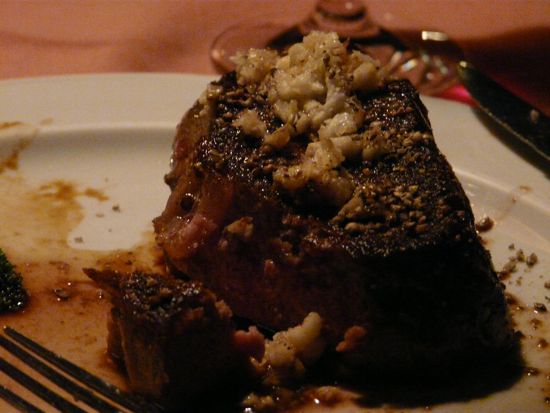
It used to be served on a wooden platter. I am guessing that health and sanitation standards now require porcelain or something less porous and prone to bacteria than wood.
And here is what we had for dessert. We totally hate the presentation, but it never fails to make us laugh, long and loud, and in spite of how it looks, the mousse is truly delicious.

We talked about all the years we had been coming to this restaurant, all the guests and friends we had brought with us, where we had been sitting with different people – including, more than once, my parents, coming back for their own sentimental journey. Ahhh . . . sweet memories. 🙂
One time, my youngest sister and her family came for a visit, and their son also tried the duck, and thoroughly enjoyed it. His father ordered the Eisbecher Burg Neuleiningen, and we didn’t tell him . . . we waited to see his face when they brought him a bowl the size of a punch bowl, filled with fifty scoops of ice-cream. 🙂 Oh, what fun!
We stayed in a truly darling hotel, and felt very lucky to get the last room. “Two hours ago, we had four vacancies,” the very nice manager said, “but now, we have just one!” In a heartbeat, we took it. The view from the Burggraf was amazing.

Strasbourg Magic
It is perfect May weather in Strasbourg right now – warm and sunny, even hot, one minute, crashing thunder, lightning and pouring rain the next. One minute you are catching the last rays of the sun on the Strasbourg Cathedral, and the next, you are ducking into the nearest restaurant to get out of the rain, have a little wine and flammekeuchen, give the weather a chance to change once again and you are on your way.

Besides the fact that we always have a lot of fun in Strasbourg – it is a great town for walking – remember that shoe store that was closed for the holiday on Friday? I have French feet; German shoes are too wide, American shoes are too serious . . .but French shoes are always just right. We go again, first thing Saturday morning, and they have all the newest shoes in the yummiest colors and they have them all in my size!

Just look at these colors! Grape! Orange sherbet! Fuscia/raspberryt! I am not really so much a shoe person, but oh! When the right shoe comes along! I know it! AdventureMan waits patiently, smiling indulgently, as I try on almost everything in my size.
Looking at me seriously, he says “Buy what you want! Who knows when you will be back in Strasbourg? I insist, you must buy at least four pair!” (Now THAT is true love.)

Truly a magical day in Strasbourg. 🙂
Intlxpatr wins Mother of the Year Award
I didn’t even know until several of my friends told me about my special award. See it here:
(I don’t seem to be able to get it to work as a hyper-link, so if you want to see my special award, you will need to copy and paste.)
Wives, be subject to your husbands
This part of today’s reading, among my set and the things we discuss, is one of the most controversial. We can debate this for hours.
What does being subject mean? If we, as wives, are subject to our husband, just as our husbands are subject to God, does it mean we can’t argue? We can’t disagree?
I saw a husband say to a wife the other day “I forbid you.” I think this is more common in Gulf culture than in our culture. I am sorry, but the thought of a husband daring to say this to a wife in the west is unthinkable. What I have also noticed is that when a husband says “I forbid you” here, it is not the end, but the opening skirmish. 🙂
There is a lot of food for thought in this reading, and I publish it to give you insight into what we read, and because I suspect you have similar readings.
Colossians 3:18-4:18
18 Wives, be subject to your husbands, as is fitting in the Lord. 19Husbands, love your wives and never treat them harshly.
20 Children, obey your parents in everything, for this is your acceptable duty in the Lord. 21Fathers, do not provoke your children, or they may lose heart. 22Slaves, obey your earthly masters* in everything, not only while being watched and in order to please them, but wholeheartedly, fearing the Lord.* 23Whatever your task, put yourselves into it, as done for the Lord and not for your masters,* 24since you know that from the Lord you will receive the inheritance as your reward; you serve* the Lord Christ. 25For the wrongdoer will be paid back for whatever wrong has been done, and there is no partiality. 41Masters, treat your slaves justly and fairly, for you know that you also have a Master in heaven.
2 Devote yourselves to prayer, keeping alert in it with thanksgiving. 3At the same time pray for us as well that God will open to us a door for the word, that we may declare the mystery of Christ, for which I am in prison, 4so that I may reveal it clearly, as I should.
5 Conduct yourselves wisely towards outsiders, making the most of the time.* 6Let your speech always be gracious, seasoned with salt, so that you may know how you ought to answer everyone.
Recent Comments
intlxpatr on Shampoo Ginger tigerbutterya0c5ff1d… on Shampoo Ginger intlxpatr on British Soldier Kidnapped, Esc… John on British Soldier Kidnapped, Esc… intlxpatr on British Soldier Kidnapped, Esc… Wikipedia Donate Button

Amazina


Early Voting in Florida


