A Quiet Friday in Strasbourg
“I have no agenda,” I said to AdventureMan as we walked the streets of Strasbourg, yesterday, walking and walking, through throngs of Strasbourgois, “but tomorrow I really need to go by the shoe store.”
He knows I love one particular shoe store.
We were up for breakfast by eight this morning – still nine, body time, Kuwait time, so it really felt like sleeping in. We are staying in a very exclusive hotel in Strasbourg with wonderful parking, we come, we park the car, and we just walk and walk and walk. We have a code to get into the hotel if we are out too late and the front door is locked. The rooms are simple, but bright and clean and stocked with shampoo and soap and spacious closets. The loo is separate from the shower room; I really like that. This hotel is so exclusive you probably couldn’t stay here – unless you, like us, are formerly military. The military hotels here have an agreement that people from other country’s forces can stay. There is a special rate for us former-military, a very agreeable rate that includes breakfast with the lightest, flakiest croissants in the world. I think it has to be the butter of the Alsace.

We were lucky to get a room. There was a huge crowd of people, a group, staying here, too.
So we headed out, taking our time, heading for the shoe store and an antiquities store AdventureMan wanted to visit. In the shoe store window are about six different pair of shoes I could happily scarf up, if only the store were open, but there is still a half an hour. We kill time, I tell AdventureMan I will catch up with him, and I stand in front of the shoe store waiting for it to open. Half an hour, I am still waiting, and AdventureMan comes; his store hasn’t opened, either.
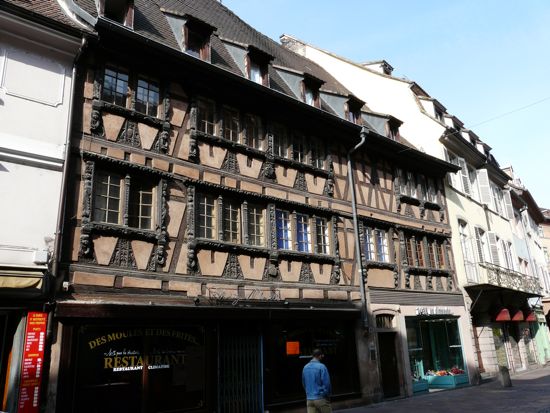
It is very quiet in Strasbourg, this Friday morning, and we are marveling at how relaxed the French are about getting up. Hmmm . . . even my favorite pharmacy is very late opening. . . several of the bakeries are not open . . . the historic post card store AdventureMan wanted to visit is closed . . .
Remember I told you I can be slow sometimes? So can AdventureMan. Around 11, we start wondering if it is a holiday. When we go to lunch, we ask, and they say “oh yes! It is the day of the end of the war! It is a holiday!” and the light bulb goes on. We will have to stop by our favorite stores tomorrow, and today, we are having a wonderful, very quiet day in the heart of Strasbourg, it is wonderful having the city mostly to ourselves. Well, we are sharing it with several thousand other tourists arriving from Germany, from Italy, and from other parts of France.
It smells so good here. There are lilacs blooming everywhere, and other wonderful smelling flowers:

We love it that the French signs for picnics show a baguette and a bottle of wine in the picnic basket:

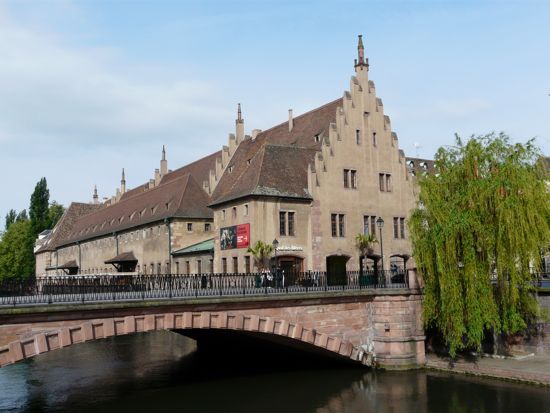
Walking in Strasbourg is so lovely; no matter where you look, there is something marvelous:
We had lunch at Le Pasha, a Tunisian restaurant. It was absolutely delicious! Sorry, we were so hungry I didn’t remember to take any photos. We had brik, a lamb stew/ lamb chops, and Tunisian pastries. It was a sweet restaurant:

And now, AdventureMan is snoozing, music to my ears. 🙂 We need a little down time as much as we need the walking, the lilacs, the vistas and the sips of wine.
Breaking all the rules
I’m breaking all the rules I made for myself. I didn’t know how to tell you I was leaving, but I thought I would tell you after I left.
Actually, I am not gone yet. My husband and I just grabbed an opportunity for a quick Mother’s Day getaway (Americans celebrate Mother’s Day this coming Sunday) and I am in France, drowning my sorrows 🙂 and walking and eating really delicious salads and pretending I am not up to my ears in boxes.
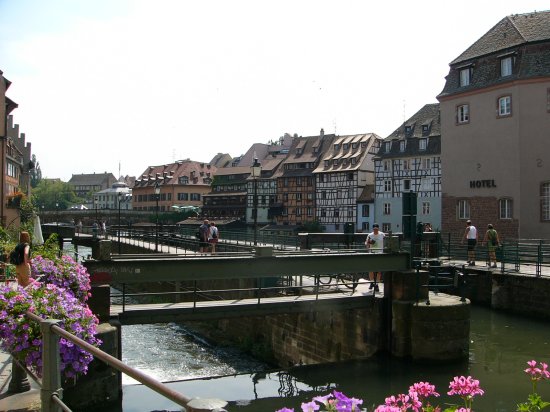
There are lilacs blooming everywhere, and wisteria. There are still some tulips. There are hydrangea. It is a riot of new life, color and growth. I am enjoying myself immensely. Very soon, it will be over and I will be back in Kuwait, packing boxes.
I will tell you more later, and even share some photos with you.
You are all so dear to me. I can’t tell you how much it hurts to move on. Usually, I cope by not thinking about it, just doing it. Somehow, in this situation, I don’t think that’s going to work very well.
Thank you for all your sweet thoughts. I haven’t decided if I will keep blogging; circumstances change . . . I will have to see if I even have anything to blog about!
Moving Violation
You may have noticed I am not as engaged with the blog right now. Truth is, I have a lot on my mind. As with many expats, this summer will bring a move from Kuwait, and moves take a lot of energy, both mental, emotional and physical.
I do some of the packing myself, because having something to do helps me fight the sadness I feel about leaving, and also because the things that the packers don’t see, don’t disappear. I know that sounds cynical.
This is my 30th move. In one of my early moves, two packers arrived with great big bags. It did occur to me that was rather odd, but I was a sweet and trusting young woman. When I arrived at the other end of the country missing two sterling silver cups engraved with my son’s name and the date of his birth, I started to get wiser about moving. To this day, it hurts me inside that someone would steal cups given to me to commemorate our son’s birth. It isn’t the cups. It’s that they were celebrating a very special event. It still hurts.

The second illumination was arriving at my destination to discover my riding boots packed with my formal gowns. it wasn’t the dresses. It was that someone cared so little that my worn, dirty boots would be packed with those filmy, fantasy creations. It was almost hostile. I still remember it, and it has to be over 20 years ago.
One move, each piece of tupperware was wrapped individually. One salad bowl – plastic – was wrapped in one large box. Even though the government was paying for these moves, not me, it sent a strong message. Someone was stretching the square footage of the move. Now, I pack my own tupperware, and it easily ALL goes in one box, and no, not a lot of wrapping.
One move, three boxes just never showed up, and they contained things of no value to anyone but me.
I have a thing about putting too much value on things. I don’t want to miss things – I want to let them go. I am good at letting go of things I choose to let go of, and I find I am not at all good at letting go of things taken from me when I had no choice.
And it’s a whole lot easier for me to focus on packing things, and thinking about things that have gone missing than to allow myself to experience the PAIN of all I leave behind every time I move, the sweet friendships, the church, the teams I play on, the sights, the smells. Sometimes I think all my photos are an attempt to hang on to something I know I will have to leave behind.
A Child’s Prayer . . .
Little Child’s Prayer
O Lord.. .. in this year please send clothes…
for all those poor ladies in dad’s computer…
I have a good friend who sends me the most amazing material. This one just cracked me up . ..
More Sleep, Fewer Colds
This is one of the weekly tips from Real Age. The problem I have with this tip is one of the reasons I knew I was coming down with something was that I was wide awake when I normally am sleeping. I had a virus recently, like a cold, but it started with being very not-sleepy. It was weird. Fortunately, I haven’t had it for long, and it seems to be moving on.
Are you like me? I was sneezing and coughing – and very worried I had caught the new swine flu. Why on earth would I think that???
That bug that’s going around? Until it’s moved to the next zip code, put yourself to bed early.
In a 2-week study, getting a little less sleep — under 7 hours instead of 8 or more — made people three times more likely to get sick after exposure to a cold virus. Now that’s something to sleep on.
Seems your immune system takes a hit from both lack of sleep and poor sleep. In fact, poor sleep may have an even bigger impact than short sleep. People in the study were five times more likely to get sick when their sleep quality dipped — even if it just dipped a smidge.
Rola Dashti Tackles Sensitive Issues
“Why are you looking so sad?” AdventureMan asked me as we sat down to dinner.
(Sigh) “There are people in Kuwait who don’t believe change is possible, and there is a movement afoot to WITHHOLD their votes as a protest.”
“Why do you care? It’s not your country?”
We call it “falling on your sword,” when a person does something fatal to self, to career, to family or to country, choosing an issue and staking everything on it. Rarely does it pay. The world moves on, life goes on and you are left behind bleeding on your sword.
Withholding your vote gives more power to those who are good at stirring up the rabble with irrational and selfish issues. Those who get the votes are those who make grandiose – and general – promises, those who refuse to be held accountable.
If you are a person who cares deeply about Kuwait – Please, do not withhold your vote. Do the hard work of listening to the candidates, and exploring their reputations for truthfulness and accountability. Think beyond your own needs, think of the greater good of Kuwait.
This is from today’s Al Watan; a candidate tackling some very sensitive issues, bringing them out in the open.
Ghenwah Jabouri
Staff Writer Al Watan
KUWAIT: In pursuit of winning enough ballots to secure a seat in the National Assembly, Dr. Rola Dashti, who is believed to be a potential woman candidate, delivered an emotive speech Monday evening to announce her parliamentary agenda if elected.
Dashti touched on sensitive and delicate issues which aroused the emotions of the audience, resulting in heated engagements later on in the evening.
Dashti mainly focused on family related issues, germane to women issues.
In an attempt to recoup the cynicism manifested by citizens toward parliament, Dashti urged the audience to not ponder on who is wrong or right.
“We need to move on; seeking to blame parliament, government, MPs, etc., is not going to serve us justice. We need to focus on developing Kuwait, rather then pointing our fingers at the wrongdoers, ” Dashti said.
She stressed that whether it was the parliament, the government, or the citizenship who committed the mistakes is not important; “what is important is that we learn from such mistakes.
“Individuals who have the cultural habituate of blaming, attacking and are cynical, do not want to move toward the future; rather, they want to travel back in time. Allow me to give you an example: last year, thirty percent of citizens in my constituency did not cast their ballot. These people are like you and me: their heart is burning for Kuwait, and they observed nothing positive, and they are in immense suffering.
“They gave up on hope and decided to ultimately not vote. Had half of them voted (nine thousand), ten people who would have succeeded in the Third Constituency elections would have determined a better fate for those that abstained from voting.” She further lamented that society should consider first and foremost Kuwait, and that the children, the youth and coming generations “deserve this.”
Dashti, further illustrating her point, noted: “For example, if soـandـsoـperson does not vote, who is going to protect their rights and so forth?”
Dashti stressed that Kuwait is experiencing “tumultuous times” and that the country is on the verge of a major collapse.
“Kuwait cannot afford political arguments and political confrontations and commotions. It is in our hands to save Kuwait. If we take responsibility, vote and call on those who did not vote to cast their ballot, change might have a chance of survival.
“Hundreds of people did not cast their votes because they lost their confidence in parliament. However, many families are suffering, and so, it is pivotal to acquire each and every vote; we need to give back what Kuwait bestowed us with.
“We need to give a little back to those who lost their lives to protect Kuwait during the Iraqi invasion in 1990; many people lost their lives during the invasion who fought for our liberty. Women were raped and families were torn apart. We need to give back a little, we need to continue to believe, and fight for our children and future generations,” Dashti added.
“Does Kuwait not deserve for us to stand in the cue for fifteen minutes to cast our votes?”
Talking more about women”s issues, Dashti noted that there are many things that need to be considered where women’s issues are concerned.
“Women have many burdens that they shoulder; the divorced, the widowed, the one who is married to an expatriate, and housing for women, all are issues the Kuwaiti woman suffers from.”
She pointed out that not every family is living happily, “although this is something I would love to achieve.
“Today, the Kuwaiti family has to wait fifteen years for (government) housing. Where will the divorced woman go during this lengthy period?
“This woman could be my sister, my mother, or our daughter; where does she go?”
Dashti noted that the law stipulates that a woman who is over forty years of age and both of whose father and mother are deceased and is unassisted by a guardian “is entitled to receive a housing allowance.”
“However,” Dashti said challenging the law, “what about other women in a somewhat parallel situation where the father is deceased but is not receiving allowance from her guardian ـ what can she do? Shall the woman take her guardian to court to sue him?
“Why does the law in pursuit of helping women insist on punishing them, even insulting her?
“This law is one of many that are flawed and need to be amended,” Dashti stressed.
She further said that “neither Kuwait or the people of Kuwait can tolerate empty words and useless slogans. Today we need to put many things on the table and take action in tackling them.
“Let”s now have a look at the children of some Kuwaiti women who are married to expatriates: we need to look at their educational, health, and employment and social needs and treat them with justice, like other children are treated who have Kuwaiti fathers.
“This is their country, why are we abusing them? These are our cousins, our brothers and sisters, and have to be treated with equality when their mother is a citizen of the country.”
She further added that citizens have been “fooled” enough; “vote for someone who knows what they can do, someone who can save us from the financial burden.” Touching on an issue that has become central in campaigns, Dashti noted, “We should not allow people who do not understand finance to tamper with the budget.
“Nor should we allow individuals who are responsible in dealing with the financial budget to use the financial budget for personal gains.”
“Why should we follow those who damage our financial budget, and steal the money of the public? There is another option: choose someone who will protect the public financial budget and enhance the budget!”
Dashti further stated that there is an “internal bleeding” in the country and that she is not going to offer an “aspirin to silence your pain to only kill you” as a member of parliament.
“I will opt for a long term alternative and choose to cure you.”
During the question and answer session following her address, particularly passionate but enraged voices emerged, where some expressed their frustration with the old faces of parliament.
One woman said she was “fed up with the old faces and that it is about time new faces took over.”
She further said, “We have been deceived, fooled and cheated by the old MPs,” and stressed, “We are suffering and are in desperate need of MPs who will promote social and financial justice.
“Kuwait has hit a plateau and something”s got to give,” she noted.
Another woman made a remark about Dashti”s strong foreign accent.
She noted: “Society often criticizes you (Dashti) for speaking in a Lebanese accent.
“I don”t understand why you come under scrutiny for such a reason. After all, people have television at home and typically watch the satellite channels, all of which speak in foreign accents.”
The woman”s comment was understood to be a positive comment, where she welcomed Dashti”s candidacy and believes that the candidate will be a forceful vehicle towards righteous deeds toward society.
Another frustrated woman spoke about property and about people whose houses was taken from them by the banks. She said that she read an article in Al Watan newspaper that there are many withdrawn properties and houses for sale.
“The inheritors are crying blood and are traumatic, because their houses are being taken from them. Other citizens are staying in small apartments after they used to occupy villas,” she said.
Another woman who was virtually in tears pled to the people “to opt for change and choose new faces, even if the new members of parliament will do nothing.
“The former parliament has tormented and killed me; please, give your votes to new faces, in the name of God, please, vote for change.”
Jodi Picoult: Handle With Care
I just finished the latest Jodi Picoult novel, Handle with Care. I was uncomfortable with it at the beginning, as I often am with Jodi Picould novels. She’s like that guest who brings up topics no one else brings up, and sometimes you wish she would stop, but the conversation gets rolling and everyone has an opinion, and the party would be much duller if she weren’t there.
She’s also the friend you would go to if you had an embarrassing problem you couldn’t discuss with anyone else. We all need that kind of friend, an honest sounding board, not afraid to deal with the grit and grime of everyday life.
I know the reason her books make me uncomfortable is that sometimes I see things I don’t like about myself in her characters.

The subject of the book is a disease called osteogenesis imperfecta (OI), and Willow, the youngest daughter, has Type III, which means she was born with broken bones, her bones would break if you picked her up wrong, changed her diaper the wrong way, even if she rolled over. Her bones were brittle, and the slightest thing could cause a break. She is also very smart, and a delightful character.
Picoult takes us inside many heads – the mother, Charlotte, a former pastry chef (Picoult includes some of her very best recipes, YUMMMM), Sean, the fiercely loving father, Amelia, a troubled pre-teen who hides her bulemia and cutting, and Marin, the lawyer, searching for her own birth mother. When Charlotte files a wrongful birth suit against her best friend – and obstetrician – Piper, her life starts to fall apart. It’s hard to believe things could get worse than having a child whose bones break all the time, but things definitely get worse.
What I hated about Charlotte, who has learned to anticipate her damaged child’s needs, is seeing myself through her eyes. Frequently, she shows us our insensitivity to the disabled, how we patronize, how we are oblivious to the simplest needs. Charlotte is a little angry at the world, so protective that she bites back scathing words to outsiders – or doesn’t. People without disabilities – visible disabilities, we all have disabilities, don’t we, just some are visible and some are not? – can be so smug, so unaware of the hardships others face. I cringe when I read this book. I see myself, and I don’t like what I see.
I admire Jodi Picoult. I will read just about anything she has written, because of the courage she has to tackle the most sensitive subjects. This is not a comfortable book to read, but it is a worthwhile book to read.
Income Tax Blessing
You didn’t think those words could all be used in the same sentence, did you? AdventureMan and I have to pay something called “quarterly estimated taxes” and this year, I guess because our investment income went seriously down, we overpaid our taxes. I know, I know, that doesn’t sound like good news to you, but it sure beats the pit-in-the-stomach of learning that you owe more to Uncle Sam. We overpaid, and we will go ahead and apply it to next year’s taxes and hope that everything works out well next year, too.
We used to talk to my father about ways he could pay less tax on his income and savings. He would look at us and say “But the government was always good to me!” (he worked for the government) “They paid my salary! They pay my retirement! They help pay my medical bills! Why would I not want to pay them taxes?”
It was an extraordinary attitude; I have never forgotten it.
The Thirteenth Tale – Setterfield
After reading some heavier stuff, I needed a break, and waiting on my “read me!” bookshelf has been this book, The Thirteenth Tale, another one of those I pick up at the last minute and stuff into the last remaining centimeter of space in my overstuffed suitcases. Nobody recommended it, it just looked like it might be good.

It was good, although now I can’t think of anything so gripping about it. Setterfield took the classic gothic novel – she mentions Jane Eyre frequently – and updates it, makes it modern and personal. It was a good, fun read, had me hurrying through my daily “must-do’s” so I could read more – I like a book like this now and then.
And – the main character, Margaret Lea, loves books. 🙂 She works in her family old-books business, leads a quiet, kind of sad life, haunted by the loss of her own twin early in life. When contacted by famous novelist Vida Winter to write her biography, she is intrigued, and accepts the job offer, which involves going to stay in Vida Winter’s house.
Part of what is fun reading this book is that we are dealing with an “unreliable narrator” with Vida Winter. Sometimes she is lying, sometimes she is lying by omission, and part of the mystery is that Margaret must try to verify what she has been told and try to figure out what has been left out. She has a great adventure in the process.
This is great escape reading. Good for a long plane trip, good for sitting by a sick relative in the hospital, good for using as a carrot (“if I get this done, and this, and this – then I get to go read ‘The Thirteenth Tale!’ “) You can buy it on Amazon.com for around $10 paperback.
Cell Phone Etiquette: What do you think?
AdventureMan and I were having lunch yesterday and I saw a couple at another table, both on their cell phones. So, like they were sharing a meal, but not really sharing time with each other.

I’m not that big of a cell/mobile phone fan, although my son and my sister both have iPhones, which I look at with envy and think one day I will get one. I carry it because I think it would really be a bad thing in Kuwait to be in a car accident, not my fault, with our without a cell phone. I carry it so I can reach my husband in an emergency. But sometimes, yes, my bad, I forget it and don’t even miss it. Sometimes I stick it in my purse and remember two days later that it is still there.
Here is how I see it. If you are with another person – like if you and your best-friend-forever are having lunch, sharing your deep down secrets, how do you feel about them taking a phone call, one that really doesn’t matter? I totally understand if there are emergencies, or even if one of the children wants to ask something, but what about a full-blown conversation? Chat chat chat chat chat as if you don’t exist?
AdventureMan and I used to disagree about this. Now, if he gets a phone call and he thinks it can wait, he doesn’t answer. If he thinks it might be important, he answers but keeps it short. If we are in a large group and it is a crisis call, he will leave the group, and not subject us to be unwilling evesdroppers. I am very comfortable with this. if it is just the two of us and a tricky phone call comes in, I just pull out my Sudoku and work on a puzzle until he is free to rejoin me. It works for us.
I feel the same way about texting. Some people are very good at doing it so subtly that no one else knows; I don’t mind that. If you are in a meeting, however, and there is a speaker, don’t you think the right thing to do is to put away your phone and pay attention to the speaker? If you are with a friend, isn’t it rude to be texting all the time to someone else? What kind of message does that send about how much you value the relationship with me?
If you are texting while you are driving, how much attention are you paying to the road? I see you, half in my lane because you are trying to read the response!
I don’t like being accessible to the world 24/7. I think these mobile phones are supposed to be our servants, not our masters. I like seeing who is calling (if your number doesn’t show your name on my phone, I won’t be answering!) I like getting and sending messages. I just have a feeling there is a time and place for everything. If I have made plans to see you – I want you to pay attention to me!
Am I way out of whack on this?
There is a little voice telling me this is generational, that I am falling a little out of step with the modern way of doing things. So, you tell me. How do you see it?
Recent Comments
intlxpatr on Shampoo Ginger tigerbutterya0c5ff1d… on Shampoo Ginger intlxpatr on British Soldier Kidnapped, Esc… John on British Soldier Kidnapped, Esc… intlxpatr on British Soldier Kidnapped, Esc… Wikipedia Donate Button

Amazina


Early Voting in Florida


