Ramadan for Non Muslims

I am repeating this post from September 13, 2007 because it found so much interest among my non-Muslim friends. We are all so ignorant of one another’s customs, why we do what we do and why we believe what we believe. There is a blessing that comes with learning more about one another – that blessing, for me, is that when I learn about other, my own life is illuminated.

(I didn’t take this photo; it is from TourEgypt.net. If you want to see an astonishing variety of Ramadan lanterns/ fanous, Google “Image Ramadan lanterns” and you will find pages of them! I didn’t want to lift someone else’s photo from Flicker or Picasa (although people do that to me all the time!) but the variety is amazing.)
Ramadan will start soon; it means that the very thinnest of crescent moons was sighted by official astronomers, and the lunar month of Ramadan might begin. You might think it odd that people wait, with eager anticipation, for a month of daytime fasting, but the Muslims do – they wait for it eagerly.
A friend explained to me that it is a time of purification, when your prayers and supplications are doubly powerful, and when God takes extra consideration of the good that you do and the intentions of your heart. It is also a time when the devil cannot be present, so if you are tempted, it is coming from your own heart, and you battle against the temptations of your own heart. Forgiveness flows in this month, and blessings, too.
We have similar beliefs – think about it. Our holy people fast when asking a particular boon of God. We try to keep ourselves particularly holy at certain times of the year.
In Muslim countries, the state supports Ramadan, so things are a little different. Schools start later. Offices are open fewer hours. The two most dangerous times of the day are the times when schools dismiss and parents are picking up kids, and just before sunset, as everyone rushes to be home for the breaking of the fast, which occurs as the sun goes down. In olden days, there was a cannon that everyone in the town could hear, that signalled the end of the fast. There may still be a cannon today – in Doha there was, and we could hear it, but if there is a cannon in Kuwait, we are too far away, and can’t hear it.
When the fast is broken, traditionally after the evening prayer, you take two or three dates, and water or special milk drink, a meal which helps restore normal blood sugar levels and takes the edge off the fast. Shortly, you will eat a larger meal, full of special dishes eaten only during Ramadan. Families visit one another, and you will see maids carrying covered dishes to sisters houses and friends houses – everyone makes a lot of food, and shares it with one another. When we lived in Tunisia, we would get a food delivery maybe once a week – it is a holy thing to share, especially with the poor and we always wondered if we were being shared with as neighbors, or shared with as poor people! I always tried to watch what they particularly liked when they would visit me, so I could sent plates to their houses during Ramadan.
Just before the sun comes up, there is another meal, Suhoor, and for that meal, people usually eat something that will stick to your ribs, and drink extra water, because you will not eat again until the sun goes down. People who can, usually go back to bed after the Suhoor meal and morning prayers. People who can, sleep a lot during the day, during Ramadan. Especially as Ramadan moves into the hotter months, the fasting, especially from water, becomes a heavier responsibility.
And because it is a Muslim state, and to avoid burdening our brothers and sisters who are fasting, even non-Muslims refrain from eating, drinking, touching someone of the opposite sex in public, even your own husband (not having sex in the daytime is also a part of fasting), smoking is forbidden, and if you are in a car accident and you might be at fault, the person might say “I am fasting, I am fasting” which means they cannot argue with you because they are trying to maintain a purity of soul. Even chewing gum is an offense. And these offenses are punishable by a heavy fine – nearly $400 – or a stay in the local jail.
Because I am not Muslim, there may be other things of which I am not aware, and my local readers are welcome to help fill in here. As for me, I find it not such a burden; I like that there is a whole month with a focus on God. You get used to NOT drinking or eating in public during the day, it’s not that difficult. The traffic just before (sunset) Ftoor can be deadly, but during Ftoor, traffic lightens dramatically (as all the Muslims are breaking their fast) and you can get places very quickly! Stores have special foods, restaurants have special offerings, and the feeling in the air is a lot like Christmas. People are joyful!
There were many comments on the original post, and, as usual in the history of Here There and Everywhere, the commenters taught us all more about Ramadan than the original post. If you want to read the original post and comments, you can click HERE.
End of August Sunrise

No, no, it’s no trouble at all to be up for the sunrise, in fact, I have been up for hours. Yes, jet lagging. I thought I had dodged that bullet, but when I awoke, feeling GREAT, thinking it was morning, and checked my clock . . . it was only 2:30. 2:30 ay – em.
I’ve got all the laundry done, dishes washed, I’m all unpacked, and I think I am going to need to go back to bed soon.
I was just thinking, for Kuwaitis coming back, there won’t be a jet lag issue – with Ramadan starting almost immediately, nights and days get turned upside down anyway.
My flight in was a hoot – probably 80% families, Kuwaiti and Omani. Most of the kids were between 8 months and 2 1/2 years, but amazingly well behaved. The flight was packed. Packed. Not a single empty seat. I am guessing this was the big influx trying to get back before school starts and Ramadan starts – double whammy.
Fortunately, KLM seemed to have stocked a lot of kid’s meals, they didn’t mind the toddlers in the aisles, and the flight was relatively quiet – astonishingly so, considering all the kids on board. I have never seen a flight with so many children. The Pre-boarding of the families alone took about 45 minutes. Unaccompanied people like me were stuck in here and there where there was an empty seat.
The poor families; many had hoped for an empty seat next to them, and had to hold the babies and toddler the entire flight. There was a baby in my seat when I boarded, but the parents quickly picked her up and we had a good time chatting during our time together; we even all slept when the baby did. The baby coughed and sneezed on my meal, but I don’t seem to be suffering any ill effects. 🙂
I’m happy to be back in Kuwait. I’ve grown to love Ramadan, and I am looking forward with great anticipation to those magical days when the temperatures begin to drop once again and we can spend time outdoors.
Spotting Infections in Your Elderly Parents
I am printing this entire article because few of you will be reading the Military Officers Association of America newsletter, and this is one of the best articles I have seen on the subject. It is SO easy to dismiss a parent’s complaints as just being a normal part of aging – and it is important to catch these things early.
Role Reversal — How to Spot Infections
2008/08/22 00:00:00
By Nanette Lavoie-Vaughan
The next time your parent complains of feeling “out of sorts” or gives you a vague list of minor problems, don’t dismiss it as normal grumpiness. There’s a good chance your parent could have an infection.
Diagnosing the elderly with an infection can be difficult. Seniors are less likely to have classic symptoms such as fever, chills, and vomiting. Instead they might have atypical symptoms such as subnormal temperature, confusion, fatigue, and decreased appetite. In many cases, these subtle signs can be attributed to the normal aging process — or ignored until the late stages of the infection.
Let’s take a brief look at how the infection process works. When the human body is under stress or exposed to bacteria and viruses, it triggers a healing chain of events that, in most cases, results in the prevention of infection or illness. However, when the amount of bacteria is too great an infection occurs. At that point, the immune system kicks in doubly hard, releasing a flood of chemicals to attack the infection and promote recovery.
Seniors are more susceptible to infection because multiple chronic illnesses that occur with age put extra stress on the body, and the medications for these conditions can block the immune system. In addition, the immune system naturally weakens as we grow older.
The most common sites for infections in older adults are the urinary tract, the respiratory tract, and the skin. It also is common for seniors to develop an infection prior to an acute deterioration of their chronic medical condition or in combination with other acute medical problems. A typical example is the person with congestive heart failure who develops pneumonia. The symptoms of cough, congestion, and shortness of breath are similar and might occur simultaneously, or the onset of pneumonia might precipitate an acute attack of congestive heart failure.
So how do you know if your parent is developing an infection? Look for:
an acute change in his or her ability to perform day to day activities;
subnormal temperature;
increased pulse rate;
unexplained dehydration;
confusion;
poor appetite; and
fatigue with increased aches and pains.
For specific infections you might want to look for the following signs:
Respiratory infections
Cough
Increased mucus
Abdominal pain
Headache
Chest pain
Generalized weakness
Loss of appetite
Urinary infection
New onset of incontinence
Pain with urination
More frequent urination
Flank pain
Weakness
Blood in the urine
Skin infection
Redness
Warmth
Pain or tenderness
If you note any of these symptoms, due diligence requires a complete medical evaluation to determine the source of the infection and any other acute medical problems.
Why is this so important? The risk of sepsis, an overwhelming infection that enters the bloodstream, is higher in the elderly. The longer these types of symptoms go untreated, the more likely the bacteria will find its way into the bloodstream.
Another concern is the prevalence of antibiotic-resistant infections. The overuse of antibiotics for viral illnesses and the common cold have caused bacteria to mutate and become resistant to antibiotics that once treated most infections. The three super infections that pose a threat are Methicillin-resistant Staphylococcus aureus (MRSA), Clostridium difficile (C diff), and Vancomycin-resistant enterocolitis (VRE).
MRSA is diagnosed by obtaining a culture of the body fluid (sputum, urine, blood) where the infection is present. MRSA infections can occur anywhere in the body, and even though treatment with Vancomycin appears successful, a small amount of the bacteria can remain — a phenomenon medical professionals refer to as colonization. The remaining bacteria can cause infections to reoccur at any time.
C diff and VRE both cause diarrhea and are the result of antibiotics killing the normal, beneficial bacteria that reside in the intestinal tract and allowing infection-producing bacteria to proliferate. C diff can occur after the prolonged use of any antibiotic; VRE is specific to the use of Vancomycin. Treatment includes preventing dehydration associated with diarrhea, a bland diet, and bulking agents to decrease the amount of diarrhea, and administration of Flagyl to treat the condition and allow the normal bacteria to return to appropriate levels.
The good news is that most infections are isolated and can be treated with short-term antibiotics. Basic preventative measures — such as assuring that your parents have a pneumonia vaccination, receive the flu vaccine yearly, avoid others with acute infections, and stay well-hydrated — can decrease the likelihood of serious infections.
In addition, keeping the skin well moisturized can prevent skin infections. Dry skin is more likely to crack and tear, providing an opening for bacteria to enter. Urinary tract infections are prevented by good hygiene and adequate fluid intake.
Infection in the elderly is a serious concern, but a few simple measures and a diligent eye are all it takes to keep your parents healthy.
(For more information about infections in the elderly, super infections, and vaccinations go to http://www.health.nih.gov/topics. )
Nanette Lavoie-Vaughan is an adult nurse practitioner and professional consultant. She is a featured speaker at national professional conferences and writes about geriatrics for multiple publications. If you’d like to send Nanette a comment, question, or suggestion for a future column, please e-mail rolereversal@moaa.org.
What a Difference a “D” Makes
AdventureMan called me, laughing, and said “I just have to tell you what just happened to me.”
He was talking with a Kuwaiti woman who said “You speak Arabic amazingly well, except for one little thing – you say the ‘d’ when you should be saying the ‘Dh’.”
It was all he could do not to laugh. Not because of what she had said, but because it reminded him of a conversation we had, repeatedly.
When AdventureMan took Arabic, I took French. We were on our way to Tunis, I had a small baby, and I already spoke a little French. I made arrangements to study half days, and hoped it would be enough. Thanks be to God, together, we did just fine. In Tunis, most Tunisians spoke French and even those who spoke Arabic switched to French for the numbers. (Things are different now; this was many years ago.) The Tunisians called him “That Lebanese guy married to the French woman.” (He is not Lebanese. I am not French. Most Tunisians spoke a Berber dialect, which was not quite the same as Arabic.)
When I finally started formal Arabic classes, years later, I would say things I had learned from my husband and my dear Qatteri teacher would say “No, that is how those Lebanese people say it, not the way we say it.”
When my husband would correct my Arabic, now I could just cooly look at him and say “That is how you Lebanese say it, but we Qatteris say it this way.”
When he would lecture me on Arabic (I can only absorb about one minute of lecture at a time and them my head starts swimming) I would respond with ” ‘Dh’ AdventureMan, ‘Dh’ ” implying that his “Dh” wasn’t hard enough. It would make him laugh every time, totally crack him up. He can’t lecture me when he is laughing.
So here he is on the phone, laughing and laughing, because the Kuwaiti woman told him his Arabic was fine except that his “dh” wasn’t hard enough. God bless you, dear, whoever you are. 🙂
Home Prices Drop, Sales Rise in Seattle
The Seattle Real Estate market has been fairly bullet-proof, until lately, when following the trend across the United States, prices here have also dropped, reports this morning’s Seattle Times. (If you have ever dreamed of having a home in Seattle, even after all my rain photos, now is the time!)
By ALEX VEIGA
The Associated Press
A real-estate-agents trade group says sales of existing homes rose 3.1 percent in July as buyers snapped up deeply discounted properties.
Stephanie Kuhn — who moved in March from the Seattle area to Orlando, Fla., because of a family emergency — has yet to find a buyer for her Mountlake Terrace condo.
The two-bedroom, 1,100-square-foot condo has been on the market since March but is drawing little interest.
“I can’t buy another house until I sell my house up there,” said Kuhn, 47.
Seattle and Portland, Ore., were among the top 10 metro areas in the nation with the most pronounced drop in home sales last month compared with July 2007, according to The Associated Press-Re/Max Monthly Housing Report, which analyzed all home sales recorded by all local agents.
The AP-Re/Max home-sales report was one of two released Monday. The second was from the National Association of Realtors.
Sales of existing homes in the West edged higher overall in July, as many buyers took advantage of falling prices in foreclosure-ravaged areas in California, Nevada and elsewhere, both reports show.
About 1.1 million pre-owned houses and condominiums were sold last month in the 13-state region, up almost 1 percent from the same month last year, the Realtors group reported. But the median home price plunged more than 22 percent to $273,200, it said.
You can read the rest of the article HERE.
Hope in a Bottle
Holy Smokes, I notice I am just about out of my trade-mark Smog eye shadow, totally unavailable even in the Sephoras in Kuwait and Qatar, but fortunately available in a nearby Sephora here in Seattle. Sparkle introduced me to Smog, and Maui Wowie, by Urban Decay. If you know me, you know how funny that is. The name is so Goth. I am so not.
As I am perusing what else I might need and not even know it until I see it, a very strange man comes into Sephora with a patter and a handful of red, white and pink balloons.
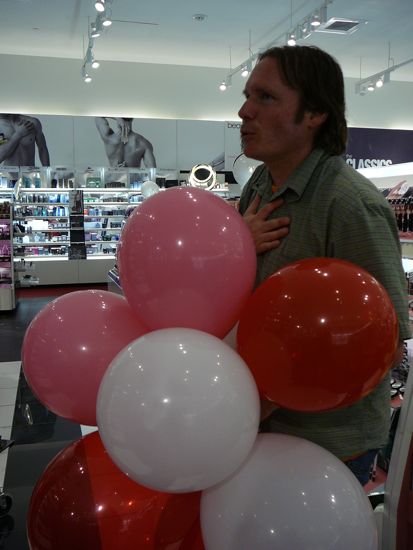
Honestly, I thought he was like a singing telegram, and maybe it was somebody’s birthday, but the gals working in Sephora were sort of brushing him off and his patter was, well, unattractive when not profane. One gal, working on a makeover, was kind but firm, and said good-bye to him and he seemed to take the hint and left. He comes by almost daily, she said.
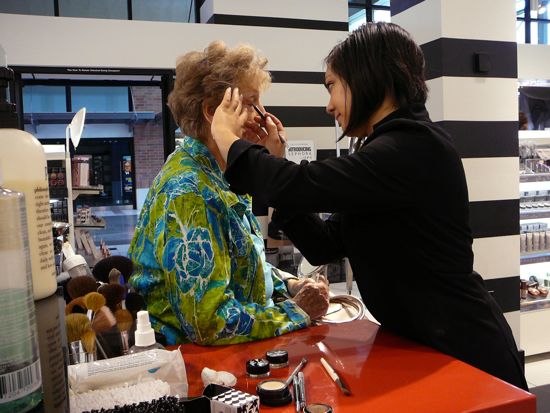
As I was checking out, I asked the Sephora lady if she had any little samples of face cream, so that when I go back to Kuwait I can put them in my little plastic sack and use them so my face won’t get all dry, and she very graciously gave me several. It wasn’t until I got home that I took a good look and started laughing. In my family, we have always called all face creams “Hope in a Bottle.”

Dinner at Girardi’s Osteria in Edmonds
It was one of those magical not-to-be-predicted warm summer evenings in Seattle. We’ve had a funny week, alternating rain and bright, sunny days. This happened to be one of those bright sunny ones, and Sparkle and Mariner Man had invited Mom and me to dinner. They picked a place I had never been and had been interested in trying.

Oh! Wow!
I got there early, and thought I would take a quick look at the menu, posted outside. I’ve always loved it that in Europe, it is a requirement, so you can get a look to see what is offered before you go in and sit down and then discover that they don’t make what you have your heart set on. But I only had time for a quick glance before I heard Wooo Hooooos, and people calling my name; Sparkle and Mariner Man and my Mom had made it to the restaurant just minutes before I did.
They were waiting patiently, and what a great wait – Sparkle was sipping a pomegranate martini, and I had something red, dry and Italian – wine. We all started with crab cakes, which, I am sorry to say, were so good we just went right ahead and ate them and I didn’t even think to photograph. When the main courses arrived, Mariner Man pulled out his camera, thank God, or I might have just jumped right in and forgotten all about you!
I had the very delicious antipasti salad – with grilled shrimp. The shrimp had a delicious smokey flavor, and the salad was perfect for a warm summer night. They grate the fresh Parmesan over your salad – I was engrossed in conversation with Mariner Man over some camera technicalities before I noticed that my salad was getting LOADED with Parmesan and said “Whoa!”

Mom had the Veal Scallopine, very mild, very tender, very delicious:
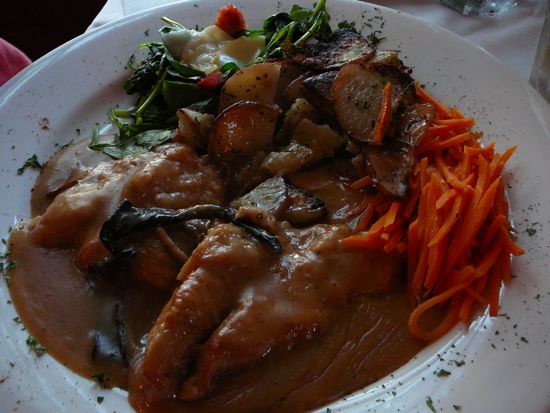
She said that as a bonus, the carrots were parboiled, so that they were still crunchy, but not crisp, and were sweet and tender. She loved those carrots.
Sparkle started with the Tricolore Salad (Caprese: tomato slices with mozarella, basil and balsamic vinegar) That had an awesome basil pesto with it, then proceeded to the Pollo Putanesca – WOW. That is one of my favorite sauces, and when it is done well, it is awesome. This one was amazing – full of kalamata olives, anchovies, capers – and was intensely flavorful. She ate every bite (except the one she shared with me so I could taste 🙂 )

Mariner Man started with a Ceasar salad – again, WOW, the real thing, served with a whole anchovy and slices of parmesan cheese, and then his main course – Pollo Masala – which was better than good – it was amazing!

The dessert list was also amazing. Creme Caramel. Tiramisu. A whole list of sorbets. We all looked at it, and then looked at each other in dismay – we hadn’t saved any room! We were stuffed!
I would go to Girardi’s again in a heartbeat. The service was friendly without being intrusive, the atmosphere was comfortable and elegant, and the food was delicious. Thank you, Sparkle! Thank you, Mariner Man!
Job and Islamic Tradition
One of the things I learned later in life, like when I lived in Doha, is that you (my Gulf and Moslem readers) have many of the same characters and stories in the Qur’an that we have in the Bible. Interesting, to me, the stories are not always exactly the same. Today’s reading in our lectionary (Old Testament) is from Job (you call him Ayoub, I think.)
First – if you read this, will you tell me if the story in Islam is similar to our story – that Satan is allowed to torment Job, because God believes him to be a faithful servant who will not turn away from him in times of hardship? Satan believes he can demonstrate that Job will be faithless?
Second – why is Satan called “the accuser?” I know Arabic is very close to the old Aramaic; is Satan always called Sheitan? Do you have other names for Satan? (These are not rhetorical questions; these are things I really don’t know) For example, Satan, in our tradition, is called The Father of Lies, The Great Deceiver, etc. But I don’t understand him being called The Accuser.
Third, toward the end of this reading his wife says essentially, give it up, Job, curse God and die. But the little asterisk says “bless”. This is a great puzzlement to me – a curse is the absolute 180° opposite of a blessing, I think. And then again, sometimes what appears to be a curse can be a blessing, and what appears to be a blessing can end up really being a curse. I just don’t understand why, in this context, the word curse could also mean bless? Do you?
Job 2:1-13
2 One day the heavenly beings* came to present themselves before the Lord, and Satan (*Heb the accuser) also came among them to present himself before the Lord. 2 The Lord said to Satan,* ‘Where have you come from?’ Satan* answered the Lord, ‘From going to and fro on the earth, and from walking up and down on it.’ 3 The Lord said to Satan,* ‘Have you considered my servant Job? There is no one like him on the earth, a blameless and upright man who fears God and turns away from evil. He still persists in his integrity, although you incited me against him, to destroy him for no reason.’ 4 Then Satan* answered the Lord, ‘Skin for skin! All that people have they will give to save their lives.* 5But stretch out your hand now and touch his bone and his flesh, and he will curse you to your face.’ 6 The Lord said to Satan,* ‘Very well, he is in your power; only spare his life.’
7 So Satan* went out from the presence of the Lord, and inflicted loathsome sores on Job from the sole of his foot to the crown of his head. 8Job* took a potsherd with which to scrape himself, and sat among the ashes.
9 Then his wife said to him, ‘Do you still persist in your integrity? Curse* (bless) God, and die.’ 10 But he said to her, ‘You speak as any foolish woman would speak. Shall we receive the good at the hand of God, and not receive the bad?’ In all this Job did not sin with his lips.
11 Now when Job’s three friends heard of all these troubles that had come upon him, each of them set out from his home—Eliphaz the Temanite, Bildad the Shuhite, and Zophar the Naamathite. They met together to go and console and comfort him. 12 When they saw him from a distance, they did not recognize him, and they raised their voices and wept aloud; they tore their robes and threw dust in the air upon their heads. 13 They sat with him on the ground for seven days and seven nights, and no one spoke a word to him, for they saw that his suffering was very great.
Daily Odds and Ends
This cat was found as a kitten; he’d been hit by a car. The man who found him paid $1400 to get him well again. Now he had a home where he is happy, has special furniture just for him, and a life where he is treasured. His name is Lucky. He looks crabby, but he is a sweetheart:
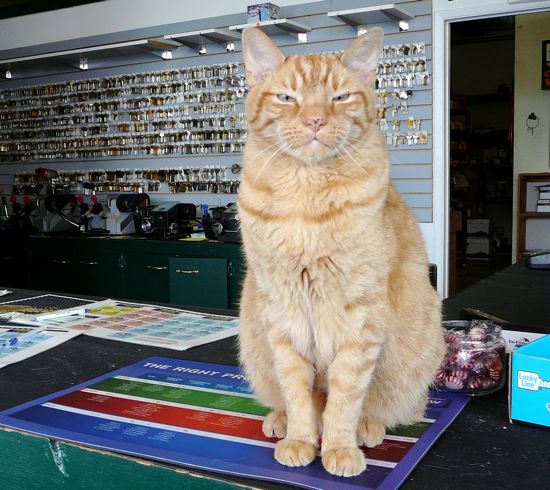
Lucky lives next door to an Ethiopian Grocery store:

In an antique store, I found this unique display:
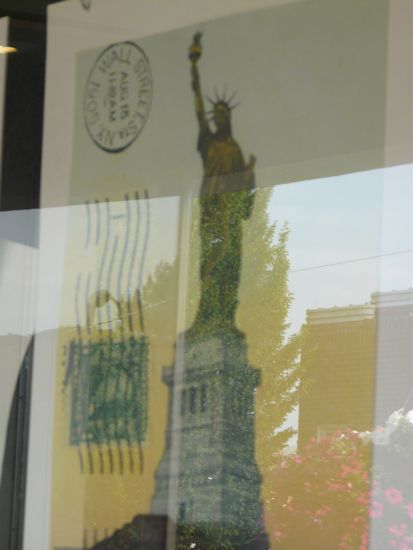
I’m crazy about old silver, and these pieces knocked my socks off. I am guessing it is old hotel silver – I didn’t ask.

I talked my military-wife-friend into going back to Tai-Ho’s and this time we tried their famous noodle soup with meat and chinese pickles. It is to die for!

Mom called as we were saying goodbye to say that if I was anywhere near the coast, there was going to be a fabulous sunset with magnificent clouds:

All in One Day
Life is funny, in Kuwait, you are just getting up, brushing your teeth, getting ready to head for work, knowing tonight is date night and tomorrow you sleep in. I’m in my jammies, lying in bed with my computer, watching old Law and Order’s on TNT (sometimes the Olympics just get boring) and winding down, getting ready to call it a day.
And what a day! My long time Army-wife friend and I went out playing – picked up lunch at Ivar’s and took it over to the park to eat, where we found a whole flock of new friends:

This guy was persistent – after we ate our fish, we threw him the fries:

We looked at a house for sale – great bones, significant view, lousy location:

The day was warm, but there was a persistent wind, and at one point, we drove home from the crowded malls in a driving rain. Everywhere, for the next three hours, people were saying “this is October weather, not August weather!”

A great night for Chinese food. T&T’s Seafood is SO Chinese that there aren’t that many things on the menu I am comfortable ordering, and I fly close to the edge of the envelope when exploring Chinese food. I ordered Hot and Sour Soup, Green Beans with shaved meat, and Prawns with Honeyed Pecans. I sat with all the other take-out people waiting for their orders – it’s truly that kind of night. Everyone is talking about the weather. They don’t do a lot of delivery in Seattle; mostly you have to go pick it up yourself:

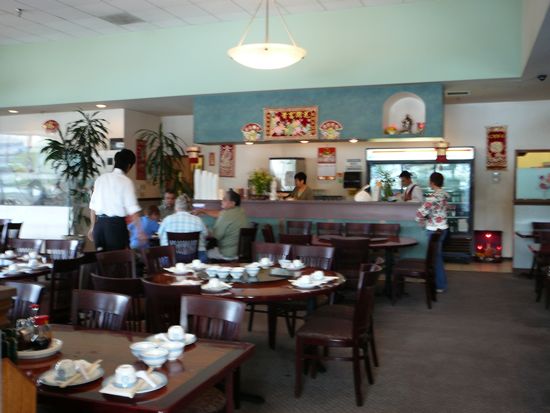
It was pouring when I went in – clearing when I came out:

Heading toward the coast:

After dinner, I drove down to surfside to take a sunset photo with these wonderful clouds:

Recent Comments
intlxpatr on Shampoo Ginger tigerbutterya0c5ff1d… on Shampoo Ginger intlxpatr on British Soldier Kidnapped, Esc… John on British Soldier Kidnapped, Esc… intlxpatr on British Soldier Kidnapped, Esc… Wikipedia Donate Button

Amazina


Early Voting in Florida


 Here There and Everywhere