Lisey’s Story: Stephen King
Mostly I wait for books to come out in paperback, so that they don’t hurt me if I fall asleep while I am reading (!), but for a few authors I will make an exception. One, James Lee Burke, I told you about in a previous post He Had Me From Hello.
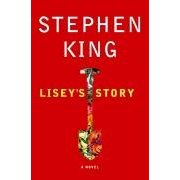
My most recent exception was for Lisey’s Story, the newest novel out by Stephen King. It’s a departure from Stephen King as we know him, and yet, there are resonances and echoes of earlier writings. Stephen King is brilliant at capturing the terrors of childhood, and the diaphanously thin membrane separating reality as we know it (not that we agree on what “reality” is! 😉 ) from the “otherworld”. In the Dark Tower series, the otherworld was where all the bad things were created and passed over to this side through leaks, places where the membrane holding worlds apart thinned and even disappeared.
This book is covered with flowers, bright pink and fushia and purple peonies, lupin and daisies, shading into blacks, whites and greys at the top, so that the holleyhocks are only faintly blue. It’s a very odd cover for a Stephen King book, but this is a very odd book. Early reviews say it is about as autobiographical a book by Stephen King as he has ever written, and I believe it. Stephen King writes what he knows – from Misery, written shortly after his nearly fatal accident as he was walking along a road near his Vermont farm and was hit by a van and nearly crippled for life, to this one, Lisey’s Story, in which we spend a lot of time in a dead author’s writing loft in an old barn in – you guessed it – Vermont.
As Lisey’s Story opens, we learn that she is the widow of an author (an author a whole lot like Stephen King) who has made a fortune writing fantasy/horror books. As the book unfolds, we walk with her through her devastating grief, bitter anger, and the endless exhaustion of trying to clear out her husband’s study. Every time she tackles the task, she is distracted by vivid and disturbing memories, memories she has tried to keep deeply buried because of their troubling implications.
King is writing on multiple levels. On one level, it is about a widow coming to terms with the death of her life partner. On another level, it is about a woman who doesn’t know her own strength and who comes to understand more about herself and about her relation to the world, and to her family of sisters. We’re there. We walk with her. If you’ve ever had sisters, you will particularly appreciate King’s treatment of how sisters relate to one another, and how that relationship both stays strong and loyal, and also evolves as sisters become adult people facing adult crises.
Throughout the book are whispers reminding us that the dead are all around us, leaving hints and reminders that their reality, too, is only a thin membrane away from our own.
And, on the most obvious level, King is writing about a boy and the source of his nightmares, the same source of his healing powers, the real life nightmares that haunt us all, and how with bravery and goodness and tools we don’t even know we have, we can triumph over evil.
Stephen King taps into the child within us all. He knows the terrors of our childhood, and he knows that evil gains power from the ability to terrify. Stephen King believes good can triumph over evil – when good people band together, evil can be beaten. In every book, there is a moment when one has to make a choice to stand against evil or be crushed by evil, and while his heroes and heroines are flawed and human – they are good, and they choose to stand against the evil. They may come out scarred and bloody, but they also come out triumphant.
It may not be great literature, but it’s a fine read. Stephen King’s books also are great vocabulary builders. He uses unusual and precise words to paint his word pictures.
Addiction and Amy Tan
“I’ll just go in to get the birthday cards,” I said to myself, but the moment I opened the large brass-handled swinging doors, my heart started pounding, my breath came faster and like a moth to the flame, I headed straight toward that huge pile of “Best Sellers” just inside the door.
Mentally slapping myself and forcing myself back on the planned path, I forced myself away from the new arrivals and towards the cards. But oh, the temptations along the path . . . new sudoku. . . .oh a new Gregory Maguire . . . oh! oh! oh!
With great discipline, I manage to buy the cards and only two new books, a new Stephen King book, hot off the press, (my son had mentioned it and that it was getting great reviews) and the new Amy Tan book. Rationalization – I am returning to Kuwait and it is a looooooooooooonnnnnngggggg trip, easily a two book trip. But when you have an addiction, any excuse will do.
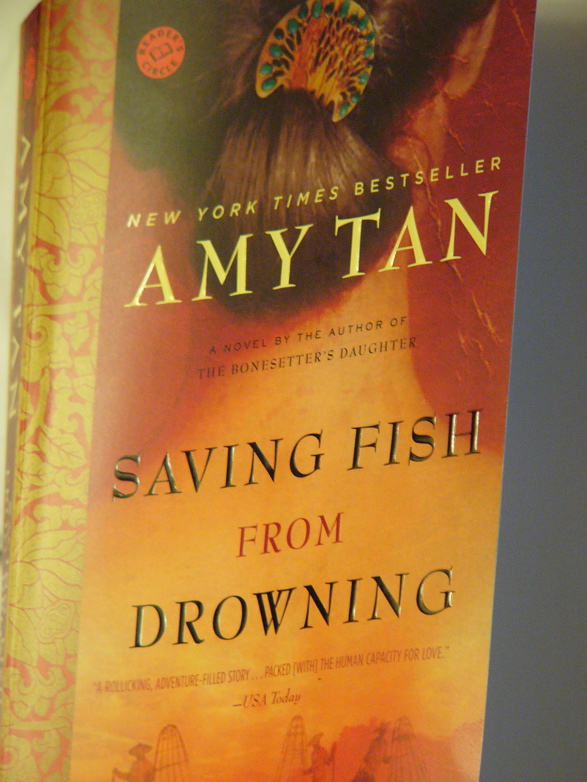
Amy Tan is always a rollicking good read. For one thing, her books focus on that big favorite theme of mine, cross cultural communication – and miscommunication. She has a keen eye, rapier sharp wit, and filets her characters neatly, but humanely.
Saving Fish from Drowning is about a tour group en route to China and Burma, told from the point of view of the tour group organizer – an art and museum patron who dies before the trip begins! She is with the group, however, in spirit – able to see everything, know what people are thinking, but not to intervene. Without her guidance, the group goes desperately awry – and it is funny, but also very very scary. You know something BAD is going to happen, and it isn’t going to be pretty.
Tan writes some great prose. Here is an excerpt about the main character, as she looks back over her life:
“But I ask myself now – was there ever a true great love? Anyone who became the object of my obsession and not simply my affections? I honestly don’t think so. In part, this was my fault. It was my nature, I suppose. I could not let myself become that unmindful. Isn’t that what love is – losing your mind? You don’t care what people think. You don’t see your beloved’s faults, the slight stinginess, the bit of carelessness, the occasional streak of meanness. You don’t mind that he is beneath you socially, educationally, financially and morally – that’t the worst I think, deficient morals.
“I always minded. I was always cautious of what could go wrong, and what was already “not ideal.” I paid attention to the divorce rates. I ask you this: What’s the chance of finding a lasting marriage? Twenty percent? Ten? Did I know any woman who excaped from having her heart crushed like a recyclable can? Not a one. From what I have observed, when the anesthesia of love wears off, there is always the pain of consequences. You don’t have to be stupid to marry the wrong man.”
Whew! Amy! You said a mouthful!
The Golden Crown
I was folding the laundry, and I could hear my Dad scolding my Mom in the next room.
“Those health care workers are for me! They’re not supposed to be ironing, or vacuuming, or helping you, they are supposed to be helping ME!”
She had just finished asking him for a check, so I could take her out to buy a couple new pair of pants. Back in the house now, he is busy retaking lost territory and asserting who’s the boss.
In the car, she weeps.
“What am I going to do?” she asks me.
Inspiration strikes.
“Mom, remember the golden crown you wore at the rehersal dinner, the night before the wedding? I saw it on the top shelf of the linen closet when I was putting things away.”
She looks at me like I am out of my mind.
“Mom, when he talks to you that way, don’t talk back. Just go get the crown and put it on. Don’t say anything, just wear the crown.”
She starts to giggle. Good. Got her laughing.
“Why would I wear a crown?” she demands.
“Because it will drive Dad crazy. Eventually, he will have to ask you why you are wearing the crown, and you can just tell him it reminds you of a time when you were treated with respect, and you were happy.”
At this point, we both dissolve in giggles. I don’t think she will ever put the crown on – she has her own ways of dealing with Dad. But at least she remembers that things have not always been this way, and she can hold her head high.
My husband reminds me that one day, we too will be facing the challenges of being, we hope, very old. He says we will probably be nasty and angry, too at losing control over our lives, at losing independance. Having that kind of input is one of the benefits of having been married to the same person for a long time. Hope someone gives me a golden crown.
He had me from “hello”
I like James Lee Burke so much that when his newest book came out – Pegasus Descending – I went ahead and pre-ordered it in hardcover. We usually wait for books to come out in paperback; they don’t hurt so much when you accidentally fall asleep and the book falls on your face. 😉
My first James Lee Burke mystery was A Morning for Flamingos. Here is the opening paragraph:
“We parked the car in front of the parish jail and listened to the rain beat on the roof. The sky was black, the windows fogged with humidity, and white veins of lightening pulsated in the bank of thunderheads out on the Gulf.
‘Tante Lemon’s going to be waiting for you,’ Lester Benoit, the driver, said. He was, like me, a plainclothes detective with the sheriff’s department. He wore sideburns and a mustache, and had his hair curled and styled in Lafayette. Each year he arranged to take his vacation during the winter in Miami BEach so that he would have a year-round tan, and each year he bought whatever clothes people were wearing there. Even though he had spent his whole life in New Iberia, except for time in the service, he always looked as if he had just stepped off a plane from somewhere else.”
Holy Smokes! He had me from”hello!” This beautiful prose in a detective series?
The main character in the New Iberia (Louisiana) series is Dave Robicheaux, a deeply flawed sometimes-detective. A former drunk, he follows the 12 step programs, attends meetings, and introduces us to the complexities of crime and detective work in the arcane society of deep-South Louisiana. Occasionally, he will fall off the wagon, and you can feel it happening with anticipation and dread. You can hear the seductive siren of Jim Beam calling to him in his weakest moments. I’ve never been a drunk, and I’ve never lived in Louisiana, but thanks to James Lee Burke, I feel like I have. He puts us inside the skin of Dave Robicheaux, for better or worse.
He also takes us inside the social issues – race relations, big oil, organized crime, organized gambling, and all the other issues of louche Louisiana. Burke’s most deeply held convictions come through shining clearly – that crime not only damages the innocent, but damages those who choose the criminal track. His greatest scorn is for those who commit the crimes, and then crave social respectability.
Burke’s books are not only intensely visual, they are deeply sensual – you hear the sounds of the crickets, you taste the crawdads at the celebration on the village green, you suffer the beatings, and your skin crawls when you meet some of the nastiest-every day villains you will ever meet. They all seem to swarm to New Orleans and New Iberia.
This is from Pegasus Decending:
“It was hot and breathless outside, and the sound of dry thunder, like crackling cellophane, leaked from clouds that gave no rain. Through the back window I could see vapor lamps burning in City Park and a layer of dust floating on the bayou’s surface. I could see the shadows of the oaks moving in my yard when the wind puffed through the canopy. I could see beads of humidity, as bright as quicksilver, slipping down the giant serrated leaves of the philodendron, and the humped shape of a gator lumbering crookedly across the mudband, suddenly plunging nto water and disappearing inside the lily pads. I saw all these things just as I heard helicopter blades soaring by overhead, and for just a second, I saw Dallas Klein getting to his knees on a hot street swirling with yellow dust in Opa-Locka, Florida, just like a man preparing himself for his own decapitation.”
Wow. Doesn’t that just take your breath away?
James Lee Burke has won an astonishingly rare two Edgar Awards – Best Mystery of the year. His heros are gritty, there is violence and bloodshed – these are not feel-good stories. And yet, in small moments, there is redemption. His hero is both self-destructive and takes good care of his wild housecat, Snuggs, and his three legged racoon, Tripod. In this book he is on his third wife – I wonder if he kills off his current wife when the author is angry with his real-life wife? He wouldn’t be the first author to take his ire out on his characters!
If you like a good, can’t-put-it-down read, if you can handle the brutality of police work, and if you like a book that transports you to a new culture and new location and makes you feel like you have lived there, then James Lee Burke will delight you. I am so addicted, that I pre-order his books when I know a new one is coming out. He is that good.
Dave Robicheaux Novels:
The Neon Rain
Heaven’s Prisoners
Black Cherry Blues
A Morning for Flamingos
A stained White Radiance
In the Electric Mist with the Confederate Dead
Dixie City Jam
Burning Angel
Cadillac Jukebox
Sunset Limited
Purple Cane Road
Jolie Blon’s Bounce
Last Car to the Elysian Fields
Crusader’s Cross
Pegasus Descending
Billy Bob Holland Novels (Montana deeply flawed, former alcoholic detective a lot like Dave Robicheaux)
Cimmarron Rose
Heartwood
Bitterroot
In the Moon of Red Ponies
Other Fiction:
Half of Paradise
To the Bright and Shining Sun
Lay Down my Sword and Shield
Two for Texas
The Convict
The Lost Get-Back Boogie
White Doves at Morning
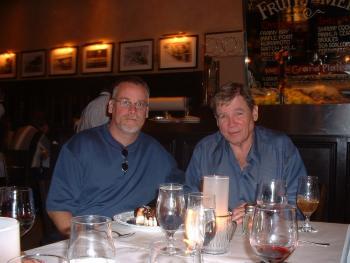
James Lee Burke(R) in New Iberia
We Need to Talk About Kevin
This morning on BBC, as part of the coverage on the horrorific murders in the peaceful Amish country of Pennsylvania, they interviewed Lionel Shriver, author of the award winning book “We Need to Talk About Kevin.”
This is not a recommendation. Shriver’s book, which has won several awards for literary excellence, is not for the faint-hearted. It is a tough, muscular, bleak examination of a similar, fictional incident, written after the Columbine High School massacres.
My best friend and I read this book at the same time – it was a book club selection, paired with another book on a similar theme, “Early Leaving.” We ended up exchanging horrified e-mails every morning, discussing events in the book as if they were a part of our daily life, and speculating on where this was all going.
It is from a mother’s point of view, written to her husband, from whom she is separated after . . . .something . . . We don’t know what that something is. The book unfolds steadily and relentlessly. You want to stop. Truly you do, I am not exaggerating. The book rolls on, so dark, so ominous, you know it is leading up to something truly horrible. You don’t want to look. And you can’t stop reading.
“Why are we reading this???” we asked each other in agony. And we didn’t stop.
“Why did you want me to read this?” your friends will say, as you pass this book along, and then, shell shocked, they will come to you to discuss it. Most often, I didn’t even recommend the book, but friends would overhear other friends talking about it in hushed, horrified voices, and would insist.
The book is the scariest, most real book I have ever read. It hits at the heart of every mother’s secret fears – what if we have done something wrong while raising our child? What if our child turns into a monster? Do we ever really know anyone – our children? Our husbands? Ourselves? We are all so vulnerable in our mothering skills, so quick to blame ourselves for our children’s failings, and this book bravely explores that fear, that vulnerability, without taking the easy way out and giving easy answers.
If you read this book you will find yourselves talking about it months – even years – after you read it. It is a terrifying book.
And after you read it you will understand why my heart is breaking for everyone involved in this unthinkable killing in Pennsylvania. Were I some superstitious person, it would be so easy – it is clearly the devil’s work. I can’t imagine what this man could have been thinking, but he chose his victims – young, innocent girls – with purpose. My heart aches for his wife and children, who will bear this shame for the rest of their lives, and for his parents, who will wonder where they went wrong. My heart breaks especially for the peaceable Amish, revered throughout America for their simplicity and commitment in living their faith, who must try to find a way to forgive the man who took their innocent daughters’ lives.
The World is Not Enough
Whew! I just got back from a week in 12th century France, courtesy of my friend Zoe Olderbourg. (slaps a flea biting her arm) I bought this book, The World is Not Enough, a while back, and have tried to read it several times, but couldn’t get into it. This time, man, I got into it and couldn’t put it down!
We enter at the wedding of Alis to Ansiau, she (slapping the flea on my neck) the 14 year old daughter of Joceran of Puiseaux, Ansiau the son of Ansiau the Elder, castellan of Linnieres, who knows he is dying and wants to see his line continue before he goes.
“The two of them, standing there, were moved, as two children must be who have just been washed, dressed, lectured and left at teh altar by their parents in front of all the guests, their brothers, their sisters, their uncles, their playmates. They were so little alike. He was a boy and she a girl.”
Alis and Ansiau marry and fall quickly in love. (checking the bedding for fleas) They hunt, they go to tournements, Ansiau goes off on Crusade to the Holy Land – twice. Alis runs the daily life of the castle, has twenty pregnancies, 12 children who live. Ansiau has a mid-life crisis. In their late 50’s, we leave them, scratching one another’s flea bites and looking off into the sunset.
Reading this book, you are totally immersed in the daily life of the nobility. The nobility, as it turns out, are the original credit-crazy spenders – they borrowed against their inheiritance, they borrowed against their lands, they borrowed against their doweries. They were constantly short funds, and constantly mortgaging their future for a few baubles today.
The “castle” had a great hall downstairs, where most of the men slept and where cows and horses and chickens and sheep were brought if it got too cold in the stables in the winter, and up a laddar, one great room where there was one big bed for the king and queen and whoever else they invited to sleep there, and a couple other beds, mostly shared by four or five people. This was where ladies slept, and hung out, and embroidered, and (scratching at a fleabite on the ankle) exchanged gossip.
It was a fascinating visit into a world with no running water, no heat, no air conditioning, where babies died at birth as often as not. It was a world where people caught smallpox, and the lucky ones, those who survived, lived the rest of their lives with pock marks like craters on their faces. It was a world where the nobility didn’t read, and there were no books except in the monasteries. Only priests were authorized to read and explain scripture. It was a world where wolves and bear still roamed the forests of France.
The book is set near Troyes and Langres, in the Champagne area of France. Zoe Oldenburg captures the poverty and brutality suffered by the majority of people, rich and poor alike, without sacrificing the human joys and kindnesses which brightened the world, and made life worth living. The book is so realistic and richly detailed that you will be looking for flea bites when you finish!
Driving in Kuwait – Traffic Stop
Sitting on the side of the road waiting to catch speeding drivers, a
Kuwaiti traffic policeman sees a car puttering along at 30 km/h. He thinks to himself, “This driver is as dangerous as a speeder!”
So he turns on his lights and pulls the driver over. Approaching the car, he notices that there are women – two in the front seat and three in the back, wide-eyed and white as ghosts. The driver, obviously concerned, says to him, “Officer, I don’t understand. I was going the exact speed limit, 30 km/hr. What seems to be the problem?”
The policeman, trying to contain a chuckle, explains to her that 30 was
the road number, not the speed limit. A bit embarrassed, the woman
grins and thanks the officer for pointing out her error.
“But before you go, Ma’am, I have to ask, is everyone in this car OK?
These women seem awfully shaken.”
“Oh, they’ll be all right in a minute, officer. We just got off Road 303.”
Recent Comments
intlxpatr on Yellowstone: Old Faithful to C… Michelle on Yellowstone: Old Faithful to C… Cathy on No Grown-Ups in Charge intlxpatr on Waiting for Snow intlxpatr on Waiting for Snow Wikipedia Donate Button

Amazina


Early Voting in Florida


 Here There and Everywhere