The Wire
A couple years ago our son started talking to us about The Wire. He always puts us on to really interesting series. The Wire is an HBO series, like Rome
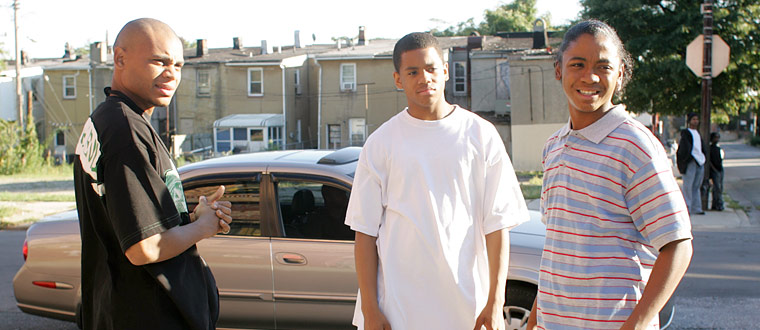
Season 1 starts with a new unit being set up to interdict the drug trade in Baltimore. Season 2 re-unites the team to combat illegal imports and illegal importation of sex slaves out of Eastern Europe and Asia. Season 3, my favorite season of all, is back to the drug trade, but with a difference.
In Season 3, one police district changes the rules. They clean up their neighborhood and send all the drug traders and sex trade workers to one area. The area doesn’t legalize crime – not exactly – but the police leave that area alone. As they explain it to the primary drug dealers, it’s a little like Amsterdam. The homies don’t understand; they call it “Hamsterdam”. I laugh everytime I hear it.
The series doesn’t focus strictly on the police – we get to go inside to watch how the drug dealers organize and divide up the city. We learn how drug lords use big business management modules to streamline their supply and demand, and to stay ahead of the police technology. And they are masters at manipulating the judicial system.
There is brutality. There is sex. There is love and there is betrayal. Sometimes, it isn’t easy to tell who the “good” guys are. There are bad guys who show decent values and there are police and politicians on the take. You get the impression it is probably pretty real stuff. In one season 3 episode, a policeman is shot in the line of duty, and they hold a wake in an Irish pub. They are all very very drunk, and vomiting out in the streets. It isn’t pretty.
And all the same, when each season ends, we can hardly wait for the next one. It is gripping drama, vintage HBO cutting edge production. It keeps you on the edge of your chair. You can read more about The Wire at it’s HBO site, where I just learned that The San Francisco Chronicle calls The Wire “the best television show of the year.”
Good Omens
When our son asked me what I might like for Christmas, I told him “find three really good books that I probably wouldn’t buy for myself.” I can trust him to do a great job because:
1. He has alwasy spent a good amount of time hanging out around books.
2. He has a good idea what I buy for myself.
3. He has a whacky sense of humor.
Good Omens, by Niel Gaiman and Terry Pratchett was one of the books he and his bride gave me, and it was a riotous good read.
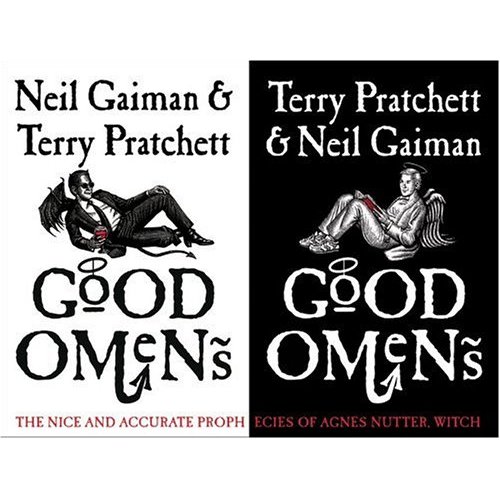
This book is not heavyweight – you can read it on one leg of an airplane trip or two or three nights before falling asleep. It treats a very heavy topic – The End of Days/ the Apocalypse in a very irreverant, very funny way. It treats the characters of good and evil – angels and devils – as real characters. In spite of the lightweight plot, there are some interesting – and hysterical thoughts.
Crowley, the demon/devil who was placed on earth to torment and tempt humans, hopes the end of the world will be a long way off . . . through the centuries, he has grown to rather like people.
Oh, he did his best to make their short lives miserable, because that was his job, but nothing he could think up was half as bad as the stuff that they thought up themselves. They seemed to have a talent for it. It was built into the design, somehow. They were born into a world that was against them in a thousand little ways, and then devoted most of their energies to making it worse. Over the years Crowley had found it increasingly difficult to find anything demonic to do which showed up against the natural background of nastiness. There had been times, over the past millenium, when he’d felt like sending a message back Below saying Look, we may as well give up right now, we might as well shut down Dis and Pandemonium and everywhere and move up here, there’s nothing we can do to them that they don’t do themselves, and they do things we’ve never evey thought of, often involving electrodes. They’ve got what we lack. They’ve got imagination. And electricity, of course.
The Anti-Christ is born, and cosmic events get underway. But . . .this being Earth, and bureacracies being as they are, things get screwed up. I’m not going to get specific; it’s part of the droll fun these authors have with us as they write this book. The Four Horsemen appear, but they ride motorcycles, and Pestilence has been replaced by Pollution.
As the situation heats up and the end of the world as we know it nears, Crowley ends up with an unlikely ally, the angel Aziraphale.
Now as Crowley would be the first to protest, most demons weren’t deep down evil. In the great cosmic game they felt they occupied the same position as tax inspectors – doing an unpopular job, maybe, but essential to the overall operation of the whole thing. If it came to that, some angels weren’t paragons of virture; Crowley had met one or two who, when it came to righteously smiting the ungodly, smote a good deal harder than was strictly necessary. On the whole, everyone had a job to do, and just did it.
Now, throw into the mix an ancient book of totally accurate prophesies that are sufficiently oblique to be disasterously mis-interpreted, The Nice and Accurate Prophesies of Agnes Nutter, Witch. “Nice” in this case refers to its oldest meaning, exact. And, while the prophesies ARE exact, finding out their exact meaning is another hilarious exercise.
All in all, a great read, a lot of fun . . . and underneath the fun, some little pinpricks of thought about human beings, the human condition, and our treatment of our world and one another that needle you long after you finish reading. Son, thanks, you chose a great book.
Dying Laughing: Al Qaeda in Seattle
My niece, Little Diamond has found a SATIRICAL article (I can’t figure out where, it is not The Onion ) on Al-Qaeda buying property in Seattle. If you know Seattle, and the pride Seattleites take in civility, friendliness, and neighborliness, then you, too, will die laughing. Click on A Diamond’s Eye View of the World for your grin to start the week.
And a part of me thinks – isn’t this what we are supposed to be doing? Be kind to our neighbors? Isn’t it the only way to interrupt the spiraling cycle of hatred and violence? Sometimes, an unexpected kind word changes everything – I know it has in my own world.
Book Meme – Too Much Temptation
Friday mornings in Kuwait can be VERRRRRY quiet. Today, I explored Technorati, and found people who have linked to me. One was PearLady and oh, what fun, she published a Book Meme.
I don’t do tags. I don’t do memes. Oh well, she found my weak spot. Here goes. Please read all the way to the bottom.
Hardback or paperback? I prefer paperback, just because I read all the time and paperback is more portable. And because I like to pass it along, and paperback is cheaper. But I buy hard cover when it is brand new from an author I love and I can’t wait.
Amazon or brick and mortar? Hands down Amazon, although if I am in the states, I can’t resist Barnes and Noble, and I always spend money there, and Half Price Books. Both ruin my weight allowance when I come to fly back to Kuwait.
Barnes & Noble or Borders? Either. Both. And all the little independent book sellers, too.
Bookmark or dog-ear? Bookmark is preferable, but occasionally I dogear sections I want to blog about. (Gasp) – occasionally I even underline.
Alphabetize by author, alphabetize by title or random? First by subject, then by author, but not by title.
Keep, throw away, or sell? Part with a friend??? Ah well, sometimes it is necessary. I even keep shelves of books for people to borrow, or to take. I buy multiples of the best ones, and trust that they will find new friends when they depart from my shelves.
Keep dust jacket or toss it? I take it off to read the book, then put it back on and give the book away. Hardcover books are too heavy to ship!
Read with dust jacket or remove it? Oops, see above.
Short story or novel? I love them both. Good science fiction often comes in short stories, stories you can remember years later. And novels – those are the friends that you keep around.
Collection (by same author) or anthology (by different authors)? Collection by the same author, because I am particular and don’t like all authors.
Harry Potter or Lemony Snicket? I prefer Harry Potter. I don’t know why, but I find Lemony Snicket a little creepy.
Stop reading when tired or at chapter breaks? Prefer to stop at chapter breaks, but sometimes I fall asleep and just have to give it up.
‘It was a dark and stormy night’ or ‘Once upon a time’? For me, once upon a time. Love history.
Buy or Borrow? Mostly buy, but sometimes the book I want to read isn’t available for sale, and have to borrow.
New or used? Both. Some books you can’t find new.
Buying choice: book reviews, recommendation or browse? Often look for specific authors, always looking for recommendations and often ask fellow travellers who look absorbed in what they are reading.
Tidy ending or cliffhanger? Tidy endings are nice, and I also find that the ones that end without resolution are the ones I think about the longest.
Morning reading, afternoon reading or nighttime reading? Any time. Usually, I use it as a carrot to make me get work done and projects finished, so normal is later in the day.
Standalone or series? Both. I like the Dickensian continuity of series.
Favourite series? Dorothy Dunnet’s Niccolo series. Fascinating characters and I learn so much. Great, vivid images, takes you back to the mid 1400’s.
tag…you’re all it…show me the meme! (If you don’t have a blog, you are welcome to comment below, or cut and paste.)
Donna Leon: Read and Savor
When I tell you about Donna Leon, I am really introducing you to a friend. I can’t remember when we met, but I can tell you that I seek her out whenever I can. Just listing her books, I realized there were several I hadn’t seen and I ordered them immediately, from the Amazon re-sellers.
“Why the resellers?” you are asking. Donna Leon is not that easy to find, in the United States. Some of the books in her series seem to have been printed only in the UK, which is a pity, because The Donna Leon books really need to be read in order.
While they can be a quick read, they are better read slowly and savored. It’s not that hard. Her humor is subtle, sometimes even sly. Commissario Guido Brunetti, her main character, lives in Venice. He has a family, a sweet wife – Paola, and a daughter and a son. He eats Venetian meals, he lives in an illegal Venetian apartment, he has a glass of wine or two with his lunch. It helps to read the books in order, as his children grow from childhood to teen-agers, and to grow older with him as he solves his cases.
But in Donna Leon’s books, solving the cases is not the goal. As often as not, even while Brunetti solves the case, justice is not served. The books are about the living conditions and social realities of life in Venice, and in Italy. The books are about painful subjects – child prostitution, traffic in women, blood diamonds and African immigrants, and about art fraud and Mafia crime and big business. And the book is about Venetian and Italian interconnections, so that some crimes just disappear, some evidence just disappears, and Brunetti’s dunderhead of a boss tells him to just look the other way.
While each book is deceptively short, and written in clear, simple language, the books are richly complex, weaving a myriad of details into each page.
Thanks to Donna Leon, I know what it is like on a cold, rainy day in Venice, when the water rises and you have to try to walk on raised boards to get where you are going. I know what it is like to have a family emergency and the police vaporetto is in use elsewhere and to try to figure out the fastest way to run home, crossing bridges, grabbing a taxi, complicated by the canal system and tourist infestations in Venice. I know when policement get together for lunch in Venice, you don’t talk business until AFTER you have finished your exquisite pasta with truffles, accompanied by a glass or two of the fabulous house wine. Donna Leon has taken me there.
In Death and Judgement, the book I just finished, Brunetti is called by a police sergeant who has arrested a former police sergeant and wants Brunetti to come to the station. Brunetti’s conversations with the arresting sergeant always require a lot of patience:
(Brunetti) “Did the people in Mestre tell you to make out an arrest report?”
“Well, no, sir,” Alvise said after a particularly long pause. “They told Topa to come back here and make a report about what happened. The only form I saw on the desk was an arrest report, so I thought I should use that.”
“Why didn’t you let him call me, officer?”
“Oh, he’d already called his wife, and I know they’re supposed to get one phone call.”
“That’s on television, officer, on American television,” Brunetti said, straining towards patience.
We’ve all been there. Dealing with those who think they understand, and their understanding is . . . imperfect.
In another part of this book, in which the major issue is the big business of trafficking in women for prostitution, Brunetti is having a conversation with his wife:
Paula pulled gently on his hand. “Why do you use them?”
“Hum?” Brunetti asked, not really paying attention.
“Why do you use whores?” Then, before he could misunderstand, she clarified the question. “Men, that is. Not you. Men.”
He picked up their joined hands and waved them in the air, a vague, aimless gesture. “Guiltless sex, I guess. No strings, no obligations. No need to be polite.”
“Doesn’t sound very appealing,” Paola said, and then added “But I suppose women always want to sentimentalize sex.”
“Yes, you do.” Brunetti said.
Paola freed her hand from his hand and got to her feet. She glanced down at her husband for a moment, then went into the kitchen to begin dinner.
If you are reading that interchange too quickly, too superficially, you will totally miss the significance of the last sentence. If you have been married a long time, you will totally understand that a whole lot happened. This is one of the things I love about Donna Leon.
Death at La Fenice
Death in a Strange Country
Dressed for Death
A Venetian Reckoning
Acqua Alta
The Death of Faith
A Noble Radiance
Fatal Remedies
Friends in High Places
A Sea of Trouble
Willful Behavior
Uniform Justice
Doctored Evidence
Blood From a Stone
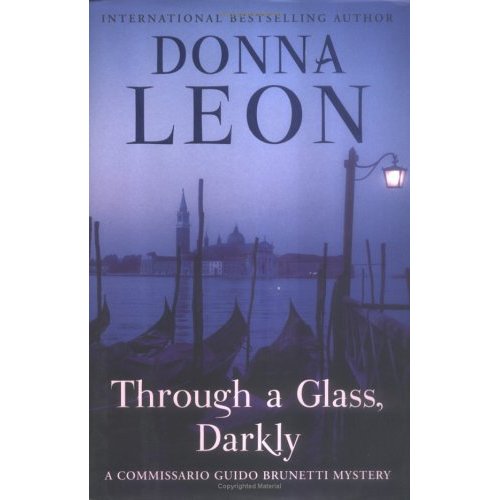
Through a Glass Darkly
Stephen King and Hearts in Atlantis
You can be talking with serious people and watch their eyes change when they find you read Stephen King. I refuse to back down. Yep, I read Stephen King. I think he is a brilliant author, some books better than others, but when I am reading, sometimes I can feel my blood move faster through my veins as I wait for a life-threatening situation to resolve itself.
I can trust Stephen King. He taps into who we really are. I can also trust that most of the good guys will still be standing at the end, and most of the bad guys will meet a truly horrible and well-deserved death. I can trust that when bad things happen to good people, other good people will gather round, band together and the gestalt of all that willingness to help one another will prevail against the darkness.
The scariest book I ever read by Stephen King didn’t have any monsters, per se. It didn’t have the Walking Man, or any Wolves of Calla or any great evil, other than the evil that lurks in the human heart. The scariest book I have ever read by Stephen King was Hearts in Atlantis.
Hearts in Atlantis wasn’t even a novel, it was several shorter stories combined in one book. But the title story, Hearts in Atlantis, was about addiction. Not just any old addiction, either, but an addiction I had experienced.
It was my sophomore year in university. I had sailed through the trauma of freshman year with grace, great grades, I felt very confident. That summer, back home, I had taken bridge lessons, and holy smokes – I loved the game. It all made sense to me, and I loved figuring the probabilities and the possibilities, who had what card, how I could finesse that card, how I could WIN. I loved winning.
During the summer after my freshman year, I played a lot of bridge. So it was no wonder, when I got back to school, that I discovered a whole world of bridge players. Early in the morning, before my first class, I would head for the student union and pick up a coffee – and often a game.
The problem was, if I had a particularly good hand, the little devil on my shoulder would whisper “if you skip your class, you can win this hand!” and the bigger problem was – I would listen. I could afford to skip a class here and there, I did the homework. But through the year, I spent more and more time playing bridge and less and less time in the library. At the end of my sophomore year, my grade point average had fallen one full point.
That got my attention. I really wanted academic success. I spent my junior and senior years desperately working to get my grade point average back up to an acceptable level. Once the GPA falls, however, it only inches back up incrementally. It took almost straight A’s to undo the damage I had done to myself the year of bridge playing.
After graduation, I fell back into bridge playing on the duplicate level. But after a while, I noticed that while I travelled from place to place, it was the same smoke-filled room in every new city where we ended up, surrounded by a vampire-like culture that slept a lot of the day and only came alive at night. I also noticed that most of the conversations were about “the one that got away” – how such and such a hand might have been played best. Yawn. Yawn. Yawn. So one day, I just walked away, and never looked back.
Like all addictions, from time to time I hear bridge calling. From time to time I will enter a friendly game – party bridge, but it is no longer irresistable, no longer so seductive, so attractive. Thank God. Reading Stephen King brings back the terror of addiction.
Jean Plaidy and Courts of Love
My last day back in Seattle, I allowed myself a trip to the nearest Barnes and Noble. It was a shorter trip, only ten days, and full of family and family gatherings, centered around my father’s recent death. The days sped by, each full and exhausting.
I had already packed most of my bags. I do this so I know how much, if any, room I have. That way, I won’t buy too many books. I know myself. I know my vices. There is a part of me that says “how can there be too many books? How can there be too much of such a good thing?”
And then I am stuck trying to shovel books into an already overpacked suitcase, stuffing more into my stuffed backpack, shoving, re-arranging, tossing out old underwear to make way for yet another book.
I only bought a few books, one of which was Courts of Love by Jean Plaidy. If you follow this link, you will find many reviews of this book that disagree with my opinion, and gave this book almost five full stars.
I have always held Eleanor of Aquitaine in great awe. Born in the Languedoc region of France, she was raised in a court full of literature and poetry, visitors from distant places bringing news. She was educated, and exposed to rule. She was expected to inheirit the rich province of Aquitaine until a younger brother was born, but, as was not uncommon in the times, he succumbed to a childhood illness, and she once again became the inheiritor of a fabulously wealthy and desirable province, the Aquitaine.
And if being the inheiritor of Aquitaine wasn’t enough, she was also thin, and elegantly beautiful, and educated, and she had spirit. She never felt herself limited by being a woman.
She first married Louis, King of France, who was nowhere near her match. She insisted on accompanying Louis on his crusade to free Jerusalem (failed) and upon her return to France met Henry, the heir to the English throne, secured a divorce from Louis of France based on the fact that they were distantly related, and then quickly married Henry, who was even less distantly related. She did as she wished.
Henry was several years younger than Eleanor, and they were both full of fire, and ambition. They had force, and strategic vision; as a couple, they were unbeatable. Eleanor gave birth almost yearly, mostly sons, and was happy until she discovered her husband’s multiple infidelities. His inability to be a faithful husband created a bitterness in her heart, a wall between the two of them. From time to time, Henry had Eleanor imprisoned to keep her out of his way. He believed she had turned his sons against him. But many times, he would need her, and call her out of her captivity to help him. It’s a bitch, being married to a king.
Where am I going with this review, you might ask?
I finished the book, and all I can wonder is how Jean Plaidy took such a fiery woman, a sensual and vibrant woman, and made her so wooden? It must be some problem in me, as the other reviewers give the book a much higher rating than I would, and I wonder if they are confusing their awe with the subject (Eleanor) with the quality of the book?
Or maybe I have become so used to Phillipa Gregory’s treatment that I am spoiled for Jean Plaidy? When you read The Queen’s Fool, The Other Bolyn Girl and The Constant Princess you are there, you are in their world, feeling their thoughts. The dialogue is rich and lively, you are surrounded by sensory clues, smells, feels, tastes – the world is richly created, and when you finish the book, you feel like you have travelled in time, as if you were really there.
Not so with Courts of Love.
I would rate this book far lower, because I DO admire Eleanor of Aquitaine, and I think she deserves an equally lively, richly sensual treatment. I want to know her world, I want to peek inside her mind and experience a little of what she experienced. I want Philippa Gregory to write about Eleanor of Aquitaine! Jean Plaidy, in my opinion, took an extraordinary woman, and make her less vibrant, and just a little drab. A grave injustice, in my book!
The Mysteries of Blogging
Every blogger will tell you – you can’t anticipate what your audience will love. There are pieces I labor over – mostly the travel pieces – and I get some comments, and the hits are steady over time, but nothing spectacular.
And then I will just jot off something in a hurry, and it will get hit after hit. When WordPress first came out with it’s snap-to feature, I wrote just a short blurb, and it gets several hits a day, even almost a month later.
But yesterday, all of a sudden, I started getting hits on Unexpected Pleasures a very abbreviated book report I wrote back in January on a book about belly dancing. If it were just one or two or three or four, I would have just thought it were a fluke, but it was 17, then 26, and finally 31 – in one day!
Most of the hits were coming from one referrer, and when I tried to check the referrer, it had some posts that were not public, so if she has mentioned my review, it is not visible to me. I wrote to Little Diamond who had reviewed the book, and she said she, too, had received a huge number of hits yesterday on that one obscure review.
It is a total mystery. No comments, just people peeking in. I don’t know what they are looking for. I don’t know why that one entry interests them. It is a blogging mystery.
iPhone Obsolete
(From The Onion, and therefore SATIRE)
CUPERTINO, CA—Only a month after the much-heralded announcement of the iPhone, Apple CEO Steve Jobs confirmed that his engineers were already working around-the-clock on the touchscreen smartphone’s far-superior replacement. “We looked at [the iPhone’s] innovative user interface, the paradigm-shifting voicemail, the best-in-class mobile browser, and we realized we could make all that seem ridiculously outdated by the time the product becomes available to customers in June,” said Jobs, who described the project as “Apple reinventing the iPhone.” “When the second-generation iPhone comes out this fall, we want iPhone users to feel not just jealous, but downright foolish for owning such laughably primitive technology.” Jobs also hinted that the second iPhone device would not be compatible with existing Mac computers, third-party peripherals, or any future Apple products.
Arabesk and Jon Courtenay Grimwood
I am blessed with friends and family who share books, and Pashazade came into my life courtesy of Little Diamond, my globe-trotting glamourous niece. She always leaves a trail of books as she wanders hither and yon. Some of them are just too deep for me, or need too much attention. This series, the Arabesk Trilogy by Jon Courtenay Grimwood almost fell in that category.
I missed a clue. I kept trying to start the first volume, Pashazade, but was having a problem keeping up with the plot and the technology. I would go back and read again, trying to figure out what I was missing. I know I’m living in Kuwait, but I read! I keep up with the news! When did all this new stuff happen?
And then I just happened to look at the cover of the book and it all became clear – it is a parallel world, it is science fiction, and once I started reading and accepting all the strange words and implants as literary license, the book became fun, and intriguing, and very very hard to put down. And then I had to wait while the second and third volumes (Effendi and Felaheen) because the series is that much fun.
The main character, Ashraf al-Mansur has a complicated past. The plot is complex enough, but Ashraf doesn’t know who he is, we don’t know who he is, and we have to take time out from the plot now and then to get another piece of the puzzle. Fortunately, the puzzle pieces are in all kinds of cool places – Alexandria (but a different Alexandria from current day Alexandria) and the Sudan) but a slightly different Sudan, with a prophetic edge to it) and Seattle and a mental institution, and Tunis and the desert oases . . . oh, this is a lot of fun.
So Ashraf starts out in Alexandria, with his Aunt Nafisa who lives in this marvelous old madresa in Al Iskandriya, but then his aunt is killed, Ashraf becomes guardian to an exceedingly bright and introverted young girl, and falls in love with a young woman with whom he refused an arranged marriage.
Ashraf has friends in high places, is believed to have relations in high places, and although he gets into the worst situations, he has WASTA and a lot of problems just disappear. (For my non-Kuwaiti readers, wasta is sort of like the-power-of-connection-and-who-you-know-and-maybe-who-owes-you-a-favor-or-might-be-open-to-a-little-encouragement). These connections get people killed in the Arabesk trilogy, threaten chaos and mutilation and disaster, and take you on a great ride. Oh! Did I mention this is also a mystery, romance and has political intrigue, too?
It’s modern day – or maybe a year or two in the future – and with a huge twist in the universe here and there, so that it seems familiar, but it isn’t. There are dark shadows and differences that can be critical. And it has a whole raft of “who’s your ally?” kind of situations. It is a richly textured romp, and you are along for the ride. Don’t fight it, just lean back and hang on.
It is pure escapism, no great deep thoughts here. When the trilogy ends, however, you remember the characters, you remember the plots, and you still grin about them months later.
Pashazade, the first volume, is available through Amazon in hardcover and paperback. Paperback starts under $5.00, through used vendors.
Effendi is available from $10.20, new paperback edition.
Felaheen is available new and used from $8.99

Recent Comments
Kitchen on Isiais: Winding Down intlxpatr on Shampoo Ginger tigerbutterya0c5ff1d… on Shampoo Ginger intlxpatr on British Soldier Kidnapped, Esc… John on British Soldier Kidnapped, Esc… Wikipedia Donate Button

Amazina


Early Voting in Florida


