Where is Terekeka, South Sudan?

Today the church prays for the diocese of Terekeka, in the South Sudan. I have never heard of Terekeka – have you?
When I looked for it on Google Maps, it didn’t have any information. When I went to The South Sudan and then googled Terekeka, it came up with a reference, and I had to go to this website to find it – they had a map.
The organization who put up the map, Harvesters Reaching Nations, has two locations in the southernmost part of South Sudan, the newest nation on earth. They are building hospitals, and taking in orphans. If I hadn’t gone looking, I would never have heard of the good works they are doing, saving lives, changing lives.
This is what they say:
We currently serve more than 190 orphans in two locations in South Sudan – Yei and Terekeka. Our school in Yei provides a Christian education to more than 500 students. In addition to our school-age orphans, more than 400 children from surrounding villages attend our school.
The Harvesters campus in Yei consists of 90 acres of land donated by the South Sudan government. Since our beginning in 2001, we have built homes, dorms, classrooms and other facilities within a fenced-in campus. We use the land we own beyond the fencing for planting and growing corn, tomatoes and other vegetables for use in the orphanage.
Harvesters’ campus in Terekeka, South Sudan opened in 2010. At this campus, we currently provide care for 44 orphans, but will grow to 80 in the near future. We have built homes, dorms and a clinic within a five acre, fenced-in campus. Additional facilities, including a church and school classrooms, will be built in the near future as the needs and resources dictate.
To do this, they sold everything they owned, and moved to the South Sudan, and used the proceeds from selling everything to build the hospitals and schools. I bet they are the happiest they have ever been, and the most thoroughly engaged in life they have ever been.
Airline Fees We Love To Hate
Frequent Flyer.com reveals a new survey identifying the fees airline travelers hate the most:

It goes without saying that of the many gripes travelers currently have about flying, the so-called ancillary fees charged by the airlines for, well, everything they can disaggregate from the core service would rank near the top of the most-despised list.
But of the multitude of such fees, which irk travelers the most?
A new survey conducted by Skift shines some light into that dark corner of the travel experience.
According to a poll of 1,000 adults, the most and least reviled airline fees are as follows:
Bag check fees (50.1%)
Seat selection fees (18.4%)
Inflight WiFi fees (12.4%)
Inflight food or beverage fees (9.7%)
Early boarding fees (9.4%)
Although there was general unanimity across age and other groups, there were a few interesting demographic disconnects:
Wealthier travelers were less bothered by bag fees but more bothered by seat-selection fees.
Less wealthy travelers were notably less bothered by inflight meal/drink fees.
Younger flyers were more bothered by inflight WiFi fees.
Travelers 65 years and older were most bothered by inflight meal/drink fees.
Saudi Arabia Inching Toward Allowing Women to Drive
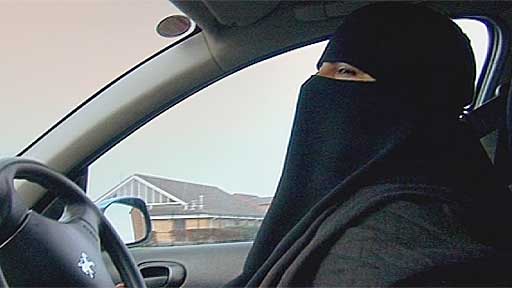
Saudi Arabia is the only country in the world where women are not allowed to drive. There is an irony – there is no law banning women from driving. They do not issue driver’s licenses to women, they arrest women seen driving, and they do not – officially – teach women to drive. Thank God for good fathers and brothers and husbands, who take their daughters, sisters and wives to isolated places and teach them, often for the good of the family in case of an emergency.
Saudi women drive in Europe, in the USA – they drive everywhere except in their own country. The government shows signs of wanting to allow women to drive (officially) but they seem hesitate to stir the wrath of the religious police who believe – based on nothing – that God forbids women to drive. Recently, the head of the Saudi religious police said there is nothing in Islam that forbids a woman to drive. What’s the hold-up guys?
This article is from AOL Auto News, where you can also see a video of a woman driving in Saudi Arabia with cars passing her and waving encouragement:
Saudi Arabian Women To Protest Driving Ban On Oct. 26
Saudi society is slowly inching toward more equality, but driving is still disallowed for women

When Farha was a young girl, about seven years old, her mother told her something that rocked her world: She said women could drive.
For Farha, a 24-year-old writer who has spent her entire life in Saudi Arabia, this was akin to a Western child learning the truth about Santa Claus. She’d only ever seen men behind the wheel in her country, where women are not permitted to drive. The revelation was slightly scandalous, a little bit funny, and totally paradigm-shifting.
It took another two years for Farha (who didn’t want to be identified with her last name due to the sensitivity of the issue in her home country) to decide she would, one day, learn how to drive a car. And, for good measure, she’d learn how to ride a bike. Two modes of transportation that have been banned to women and girls for most of Farha’s lifetime.
On Oct. 26, women in Saudi Arabia will engage in the third protest against the female driving ban by getting behind the wheel anyway. The protest won’t be widely attended, because the vast majority of women in Saudi Arabia don’t know how to drive. There are no driving schools in the Kingdom that cater to females, and state agencies will not issue a driver’s license to a woman.
“Since there is no justification for the Saudi government to prohibit adult women citizens who are capable of driving cars from doing so, we urge the state to provide appropriate means for women seeking insurance of permits and licenses to apply and obtain them,” a petition at the protestor’s web site reads. The web site has been blocked within Saudi Arabia, yet there are still a thousand or so names on the petition. The few women who are adept behind the wheel learned while living overseas, often in the U.S., Canada, or nearby Bahrain or Dubai.
In urban areas, women are chauffeured around by male relatives or paid drivers, or they pay for taxis. In rural areas, the driving ban generally isn’t enforced, and more women drive out of necessity. One woman who was recently videotaped disobeying the ban got support from her fellow (male) drivers, who passed by and gave her the thumbs up, a sign that society may be more willing to accept an eventual change.
Learning to drive
Farha tackled the task of learning to drive first by reading about the process. She edited a story on how to drive for her high school newspaper, and from that she felt she learned quite a bit. Then her father spent some time talking to her about how cars work, and the theoretical aspects of driving. He took her out for a few hours over the course of a few days, letting her drive around their neighborhood in the coastal city of Jeddah. But she never ventured onto the main roads.
She also learned the basics of riding a bicycle, but doesn’t consider herself adept at either skill. When the ban is lifted, she said she’ll sign up for classes at a real driving school.
“I always thought this ban would go away when I was 18,” she told AOL Autos. We connected with her through a publication where Farha wrote, under a pseudonym, about the driving ban. “And I’m still hoping it will be lifted when I am 26.”
“I always thought this ban would go away when I was 18,” Farha said. “And I’m still hoping it will be lifted when I am 26.”
Not driving makes life’s everyday movements difficult. Sidewalks aren’t available, so walking isn’t realistic. Farha’s father has mostly been responsible for driving her and her mother around, but five months ago he got into a car accident and broke his leg. He is currently unable to drive. Farha feels the burden of her father’s injury. If she could drive, she said, she could bring him to doctor’s appointments and help him get out of the house. Instead, the family is home-bound unless they pay someone to bring them places.
Farha has hired a part-time driver to take her to and from work. It costs about 2,000 to 3,000 Saudi riyals (or around $530 to $800) a month for a driver. That’s about the same amount that women make earning minimum wage in Saudi Arabia, prompting many women to just stay home.
“A lot of women don’t feel the incentive to work and hire a driver,” she said. “It doesn’t make any economic sense.”
Some women opt for the public bus system, but that makes women from conservative families feel nervous because it exposes them to strange men – the exact problem the country is trying to avoid by banning women drivers. Taxis run the same problem, putting females into cars with strange men. “It doesn’t make sense,” Farha said.
Farha is considering signing up for a karate class, but she’ll have to pay her driver for more hours or take a taxi to the classes. On top of the class fees, the price of getting to and from karate starts to seem like a silly amount of money, she said.
And she worries she’s spending too much money on herself. She could spend 30 riyals on a taxi each way, or she could donate that money to a family in need. Or spend that money sending school supplies to girls in other countries.
“It’s a difficult decision to make every time,” she said.
One unintended consequence of the rule strikes Farha as incredibly unsafe: Women often let their 13-year-old sons drive them around when they are out of other options. Farha’s observation was backed up by a U.S. intelligence research note made public by Wikileaks, which noted that these young drivers sometimes get into very serious accidents.
Weird, long history
Oddly enough, there isn’t any actual law in Saudi Arabia banning women from driving. In 1991, the late Grand Mufti of Saudi Arabia, Sheik Abdulaziz bin Baz issued a fatwa prohibiting women from driving. A fatwa is different from a government law, in that only followers of the religious leader who issues the fatwa are obliged to follow that law. But given the intertwined nature of Saudi Arabia’s government and its religious leaders, the fatwa took hold. The government agency in charge of issuing driver’s licenses will not issue one to a woman. Saudi Arabia’s court system relies heavily on fatwas from the Grand Mufti.
So, in essence, the religious order became a rule that everyone follows, even though it’s not enforced by the Saudi government. The government just makes it impossible for women to get drivers licenses, and if they catch women driving, they make them sign a pledge promising they won’t do it again.
Abdulaziz bin Baz said at the time that the ban would protect women, because allowing women to drive would put them out in society alone, leaving them to mix with men. If women were stranded by the side of the road due to a flat tire or car problem, they could end up being assaulted or raped by a man who came to help them, argue critics who still uphold the ban.
A reporter for the Christian Science Monitor recalled a 2012 conversation with a man in Saudi Arabia about what would happen if the ban was lifted. “What would happen if a woman got in a car accident, he asked? Then she would be forced to deal with the male driver of the other car, a stranger, with no oversight – a problematic situation in a country where male guardianship of women is deeply entrenched.”
Just last week, a Saudi cleric came under fire for claiming women were damaging their pelvises and causing birth defects by driving. Sheikh Saleh bin Saad al-Lohaidan argued women should put reason ahead of their hearts, because it “could have negative physiological impacts as functional and physiological medical studies show that it automatically affects the ovaries and pushes the pelvis upward.”
Saudi society is slowly inching toward more equality for women. Just this week, four women became attorneys. Earlier this year, women were allowed to work in retail establishments that sell underwear and bras, taking away the embarrassment for women who’d previously had to purchase these items from male salespeople.
Since around 2006, the Saudi government has been indicating it would consider lifting the driving ban if society deems it acceptable for women to drive. Diplomatic cables released by Wikileaks showed the U.S. government has been paying attention to this issue, and putting some pressure on the Saudis to change their ways.
Will of the people?
But it’s clear the Saudi government won’t make any controversial moves: “This has to do with the will of Saudi society,” said Saudi Justice Minister Muhammad Al-Issa in a TV interview in April, according to a translation by the non-profit group MEMRI. “If Saudi society, given its culture, wants women to drive, it’s fine. But if society has any reservation for whatever reason, that’s fine too.”
Farha said she’s holding out hope that the rules will change, as soon as possible. But the change will depend greatly on men’s attitudes.
“More men certainly support it now, but … they have their concerns,” she said. And “some are outright hostile to the idea.”
When she does get her license, Farha said she’d like to try driving a sports car. It doesn’t matter what kind, she just would like to try driving something fun. But she’d rather be able to walk or bike to work, even if she could drive.
“Cars feel suffocating inside,” she said. “But the whole idea is to lift this difficulty for women. I hope it happens soon.”
In sharing this story, and others, with our readers we hope you are inspired to Raise Your Hand for girls’ education, helping us spread the word on this crucial effort.
Kuwait Divorce Rate “50% and Rising”
How did I miss this truly excellent article in the Arab Times?
Divorce Rate In Kuwait 50pc … And Rising
Huge Increase Seen In ‘Cheating’
A good, productive and stable marriage is built on one’s ability to love someone else and make sacrifices for that person. We in this region as a whole are sometimes very materialistic and usually wealthy. Many a time couples get married for the wrong reasons. Sometimes because marriage is the new “thing to do”, it’s merely the new toy. Maybe the honeymoon period is the only highlight of the whole affair.
Lawyer Waleed Khaled Al-Dousari was talking to the Arab Times on marriages in Kuwait, exploring the causes behind the increasing rate of divorces in the society. “The rate of divorce in Kuwait has reached more than 50 per cent, and the number is still on the rise,” he adds.
Q: How would you describe marriage in Kuwait, and have the trends changed?
A: Traditionally, the ideal marriage was tribal, related families encouraging their offspring to marry cousins or other relatives in order to increase and strengthen the tribe, or occasionally to marry into another tribe in order to heal rifts between families. Another reason for such marriages was that families knew the background of the partner.
As is the case in some Latin countries, young couples in the region are allowed to meet under the watchful eyes of a chaperon. In Kuwait, however, the marriage is arranged without any part of the girl’s body (including her face) being seen by the prospective groom, who must rely on the reports of his female relatives as to his wife’s appearance.
There are three main elements in an Arab marriage. First, the groom must discuss and agree the dowry with the bride’s father. This might include gold, jewelry and clothing and is usually of considerable valuable. After the dowry settlement, comes the actual marriage contract, which is conducted by a legal or religious representative.
The bride is asked in the absence of the prospective groom if she agrees to the marriage and this question is then put to the groom. After the agreement, the groom joins hands with his future father-in-law and, with two witnesses present, the marriage becomes official.
However, there’s another stage before the couple actually meet as man and wife: the wedding party. Celebrations are segregated, with the women in one section of the house or private ballroom and the men in another. Finally, on the last night of celebrations, the couple meets, accompanied by all their friends, and eventually leaves for their honeymoon. On their return, they either live with the groom’s parents and become members of the extended family or – as is increasingly the case – set up a separate home by themselves.
According to Sharia, a Muslim man may have four wives, provided that he can look after them materially and treats them equally. This practice is now dying out, however, not only because only a few can afford it, but also because women are becoming more independent and assertive and many refuse to accept it.
In fact, a Muslim woman can insert a clause in the marriage contract that restricts her husband from marrying another woman for as long as the contract is valid. The wife also retains her own name after the marriage.
Although gender roles have always been clearly defined in the Islamic world, with the man as ‘provider’ and the woman as ‘nurturer’, both the man and the woman are increasingly going out to work, although this is much less common in Saudi Arabia, where there are restrictions on women working, except in culturally ‘acceptable’ occupations such as medicine and teaching. However, many Saudi men are reluctant to marry doctors and nurses, who have physical contact with male patients.
A man can divorce his wife simply by saying ‘I divorce you’ three times. He can rescind the divorce if this was done in the heat of the moment, but only if the wife agrees (and only on three occasions though). On the other hand, even if a wife has a good reason to seek a divorce (e.g. if her husband has been unfaithful, abused or deserted her, or engaged in criminal activity), she must go to a court for the case to be heard.
The husband must maintain a divorced wife and any children from the marriage if the wife is unable to support herself. He can claim custody of any sons when they reach a certain age; however, the priority is given to the mother, but this still depends on the sect of the couple. A female divorcee usually returns to her family, and few remarry.
Although a Muslim woman may not marry a non-Muslim man unless he converts to Islam, the reverse isn’t the case. Non-Muslim women are often pressurized into converting, and there have been many cases of foreign women marrying Arabs and then discovering that the local culture and lifestyle are unacceptably restrictive. It should also be noted that, in the event of the breakdown of such a union, the children are usually kept by the husband in his home country.
Expatriate workers can usually be married in the Gulf, provided that they meet the civil and religious requirements of their home country. Embassy and consulate staff sometimes performs civil marriage ceremonies, again provided that certain requirements are met. Religious ceremonies can be arranged, but only in countries that allow churches or similar non-Muslim places of worship.
Although many young citizens in Kuwait are still seeking the blessing and help of their parents for choosing life partners, some youngsters in Kuwait prefer finding their partners without parental guidance and mediation. This approach is the result of cultural interactions. This changing trend has become quite noticeable in the countries of the region.
Q: Why are we currently encountering an increasing rate of divorce in the country?
A: A good, productive and stable marriage is built on one’s ability to “love” someone else and make sacrifices for them. We in this region as a whole are sometimes very materialistic and usually wealthy. Many a time couples get married for the wrong reasons. Sometimes because marriage is the new “thing to do”, it’s merely the new toy. Maybe the honeymoon period is the only highlight of the whole affair.
In some cases, both partners may be in need of intimacy and so they get married to have that kind of intimacy. There’s nothing wrong with that. In fact in this arrangement, there is one good thing in that youngsters feel that they should “get married first” before “becoming intimate with anyone”. That’s a noble and encouraging thought.
But after the first few months or the first couple of years, we start noticing the first signs of trouble, and you see both sides contemplating the “D” word. They think “I don’t need this.” And rightly so, they really don’t need it. Both are wealthy, both have high paying jobs, their rooms in their parents’ houses are still empty and perhaps are still untouched with their original furniture in place and in tact.
Other reasons, however, come along due to the change in the definition of marriage as a whole from the perspective of both men and women. Even families in Kuwait today no longer feel shameful that their daughter or son is divorced. Some families are actually encouraging their daughters to divorce, because sometimes that divorce gives her more financial gains than she already has.
In Kuwait, it is a huge problem when a man cannot provide a luxurious life to his wife. It is his duty to provide her with the maid, driver, shopping every now and then, and the ability to travel at least on a yearly basis.
However, not all Kuwaitis are able to provide this kind of lifestyle for their wives and children.
Another issue is that of cheating. There is a huge increase in the percentage of cheating wives and husbands. It has become so easy for a husband or wife to cheat on each other, especially because marriages are neither based on love nor respect.
The high divorce rate in Kuwait insinuates that we are too spoiled to remain stuck to our marriages.
So what will happen to us in say 50 years? The world will be less dependent on our oil, and the oil will become less abundant anyway. We will become poorer in general. Isn’t that right?
We will have less materialistic “toys” to play with. And therefore we will be less spoiled. And I think we will tend to stay committed to our marriages more.
Our men will start actually doing some “work” to earn a living. And less of these jobs will be suited to women, and women will have less incentive to leave the umbrella of her husband’s (modest) financial security. Just like the times of our grandfathers and grandmothers.
Now, this might be a bleak picture, but maybe with less material distractions, and with healthier marriages, I only see us becoming happier people.
Q: So what happens, when a couple comes asking for a divorce?
A: From my experience as a lawyer, the usual scene when two couples ask for a divorce is that they come to my office in the image of two enemies who completely hate each other, and cannot even stand being in the same room with each other.
The women usually tries to file as much cases against her husband to get all the rights that she wants, and the man tries to do the same thing.
Q: What is the role of Shari’a law in divorce cases? Is there a difference between the rights that a woman may take if she was Sunni or Shi’ite?
A: In Kuwait we abide by the Islamic Sharia law when it comes to marriage or divorce. Therefore, when a couple asks for a divorce, usually there are certain proceedings that should take place.
To apply for divorce, you should be of sound mind and be able to make your own choices.
The first step the couple should do is to register the case at the Moral and Family Guidance Section at the court.
Shortly afterwards, a counselor will meet the couple and discuss their problems. They are then given a three-month time to try and solve the problems, before beginning the divorce process.
If the couple, or either of them, still insists on divorce, the papers will be forwarded to the court for the judge to study the case. The judge will discuss it with the couple and listen to the witnesses. It could take a couple of sessions before the judge makes his decision. The couple needs to attend all the proceedings.
A woman may be granted a divorce if she can prove that her husband has physically hurt her or mentally tortured her. A woman also may sue for divorce if her husband abandons her for a period of three months, or if he has not taken care of her needs or that of their children.
The law allows women to obtain a khula – a separation, when she returns the dowry to the husband.
The Sharia Court will accept a divorce lawsuit from Muslim men or Christian or Jewish women married to a Muslim and apply the Islamic laws.
If the divorce applicants are both Muslims, but from different countries and are residents in Kuwait, they will be divorced according to the administrative laws in their country, or the Kuwaiti law, whichever they wish. While Sharia is same in all Muslim countries, there are a few administrative differences between the various schools of thought.
If the couple is from the same country, the law of their country, will be applied or the Kuwaiti law may be applied, if they so wish.
If the husband is a Muslim and the woman is not a Muslim, the Kuwaiti laws will be applied, or the law of the country where they had got married will be applied.
If the couple is non-Muslim, they can seek divorce according to the law of their country, at the embassy or consulate.
There is not much difference between the two sects when it comes to divorce; there is only one main difference, and that is a Sunni women can take the custody of her children without ever having to return them to their father. However, the father can be with his children on previously arranged days.
According to the Shi’ite sect, the father can take his children when the children reach the age of seven or above, by which time the children too have a say in that kind of decision.
However, even the issue of custody is abused by some women, who place a huge financial burden on the man under the pretext of asking for the children’s upkeep. Some women do so despite being financially well off themselves.
Q: Can you give us examples of some divorce cases in Kuwait?
A: One intriguing divorce case involved a woman who divorced her husband on their wedding day because she found out at the wedding ballroom that groom had not made the costly arrangements that she had asked for, and instead chose a reception that cost much.
Some women get divorced because they see divorce as a financial gain for them. Men are sometimes forced to provide his divorcee with a house, a maid, a driver, and a monthly alimony for her and her children.
In many cases the reasons are very silly, which makes it very difficult for us lawyers to take any stand on the issue. For example one woman filed for a divorce because she didn’t like the way her husband made sounds while eating.
Q: What do you think is the role of society to tackle the problem of increasing divorce rates? How can education help reduce the rate of divorce, or help couple’s understand and appreciate the true value of marriage?
A: In light of high rates of divorce cases, social authorities should play a role in educating youth about the basic criteria for sound marriages. Grassroots associations and the media in the Gulf have to educate families about potential negative aspects of coercing young males and females to marry relatives, in the first place, and also how arranged marriages can have very harmful results on both couples, especially as they might not be suitable for each other.
Most of the persons I have met expressed desire to marry non-relatives, thus affirming the idea that parents must refrain from coercion. Moreover, to by taking away the right of youngsters to choose their life partners is against religious values and common sense.
Some official reports estimate that divorce cases in Kuwait are at 50 percent, and the phenomenon has been linked to diverse factors related to modern-day developments in the country, and western concepts and values and post-oil-boom social transformations.
Most males in Kuwait tend to get acquainted with the would-be “soul mate” personally while the majority of the females favor the parents’ role in this regard.
In Kuwait, we are starting to have many welfare societies that are helping couples to refrain from divorce as much as possible. However, the problem is that we do not have the right education concerning marriage in the country.
Neither families nor schools educate children on marriage or even give them the chance to fall in love and make their own choices of who they want to get married to.
We need to set a proper age limit for marriage for both males and females, because some are getting married at a very young age, such as 17 and 18. This is also leading to the great increase in divorce rates. The proper age for males to get married should be between 26 and 30, and that for the females should be above 20. However, that is only my opinion.
As to the qualifications of the would-be partner, the couples should believe in commitment. They should be educated. There is the need to be attracted to the physical appearance of each other and not be forced to get married to people they don’t know. Then of course financial capacities and employment are important factors. These are not the most important issues though.
biography
Born in 1983
Khaled Al-Dousari: currently a divorce lawyer at the Mohamad Saleh Al-Sabti, Lawyer Office. Started at the office in January 2007.
Graduated from the Academic Law Institute in Jordan in 2006.
Until today he has taken up to 300 cases of divorce.
By: Rena Sadeghi
God Vs. Worry; God Wins
One of the things that adds texture to my life, and helps keep me on the straight and narrow (and that takes a LOT) is reading the daily lectionary every single morning of the year, before I do anything else. Normal days, I access it from my computer, traveling or appointment days, I can access it from my iPad or iPhone. It’s like a little extra fence that helps keep me safe from myself and my own creativity when it comes to evil.
There is another side, the blessing side. In one of the bible studies I attend, we learn, over and over that God blesses the believer. You don’t have to be perfect – and it’s a good thing, because none of us are. If you want to see how much God can love a sinner, just read your bible. Sin is one of the main characters, right along side Abraham and Sarah, Job, Lot, and especially King David.
But in my life, I have seen wondrous things, and I have had some totally WOW moments when God has blessed me beyond any prayer I could have raised. One of those moments was showering under a waterfall near an oasis in the Tunisian desert. Two others happened this year, and these were blessings that stopped me in my tracks with their timing and aptness. First, we got an unexpected tax refund which arrived in our account just in time to cover the big expensive air conditioning system on the main floor when it broke and had to be replaced.
Second, when we were looking for the last few thousand dollars to help us buy a new car (we prefer to pay cash) we got another tax refund – we had asked that they re-look taxes for a move, and they allowed the moving expenses. We had waited almost a year for that decision; we had waited so long we had pretty much forgotten and given up on it. I mean tax refunds – it’s a never-never land, it all seems so arbitrary. You can have a perfect case, and it can be denied for a reason you’ve never heard of.
God’s timing is perfect. His sense of humor is breath-taking. The funds we needed poured into our hands just when we needed them, in just the right amount.
Matthew 6:25-34
25 ‘Therefore I tell you, do not worry about your life, what you will eat or what you will drink,* or about your body, what you will wear. Is not life more than food, and the body more than clothing? 26Look at the birds of the air; they neither sow nor reap nor gather into barns, and yet your heavenly Father feeds them. Are you not of more value than they? 27And can any of you by worrying add a single hour to your span of life?* 28And why do you worry about clothing? Consider the lilies of the field, how they grow; they neither toil nor spin, 29yet I tell you, even Solomon in all his glory was not clothed like one of these.
30But if God so clothes the grass of the field, which is alive today and tomorrow is thrown into the oven, will he not much more clothe you—you of little faith? 31Therefore do not worry, saying, “What will we eat?” or “What will we drink?” or “What will we wear?” 32For it is the Gentiles who strive for all these things; and indeed your heavenly Father knows that you need all these things. 33But strive first for the kingdom of God* and his* righteousness, and all these things will be given to you as well.
34 ‘So do not worry about tomorrow, for tomorrow will bring worries of its own. Today’s trouble is enough for today.
The Alaska Gulf: Chenega Bay to Yakutat All Mountains and Glaciers

The sky is full of sunshine as we awake, and we are surrounded by snowy
mountains, gleaming in the sunshine. It is unspeakably beautiful. We eat our breakfast cereal and head outside, after listening to the complaints of a group of Texans at the next table.
“It’s like a bunch of hobos!” one man says of the aft viewing room, “I’ve never seen anything like it! They have their big rucksacks and sleeping bags and pillows all over the place!” The sign says you can only sleep from 8 at night to 8 in the morning, but they are still sleeping.”
Well, or still trying to sleep. Many of these people are living on a shoestring, and the ferry is the only way they can get to the doctor, or get their children to school, or get to their next job. They are frugal, bringing on their own food, trying to keep their kids dressed and entertained. The Alaska Maritime Highway has compassion on these travelers, provides a solarium area where campers can set up tents, rent sizable lockers. There are other areas, the aft lounges, where campers without tents can sleep, and this is where the Kodiak football team and cross country teams hung out. There is a children’s play area where families sleep right under the “no camping” signs, and the ferry personnel look the other way. It’s an Alaskan thing. It makes me proud to be born Alaskan. People take care of one another, and cut each other some slack.
Honestly, people, you are on the wrong ship! This is the Alaska Marine Highway, not the Diamond Princess!
We are drawn to the decks, compelled by the gorgeous scenery. Each snow covered mountain has its own beauty. We meet a Canadian couple; she has to excuse herself when the topic turns to food – she is seasick. A Kansan with whom we have a long conversation is also suffering a little from seasickness, and AdventureMan shares a Dramamine tablet with him.

We have already made our reservations for the great Celebration in Juneau next year. It’s the reason we made the trip this year. As we started talking about the Celebration, which is only held every other year, we had so many ideas we knew we needed to take a reconnaissance trip so we would know how easy – or hard – travel is, and have a better idea what we want to see and do. This ferry trip has been a great introduction, and we have questioned many many Alaskans and travelers as to what they have seen and enjoyed.
Some things we know we don’t want to do. We don’t want to be on buses, going through Denali, following one bear. We don’t want to be on a cruise ship. We don’t want to travel in a group. I kind of think that RV rental might be a good way to go, but the truth is, I prefer sleeping in a bed, and I don’t like cooking in camping situations. As I see it – and I’ve done a lot of camping – camping is hard work. It’s all the things you have to do at home – shop for food, prepare food, cook food, and clean up – done under the most primitive conditions. I think we will look for an auto rental and good lodges and restaurants along our route, whatever that route is, after the Celebration in Juneau.
What is the Celebration? The Celebration is sponsored by Sealaska, and brings together all the tribes and clans of Alaskan native inhabitants to share knowledge. They wear their ceremonial clan robes and have a parade down the Main Street of Juneau. They gather to do the dances, transmitting their legends and language to their children. They share craftsmanship; the baskets, the robe making, wood carving, totems. If it is anything like the desert festivals we attended in Tunisia, it is also a time when the young men and women of different – but related – tribes can eye one another with marriage in mind, good for getting some healthy variation in the gene pool. I can hardly wait to see this.
I had planned to call the car rental again as soon as I hit Chenega Bay or Yakutat, so we will have a rental car when we hit Juneau again, but . . . I can only laugh now at my presumption . . . there is no service at either. My phone does not work. It is frustrating.
When I pack for trips, the worst of my obsessive-compulsiveness kicks in. I make lists, and check them – more than once. I order the right maps, and go over them. I check and double check reservations.
This trip, assuming I could just call and use my Google Maps and GoogleEarth, I didn’t worry. Information, in this wonderful day of technology, is literally at my fingertips. This has been a great lesson in just how dependent we all are on technology, and how devastating it is to learn that it cannot always be relied upon.
Dolphins frolic, so many and so hard to photograph as they move so quickly!

When I saw this, I thought at first it was part of the tsunami trash drifted over from Japan, and then I saw it was a flat barge loaded with containers. So loaded with containers, you can hardly see the barge:

A brief shift in the weather:


We are out on the deck most of the day, just watching this grandeur pass by, huge mountains, gigantic glaciers, parading past, one after another:


Someone said this is Mount Saint Elias, but I don’t think it is. None the less, it was a very high mountain, higher than anything near. This is the very tip. I spent hours trying to find a time when the whole mountain would come into view . . .

This is about the best I could get, the most of the mountain exposed:

This is what I was dealing with for hours as we passed – it truly is a huge mountain, but weather shifted often, and it was shrouded in these thin grey bands of clouds:

We passed several glacier fields, and I think this one was the Behring:

We are nearing Yakutat, the sun is setting:

In Yakutat I have just enough coverage to make a car reservation before we hit the sack.
Kodiak and the Trip to Homer on the M/V Kennicott
Landed in Kodiak early, so early I don’t know how early. We rise, dress and WOW, it is not raining, you can even see some sun, so we decide to walk into Kodiak. As we debark, we ask which way and the Terminal Manager Steve catches up with us and offers us a ride. It warmed my heart, this is exactly what I wanted AdventureMan to see, this is what I grew up with, the Spirit of Alaska 🙂 taking care of one another. Alaska is like one big community.
On the way, he gives us an overview of Kodiak and we talk about the big problem with the lack of ferry transportation this year with the Tustemena out of service. Tustemena is the M/V ferry that runs down the Aleutian Islands all the way to Dutch Harbor/Unalaska, another trip we want to make. It’s been a big loss for all tour related businesses on the peninsula and for Kodiak. The Kennicott will make a run down in late September to help get people, goods and vehicles out who are waiting for transportation.
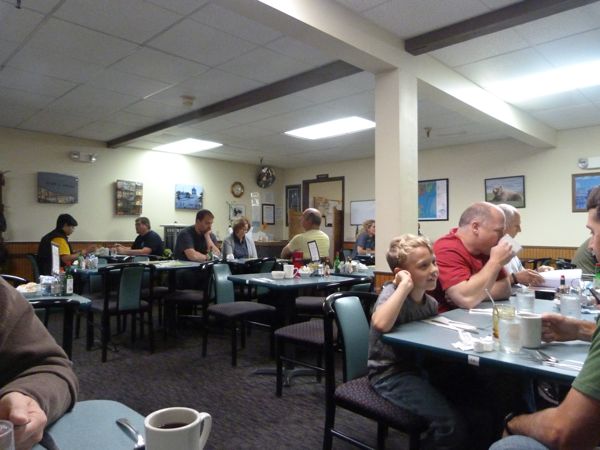
We told him we wanted some breakfast, and he dropped us off at the Shelikof Lodge, full of locals. I actually asked where he eats breakfast, and he said “at home” and we learned why – this is a very busy man. He runs back and forth between all the terminals, solving problems, making sure everything is going smoothly. In Kodiak, people work hard.
At the Shelikov, AdventureMan has biscuits and gravy, and I have reindeer sausage for the first time, with a hot, spicy aftertaste I love. Even though it is very lean meat, I only eat half.

Shelikov Lodge Breakfast Specialties:

AdventureMan’s Biscuits and Gravy

Reindeer Sausage

We hike to the Russian Orthodox Church, passing a tidal wave marker on the way. It is scary – it seems rather high on the island. That tidal wave came a long way up.


We walk through Kodiak, past all the processing plants, to ship. It’s not a very big place, but you can see a lot of pride in what they do.





LOL, loading the cars and trucks and containers and R/Vs takes hours and there is a long long line of walk ons, first the Kodiak football team, all in their jerseys, and then the Kodiak high school cross country team in bright lemon yellow wind breakers. Maybe 150 students, good kids, full of energy, whooping it up.

We leave Kodiak late, but these late departures seem to be built into the ferry schedule – they never know where they will need more time.


These meadows look so Swiss to me.


Just like Life of Pi! Fish jumping out of the water in tens and hundreds, flying!

Whales to feed on those crops of fish


Approaching the Barrens, as the sea passage gets a little rougher. This is one of the windiest, roughest areas to traverse

There is a whole new dynamic on board with the high-schoolers. They are hilarious! All that teenage energy! We hit rough water just after going through the Barrens, and the kids are standing on the forward deck waiting for huge waves to break over the bow. When the huge waves break, it is like in a movies, a sheet of water, and the kids hang on and come up laughing.




We go through rough waters about an hour, then things calm down and . . . the sun comes out! Gorgeous scenery, all the way to Homer.
Approaching Homer Spit on M/V Kennicott:

Docked almost exactly at 9, as scheduled. We waited for the kids to all get off, then walked to the terminal, where there are NO taxis waiting. When I made reservations, I had asked the hotel if they send a shuttle to the ferry terminal and they said no, they didn’t have a shuttle, but there are always taxis waiting. No. No, that is just not true. There are not always taxis waiting.
We see a couple we had met onboard, they ask where we are going and we tell them the Driftwood Inn and he says “that’s where we’re going!” and offers to split the cab they have already called with us. Perfect! Except when we get to the hotel he discovers that he is NOT staying at the Driftwood Inn, and he has to call the taxi driver back again to take him to the Heritage Inn.
It’s sad, I think this is a generational thing, he kept calling himself a dummy. We are raised in a different generation, to call someone a dummy is just so negative and so degrading that we would never do it, not to anyone else, not to ourselves. We might say “How could I be such an idiot!?” but we were horrified – and a little heartbroken – to hear this really nice man berate himself like that.
What was cool is that we ran into them again – twice – before twenty-four hours had passed, once at the car rental agency, and once again at the Homer Farmer’s Market. They had settled in quickly, only a couple blocks from where we were staying and were having a wonderful time, heading out that afternoon in route to Prudhoe Bay. (I’m impressed.)

Our room is lovely, spacious and welcoming, with gorgeous shared spaces and a view to die for, maybe 230 degrees of glaciers, mountains, Kachemak Bay and driftwoody beach. The sun is setting, the air smells clean; sea, salt and pine, the skies are clear, and oh, life is sweet.
Sunset from Driftwood Inn, Homer, Alaska:

USPS Scam
One tiny word, one great big tip-off. It’s almost always in the prepositions 🙂
From Courier Ethan Reilly ethan_reilly44@malagaserviciotecnico.com

A Great Deal of Profit – for Me!
—–Original Message—–
From: Aisha Shukri Ghanem
To: Recipients
Sent: Mon, Sep 2, 2013 9:59 am
Subject: Re: Uprising
Hi there,
My name is Aisha daughter of Shukri Ghanem. We fled from Libya last year
following the uprising against Col Muammar Gaddafi.
My father’s death is no longer news but my mother’s deteriorating health made me want to do this despite the fact that I barely know you. I believe in my late father’s philosophy: “risk many things in life; but not life itself”. I believe in taking business risk with strangers mainly to escape the spotlight and I hope you can do this for my family.
I have a rather unusual proposition having found you on the internet in
desperation and I am here to surprise you with this extreme offer you can easily afford. It’s something that I believe could provide a great deal of profit to you if you give me a moment of your time. I would like to propose a joint venture with you because we are looking at investment opportunities in your area and we need a local presence to carry out our plans. Everything depends on you and ultimately how self-motivated you are.
Of course, you may simply have reservations about teaming with us when you don’t know my family. Please be assured that I want nothing more than what could be a very profitable joint venture and a lasting business relationship.
Please write back and I’ll explain everything in full detail.
Thank you.
Best Regard,
Aisha Ghanem.
Homecoming and Judgement
Home again, home again and the daily grind recommences. Giving up a vacation is hard for me. Part of it is my compulsiveness; my mind whirls with my must-do’s and almost all the things I really like to do are not on the must-do’s list. Must do’s include things like laundry and dishes, tasks which are mindless and I don’t really mind too much, but they get in the way of what I want to do, which is to tell you about our Alaska adventure 🙂 Before I can do that, in addition to the must do’s, I also have to transfer all my photos from my iPad to my computer, which makes blogging so much easier, so once again – something hard before something fun.
Am I grumbling? Sorry if it sounds that way. I love vacations. I love other people doing the cooking and cleaning and me just responsible for putting clothes on and figuring out what I want from the menu. I love the stimulation of seeing new things, smelling new smells, walking new paths.
As soon as we got home, we dropped our bags and zipped as fast as we could over to our son’s house to visit with him and his family. I got to hold my new little granddaughter for the entire visit – oh, so such a sweet tiny baby.
Yesterday, I hit the early service, hit the commissary, put all the groceries away and then AdventureMan and I took our little grandson to Red Robin, where . . . . in a momentary loss of my senses, I ordered a hamburger, my second of the year. It didn’t taste as good as my 4th of July hamburger, serves me right. But we had such a fun time, and here is the grand triumph – our grandson is using a napkin! He is wiping his hands and mouth with a napkin, not with his hand or arm! Wooooo HOOOOOO! He chats and makes conversations, oh, he is so much fun.
So today, on! On! Get that laundry done! Get those files transferred!
Yesterday’s sermon was on the tendency of the most Christian of Christians to want to sit in the highest seats, and Jesus’ words to choose the lower seat and allow the host to move you up, giving you honor, rather than choosing a high seat and being asked to move lower so that someone of higher distinction can have your seat. Father Neal Goldsborough mentioned that he sees the saving-of-the-seats, the tipped chairs, the stretched out handbags all the time, and we were all squirming. We’re all guilty. It was a great sermon.
From today’s Forward Day by Day readings on the daily lectionary:
James 2:1-13. Mercy triumphs over judgment.
It’s easy to pass judgment—she’s too liberal or too conservative, his clothes are too cheap or too rich, she doesn’t believe the “right” theology, his values aren’t properly aligned, etc. As easy as passing judgment is, it can do a lot of damage.
All too often, this judgment happens in churches. Comparisons and assessments pop up, and the pews that should be a safe haven for all people become trial benches. A 2007 Barna Group survey found that 87 percent of young non-Christians perceive present-day Christianity as judgmental—and half of their churchgoing counterparts answered the same. I’d be surprised by these numbers if they didn’t ring so true with perceptions among my own friends and acquaintances.
Putting mercy above judgment does not mean moving into a slippery relativism. It means embracing the radical Good News of Jesus and living as a conduit of Christ’s love to the world. Today’s passage from the book of James precedes tomorrow’s familiar proclamation, “So faith by itself, if it has no works, is dead” (2:17). An act of mercy is a work of faith, a witness putting Christianity in its rightful place.
Recent Comments
intlxpatr on Shampoo Ginger tigerbutterya0c5ff1d… on Shampoo Ginger intlxpatr on British Soldier Kidnapped, Esc… John on British Soldier Kidnapped, Esc… intlxpatr on British Soldier Kidnapped, Esc… Wikipedia Donate Button

Amazina


Early Voting in Florida


