START with Sea of Poppies, by Amitav Ghosh
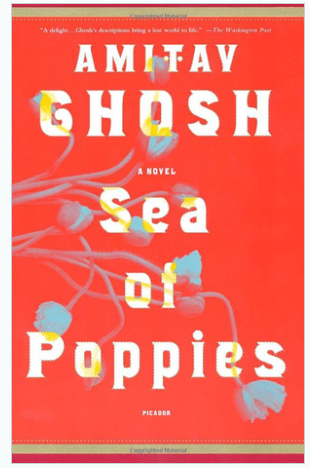
I recently wrote a book review on River of Smoke, by Amitav Ghosh, which held me spellbound, so riveting that I had to order Sea of Poppies, which is actually the first volume of the trilogy. I had heard a review of River of Smoke on NPR and although it was written as the second volume in a trilogy, it can be read as a stand-alond.
Yes. Yes, it can be read as a stand-alone, but it is so much easier, I can state with authority, if you read them in order. Once I started Sea of Poppies, I also discovered an extensive glossary in the back, several pages, a list of the words, annotated with suggested origins, and it adds so much color to an already brilliantly colored novel. Much of both novels uses words from many cultures, and words that have been formed by another culture’s understanding of the words (some hilarious). If you like Captain Jack Sparrow, you’re going to love the polyglot language spoken by ship’s crews from many nations trying to communicate with one another. It can be intimidating, but if you sort of say the words out loud the way they are written at the beginning, you begin to find the rhythm and the gist of the communication, just as if you were a new recruit to the sea-going vessels of the early 1800’s. I loved it because it captured the difficulties encountered trying to say the simplest things, and the clever ways people in all cultures manage to get around it, and make themselves understood.
Sea of Poppies starts in a small Indian village, with one of the very small poppy gardens, planted on an advance from an opium factory representative, thrust upon the small farmer, with the result that most small Indian farmers converted their entire allotment from subsistence foods to poppies. Ghosh walks us through an opium processing factory, which is a little like walking through the circles of hell. We meet many of the characters we will follow in River of Smoke, and learn how this diverse group bonded into one sort of super-family through their adventures – and misadventures – together.
It is an entirely engrossing work. Sea of Poppies was short listed for the Man Booker award, and was listed as a “Best Book of the Year” by the San Francisco Chronicle, Chicago Tribune, Washington Post and The Economist. The theme is the opium trade, leading to the Opium Wars, with China, and is a chilling indictment of how business interests manipulate a population’s perceptions of national interests to justify . . . well, just about anything, in the name of profit.
The theme is woven through human stories so interesting, so textured, so compelling, that you hardly realize you are reading history and learning about the trade, cultures, travel, clothing, traditions, religions, food, and motivations as you avidly turn the pages.
I can hardly wait for the third volume. Get started now, so you’ll be ready for it when it comes out!
New Virus in Middle East Kills 50% Victims
I found this on WeatherUnderground News this morning. What scares me is that there may be more victims, many more, shepherds who work with goats, laborers, people thought to have very bad colds, maybe even pneumonia, who don’t have the kind of money to fly to London to be diagnosed. If one man spread it to two family members, imagine how many people he had contact with on that airplane flying to London.
LONDON, Feb 27 (Reuters) – The emergence of a deadly virus previously unseen in humans that has already killed half those known to be infected requires speedy scientific detective work to figure out its potential.
Experts in virology and infectious diseases say that while they already have unprecedented detail about the genetics and capabilities of the novel coronavirus, or NCoV, what worries them more is what they don’t know.
The virus, which belongs to the same family as viruses that cause the common cold and the one that caused Severe Acute Respiratory Syndrome (SARS), emerged in the Middle East last year and has so far killed seven of the 13 people it is known to have infected worldwide.
Of those, six have been in Saudi Arabia, two in Jordan, and others in Britain and Germany linked to travel in the Middle East or to family clusters.
“What we know really concerns me, but what we don’t know really scares me,” said Michael Osterholm, director of the U.S.-based Center for Infectious Disease Research and Policy and a professor at the University of Minnesota.
Less than a week after identifying NCoV in September last year in a Qatari patient at a London hospital, scientists at Britain’s Health Protection Agency had sequenced part of its genome and mapped out a so-called “phylogenetic tree” – a kind of family tree – of its links.
Swiftly conducted scientific studies by teams in Switzerland, Germany and elsewhere have found that NCoV is well adapted to infecting humans and may be treatable medicines similar to the ones used for SARS, which emerged in China in 2002 and killed a tenth of the 8,000 people it infected.
“Partly because of the way the field has developed post-SARS, we’ve been able to get onto this virus very early,” said Mike Skinner, an expert on coronaviruses from Imperial College London. “We know what it looks like, we know what family it’s from and we have its complete gene sequence.”
Yet there are many unanswered questions.
Spotlight on Saudi Arabia, Jordan
“At the moment we just don’t know whether the virus might actually be quite widespread and it’s just a tiny proportion of people who get really sick, or whether it’s a brand new virus carrying a much greater virulence potential,” said Wendy Barclay, a flu virologist, also at Imperial College London.
To have any success in answering those questions, scientists and health officials in affected countries such as Saudi Arabia and Jordan need to conduct swift and robust epidemiological studies to find out whether the virus is circulating more widely in people but causing milder symptoms.
This would help establish whether the 13 cases seen so far are the most severe and represent “the tip the iceberg”, said Volker Thiel of the Institute of Immunobiology at Kantonal Hospital in Switzerland, who published research this month showing NCoV grows efficiently in human cells.
Scientists and health officials in the Middle East and Arab Peninsular also need to collaborate with colleagues in Europe, where some NCoV cases have been treated and where samples have gone to specialist labs, to try to pin down the virus’ source.
“One Big Virological Blender”
Initial scientific analysis by laboratory scientists at Britain’s Health Protection Agency (HPA) – which helped identify the virus in a Qatari patient in September last year – found that NCoV’s closest relatives are most probably bat viruses.
It is not unusual for viruses to jump from animals to humans and mutate in the process – high profile examples include the human immunodeficiency virus (HIV) that causes AIDS and the H1N1 swine flu which caused a pandemic in 2009 and 2010.
Yet further work by a research team at the Robert Koch Institute at Germany’s University of Bonn now suggests it may have come through an intermediary – possibly goats.
In a detailed case study of a patient from Qatar who was infected with NCoV and treated in Germany, researchers said the man reported owning a camel and a goat farm on which several goats had been ill with fevers before he himself got sick.
Osterholm noted this, saying he would “feel more comfortable if we could trace back all the cases to an animal source”.
If so, it would mean the infections are just occasional cross-overs from animals, he said – a little like the sporadic cases of bird flu that continue to pop up – and would suggest the virus has not yet established a reservoir in humans.
Yet recent evidence from a cluster of cases in a family in Britain strongly suggests NCoV can be passed from one person to another and may not always come from an animal source.
An infection in a British man who had recently travelled to Saudi Arabia and Pakistan, reported on Feb. 11, was swiftly followed by two more British cases in the same family in people who had no recent travel history in the Middle East.
The World Health Orgnisation says the new cases show the virus is “persistent” and HPA scientists said the cluster provided “strong evidence” that NCoV, which like other coronaviruses probably spreads in airborne droplets, can pass from one human to another “in at least some circumstances”.
Despite this, Ian Jones, a professor of virology at Britain’s University of Reading, said he believes “the most likely outcome for the current infections is a dead end” – with the virus petering out and becoming extinct.
Others say they fear that is unlikely.
“There’s nothing in the virology that tells us this thing is going to stop being transmitted,” said Osterholm. “Today the world is one big virological blender. And if it’s sustaining itself (in humans) in the Middle East then it will show up around the rest of the world. It’s just a matter of time.”
Auction Navajo First Phase Chief’s Wearing Blanket Game Changer
You’ve got to watch this video for the best thing that will happen to you all day. Just when you think you hit bottom, something wonderful can happen. It happened to this man, who had lost a lower leg in an accident, was living on $800 plus disability and wondering how he was going to survive. (Thank you, Hayfa, for sending this!)
Published on Jul 11, 2012
This stunning Navajo First Phase Chief’s Wearing Blanket made headlines when it sold for 1.8 million dollars at John Moran Auctioneers’ June 19th sale in Southern California, smashing the previous world record of $522,500 for a similar blanket. An example of the rarest type of the earliest phase of Navajo blankets, it emerged from obscurity when it was brought into Moran’s free appraisal clinic by a man whose family handed it down through the generations, casually using it around the house. The sale of this museum-quality treasure has dramatically changed his life, and made auction history.
Video from JohnMoranAuctions:
La Sur Consommation
Thank you, Hayfa, for sending this truly horrifying video about our food, and where it comes from . . .
La surconsommation from Lasurconsommation on Vimeo.
Catastrophic Vanishing Water in Middle East
I found this article in the Weather Underground News this morning:
DOHA, Qatar — An amount of freshwater almost the size of the Dead Sea has been lost in parts of the Middle East due to poor management, increased demands for groundwater and the effects of a 2007 drought, according to a NASA study.
The study, to be published Friday in Water Resources Research, a journal of the American Geophysical Union, examined data over seven years from 2003 from a pair of gravity-measuring satellites which is part of NASA’s Gravity Recovery and Climate Experiment or GRACE. Researchers found freshwater reserves in parts of Turkey, Syria, Iraq and Iran along the Tigris and Euphrates river basins had lost 117 million acre feet (144 cubic kilometers) of its total stored freshwater, the second fastest loss of groundwater storage loss after India.
About 60 percent of the loss resulted from pumping underground reservoirs for ground water, including 1,000 wells in Iraq, and another fifth was due to impacts of the drought including declining snow packs and soil drying up. Loss of surface water from lakes and reservoirs accounted for about another fifth of the decline, the study found.
“This rate of water loss is among the largest liquid freshwater losses on the continents,” the authors wrote in the study, noting the declines were most obvious after a drought.
The study is the latest evidence of a worsening water crisis in the Middle East, where demands from growing populations, war and the worsening effects of climate change are raising the prospect that some countries could face sever water shortages in the decades to come. Some like impoverished Yemen blame their water woes on the semi-arid conditions and the grinding poverty while the oil-rich Gulf faces water shortages mostly due to the economic boom that has created glistening cities out of the desert.
In a report released during the U.N. climate talks in Qatar, the World Bank concluded among the most critical problems in the Middle East and North Africa will be worsening water shortages. The region already has the lowest amount of freshwater in the world. With climate change, droughts in the region are expected to turn more extreme, water runoff is expected to decline 10 percent by 2050 while demand for water is expected to increase 60 percent by 2045.
One of the biggest challenges to improving water conservation is often competing demands which has worsened the problem in the Tigris and Euphrates river basins.
Turkey controls the Tigris and Euphrates headwaters, as well as the reservoirs and infrastructure of Turkey’s Greater Anatolia Project, which dictates how much water flows downstream into Syria and Iraq, the researchers said. With no coordinated water management between the three countries, tensions have intensified since the 2007 drought because Turkey continues to divert water to irrigate farmland.
“That decline in stream flow put a lot of pressure on northern Iraq,” Kate Voss, lead author of the study and a water policy fellow with the University of California’s Center for Hydrological Modeling in Irvine, said. “Both the UN and anecdotal reports from area residents note that once stream flow declined, this northern region of Iraq had to switch to groundwater. In an already fragile social, economic and political environment, this did not help the situation.”
Jay Famiglietti, principle investigator of the new study and a hydrologist and UC Irvine professor of Earth System Science, plans to visit the region later this month, along with Voss and two other UC Irvine colleagues, to discuss their findings and raise awareness of the problem and the need for a regional approach to solve the problem.
“They just do not have that much water to begin with, and they’re in a part of the world that will be experiencing less rainfall with climate change,” Famiglietti said. “Those dry areas are getting dryer. They and everyone else in the world’s arid regions need to manage their available water resources as best they can.”
The Orphanmaster by Jean Zimmerman
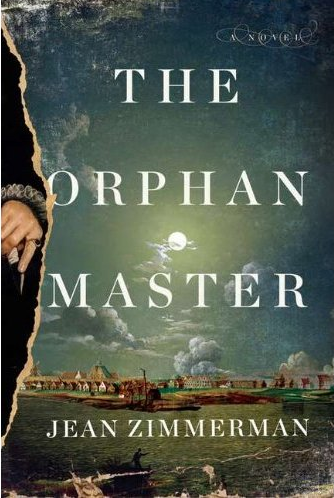
The Orphanmaster is another National Public Radio recommendation for people who like historical fiction, which I really do. I remember being a kid, and yawning my way through history, memorizing dates, it all seemed so irrelevant. Discovering historical fiction was like a light going on in a dark room for me – clever authors have found ways to illuminate events otherwise beyond my comprehension or worse – events I have a hard time making myself care about.
Suddenly, the times are right now and relevant when the right author handles it, and it isn’t always easy to get it right. I have a few very favorite authors – Philippa Gregory, Zoe Oldenberg, Sharon Kay Penman, Jean Plaidy, Edward Rutherford – authors who do a lot of research before they ever sit down to write a novel, and from whom you can learn a lot. They get the nature of the dialogue right, they get the customs, traditions and mind-sets right, and they get it right when a person is born ahead of his or her time in terms of the challenges they face.
I couldn’t put Orphanmaster down. It has to do with an era in American history which barely gets a paragraph in many history books, when the Dutch had a colony on what is now Manhattan Island, and trading posts up what is now the Hudson, into what is now New York. It was New Amsterdam, and many of the street names in modern day New York reflect their Dutch origins.
The Orphanmaster‘s main character is not the Orphanmaster. He is a supporting character to the main character to a girl orphaned at 15, daughter of a Dutch man and wife who were not rich, but who did all right. They had a business, they traded, Blandine learned many things before they died, leaving her an orphan. She was determined to be what would now be an “emancipated minor,” but until she turned 16, she was semi-legally under the responsibility of the Orphanmaster, who sort of kept hands off and sort of watched out for Blandine. She lives on her own and is a successful trader, in her early twenties. She is also a very clean housekeeper, and has plans to grow her trading business, and has a serious suitor she intends to marry.

Orphans start disappearing, and we discover a monster, a witiga, is on the loose. Blandine, and her new friend Drummond, are intrigued and disturbed by the disappearance of orphans, and the bloody, ritualistic mutilations of the orphans by the legendary Witiga.
It’s well written. You want to keep reading and keep reading because you want to know how it ends and how they are able to solve the problem.
It’s not one of the best books I’ve ever read for one reason – the author had the main characters talk as if they were modern people, using modern language, like ‘stuff.’ There was great openness between Blandine and her male friends. Blandine made all her own decisions, made her own arrangements and had full freedom, going where she wanted, doing what she wanted. The author explains it as part of the Dutch system, where some women had a lot of freedom, but I have a really hard time believing in a Dutch colony in the late 1600’s that any woman had the freedom Blandine had. There are parts of the novel where I am reading fast because I want to know what happens next and I get stopped up because Blandine says or does – or even THINKS – in a way that is very modern, and I just can’t buy it.
We are who we are. There are many smart women. Most women through the centuries have had to learn to maneuver in whatever societal constrictions they have been allowed. I suspect there were a lot of societal restrictions in New Amsterdam, and Blandine’s freedom to take off with only her male servant, to run off and live with a man not her husband (even though they are both escaping death sentences), to live an unescorted life . . . I just have a hard time buying it. I know how restricted women are even to day. Four hundred years ago, women were more restricted, and worse, we bought into it. We didn’t have a lot of choices.
So I like this book, and I think there is a lot of information that is true of the settlement of New Amsterdam, I loved the geography and the physical descriptions, I loved the maps included, I loved the descriptions of food and living conditions. I do not buy the heroine, not for one minute. I do not believe, in that historical context, she would have been possible.
Christ Church Antique Fair 2013
More people attending the Preview, more tickets sold, more people buying up antique linens, jewelry and silver . . . I think we’ve turned a corner on the economy. People seem to be feeling more optimistic, seem to be less concerned about buying a small luxury 🙂 I never see any pearling boxes, or Arabic calligraphy . . .


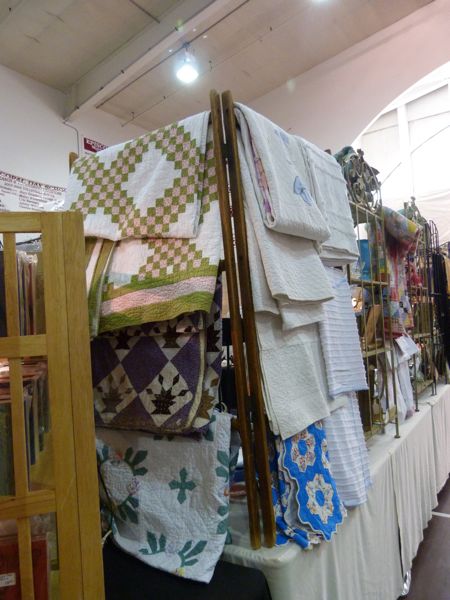


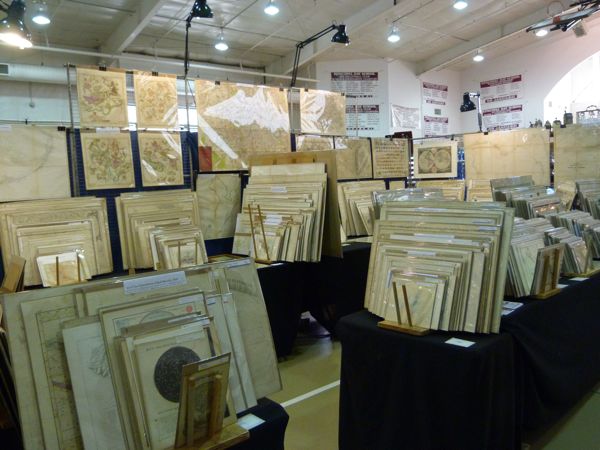

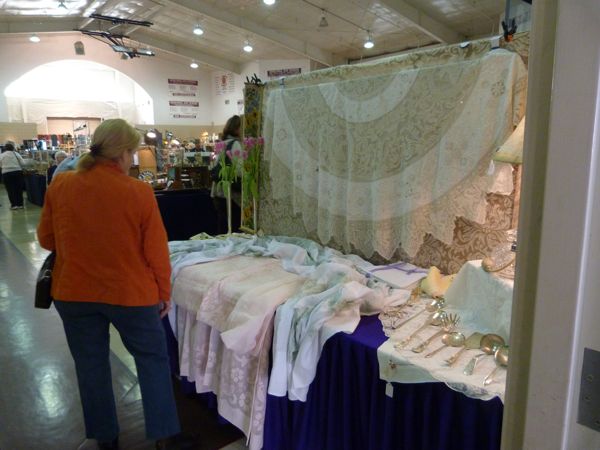
Christ Church has sponsored this Antique Fair for 56 years now; it is well-respected and well-attended by antique-loving Pensacolians. It raises a majority of the money the church uses to support charities in the communities, and all the labor is lovingly performed by the Episcopal Church Women, who toil and prepare for this event for months. It is open today (Saturday) until five, and from 11 – 3 on Sunday, February 3rd. Admission is $7.
The Death of Bees by Lisa O’Donnell
Death of Bees was another powerful recommendation by National Public Radio.

I believe in a greater power, in a God who sends things my way and that I am meant to be paying attention. Several books have been recommended to me lately which I didn’t choose, or might have avoided had I known how painfully they dealt with poor parenting and children in the depths of horrific poverty.
Here is what the lead into the book says:
Today Is Christmas Eve,
Today is my birthday,
Today I am fifteen,
Today I buried my parents
in the back yard.
Neither of them were beloved.
Oh my goodness! I am sucked in immediately. And immediately I am overcome by the grinding nature of poverty, the enormous amount of energy it takes just to be fed, to have a roof over your head, to function in the bureaucracy that seeks to ameliorate the burdens of poverty.
I am horrified by the lives of innocent children in the hands of people who should never have responsibility for anyone, even themselves, their decision making skills are so non-existent. There are parents who have no idea what self-sacrifice GOOD parenting requires, who raise children who are often trying to survive their own parents.
The Death of Bees has redemption. It has two sisters who love one another and are smarter than the average child. It has a neighbor who notices, not in a snoopy or intrusive way, but in a kind, helping and ultimately sacrificial way. It has moments of black humor, when the neighbor’s dog keeps digging at the parental graves in the backyard and bringing bones inside just at the worst moments.
Ultimately, it is a tale of survival, in spite of the parents, in spite of the system, in spite of betrayals by family and friends. There is a glimmer of hope that life may be different for these sisters, if they can survive their upbringing and overcome their childhood.
Now, go read the book 🙂
Amitav Ghosh and River of Smoke

The National Public Radio website recommended this book as one of the best historical fiction reads, and I had never heard of it, so I ordered it. I ordered it in spite of the little voice I had in my head reminding me that this was the second in a trilogy, that the first is Sea of Poppies. I was too eager. I wanted to jump right in, and the review said it could be read stand-alone. I had read Ghosh’s Glass Palace a couple years ago for book club, loved it, and was eager to read this one.
With a raging cold and no possible way I can be around humanity, it was a good time to start. Just picking up the book, it has a dense feel. Once you start, it is like being suddenly in a whirlpool, drowning in new words, characters who have more than one name and more than one identity, whirling between England, Mauritius, Hindustan, Gujerat, Hong Kong, Macau and China, whirling between cultures and professions and trades, but oh, what a ride.

It would have been helpful to be reading River of Smoke on an iPad, where I could poke at a new word and it would give me the meaning, but in truth, you can guess a lot of the meaning of the vocabulary from the context. The seafarers all speak a language sort of like Jack Sparrow, a pidgen language filled with simplified grammar and with words from many nations and cultures. It forces you to slow down. It’s worth it. It would also be nice if you could poke on a place-name and have Google Earth show you where it is. There used to be a website called Google Books, and you could put in a book and it would show you the places in which actions in the book took place; that would be particularly handy reading this book, provide context in place-relations.
But reading slowly is it’s own reward. This book has depth, depth of character, depth of textures and senses, and depth of morality. I love a book like this where you can smell the smoke drifting over the water, where you can smell the sewer and bloated animal corpses floating outside the foreign hongs of the Canton traders, you can feel the textures of the textiles and see their colors, you can taste the exquisiteness of Macau cuisine and you can hike in a Hong Kong not yet settled by anyone, Chinese or foreign.
The scope of time covered by the major part of the story is short, although there are years of back-stories for several characters. The period is 1837-8, during which the Chinese Emperor decides to put teeth in the long established edict against opium trade to China. The edict had been in place, but not enforced, and China watched her citizens sink into opium addiction and lowered productivity. The traders were making fortunes – shiploads of money. Opium was grown in India and shipped from there to China.
When the ban against shipping opium into China is announced, many traders believe it is just another attempt to attain greater bribes on the part of the mandarins, and decline to obey. There is great debate, and while it is lively in the book, it is based on documents from that era, many of the arguments word for word. Traders stood to loose a great deal of money, in truth, it would ruin most of them to lose their shipments.
There is a side story I also like, that of the botanical trade between China and England, and the importation of many of the garden plants we take for granted today, which were unknown until sent from China. Camellia – one of which is the plant for tea, did you know that? Roses, azaleas, orchids – many many familiar plants would be missing from our gardens were it not for their introduction during this period.
Ghosh gives us disparate characters of many cultures and upbringings, and slowly weaves them together, each one tangential to all the others, some closely interwoven. It is a fascinating read, and I can’t wait for the next volume. I may have to go back and read Sea of Poppies while I am waiting.
Payback is a Bummer
People all around Pensacola are dropping like flies; the weather fluctuates between hot and humid and cold and dry, with thunderstorms marking the boundaries, and there are colds and flu popping up everywhere. I’ve flown serenely through the season without much problem, just a little four day cold around Christmas, feeling thankful for my strong immune system. I may have been a little smug.
And then, WHAM, it hit. One minute I was in a meeting, and the next, as I headed home, I was sniffing and reaching for a tissue. It quickly got worse. It was one of those nights where you can’t sleep because you are drowning in your own mucus. I know, I know, too much information, too graphic. Trust me, the reality has been worse. I stayed in bed most of Friday, and Saturday, when I was feeling better, we discovered our water heater has sprung a leak. All that mopping up was probably good exercise; once we got all the water up we were OK. Yesterday, my sniffles had turned into aching, irritated sinuses, so I spent the day putting warmth on my face.
This morning, we have the plumbers coming in with a new water heater, I feel marginally better, and I know I will feel a LOT better once I can get a hot shower 🙂
There was a huge blessing in all this. Our calendars for January and February are full, winter is the active season in Pensacola. We have events, we have commitments, and we have house guests coming. In the entire period, I only had five dates with no obligations, and that was this weekend. It’s a strange thing to be thankful for, but I thank God to be sick during a time when I can stay home and take care of myself, and I don’t have to call anyone and renege on an obligation.
It’s also wonderful that if the water heater was going to go (and it is ten years old) it burst while we were here, and we were able to stop the flow and mop up the water before it caused a lot of damage. We had a water heater go out several homes ago, while we were out of town, and oh, what a mess we came back to, and it took forever to get all the carpeting dried out and replaced. It’s wonderful that we could take care of this BEFORE our house guests start arriving.

We’ve been exploring tankless heaters; our heater is smack in the center of the house, a terrible location, where, if it goes, it can cause a lot of damage. We’ll go ahead with a regular old-fashioned heater this time, but suddenly, we have some urgency to trying to install tankless – maybe in the next couple of years. We had tankless heaters in Germany, and in the Middle East; we are used to them and comfortable with the idea. I like the idea of not keeping water warm when we are not using it, and heating it only when we do. I also like the idea of not having gallons and gallons of water spilling into my kitchen, dining room, living room and family room when the tank goes 😦
I miss my energy . . . I no longer feel smug, no longer assured of my good health. I’d forgotten how wonderful it is to be normal, without sinus pain, without this thick-headed draggy feeling. I think I’m on the mend; the last three days I couldn’t even begin to think about writing a blog entry . . .
Recent Comments
ExpatAlien on What Country am I Living … intlxpatr on Yellowstone: Old Faithful to C… Michelle on Yellowstone: Old Faithful to C… Cathy on No Grown-Ups in Charge intlxpatr on Waiting for Snow Wikipedia Donate Button

Amazina


Early Voting in Florida


 Here There and Everywhere