Non-Profits: Something From Nothing
Here is what I love – people who get an idea, and make the world a better place because they have a vision and make a plan so that the vision can become a reality.
The Gulf Coast Citizens Diplomacy Council
I volunteer for the Gulf Coast Citizens Diplomacy Council. The one in Pensacola was started from nothing by a young woman with a vision, Gina Melancon Gissendanner. Her organization, her Board of Directors, her members and her resources deep within the Pensacola community have welcomed several hundred of the US Department of States International Visitor’s Leadership program delegates, bringing awareness – and dollars – to Pensacola.
When the visitors come into town, they have activities, tours and visits with professional counterparts that give them new strategies and resources to take back with them to their home countries. While here, they meet local people, shop in local stores and dine in local homes.
I love this program. From nothing, this young woman has created an organization with a far-reaching legacy. Thanks to her innovative and relevant programs, the international delegates leave here with happy memories of their time in Pensacola, and they go home and tell their friends and neighbors about their time here.
This weekend, we crossed paths with three more organizations, creating a better world, each in their own way.
The Master Gardeners
“You have to come to the sale at the County Extension Office!” our aqua aerobics friends told us. “It is so much fun, and they have Florida-hardy plants available at really good prices.”
OK! Finding ourselves awake and ready to hit the road early on a Saturday morning, we headed for the County Extension office, and the Master Gardener’s Sale. Now, I may get some of the details in this story wrong, but this is what I think I have been told. . . Several years ago, county extension offices (who answer questions about soil and growing things) found themselves deluged with questions, with too few people to answer them. They started a program – and I believe it is nation wide – training people in all aspects of growing things in the local area.

People who signed up for the training also signed up for a commitment to volunteer, and pass their knowledge along. Slowly, slowly, we have begun to know these people.
The sale was a lot of fun. While gardeners love a challenge, like growing flowers in Florida that aren’t supposed to grow here (like me, I am trying to grow bougainvillea, which isn’t really good at getting through cold winters, but maybe if I find the right protected spot, I can get it going and keep it going until it develops a deep root system and an ability to withstand the minimally cold winters we have in Pensacola) and they also love to share their knowledge.

There was an experienced, knowledgeable and enthusiastic Master gardener about every ten steps at the sale, and we could ask all the questions we ever wanted, and they just loved talking with us and giving all the answers. Free! There was no admission charged, the plants were reasonably prices (and many were very cool plants) and it was just a great place to pass a Saturday morning.
We’ve been told the Spring Sale is THE best sale – we can hardly wait.
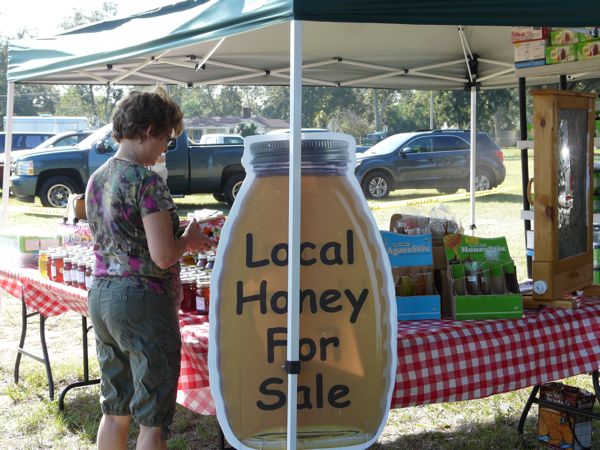
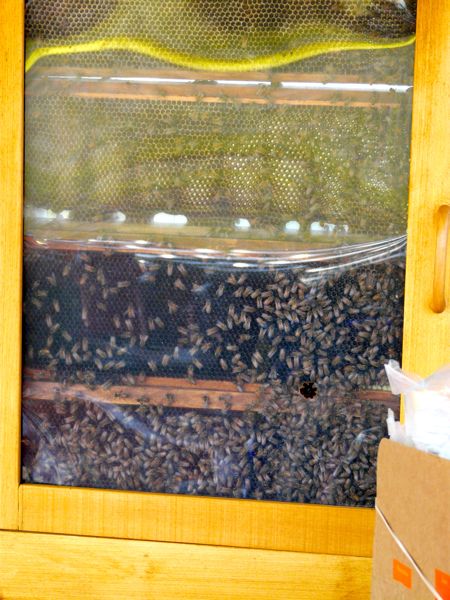

When we left, AdventureMan said “Every one of them seemed so comfortable in their own skin.” I think he is right. I think working in the earth with your hands helps ground you. 🙂
The Master Gardeners are those people you find in Home Depot and Lowes, giving information on gardening in Florida, and at special booths at Arts Fests, in the schools, and working the beds at the County Extension office. They are volunteers. They do this work for the love of making the world a more beautiful place.
The Butterfly House
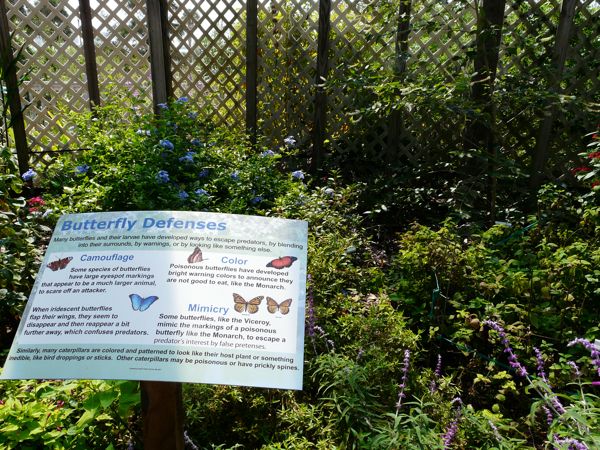
Our next stop was the Monarch Madness festival at the Panhandle Butterfly House in Navarre, where there was also an Arts Fest in progress. The volunteers at the Butterfly House all wore these terrific T-shirts with a caterpiller on the front and Monarch butterfly on the back. They had a great system, too, for getting a lot of people through the butterfly house in an organized and civil way, still giving people a lot of time to ask questions, and with lots of really cool activities for children to do, to help them understand the life cycle of these beautiful and short-lived creatures.





The Manna Food Pantries, Pensacola
I’m lucky. I work on a church committee where the chair brings in representatives from all the major charities in Pensacola to talk with us about what they do. The Manna Food Pantries is, in my humble opinion, a poster-child for how a non-profit should operate. Providing food for those who are hungry, for those going through tough times – and there are more than you might think – is truly part of God’s work for us here on earth. Manna Food Pantries collect and distribute food to the hungry. This morning, we had two Manna vans at the church and people were bringing in their full bags to donate.
It’s been a very tough year in Pensacola. The tough times just go on and on. You can prepare for tough times, save your money, gather your resources, but when tough times linger, sometimes those resources run dry. Manna has been faced with just such a time; resources are drying up, donations were down and the need is greater than ever. Manna hit the front page this week two days in a row, and is getting great coverage on radio, in the churches, in social groups – they are very very good at getting the message out, and the message is clear: We need your continued support, food, money, now more than ever.
They are brilliant at managing their volunteers, and many have been with them for years and years.
All these organizations are only able to exist because people believe in giving of their time and efforts in the hopes of making the world a little better, a little more beautiful, a little more peaceful, a little more hopeful – one person at a time.
Where are you going to put your efforts? What organizations do you support – and why?
The Marital Contract in California?
This guy is hilarious – found this on AOL Huffpost this morning:
A Modest Proposal: Why Can’t Couples Have a Proxy Statement for Their “Merger & Acquisition”?
William Quigley
The recent debates over gay marriage, civil unions and what exactly marriage even means today reminded me of how antiquated our marriage and family laws have become. They don’t take into account how the nature of wealth has vastly changed over the last few decades. I am neither an advocate nor an opponent of marriage but I do believe that the financial obligations we assume when entering into a marriage contract, including the court-ordered redistribution of personal wealth that takes place upon divorce, are not well understood by most of our citizens. Even lawyers I have known have been confused about the differences between spousal versus child support. If Chris Anderson really wanted to investigate the long tail, he should have taken a look at the potential length of California spousal support terms.
California has always been the leader in divorce and alimony law, and I think it is time the state started addressing the profound inequities alimony judgments have created. In short, alimony has evolved into a pension plan for the less successful spouse. In many cases, this pension commitment becomes a lifelong burden for the paying spouse, regardless of who initiated the divorce and under what conditions the marriage dissolved. It promotes unproductive behaviors as well, such as the alimony recipient avoiding employment in order to maximize spousal support. The spousal support payer may reluctantly forgo re-marriage as well, fearing the income of his/her new partner will be combined for the purposes of calculating higher support payments. If the state believes that promoting marriage among the population is a public good (a reasonable belief), then it needs to reduce the severe financial penalties associated with divorce. And since many marriages do end in divorce, it makes sense to acknowledge, upfront, the consequences of that likely outcome.
One marriage-neutral option would be to provide every couple with a simple disclosure form that highlights the financial obligations they are about to assume.
This disclosure form could easily fit on just a single page, with disclosures of the following sort:
1. The State of California recognizes your marriage as a legally binding contract.
2. By entering into marriage in this state, you agree to assume all debts incurred by your spouse during the marriage, whether or not you were aware of these debts when incurred, and whether or not you personally benefited from them in any way.
3. You also agree to provide monetary payments to your spouse in the event your marriage dissolves and you are the higher income earner. The amount and length of these payments will be decided by a court of law.
4. The State can and will use its court and police powers to enforce the financial obligations you are assuming in the event of divorce, including the garnishment of your wages and your incarceration in the state prison system for your failure to comply with court ordered spousal payments
5. If your spouse so chooses, he/she may divorce you at anytime. In so doing, he/she may be legally entitled to receive monetary payments from you for a time period that may extend to the rest of your natural life. These spousal support payments may exceed 50% of your income, could be adjusted upward if you remarry and as a result have more disposable income, and they cannot be eliminated though bankruptcy.
6. The conduct of your spouse, including him/her having one or multiple out-of-wedlock affairs, does not change your legal obligation to provide spousal support.
7. If you are the higher earning spouse, you may be required to pay your lower earning spouse’s divorce related legal bills. This is the case regardless of which spouse initiated the divorce and regardless of the conduct of either spouse during the marriage
8. If you have questions or concerns about what financial obligations you are about to assume, it may be advisable to consult with a family law attorney before signing your marriage contract.
The most important point to highlight when it comes to marriage is that the State of California recognizes it as a legally binding contract. Too often that simple fact is misunderstood or ignored by the couple getting married. In fact, curiously, the one thing the state absolutely does not care about is whether or not a couple is “in love.” There is no requirement to be “in love” to be legally married in the State of California, or any other state for that matter. Only in recent human history — perhaps the last 150 years — has the predominant purpose of marriage been associated with romantic love. It has nearly always been, and remains in much of the world, primarily an efficient method of property redistribution. In the end, the state, and your future divorce lawyer, care only about one thing: the legal enforceability of the marriage contract as it relates to the financial obligations borne by the higher wage earner.
Our society has become accustomed to warning its citizens of potential legal and financial hazards every time they enter into a contract, even those of relatively small consequence. We as a society like to be informed when we are assuming a financial obligation, particularly one that is potentially large and open-ended. Isn’t it odd then that while we require our citizens to initial car rental forms (just in case they didn’t realize that they will be charged $6 a gallon to fill the gas tank), we let 18 year olds get married without so much as a tap on the shoulder about the greatest financial liability they will likely ever assume? Keep in mind that we are talking about state-sanctioned marriage, a legally enforceable contract. Shouldn’t such a contract, with its profound lifelong financial repercussions, only be assumed by those fully informed of its potential consequences? This is why I completely support a marriage financial obligation disclosure form.
Secrets to a LONG Marriage
Read this article and weep, and be sure you have a group of wild girlfriends. 🙂
I found it this morning in AOL News Huffpost:
The Fine Line Between Marriage and Divorce
Iris Krasnow, Author, The Secret Lives of Wives: Women Share What It Really Takes To Stay Married
I’m just coming off 200 interviews and two years of listening to mature wives reflect on — or moan about — how they are managing to stick it out in long marriages. Scenes from their relationships that range from 15 to 70 years are woven together in my new book, The Secret Lives of Wives: Women Share What It Really Takes To Stay Married coming out in early October.
I’ve been married for 23 years during which my husband and I have raised four sons, and have had plenty of rocking and rolling in our relationship. From my own experiences, and from the dozens of sagas unloaded into my tape recorder, I am constantly reminded of the eggshell-thin line that separates loving from loathing. I know that staying married can mean plates flying across kitchens, tears soaking pillows and emailing old boyfriends at 3 a.m.
I thought nothing could shock me about what really goes on behind closed doors between two people working hard to make it “til death do us part” — without killing someone first. After all, I have heard every brand of twisted love story — swinging, adultery, spouses coming out as gay after 30 years together, threesomes, fist fights in restaurants, even the tale of a husband discovered to be having sex with a sheep, documented in a photograph discovered by his wife in his nightstand drawer.
But in piecing together this latest book I have been surprised at some of the revelations. I’m not as ruffled by the tawdry tales of farm animals or one I heard from a 55-year-old wife about screwing a perfectly sculpted landscaper while her doctor husband was lecturing on vein surgery in another country. My biggest shock is how many outwardly cheerful women who have been married forever think about divorce if not weekly, at least once a month.
How’s this for a statistic? Of the 200 plus women interviewed and woven into The Secret Lives of Wives, I can count on one hand those who have never considered splitting up. It was no surprise that Beth often considered leaving her husband. He routinely told her she was fat and ugly, and when they fought in the car he would pull over and shove her out the door. Who could blame Shauna for her many consults with a divorce lawyer? She’s the wife of the traveling doctor, a man who hasn’t initiated sex since their honeymoon 30 years ago. Her secret is that she has it both ways: an intact family and a ten-year affair with a hard-bodied lover, who does her landscaping for free.
The biggest shocker is the number of wives in stable unions who frequently contemplate fleeing their marriages. These are not abused wives; they are women with nice husbands who give them orgasms and jewelry and stability. Yet many of these settled midlife women admitted they were slightly jealous of Tipper Gore who gets to have a fresh start after 40 years of matrimony with the same guy. While many speculated about whether one of the Gores fell in love with someone else, my instincts without talking to either of them is that perhaps they are a lot like other couples portrayed in the book. Maybe they were simply sick of being around each other. And maybe one or both of them finally couldn’t take it any more.
Who stays married and who doesn’t is a question not always about commitment or deep abiding love — it’s about endurance.
I have found in my collection of wives who remain in long running marriages that the majority of them share these common traits: They have the guts and determination to stick it out, no matter what. And their laments about their marriages aren’t because of anything serious. It’s the subtle nuances of living with one person in one house for a very long time that grates at the soul, that causes a simmering malaise. It’s the grind of the ordinary that drives people into thinking, “Is this all there is? I want more. I want adventure. I want change.”
Who wouldn’t want changes with the current statistics on lifespan? Women in their 80s and 90s are the fastest growing segment of the aging population which means that many of us wives could easily hit our 50th wedding anniversaries and beyond. That’s a hell of a long time to sustain one love affair, particularly when empty nest hits and it’s only you and the husband with no cushion of kids as a buffer.
There are three strategies that have worked the best with the women I interviewed. The happiest wives have a sense of purpose and passion in work and causes outside of the home. Wives who counted on a spouse for fulfillment and sustenance were often angry and lonely. And the happiest wives don’t spend a whole lot of time with their husbands. My chapter called Separate Summers is filled with women who take their own vacations, take their own summers, take charge of their own lives. Couples who allow each other to grow separately are the ones with the best chance of growing together and staying together.
Finally, the wives with the highest marital satisfaction have a tight circle of wild women friends with whom to drink, travel and vent about their husbands.
Yes, my work on this book has been quite surprising and enlightening. I now know that acceptance of mediocrity in a marriage relationship is more prevalent that you would imagine. I know that sometimes the only reason women stay with a spouse is because they have divorced friends who may have more sex than they do with new husbands but they also have cranky step-kids who hate them. Other women stay in lackluster marriages because they don’t want to give up their swanky lifestyles, and divorce is expensive, really expensive. We know from our friends who are pushed to the edge and do call it quits that the grass isn’t always greener, there are parched patches on both sides of the fence.
But most women told me they stay married simply because they like their marriages more than they dislike them, even if much of the time it’s 51 percent “like” to 49 percent “dislike.”
Iris Krasnow is a bestselling author and an assistant professor in the School of Communication at American University. Connect with her on: http://www.iriskrasnow.com
Sobering Reading on Wealth
It’s a long weekend, Labor Day weekend, and Pensacola awakes to rain-sodden streets and forecasts of a rain soggy three day weekend (bad for hotels and restaurants at the beach who hope for a sell-out Labor Day) and high surf from off-shore storms.
The reading for today from James is equally gloomy. I always think of “Insh’allah” when I read it, because it probably has an equivalent somewhere in the Quran, and my Muslim friends say “Insh’allah” (As God wills, or If God wills it) when they state a planned event.
While we are not rich, we have a large homeless population in Pensacola, sleeping out under the skies in hidden camps, scrounging for food, often with a dog, seeking handouts, seeking scraps. They are a constant reminder, to me, of how comfortable we are, and how comfort wars with the religious spirit. When we are too comfortable, we often fail to keep our focus on God, and are distracted by our toys and interests.
(I told you this would be gloomy.)
On the other hand, I wonder how spiritual I would be if I were hungry, worried about getting enough to eat, worried about my safety sleeping out in one of the camps. I wonder if their community looks after one another, or if it is a brutal and chaotic life. I wonder how you can keep your mind on things of the spirit when the search for basic necessities takes up a large part of your life.
James 4:13-5:6
13 Come now, you who say, ‘Today or tomorrow we will go to such and such a town and spend a year there, doing business and making money.’ 14Yet you do not even know what tomorrow will bring. What is your life? For you are a mist that appears for a little while and then vanishes. 15Instead you ought to say, ‘If the Lord wishes, we will live and do this or that.’ 16As it is, you boast in your arrogance; all such boasting is evil. 17Anyone, then, who knows the right thing to do and fails to do it, commits sin.
5Come now, you rich people, weep and wail for the miseries that are coming to you. 2Your riches have rotted, and your clothes are moth-eaten. 3Your gold and silver have rusted, and their rust will be evidence against you, and it will eat your flesh like fire. You have laid up treasure* for the last days. 4Listen! The wages of the labourers who mowed your fields, which you kept back by fraud, cry out, and the cries of the harvesters have reached the ears of the Lord of hosts.
5You have lived on the earth in luxury and in pleasure; you have fattened your hearts on a day of slaughter. 6You have condemned and murdered the righteous one, who does not resist you.
Credit Card Blues
“Because your name and card number are on file with us, it is possible that your card information has been compromised. While we employ the strongest encryption processes, it is possible that a motivated and persistent hacker could access your information. For this reason, we suggest that you inform your credit card company and explore the possibility of closing your current card and starting another.”

I don’t even have a pit in my stomach this time when I get this message. This is our third change in one year on one card. One of the changes was due to our card company shifting its business to another company, but two were due to possible compromises of our information, which had nothing to do with anything we had done except to use our credit card.
In Saturday’s paper, we read that there has been a huge shift in the restaurant business. An owner said that ten years ago cash customers and credit card customers were about 50/50, but now, 90% of all customers use credit cards. (We’re in the 10% who use cash, but it’s because of all our years living overseas.)
The new cards have arrived, and I spent the day going to all the sites that bill me automatically, and monthly, and to my car rental people, and airline reservations people . . . all those automatic charges that would bounce if I didn’t get the correct new number to them. Even as I am sending out all this information, I cannot help but be aware that 1) It is the companies storing my information that make me so vulnerable, and 2) in some cases, there are no alternatives. Credit cards are the accepted way of paying these days.
It’s been a long journey. I remember my first eye-opening experience; I was back from Qatar, re-opening a mobile phone account and I handed the sales person a hundred dollar bill, and she just gaped. “No one ever pays in cash anymore,” she said, “I don’t even know what to do!” As it turned out, they didn’t have change, so I had to charge it, but it went against my grain – we use our cards, but selectively, and pay them off in full every month.
And we only really use one card. We have a couple back ups, but we never use them.
I can’t help but feel that we are all increasingly vulnerable by our reliance on the credit card system. Hackers are the least of the problem – I also worry about those heaps of paragraphs in 2 pt type that we have to ‘read’ and sign, because do you really read them? I know I scan them, but there are words in those agreements designed (I believe) to make you tired of reading, big words, lots of them strung together. They probably have some meaning, but although I am not stupid, reading financial disclosure statements makes my head spin.
What kind of vulnerability do we have to our banks with these cards?
What are our obligations that we don’t even know about?
While we were waiting for our cards, I had three pre-orders with Amazon.com that failed. I wrote to them, suggesting that because I was a good customer, a shareholder, and a faithful buyer with them almost from the very beginning, that maybe they could send them anyway (especially the new Song of Ice and Fire volume by George R.R. Martin, A Dance With Dragons,) but no, they would not. This is not the Amazon.com I used to know, who sent me a coffee cup for being a faithful customer, back in 1997. No, I had to zip up the road to Barnes and Noble, the old fashioned way.
On the other hand, our mail-order-pharmacy people were just great. I had an automatic order and when I explained the problem and that we were waiting for our new cards to arrive, the customer service lady just laughed and said “We’ll send it out and bill you later.” How very very civilized. (ExpressScripts – YAYYYYY)
I used to know my credit card number by heart. We had the same card for almost 20 years. I even memorized my next card, but not this one. I have little faith it will be good for all that long.
Businesses Support Police Blue Shepherd Sting
I love it. Operations like this cost money, and Pensacola businesses stepped up to the plate, even though they could not be told what the operation was about. It makes all the difference in the world when a police force has the community support. From today’s Pensacola News Journal:
It takes a village to catch a predator
Written by
Jamie Page
When undercover law enforcement officers slammed accused child sex predators to the ground and arrested them, the police had plenty of backup.
That is, financial backing from at least four local businesses that sponsored the sting operation by providing food, water, paper products and Internet service.
It’s a novel concept, but a necessary one for a budget-intensive operation such as this one, said Pensacola Police Chief Chip Simmons.
“We have had to do what we could to maintain that undercover location, and to do that we had to make it have everything a normal house would have,” Simmons said.
“So, we contacted businesses and they agreed to donate things to the cause. It’s always good to know there are good people and businesses to chip in and help.”
For a month, law enforcement agencies rented a vacant northeast Pensacola home to use as the point of arrest for 25 men during the weeklong undercover Operation Blue Shepherd. Suspects were accused of using the Internet to set up sexual encounters with children.
The suspects came to meet the minors at the home.
“We had to make it look like a living, breathing home with toys, bicycles, mailbox and trash cans outside, and we had to have furniture inside to make the view from the roadway consistent with what an average home would have,” Simmons said.
Many of those things came from police-seized items or were contributed by officers or others for use in the sting.
But the police needed help with other things, such as food and supplies, which were provided by the Apple Market, Dillards, Pensacola Improv Event Center and Cox Communications.
Businesses were not told the nature of the sting, but simply that their contributions would go toward a Pensacola Police Department operation.
“I did not know what they were doing, I just had an officer come to me and ask if I would be willing to provide meals for several people for several days in a row, but I couldn’t talk about it, and I said fine,” said David Apple, owner of Apple Market in Pensacola.
“I just knew I was assisting the Police Department. And anything we can do to assist them, well, we are always eager to support our military and law enforcement any way we can.”
Apple had to sign a confidentiality agreement and could not talk about his catering, which he provided to officers at a rate that allowed him basically to break even.
Apple Market could not deliver the food. Officers would pick it up and take it to the location, which Apple also was not told about.
“The only complaint they had about the food was that everybody gained weight,” Apple said. “It was pretty enormously satisfying to know we helped feed those guys and they were so successful in what they set out to do.”
Representatives from Cox, Dillards and Pensacola Improv could not be reached for comment.
I Need Your Trust . . .
Here is my scam letter for today, and here is part of what makes me so sad and so mad about these letters. IF they were true, which they are not, someone thinks I am the kind of person who would be a part of stealing a substantial sum of money. There may well be other relatives, or others who need that money – IF it were true, which it is NOT.
I NEED YOUR HELP WITH TRUST,
FROM: MR REDA ABDALLAH,
Please read carefully,
This message might meet you in utmost surprise. However, it’s just my urgent need for foreign partner that made me to contact you for this transaction. I got your contact from yahoo tourist search while I was searching for a foreign partner. I assured of your capability and reliability to champion this business opportunity when I prayed about you.
I am (MR Reda Abdullah) a banker by profession from Burkina Faso in west Africa and currently holding the post of Audits and Account manager at the foreign remittance department, i have the opportunity of transferring the left over sum of ($9.2 Million Dollars) that belongs to late Mr Rudi Harmanto from Indonesia who died along with his entire family in the Asia Earth Quake (TSUNAMI,DISASTER IN INDONESIA / INDIA. 2004, and since then the fund has been in a suspense account.
After my further investigation, i discovered that Mr Rudi Harmanto died with his next of kin and according to the laws and constitution guiding this banking institution, stated that after the expiration of (7) Seven years, if no body or person comes for the claim as the next of kin, the fund will be channel into national treasury as unclaimed fund. Because of the static of this transaction i want you to stand as the next of kin so that our bank will accord you their recognition and have the fund transfer to your account.
I don’t want the fund to go into our bank treasury account as unclaimed fund. So, this is the main reason why i have contacted you, so that we will release the fund to you as the nearest person to the deceased customer ( next of kin).Please, I would like you to keep this proposal as a top secret or delete it if you are not interested.
Upon receipt of your reply, I will send to you the full details on how the business will be executed, and an official copy of the ‘Application Form Of Claim’ of which you will fill, and send to the bank for the release of the fund into your receiving bank account. Also, note that you will have 40% of the above mentioned sum, if you agree to transact the business with me, and while 60% will be for me.
I won’t fail to bring to your notice that the risk to be taken is 100% free in this transaction, and that you should not entertain any atom of fear as all required arrangements have been made for the transfer of the fund into your bank account. Please, don’t ever forget to reply me this email urgently with your contact information’s like:-
(1)Name:……………………………………………
(2)Age:…………………………………………….
(3)Marital Status:…………………………………..
(4)Telephone Or Cell Phone Numbers:……………………
(5)Your Country:…………………………………….
(6)Your Occupation:…………………………………
I will like to receive the above following information’s from you as you reply this email to me for more trust, and better understanding of who you are. Looking forward to receive your reply urgently.
Thanks from,
Mr. Reda Abdallah
Freedom Greater Factor than Wealth in Happiness
Fascinating study, I found it today on AOL Health News
Freedom More Important to Happiness Than Wealth, Study Finds
Personal independence, autonomy trump money in data from more than 60 countries.
SUNDAY, June 19 (HealthDay News) — Personal independence and freedom are more important to people’s well-being than wealth, a new study concludes.
Researchers at the Victoria University of Wellington in New Zealand analyzed the findings of three studies that included a total of more than 420,000 people from 63 countries and spanned nearly 40 years.
Their key finding: “Money leads to autonomy, but it does not add to well-being or happiness.”
The studies looked at data from three different psychological tests familiar to therapists:
The General Health Questionnaire, which measures distress in terms of anxiety and insomnia, social problems, severe depression and physical symptoms of mental distress, such as unexplained headaches and stomach aches.
The Spielberger anxiety inventory, which evaluates how anxious respondents feel at a particular moment.
The Maslach Burnout Inventory, which screens for emotional exhaustion, depersonalization and lack of personal accomplishment.
The analysis revealed “a very consistent and robust finding that societal values of [freedom and autonomy] were the best predictors of well-being,” wrote psychologists Ronald Fischer and Diana Boer in an American Psychological Association release.
“Furthermore, if wealth was a significant predictor alone, this effect disappeared when individualism was entered,” they added.
“Our findings provide insight into well-being at the societal level,” the researchers concluded.
The study appears in the Journal of Personality and Social Psychology.
Adaobi Tricia Nwaubani: I Do Not Come to You by Chance
This book, the first novel from Adaobi Tricia Nwaubani, is hilarious, with moments of pathos, and a fresh point of view.
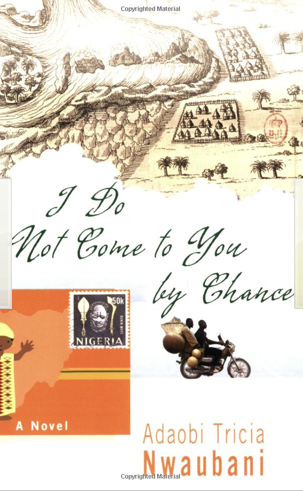
Amazon.com recommended it to me as I was busy buying books by author Chimamanda Ngozi Adichie; I thought ‘OK, I’ll read a series of Nigerian books as part of my summer reading.
Young Kingsley Ibe is the family’s first born male, and with that status goes many privileges – and responsibilities. After graduating with a Masters in Chemical Engineering, he has no success in his search for a job with an oil company in Nigeria, and consequently loses the love of his life, Ola, to another who has secure employment.
Worse, his retired father has a stroke, and the family discovers that with all the fees required, they haven’t enough for his continued care, so Kingsley must approach his uncle, Boniface Mbamalu, more familiarly known as Cash Daddy, for funds to transfer his father to a long term care facility, and, later, for his father’s funeral.
Serious Kingsley’s eyes nearly pop as he sees the life his uncle is living, cars, women, designer watches, shoes, suits and all the trappings of new wealth. Soon, his uncle makes a convincing case for Kingsley coming to work for him, the better to help out his family of mother, brothers and sister, now that he is the senior male in the family.
Kingsley discovers he has a gift for the work – which is writing 419s, those scam letters which I frequently publish in this column. I loved being on the inside, learning how strong possibility e-mail addresses are netted, how response e-mails are massaged – not unlike fund raising techniques by charitable organizations in the US. Kingsley’s education helps him achieve enormous financial success in a very short time – but he finds that all the cash and designer goods in the word do not solve his problems nor make him happy.
I learned a lot about how successful many of these scammers are, and how the money made is spread throughout the Nigerian communities. The author takes a balanced view, balancing the way the cash makes life easier for people – a lot of people, because the rich man has many obligations to his community, balanced against the disgust, and sick fear felt by his religious mother and aunt, and his one time girlfriend, when they learn the work he is doing. They are disappointed that a man of such promise has sunk to making so much money in a dishonest way. The book also does not deal sympathetically with those who have given or lost money to the scammers, nor, in my opinion, does the ending satisfy.
This is one of the funniest parts of the book – a group of Nigerian scammers is about to meet with a representative of a major US investment firm. He thinks he will be meeting with the Nigerian Minister of Transportation to discuss building a new airport; the reality is that Cash Daddy, in disguise, will be pretending to be the minister. Kingsley protests that Cash Daddy looks nothing like the minister, and Cash Daddy responds:
“Let me tell you something . . . Me, I really like these oyibo people. They’re very very nice people. See how they came and showed us that the ground where we’ve been dancing Atilogwu has crude oil under it. If not for them, we might never have found out. But Kings,” he dragged in his dangling foot and sat up in the tub, “white man doesn’t understand black man’s face. Do you know tht I can give you my passport to travel with . . . Even if your nose is ten times bigger than my own, they won’t even notice?”
It was a fascinating book. I understand better now why 419 scams work. (419 is the section of the Nigerian criminal code making scam e-mails a crime; thus the crime is called ‘a 419’) There are some very funny and very insightful moments in the book. It is no where near the level of literature that you experience with Chimamanda Ngozi Adichie, but there is more humor, and the book shows a more modern day Nigeria. Not a bad summer read, but not great literature.
Jeannette Walls: The Glass Castle

The Glass Castle was a hugely popular best seller in the USA, and it must have been while I was gone. A part of me remembers reading a little bit about it and deciding it wasn’t my kind of book, but after reading Half Broke Horses, I had forgotten what the subject matter was and was excited to have another Jeannette Walls book I could read.
Big mistake. This book is nothing like Half Broke Horses.
Or maybe it is. Maybe what I loved about Half Broke Horses was the voice of an amazing woman, and maybe what kept me reading The Glass Castle is the voice of an amazing child who tells a heart breaking story. Or maybe it isn’t so heartbreaking, because the children survive. They are scarred and damaged, but never so damaged or loony or self-deceived as their parents.
I don’t like reading books about kids whose parents don’t take good care of them. Oprah chose a lot of those books in her book club. These books depress me. I cannot imagine how parents can be so self-absorbed, how they can take on the responsibilities of children and then not put those children first. How can they?
The Glass Castle stars the daughter of Lily Casey Smith, who is the mother of Jeannette Walls, and her husband, who is Jeannette’s father. The book opens with little three year old Jeannette proudly cooking up a hot dog. Her mother is busy painting and has told her to find something to eat. Her nightgown catches fire, and she is terribly burned. She spends a long time in the hospital, which ends with her father taking her out in a hurry, bundling her into the car, already loaded with her family, and “doing the skedaddle” which is leaving town just in front of the bill collectors.
This is her life. From time to time, their alcoholic Dad will take a job and bring home some of the paycheck (he drinks and gambles most of it) and when he won’t work, on rare occasion, their mother will take a teaching job, but the kids have to get her out of bed in the morning, have to grade her papers and make her lesson plans. Often there is not enough for the family to eat. They don’t stay in one place; they ‘skedaddle’ before they are evicted for non-payment of rent. They eat cold food – when they eat – because the parents didn’t pay the electric bill.
The Dad is smart, charming and cajoling, and when he is sober, the kids learn amazing things from him, and educated engineer. Unfortunately, he is not often sober. He chases after alcohol and he chases after women; the people in the towns where they live know it and the children learn to know it, too, to their constant humiliation. When he wheedles money off his kids, and promises to repay, he asks “Have I ever let you down?” The answer is so stunningly obvious as to be heartbreaking – Yes. Yes, again and again and again.
The Mother is equally irresponsible. One time, when the family is starving, she is in bed and occasionally goes under the covers, where Jeannette discovers her mother has a chocolate bar hidden that she can eat – while her children go hungry.
The author’s voice is never self pitying, she just lays it all out and leaves us to draw our own conclusions. Each child escapes the family as soon as possible; the children plan and save their money to get out, first sending off the oldest sister, then Jeannette, then the son. They all head for New York, where they find work and support themselves. Like bad pennies, Mom and Dad show up in New York, cadge meals and money and join the ranks of the homeless in New York, going from food pantry to soup kitchen, and diving dumpsters for their worldly needs.
This is not a feel good novel. The good part about it is that children can survive this kind of criminal neglect, and become a successful author as Jeannette Walls has done. I am so glad I read Half Broke Horses first, because her grandmother is such an admirable character, whereas her parents are scum and I just felt so angry when I read the matter-of-fact descriptions of their behavior that I was glad they were not where I could get my hands on them.
I don’t know any parents as bad as Rose Mary and Rex Walls, but I know I believe this – if you choose to marry, and if you choose to have children, know that children require time, and love, and energy, and patience. Know that if you have grand ambitions, or an addiction, or a character flaw, you won’t be able to provide for your children’s physical, emotional and spiritual needs, unless you are willing to sacrifice your own needs and wants. While the children in the book loved their parents, they recognized that their parents were sadly lacking in the parenting roles. The way these children were neglected will make me remember this book for a long time.
Would I recommend it? Yes. It is a gripping book, at times even horrifyingly humorous, as when Jeannette figures out how to find lunch food in the garbage cans when all the other kids have finished eating. It is not a feel-good book. It is a horrifying indictment of self-absorbed, neglectful parents, parents you will love to hate.
If I sound a little overwrought, it’s because I worked with the homeless. We were able to help many, but I also ran into families like this family, families who would prefer not taking any help if it meant they had to play by the rules, you know, rules like “you have to take care of your children.” We had all kinds of classes and forums and mentors to help with learning skills, like feeding children well on a small budget, learning to discipline, simple skills, survival skills.
The problem is that these skills require self-discipline, and many of the parents would rather not take help than have to exercise self-discipline. I saw women who would sacrifice their children for their current boyfriend, a woman who was severely angry with her daughter for reporting a family member had molested her, a man who didn’t want to take a job that would ‘tie him down’ when his family was starving. I saw this, with my own eyes, and there is no way you can MAKE people take good care of their children. You have to ask if the children are better off with these parents, or ‘in the system.’ Not a pretty choice.
This book, too, is on Amazon.com. Reading it is like watching a disaster on CNN. You don’t want to believe it is happening and you can’t look away.
Recent Comments
ExpatAlien on What Country am I Living … intlxpatr on Yellowstone: Old Faithful to C… Michelle on Yellowstone: Old Faithful to C… Cathy on No Grown-Ups in Charge intlxpatr on Waiting for Snow Wikipedia Donate Button

Amazina


Early Voting in Florida


 Here There and Everywhere