The Paper Moon by Andrea Camilleri
Ahhh! Another book about corruption, but this one is no where near so painful for me to read as The Appeal by John Grisham, because this one is set in Sicily, where we expect a certain level of corruption, and Italy, where the whole system operates by rules we can barely begin to comprehend, but it is ITALY, and fascinating, and funny, and another great page turner for these hot hot hot summer days.

Andrea Camilleri has a whole series of books about Inspector Montalbano, which I love almost as I love the Donna Leon series about the Venetian, Guido Brunetti. Brunetti has the edge because he is married and has a family, and it IS Venice – no competition there, Venice will always win, hands down. But Inspector Montalbano’s single status allows for a whole different flavor permeating his investigations, and he, like Guido Brunetti, shares the Italian reverence for really great food.
I didn’t want to fix dinner. I didn’t want to get out of bed. All I wanted to do was to read the whole book, and, when I finished, I wanted another one!
Inspector Montalbano is asked by a woman to find her missing brother, and he finds him almost immediately, dead, under bizarre circumstances. The brother has a very large amount of money unaccounted for, and unaccounted in terms of earnings, as well. He is a pharmaceutical representative, good at what he does – but he still has way too much money, and Inspector Montalbano finds he is rather fond of the prime suspect.
In the meantime, his office has also been tasked to find the reason several high level politicians have suddenly died, purportedly of a variety of causes, but in reality, all have died of drug overdoses. The problem is, that finding the culprit means exposing the reality of high level drug usage, and the inspector realizes the case has been dumped on his office because no one wants to take responsibility for what happens when the culprit is caught. It’s all very Italian, very Sicilian.
Between investigations, Inspector Montalbano eats some amazing meals. 🙂 He takes his glass of wine and walks in the sand out to the sea. We get to know the characters working out of his office better, and to appreciate their quirkiness. This is a great series, a lot of fun. I think I need to go to Sicily for a visit. I definitely need some Italian food and a glass of vino!
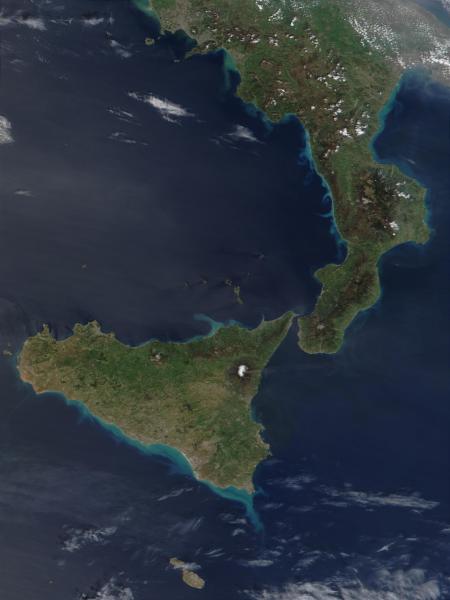
Photo courtesy of http://visibleearth.nasa.gov/)
From time to time a word or phrase would appear that required going to the back of the book where the word is not only translated, but the concept explained, something crucial when reading a novel from another culture. In this series, it is particularly valuable, as the background for the crimes and their investigations with political implications, and if you don’t understand the politics, you can miss the point of the novel.
I found this book at Amazon.com. for a mere $10.19 plus shipping.
The Appeal by John Grisham
One of the things I like about John Grisham is that he really likes the underdog. In his books, the person often the least likely to prevail does so, usually because he has a smart attorney, one who is paying attention and taking good care of the client. Warning – this book review contains a spoiler, so don’t go any further if you don’t want to know too much about the plot and resolution.
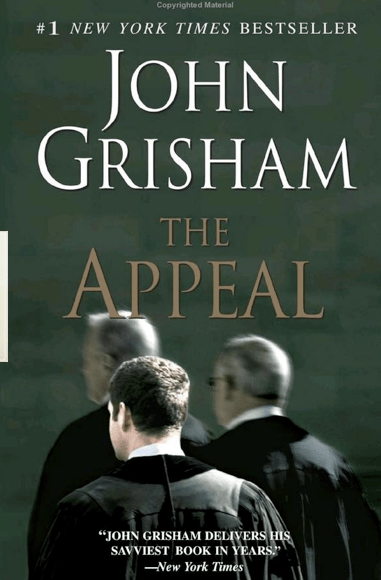
The Appeal is the exception. No one wins, not even the apparent winner, who sails off in the end with his empty, unsatisfying life. He schemes, he exploits, he lies, he buys elections, and he makes a fortune – and he isn’t satisfied. He is married to a woman who sounds more like a greyhound, all skin and bones and self-absorption.
The subject matter is a case where a chemical company has dumped toxic wastes into the ground in Mississippi, it has penetrated into the groundwater, and polluted the entire water system of a small fictional town. Two lawyers, married to one another, sacrifice everything and face bankruptcy to win a case for their client who has lost both husband and son to cancer caused by the toxic chemicals dumped. They win.
There is an appeal.
What this book is about isn’t just about groundwater contamination, or even about buying elections in Mississippi – it is an indictment of every state that elects judges. The core of the novel is about how big money, big corporations, pick candidates and fund them, legally and illegally, and insure that they win. They pack the courts with judges who are opposed to large settlements.
God bless John Grisham. With all his great legal thrillers, he has made a bundle and can take risks like writing a book like The Appeal, which should be an eye opener, and should be read by every caring citizen.
Judges should not be elected. When the judiciary are elected, they have to think about their next election, with every legal decision. It taints objectivity. It corrupts objectivity. It eliminates objectivity. Without an objective judiciary – why bother? They will always rule on the side whose interests are the most powerful and profitable.
Here are a couple quotes that tell you where the novel is going. My Kuwaiti friends are going to love this – I have taken so many shots at Kuwait corruption – so here it is, my friends, exposure of the institutionalized corruption in my country:
Barry laughed and crossed his legs. “We do campaigns. Have a look.” He picked up a remote and pushed the button, and a large white screen dropped from the ceiling and covered most of the wall, then the entire nation appeared. Most of the states were in green, the rest were in a soft yellow. “Thirty-one states are in the green. The yellow ones have the good sense to appoint their courts. We make our living in the green ones.”
“Judicial elections.”
“Yes. That’s all we do, and we do it very quietly. When our clients need help, we target a supreme court justice who is not particularly friendly, and we take him, or her, out of the picture.”
“Just like that.”
“Just like that.”
“Who are your clients?”
“I can’t give you the names, but they’re all on your side of the street. Big companies in energy, insurance, pharmaceuticals, chemicals, timber, all types of manufacturers, plus doctors, hospitals, nursing homes, banks. We raise tons of money and hire the people on the ground to run aggressive campaigns.”
* * * * * * * *
The Senator did not know who owned the jet, not had he ever met Mr. Trudeau, which in most cultures would seem odd since Rudd had taken so much money from the man. But in Washington, money arrives through a myriad of strange and nebulous conduits. Often those taking it have only a vague idea of where it’s coming from; often they have no clue. In most democracies, the transference of so much cash would be considered outright corruption, but in Washington the corruption has been legalized. Senator Rudd didn’t know and didn’t care that he was owned by other people. He had over $11 million in the bank, money he could eventually keep if not forced to waste it on some frivolous campaign. In return for such an investment, Rudd had a perfect voting record on all matters dealing with pharmaceuticals, chemicals, oil, energy, insurance, banks and on and on.
I like almost every book I read by John Grisham. He is a man with a conscience, and he is trying to raise our awareness of corruptive factors before our system goes entirely under. I couldn’t put this book down, and I can hardly wait to read the next one.
Selling My Car
I have a darling little car, I bought it in Doha six years ago. Aye, there’s the rub. While the company agreed to ship the car for us, Qatar won’t accept a car older than 5 years old. My sweet car has less than 40K km on it, has been lovingly maintained, and I totally love it – I was outraged at Qatar. But being outraged at a bureaucracy is a loser’s game, it isn’t going to change, the rules aren’t going to be excepted for me. So I had to sell the car.
I looked up the blue book price, and I knew my car was better than that, but these are hard times for selling a used car. I just put it out word-of-mouth, and within a week, I had my buyer.
She came. She sat in the car. She said “I will take it.”
I said “but you haven’t even driven it!”
She said “I can look at you, and look at this car, and I know it is a good car.”
We talked about a price. We agreed to a price a little higher than the blue book price, a little lower than I wanted. We were both happy.
She paid me in cash.
When we went to transfer title – this is Kuwait – the administrative section was closed! It wasn’t supposed to be closed! The area was full of Kuwaitis, Jordanians, people like us, wanting to transfer title. Fortunately, the woman knew another administration place nearby, so we went there, and after the normal finagling, the title transferred and all was completed.
We really wanted this woman to have the car. It has so many good years left on it, and this is a good woman.
AdventureMan laughs at how quietly all the decisions were made, all the negotiations done. The day after we sold the car, we got an SMS from the buyer saying how happy she was, and asking God to bless us richly. We feel already blessed, having sold the car to a fine woman.
The Richest Man in Town
This is from AOL’s WalletPop, their how to manage money series.
As I read through this very American tale of building wealth, I wonder . . . how does this apply cross-culturally? Do you think the richest men in the Gulf follow these guidelines? The richest in the EU? The richest Asians? Indians?
Review: The Richest Man In Town by W. Randall Jones
Tom Barlow
May 20th 2009 at 7:30PM
Filed under: Wealth
Some people dream of getting rich. Instead of dreaming, W. Randall Jones, author of The Richest Man In Town, set out to talk to the richest person in each of the 100 U.S. towns he visited for his study to see what commonalities he could find. From these interviews he found 12 attributes that ran rich within these mostly self-made magnates. Apparently, while God could get by with 10 commandments, the rich need a dozen; thus the subtitle, The Twelve Commandments of Wealth.
Let’s get those 12 on the table first (I paraphrase)-
Don’t seek money for money’s sake
Find your perfect niche
Be your own boss
Get addicted to ambition
Be early
Execute or get executed
Fail so you can succeed
Location doesn’t matter
Don’t compromise your morals
Embrace selling
Learn from the best and the worst
Never retire
I have the last one nailed.
Book after book about wealth and entrepenuership seem to boil down to these same points, usually derived from the same inductive reasoning that seems to underlie this book; watch what rich people do, then figure out the principles behind their success. What is missing, imho is the study of failed businesspeople. I often wonder if, for every multimillionaire that followed these commandments, there might not be a hundred who followed them yet failed. Everyone talks to the winners, but until you study the losers, it’s hard to know which commandments are the important ones.
Although the “secrets of the millionaires” genre is well mined, Jones does a particularly deft job of weaving the stories of a hundred people within the commandments structure. His many years of experience as a writer and founder of Wealth magazine are evident in the book’s engaging storytelling and brisk pacing. Many writers of similar books have taken the easier person-by-person approach,
which gives the reader more of the personality of the people interviewed but obscures the insights that the readers seek. Kudos to Jones for taking the hard road.
He also manages to land some very colorful subjects to interview, such as Hartley Peavey of Meridian, Miss. who told him “I believe that life is a test to see how much BS you can take.” Ron Rice of Daytona Beach was fired from six teaching jobs in eight years. Phil Ruffin of Wichita wants his tombstone to read, “This is his last real estate deal.”
For readers who are curious about how the richest man (Jones is apologetic about the use of the word man, but sadly, the richest person in most towns is one) in town came by his fortune, this book may well be best in class. And these commandments leave you free to covet all you want.
Investment in Africa
This was in the morning’s e-mail. Unlike the e-mails I post inviting me to get lots and lots of free money, this one seems to have some interesting information. Here is one excerpt from their opening page, The Conversation Behind Closed Doors:
To make itself more attractive for US investment, Africa should:
Invest in education , health and infrastructure
Ensure the rule of law and a business-friendly climate for all investing companies
Show it is serious about attracting foreign investment
Market itself as aggressively as other regions of the world
Demonstrate opportunity cost of not investing
I would have to say there is nothing I disagree with there. I have not explored the whole site, but it looks legitimate, and interesting, if you, like me, are interested in Africa, and future solutions.
Hi
I’m reaching out to you because I thought you and the readers of here there and Everywhere would be fascinated by what my firm has recently uncovered about the attitudes toward corporate investment in Africa among leading U.S. corporations — according to senior officers of 30 American Fortune 100 corporations we interviewed. Why has Africa not attracted more interest from the U.S. business community? We have collected all of the answers and case studies into a news release introducing a study that launched yesterday commissioned by the US Chamber of Commerce:
http://www.usafricainvestment.com
We’re very excited about the revelations in this paper and would love it if you could let your readers know about what we’ve uncovered through a post or a tweet. If you are able to post please let me know so that I can share it with the team. If you have any questions or would like to speak to the partners who wrote this paper, let me know and I will set it up.
Thank you so much,
Fabiane
—
Fabiane Dal-Ri
fabiane@usafricainvestment.com
Alexander McCall Smith: Tea Time for the Traditionally Built
This brand new book in the No. 1 Ladies’ Detective Agency series could not have come at a better time for me. Sorting through, giving away, selling my car – it all takes a toll. It’s a little like dying, this moving. I know I will be “resurrected” in another life, but in the meanwhile, I have so much grief, and I just stuff it away and keep going. These books are my carrots; they are my reward at the end of the day.

I have a stack of books and I am going through them like a locomotive – just chugging along.
Mma Precious Ramotswe and her totally different world in Botswana sweep me away totally. I love the sweetness of the way she thinks, her love for her country, and her tolerance. In Tea Time for the Traditionally Built, several things are going on at once, not the least of which is that she, also, must part with her dearly loved little white van, which has gone as far as it can go, and can go no further. The engine cannot be revived, not even one more time, by her dear husband, mechanic J.L.B. Matekoni.
Just in time, just when they need a new customer, comes Mr. Molofololo, the owner and manager of the Kalahari Swoopers, who hires Mma Ramotswe to find the traitor who is causing the Swoopers to lose their games.
Last, but not least, Mma Makutsi’s fiancee (she is the Assistant Detective now, remember?) Phuti Radiphuti, is being assaulted by Makutsi’s old rival from the secretarial school, Violet Sephotho, who is looking for a rich husband, and would love to steal Grace’s fiancee away, for all the worst reasons. How can plain Grace, with her big glasses and her unfortunate complexion, compete with the glamorous and seductive Violet? Can Phuti resist her wiles?
When I reached the last ten pages of the book, none of these crises had been resolved, and I thought “Oh no! How can the book end with all these loose ends out there?” but in a deft drawing together, McCall vanquishes the devils, finds simple solutions, and leaves us with Mma Ramotswe and Mma Makutsi having tea together at the President Hotel.
This book is a great way to end the day with a smile on your face. 🙂 I bought this book for $21 in a bookstore, but Amazon has it for $14.37 plus shipping. I don’t buy a lot of hardcover books, but this one was worth every penny.
Old Fashioned Piracy Goes High Tech
Thanks to blogger BitJockey, and news service Reuters for this update on the Somali pirates:
MADRID (Reuters) – Somali pirates are planning attacks on shipping using detailed information telephoned through by contacts in London, according to an intelligence report cited by Spanish radio on Monday.
The pirates have built up a network of informants in London with access to sensitive data from shipping companies about vessels, routes and cargoes, according to a European military intelligence report that Cadena Ser radio said it had seen.
The pirates receive their information by satellite phone and use sophisticated equipment to locate their targets, Cadena Ser said.
The intelligence report also said that the pirates seem to avoid attacks on ships of some nationalities, including British ships.
It listed several attacks in which the pirates had surprised crew with detailed information of their prey, including the nationalities of those on board.
Cadena Ser did not provide any more details about where the report originated, identifying it only as “European.”
Western nations have sent warships to try to stop the pirates, who have made millions of dollars from ransoming ships and their crews in strategic shipping lanes off the Horn of Africa that connect Europe to Asia.
They are currently holding about 20 vessels with nearly 300 hostages, according to monitoring groups.
Efforts to fight the pirates have been hindered by the gaps in international maritime law, which have sometimes left it unclear who, if anyone, can put them on trial.
Spanish authorities have disagreed among themselves over what to do with 14 Somalis caught last week by a Spanish warship. A judge tried to bring some of them to Spain while the government argued they should be sent to a court in Kenya.
(Reporting by Jason Webb; Editing by Kevin Liffey)
My Lucky Day
Woo Hooo on ME! Although I have never been in Nigeria, somehow someone there neglected to pay me my TEN MILLION FIVE HUNDRED THOUSAND DOLLARS! Yes! Yes! This is “online” with my dearest dreams! Someone wants to give me a lot of free money! Wooo HOOOO!
From: “Barrister Afred Mark”
Subject: FOREIGN PAYMENT INVESTIGATING UNIT.
Date: April 28, 2009 3:25:28 PM GMT+03:00
FEDERAL REPUBLIC OF NIGERIA
CENTRAL BANK OF NIGERIA
TINUBU SQUARE LAGOS
FROM THE DESK OF:
AFRED MARK & ASSOCIATE’S
LEGAL ADVISER TO THE
CENTRAL BANK OF NIGERIA (CBN).
ATTENTION:
PAYMENT INVESTIGATING UNIT.
From the records of outstanding payment with the Federal Government of Nigeria, your name was discovered as next on the list of The outstanding beneficiaries who have not received their payments.
I wish to inform you that your payment is being processed and will be released to you as soon as you respond to this letter. Also note that from my record in my file your outstanding payment is US$10.5, (Ten Million Five Hundred Thousand United States Dollars only)
Please re-confirm to me if this is Online with what you have in your record and also re-confirm to me the followings.
(1) Your full name.
(2) Phone, fax and mobile #.
3) company’s name,position and address.
4) profession, age and marital status.
5) Copy of int’l passport or any scanned identity to prove yourself.
As soon as this information are received, your payment will be made to
you in a certified bank draft from central bank of Nigeria and a copy
will be given to you for you to take to your bank and confirm it.
YOURS SINCERELY,
AFRED MARK.
LEGAL ADVISER TO THE
CENTRAL BANK OF NIGERIA (CBN).
What? What? It’s a scam? Oh! Oh, say it isn’t so!
56,660 Kuwait Car Accidents: 2008
This is a totally breathtaking statistic. Kuwait just isn’t that big. That is more than one thousand car accidents, every week, in Kuwait.
We had three accidents in front of my house this morning. One included a school bus. Thank God, there were no children on board.
I would love to see a statistical breakdown on age groups, nationality, whether speed was involved, and whether the person was using a mobilephone while driving when the accident occurred.
One of my readers reported she had been in a car accident shortly after her arrival in country. A car going too fast rear-ended them. In almost every country in the world, if someone hits you from behind, they are charged, immediately, with following too closely and inattentive driving. You are supposed to be driving carefully enough to anticipate the car in front of you slowing down. Here, after six months, and several trips to the police station, it was determined that her husband was at fault. Unbelievable.
She adds that thanks be to God, no harm came to the infant traveling in the front seat of the car that hit them, on his mother’s lap, or they would have been liable for that, too. Unbelievable.
56,660 car accidents in 2008 alone
Staff Writer Al Watan
KUWAIT: Head of the Traffic Safety Department Bader AlـMatar has warned that the number of annual traffic accidents is on the rise. An estimated 56,660 car accidents and 410 cases of accident related fatalities occurred in 2008. AlـMatar added that the United Nations reports that car accidents claim more than 1,300,000 fatalities around the world each year, most of whom are young men.
The Next Five Years in American House Trends
Consumers stay at home more, and housewares industry takes note
By Amy Hoak, MarketWatch
CHICAGO (MarketWatch) — As the recession takes a toll on most businesses, the housewares industry is actually expecting to see some benefit as more consumers eat, entertain and generally spend more time at home in order to save money.
In a presentation earlier this week, Mirabile pointed out several home trends he’s expecting for 2010. Below are five trends he predicts for the kitchen and beyond:
The live-in kitchen. Consumers spend three to four hours in the kitchen every day, not only cooking there but using it as a place to entertain, work, craft and spend leisure time, Mirabile said. The kitchen is being reinvented as a second living room, he said, as appliances are camouflaged and functional objects are hidden or minimized, allowing people to create ambiance in the room.
Living within our means. The recession is changing long-held opinions on how we spend our money. Consumers are looking for quality and durability in products — a shift away from disposable consumption, he said. They’re canning food more and growing their own herbs, they’re brown bagging lunches and they’re shopping in bulk at warehouse clubs or stocking up during grocery store sales to save money.
The green kitchen. Americans continue to make their lives more environmentally friendly, but they’re increasingly confused and frustrated about what is really “green,” Mirabile said. While they want products to be eco-friendly, they’re not going to pay much of a premium for it either — they expect retailers and manufacturers to deliver green products at competitive prices.
The wellness kitchen. Buying local food and/or growing your own often means it will be fresher and free from pesticides and preservatives — in short, more nutritious, he said. Today’s consumers are also interested in purifying their water and air.
Cooking for fun. We’re a nation of foodies, Mirabile said, quoting a Nielsen survey that found one in every five households has a “budding gourmet chef.” It’s not just women spending more time in the kitchen, either; “gastrosexuals” are men who consider cooking more of a hobby than a household chore, and use kitchen skills to impress friends and prospective partners. The popularity of the Food Network has helped to inspire a new love with food and cooking, and he expects consumers to continue to search for new recipes, techniques and cooking tools.
Amy Hoak is a MarketWatch reporter based in Chicago.
Recent Comments
intlxpatr on Shampoo Ginger tigerbutterya0c5ff1d… on Shampoo Ginger intlxpatr on British Soldier Kidnapped, Esc… John on British Soldier Kidnapped, Esc… intlxpatr on British Soldier Kidnapped, Esc… Wikipedia Donate Button

Amazina


Early Voting in Florida


