“Illusions Driving Market Havok”
A fascinating article in today’s BBC News sheds light on our cascading stock markets. . . it isn’t rational, but it is explainable:
‘Illusions driving market havoc’
City traders may be seeing patterns that ‘aren’t really there’
The mind naturally creates illusions and superstitions at times of stress – and this could be adding to the global financial crisis, say scientists.
US researchers say feeling “out of control” makes us more likely to misinterpret information as we search for signs of order.
The study in the journal Science found investment decisions of volunteers were adversely affected by these feelings.
Simple psychological techniques might improve their performance, they said.
The researchers, from the University of Texas and Northwestern University in Evanston, Illinois, believe that humans cope with feeling out of control by trying to impose order subconsciously – even in situations where there is none.
At a simple level, they demonstrated the principle by asking volunteers to look for images embedded in “snowy pictures”.
Those whose feelings of control had earlier been undermined were more likely to claim to have seen an image, even where none existed.
However, the researchers believe that other kinds of illusion, from conspiracy theories to superstitions, stem from the same basic subconscious problem, and that it may be contributing to the current havoc on the world’s financial markets.
Read the entire article Here.
International Medical Corps Thanks YOU
This announcement was in the e-mail this morning. I love it when a striving non-profit finds a cost-effective way to spread the word and compete for the funding they need. Smart non-profits get grants, get corporate donations and use the least costly ways to raise additional funds from individual donors. They maintain a very low expenses rate and a high services rate.
Hi again,
I am so excited and wanted to thank you so much for your help! There were more
than 87,000 votes cast and thanks to you & everyone who blogged & voted, our
project, “Saving the Lives of Malnourished Children,” is now in the Top 5 of
American Express Members Project. It got pretty close at the end and we only
made it by 147 votes. We really couldn’t have done it without you!
We are now guaranteed at least $100,000 in funding, but we still need your help.
The second round of voting has begun and the project with the most votes will
receive $1.5 million. Your vote and the votes of your readers will determine how
many lives we can save. I would be so grateful if you could repost to keep the
conversation and awareness out there and if you could thank your readers for
voting for us too.
http://internationalmedicalcorps.smnr.us/
Please let me know if you can post and please vote again for “Saving the Lives
of Malnourished Children.” Voting ends October 13th. Thank you so much.
Chessia
—
Chessia Kelley, International Medical Corps
ckelley@imcworldwide.org
http://imcworldwide.org
“You Read the Policy?”
“You read the policy?” the insurance lady asked, and I could hear the laughter restrained in her voice.
“Yes, I did. It doesn’t cover much! With all the restriction, the flood insurance has to work together with the high wind insurance, and it seems to me I need to put the majority of my coverage there,” I replied.
“I’ve just never had a customer before who actually read through the policy,” she responded, her voice still bordering on laughter.
She and I get along great. She helped me out when a company refused to insure our Florida house, a year after all the insurance agencies had taken a major battering from an onslaught of hurricane losses.
I hate reading policies. Do you ever read through your credit card agreements before you sign them? Do you read through the restrictions on software before you download it? Do you know what your insurance REALLY covers?
Sometimes the cheapest policy isn’t always the best – it depends on how good they are when you need to make a claim. Even if you read the policies, it isn’t always what-you-see-is-what-you-get. You also need to check a company’s reputation for claims adjustments.
So far, we have been very lucky. We’ve never made a claim on our auto insurance; any accident – and there haven’t been many – have had only small damage, usually covered by the other person. The only accident I have had in the Middle East was when another American woman rear-ended me on the little road into our compound. The only claim we ever made on a house (we came home from a trip to discover a water pipe had broken) was wiped out by the deductible we had chosen, so we didn’t make the claim.

House insurance freaks me out. The power of almighty God is in a hurricane; a beautiful house can be nothing but shards and embers in no time at all. If you own a Florida house, you have to have separate policies for fire, for liability, for high wind (hurricane) and for flood. The total cost of all those insurances is about equal to one house payment. The fact that all my coverages come due during hurricane season works to my agent’s advantage.
You can track any hurricane/tripical storm in the world at Weather Underground.
9/11 Conspiracy Theories Live
When most Americans hear these theories, they just laugh – it never occurs to them that anyone could take them seriously. The New York Times does an article on 9/11 conspiracy theories just as that tragic anniversary approaches:

9/11 Rumors That Become Conventional Wisdom
Justin Lane for The New York Times
CAIRO — Seven years later, it remains conventional wisdom here that Osama bin Laden and Al Qaeda could not have been solely responsible for the attacks of Sept. 11, 2001, and that the United States and Israel had to have been involved in their planning, if not their execution, too.
Many in Cairo see the attacks as part of an anti-Muslim plot.
This is not the conclusion of a scientific survey, but it is what routinely comes up in conversations around the region — in a shopping mall in Dubai, in a park in Algiers, in a cafe in Riyadh and all over Cairo.
“Look, I don’t believe what your governments and press say. It just can’t be true,” said Ahmed Issab, 26, a Syrian engineer who lives and works in the United Arab Emirates. “Why would they tell the truth? I think the U.S. organized this so that they had an excuse to invade Iraq for the oil.”
It is easy for Americans to dismiss such thinking as bizarre. But that would miss a point that people in this part of the world think Western leaders, especially in Washington, need to understand: That such ideas persist represents the first failure in the fight against terrorism — the inability to convince people here that the United States is, indeed, waging a campaign against terrorism, not a crusade against Muslims.
“The United States should be concerned because in order to tell people that there is a real evil, they too have to believe it in order to help you,” said Mushairy al-Thaidy, a columnist in the Saudi-owned regional newspaper Asharq al Awsat. “Otherwise, it will diminish your ability to fight terrorism. It is not the kind of battle you can fight on your own; it is a collective battle.”
There were many reasons people here said they believed that the attacks of 9/11 were part of a conspiracy against Muslims. Some had nothing to do with Western actions, and some had everything to do with Western policies.

Again and again, people said they simply did not believe that a group of Arabs — like themselves — could possibly have waged such a successful operation against a superpower like the United States. But they also said that Washington’s post-9/11 foreign policy proved that the United States and Israel were behind the attacks, especially with the invasion of Iraq.
“Maybe people who executed the operation were Arabs, but the brains? No way,” said Mohammed Ibrahim, 36, a clothing-store owner in the Bulaq neighborhood of Cairo. “It was organized by other people, the United States or the Israelis.”
You can read the entire article at The New York Times.
Home Prices Drop, Sales Rise in Seattle
The Seattle Real Estate market has been fairly bullet-proof, until lately, when following the trend across the United States, prices here have also dropped, reports this morning’s Seattle Times. (If you have ever dreamed of having a home in Seattle, even after all my rain photos, now is the time!)
By ALEX VEIGA
The Associated Press
A real-estate-agents trade group says sales of existing homes rose 3.1 percent in July as buyers snapped up deeply discounted properties.
Stephanie Kuhn — who moved in March from the Seattle area to Orlando, Fla., because of a family emergency — has yet to find a buyer for her Mountlake Terrace condo.
The two-bedroom, 1,100-square-foot condo has been on the market since March but is drawing little interest.
“I can’t buy another house until I sell my house up there,” said Kuhn, 47.
Seattle and Portland, Ore., were among the top 10 metro areas in the nation with the most pronounced drop in home sales last month compared with July 2007, according to The Associated Press-Re/Max Monthly Housing Report, which analyzed all home sales recorded by all local agents.
The AP-Re/Max home-sales report was one of two released Monday. The second was from the National Association of Realtors.
Sales of existing homes in the West edged higher overall in July, as many buyers took advantage of falling prices in foreclosure-ravaged areas in California, Nevada and elsewhere, both reports show.
About 1.1 million pre-owned houses and condominiums were sold last month in the 13-state region, up almost 1 percent from the same month last year, the Realtors group reported. But the median home price plunged more than 22 percent to $273,200, it said.
You can read the rest of the article HERE.
“We Didn’t Have a Refrigerator”
We were eating breakfast together, my Mom and I, when she dropped a bomb. I had no idea she could catch me by surprise that way. We’d been talking about fresh peaches, and preserves.
“When your Dad and I got married, we didn’t even have a refrigerator,” she said.
Not have a refrigerator? You can get married and not have a refrigerator?
“How did you get one?” I asked, still reeling from astonishment.
“Your Dad inherited $100 from some very distant relative,” she related, “he got like 1/32nd, which came to $100. We used it to buy a refrigerator.”

“What did you do before you had it?” I asked, still a little disoriented.
“Well, it was Alaska,” she said. “We had these sort of pantries that had shelves with little holes opening to the outside, covered with screen to keep out insects and mosquitos, but it would let in the cool air. It didn’t get that hot, even in the summer. In the winter, we had shelves on the outside porches, too.”
Holy smokes, I thought to myself. How would I function without a refrigerator? We would have to go back to shopping every day. If there weren’t refrigerators, maybe stores wouldn’t have frozen sections, too? Maybe we would have to be buying meat just as it was slaughtered, only vegetables that could travel from not too far without refrigeration, we would be using a lot more grains and things that didn’t need refrigeration to preserve them.
Maybe we would be drying more foods? We would probably, in Kuwait, be eating more dates and rice, eating more locally raised foods – what, sheep? camel meat? We would probably be eating a lot more fish. We would probably go back to canning foods while they were abundant – tomatoes, fruit jams, maybe we would even pickle some fish and/or shrimp for out-of-season eating. Our food might be saltier, as salt is also a preservative. Maybe we would eat more rice, more pomegranate . . . maybe occasionally a boat would come in from Ethiopia or Kenya bringing rare coffee beans, and only very special, very lucky people would have access to the little luxury we all take for granted.
Ooops. Well, I am getting carried away. I was so amazed to hear my mother had initially kept house without a refrigerator that I sort of spaced out.
She went on to tell me that as she was growing up, her family had an ice box, and they would put out a special piece of paper when they needed ice from the ice man, who would drive by every day to provide ice for the cool-boxes. The ice came in different sizes, depending on the size of the ice box.
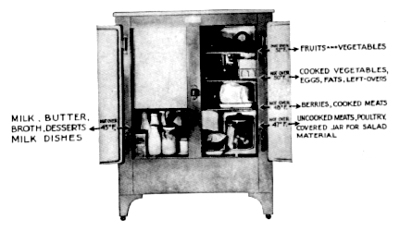
(I found this picture and a fairly clear explanation of ice boxes on on Wikipedia.)
It gets better. As I was reading the Wikipedia information, I came across the Pot in Pot refrigerator , known in Arabic as a “zeer” for which Mohammed Bah Abba was awarded a Rolex Laureate (Rolex Awards for Enterprise) in 2000. You can read about Mohammed Bah Abba, the Nigerian teacher who developed this simple, but effective refrigeration technique, by clicking on the blue type above. You can read more about the Zeer pot, and see a photo of how they work, by clicking here: Science in Africa.
Hard Times
I noticed it right away, driving home on the Seattle freeway – a significantly reduced number of cars, and NO one is speeding. Seattle has outgrown it’s freeways – even early mornings the roads are packed. Or they were – they aren’t now.
At first, I thought I might be imagining it, but the trip down to the ocean cabin in Oregon and back up and through and into Seattle several times have only driven the point home – there are fewer cars on the road.
The Starbuck’s have fewer customers. This is mid-summer, normally a carefree, free-spending time, but not this summer.
There are also fewer shoppers in the stores – and, in downtown Seattle, many of the shoppers were foreigners, here to take advantage of the bargains provided by the weakened dollar. I have to admit, it’s humbling to be a bargain destination. I know many Kuwaitis headed for the USA this summer, enjoying an improved exchange rate.
Sitting in Barnes and Noble with a friend, we heard a very plummy voice giving directions to friends who were to meet them there.
“We drove through the most amazing rural area,” she trilled, “SO picturesque, you must try to find it, it is called Bothell.”
Bothell picturesque? Bothell rural? Bothell is a bedroom community to Seattle, full of sub-divisions where there used to be farms. I wanted to give her a dirty look, but I remember saying the same things – glowing about the desert and camels or sweet little French villages, and I just figure what goes around comes around and I am just getting a little payback.
It’s also scary seeing how much prices have gone up – eggs! The same problem Kuwait is having – eggs are more expensive. Rice is more expensive. My Mother thinks some merchants are just marking things up because they can, and they can blame it on oil and it’s all just GREED.
I think all this has a lot to do with perception. Right now, people are feeling insecure and are trying not to spend too much money, not knowing what is around the corner. Americans have an irrepressible sends of optimism, and I suspect that a more positive approach will take hold in the next few months. Once it does, markets will rise, people will be spending again . . . and I wonder if the prices will go down, or just keep going up?
Combination of Events
Yesterday I visited our house. We have been seriously blessed with good renters, people who are good hearted, and take care of the house. We have a good property manager; when something needs to be done – a new roof, a new furnace, a new fence – he has people who can handle the job, and the job gets done well.
The house still has it’s original refrigerator from when it was built. I think it needs a new one – before an emergency happens and our renters lose their food. I measure, take stock of how the house is doing, and then . . . I have to go buy a refrigerator.
For me, this is stressful. A refrigerator is something that is supposed to last for a while. I go to Consumer Reports and I read about all the refrigerators. Here is what is interesting – the top rated model, in terms of keeping things cold or frozen, in terms of energy use, etc. has thirteen consumer reviews, and most of them are negative! Most needed repairs, and most of the repairs had to do with the ice maker and the cold water on the door thingie (to use the technical term)
So I visited three stores, looked at refrigerators. At two of the stores, you had three choices – white, stainless steel or black. I am not a black-appliance person, I am not a person who wants black in my kitchen. Neither, I discovered, am I a white-appliance person. And the stainless steel just makes me tired; it is a fad that is already passing. So what to do?

I went to the third store and there is more choice. I find the top rated model, which is on sale, and then ask the salesman if he has the same model WITHOUT the cold water and ice dispenser on the door, and he does! And it is on sale! And WITHOUT the fancy extras – it is exactly the same price as the ones WITH the fancy extras!
How funny is that?
I went ahead and ordered the one without all the water dispensers. It does have an ice cube maker, that is fine with me. Then, it took me longer to pay for it and arrange for delivery than it took me to research and decide which model to buy.
The salesman was very good, he knew his stuff. This wasn’t his fault. The problem is that I am an anomaly. My billing address is not the same as the address to which the refrigerator will be delivered. I have several different phone numbers, one of which is only active when I am in the USA, one of which rings in Kuwait, and I don’t want people calling in the middle of the night, oh, what to do?
I don’t exactly know what time is a good time for delivery for the renter; that is always handled by the property manager. I don’t have his phone number with me. GROAN!
When I finally get back to my Mother’s place, I am exhausted. A soft rain starts falling around 4 pm and from then on, I keep falling asleep. I am probably still jet lagging, yes, I know, it’s been a week but my body still has a time zone all its own.
I know it is too early to go to sleep so I make myself stay awake, I try to read, but at 9 pm, I totally give up. It’s the exhaustion, and it is the soothing sound of the steadily falling light rain. I keep my window open; I love the fresh air, and I love to hear the birds, and oh, the sound of rain! This morning, yes, 4 a.m. and I am wide awake. It is a GORGEOUS, sunny day, the clouds and rain have gone, and I had better start packing for the next leg of this journey while I have all this energy.
Seattle OKs Bag Fee
From the Seattle Post Intelligencer:
City OKs 20-cent fee on plastic, paper bags
Council also outlaws foam food and drink containers
By KATHY MULADY
P-I REPORTER
Move over, baseball caps and T-shirts.
Logo-emblazoned cloth grocery bags could soon become the most popular company freebie in the Puget Sound region.
Seattle became on Monday one of the first major American cities to discourage the use of paper and plastic shopping bags by requiring grocery, drug and convenience stores to charge 20 cents per bag. In a related action, the City Council also banned plastic foam food and drink containers.
Both laws will go into effect Jan. 1.
People can avoid the fees by bringing their own reusable bags when they shop. The city of Seattle will launch a 90-day education effort to help people figure out the best ways to use cloth bags, and remember to take them when they go shopping. The city also plans to provide residents with a couple of free bags.
One of my favorite stores, Trader Joe’s, has been selling reusable bags forever. They now have a display with many sizes and designs to choose from:
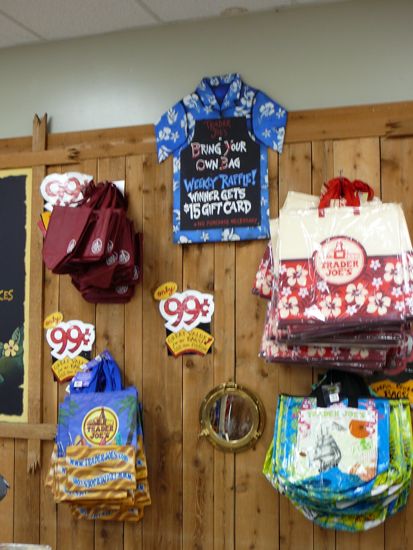
I’m really trying hard. I have a friend who is so conscientious about recycling, she always carries her own bags, and her actions have influenced me greatly. She believes even one person makes a difference, and I believe her – I can see that her behavior has already changed mine! I am trying to carry my own reusable bags now, too.
Especially for my Kuwait/Gulf/Middle East readers, I got a big grin when I saw this in the prepared food section:

A ready-to-go lunch, with felafel, hummous, tabouli and a little bit of flat bread.
Riots and Internet Offenders
From today’s Arab Times:
Kuwait preparing law to punish ‘Internet offenders’: Al-Othman
KUWAIT CITY (AP): Kuwait’s prosecutor general says Internet offenders will no longer be able to escape punishment in this country. Hamed Al-Othman says in an interview with Al-Qabas daily published Sunday he has prepared a bill that criminalizes promoting vice, incitement against the country’s leadership, divulging state secrets, or insulting Islam on the Web. If convicted, offenders would be sentenced to up to one year in jail and/or a fine, but face seven years in prison if their victims are minors. Al-Othman’s office confirmed that he made the comments to Al-Qabas.
The draft Internet crime and data information law recently passed by the Public Prosecution Department will be forwarded to the Council of Ministers for their consideration, adds Al-Othman.
Al-Othman explained the importance of passing such a law at this time, saying “it’s obvious to all who care about protecting our customs and the future generations that such a law is needed to combat the increasing electronic crimes associated with the ever-improving electronic technology. “The law will include 37 articles and punishment for those who fall foul of the law will be either jail sentence or financial fine,” he added.
Protest turns violent in fight over pay
KUWAIT CITY : A riot by about 2,000 workers of Al-Jawhara Company for Stevedor-ing and Cleaning in their camp in Hassawi led to the destruction of six vehicles and injuries to five camp officials, says K. John, the company’s Operations Manager. The manager was speaking to the Arab Times Sunday after the riot was brought under control by policemen. The riot, which began Saturday night, reached its peak by Sunday morning and continued till noon. The workers, John said, were disgruntled over their wages and were demanding a hike, talks over which have been going on for the last couple of weeks. “The recent outbursts in other cleaning companies stoked the angry workers to violence Saturday,” he added.
Meanwhile, late Sunday evening, the Ministry of Social Affairs agreed to almost all demands of workers of cleaning companies who had threatened to go on strike, besides setting a minimum wage of KD 40 for cleaning workers – without any deductions an embassy official said on condition of anonymity. The embassy official added that the ministry has also asked the cleaning companies to pay for health and residency fees of their workers and that companies which violate the rights of workers will face “full force of the law.” The official also said that Bangladeshi officials, who maltreat or exploit their workers, will be referred to the concerned authorities.
A mob of hundreds of Bangladeshi cleaners had attacked their company’s office in Jleeb Al-Shyoukh Saturday evening, and beat up five supervisors who were reportedly exploiting the workers, some cleaners told the Arab Times.
The workers were protesting about their unpaid wages and poor working conditions. All five supervisors are Bangladeshis and are currently being treated at the Farwaniya hospital.
A cleaner said the condition of the two injured officials was critical. However, this could not be independently confirmed.
The cleaners reportedly damaged furniture, computers, printers and other office equipment in the attack that lasted for a few minutes.
According to the workers, no arrests were made and a large police force was deployed at the camp from Saturday evening until late Sunday afternoon.
The timely arrival of police and embassy officials prevented the situation from spiraling out of control, added the cleaners. The workers said that they embarked on indefinite strike from Sunday and that they will not return to work unless all their problems are redressed by the company.
This is the first violent demonstration to grip Kuwait since the strikes of Bangladeshi cleaners began last Sunday.
Some of the problems facing the workers include: underpayment; company is making them pay for the health and residency fees; some cleaners are made to work for more than eight hours without any overtime benefits; company is not allowing workers to take vacation every two years; company is not granting sick leave, among other problems.
About 5,000 Bangladeshi cleaners are employed with this local company and are placed at various government establishments.
Jleeb Al-Shyoukh is home to thousands of Bangladeshi cleaners, who live in squalid camps and a majority of them are paid as low as KD 18 salary.
Another worker told the Arab Times that the problem had been simmering for a long a time and that the five supervisors were warned by them not work against workers’ interests.
He added that the trouble began when some of the workers confronted the supervisors as to why they were deducting their pay and that two supervisors reportedly threatened some cleaners, thereby leading to the showdown.
He said that the officials of the ministry of social affairs and labour rushed to the camp Saturday evening and urged the workers not to resort to violence and that they would put an end to their grievances as soon as possible.
Expressing his views on the company’s alleged apathy, another worker said: “We tried to resolve our problems with the company in an amicable manner, but our appeals fell on deaf ears. The supervisors in question are hand in glove with the company’s managers and used to report every development that took place at the camp.”
“When we decided to go on strike a few days ago, the supervisors quickly informed the company. The company then scuttled our plans by turning up the heat on our representatives. We know it is wrong to take the law in our hands but our situation was worsening by the day.”
The ministry of social affairs and labour has taken tough measures against cleaning companies that violate rights of workers, even as the ministry recently said that it had cancelled the contract of a company whose workers went on strike last Sunday.
On Saturday, senior officials of the ministry managed to convince some 7,000 Bangladeshi cleaners to drop their strike, who had threatened to stop work on Sunday if their demands were not met.
According to the workers, the ministry has agreed to all their demands and that they would be paid KD 40 salary, up from KD 8. It was also reported earlier that the ministry will soon send inspectors to labour camps to take a stock of workers’ living conditions and also to address their grievances.
When asked why the workers were unhappy over the wages, John said the issue is very complex, and the government is partly to be blamed for the current state of affairs. “The workers demand health insurance, which is KD 50 per person, while it is only KD 10 for domestic maids. This makes it very difficult for companies to provide health insurance of its workers.
“The municipality pays just about KD 23 per cleaning worker, and the government can’t expect us to pay more than that. Our workers receive anywhere between KD 20 and KD 70 depending upon their rank and job.
“Tendering rules also need to be reformed by the government. There are many small players who make abysmally low quotes to win tenders and bring down the quality of this sector. This despite the fact that we need to show bank guarantees of very huge sums to win tenders,” John explained.
Stressing the cleaning companies are an asset to the nation and should be treated with due importance, John said “the government has to provide us lands at subsidized rates to help sustain the industry.
“The workers ransacked the rooms in the camp and destroyed some computers. We also suspect that workers from neighboring camps joined in the riot, adding to the ferocity of the violence. The project manager had to be rescued from the camp by the police from the marauding rioters,” he revealed.
When asked what future course of action the company is planning to take, John said a meeting of the Cleaning Companies Association was called Sunday evening, “and the issue was to be discussed to find a solution to this problem that’s getting out of hand.”
“The demands of the workers are not wholly over the board given the inflation rates in the state. If the issue is not resolved many government institutions and private companies will be hit,” John added.
“The workers at Al Jawhara Company do not have any unpaid dues and all their salaries are paid in time,” he concluded.
Also:
KUWAIT: Acting Assistant Undersecretary of the Ministry of Social Affairs and Labour for labour sector Hamad Al-Me’dhadi revealed Sunday that the main reason behind the majority of recent strikes was the demand for salary increase.
He said that the Ministry of Social Affairs and Labour will report to the Cabinet on these strikes coinciding with another report to be submitted by the Ministry of Interior in this regard.
He added that ministry officials met with a representative of the Bangladeshi embassy and informed him that the strike of laborers must be expressed in an orderly manner and according to official channels.
He pointed out that it had been agreed with the Bangladeshi embassy that there should be representatives for all those laborers so that the ministry’s legal researchers and inspectors can listen to the workers demands.
Meanwhile, the issue of continuous strikes by expatriate workers and their rights are on top of the agenda for the Council of Ministers’ meeting on Monday. The meeting will be presided by the Acting Prime Minister and the Defense Minister Sheikh Jaber Al-Mubarak Al-Sabah.
“The Cabinet is ready to sanction erring companies and they may request the National Assembly to pass the new labor law at the beginning of the next parliamentary term,” Source added.
By Francis A. Clifford Cardozo and Valiya Sajjad
Arab Times Staff
Recent Comments
intlxpatr on Shampoo Ginger tigerbutterya0c5ff1d… on Shampoo Ginger intlxpatr on British Soldier Kidnapped, Esc… John on British Soldier Kidnapped, Esc… intlxpatr on British Soldier Kidnapped, Esc… Wikipedia Donate Button

Amazina


Early Voting in Florida


