Prices and Variety
My friends and family enjoyed my last Sultan Center post so much, I am going to add a couple photos here.
The price of eggs is breathtaking:

(Remember, for KD to $, you can figure about $4/KD)
Down below these packages of 6 (top shelf) and 12 second shelf) were flats of 30 for only KD 1.000. They are smaller eggs, and need washing, but that’s what I bought.
The Sultan Center serves a wide variety of people – local and expat – so I always love to see the things they put next to each other. This is a section I call “food helpers;” they are not food, but you add them to something – meat, rice, something that really IS food:

There is no lack of condiments. There is only the lack of the one particular condiment you need on the day that you need it!

Drought and Rising Food Prices
We are all so interconnected. I knew rice prices here in Kuwait had gone sky high, so high that imported American rice is now a relative bargain. I always bought Indian rice, in an effort to buy more (relatively) locally, and I knew India had restricted rice exports, but I didn’t know that the long drought in Australia was also contributing to the short supply.
You can read the entire article at this New York Times link.
THE FOOD CHAIN
A Drought in Australia, a Global Shortage of Rice
By KEITH BRADSHER
Published: April 17, 2008
. . . . . .
The collapse of Australia’s rice production is one of several factors contributing to a doubling of rice prices in the last three months — increases that have led the world’s largest exporters to restrict exports severely, spurred panicked hoarding in Hong Kong and the Philippines, and set off violent protests in countries including Cameroon, Egypt, Ethiopia, Haiti, Indonesia, Italy, Ivory Coast, Mauritania, the Philippines, Thailand, Uzbekistan and Yemen.
Drought affects every agricultural industry based here, not just rice — from sheepherding, the other mainstay in this dusty land, to the cultivation of wine grapes, the fastest-growing crop here, with that expansion often coming at the expense of rice.
The drought’s effect on rice has produced the greatest impact on the rest of the world, so far. It is one factor contributing to skyrocketing prices, and many scientists believe it is among the earliest signs that a warming planet is starting to affect food production.
It is difficult to definitely link short-term changes in weather to long-term climate change, but the unusually severe drought is consistent with what climatologists predict will be a problem of increasing frequency.
Read the rest of this article, and related articles, by clicking HERE.
Housing Collapse and Demographics
From The New York Times:
DUBLIN — The collapse of the housing bubble in the United States is mutating into a global phenomenon, with real estate prices swooning from the Irish countryside and the Spanish coast to Baltic seaports and even parts of northern India.
This synchronized global slowdown, which has become increasingly stark in recent months, is hobbling economic growth worldwide, affecting not just homes but jobs as well.
In Ireland, Spain, Britain and elsewhere, housing markets that soared over the last decade are falling back to earth. Property analysts predict that some countries, like this one, will face an even more wrenching adjustment than that of the United States, including the possibility that the downturn could become a wholesale collapse.
To some extent, the world’s problems are a result of American contagion. As home financing and credit tightens in response to the crisis that began in the subprime mortgage market, analysts worry that other countries could suffer the mortgage defaults and foreclosures that have afflicted California, Florida and other states.
Citing the reverberations of the American housing bust and credit squeeze, the International Monetary Fund last Wednesday cut its forecast for global economic growth this year and warned that the malaise could extend into 2009.
“The problems in the U.S. are being transmitted to Europe,” said Michael Ball, professor of urban and property economics at the University of Reading in Britain, who studies housing prices. “What’s happening now is an awful lot more grief than we expected.”
You can read the entire story HERE
Yes, some banks made loans to a few people who really couldn’t afford the housing, and yes, a small percentage have been foreclosed. Is the entire downturn in the housing market caused by the sub-prime loan debacle?
In the USA, there is a HUGE demographic, the baby boomers, who have already started retiring. As they retire, many are downsizing, looking for a simpler way of life. Could it be that there is more than one factor acting here? Could housing demand be dropping? Wasn’t there a similar post World War II baby boom in Europe? How will the boomers’ retirement effect the US economy?
Kuwait has one long continuous baby boom – seems to me the housing prices here continue to go up!
More Airline Fees
I had total sticker shock when I bought my ticket to go home this summer – I paid for an economy class ticket what I used to pay for a business class ticket. Ulp. More money, less legroom, more headaches . . .
The Washington Post ways we have more unpleasant surprises in store:
Airline passengers, already enduring persistent flight delays and other customer service headaches, are confronting another aggravation: mounting fees for everything from checking a second bag to sending a child alone on a trip.
Carriers are turning to the fees and charges — some of which are built into the cost of a ticket — to help them cope with rising fuel costs, which account for increasing portions of their budgets.
Just in time for the summer travel season, airlines have tacked on a $25 fee to check a second bag, and yet another carrier announced last week that it was adding a fee for curbside baggage check-in. Others have steadily brought back pesky overnight-stay requirements to help them better separate business fliers from penny-pinching leisure travelers. Most have tried to slip fuel surcharges into the cost of tickets — fees that have climbed past $150 each way on some international flights.
Passengers won’t be feeling the squeeze just in their purses. Most major carriers have also announced reductions in flights by the fall to help improve efficiency, a move that will cram more passengers onto already crowded jets.
You can read the entire article HERE.
Hold Your Calls, Save Your Life
Actually – not a bad slogan. Pithy, personal, memorable.
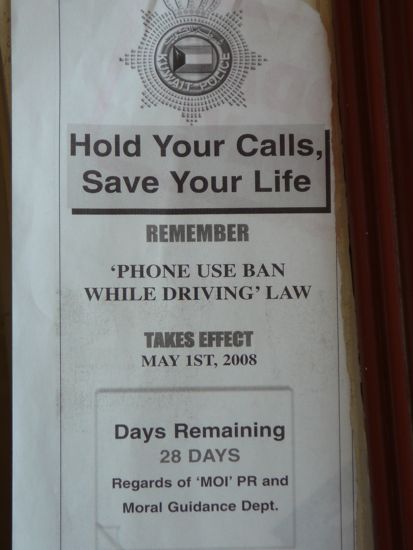
Found this in yesterday’s Kuwait Times. Was it also in the Arabic language newspapers? Doesn’t say anything about the fine . . . . the newspaper announcement leads us to believe they are serious. The fine of 5KD (about $20) remains laughable. Nonetheless – if you use a mobile phone while driving, you will become a CRIMINAL after May 1! 😉
No one is going to hate this law more than AdventureMan. Sometimes he calls me when he is driving just to see if I will hang up on him. He tries to talk me into talking with him. I have always said I don’t want to hear his last words being “Oh ____!”
Feel Like Dancin’

Thanks for all your good thoughts as I – well, I didn’t prepare our taxes, I prepared the worksheet for our taxes. I used to do taxes, but taxes have gotten so complicated, now we have to pay someone else a bucket of money to do them for us. In the meantime, it takes a whole day just to fill out the sheets of preparation. It takes a year of saving receipts and records.
I discovered that in an increasingly paperless world, it is not so easy to document as it used to be. I used to dread filing, but I also knew where things were. A lot of my day yesterday was spent looking up accounts online, and printing off things. When we went more paperless, we also sacrificed easy access to good record keeping. AArrgh!
I remember my Dad always did the family taxes, and he would do them late in January, as soon as all the financial statements had arrived. We would give him hints about better ways of shielding his money from taxation, and he would say “I don’t mind paying taxes. I worked for the government, and the government put you kids through university by paying me a generous salary and health benefits and retirement.” We would shake our heads in wonderment – have you ever met someone who didn’t mind paying taxes? It must be generational.
We had a complicated year, financially, and in gathering all the records I noticed in my zeal to keep everything paid off and up to date, I actually OVERPAID our taxes. . . how often does that happen? AdventureMan and I have something to celebrate!
Those penguins are from a website called CafePress and they sell all kinds of adorable things, unique.
(At nine in the morning, it is still only 73°F / 23°C – wooo hoooooo! Gonna be a great Thursday!
Big Plans, No Action
Hmmm, let’s see . . . plans drawn up, billions allocated for renovation and restoration and blah blah blah and nothing happens. Good ol’ Kuwait? Nope! The tragic quagmire of post-Katrina New Orleans. You can read the entire article at The New York Times.
By ADAM NOSSITER
Published: April 1, 2008
NEW ORLEANS — In March 2007, city officials finally unveiled their plan to redevelop New Orleans and begin to move out of the post-Hurricane Katrina morass. It was billed as the plan to end all plans, with Paris-like streetscape renderings and promises of parks, playgrounds and “cranes on the skyline” within months.
But a year after a celebratory City Hall kickoff, there have been no cranes and no Parisian boulevards. A modest paved walking path behind a derelict old market building is held up as a marquee accomplishment of the yet-to-be-realized plan.
There has been nothing to signal a transformation in the sea of blight and abandonment that still defines much of the city. Weary and bewildered residents, forced to bring back the hard-hit city on their own, have searched the plan’s 17 “target recovery zones” for any sign that the city’s promises should not be consigned to the municipal filing cabinet, along with their predecessors. On their one-year anniversary, the designated “zones” have hardly budged.
“To my knowledge, I don’t think they’ve done anything to any of them,” said Cynthia Nolan, standing near a still-padlocked, derelict library in the once-flooded Broadmoor section, which is in the plan.
“I haven’t seen anything they’ve done to even initiate anything,” said Ms. Nolan, a manager in a state motor vehicles office who has painstakingly raised her house here nearly four feet. “It’s too long. A year later, and they still haven’t initiated anything they decided to do?”
The library still bears the cross-hatch markings made by emergency teams in the days immediately after Hurricane Katrina, to indicate whether any bodies were inside (there were none).
The city official in charge of the recovery effort, Edward J. Blakely, said the public’s frustration was understandable, but he suggested that bureaucratic hurdles had made moving faster impossible. Mr. Blakely said crucial federal money had only recently become available, the process of designing reconstruction projects within the 17 zones was time-consuming, and ethics constraints on free spending were acute, given a local history of corruption.
Sunrise and the Qatteri Cat
The Qatteri Cat started getting restless around 4 a.m. this morning. This was entirely my fault; I forgot the check the cat food before I went to bed and around 4 he likes to have his main meal of the day, take care of toileting needs, scramble around the house, listen to all the noises on the street – it’s his time of day. I knew QC was hungry, but I couldn’t make myself wake up enough to feed him.
He is a very polite cat – he just keeps coming back. By 5:30 a.m. and his 5th or 6th greeting, I was ready to get up. And I really am glad I did, as the sun is rising these days around 5:44 and I was able to capture the beginning of what I believe is going to be a truly glorious day.

The high today will only be 93°F / 34°C; it is a balmy 70°F / 21° C at 5:56 in the morning.
The only meeting I had scheduled for today was postponed, and I have the entire day to devote to organizing my taxes. I don’t know why I make such a big deal out of it, put it off, all it takes is focus and just getting organized, but for some reason I dread doing it make it worse than it really is. I even have a reward for myself when I get it done, so what’s my problem?
Have a great day out there.
Reservations
I just had a truly gut-wrenching experience.
I’ve been checking airline prices for my summertime journey back to the USA. I use Mobissimo most often, but I use them all, just to see how prices compare.
The prices have been high. I finally reserved – paying more than what I used to pay for business-class for an economy-class ticket. Seats are disappearing, prices are soaring and I am betting many families will opt just not to travel this summer, or to travel using a Jazeera-type-airline for travel to more local vacation sites.
If you have travel plans, you might want to start looking at your plans now. It’s going to be a rough summer out there.
Education and No Child Left Behind
One of the most cynical education programs ever put into place, in my opinion, is the No Child Left Behind program. It’s impact, while claiming lofty goals, in actuality forced schools to exclude students who would fail, so as not to have them on their statistical base.
Quote from article: If low-achieving students leave school early, a school’s performance can rise.
In this story from the New York Times you can read how US schools fudge statistics to have a respectable high school graduation rate for federal funding purposes, while the truth is far less positive.
JACKSON, Miss. — When it comes to high school graduation rates, Mississippi keeps two sets of books.
One team of statisticians working at the state education headquarters here recently calculated the official graduation rate at a respectable 87 percent, which Mississippi reported to Washington. But in another office piled with computer printouts, a second team of number crunchers came up with a different rate: a more sobering 63 percent.
The state schools superintendent, Hank Bounds, says the lower rate is more accurate and uses it in a campaign to combat a dropout crisis.
“We were losing about 13,000 dropouts a year, but publishing reports that said we had graduation rate percentages in the mid-80s,” Mr. Bounds said. “Mathematically, that just doesn’t work out.”
Like Mississippi, many states use an inflated graduation rate for federal reporting requirements under the No Child Left Behind law and a different one at home. As a result, researchers say, federal figures obscure a dropout epidemic so severe that only about 70 percent of the one million American students who start ninth grade each year graduate four years later.
California, for example, sends to Washington an official graduation rate of 83 percent but reports an estimated 67 percent on a state Web site. Delaware reported 84 percent to the federal government but publicized four lower rates at home.
The multiple rates have many causes. Some states have long obscured their real numbers to avoid embarrassment. Others have only recently developed data-tracking systems that allow them to follow dropouts accurately.
The No Child law is also at fault. The law set ambitious goals, enforced through sanctions, to make every student proficient in math and reading. But it established no national school completion goals.
“I liken N.C.L.B. to a mile race,” said Bob Wise, a former West Virginia governor who is president of the Alliance for Excellent Education, a group that seeks to improve schools. “Under N.C.L.B., students are tested rigorously every tenth of a mile. But nobody keeps track as to whether they cross the finish line.”
Furthermore, although the law requires schools to make only minimal annual improvements in their rates, reporting lower rates to Washington could nevertheless cause more high schools to be labeled failing — a disincentive for accurate reporting. With Congressional efforts to rewrite the law stalled, Secretary of Education Margaret Spellings has begun using her executive powers to correct the weaknesses in it. Ms. Spellings’s efforts started Tuesday with a measure aimed at focusing resources on the nation’s worst schools. Graduation rates are also on her agenda.
You can read the rest of the story HERE.
Our young people are the leaders and decision makers of tomorrow. My generation thought we were going to change the world, and here the world continues on it’s merry way to pollution, desolation and degradation. I hope the young people of today can do what we have failed to do – create a better world.
Recent Comments
intlxpatr on Shampoo Ginger tigerbutterya0c5ff1d… on Shampoo Ginger intlxpatr on British Soldier Kidnapped, Esc… John on British Soldier Kidnapped, Esc… intlxpatr on British Soldier Kidnapped, Esc… Wikipedia Donate Button

Amazina


Early Voting in Florida


