‘Kuwait In Fight With Drugs, Money-Wash’UN Briefed On Efforts
NEW YORK, Oct 10, (KUNA): A Kuwaiti diplomat has briefed a United Nations commission about the State of Kuwait efforts to combat money laundering and other illegal financial activities as well as menace of narcotics. Ibrahim Faisal Al-Da’ee, the third secretary serving with the permanent Kuwaiti mission at the UN, in an address to the UN Social, Cultural and Humanitarian Affairs Committee (SOCHUM), underscored necessity of taking effective action against crime and boosting coordination at the international and regional levels in this respect. As to combating “corrupt financial activities and funding from illegitimate resources,” the third diplomat noted that the State of Kuwait issued lawinto- decree number 23 in 2012, setting up the public authority for combating corruption and issuing special rules for financial assets’ disclosure, as well as the Ministerial Resolution No. 37 (2013), containing executive regulations for combating money laundering and terrorism funding.
Established On basis of the above mentioned, diplomat Al-Da’ee continued, the national commission for combating money laundering and terrorism was established. Moreover, the Central Bank of Kuwait issued a number of decisions aimed at clamping down on money laundering, in tandem with Kuwait’s endorsement of the UN convention for combating corruption. Regarding the drugs, Kuwait urges for taking necessary precautions to resolve this international problem by means such as encouraging planting of legitimate crops and improving living conditions in rural regions. Also in this respect, he pointed out, Kuwait had signed international conventions concerning such issues. According to Kuwait’s Ministry of Interior, number of drug-related crimes, during 2010-2013, dropped 6.4 percent, drug dealing cases 7.2 percent and narcotics-linked deaths 30 percent. He concluded his address to the international commission, stressing on respect for human and basic rights, through action against crimes, urging for collective global efforts against narcotics.
So . . . now we have legislation and a decree. Does Kuwait have the resources and/or the will to go after those who are funneling the funds to ISIS? Legislations and decrees are great, but even greater is following through; it gives a government credibility.
AdventureMan and I are not even typical of our generation. Living overseas, living in so many countries, we just got used to paying in cash. In our early years, even countries like France had more places that didn’t take credit cards than places that did. When it comes to buying gas in France, you’d better have a bucketful of cash 😉
But even those in our generation tend to pull out their credit cards for meals out, so this week AdventureMan asked wait staff percentages of who paid cash and who paid with cards. The most common answer was around 85% paid with a card.
I can understand. The restaurants/stores don’t have to keep as much money on hand for change, so it is easier on them, and those who pay with a card can track their expenses. Part of me laughs and says I think we don’t want to track our eating-out expenses, and another part thinks that because we pay cash, we probably don’t indulge in extras so often, which, for us, is a good thing. If we have dessert, we normally split it.
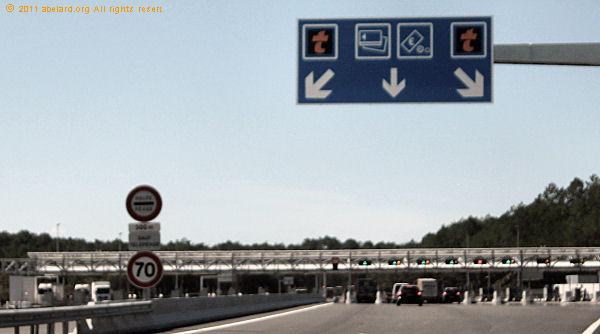
I do remember how wonderful it was to be able to pay all the tolls on the toll roads in France with a credit card, how wonderfully easy it was to use my credit card and the ATM’s in Kuwait and Qatar and Saudi Arabia – for some reason, it was like they were years ahead of the USA in banking technology, and banking by phone. But even there, in the smaller shops, you needed cash.
Hey, millennial! Yes, you there, standing in line at the Starbucks (SBUX) counter, tapping away on your smartphone, with the button-like doodads growing into your earlobes — put away that debit card.
No, don’t worry. No one’s going to nag you about buying a cup of overpriced coffee. We all have our vices. And you’re still basking in the fresh glow of youth. At least your vices won’t hurt you as much as they’d hurt us old codgers.
But the way you’re buying your coffee — you’re doing it wrong. And you’re not alone.
Paper or Plastic?
According to a recent survey by CreditCards.com, only about 1 in 3 American consumers currently uses a plastic card — credit or debit — when buying something that costs $5 or less. Most folks still pay with cash for such small purchases, with folks ages 65 and up having the greatest fondness for paying with greenbacks (82 percent).
But when it comes to the Millennials, 51 percent use plastic to pay for such purchases.
There’s only so much cash that will fit in your wallet, and if you limit yourself to paying in cash — you eventually run out. Old folks like me, whose memories aren’t what they used to be (and maybe never were), like this “automatic” check on spending. And as a result, CreditCards.com reports that the older a consumer is, the more likely he or she is to pay for small purchases in cash than to pull out a plastic card.
Not All Plastic Is Created Equal
Among plastic cards, nationally, consumers are about twice as likely (22 percent) to use a debit card to pay for a small purchase as to put the purchase on credit (11 percent). When the data is broken down by age group, it turns out that millennials are even more fond of debit cards than the average shopper. Consumers ages 18 to 29 use debit cards more often than any other age group when making small purchases.
But here’s the thing: Debit and credit cards may be nearly equal in their convenience of use when shopping for small items (eliminating the need to carry weighty pockets, jingling with unwanted coins). But they’re not at all equal in the financial benefits they convey to a consumer.
To cite the most obvious example, credit cards often offer you “rewards” for using them. With card companies charging retailers fat interchange fees for every transaction they process, they can afford to pay you generously when you “choose plastic.” Airline miles; “points” redeemable for cash back, account credits, merchandise, and gift cards; and just plain cash-back offers, as high as 5 percent, all make the choice between credit and debit a bit of a no-brainer. (Granted, some debit cards offer rewards of their own — but they’re rare, hard to find and usually much less generous.)
But rewards are only the most obvious monetary benefit of choosing credit over debit. Consider: When you pay for a purchase — large or small — with a debit card, that money is almost immediately deducted from your account.
What Warren Buffett Thinks
In contrast, a charge placed on a credit card is a debt that doesn’t come due — and needn’t be paid — until your credit card bill is sent to you. Depending on the date of purchase and the due date on your credit card bill, you may not have to pay that bill for as long as a month — which means you may be able to hang on to your money, and collect interest on it at your bank, for that time. (Super-investor Warren Buffett calls this concept of using someone else’s money, and collecting interest on it for your own benefit, “free float,” and deadpans that his business partner “Charlie and I find this enjoyable.”)
Granted, with the ultra-low interest rates that banks are paying on checking accounts these days, free float isn’t as profitable as it used to be — probably only pennies per credit card billing cycle. But still, free money is free money. Are you going to turn it down because you’re not being offered enough free money?
Of course, you do need to remember to pay your credit card bill on time, so as not to get hit by late fees. But as long as you can manage that, a credit card isn’t really a card you use for taking out long-term credit at all. It’s a pay-once-a-month debit card — that pays you free money every month.
The High Cost of Not Buying on Credit
Another advantage: CreditCards.com quotes Martin Lynch, director of education of the Cambridge Credit Counseling Corp. of Massachusetts, noting that “debit cards … can’t be reported to the credit bureaus and, thus, they don’t build [up] credit [ratings].” Building up a strong credit rating is crucial to a young person looking to buy his or her first car or to secure a mortgage on a starter home.
Getting charges and on-time payments, onto your credit report — to establish a track record as a reliable borrower — is therefore a good thing. It’s something you want to do as often as possible, and using a credit card to pay for small purchases is a great way to build up your credit report quickly.
Melinda Opperman, senior vice president of community outreach at Springboard Nonprofit Consumer Credit Management Inc., another expert interviewed by CreditCards.com, echoes the sentiment: “We like the idea of using credit cards frequently for small, manageable expenses. This gives users the benefit of an active credit history, but leaves them with monthly bills that are small enough to pay off in full, so they don’t have to pay any interest.”
Suffice it to say, any idea that’s supported by professional credit counselors, and by the world’s third richest man, is one that millennials would be well advised to take to heart.
Motley Fool contributor Rich Smith has no position in any stocks mentioned, and hasn’t used a debit card in years. The Motley Fool recommends and owns shares of Starbucks. To read about our favorite high-yielding dividend stocks for any investor, check out our free report.
Today I received a text from my bank telling me that a document from them had been returned as undeliverable and telling me to click on the blue hypertext with my banks name dot com.
It didn’t smell right, so I called my bank, and no, they had not sent that text.
Did you know when you get a phone call or text that seems odd to you that not only do you not have to answer, but you can go online and check that number? Just google the exact number and you will find records that show if it is a scam or telemarketer. It is a wonderful resource.
The Islamic State of Iraq and Syria (ISIS), now threatening Baghdad, was funded for years by wealthy donors in Kuwait, Qatar, and Saudi Arabia, three U.S. allies that have dual agendas in the war on terror.
The extremist group that is threatening the existence of the Iraqi state was built and grown for years with the help of elite donors from American supposed allies in the Persian Gulf region. There, the threat of Iran, Assad, and the Sunni-Shiite sectarian war trumps the U.S. goal of stability and moderation in the region.It’s an ironic twist, especially for donors in Kuwait (who, to be fair, back a wide variety of militias). ISIS has aligned itself with remnants of the Baathist regime once led by Saddam Hussein. Back in 1990, the U.S. attacked Iraq in order to liberate Kuwait from Hussein’s clutches. Now Kuwait is helping the rise of his successors.As ISIS takes over town after town in Iraq, they are acquiring money and supplies including American made vehicles, arms, and ammunition. The group reportedly scored $430 million this week when they looted the main bank in Mosul. They reportedly now have a stream of steady income sources, including from selling oil in the Northern Syrian regions they control, sometimes directly to the Assad regime.
But in the years they were getting started, a key component of ISIS’s support came from wealthy individuals in the Arab Gulf States of Kuwait, Qatar and Saudi Arabia. Sometimes the support came with the tacit nod of approval from those regimes; often, it took advantage of poor money laundering protections in those states, according to officials, experts, and leaders of the Syrian opposition, which is fighting ISIS as well as the regime.
“Everybody knows the money is going through Kuwait and that it’s coming from the Arab Gulf,” said Andrew Tabler, senior fellow at the Washington Institute for Near East Policy. “Kuwait’s banking system and its money changers have long been a huge problem because they are a major conduit for money to extremist groups in Syria and now Iraq.”
Iraqi Prime Minister Nouri al-Maliki has been publicly accusing Saudi Arabia and Qatar of funding ISIS for months. Several reports have detailed how private Gulf funding to various Syrian rebel groups has splintered the Syrian opposition and paved the way for the rise of groups like ISIS and others.
“The U.S. has made the case as strongly as they can to regional countries, including Kuwait. But ultimately when you take a hands off, leading from behind approach to things, people don’t take you seriously and they take matters into their own hands.”
Gulf donors support ISIS, the Syrian branch of al Qaeda called the al Nusrah Front, and other Islamic groups fighting on the ground in Syria because they feel an obligation to protect Sunnis suffering under the atrocities of the Assad regime. Many of these backers don’t trust or like the American backed moderate opposition, which the West has refused to provide significant arms to.
Under significant U.S. pressure, the Arab Gulf governments have belatedly been cracking down on funding to Sunni extremist groups, but Gulf regimes are also under domestic pressure to fight in what many Sunnis see as an unavoidable Shiite-Sunni regional war that is only getting worse by the day.
“ISIS is part of the Sunni forces that are fighting Shia forces in this regional sectarian conflict. They are in an existential battle with both the (Iranian aligned) Maliki government and the Assad regime,” said Tabler. “The U.S. has made the case as strongly as they can to regional countries, including Kuwait. But ultimately when you take a hands off, leading from behind approach to things, people don’t take you seriously and they take matters into their own hands.”
Donors in Kuwait, the Sunni majority Kingdom on Iraq’s border, have taken advantage of Kuwait’s weak financial rules to channel hundreds of millions of dollars to a host of Syrian rebel brigades, according to a December 2013 report by The Brookings Institution, a Washington think tank that receives some funding from the Qatari government.
“Over the last two and a half years, Kuwait has emerged as a financing and organizational hub for charities and individuals supporting Syria’s myriad rebel groups,” the report said. “Today, there is evidence that Kuwaiti donors have backed rebels who have committed atrocities and who are either directly linked to al-Qa’ida or cooperate with its affiliated brigades on the ground.”
Kuwaiti donors collect funds from donors in other Arab Gulf countries and the money often travels through Turkey or Jordan before reaching its Syrian destination, the report said. The governments of Kuwait, Qatar, and Saudi Arabia have passed laws to curb the flow of illicit funds, but many donors still operate out in the open. The Brookings paper argues the U.S. government needs to do more.
“The U.S. Treasury is aware of this activity and has expressed concern about this flow of private financing. But Western diplomats’ and officials’ general response has been a collective shrug,” the report states.
When confronted with the problem, Gulf leaders often justify allowing their Salafi constituents to fund Syrian extremist groups by pointing back to what they see as a failed U.S. policy in Syria and a loss of credibility after President Obama reneged on his pledge to strike Assad after the regime used chemical weapons.
That’s what Prince Bandar bin Sultan, head of Saudi intelligence since 2012 and former Saudi ambassador in Washington, reportedly told Secretary of State John Kerry when Kerry pressed him on Saudi financing of extremist groups earlier this year. Saudi Arabia has retaken a leadership role in past months guiding help to the Syrian armed rebels, displacing Qatar, which was seen as supporting some of the worst of the worst organizations on the ground.
The rise of ISIS, a group that officially broke with al Qaeda core last year, is devastating for the moderate Syrian opposition, which is now fighting a war on two fronts, severely outmanned and outgunned by both extremist groups and the regime. There is increasing evidence that Assad is working with ISIS to squash the Free Syrian Army.
But the Syrian moderate opposition is also wary of confronting the Arab Gulf states about their support for extremist groups. The rebels are still competing for those governments’ favor and they are dependent on other types of support from Arab Gulf countries. So instead, they blame others—the regimes in Tehran and Damascus, for examples—for ISIS’ rise.
“The Iraqi State of Iraq and the [Sham] received support from Iran and the Syrian intelligence,” said Hassan Hachimi, Head of Political Affairs for the United States and Canada for Syrian National Coalition, at the Brookings U.S.-Islamic World Forum in Doha this week.
“There are private individuals in the Gulf that do support extremist groups there,” along with other funding sources, countered Mouaz Moustafa, executive director of the Syrian Emergency Task Force, a Syrian-American organization that supports the opposition “[The extremist groups] are the most well-resourced on the ground… If the United States and the international community better resourced [moderate] battalions… then many of the people will take that option instead of the other one.”
My third year in Pensacola, I got a huge shock. My water/sewage bill jumped, jumped horribly. I knew we had used a lot of water in October and November of the previous year, because we had installed some new landscaping in October which needed watering in, but I had no idea why EVERY month my bill was so high.
Then the fourth year, the bill came and it was so low, I called and said “I think there has been a mistake.” I didn’t want to be getting a huge bill the next month to rectify the mistake. The wonderful customer service woman asked me if I didn’t know about “averaging.” No. I’m new. I don’t know about averaging, and I have never heard anyone talk about it.
She explained that in November, December and January, they average water use and then use it to estimate the sewage bill for the entire year, since they can’t separate water used for watering lawns and water used that goes into sewage. Most people, she explained, turn off their outside water around November. Evidently, horrified by my huge bills resulting from watering in the landscaping, I had been extremely careful in the last year, and was greatly blessed with much smaller water bills.
As it turns out, it’s not just new people who don’t know about “averaging.” There are a lot of people who have lived here their entire lives who don’t know about it either. Last year, aware of averaging, I watched for the announcement, which wasn’t really an announcement. In the ECUA newsletter, buried deep in one of the columns, was a mention that averaging would begin in November, depending on your billing, on or around the middle of November.
You can call ECUA Customer Service (850-476-0480) and find out close to when your meter is checked in November – for you, that is when averaging starts. Averaging runs November – December – January and measures how much water you use and uses that to compute your sewerage amount. If you are careful about your water use in those three months, you will lower your water bill for the entire year.
President Obama is laying out his strategy to counter the Islamic State, whose rampages across Iraq and Syria have riveted Americans’ attention on a zone of conflict that many had hoped to forget. Many are urging him to step up military action. But if Obama wants to defeat the jihadis, he will need more than airstrikes—he should follow the money.
For all that ideology, religious belief and perhaps a lust for violence and power might motivate those who fight for the Islamic State (known variously by the acronyms ISIS and ISIL), money is what keeps the group going. As with any state, ISIL has bills to pay and mouths to feed. Even for the world’s richest terrorist organization—which, by all available accounts, ISIL is—money doesn’t grow on trees, and nothing in the world comes for free.
So where does ISIL’s money come from? As part of my research at the RAND Corporation, since late 2006 I have been studying the finances, management and organization of the precursors to the Islamic State—Al Qaeda in Iraq and the Islamic State of Iraq—using their own documents, manuals and ledgers. More recently, Rand has teamed up with scholars from Princeton and Emory universities, as well as analysts from other organizations, to study more than 150 documents produced between 2005 and 2010. Although our work is still not yet done, we can draw a number of conclusions.
The most important thing for U.S. policymakers to remember is that ISIL now possesses the financial means to support a long-term fight—some $2 billion, according to a recent report in the Guardian, citing a British intelligence official. At the same time, ISIL’s preferred fundraising methods and many financial commitments create vulnerabilities. The organization was badly damaged by late 2009, thanks to a combination of coalition and Iraqi forces, as well as intervention by the Iraqi government, and it can be badly damaged again. But without the establishment of a widely accepted, legitimate political order in Iraq, ISIL cannot be eradicated—and will continue to seek out and mete out cash.
ISIL raises most of its money domestically in Iraq and Syria. Its income streams include oil smuggled to other countries in the region, extortion, taxes—especially on non-Muslim minorities—and other essentially criminal activities.
Oil is ISIL’s biggest source of revenue but also presents the biggest problem. ISIL controls about a dozen fields in Syria and Iraq, in addition to a number of refineries, including mobile refineries. Based on media accounts, RAND has estimated the total production capacity of these fields to be more than 150,000 barrels per day, although actual production is estimated to be much lower: The website Iraq Oil Report has reported that exports for the month of August at about 2.4 million barrels per day, for instance.
ISIL smuggles this oil out in tanker trucks—clearly visible from the sky should any drone pass overhead, so the smuggling is not particularly furtive. The group then sells the oil to whoever will buy it—reported in the media to be buyers in Syria, Turkey, the Kurdistan Region of Iraq and possibly in Iran and even Bashar Assad’s regime in Syria, among other countries. Sales take place at rates deeply discounted from world prices. But even so, revenues have been estimated in the media at $1 million, $2 million or even $3 million per day.
We have seen this before. From 2006 to 2009, ISIL’s predecessor, the Islamic State of Iraq, raised perhaps $2 billion through smuggled oil originating in the Baiji refinery in northern Iraq. This ended as a result of a concerted effort by U.S. and Iraqi forces to destroy the group and create the conditions in which the Iraqi government could exercise its law-and-order responsibilities, as well as vastly improved management at Baiji, owned by the Iraqi government.
So where does all of ISIL’s money go?
ISIL historically has paid its members (yes, it maintains payroll sheets) based on a flat monthly rate per person and then additional fixed amounts for each wife, child and dependent unmarried adult woman in the household. In Anbar, Iraq, the rate was $491 per year in 2005 and 2006, and then about $245 per year per dependent; the rate was similar in Mosul in 2007 and 2008. These payments to family are meant to continue if the ISIL member is captured or killed—a primitive form of life insurance. If enough members are captured and killed, however, these costs start to mount.
ISIL also pays rent for its members in some cases—payments that might be bonuses to high-performing members, although we cannot be sure—and medical expenses for some members and their families. In the past, the group has sometimes hired lawyers to help get captured members out of jail. And it runs safe-houses and has to buy equipment. Guidelines published by a predecessor of the group say that expense reimbursements should be filled out in triplicate and explain where each copy goes within the organization. We don’t know for sure whether ISIL today is making money or even breaking even, but at least in Anbar from 2005 to 2006, the money was being spent as fast as it came in.
As a cash-based organization, ISIL relies on couriers not only to deliver messages among its dispersed leadership but also to move money—follow the right courier and you get to the leadership. Because it deals only in cash, ISIL also needs to worry about the honesty of its members. We have seen instances of skimming for personal enrichment, as you might see in any cash-based criminal network.
As a state, albeit a twisted version of one, ISIL also has administrative expenses. It is responsible for making sure electricity and water flow and the roads stay repaired in the regions of Iraq it now controls—including parts of the Anbar, Ninewa Salah-al-Din, Kirkuk and Diyala governorates. Whether the group chooses to or is able to fulfill those responsibilities creates a vulnerability: A discontented population is unlikely to remain passive under ISIL’s leadership.
Even if ISIL is making $3 million per day—at the higher end of the various estimates out there—then it makes slightly more than $1 billion per year. Just to be conservative, in case ISIL is doing more business than we’re aware of, let’s double that to $2 billion per year. Although exact totals are difficult to find, in 2013, before ISIL’s advance, the Iraqi government spent far more than $2 billion per year running the governorates ISIL now controls, including salaries to civil servants, other costs of service provision and investment spending. That means ISIL likely isn’t keeping up the same level of service that the Iraqi government once did. True, ISIL need not maintain that level—it hardly rules with the consent of the governed. But it’s not only a problem that those under its rule can rebel, as happened in 2007 and 2008; with the exception of oil, the group’s continued revenue-raising also depends on there being enough money to skim and extort from the economy, and this requires some minimum level of services and economic activity.
There is little that outside forces can do to halt the extortion and skimming that take place within ISIL territory. Oil smuggling, though, can be disrupted, at least to an extent. Intelligence resources from the United States, Iraq and any other country that takes on ISIL should be focused on identifying middlemen and buyers for the smuggled fuel and using any means necessary to halt those purchases.
It would be counterproductive to destroy oil field infrastructure, since repairs would be expensive and legitimate governments will need those oil revenues when they reestablish control. But mobile refineries should be targeted, and roads and other pathways that tanker trucks use to transport oil to and from oil fields should be made impassable by military means. The refineries and roads can be easily repaired when the time comes, but for now, ISIL should find it very difficult to move oil from fields.
Stopping ISIL will of course require much more than disrupting its funding. It will have to be defeated militarily, and legitimate, trusted governments will have to be established in Iraq and Syria to defeat the group over time. There’s no simple path to achieving this, but as long as ISIL’s coffers remain full, the task will not get any easier.
Big article in AOL news about Dan Gilbert going to Silicon Valley to pitch moving their offices to Detroit because it’s way cool.
Excuse me?
While I appreciate his loyalty to Detroit, the things he is pitching all apply to Pensacola – AND. And in Pensacola you don’t have harsh winters. And in Pensacola you are minutes from one of the most beautiful sugar-white sand beaches, uncrowded, in the world. And Pensacola is family oriented. And Pensacola has affordable housing. And Pensacola has a way-cool culture, with parades, symphony, ballet, opera, theatre and restaurants, and world class National Naval Aviation Museum. And people spend thousands of dollars to come visit Pensacola when they could be living the dream – in Pensacola.
Dan Gilbert is a powerful man – in Detroit. Now he wants to convince Silicon Valley to move to America’s Motor City where they’ll have wide open offices, inexpensive living, and access to amazing talent.
Gilbert, the chairman of Rock Ventures and the owner of Quicken Loans, owns 60 buildings in downtown Detroit that house 12,000 employees. He is also an active backer in startups and has been inviting small companies to come bloom in Detroit over the past half-decade.
Why should you move to Detroit?
“The perception doesn’t do it justice. You have a huge talent pool,” said Gilbert. “And the people are way cooler.”
Gilbert believes that the Midwest work ethic isn’t a myth. He said that, despite the rumors to the contrary, the city has an innovative city government and, thanks to his extensive purchases in Detroit, there is space to spare for new startups. He is also working hard to reduce blight around the city, ensuring that city doesn’t look like it does in the popular “desolation porn” that characterizes the city.
The result is a smaller, more compact city that allows smaller companies to gain a foothold in the tech economy.
The city is, arguably, entering a period of renaissance. Thanks to Quicken Loans and Gilbert’s work in the city, most of the blight has been converted to cheap office space. While it does still seem like a wasteland to the average graduate, we saw a city reborn when we visited in 2012 and things are improving immensely.
In short, he said, Detroit is all about opportunity.
“We have great bones,” said Gilbert.
Detroit has good bones? Pensacola has office space, room to grow, a population of workers that can be trained to fill high tech jobs, several colleges, a university, and low stress living. It’s such an easy sell.
I had one reader write me in the background saying I was rude to publish these letters. No, It is not rude. I told her/him about all the hits I get on these publishings; people who are checking out the names, who get the same trusted friend letters I get, fishing for the gullible reader who will succumb. When we share these scam letters (and phone numbers) we protect others from identity fraud and losing money to cons and scams.
Hello My Dearest
Please permit me to introduce myself, my name is Sabrina Kipkalya Kones, 24yrs old female (single) and i’m from Kenya in East Africa. I appeal to you to exercise a little patience and read through my letter because i feel quite safe dealing with you in person, for that, I’m writing this mail to you with due respect, trust and humanity and with pains, tears and sorrow from my heart, strongly believing in Al-Mighty God/Allah that you will consider my letter and help me and also benefit from me. Although, we have neither met in person nor by communication. But i believe, it is one day you get to know someone, either by physical or through correspondence. Honestly, i wish to contact you personally for a long term business relationship and investment assistance in your country.
My Father (Hon. Kipkalya Kones)was the former Kenyan road Minister. He and the assistant minister of home affairs (Mr.Lorna Laboso) were on board when the plane crashed on the Tuesday 10th, June, 2008 which was headed to kericho and crashed in a remote area called kajong’a, in Western Kenya and the plan number was ( Cessna 210 ). My late Father was an investor, he Invested his fund to Kenya stock exchange market, Gold storing investment, he was a preference shareholder in Shell Petroleum Company and deals in Real Estate building investment. My late Father deposited the sum of USD$5.800.000.00M in my name here in Burkina Faso.
You can read more about the crash through the below site: http://edition.cnn.com/2008/ WORLD/africa/06/10/kenya. crash/index.html
You are entitle of financial benefit of 30% of the total fund and 5% will be set aside for any expenses incured during the time ofcompleting the transaction on your side, while the rest of the fund shall be my investment capital in your country. i have no knowledge of international transaction of this nature but I took this decision personally because it occured to me that transfer of this type must involve an expenditure,on the other hand, in the absent of expenses, the 5% set aside will be return to me. As soon as I receive your positive response showing your interest I will put things into action immediately. In the light of the above, I shall appreciate an urgent message indicating your ability and willingness to handle this transaction sincerely. Awaiting your urgent and positive response.
Please do keep this only to your self for now until the bank will transfer the fund. I beg you not to disclose it until i come over because I am afraid of my wicked uncle who has threatened to kill me and have the money alone ,I thank God Today that am out from my country (Kenya) but now In(Burkina Faso) where my father deposited these money with my name as the next of Kin. I have the documents for the claim.
Every year around this time, we get a whopper of a cable bill, far above our normal bill.
And we gird for war.
I used to handle it and AdventureMan would sometimes laugh from his office. (Once an insurance agent said to me “You READ the policy??” when I told her I was discontinuing it because the things it covered were things that didn’t apply, and the things that I needed weren’t covered.) When AdventureMan volunteered to handle the annual cable bill call, I danced for joy.
If you want to win, you have to have a strategy. But not any old strategy is going to win the cable bill battle, you have to have the strength and fortitude for THE LONG PHONE CALL.
As we do this, I can hear my Dad’s voice as he would do battle over the phone, with the post office over an extra charge on a package, or a financial institution about just when that interest should be paid and how it should be calculated.
You can’t do this unless you have the time and energy.
AdventureMan ultimately prevails, and saved us over $600 over the course of the cable year, but it is a tedious battle, at one point, the equivalent of a siege, a battle of attrition, as he goes through what we are buying line by line.
The cable representative, however, has his own weapons – wire and smoke and mirrors, disguised as bundles and discounts and specials. They can “stack” some, but not others, and the packages may not be as described. It’s dirty warfare, down in the trenches, but the ultimate weapon is that AdventureMan has the time, and they have their time limits.
One day we are hoping to walk away from cable altogether, but until we can figure out how to get Downton Abbey, Game of Thrones, and other programs we like on a reliable basis, we stick with the devil we know.
The people in my group last week suffered greatly in the high temperatures and high humidity we are experiencing. I must be adapting a little; I remember being thankful for the breeze.
“What do you wear when it gets this hot?” they asked me, “like around the home?”
I laughed. I learned a thing or two in Tunis, in Amman, in Tabuk and Riyadh, in Kuwait and in Doha. At home, I dress like local women, in long loose dresses.
Or worse. I dress like their maids. In the souks you could find wonderful, 100% cotton dresss that were loose and flowing, and that is good in hot weather so the air can circulate. Some of the dresses were nicer, but the dresses I liked a lot for just being around the house doing what people do, like making sure the dishes are done and a meal prepped, doing a little quilting or reading . . . you could buy these great little dresses for about $3.00 in the souks. Not only were they practical – especially when you live in a house with a cat, and always put on “real” clothes just as you are about to run out the door so you don’t have any cat hair on you – but they came in great colors and prints, designs that made me happy to put them on.
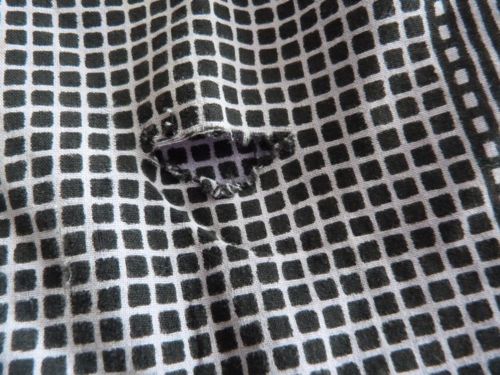
Now, one of my all time favorite dresses, in purple and black, has bit the dust. I liked it because it had some geometrics, and the geometrics changed, and – it was purple. I have worn it for about six years now, and I have worn it out. I mended it several times when the underarm seams ripped:
But now, it has gotten all soft, so soft the material just rips easily with holes that cannot be mended.
I like this dress so much I am saving it and cutting it up so it will have another new life as a quilt 🙂
And I am thinking it is time to plan a trip back to Doha and Kuwait to replenish my hot weather dresses 🙂












 Here There and Everywhere