Alternatives to Statin Drugs
I found this article through Google News at US News and World Report.
I know statins work – many of my friends testify to their having lowered cholesterol through use of statins. But doesn’t it make you nervous that most of the tests proving their efficacy are done by the very drug-merchants who are selling them? For me, it is that way with most medications. I watch people lining up their pills, lowering their blood pressure, lowering their cholesterol, and it makes me very nervous.
My father stayed alive using cortisone. He tried to get off cortisone, but his body was so addicted to it that every time he tried, he suffered horrible pain. By the end of his life, you could barely touch him without injuring his skin, thinned by many years of cortisone usage. We pay a price for the drugs we take – I want to know the price – and the alternatives – before I choose a pill I have to take every day for the rest of my life.
6 Ways to Reduce Inflammation—Without a Statin or a Heart Test
By Deborah Kotz
Posted November 11, 2008
There’s been a lot of hoopla this week over research showing that the cholesterol-lowering drug Crestor lowers the risk of heart attacks and strokes in those with normal cholesterol but high levels of inflammation—measured by a marker called C-reactive protein, or CRP. The Jupiter study, which involved nearly 18,000 people and appears in the current issue of the New England Journal of Medicine, found that people taking the statin Crestor for two to five years cut their risk of having a heart attack or stroke by 50 percent during that period. They also had a lower risk of bypass surgeries and angioplasties.
Experts predict that as a result of the study, many millions of seemingly healthy people will be screened for inflammation using a blood test called high-sensitivity C-reactive protein (hs-CRP) and that millions of them will be put on statins to combat inflammation. While statins certainly are lifesaving for those with high cholesterol or established heart disease, their benefits are more modest for those at fairly low risk of heart disease: About 0.72 percent of the statin takers in the trial had a heart attack or stroke compared with 1.5 percent of those taking placebos.
So, some experts say, if you have high CRP but are otherwise healthy, “go slow,” and consider all the benefits and risks of statins before you decide to take them. Where that hs-CRP screening test might come in handy is to spur you to make lifestyle changes that will naturally lower excess inflammation—and your heart disease risk. Try these six measures:
1. Stop smoking. Smoking hardens the arteries and could send CRP levels surging. But research shows you can reverse all the damaging effects to your arteries within 10 years of quitting. (For help quitting, you can click here.)
2. Think olive oil, fish, and nuts. Researchers have shown that overweight folks who stick with a Mediterranean-style diet—based on fruits, vegetables, whole grains, nuts, and olive oil—can lower their levels of inflammation. “An anti-inflammatory diet is about reducing saturated fat and trans fats and eating more foods rich in alpha-linolenic acid—like flaxseed, walnuts, and canola oil—and omega-3 fats, which fight inflammation,” says Evangeline Lausier, a staff physician at Duke Integrative Medicine. On the flip side, scientists have shown that the typical American fast-food diet increases heart attack risk by 30 percent. (Here’s the latest on four healthful diets and on 11 easy ways to load up on omega-3s.)
3. Get active. No one wants to exercise, but it’s a great way to lower inflammation without any side effects associated with medications. An ideal amount? Not too much (which raises inflammation) and not too little. Aim for five days a week of steady exercise (brisk walking, swimming, biking) for 30 to 45 minutes. (You can read up on how to make your workout quick and sweaty.)
4. Shrink your waist size. Take a tape measure and measure your waist, right around the point of your bellybutton. If you’re a woman with a waist measurement of over 35 inches or a man with a waist of over 40 inches, you probably have high inflammation. Whittling a few inches off the waist by reducing your portions and increasing activity can go a long way toward solving that problem. (Here’s a dietary technique that might help you lose weight.)
5. Get enough sleep. A new study out this week shows that elderly people with high blood pressure who sleep less than 7.5 hours a night have dramatically elevated chances of having a stroke or heart attack or suffering sudden cardiac death. Other research has shown that too little sleep (less than six hours) or too much (more than eight hours) results in more inflammation. The American Academy of Sleep Medicine says most adults need between seven and eight hours of shut-eye a night. (Not convinced? Consider these 10 reasons not to skimp on sleep.)
6. Reduce stress. High levels of stress hormones can lead to the release of excess inflammatory chemicals, so try each day to pencil in 15 minutes of relaxation—deep breathing, meditation, or a bubble bath that lets you leave the world behind.
The Feast of St. Martin, and St. Martin’s Goose
I’ve always loved St. Martin’s Day because the children of the villages in Germany gather with laterns and walk the cobbled streets singing a song “Laterne! Laterne! . . . .” There is usually someone dressed in a large red cloak who rides a horse, as St. Martin.
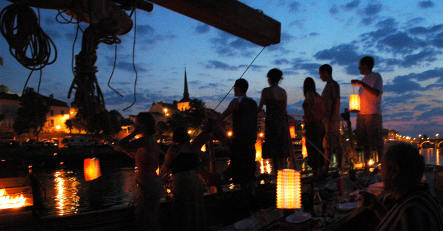
Something else happens on St. Martin’s Day – it is the beginning of goose season! There is only about one month, in Germany, when you can eat this speciality, St. Martin’s Goose. It is baked, served with a very fatty gravy (sounds horrible, but it is delicious), red cabbage and potatoes. You can get a quarter goose, a half goose or you can go as a group and have an entire goose feast. The smell of roasting goose is yummy, and the goose itself, when well prepared, is succulent and tasty.

Here is how to roast a St. Martin’s goose:
Preparation: 1 hour
Cooking: 1/2 a hour by kg
Ingredients (for 6 persons):
– 1 goose of 6kg approximately
– 500 g of chopped pork – 1 egg – 4 shallots
– 1 small stalk of thym
– 200 g of crumb of bread (or gingerbread!)
– salt, pepper, nutmeg, parsley
– 100g of walnuts and chopped hazelnuts
Mix the various ingredients of the practical stuffing. Stuff, and let it gild on all the surface in its fat of goose, in the owen. Put then the goose in the oven and cook in its own juice (half an hour by kg). It came from This Website on European Cultures.
The stuffed goose uses surrounded with purée of chestnuts or with whole chestnuts cooked in a little broth then in the juice of the goose and accompanied with a Riesling of Moselle region.
Here is the story of St. Martin by James Kiefer from the Lectionary.
(I’ve always wondered why St. Martin tore his cloak in half, and didn’t give the whole cloak to the begger, since he probably had on warm clothing underneath.)
MARTIN OF TOURS
BISHOP AND THEOLOGIAN (11 NOV 397)
Martin was born around 330 of pagan parents. His father was a soldier, who enlisted Martin in the army at the age of fifteen. One winter day he saw an ill-clad beggar at the gate of the city of Amiens. Martin had no money to give, but he cut his cloak in half and gave half to the beggar. (Paintings of the scene, such as that by El Greco, show Martin, even without the cloak, more warmly clad than the beggar, which rather misses the point.) In a dream that night, Martin saw Christ wearing the half-cloak. He had for some time considered becoming a Christian, and this ended his wavering. He was promptly baptized. At the end of his next military campaign, he asked to be released from the army, saying: “Hitherto I have faithfully served Caesar. Let me now serve Christ.” He was accused of cowardice, and offered to stand unarmed between the contending armies. He was imprisoned, but released when peace was signed.
He became a disciple of Hilary of Poitiers, a chief opponent in the West of the Arians, who denied the full deity of Christ, and who had the favor of the emperor Constantius. Returning to his parents’ home in Illyricum (Yugoslavia, approximately), he opposed the Arians with such effectiveness that he was publicly scourged and exiled. He was subsequently driven from Milan, and eventually returned to Gaul. There he founded the first monastary in Gaul, which lasted until the French Revolution.
In 371 he was elected bishop of Tours. His was a mainly pagan diocese, but his instruction and personal manner of life prevailed. In one instance, the pagan priests agreed to fell their idol, a large fir tree, if Martin would stand directly in the path of its fall. He did so, and it missed him very narrowly. When an officer of the Imperial Guard arrived with a batch of prisoners who were to be tortured and executed the next day, Martin intervened and secured their release.
In the year 384, the heretic (Gnostic) Priscillian and six companions had been condemned to death by the emperor Maximus. The bishops who had found them guilty in the ecclesiastical court pressed for their execution. Martin contended that the secular power had no authority to punish heresy, and that the excommunication by the bishops was an adequate sentence. In this he was upheld by Ambrose, Bishop of Milan. He refused to leave Treves until the emperor promised to reprieve them. No sooner was his back turned than the bishops persuaded the emperor to break his promise; Priscillian and his followers were executed. This was the first time that heresy was punished by death.
Martin was furious, and excommunicated the bishops responsible. But afterwards, he took them back into communion in exchange for a pardon from Maximus for certain men condemned to death, and for the emperor’s promise to end the persecution of the remaining Priscillianists. He never felt easy in his mind about this concession, and thereafter avoided assmblies of bishops where he might encounter some of those concerned in this affair. He died on or about 11 November 397 (my sources differ) and his shrine at Tours became a sanctuary for those seeking justice.
The Feast of Martin, a soldier who fought bravely and faithfully in the service of an earthly sovereign, and then elisted in the service of Christ, is also the day of the Armistice which marked the end of the First World War. On it we remember those who have risked or lost their lives in what they perceived as the pursuit of justice and peace.
Pomegranate in Quinoa Pilaf
Hot off the press, from the New York Times:
Quinoa Pilaf With Chick Peas, Pomegranate and Spices
By MARTHA ROSE SHULMAN
Published: November 7, 2008
Considered by many nutritionists to be a superfood, pomegranate juice is loaded with antioxidants and appears to lower blood pressure. This quinoa pilaf is based on a Turkish pilaf that is traditionally made with rice or bulgur.
1 teaspoon cumin seeds
3/4 teaspoon coriander seeds
2 tablespoons extra virgin olive oil
1/2 medium onion, chopped
1/2 teaspoon salt
2 garlic cloves, minced
1 cup quinoa, cooked (4 cups cooked quinoa)
1 cup cooked chick peas (canned are fine), rinsed
1/4 cup pomegranate seeds
For garnish (optional):
1 cup thickened yogurt
1 small garlic clove, pureed (optional)
1. Heat a large, heavy frying pan over medium-high heat and add the cumin seeds and coriander seeds. Toast in the pan, stirring or shaking the pan, until they begin to smell fragrant, and transfer to a spice mill. Allow to cool for a few minutes, then pulse to crush or coarsely grind. Set aside.
2. Return the frying pan to medium heat and add 1 tablespoon of the olive oil. Add the onion and cook, stirring often, until tender, about 5 minutes. Add the garlic and salt, stir together for about half a minute, and stir in the cumin seeds, and coriander seeds. Add the remaining olive oil and stir in the quinoa, chick peas, and 3 tablespoons of the pomegranate seeds. Stir over medium heat to heat through, several minutes. Taste and adjust salt. Transfer to a platter or wide bowl and decorate with the remaining pomegranate seeds. You can also mold the pilaf into 1/2-cup ramekins or timbales and unmold onto the plate, then decorate with pomegranate seeds.
3. Stir the garlic into the thickened yogurt. Serve the pilaf topped with the yogurt.
Yield: Serves 6
Variation: Some people like to drizzle a few drops of lemon juice over the top of this pilaf.
Advance preparation: This can be made a day ahead and reheated.
Blood Spatter and Persephone’s Pomegranates
This morning I was hulling pomegranates. I’m not very good at it, and I was imagining the cooks at someplace like Shebastan could make quick work of what took me quite a while. My hands were thoroughly stitcky, but I had a nice healthy bowl of seeds, which I now know are called Aril, that I will eat like candy, and pop into my morning oatmeal – makes it edible and it tastes like health in a bowl.
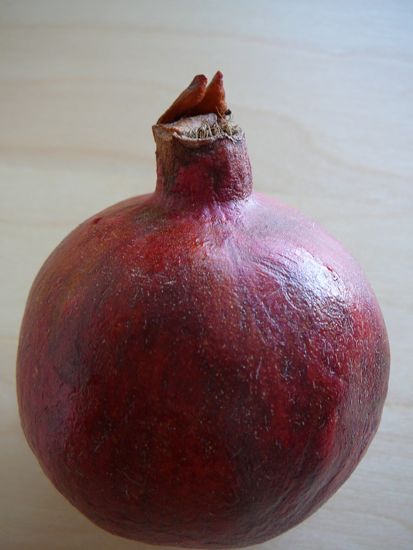
Pomegranate - Just look at that beautiful color!
My very cool Mom bought me my first pomegranate – here in Kuwait, they are called Roman’, which my husband said is because they came in with the Romans, but that seems very strange to me because clearly they are Iranian in origin. It took me forever to dig the seeds out. Now I know to just lightly cut the skin in a few places, tear off a hunk and start separating. I read on Wikipedia that it goes faster in water, the seeds sink and the pulp floats. I’ll have to try that next time.

Pomegranate seeds - again - look at those colors!
Mom bought me the pomegranate because I was crazy about Greek mythology, and Persephone had to spend six months in hell every year because (it’s a long story, this is just the short version) she had been tempted to eat and she ate just six pomegranate seeds, and so when she was freed from hell she still has to go back for six months and that’s why we have winter (well, I was just a kid and it made sense to me) but I always wondered what a pomegranate would be like.
I’ve loved them ever since. But when I was done, I noticed I had spots and streaks like something out of Dexter all over the walls. I think I have it all cleaned up, but I keep finding places I missed!
But you know how one thing leads to another, and then leads to Wikipedia. I wanted to make sure I got the legend of Persephone right, but instead, I learned that pomegranates have symbolism in all three religions of the book – Judaism, Christianity and Islam. Click on the blue type above and you can learn more about Pomegranates. Read below for what Wikipedia tells us about the pomegranate’s symbolism in different religions:
Pomegranates and symbolism
[edit]Judaism
Exodus 28:33–34 directed that images of pomegranates be woven onto the hem of the me’il (“robe of the ephod”), a robe worn by the Hebrew High Priest. 1 Kings 7:13–22 describes pomegranates depicted on the capitals of the two pilars (Jachin and Boaz) which stood in front of the temple King Solomon built in Jerusalem. It is said that Solomon designed his coronet based on the pomegranate’s “crown” (calyx).[31]
Jewish tradition teaches that the pomegranate is a symbol for righteousness, because it is said to have 613 seeds which corresponds with the 613 mitzvot or commandments of the Torah. For this reason and others, many Jews eat pomegranates on Rosh Hashanah. However, the actual number of seeds varies with individual fruits.[32] It is also a symbol of fruitfulness.[33] The pomegranate is one of the few images which appear on ancient coins of Judea as a holy symbol, and today many Torah scrolls are stored while not in use with a pair of decorative hollow silver “pomegranates” (rimmonim) placed over the two upper scroll handles. Some Jewish scholars believe that it was the pomegranate that was the forbidden fruit of the Garden of Eden.[33] Pomegranate is one of the Seven Species (Hebrew: שבעת המינים, Shiv’at Ha-Minim), the types of fruits and grains enumerated in the Hebrew Bible (Deuteronomy 8:8) as being special products of the Land of Israel.
[edit]Christianity
For the same reasons, pomegranates are a motif found in Christian religious decoration. They are often woven into the fabric of vestments and liturgical hangings or wrought in metalwork. Pomegranates figure in many religious paintings by the likes of Sandro Botticelli and Leonardo da Vinci, often in the hands of the Virgin Mary or the infant Jesus. The fruit, broken or bursting open, is a symbol of the fullness of his suffering and resurrection.[33] In the Eastern Orthodox Church, pomegranate seeds may be used in kolyva, a dish prepared for memorial services, as a symbol of the sweetness of the heavenly kingdom.
[edit]Islam
According to the Qur’an, pomegranates grow in the gardens of paradise (55:068). According to Islamic tradition, every seed of a pomegranate must be eaten, because one can’t be sure which aril came from paradise. The Prophet Mohammed is said to have encouraged his followers to eat pomegranates to ward off envy and hatred.[33] The Qur’an also mentions (6:99, 6:141) pomegranates twice as examples of good things God creates.
[edit]Greece and Greek mythology
The wild pomegranate did not grow natively in the Aegean area in Neolithic times. It originated in eastern Iran and came to the Aegean world along the same cultural pathways that brought the goddess whom the Anatolians worshipped as Cybele and the Mesopotamians as Ishtar.
The myth of Persephone, the chthonic goddess of the Underworld, also prominently features the pomegranate. In one version of Greek mythology, Persephone was kidnapped by Hades and taken off to live in the underworld as his wife. Her mother, Demeter (goddess of the Harvest), went into mourning for her lost daughter and thus all green things ceased to grow. Zeus, the highest ranking of the Greek gods, could not leave the Earth to die, so he commanded Hades to return Persephone. It was the rule of the Fates that anyone who consumed food or drink in the Underworld was doomed to spend eternity there. Persephone had no food, but Hades tricked her into eating four pomegranate seeds while she was still his prisoner and so, because of this, she was condemned to spend four months in the Underworld every year. During these four months, when Persephone is sitting on the throne of the Underworld next to her husband Hades, her mother Demeter mourns and no longer gives fertility to the earth. This became an ancient Greek explanation for the seasons.
Dante Gabriel Rossetti’s painting Persephona depicts Persephone holding the fatal fruit. It should be noted that the number of seeds that Persephone ate varies, depending on which version of the story is told. The number of seeds she is said to have eaten ranges from three to seven, which accounts for just one barren season if it is just three or four seeds, or two barren seasons (half the year) if she ate six or seven seeds. There is no set number.
The pomegranate also evoked the presence of the Aegean Triple Goddess who evolved into the Olympian Hera, who is sometimes represented offering the pomegranate, as in the Polykleitos’ cult image of the Argive Heraion (see below). According to Carl A. P. Ruck and Danny Staples, the chambered pomegranate is also a surrogate for the poppy’s narcotic capsule, with its comparable shape and chambered interior.[34] On a Mycenaean seal illustrated in Joseph Campbell’s Occidental Mythology 1964, figure 19, the seated Goddess of the double-headed axe (the labrys) offers three poppy pods in her right hand and supports her breast with her left. She embodies both aspects of the dual goddess, life-giving and death-dealing at once. The Titan Orion was represented as “marrying” Side, a name that in Boeotia means “pomegranate”, thus consecrating the primal hunter to the Goddess. Other Greek dialects call the pomegranate rhoa; its possible connection with the name of the earth goddess Rhea, inexplicable in Greek, proved suggestive for the mythographer Karl Kerenyi, who suggested that the consonance might ultimately derive from a deeper, pre-Indo-European language layer.
Pomegranate — opened up
In the 6th century BC, Polykleitos took ivory and gold to sculpt the seated Argive Hera in her temple. She held a scepter in one hand and offered a pomegranate, like a ‘royal orb’, in the other. “About the pomegranate I must say nothing,” whispered the traveller Pausanias in the 2nd century, “for its story is something of a mystery.” Indeed, in the Orion story we hear that Hera cast pomegranate-Side (an ancient city in Antalya) into dim Erebus — “for daring to rival Hera’s beauty”, which forms the probable point of connection with the older Osiris/Isis story. Since the ancient Egyptians identified the Orion constellation in the sky as Sah the “soul of Osiris”, the identification of this section of the myth seems relatively complete. Hera wears, not a wreath nor a tiara nor a diadem, but clearly the calyx of the pomegranate that has become her serrated crown.
The pomegranate has a calyx shaped like a crown. In Jewish tradition it has been seen as the original “design” for the proper crown.[31] In some artistic depictions, the pomegranate is found in the hand of Mary, mother of Jesus.
In modern times the pomegranate still holds strong symbolic meanings for the Greeks. On important days in the Greek Orthodox calendar, such as the Presentation of the Virgin Mary and on Christmas Day, it is traditional to have at the dinner table “polysporia”, also known by their ancient name “panspermia,” in some regions of Greece. In ancient times they were offered to Demeter[citation needed] and to the other gods for fertile land, for the spirits of the dead and in honor of compassionate Dionysus.
When one buys a new home, it is conventional for a house guest to bring as a first gift a pomegranate, which is placed under/near the ikonostasi (home altar) of the house, as a symbol of abundance, fertility and good luck. Pomegranates are also prominent at Greek weddings and funerals. When Greeks commemorate their dead, they make kollyva as offerings, which consist of boiled wheat, mixed with sugar and decorated with pomegranate. It is also traditional in Greece to break a pomegranate on the ground at weddings and on New Years. Pomegranate decorations for the home are very common in Greece and sold in most homegoods stores.[35]
The photos, by the way, are of Indian pomegranates, but I bought Indian ones, Iranian ones and Egyptian ones; some are great big and very red, some are more orangey-red. These Indian ones are delightfully sweet!
Google can help you find all kinds of pomegranate recipes, but there is actually an organization called Pomegranates.org that lists lots of recipes in one easy location. 🙂 This must be pomegranate season, because they are plentiful, and reasonably priced, and oh, what luxury!
Here is one of their recipes:
Chicken with Pomegranate and Walnuts
2-3/4 pound fryer chicken
2 cups walnuts, finely chopped
3 tablespoons shortening
3-1/2 cups water
1/2 teaspoon poultry seasoning
1 teaspoon salt
1/2 teaspoon cinnamon
1/2 teaspoon pepper
2 teaspoons lemon juice
1 large onion, finely chopped
1 cup fresh pomegranate juice
3 teaspoons butter
2 teaspoons tomato sauce
1 teaspoon sugar
Prepare chicken for frying. Saute chicken with poultry seasoning in shortening until light brown, set aside. In a large pot saute the onion in 3 teaspoon butter until golden brown. Add tomato sauce and saute for a few minutes. Add walnuts to the onions and saute over meduim heat about 5 minutes, stirring constantly. Add water, remaining seasonings, lemon juice, and pomegranate syrup. Cover and let cook on low about 35 minutes. Taste the sauce and add sugar if needed. Arrange browned chicken pieces in the sauce, cover and let simmer 20-25 minutes. Serve over white rice.
Serves 6.
Sweet October Morning
Goooooood Morning, Kuwait!
It is a sweet morning, a beautiful morning. You can see almost all the way to the horizon, and the lethal layer that hangs over it is somehow thinner this morning:

One of my favorite places, Weather Underground: Kuwait tells us we have five more days below 100°F coming up and here is what it looks like this morning:

The house still smells of cinnamon and clove and Mom’s Fruit Cakes which I spent all day yesterday chopping, pitting, baking, and wrapping in the crisp Kuwait Autumn weather. 😉 I fell into bed last night around eight, and slept almost straight through until 0600 this morning, an exhausted Qatteri Cat snuggled up between AdventureMan and me. No, no, we don’t eat the fruitcakes yet. You make them around the end of October and you store them, heavily wrapped, in the refrigerator until Thanksgiving (4th Thursday in November) when you are allowed to taste the first one. They mellow as they age in the refrigerator.
In other countries, not Kuwait, you wrap them in cheesecloth soaked in brandy, and you can open them now and then and brush on a little more brandy with a pastry brush. Sigh. I am not much for drinking, but I miss the smell of the brandy soaking into the fruitcakes.
Happy (Canadian) Thanksgiving
Tomorrow is the official Canadian Thanksgiving, although our Canadian friends have been partying and dining in splendor throughout the weekend. If you have any Canadian friends, be sure to greet them on their special holiday.
Wikipedia says:
Thanksgiving, or Thanksgiving Day (Canadian French: Action de grâce), is an annual one-day holiday to give thanks to God for the things one has at the close of the harvest season. The holiday is celebrated on the second Monday in October.
While the actual Thanksgiving holiday is on a Monday, Canadians might eat their Thanksgiving meal on any day of the three day weekend. Thanksgiving is often celebrated with family, it is also often a time for weekend getaways for couples to observe the autumn leaves, spend one last weekend at the cottage, or participate in various outdoor activities such as hiking, fishing, and hunting.
I saw several references to the Canadian Thanksgiving deriving from the American Thanksgiving, but Wikipedia says otherwise:
The history of Thanksgiving in Canada goes back to an explorer, Martin Frobisher, who had been trying to find a northern passage to the Orient. In the year 1578, he held a formal ceremony, in what is now the province of Newfoundland and Labrador, to give thanks for surviving the long journey.
This feast is considered by many to be the first Thanksgiving celebration in North America, although celebrating the harvest and giving thanks for a successful bounty of crops had been a long-standing tradition throughout North America by various First Nations and Native American groups. First Nations and Native Americans throughout the Americas, including the Pueblo, Cherokee, Cree and many others organized harvest festivals, ceremonial dances, and other celebrations of thanks for centuries before the arrival of Europeans in North America [2]. Frobisher was later knighted and had an inlet of the Atlantic Ocean in northern Canada named after him — Frobisher Bay.
At the same time, French settlers, having crossed the ocean and arrived in Canada with explorer Samuel de Champlain, also held huge feasts of thanks. They even formed ‘The Order of Good Cheer’ and gladly shared their food with their First Nations neighbours.
The centerpiece of the Canadian Thanksgiving is the turkey and stuffing, surrounded by dishes made of root vegetables and gourds – beets, turnips, pumpkin, squashes, etc.
Those Canadians with French roots add special dishes to the mix:
Tortiere (a fabulous meat pie)
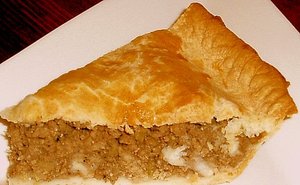
Maple Syrup Pie

I grabbed these photos from a fabulous Quebec blogger page where she has included recipes for the above, and for many other Canadian specialties. I wish One Whole Clove were still blogging. In the meanwhile, visit her pages for some delicious and out-of-the-ordinary delights.
Wishing all of our Canadian friends a delicious and delightful Thanksgiving, with many many blessings for which to be thankful, and for an abundant year to come.
Northpole Goodies
In an e-mail I received this week, a friend had a loooonnnnggggg list of Candy and Cookie recipes for the upcoming Christmas season. Purely out of curiousity, I clicked a few – and wow. These recipes are quick, delicious, and easy.

I don’t think there is a nutritious recipe in the whole website! All the recipes are for sweets! Here is just a partial selection from the Pies department:

I admit it, I am not that vulnerable to candy, but chocolate truffles are my downfall – and I am going to have to try their chocolate truffle recipe!
Here is the website: North Pole Kitchen Cookbook.
Have fun!
Joanna Brady and Tumbleweeds
I have a lot going on right now, and that is when I turn to books, I don’t know why. The more scheduled I am, the more important it is that I have fairly lightweight reading. My favorite genre is mystery, and there are a number of authors I follow, some more important than others.
I was reading the lastest Joanna Brady mystery, Dead Wrong, by Seattle author J.A. Jance. Joanna Brady became Police Chief in the small (fictional) Arizona town of Bisbee when her husband, then the police chief, was killed and she was asked to fill his position. Since then (several books) she has been elected and re-elected, and solved a lot of crimes, and re-married.
Now, in Dead Wrong, she is heavily pregnant, trying to solve a tricky murder that involves a puppy breeding mill and dog fighting ring.
“We have to go to Tumbleweeds tonight!” I call out to AdventureMan. “Joanna Brady is pregnant and she can’t eat creme brulee, but she dives right into tacos and enchiladas! Now I am starving for Mexican food!”
AdventureMan just laughs, he is always ready for Mexican food.
So just after sunset, we are king of the road, and we drive to Tumbleweeds.
I would love to say something nice about Tumbleweeds.
The service was slow. The servers were poorly trained. The food was SO mediocre. The chips were thick, and cold, and you could see fat congealed on them. The salsa was dull. The burritos and tacos were bland. No wonder we go there so rarely.
Glassy Shimmer
This morning, it is once again only 81°F / 27°C at 0700 – it gets hot later in the day, but not so much humidity as before. Yesterday, after being outside only a short time, I felt like my skin had turned into cracked alligator hide – the dry heat just sucked all the moisture out. My eyes also felt gritty, even through it appeared fairly clear.
Another gorgeous morning, just a hint of that sulphery yellow haze on the horizon, sea flat as glass:

A fisherman is trying to snag something for the pot for tonight’s dinner:

Change in the Weather
At 0700 this morning, it is only 81°F / 27°C. What a change! No steamed up windows, the humidity is also down.
I love October in Kuwait, when the temperatures swing dramatically into the comfortable zone, and we can even start eating outside at night. We are yearning to go back to the Souk Mubarakiyya after church on Fridays, or on a relaxed Saturday night. Or Paul’s in the Fehaheel Al Kout Mall, out by the fountains. For six months, Kuwait is a delightful place to be. While my fellow Americans – or at least those not stationed in Kuwait or Iraq or Qatar – are slogging their way through the rain and wind and snow, we are basking in a sweet mostly-warm climate, our reward for the brutality of the summers here.
Although – there ARE people who love the heat! I even notice that I am not so uncomfortable in the summers as I once was. Unless it is humid, I don’t even break a sweat when I am out, or else it is so hot that it is just evaporating off me and I don’t even know it.
Yesterday, when I got up, it was too late to catch the sunrise, but what I did catch was lovely – a whole fleet of boats out fishing. Thanks to Enviro Girl telling me about the enhanced zoom capability on my camera, I was able to get some fairly clear shots, even at a distance:

Here, they’re hauling in something for dinner!

(Or maybe they are just hauling in the anchor. 🙂
If you want to see all the photos from the Souk Mubarakiyya, just do a search in the search box to the right and it will show you all the articles and photos I have taken there.
Recent Comments
intlxpatr on Shampoo Ginger tigerbutterya0c5ff1d… on Shampoo Ginger intlxpatr on British Soldier Kidnapped, Esc… John on British Soldier Kidnapped, Esc… intlxpatr on British Soldier Kidnapped, Esc… Wikipedia Donate Button

Amazina


Early Voting in Florida


 Here There and Everywhere