First Dates
There are some advantages to being in Kuwait in the dead heat of summer. One is that even in peak driving time, the roads are far less crowded. Restaurants are less crowded. Shops are full of all the things that go missing when the entire population is in town.
And – if you are here in July, and if you have good Kuwaiti friends with date trees – you get a big bowl of fresh, sweet DATES!

These are unbelievably yummy. I always liked dates, but until we moved to Tunisia, I didn’t know the pure joy of fresh dates. Living in Kuwait when the first dates of the season start ripening – pure bliss.
No, my Kuwaiti friends are very generous, they gave me a great big plate of dates, it’s just I’ve already eaten most of them! I had to take a photo quickly, before I ate the few remaining!
I went to Wikipedia on Date Palms to discover there are countless varieties of dates. They give this lengthy list of dates, and then say that in Iraq there are more than 100 different dates cultivated:
Aabel – common in Libya
Ajwah – from the town of ‘Ajwah in Saudi Arabia, it is the subject of a famous hadith of the prophet Muhammad.
Al-Barakah – from Saudi Arabia
Amir Hajj or ‘Amer Hajj’ – from Iraq, these are soft with a thin skin and thick flesh, sometimes called “the visitor’s date” because it is a delicacy served to guests.
‘Abid Rahim (Arabic: عبد رحيم), from Sudan
Barakawi (Arabic: بركاوي), from Sudan
Barhee or (barhi) (from Arabic barh, a hot wind) – these are nearly cylindrical, light amber to dark brown when ripe; soft, with thick flesh and rich flavour. One of the few varieties which are good in the khalal stage when they are yellow (like a fresh grape as opposed to dry, like a raisin).
Bireir (Arabic: برير) – from Sudan
Deglet Noor (Arabic: ‘translucent’ or ‘date of light’) – so named because the centre appears light or golden when held up to the sun. This is a leading date in Algeria, the USA, and Tunisia, and in the latter country it is grown in inland oases and is the chief export cultivar. It is semi-dry and not very sweet.
Derrie or ‘Dayri’ (the ‘Monastery’ date) – from southern Iraq – these are long, slender, nearly black, and soft.
Empress – developed by the Deval Family in Indio California USA from a seedling of ‘Deglet Noor’. It is larger than ‘Deglet Noor’, somewhat softer and sweeter. It generally has a light tan top half and brown bottom half.
Ftimi or ‘Alligue’ – these are grown in inland oases of Tunisia.
Holwah (Halawi) (Arabic: ‘sweet’) – these are soft, and extremely sweet, small to medium in size.
Haleema – in Hoon, Libya (Haleema is a woman’s name)
Hayany – from Egypt (Hayani) (Hayany is a man’s name) – these dates are dark-red to nearly black and soft.
Iteema – common in Algeria
Kajur – common in Pakistan / India
Kenta – common in Tunisia
Khadrawi date / Khadrawy (Arabic: ‘green’) – a cultivar favoured by many Arabs, it is a soft, very dark date.
Khalasah (Arabic: ‘quintessence’) – one of the most famous palm cultivars in Saudi Arabia, famous for its sweetness level that is not high nor low, thus, suits most people. Its fruit is called ‘Khlas’. Its famous place is ‘Huffuf’ (Al-Ahsa) in the Eastern Province of Saudi Arabia (Al-Sharqheyah).
Khastawi (Khusatawi, Kustawy) – this is the leading soft date in Iraq; it is syrupy and small in size, prized for dessert.
Maktoom (Arabic: ‘hidden’) – this is a large, red-brown, thick-skinned, soft, medium-sweet date.
Manakbir – a large fruit which ripens early.
Medjool date
Medjool or (Mujhoolah) (Arabic: ‘unknown’) – from Morocco, also grown in the USA, Saudi Arabia, Jordan and Israel; a large, sweet and succulent date. It is named unknown because who owned it at first didn’t know its specie and thus called it unknown.
Migraf (Mejraf) – very popular in Southern Yemen, these are large, golden-amber dates.
Mgmaget Ayuob – from Hoon, Libya
Mishriq (Arabic: ‘East’ – مشرق) – from Sudan and Saudi Arabia
Nabtat-seyf – in Saudi Arabia.
Rodab – from Iran, they are dark and soft.
Sag‘ai – from Saudi Arabia.
Saidy (Saidi) – soft, very sweet, these are popular in Libya.
Sayer (Sayir) (Arabic: ‘common’) – these dates are dark orange-brown, of medium size, soft and syrupy.
Sekkeri – (lit. sugary) Dark brown skin; distinctly sweet and soft flesh, from Saudi Arabia.
Sellaj – in Saudi Arabia.
Tagyat – common in Libya.
Tamej – in Libya.
Thoory (Thuri) – popular in Algeria, this dry date is brown-red when cured with a bluish bloom and very wrinkled skin. Its flesh is sometimes hard and brittle but the flavour described as sweet and nutty.
Umeljwary – in Libya.
Umelkhashab – Brilliant red skin; bittersweet, hard white flesh (Saudi Arabia).
Zahidi (Arabic: ‘[Of the] ascetic’) – these medium size, cylindrical, light golden-brown semi-dry dates are very sugary, and sold as soft, medium-hard and hard.
If You Have the Eyes to See
I have a dinner party coming up, and I always have to keep my menus flexible – I am never entirely sure what I will find in the stores. The most unlikely things will show up, and then, just when you really need them, disappear.
I usually keep a little corn syrup on hand, but I also use it a lot – remember that Pecan-Date Pie?
First step, check the cupboards. Nope, no corn syrup. I can make something else, but one of my guests has a real sweet tooth, and this pie disappears in a heartbeat where people love sweets.
Second step – scour the stores. Nope, no corn syrup. They sometimes have it. Not today when I need it.
Third step – pray. Actually, I started this step while I was still in the store. I didn’t used to believe in prayers for selfish things, but I discovered that sometimes God delights in answering small prayers. I was in a bible study, where they told us to keep a prayer journal, and when we prayed for a person or something, to write it down, that a lot of times when prayers are answered, we don’t even say thank-you, we just move on.
I was astonished. They were right. When you write down what you’ve prayed for, especially for long, complicated situations, and then you go back and see the prayers that have been answered, prayers you forgot you even prayed, it is astonishing. God is so Good! And imagine answering prayers and the person praying doesn’t even say “thank you!”
When I got home, I put the cold things in the refrigerator or freezer, washed off all the vegetables, put away the other groceries, and then got the stepping stool, still praying that somewhere in my kitchen was a bottle of corn syrup that was misplaced.
I checked the baking cupboard – again. Moved everything so I could see even in the darkest corners. No corn syrup. Checked my “spares” cupboard. Nope, not there. Checked my back-up spares cupboard, sigh, no not there. Checked the breakfast / snack cupboard, can’t see anything, but I’ll check Little Diamond’s shelf, where the breakfast cereal and Canderelle are kept – and oh my! It’s a genuine miracle! When did I put the corn syrup on that shelf?
This is what a miracle looks like in my life this morning:

Thanks be to God! He takes care of our smallest needs!
Maitland and The Company of Liars: A novel of the plague
I had just finished The Swallows of Kabul and still had a long flight to go. Fortunately, I was in the Johannisburg airport, with it’s truly wonderful bookstore, and came across The Company of Liars: a novel of the plague. Well, it isn’t exactly a novel of the plague. The story opens in 1348, a year in which le morte bleu hit the British Isles, only later to be called the plague. The author captures the times, the filth, the lack of bathing, the superstitions, the ways of life.
The plot centers around a group who wanders through the island, just trying to stay alive. The spreading plague impacts on their wandering, but to call this a novel of the plague is just not accurate. The plague is the reason for the journey, but the journey is the center of the novel, not the plague.
Before I started reading the book, I read the Historical Notes in the back, and that is where I came across the most interesting information in the entire book:
The 1348 plague was only the latest in a series of disasters to hit Britain. The period between 1290 and 1348 had seen a rapid and drastic climate change which was so noticeable that the Pope ordered special prayers to be said daily in every church. Eyewitness accounts claimed that 1348 was a particularly bad year, for it rained every day from Midsummer’s Day to Christmas Day. Climate change brought about crop failure, liver fluke in sheep and murrain in cattle, as well as causing widespread flooding which virtually wiped out the salt industry on the east coast. This, combined with a population explosion, meant that as many people died from starvation as from the plague itself.
Interestingly, the book will not be released in the US until September 2008. The cover shown is nothing like the cover of the book I bought.
American issue cover:

Cover on book bought in Johannisburg:

I like the cover of mine better.
Some reviewers call this book “enthralling” or “gripping.” I wans’t all that enthralled or gripped, but it did make good airplane reading. I learned a lot about the grim brutality of life in 1348, but as I told AdventureMan, this is more a book about a slice of time than a book with a great plot. The plot isn’t that great, it is the historical detail that is interesting, and fiction just makes it more easily absorbed. (my opinion)
Mediterranean diet ‘cuts cancer’
While this is not new news, it is verification of what we know to be true – that using olive oil in place of other oils can reduce your risk of serious disease. From BBC Health News:
Mediterranean diet ‘cuts cancer’
A study of 26,000 Greek people found just using more olive oil alone cut the risk by 9%.
The diet, reports the British Journal of Cancer, also includes higher amounts of fruits, vegetables, cereals, and less red meat.
A separate study found adding broccoli to meals might help men vulnerable to prostate cancer cut their risk.
It shows there are a number of things you can do, and there is no one ‘superfood’ that can stop you developing the disease
The Mediterranean diet came under scrutiny after researchers noticed lower rates of illnesses such as heart disease in countries such as Spain and Greece.
They noticed that people living there generally ate more vegetables and fish, less red meat, cooked in olive oil and drank moderate amounts of alcohol.
The latest study is one of the largest yet to look at the potential impact on cancer of the various parts of this diet.
‘No superfood’
Researchers from Harvard University persuaded thousands of Greek people of various ages to record their food intake over an eight-year-period.
Broccoli may help ward off prostate cancer
Their adherence to the Mediterranean diet was ranked using a scoring system, and the group with the worst score compared with those who followed a couple of aspects of the diet, and those who followed it the most closely. The biggest effect they found – a 9% reduction in risk – was achieved simply by eating more “unsaturated” fats such as olive oil.
But just two changes – eating less red meat, and more peas, beans and lentils, cut the risk of cancer by 12%.
Dr Dimitrios Trichopoulos, who led the study, said: “Adjusting one’s overall dietary habits towards the traditional Mediterranean pattern had an important effect.”
Sara Hiom, from Cancer Research UK, said the research highlighted the importance of a healthy balanced diet.
“It shows there are a number of things you can do, and there is no one ‘superfood’ that can stop you developing the disease.”
Broccoli benefit
The other study suggesting that food had the power to prevent cancer came from the Institute of Food Research in Norwich.
Scientists compared the effects of adding 400 grams of broccoli or peas a week to the diet of men at high risk of prostate cancer – and in the case of broccoli found differences in the activity of genes in the prostate which other studies have linked to cancer.
Their findings raised the possibility that broccoli, or other “cruciferous” vegetables, such as cauliflower and Brussels sprouts, could help prevent or slow down the disease, particularly if the man had a particular gene variant – GSTM1.
Professor Richard Mithen, who led the research, published in the Public Library of Science journal, said: “Eating two or three portions of cruciferous vegetables per week, and maybe a few more if you lack the GSTM1 gene – should be encouraged.”
Professor Karol Sikora, medical director of CancerPartnersUK, said the study was the first time in a properly controlled clinical trial that broccoli had been shown to change the expression of specific genes in the prostate gland.
“Although the observation period was too short and the numbers too small to show that the incidence of cancer actually fell, it is the first clear demonstration that broccoli and presumably other cruciferous vegetables may well reduce cancer risk.”
Nuts vs Seeds
AdventureMan and I got into a discussion the other day of “what is a nut, what is a seed, what makes a peanut a legume?” We could guess, but we didn’t have any hard evidence.
God bless Google, and God bless my friend Coeurcountry, who told me about Dogpile, too, because this morning we looked up Nuts vs seeds, and got this comprehensive answer from Newton: Ask a Scientist at the US Department of Energy web page:
Question – What is the difference between a nut and a seed. How can
you define the difference. Some say that a nut has a hard shell, and a
seed can produce a plant. But many nuts like hazel nuts, and walnuts
produce new plants, such as trees. What is the difference????
—————————————
A nut is a type of fruit. So then what is a fruit?
A fruit is a mature ovary from a flower. Every fruit contains one or more
seeds.
And what is a seed?
A seed is an embryonic plant encased in a covering, called the seed coat or
integument. Every seed has the potential to germinate and grow into a mature
adult plant.
After a flower is pollinated, sperm are delivered to the eggs, deep down in
the part of the flower called the ovary. After the eggs are fertilized, each
one can develop into an embryo enclosed by an integument. That is a seed. As
seeds mature, the surrounding ovary tissue develops into a fruit. This fruit
can take many forms; some plants make berries (like blueberries or
tomatoes), some make legumes (like peas and beans), some make dry capsules
(like poppies).
Other plants make pretty bizarre fruits; grasses make a
fruit called a caryopsis (like a grain of wheat or a corn kernel) and
members of the daisy family make a fruit called a cypsela (the little
parachute things that we like to blow off the tops of dandelions).
To answer the question: many plants make a fruit called a nut. Technically,
a nut is a single-seeded fruit with a hard, dry outer wall that doesn’t
crack open at maturity. An acorn (the fruit of an oak tree) is a perfect
example of a nut. By the way, some things we usually call “nuts” are not,
botanically speaking nuts. A peanut (when still in its shell) is a legume.
An almond is a type of fruit called a drupe. A coconut is also a drupe.
Here is a good resource that explains, in very simple terms, how botanists
think about fruits:
http://koning.ecsu.ctstateu.edu/Plants_Human/fruittype.html
C. Perkins
====================================================================
Nuts ARE seeds. A fruit is the part of a plant that contains the seeds. So
the nutshell is the fruit, and the nut is the seed.
vanhoeck
====================================================================
A nut is a hard-shelled dry fruit or seed that you can sperate the rind or
shell and interior kernel.
A seed if the fertilized inside part of a flowering plant and that germinate
and form a new plant.
So, the seed might only have one covering, like a sunflower seed, or none at
all, like a dandelion seed. A nut would have a thick, seperate covering like
a walnut seed.
Grace Field
====================================================================
Dear Susan,
I went right to the source on this one; Webster’s dictionary. A nut is “the
dry, one-seeded fruit of any of various trees or bushes, consisting of a
kernel, often edible, in a hard and woody or tough and leathery shell more
or less separable from the seed itself: walnuts, pecans, chestnuts, acorns,
etc. are all nuts. 2. the kernel or meat of such a fruit. 3. loosely, any
hard-shelled fruit that will keep more or less indefinitely; peanuts,
almonds, and cashews are also called nuts.”
A seed is defined as “the part of a flowering plant that contains the
embryo and will develop into a new plant if sown; a fertilized and mature
ovule.”
It seems a nut is really a fruit which technically means it contains the
seeds of the plant that produces it. Perhaps we can say all nuts are seeds
but not all seeds are nuts.
Maybe there’s a botanist out there who could be a little more specific for
you. I hope this helps a little anyway.
Martha Croll
Alternate Breakfast
Just before she skipped town, one of my partners-in-crime (girlfriends) gave me a packet of fresh home-made granola. I’ve been eating it as a breakfast alternative to the raspberry-blueberry-Activia smoothies I am addicted to, but I am eating sparingly of the granola, trying to make it last until she will come back and make me some more!
It is SOOOO good, and I don’t know how she does it, makes something good for you taste so good!

Good News For People Who Like Oily Fish
I love articles like this one, from BBC Health News that give me hope I am doing something right. I think the fish with the right stuff are tuna, and mackeral . . . what Kuwait fish have these valuable Omega-3 oils?
Is there much macular degeneration in Kuwait?
Oily fish ‘cuts eye disease risk’
Eating food rich in omega-3, such as oily fish, could help some people avoid one of the most common causes of vision loss, a research review suggests.

The Annals of Ophthalmology review suggests omega-3 may cut the risk of age-related macular degeneration (AMD) by a third. . . .
Studies have already linked omega-3 fatty acids with a variety of health benefits, the most significant being suggestions that it can help people with heart disease.
You can read the entire article HERE.
Hot Weather Foods
I’ve been making an effort to eat breakfast, and I have finally found something I can like. I have tried to find the post where someone recommends Activia in the comment section, but I can’t find it. Whoever you are, it got filed away in the recesses of my memory – I was looking for non-fat yoghurt to make smoothies with, and my friend handed me a six-pack of Activia and said “Use this.”
I trust my friend, she is all into nature, and being interconnected and fresh fresh food, so when she says “use this,” that’s enough for me. Plus, I remembered someone else telling me about how good Activia was, along with a cheese, maybe called Kiri. I had asked what I could use as a local cheese substitute for Philly Cream Cheese. Kiri isn’t really a subsititute, but it sure is good! 🙂
So here is what I am eating for breakfast:

It tastes SO good! I use one container of Activia (maybe 8 oz.), throw in some frozen raspberries, throw in some frozen blueberries, put in some honey and some cinnamon and blend. YUMMMMM. I am also eating walnuts and almonds, as you can see, because they are good for me, but also because the almonds and walnuts that we buy here seem fresher, they taste more walnutty and more almond-y than the ones we buy in the USA, I don’t know why.
The other thing I make that tastes SO good in this hot weather is tomato salsa. There are a million kinds of salsa, but I use this as a condiment with so many things, I even use it on sandwiches!

I take about:
five fresh Kuwaiti tomatoes, and chop them finely,
one onion, chopped finely,
1/2 bunch cilantro – cut coarsely with scissors,
a sprinkle of sea salt
a big grating of peppercorns (it makes a difference; always use freshly ground pepper)
(the secret ingredient) a sprinkle of lime juice.
Oh, it tastes so good! It tastes so fresh! You can even eat it on crackers.
Grilled Portobellos
My friends, this is not my recipe. This is what happens when you are up at 4 a.m. and there is no one around to play with. I have never checked my Amazon blog before, I’ve never even noticed it at the top of my page, but I saw I had two new entries, and I clicked.
OMG.
Another book I never knew I needed. This recipe sounds to-die-for. Every single ingredient is available in Kuwait, and lucky lucky you if you are growing your own basil!

It’s easy to expand your barbecue menu with these mouth-watering mushrooms from the BBQ Queens (the recipe’s from their book The Big Book of Barbecue, which is available from Harvard Common in both paperback and hardback, depending on how you like your books served). The hard part is deciding which cooking method to use, as the Queens disagree in this instance–barbecue style can be a bit divisive even within the tightest cooking teams. You can check out Judith’s way and Karen’s way in the directions below, and then choose your mushrooming option.
Serves 4
Ingredients:
4 large Portobello mushrooms
1/4-cup extra virgin olive oil
4 cloves garlic, minced
8 ounces goat cheese, crumbled or cubed (can also substitute feta cheese, Boursin, Gorgonzola, or Brie)
2 tablespoons toasted pine nuts
8-10 fresh basil leaves, chopped
Kosher or sea salt for seasoning
Directions:
1. Remove the stems from the Portobello mushrooms, then brush both sides of each mushroom with extra virgin olive oil.
2. In a small bowl, combine the minced garlic cloves; the goat cheese (or feta cheese, Boursin, Gorgonzola, or Brie); the toasted pine nuts; and the chopped fresh basil leaves.
3.:
Karen’s version: Place one-fourth of the mixture inside each mushroom cap. Season with kosher or sea salt to taste. Place the mushroom caps directly over the hot fire and grill with the lid down until the mushrooms are soft, 8 to 10 minutes.
Judith’s version: Grill the mushrooms gill side down for about 4 minutes with the grill lid open. Turn the mushrooms, fill them with the goodies, and season with salt. Close the lid and grill for another 4 minutes. Serve hot.
–A.J. Rathbun
One Last Barbecue
Yes, yes, we have barbecue in Kuwait, and it is fabulous. Fabulous barbecued Kuwaiti shrimp and hammour (grouper), fabulous lamb, fabulous chicken, fabulous kebab. . . . and it isn’t the same. From time to time, AdventureMan and I just yearn for some American Barbecue.
Today I stopped by Sharp’s and picked up a Kansas City Barbecue:

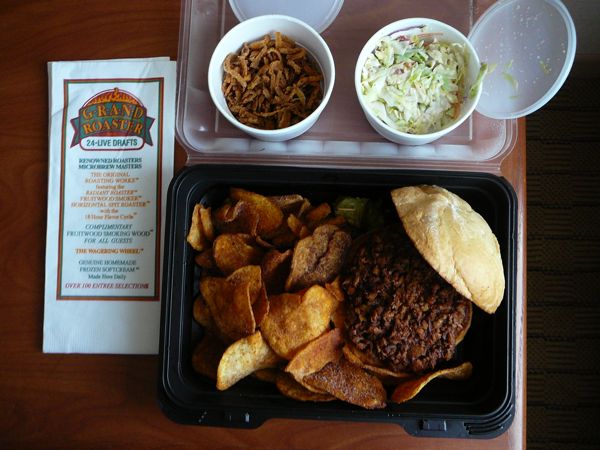
You put the cole slaw and the fried onions on top of the BBQ meat there – it already has a Kansas City mustardy sauce cooked right into it. . . oh YUMMMMM. And just look at those chips! Real potato! And SO crisp!
Recent Comments
ExpatAlien on What Country am I Living … intlxpatr on Yellowstone: Old Faithful to C… Michelle on Yellowstone: Old Faithful to C… Cathy on No Grown-Ups in Charge intlxpatr on Waiting for Snow Wikipedia Donate Button

Amazina


Early Voting in Florida


 Here There and Everywhere