Teriyaki Time
On my own for dinner, I noticed a little storefront dine-in and take-out place near the gas station and thought I would give it a try.
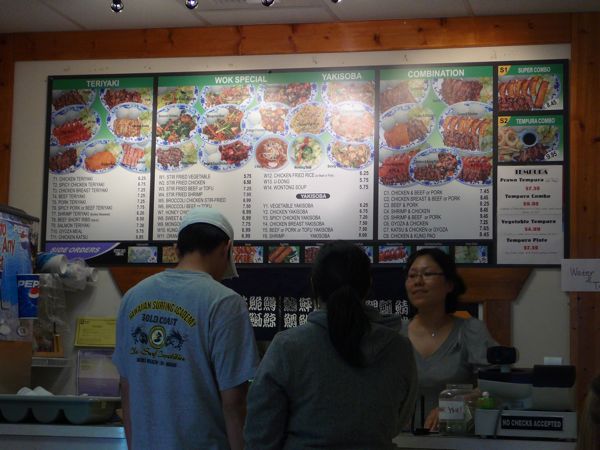
Good guess! It took me 30 minutes to get my dinner (salmon teriyaki) because the place was so full of locals (always a good sign.) Not exactly fast food, but worth the wait.
I love the photos to show people what they can order – although most of the people already knew. This place turned out to be very popular.
My First Favorite: 5 Star Pho
This is usually my very first stop when I get to Seattle. I CRAVE the 5 Star Pho salad rolls. They know me; they know I often stop on the way to my parent’s house to pick up an order, they have seen me fuzzy and smelly from my long travels. I bring my sisters and they put up with our laughter and chatter, I take my Mom here for noodle soup and green tea.

The owner and his wife always make us so welcome. It is a simple place, but they do steady business in the neighborhood – and it is also a favorite stop for the local cops.

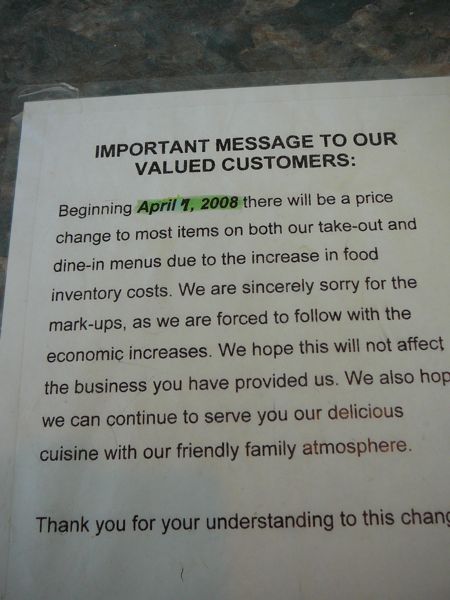
Like Kuwait, increasing food costs have forced prices up everywhere:
When my aunt died, I got her little cat that always sat up above her kitchen sink in Santa Barbara. I was told that a cat with right paw raised welcomes guests, and a cat with left paw raised welcomes prosperity. I was told that these are Chinese cats, but my Chinese friends think they are Japanese. I don’t know where they originated, but you often see them in Chinese restaurants, too.

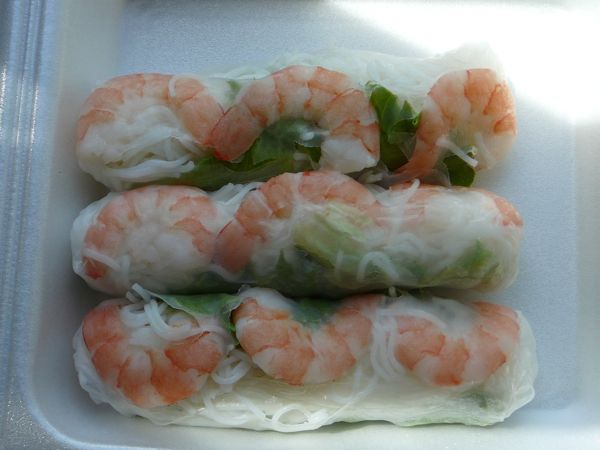
And finally – what I have been craving, what I have been waiting for! The 5 Star Pho Shrimp Salad Rolls (yes, there is one missing):
Girl’s Night Out
Sorry AdventureMan, I have had my first Mexican meal, and it was wonderful. You could have come! You could have come to wedding with me! You could have had Ivar’s seafood, and you could have had Las Brisas wonderful Mexican food.
My Mom insisted my sister try my new camera and take some photos of me. Of course, we got the giggles and every shot she took of me was worse than the one before. She said the photo gene skipped her, and – Sparkle – I agree. Those were some pretty awful photos. Of course, being hit by that great train jet lag didn’t help me to be a great subject.
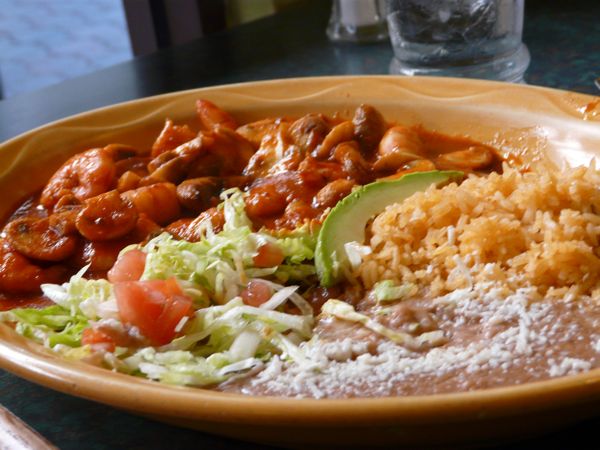
Mom had the Camarones al Diablo, her long time favorite, and Sparkle and I had Chicken Mole. It was good, and we are looking forward to some time in California, with non-dumbed-down Mexican food, spicy!
The camarones (shrimp):
The chicken mole:

Wish I could bring you some, AdventureMan!
Meat Eating Drives up Costs
I first heard this idea weeks ago, on BBC, as I was listening back in the project room. “How can this be?” I thought, as I first heard the idea that as the poor become richer, their diets are changing and they are demanding cars. That the burgeoning middle-class in China and India are changing everything, and changing it quickly, in ways we never foresaw.
This article has to do with a shortage of fertilizer, and when you get down to the middle of the article (where I stopped) you learn that what is driving up the cost of fertilizer is that so much food that used to go to human consumption is now going into feeding animals for human consumption.
So how are we, as a world community, going to fairly allocate the world’s resources so that nobody goes hungry, everyone has “enough”?
From today’s New York Times; you can read the entire article by clicking here)
By KEITH BRADSHER and ANDREW MARTIN
Published: April 30, 2008
XUAN CANH, Vietnam — Truong Thi Nha stands just four and a half feet tall. Her three grown children tower over her, just as many young people in this village outside Hanoi dwarf their parents.
The biggest reason the children are so robust: fertilizer.
Ms. Nha, her face weathered beyond its 51 years, said her growth was stunted by a childhood of hunger and malnutrition. Just a few decades ago, crop yields here were far lower and diets much worse.
Then the widespread use of inexpensive chemical fertilizer, coupled with market reforms, helped power an agricultural explosion here that had already occurred in other parts of the world. Yields of rice and corn rose, and diets grew richer.
Now those gains are threatened in many countries by spot shortages and soaring prices for fertilizer, the most essential ingredient of modern agriculture.
Some kinds of fertilizer have nearly tripled in price in the last year, keeping farmers from buying all they need. That is one of many factors contributing to a rise in food prices that, according to the United Nations’ World Food Program, threatens to push tens of millions of poor people into malnutrition.
Protests over high food prices have erupted across the developing world, and the stability of governments from Senegal to the Philippines is threatened.
In the United States, farmers in Iowa eager to replenish nutrients in the soil have increased the age-old practice of spreading hog manure on fields. In India, the cost of subsidizing fertilizer for farmers has soared, leading to political dispute. And in Africa, plans to stave off hunger by increasing crop yields are suddenly in jeopardy.
The squeeze on the supply of fertilizer has been building for roughly five years. Rising demand for food and biofuels prompted farmers everywhere to plant more crops. As demand grew, the fertilizer mines and factories of the world proved unable to keep up.
Some dealers in the Midwest ran out of fertilizer last fall, and they continue to restrict sales this spring because of a limited supply.
“If you want 10,000 tons, they’ll sell you 5,000 today, maybe 3,000,” said W. Scott Tinsman Jr., a fertilizer dealer in Davenport, Iowa. “The rubber band is stretched really far.”
Fertilizer companies are confident the shortage will be solved eventually, noting that they plan to build scores of new factories. But that will probably create fresh problems in the long run as the world grows more dependent on fossil fuels to produce chemical fertilizers. Intensified use of such fertilizers is certain to mean greater pollution of waterways, too.
Agriculture and development experts say the world has few alternatives to its growing dependence on fertilizer. As population increases and a rising global middle class demands more food, fertilizer is among the most effective strategies to increase crop yields.
“Putting fertilizer on the ground on a one-acre plot can, in typical cases, raise an extra ton of output,” said Jeffrey D. Sachs, the Columbia University economist who has focused on eradicating poverty. “That’s the difference between life and death.”
The demand for fertilizer has been driven by a confluence of events, including population growth, shrinking world grain stocks and the appetite for corn and palm oil to make biofuel. But experts say the biggest factor has been the growing demand for food, especially meat, in the developing world.
Eat Your Tomatoes!
I have a Kuwaiti friend who grows tomatoes, and was grousing because this year’s crop wasn’t as abundant as last year’s. Two short weeks later, he changed his tune.
“Come get tomatoes! We have all the tomatoes in the world!”
He had planted a large variety this year, partly because I wanted to see how some American “heirloom” seeds would do here. Either the climate is a little funny this year, or the heirloom seeds just take a little longer, but oh, what a crop there is! One of my friends said “it is like eating tomato candy!” Some of them are that sweet!
Just a little balsamic vinegar and a little of the best olive oil, a little fresh ground pepper and a little salt – oh, what heaven.
But there were so many, we cooked up a tomato sauce, just tomatoes, not even any onions. It was magnificent.
And then in today’s Health News, we learn that in addition to helping us have a healthy heart, eating tomatoes can also help protect our skin against the sun:

(photo courtesy BBC News)
From yesterday’s BBC Health News. (You can read the entire article by clicking on the blue type.)
Tomato dishes ‘may protect skin’
Pizza and spaghetti bolognese could become new tools in the fight against sunburn and wrinkles, a study suggests.
A team found adding five tablespoons of tomato paste to the daily diet of 10 volunteers improved the skin’s ability to protect against harmful UV rays.
Damage from these rays can lead to premature ageing and even skin cancer.
The study, presented at the British Society for Investigative Dermatology, suggested the antioxidant lycopene was behind the apparent benefit.
This component of tomatoes – found at its highest concentration when the fruit has been cooked – has already been linked to a reduction in the risk of prostate cancer.
Now researchers at the universities of Manchester and Newcastle have suggested it may also help ward off skin damage by providing some protection against the effects of UV rays.
Anti-ageing paste?
They gave 10 volunteers around 55g of standard tomato paste – which contains high levels of cooked tomatoes – and 10g of olive oil daily. A further 10 participants received just the olive oil.
After three months, skin samples from the tomato group showed they had 33% more protection against sunburn – the equivalent of a very low factor sun cream – and much higher levels of procollagen, a molecule which gives the skin its structure and keeps its firm.
Penny Carrot Salad
So easy and so good, this salad is also very sweet, so I am sharing it with my Kuwaiti friends. (Is it possible to be Kuwaiti and not have a sweet tooth?)
It is called Penny Carrot Salad because you cut the carrots into round pieces about 1/4 inch thick, so that they look like coins. Do not over cook, or you will have carrot mush! Especially good on hot summer nights.
2 lbs (4 cups) sliced, cooked carrots
1 large onion
1 large green pepper
1 can tomato soup
1/2 cup olive oil
1 cup sugar
1/4 cup vinegar
1 teaspoon worcestershire sauce
1 teaspoon mustard
Mix liquid and seasonings together and pour over drained carrots as soon as they are finished cooking. Refrigerate overnight. Keeps well.
Prices and Variety
My friends and family enjoyed my last Sultan Center post so much, I am going to add a couple photos here.
The price of eggs is breathtaking:

(Remember, for KD to $, you can figure about $4/KD)
Down below these packages of 6 (top shelf) and 12 second shelf) were flats of 30 for only KD 1.000. They are smaller eggs, and need washing, but that’s what I bought.
The Sultan Center serves a wide variety of people – local and expat – so I always love to see the things they put next to each other. This is a section I call “food helpers;” they are not food, but you add them to something – meat, rice, something that really IS food:
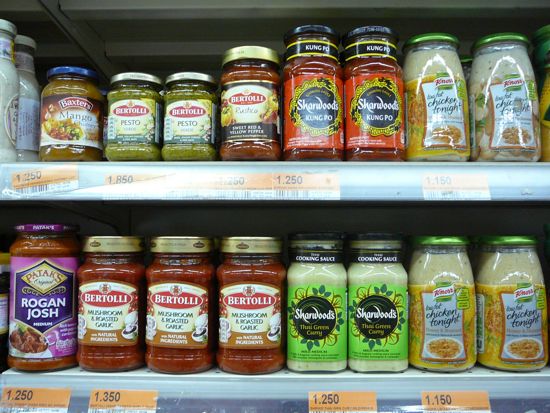
There is no lack of condiments. There is only the lack of the one particular condiment you need on the day that you need it!

Drought and Rising Food Prices
We are all so interconnected. I knew rice prices here in Kuwait had gone sky high, so high that imported American rice is now a relative bargain. I always bought Indian rice, in an effort to buy more (relatively) locally, and I knew India had restricted rice exports, but I didn’t know that the long drought in Australia was also contributing to the short supply.
You can read the entire article at this New York Times link.
THE FOOD CHAIN
A Drought in Australia, a Global Shortage of Rice
By KEITH BRADSHER
Published: April 17, 2008
. . . . . .
The collapse of Australia’s rice production is one of several factors contributing to a doubling of rice prices in the last three months — increases that have led the world’s largest exporters to restrict exports severely, spurred panicked hoarding in Hong Kong and the Philippines, and set off violent protests in countries including Cameroon, Egypt, Ethiopia, Haiti, Indonesia, Italy, Ivory Coast, Mauritania, the Philippines, Thailand, Uzbekistan and Yemen.
Drought affects every agricultural industry based here, not just rice — from sheepherding, the other mainstay in this dusty land, to the cultivation of wine grapes, the fastest-growing crop here, with that expansion often coming at the expense of rice.
The drought’s effect on rice has produced the greatest impact on the rest of the world, so far. It is one factor contributing to skyrocketing prices, and many scientists believe it is among the earliest signs that a warming planet is starting to affect food production.
It is difficult to definitely link short-term changes in weather to long-term climate change, but the unusually severe drought is consistent with what climatologists predict will be a problem of increasing frequency.
Read the rest of this article, and related articles, by clicking HERE.
Cynthia’s Praline Cake
My friend Cynthia, who knows I love mysteries, confessed to me that it was HER praline cake featured in JA Jance’s Joanna Brady series, and that she was the Cynthia who, in the book, brings it to the community potluck supper. And . . . she shared the recipe with me!
My friends, it is an easy recipe if you have the ingredients on hand (oats, brown sugar, butter) but I warn you – no substitutions! Yes, it is full of sugars and fats – why do you think it tastes so good??
Cynthia’s Praline Cake
(This is another one you can make in two 8″ round pans, and freeze one for later.)
1 cup quick-cooking oats
1 cup cold water
1 cup white sugar
1 1/4 cups brown sugar
1 cup oil
2 eggs
1 1/2 cups flour
1 teaspoon baking soda
1 teaspoon cinnamon
1/4 teaspoon salt
Icing
1 stick butter (1/2 cup)
2 Tablespoons milk
1 cup packed light brown sugar
1 1/4 cut chopped pecans
In a small bowl combine the oats and water, set aside. In another small bowl, combine and mix the dry ingredients – the flour, soda, cinnamon and salt.
In a larger mixing bowl, cream together the sugars, oil and eggs. Beat, add the oat mixture alternately with the mixed dry ingredients. Mix well.
Pour into greased and floured 9 x 13 inch baking pan. Bake at 350 degrees for 35 – 40 minutes.
For the icing: Just before the cake is done, combine butter, milk, and brown sugar in a saucepan, bring it to a boil and boil for one minute. Add the pecans and mix. Spread over cake.
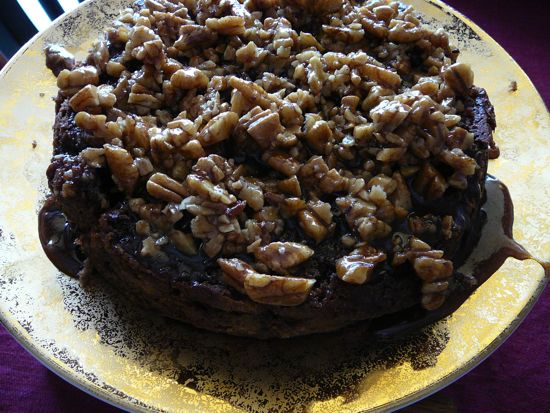
For Jewaira, who always asks for pictures, this is what the finished cake looks like:
Shop and Eat Locally
I’m fascinated with the concept of trying to eat “local” and there is an article in Wired: How to Shop and Eat Locally that tells us more about it. Below is an excerpt:
Innumerable books and other media extol the virtues of eating food that’s grown and processed near you: it benefits the planet, it benefits the farmers, it tastes better, it’s better for you. ReadMichael Pollan or Barbara Kingsolver for examples.
But piecing together a local menu isn’t as easy as going to the Local aisle of your supermarket. Here are some tips for bringing your meals closer to home.
Start small. Shopping locally goes against the grain (pun intended) of our globalized economy, so it’s not the easiest thing to do. Even if you live in a region that’s rich in vegetables and meats, chances are you won’t have easy access to staples like sugar, salt, oil, and flour. Just focus on what you can get, and keep an eye out for sources and/or substitutes for what you can’t.
Personalize. If you want to try the classic 100-mile diet, you can find your personal 100-mile radius at 100milediet.org.
Get a supplier. You can find farms, greenmarkets, and locally oriented stores in your area using web tools offered atEatwellguide.org and Localharvest.org. If you live in a city, investigate CSA — Community-Supported Agriculture. Citydwellers pay a fee to subscribe to a farm, and get a share of its output delivered in weekly boxes of joy. Just Food offers a listing for New Yorkers.
Recent Comments
Kitchen on Isiais: Winding Down intlxpatr on Shampoo Ginger tigerbutterya0c5ff1d… on Shampoo Ginger intlxpatr on British Soldier Kidnapped, Esc… John on British Soldier Kidnapped, Esc… Wikipedia Donate Button

Amazina


Early Voting in Florida


