Virginia Hall: A Modest Heroine
The Good Shepherd, a new movie with Angelina Jolie, and Matt Damon, directed by Robert DeNiro (!), will open Friday, a story of the beginnings of the American intelligence services, the OSS and the CIA. I can hardly wait.
Earlier this week, there were some small news articles about Virginia Hall, who served her country risking her life time and time again, fighting the Nazis in the allied clandestine services, facing the possibility of torture and death if she were caught. Hall didn’t let anything hold her back. She believed that what she was doing was worth doing, and when WWII ended, she continued working quietly for the greater good. I would have loved to meet this woman. What a pistol!
Here is what Wikipedia has to say about her:
Virginia Hall MBE DSC (April 6, 1906 – July 14, 1982) was an American spy during World War II. She was also known by many aliases: “Marie Monin,” “Germaine,” “Diane,” and “Camille.”[1]
She was born in Baltimore, Maryland and attended the best schools and colleges, but wanted to finish her studies in Europe. With help from her parents, she traveled the Continent and studied in France, Germany, and Austria, finally landing an appointment as a Consular Service clerk at the American Embassy in Warsaw, Poland in 1931. Hall hoped to join the Foreign Service, but the loss of her lower leg was a terrible setback. Around 1932 she accidentally shot herself in the left leg when hunting in Turkey, it was later amputed from the knee down, which caused her a limp.[2]
The injury foreclosed whatever chance she might have had for a diplomatic career, and she resigned from the Department of State in 1939.
The coming of war that year found Hall in Paris. She joined the Ambulance Service before the fall of France and ended up in Vichy-controlled territory when the fighting stopped in the summer of 1940. Hall made her way to London and volunteered for Britain’s newly formed Special Operations Executive, which sent her back to Vichy in August 1941. She spent the next 15 months there, helping to coordinate the activities of the French Underground in Vichy and the occupied zone of France. When the Germans suddenly seized all of France in November 1942, Hall barely escaped to Spain.[3]
Journeying back to London (after working for SOE for a time in Madrid), in July 1943 she was quietly made a Member of the Order of the British Empire. The British had wanted to recognize her contribution with a higher honor but were afraid it might compromise her identity as she was then still active as an operative.
Virginia Hall joined the U.S. Office of Strategic Services (OSS) Special Operations Branch in March 1944 and asked to return to occupied France. She hardly needed training in clandestine work behind enemy lines, and OSS promptly granted her request and landed her from a British MTB in Brittany (her artificial leg kept her from parachuting in).
Code named “Diane,” she eluded the Gestapo and contacted the French Resistance in central France. She mapped drop zones for supplies and commandos from England, found safe houses, and linked up with a Jedburgh team after the Allied Forces landed at Normandy. Hall helped train three battalions of Resistance forces to wage guerrilla warfare against the Germans and kept up a stream of valuable reporting until Allied troops overtook her small band in September.
For her efforts in France, General William Joseph Donovan in September 1945 personally awarded Virginia Hall a Distinguished Service Cross — the only one awarded to a civilian woman in World War II. (emphasis mine)
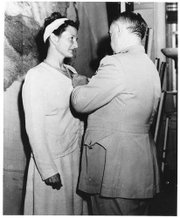
In 1950, she married OSS agent Paul Goillot. In 1951, she joined the Central Intelligence Agency working as an intelligence analyst on French parliamentary affairs. She retired in 1966 to a farm in Barnesville, Maryland.
Virginia Hall Goillot died at the Shady Grove Adventist Hospital in Rockville, MD in 1982.
Her story was told in “The Wolves at the Door : The True Story of America’s Greatest Female Spy” by Judith L. Pearson (2005) The Lyons Press, ISBN 1-59228-762-X
She was honoured in 2006 again, at the French and British embassies for her courageous work.[4]
Patricia Wells, France and Fallot Mustard
As I was scrambling through the Salmiyya Sultan, looking desperately for a few good ingredients on Thanksgiving morning, I stopped short in sheer wonder. There, on the shelves, here in Kuwait, were mustards by Edmond Fallot.
Monsieur Fallot makes the best mustards in the entire world. One year, we did a “French” turkey, slivered with a thousand slices of garlic carefully placed in a thousand tiny slits just under the turkey skin. It was magnificent. We served the turkey that year with a variety of Monsieur Fallot’s mustards.
We lived in Germany, and we often travelled to France for a couple weeks at a time, exploring different regions. We used lots of books, but the three we used most often for France were Patricia Wells Food Lover’s Guide to France, Patricia Wells Food Lover’s Guide to Paris, and a book published annually called Europe’s Wonderful Little Hotels and Inns.

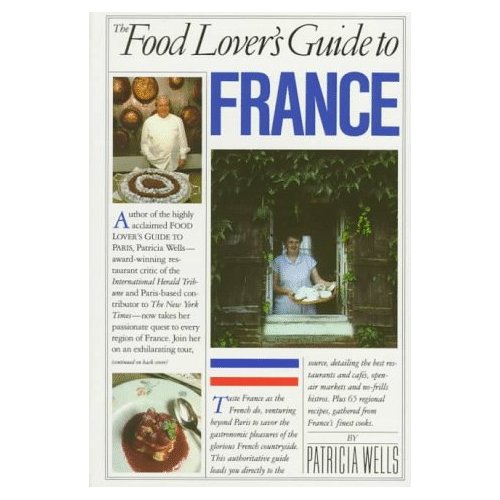
We didn’t have a lot of money, but what we lacked in money, we made up in energy, optimism and research. We found wonderful places to stay, fabulous meals and affordable side trips. We lunched out of charcouteries and boulangeries, we dined demi-pension in Michelin “Red R’s” (good local food at reasonable prices.) We found ourselves in the Burgundy area again and again, and Patricia Wells led us to Monsieur Fallot’s mustard factory in Beaune. Click there for a virtual visit to his factory in preparation for your real time, in person visit.
As I stood there, transfixed, in the Sultan Center, I was back in Beaune, travelling in France with some history and “foodie” friends, and we made a special stop at M. Fallot’s factory, whose address was listed in the original Food Lover’s Guide to France I was using then. I am guessing he has asked NOT to have his address given any more, maybe he had too many visitors like us. We couldn’t get enough of his mustards – we stayed and watch him filling jars with many different kinds, and bought at least one of each variety. His mustard is the gold standard of mustards. Worth a trip to Beaune.
Except you don’t have to go to Beaune – you can find M. Fallot in the Sultan Center in Salmiyya, or in William-Sonoma if you are in the U.S. and in other parts of the world where you find fine condiments.

The latest edition I could find of the Food Lover’s Guide to France was 1987, for $1.99 used, through Amazon. The latest edition I could find of Food Lover’s Guide to Paris was 1999, and the cost, used, was $9.99, again through Amazon. (Disclaimer/Disclosure: yes. I do own stock in Amazon. Help me keep Amazon stock high, please. 🙂 ) I imagine some of the information in both books is outdated, restaurants have closed, newer, haute-er places are open, but I would still say they are worth the price.
Both guides list market days for various arrondisement/towns/villages, and for that alone, they are worth the price. Wells describes local specialities, and best of all, Wells is deliciously readable. Even if you don’t have a trip to Paris or France in your near future, Wells’ books are fun to read, and full of wonderful, valuable information.
The most recent edition I can find of Europe’s Wonderful Little Hotels and Inns on Amazon is 2003, but I know there are more recent editions because mine is 2004. It is edited by Adam & Caroline Raphael, and has hotels listed throughout Europe, not just France, although the lion’s share of hotels listed ARE in France. They range from budget to unbelievable luxury – and the twist is, this book is made up solely of recommendations from customers. Someone has to recommend the hotel, another has to second the recommendation, and readers keep the postings up to date. We have found some truly memorable hotels using this guide, hotels full of charm but affordable for the region. Most of the hotels were awesome. Even used, even outdated, one good hotel stay at a charming but reasonably priced hotel will pay the cost of the book.
The World is Not Enough
Whew! I just got back from a week in 12th century France, courtesy of my friend Zoe Olderbourg. (slaps a flea biting her arm) I bought this book, The World is Not Enough, a while back, and have tried to read it several times, but couldn’t get into it. This time, man, I got into it and couldn’t put it down!
We enter at the wedding of Alis to Ansiau, she (slapping the flea on my neck) the 14 year old daughter of Joceran of Puiseaux, Ansiau the son of Ansiau the Elder, castellan of Linnieres, who knows he is dying and wants to see his line continue before he goes.
“The two of them, standing there, were moved, as two children must be who have just been washed, dressed, lectured and left at teh altar by their parents in front of all the guests, their brothers, their sisters, their uncles, their playmates. They were so little alike. He was a boy and she a girl.”
Alis and Ansiau marry and fall quickly in love. (checking the bedding for fleas) They hunt, they go to tournements, Ansiau goes off on Crusade to the Holy Land – twice. Alis runs the daily life of the castle, has twenty pregnancies, 12 children who live. Ansiau has a mid-life crisis. In their late 50’s, we leave them, scratching one another’s flea bites and looking off into the sunset.
Reading this book, you are totally immersed in the daily life of the nobility. The nobility, as it turns out, are the original credit-crazy spenders – they borrowed against their inheiritance, they borrowed against their lands, they borrowed against their doweries. They were constantly short funds, and constantly mortgaging their future for a few baubles today.
The “castle” had a great hall downstairs, where most of the men slept and where cows and horses and chickens and sheep were brought if it got too cold in the stables in the winter, and up a laddar, one great room where there was one big bed for the king and queen and whoever else they invited to sleep there, and a couple other beds, mostly shared by four or five people. This was where ladies slept, and hung out, and embroidered, and (scratching at a fleabite on the ankle) exchanged gossip.
It was a fascinating visit into a world with no running water, no heat, no air conditioning, where babies died at birth as often as not. It was a world where people caught smallpox, and the lucky ones, those who survived, lived the rest of their lives with pock marks like craters on their faces. It was a world where the nobility didn’t read, and there were no books except in the monasteries. Only priests were authorized to read and explain scripture. It was a world where wolves and bear still roamed the forests of France.
The book is set near Troyes and Langres, in the Champagne area of France. Zoe Oldenburg captures the poverty and brutality suffered by the majority of people, rich and poor alike, without sacrificing the human joys and kindnesses which brightened the world, and made life worth living. The book is so realistic and richly detailed that you will be looking for flea bites when you finish!
Recent Comments
intlxpatr on Shampoo Ginger tigerbutterya0c5ff1d… on Shampoo Ginger intlxpatr on British Soldier Kidnapped, Esc… John on British Soldier Kidnapped, Esc… intlxpatr on British Soldier Kidnapped, Esc… Wikipedia Donate Button

Amazina


Early Voting in Florida


