Three Movies
Most of the time, I work in silence. I have a lot of things I need to think about, and the silence helps me think. When I am ready for some entertainment, I usually listen to BBC. Occasionally, as in the last three days, I turn on the TV, more for background noise than anything else.
Most of the shows I like the best have sharp women as main characters – I love Veronica Mars! I enjoy The Closer, and Crossing Jordan. I love how they overcome their dysfunctions, and how they use their smarts to solve cases. I love it that they screw up from time to time, and have to suffer the consequences, but that they overcome their screw-ups and prevail.
The last three days, I watched parts of three movies. In the first, Braveheart, we were watching Mel Gibson playing Braveheart, but I was constantly distracted by his preening. Have you seen Braveheart? It’s like he is conscious of the camera on him every minute, we the viewers are merely mirrors, absorbing and reflecting his glorious countenance – how annoying! His vanity distracted from a pretty good movie.

Then I watched segments of Dracula playing Ludwig von Beethoven. I am from a family of movie watchers; my son and husband know all the names and rush to IMDb to check out anachronisms, historical inaccuracies, goofs in continuity, etc. All I know is that every time he went to kiss one of those Viennese women, I wanted to scream “Watch your neck!”
The movie was interesting, and they made good use of all Beethoven’s most loved music, and they used it appropriately. Oldman did a good job of bringing Beethoven to life and making his deafness tragic and believable. He also shows the fickleness and cruelty of the audience for whom he made his music.

Then, yesterday, there was Jack Bauer playing Paul Gauguin! In the early parts of the movie, he lived in a luminously violet painted interior, one I am dying to copy. But that is not the point. Jack Bauer is a stoic. Stoicism is great when it comes to playing a guy who has so many bad things happen to him in the space of 24 hours.
(this is also beside the point, but can you imagine being married to a guy like Jack Bauer? Like he would never tell you what he was really up to, the most exciting times in his life are not with you and his children but off protecting the United States of America, he comes back to you addicted to heroin, or totally burned out and just when you have him all patched up again he gets a call that his services are needed, and you don’t hear from him because he is all caught up in his latest adventure and then after 24 hours he comes home again, a total wreck? What kind of family life is THAT??)
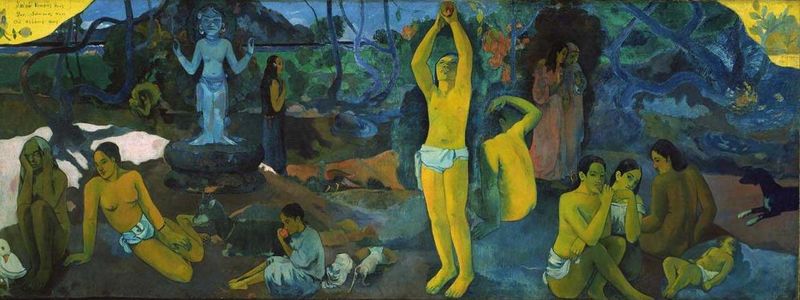
As Paul Gauguin, he leaves his stockbroker existence and becomes a starving painter, then a starving painter who somehow makes it to the South Seas to paint some of the most amazingly colored art every created but his facial expression never changes much. Paul Gauguin was all about passion – and it is just too much a stretch for Jack Bauer. He is not a believable Gauguin. He is not even a believable Frenchman. He barely moves his hands! I would watch the movie again, however, just for a glimpse of those violet colored walls.
It must be a problem for actors, especially TV actors who become too closely associated with one role. I had to look up his real name: Kiefer Sutherland. Fortunately, a new season of 24 starts in just three days. If you ever want to feel sorry for Kiefer Southerland, look at his dad’s resume’ of movies: Donald Sutherland. It wouldn’t be easy to live up to that legend.
Aimee Leduc: Murder in the Marais
Not every book can be one of the best books you ever read. Some books are so good, so filled with nuance, insights and subtleties that even if they are made into a movie, they can’t begin to capture the experience of having read the book.

(available from Amazon.com at $10.40 new and from $1.97 + shipping used)
This isn’t one of those. As I read this book, as I followed the main character, Aimee LeDuc, through the streets of Paris, solving the mystery of who is killing Jews who survived the Holocaust – and why – I kept thinking “this is like reading a made-for-TV movie, you know, the ones that went almost straight to video/DVD?”
I was intrigued when Amazon recommended this series to me, but not surprised – remember, I read Donna Leon, James Lee Burke, and have a history of buying mysteries and detective stories set in exotic locations. But I only ordered one, to test the waters.
There isn’t a lot of depth. The author, Cara Black, gives her main character Aimee LeDuc about as much substance as a cartoon character. She changes clothes a lot, she has very interesting friends, she is smart, and sassy, and savvy, and more than a little edgy. And . . . I kept reading. I even think I will buy another one, just to see. I’m not enamored, but . . . I am intrigued, mildly intrigued, intrigued enough to give it another shot.
There is something about the book that keeps me reading. Could it be the Paris setting? 🙂 Could it be the gritty reality of Aimee’s interactions? Could it be that her shallowness is deceptive, and that if I read more books in the series I will understand her better? Could it be her amazing cast of characters, including her partner, a computer-savant-dwarf?
She includes a lot of Paris-reality. Aimee’s apartment has serious heating problems, and she often takes a hot bath just to warm up – as long as the hot water lasts. In her Paris it rains. In her Paris, dealing with the bureaucracy, while not particularly corrupt, is endlessly frustrating. Her Paris is peopled with people a whole lot like us, warts and all. For me, this is a plus.
Cara Black is a little skimpy on motivation; the plot reminds me of The DaVinci Code, it doesn’t really hang together all that well. In spite of all that, I found myself enjoying riding through Paris in the rain on a little mo-ped, crashing through the back of the Issa Miyake showroom and grabbing some items from the bin to disguise me as I escaped, and grabbing a croissant here and there, smelling the Tarte Tatin from the alleyway . . . I did not enjoy the fight on the slick tiles of the Paris rooftops at all.
If you like mysteries, you need to get acquainted with Cara Black’s Aimee LeDuc, just to be able to have an opinion when another detective-loving-book-reader asks. If you already have stacks of books waiting to be read – this is a good one for reading in airports while waiting for a delayed flight.
(Side Note: The Marais is the old Jewish Quarter of Paris, and it is in the process of serious gentrification. There is an old post-card and poster store located there, with items to die for – at prices to match. It is also near the Musee Carnavalet, probably one of the best museums in Paris.
Hôtel Carnavalet
23, rue de Sévigné
75003 Paris
Standard : 01 44 59 58 58
Fax : 01 44 59 58 11)
Nemirovsky: Suite Francaise
Within five seconds of starting this book, you are in Paris, flurrying with the Parisians. It’s hot, it’s June, it’s 1940 and the Germans are coming, it is time to get out of town. We are in the middle of preparations to evacuate, with several families, couples and individuals as they make their preparations.
Have you ever been evacuated from a house or hotel due to sudden fire? Have you ever wondered why, in the seconds you had to prepare to leave, you made the choices you did? I groaned as I lived with people carefully packing their linen tablecloths and bird cages; but it’s different when it is not YOU. What I admire so much about Irene Nemirovsky’s book is that you are THERE, you feel so much a part of it. I can tell you what it was like, the desperation as “we” evacuated Paris, and later, as we lived with the enemy using our house for billeting.
The Suite Francaise is two parts, Storm and Dolce. As you reach the end of Dolce, you have a strong feeling that there should be more, and indeed, as you read, seeking satisfaction, the appendices, you discover the book was intended to have four or five sections. The interpreter who put the manuscript together, filling in from Nemirovsky’s notes, has done a masterful job on the two sections that were somewhat complete, but, unfortunately, Nemirovsky, a Catholic, had a Jewish parent, and that was enough to get her arrested, transported to a concentration camp and executed, all within a very short time. The correspondence between her husband had the authorities, in the short time between her arrest and death, is desperate, and chilling.
You can’t help but be heartsick at the loss to this world of such great talent. You can’t help but wonder what this book, as good at it is, might have been as a larger whole?
Nemirovsky, above all, has an acute eye for French thinking, French manners, French mannerisms, and above all, for French class distinctions. The dialogues are SO perfectly believable, as are the depictions of the manner in which people under the worst kind of stress can behave with both inhuman kindness and insensitive cruelty toward one another.
You know how I am always wondering what my cat is thinking. . . I share an excerpt of the book with you. I believe Nemirovsky knows what a cat is thinking!
The cat poked his nose through the fringes of the armchair and studied the scene with a dreamy expression. He was a very young cat who had only ever lived in the city, where the scent of such June nights was far away. Occasionally he had caught a whiff of something warm and intoxicating, but nothing like here, where the smell rose up to his whiskers and took hold of him, making his head spin. Eyes half closed, he could feel waves of powerful, sweet perfume running through him: the pungent smell of the last lilacs, the sap running through the trees, the cool, dark earth, the animals, birds, moles, mice, all the prey, the musky scent of fur, or skin, the smell of blood . . . His mouth gaping with longing, he jumped on to the window sill and walked slowly along the drainpipe. This was where a strong hand had grabbed him the night before and thrown him back . . . but he would not allow himself to be caught tonight.
He eyed the distance from the drainpipe to the ground. It was an easy jump, but he appeared to want to flatter himself by exaggerating the difficulty of the leap. He balanced his hindquarters, looking fierce and confident, swept his long black tail across the drainpipe and, ears pulled back, leapt forward, landing on the freshly tilled earth. He hesitated for a moment, then buried his muzzle in the ground. Now he was in the very black of night, at the heart of it, at the darkest point. He needed to sniff the earth: here, between the roots and the pebbles, were smells untainted by the scent of humans, smells that had yet to waft into the air and vanish. They were warm, secretive, eloquent. Alive. Each and every scent meant there was some small living creature, hiding, happy, edible . . . June bugs, field mice, crickets and that small toad whose voice seemed full of crystallized tears . . . The cat’s long ears – pink triangles tinged with silver, pointed and delicately curly inside like the flower on bindweed – suddenly shot up. He was listening to faint noises in the shadows, so delicate, so mysterious, but, to him alone, so clear: the rustling wisps of straw in nests where birds watch over their young, the flutter of feathers, the sound of pecking on bark, the beating of insect wings, the patter of mice gently scratching the ground, even the faint bursting of seeds opening. Golden eyes flashed by in the darkness. There were sparrows sleeping under the leaves, fat blackbirds, nightingales; the male nightingales were already awake, singing to one another in the forest and along the river banks.
And I imagine that the above all took place in the space of about 15 – 30 seconds!
If Nemirovsky can capture a cat’s thoughts so eloquently, just imagine what she can do with the French!
The second part of the Suite, Dolce, takes place in a small farming village and ties many of the evacuees from Storm loosely with the village and subsequent events. In Dolce, we live with a young married Frenchwoman in the home of her mother-in-law who blames her for enjoying life while her own son, the young woman’s husband, is a prisoner of war in Germany. If that weren’t bad enough, soon a young German officer is sent to live with them.
We have lived among the evacuating Parisians, in Storm, and now, in Dolce, we are living in the provinces, with it’s stultifying conventions. There are whole passages where the restrictions of polite French countryside society make it so suffocating, you almost have trouble breathing. And yet, as they do in every society, the young find ways around the conventions, risk their lives, risk their reputations, and live thinking that no-one sees what they are doing, while the elders bite their lips in horror. Fascinating reading. Nemirovsky’s genius to to make you feel you really are THERE.
Apples and Honey Mustard
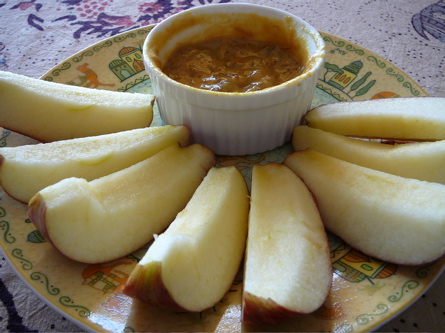
This is one of my favorite mid-morning snacks. It also works as a last-minute delicacy you can set out when friends show up unexpectedly. As good as it tastes, I hate to tell you, it is also good for you.
Slice apple into eighths. Cut out seeds. Mix 1 Tablespoon honey (some great Yemeni honey is best) with 3 Tablespoons mustard. Place in small bowl, arrange apple slices around bowl, serve! Did it even take 5 minutes? No!
Use a good mustard:

Monsieur Fallot’s mustard is, amazingly, available in Kuwait at the Sultan Centre stores.
Blue Angels in Pensacola
Today the Blue Angels are performing in Pensacola, over Pensacola Beach. Reports yesterday said it is harder for them to perform over water, because there are fewer “marks” to help them orient themselves.

(No, I didn’t take that photo, it is a Blue Angels PR photo)
Aerial displays have always thrilled me. There was a team that used to perform every year in Doha, too, I think it was a French team. Imagine, having a career as a stunt flier, in one of these powerful machines. Oh, what fun.
Our first worker arrived well before seven in the morning yesterday; fortunately I am still jet lagging and had been up moe than an hour when he drove up. He was followed shortly by the contractor, who took out my range top, in preparation for the tearing out of the kitchen counters on Monday, and later by the tile guy, coming in to measure and give an estimate on what he will charge to put tile on the wall, once the new counter and cupboards are finished.
We are putting in a Silestone countertop in Blue Sahara. It isn’t really blue, it is a variety of sand colors, with some blue flecks, the exact colors of their wedding china.
I looked at granite, but didn’t like all the upkeep, the sealing, the stains . . . someday, when I have a grown up house, I might have marble, which I had in Tunisia and loved, but I always worry about red wine spills. 😉 Meanwhile, I think the Silestone is going to be a great fix. The current countertop is an old white streaky laminate, reminds me of a diner from the fifties. They liked it so much, they ran it right up the wall to the underside of the cupboards.
Dear old friends who live nearby came for lunch, and we went to the Oyster Barn. They loved it. Said “this is REAL Florida!” which I totally love. We had grilled tuna, which had a smokey deliciousness, and grilled grouper sandwich, also looked good. We talked about our days together living in Germany, travelling in France – oh, the fun we had!
New Google Earth Hi Res
New high resolution:
Canada:
Whistler, BC; Waterloo & Toronto, Ontario; Nanaimo, BC; and Fort Saskatchewan, AB
England: Base 50cm coverage of nearly entire country, and Avon
Germany: Cities/Regions of Greifswald, Trier, Köln, Stuttgart, Bonn, Oldenburg, Rostock, Saarbrücken, Hamburg, Hannover, and Ritterhude
Austria: Villach region
France: Cities of Caen, Dijon, Metz, St Etienne, Toulouse and Rouen
Spain: Valencia Andorra
US: Imperial County (CA); Yellowstone National Park (WY); Galveston/Houston (TX); Peterborough (NH); Cheyenne (WY); Burke, Wake, and Cabarrus Counties (NC); Racine and Kenosha Counties (WI); Washington, DC; St Paul (MN); and the State of Alabama
Japan: City/Regions of Kochi, Asahikawa, Koriyama, Miyazaki, Nagano, Utsunomiya, Akita, and Toyama
Large Digital Globe (60cm) update includes areas in Sudan, expanded Africa, Australia, Mexico coverage and smaller areas of coverage in Asia, Polynesia, South America, Canada, Europe, Middle East plus some interesting islands in Antarctica and Greenland.
Updated Imagery:
Americas:
Bogotá, Columbia; Mission Viejo (CA, US); Hillsborough County (FL, US)
EU: Dublin, Ireland
Middle East/Africa: Beirut, Lebanon and Tripoli, Libya
Asia: Hong Kong and Manila, Philippine
Updated Terrain:
Western US 10m, Canary Islands 10m
Retro Metro
Getting ready to open at Villagio is one of my favorite places – Paul’s. When you can’t get to France, you can at least get to Paul’s. No, no little pichet of good wine with your salad, but truly great croissants, tartes and salads, and I am a great fan of their salmon fettucine.
And look what they are doing at Villagio! Look at the Art Nouveau wrought-iron trim on the shade! It looks like the Sacre Coeur metro stop! When it opens, it will be out in the open, a la Marina Mall, very French sidewalk cafe/restaurant. Unlike Al Kout Mall, this one has no outside area, tant pis!
When the weather outside is blistering hot, these malls are the only comfortable place to be. Thank God they are done with so much imagination.

Labyrinth by Kate Mosse
When I saw this book at the Barnes and Noble, I thought “isn’t Kate Moss a fashion model?” but that is a different Kate Moss, a Moss without the ‘e’ at the end.
This book was a New York Times bestseller, but then so was the Da Vinci Code, which I thought badly written and sometimes incoherent. The premise was interesting, but it was done years ago by French authors Michael Baigent, Richard Leigh and Henry Lincoln. Holy Blood, Holy Grail hypothesizes (and pulls together a load of hypothetical evidence to support) that the mystical grail is really a symbolic representation of the blood of Christ, that Jesus was not crucified but instead left Jerusalem with his wife Mary Magdeleine and went to France, and started a family there which eventually became the early French royal line.
I remember telling my son this story, as we travelled through the southern areas of France, and him saying in his smart-mouth-teenager way “only the French would be so arrogant as to believe the blood of God was flowing in their veins!”
We spent a lot of time travelling in France. We love France. So when I discovered that Labyrinth was about the beginning of the French crusade against the Cathars, I was delighted. We know this history. We know this area – it is one of the most beautiful areas of France. We know Carcassone, which in its renovation by Viollet-le-Duc is like Disney-does-fortified-city. It’s formidable, but it’s not entirely authentic.
Who are the Cathars? The Cathars were a break-away sect who were called by others ‘bons hommes’ or ‘bons Chretiens’ (good-Christians), but, pre-Luther, they saw many flaws in the way the Catholic church has become more political than spiritual.
They valued inner faith above outward display. They needed no consecrated buildings, no superstitious rituals, no humiliating obeisance designed to keep ordinary men apart from God. They did not worship images, nor prostrate themselves before idols or instruments of torture. For the ‘Bons Chretiens’ the power of God lay in the word. They needed only books and prayers, words spoken and read aloud. Salvations was nothing to do with alms or relics or Sabbath prayers spoken in a language only the priests understood. . . In their eyes, all were equal in the Grace of the Holy Father – Jew or Saracen, man and woman, the beasts of the fields and the birds of the air. There would be no hell, no final day of judgement, because through God’s grace all would be saved, although many would be destined to live life many times over before they regained God’s kingdom.
They believed the earth was created as a trap, by Satan, and that our lives here keep us apart from the glory of God. They believed we keep coming back, until we purify ourselves spiritually, and that in the end, if we get it right, we end up back where we came from, with God. And they believed we all have the right to read the bible, and to talk directly with God, without the necessity of a priest to interpret or to direct.
But this Crusade, the Fourth Crusade, is little known. This Crusade, declared by the Pope to wipe out the Cathar heresy (sometimes known as Bogomilism or Albigencian heresy) was really the tool of the nobility that was then France, less than half of the France of today, to grab the rich, lush southern lands of the Pays d’Oc. The Fourth Crusade was an opportunity for knights to increase their holdings. And it doubled the size of France.
The Labyrinth takes you inside the walls. The main character is not Cathar, but it didn’t matter – this war wasn’t really about wiping out the Cathars as much as subjugating an independant land and making it part of France. You may have heard one famous quote from this Crusade – as the Crusaders were attacking Besiers, the Abbot of Citeaux was asked how the soldiers could tell the good Catholics from the heritics. “Tuez-les tous. Dieu reconnaitra les sien,” he replied – Kill them all. God will know his own.
The book is lightweight, an easy read. The heroine, Alice, seems to have lived before, as Alais, and has memories she has never lived. You jump back and forth between today, and the time of the Crusade, in the early 1200s. Some of the plot mechanisms don’t make a lot of sense, but you do get a real sense of life in a fortified town during the 1200’s, and of the injustice done to this beautiful area in France. For a book I am lukewarm about in retrospect, I read it avidly, and enjoyed the read.
What I like about this book is that it brings to life a time in history that few pay any attention to. Somewhere in the book, it says that “history is written by the victors.” We see France today, and we know little about the struggle that united these diverse areas into one nation. This book illuminates a slice of time, a grave injustice, and a sense that religion is too often a tool for political ends.
Like the heroine, the big church in Carcassone, where the trials and tortures of the ‘heretics’ took place sends a cold chill up my spine, I can hear the screams of the tortured. I love churches, and I can’t go into this one. It feels unholy. Did you know that the origination of the Inquisition was not in Spain, as most people believe, but in this area of France? And it was aimed, first, at the Cathars.
All in all, not a bad book. Though light in plot, it is heavy in content, a book you will remember and think about in terms of issues, if not the main characters.
Google Earth Update
My nephew, Earthling, who works for GoogleEarth, makes the following recommendation:
“there are a lot more panoramio photos now. . . “
“Spain and France are both completely covered in 2.5 meter imagery or better now. Switzerland is now 100% high res and has new improved terrain. I highly recommend turning on terrain and flying through the alps. Highly recommend it!”
Have fun!
(If you don’t have Google Earth yet, you can download it here. It’s FREE.)
Jean Plaidy and Courts of Love
My last day back in Seattle, I allowed myself a trip to the nearest Barnes and Noble. It was a shorter trip, only ten days, and full of family and family gatherings, centered around my father’s recent death. The days sped by, each full and exhausting.
I had already packed most of my bags. I do this so I know how much, if any, room I have. That way, I won’t buy too many books. I know myself. I know my vices. There is a part of me that says “how can there be too many books? How can there be too much of such a good thing?”
And then I am stuck trying to shovel books into an already overpacked suitcase, stuffing more into my stuffed backpack, shoving, re-arranging, tossing out old underwear to make way for yet another book.

I only bought a few books, one of which was Courts of Love by Jean Plaidy. If you follow this link, you will find many reviews of this book that disagree with my opinion, and gave this book almost five full stars.
I have always held Eleanor of Aquitaine in great awe. Born in the Languedoc region of France, she was raised in a court full of literature and poetry, visitors from distant places bringing news. She was educated, and exposed to rule. She was expected to inheirit the rich province of Aquitaine until a younger brother was born, but, as was not uncommon in the times, he succumbed to a childhood illness, and she once again became the inheiritor of a fabulously wealthy and desirable province, the Aquitaine.
And if being the inheiritor of Aquitaine wasn’t enough, she was also thin, and elegantly beautiful, and educated, and she had spirit. She never felt herself limited by being a woman.
She first married Louis, King of France, who was nowhere near her match. She insisted on accompanying Louis on his crusade to free Jerusalem (failed) and upon her return to France met Henry, the heir to the English throne, secured a divorce from Louis of France based on the fact that they were distantly related, and then quickly married Henry, who was even less distantly related. She did as she wished.
Henry was several years younger than Eleanor, and they were both full of fire, and ambition. They had force, and strategic vision; as a couple, they were unbeatable. Eleanor gave birth almost yearly, mostly sons, and was happy until she discovered her husband’s multiple infidelities. His inability to be a faithful husband created a bitterness in her heart, a wall between the two of them. From time to time, Henry had Eleanor imprisoned to keep her out of his way. He believed she had turned his sons against him. But many times, he would need her, and call her out of her captivity to help him. It’s a bitch, being married to a king.
Where am I going with this review, you might ask?
I finished the book, and all I can wonder is how Jean Plaidy took such a fiery woman, a sensual and vibrant woman, and made her so wooden? It must be some problem in me, as the other reviewers give the book a much higher rating than I would, and I wonder if they are confusing their awe with the subject (Eleanor) with the quality of the book?
Or maybe I have become so used to Phillipa Gregory’s treatment that I am spoiled for Jean Plaidy? When you read The Queen’s Fool, The Other Bolyn Girl and The Constant Princess you are there, you are in their world, feeling their thoughts. The dialogue is rich and lively, you are surrounded by sensory clues, smells, feels, tastes – the world is richly created, and when you finish the book, you feel like you have travelled in time, as if you were really there.
Not so with Courts of Love.
I would rate this book far lower, because I DO admire Eleanor of Aquitaine, and I think she deserves an equally lively, richly sensual treatment. I want to know her world, I want to peek inside her mind and experience a little of what she experienced. I want Philippa Gregory to write about Eleanor of Aquitaine! Jean Plaidy, in my opinion, took an extraordinary woman, and make her less vibrant, and just a little drab. A grave injustice, in my book!
Recent Comments
intlxpatr on Shampoo Ginger tigerbutterya0c5ff1d… on Shampoo Ginger intlxpatr on British Soldier Kidnapped, Esc… John on British Soldier Kidnapped, Esc… intlxpatr on British Soldier Kidnapped, Esc… Wikipedia Donate Button

Amazina


Early Voting in Florida


