Kuwait Lifts YouTube Block?
Reports that the ban has been lifted are unconfirmed, according to this morning’s Al Watan. So if the ban is lifted, who countermanded it?
Kuwait reportedly retracts YouTube block
Nancy Oteifa
Al Watan staff
KUWAIT: Unconfirmed reports indicated on Monday that a decision to block the online videoـsharing Web site YouTube has been revoked by the Ministry of Communications. According to a blogger writing under the name of ”Falantan” who claims to work for a local Internet Service Provider (ISP), officials at the Ministry of Communications held a meeting Monday morning to discuss the issue and consequently decided to revoke the decision.
Sources stated on Sunday that a memo had been issued by the Ministry of Communications to all local ISPs ordering them to block the Web site Youtube.com.
However, speaking to Al Watan Daily, local ISP Arab Telecom denied having received any memos from the Ministry of Communication asking them to block this site. “We didn”t get any orders from the Ministry of Communication about blocking YouTube but the minute we receive the memo we will immediately block YouTube,” a company representative stated.
Reports that the Web site was to be blocked generated heated reactions from many people in Kuwait, some of who stated that this is a blatant disregard of freedom of speech, while others claimed that any site that displays material that is disrespectful to Islam and the Prophet Mohammed (PBUH) should rightfully be blocked.
Kuwait Blocks YouTube?????
Kuwait blocks Youtube
Published Date: September 22, 2008
By Jamie Etheridge
KUWAIT: The Ministry of Communication has issued a memo to all internet service providers in Kuwait asking them to block YouTube access. The popular video website came under fire from the ministry due to content considered offensive to Muslims, a source within the industry told Kuwait Times. The Ministry pointed to content including a video of a man signing verses from the Holy Quran while playing the oud and another video showing caricatures of the Prophet Mohammad (PBUH).
A Fasttelco source confirmed receipt of the memo. “It’s supposed to be blocked right now. But due to technical preparations the blocking may take until tomorrow [Monday],” said the source. The site was still accessible yesterday evening. The Ministry of Communication regularly issues memos to ISPs asking them to block certain websites, including those containing pornographic photos or ones like Skype that can be used to make international phone calls over the Internet.
YouTube is widely used in Kuwait. A search of the word ‘Kuwait’ turned up 59,000 videos, including everything from videos of car crashes on Fahaheel Expressway and Jessica Simpson’s concert for US troops in Kuwait to protests in front of Abdullah Al-Salem hall in the run up to the 2006 parliamentary elections.
You can read the entire article at Kuwait Times.
Riots and Internet Offenders
From today’s Arab Times:
Kuwait preparing law to punish ‘Internet offenders’: Al-Othman
KUWAIT CITY (AP): Kuwait’s prosecutor general says Internet offenders will no longer be able to escape punishment in this country. Hamed Al-Othman says in an interview with Al-Qabas daily published Sunday he has prepared a bill that criminalizes promoting vice, incitement against the country’s leadership, divulging state secrets, or insulting Islam on the Web. If convicted, offenders would be sentenced to up to one year in jail and/or a fine, but face seven years in prison if their victims are minors. Al-Othman’s office confirmed that he made the comments to Al-Qabas.
The draft Internet crime and data information law recently passed by the Public Prosecution Department will be forwarded to the Council of Ministers for their consideration, adds Al-Othman.
Al-Othman explained the importance of passing such a law at this time, saying “it’s obvious to all who care about protecting our customs and the future generations that such a law is needed to combat the increasing electronic crimes associated with the ever-improving electronic technology. “The law will include 37 articles and punishment for those who fall foul of the law will be either jail sentence or financial fine,” he added.
Protest turns violent in fight over pay
KUWAIT CITY : A riot by about 2,000 workers of Al-Jawhara Company for Stevedor-ing and Cleaning in their camp in Hassawi led to the destruction of six vehicles and injuries to five camp officials, says K. John, the company’s Operations Manager. The manager was speaking to the Arab Times Sunday after the riot was brought under control by policemen. The riot, which began Saturday night, reached its peak by Sunday morning and continued till noon. The workers, John said, were disgruntled over their wages and were demanding a hike, talks over which have been going on for the last couple of weeks. “The recent outbursts in other cleaning companies stoked the angry workers to violence Saturday,” he added.
Meanwhile, late Sunday evening, the Ministry of Social Affairs agreed to almost all demands of workers of cleaning companies who had threatened to go on strike, besides setting a minimum wage of KD 40 for cleaning workers – without any deductions an embassy official said on condition of anonymity. The embassy official added that the ministry has also asked the cleaning companies to pay for health and residency fees of their workers and that companies which violate the rights of workers will face “full force of the law.” The official also said that Bangladeshi officials, who maltreat or exploit their workers, will be referred to the concerned authorities.
A mob of hundreds of Bangladeshi cleaners had attacked their company’s office in Jleeb Al-Shyoukh Saturday evening, and beat up five supervisors who were reportedly exploiting the workers, some cleaners told the Arab Times.
The workers were protesting about their unpaid wages and poor working conditions. All five supervisors are Bangladeshis and are currently being treated at the Farwaniya hospital.
A cleaner said the condition of the two injured officials was critical. However, this could not be independently confirmed.
The cleaners reportedly damaged furniture, computers, printers and other office equipment in the attack that lasted for a few minutes.
According to the workers, no arrests were made and a large police force was deployed at the camp from Saturday evening until late Sunday afternoon.
The timely arrival of police and embassy officials prevented the situation from spiraling out of control, added the cleaners. The workers said that they embarked on indefinite strike from Sunday and that they will not return to work unless all their problems are redressed by the company.
This is the first violent demonstration to grip Kuwait since the strikes of Bangladeshi cleaners began last Sunday.
Some of the problems facing the workers include: underpayment; company is making them pay for the health and residency fees; some cleaners are made to work for more than eight hours without any overtime benefits; company is not allowing workers to take vacation every two years; company is not granting sick leave, among other problems.
About 5,000 Bangladeshi cleaners are employed with this local company and are placed at various government establishments.
Jleeb Al-Shyoukh is home to thousands of Bangladeshi cleaners, who live in squalid camps and a majority of them are paid as low as KD 18 salary.
Another worker told the Arab Times that the problem had been simmering for a long a time and that the five supervisors were warned by them not work against workers’ interests.
He added that the trouble began when some of the workers confronted the supervisors as to why they were deducting their pay and that two supervisors reportedly threatened some cleaners, thereby leading to the showdown.
He said that the officials of the ministry of social affairs and labour rushed to the camp Saturday evening and urged the workers not to resort to violence and that they would put an end to their grievances as soon as possible.
Expressing his views on the company’s alleged apathy, another worker said: “We tried to resolve our problems with the company in an amicable manner, but our appeals fell on deaf ears. The supervisors in question are hand in glove with the company’s managers and used to report every development that took place at the camp.”
“When we decided to go on strike a few days ago, the supervisors quickly informed the company. The company then scuttled our plans by turning up the heat on our representatives. We know it is wrong to take the law in our hands but our situation was worsening by the day.”
The ministry of social affairs and labour has taken tough measures against cleaning companies that violate rights of workers, even as the ministry recently said that it had cancelled the contract of a company whose workers went on strike last Sunday.
On Saturday, senior officials of the ministry managed to convince some 7,000 Bangladeshi cleaners to drop their strike, who had threatened to stop work on Sunday if their demands were not met.
According to the workers, the ministry has agreed to all their demands and that they would be paid KD 40 salary, up from KD 8. It was also reported earlier that the ministry will soon send inspectors to labour camps to take a stock of workers’ living conditions and also to address their grievances.
When asked why the workers were unhappy over the wages, John said the issue is very complex, and the government is partly to be blamed for the current state of affairs. “The workers demand health insurance, which is KD 50 per person, while it is only KD 10 for domestic maids. This makes it very difficult for companies to provide health insurance of its workers.
“The municipality pays just about KD 23 per cleaning worker, and the government can’t expect us to pay more than that. Our workers receive anywhere between KD 20 and KD 70 depending upon their rank and job.
“Tendering rules also need to be reformed by the government. There are many small players who make abysmally low quotes to win tenders and bring down the quality of this sector. This despite the fact that we need to show bank guarantees of very huge sums to win tenders,” John explained.
Stressing the cleaning companies are an asset to the nation and should be treated with due importance, John said “the government has to provide us lands at subsidized rates to help sustain the industry.
“The workers ransacked the rooms in the camp and destroyed some computers. We also suspect that workers from neighboring camps joined in the riot, adding to the ferocity of the violence. The project manager had to be rescued from the camp by the police from the marauding rioters,” he revealed.
When asked what future course of action the company is planning to take, John said a meeting of the Cleaning Companies Association was called Sunday evening, “and the issue was to be discussed to find a solution to this problem that’s getting out of hand.”
“The demands of the workers are not wholly over the board given the inflation rates in the state. If the issue is not resolved many government institutions and private companies will be hit,” John added.
“The workers at Al Jawhara Company do not have any unpaid dues and all their salaries are paid in time,” he concluded.
Also:
KUWAIT: Acting Assistant Undersecretary of the Ministry of Social Affairs and Labour for labour sector Hamad Al-Me’dhadi revealed Sunday that the main reason behind the majority of recent strikes was the demand for salary increase.
He said that the Ministry of Social Affairs and Labour will report to the Cabinet on these strikes coinciding with another report to be submitted by the Ministry of Interior in this regard.
He added that ministry officials met with a representative of the Bangladeshi embassy and informed him that the strike of laborers must be expressed in an orderly manner and according to official channels.
He pointed out that it had been agreed with the Bangladeshi embassy that there should be representatives for all those laborers so that the ministry’s legal researchers and inspectors can listen to the workers demands.
Meanwhile, the issue of continuous strikes by expatriate workers and their rights are on top of the agenda for the Council of Ministers’ meeting on Monday. The meeting will be presided by the Acting Prime Minister and the Defense Minister Sheikh Jaber Al-Mubarak Al-Sabah.
“The Cabinet is ready to sanction erring companies and they may request the National Assembly to pass the new labor law at the beginning of the next parliamentary term,” Source added.
By Francis A. Clifford Cardozo and Valiya Sajjad
Arab Times Staff
Committee To Make You Live the Way I Think You Should
From yesterday’s Kuwait Times Editorials is a must read by columnist Shamael Al-Sharikh, one of their most insightful political commenters.
In her column, Dichotomy, she discusses SANPFKS (Committee to Study all Negative Phenomena Foreign to Kuwaiti Society). I have only excerpted the following, to intrigue you enough to click on the blue type above and read the whole article. It is a worthy read, from beginning to end.
Well, unlike these MPs who did not react to the creation of the SANPFKS (the name starts to grow on you, doesn’t it!), I am quite invested in the success of this committee, and as a patriotic Kuwaiti citizen, I will do my utmost to cooperate with the SANPFKS to ensure its success and imminent continuation. There are many things that are foreign to Kuwaiti society and that need to be eradicated from it so we can go back to our roots. Below is a list of issues that the SANPFKS can study, report on, and subsequently eradicate:
1. Bearded men: A post-1991 phenomenon that is clearly the result of influence from other Arab countries. The result is that most Kuwaiti men have become severely unattractive, unapproachable, and mind-numbingly narrow-minded. This phenomenon should be studied extensively and recommendations should be given on how to go back to real Kuwait, where men only wore mustaches.
2. The niqab: same as above. The result is that many Kuwaiti women suffer from the incorrigible heat under layers of black cloth, when in the past, all Kuwaiti women wore an open single layer abbaya, faces uncovered. This phenomenon should be studied extensively, especially in light of the fact that women are not required to cover their face in Mecca during Hajj, making it ridiculous that they cover their face in Kuwait.
This article, from start to finish SANPFKS (Committee to Study all Negative Phenomena Foreign to Kuwaiti Society)
It is followed today by an answering column from Fouad Al-Obaid called “You Must Be Kidding!” where he captures the absurd situation of a country rushing headlong into chaos while the newly-elected ministers discuss mixing of men and women at a hospital party and Star Search instead of using their energies to focus on policies to get Kuwait’s infrastructure moving once again and economic policies to encourage development.
These two columnists make the Kuwait Times worth reading.
Wonders 1 and 2: Good Morning America
Yesterday I posted a photo of the skywalk, featured on Good Morning America’s 7 Wonders of the U.S. series and people wondered what the first two are.
The first wonder selected was the National Mall and National Park in Washington DC, a celebration of Democracy, “where American voices are heard.”

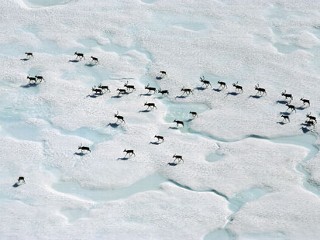
The second – and by far my favorite – was the Arctic National Wildlife Preserve, a brutal place where there are still huge herds of caribou, shaggy buffalo, polar bear . . . and where George Bush tells us we wouldn’t be paying so much for gas if we would only give him and the oil companies the go-ahead to go in and exploit the oil resources there. (See #1 George Bush – the American people raised their voices and said “NO!”)
The Grand Canyon was the third wonder announced.
There are still four more wonders to be announced. Good Morning America comes on America Plus Monday – Friday in the afternoon, maybe two or three in the afternoon, in case you want to catch the rest, or you can just click on the blue hypertext above where it says Good Morning America, and you will go to the ABC website for the Seven Wonders.
“So Many Christians!”
My Kuwaiti friend was shaking his head in disbelief. He had been to the old city to pay a condolence call on a Friday, and happened by the Lighthouse compound near the Sheraton circle on a Friday morning, just as some of the services were getting out.
“I had NO idea!” he looked at me in absolute amazement.
I just laughed. When we first got here, we attended church on that compound; our church moved off only months ago, when the road construction work got seriously under way and parking increasingly became a problem. It was the most amazing experience on earth – there were the Indian Men’s Catholic services and the Philipine Evangelical service and the rock-music evangelical service and the staid Anglican services and the family Philipine Catholic services and . . . well, you get the picture. There are an amazing number of expatriate Christians in Kuwait. At any one time on the compound, there are about twelve different services going on, and no sooner does one finish and the participants exit, than the new group is coming in.
Now, churches meet all over Kuwait. They met in villas, they meet in schools, they meet in every neighborhood. Today, in our church, we asked for blessings on Kuwait, on the Emir and his family, and those in leadership positions in Kuwait. We prayed for the leaders of all the countries in our congregation (English, Irish, Scottish, South African, Chinese, Indian, Nigerian, Kenyan, Dutch, Egyptian, Ethiopian, American, Australian {I have forgotten a few, I am sure} . . . lots and lots of blessings!) Most of all, we thank God for the freedom to worship in Kuwait.

(This is not our church in Kuwait. This is the Church of the Holy Sepulcher, in Jerusalem. I was looking for a church that looked more Middle Eastern than Western, and this is what I could find!)
Our pastor also has a blog, q8bridge about which he says “The purpose of this blog is to enable a bridge to be built between Christians and Muslims, especially those living in Kuwait. Through questions and dialogue we hope to promote deep friendships and mutual understanding.”
He examines the beliefs we have in common, and where we differ, and some of the reasons why we differ. I urge you to have a look.
Bloggers Changing the Face of News in the Middle East
“So are the “new media” – blogs, websites, chatrooms – now becoming the only truly independent media in the Arab world?”
This article is from today’s BBC News in Depth:
New media dodge Mid-East censors
By Robin Lustig
BBC radio presenter
It’s never easy writing about media freedom.
Even in countries where there is no official censorship, all reporters know there will always be some restraints on what they can say – editors need to be persuaded, owners need to be kept happy, the law has to be obeyed.
Where there is official censorship – where, for example, it is a crime to “bring the government into disrepute” or to publish material which “insults the dignity of the head of state” – the problems are all the greater.
No freedom is absolute, yet some media are a great deal freer than others.
In the Arab world, in general, the media have been heavily politicised.
Governments have tended to control the main media outlets – the main daily newspaper, the main TV and radio networks – and where independent media have been allowed, they have often been owned by opposition parties or by businesspeople with clear links to political organisations. (The establishment of the Qatar-based al-Jazeera TV news station was a rare special case.)
But then, one day, along came the internet. And it was as if someone had blown open a few million doors.
Egyptian successes
Now, everyone can write – weblogs, or blogs, were born, giving everyone with access to the internet exactly the same opportunity to write and publish as the most powerful media tycoon.
You can read the rest of this article by clicking here, on BBC News.
Stop Honor Killings.com
I used to send out e-mails to close friends about my adventures travelling and living in “exotic” places. When you live your entire life in one place, the smallest things that may seem trivial to you are interesting and different to those who have never been to your country. I would get letters back saying “you don’t know me, you don’t even know the person who shared your e-mail with me, but (that person’s) former wife is related to one of the people you sent the e-mail to . .”
If someone makes an interesting comment on a blog I follow, sometimes I follow that comment, which I did today. On the blog of a person I don’t follow, from a comment from another blogger I don’t follow, I found this fascinating website:
Stop Honor Killings.com
Here is what I would describe as their mission statement:
INTERNATIONAL: International Campaign Against Honour Killings
Posted by Ginger on Wednesday, September 05, 2007 (12:56:46) (187 reads)
Over 5000 women and girls are killed every year by family members in so-called ‘honour killings’, according to the UN. These crimes occur where cultures believe that a woman’s unsanctioned sexual behaviour brings such shame on the family that any female accused or suspected must be murdered. Reasons for these murders can be as trivial as talking to a man, or as innocent as suffering rape.
I’ve lived in countries where honor killings happened, and we knew about it. It would be in the paper. We saw it in Jordan, in particular, where there is now a huge effort to put an end to the killings, and in Qatar, where it was never in the paper, but the kids would tell their teachers about it, and word travels fast in a small country.
I never hear a word about honor killings in Kuwait.
Is that because there aren’t any?
Saudis Uphold Rape Victim Penalty
Several bloggers have brought this situation to public attention; BBC provides the full update HERE:
Authorities in Saudi Arabia have defended a judicial sentence of 200 lashes for a rape victim.
The justice ministry said in a statement that the sentence was justified because the woman was in a car with an unrelated man.
The case has aroused controversy at home and condemnation abroad.
The 19-year-old, who has not been named, was travelling in a car with a male friend last year, when the car was attacked by a gang of seven men who raped both of them.
She has become known as the “Qatif girl”, a reference to the largely Shia town which she comes from.
Four of the men were convicted of kidnapping – but the court also sentenced the woman and her friend to receive 90 lashes each for the crime of “illegal mingling”.
Last week the court increased the woman’s sentence to 200 lashes and six months in prison.
It also banned her lawyer from the courtroom and took away his licence.
Most of the world was outraged when the penalty was doubled because the victim went public.
“Committee” Cracks Down on Education in Kuwait
This is a small article from yesterday’s (October 16) Kuwait Times:
MOE Cracks down on foreign schools:
Kuwait: The council of undersecretaries at the Ministry of Education chaired by Minister of Education Nouriya Al-Sabeeh will discuss after Eid holidays the demands of the committee about the negative effects of some traditions to the Kuwait society.
(Excuse me? What committee is that? What negative effects of some traditions? Could you make this any more opaque? Or is the goal to have us ask these very questions?)
It continues:
The committee demands to stop foreign schools from making foreign trips until the regulations to control these trips and stop mixing girls and boys together have been issued. The committee also demands that foreign schools inform the ministry about any parties they intend to have and the agenda of that party to ensure that the nimistry is present and in order to make sure that the school abides by the MOE’s regulations.
The committee also asked the ministry to implement a plan for segregation among boys and girls in the high school classes, as it is more important than segregation at universities. The committee noted that segregation should start in school activities as a preliminary step an foreign schools should be instructed by this through a circular to be distributed to them.
Comment: Let’s face it, foreign schools have strange foreign ways, including the mixing of boys and girls. They believe it creates healthier relationships down the road when people learn to get along with all kinds of other people at a very young age.
Even now, fewer western families are coming to Kuwait because of the education situation. It is often discussed among expat groups that the quality of education available in Kuwait is slipping dramatically.
Of those expat families that do come, many are choosing to home-school to avoid the problems developing in the local schools, even the “foreign” schools. It seems to me that local people who send their kids to the better “foreign” schools do so because these schools have a reputation for providing a better level of education than the public schools – is this correct? It also seems to me that if the “foreign” schools are doing better than the local schools, perhaps it is a good idea to keep letting them do their thing, rather than regulate them too closely?
I saw a group of home-schooled kids on the beach recently, having PE. They were playing volleyball, big kids, little kids, boys and girls all together. They were having a wonderful time. They were polite, respectful and modestly dressed. There wasn’t a sign of romance, just good, healthy fun as they played.
A friend who teaches in one of the local schools tells me of little Abdul, whose pencil fell on the floor the other day and he said to her – his teacher – “Pick that up.” She just stood there, half in shock that he would speak to her – or to anyone – so disrespectfully. Abdul looked up at her with those charming big eyes and grinned. And said “You’re not going to pick it up, are you?” She laughed and said “No, you are!” and he did. Little Abdul is learning some strange foreign ways.
Some of you went to foreign schools, either here in Kuwait or elsewhere. What do you think?
Recent Comments
intlxpatr on Yellowstone: Old Faithful to C… Michelle on Yellowstone: Old Faithful to C… Cathy on No Grown-Ups in Charge intlxpatr on Waiting for Snow intlxpatr on Waiting for Snow Wikipedia Donate Button

Amazina


Early Voting in Florida


 Here There and Everywhere