“Cross-Dressing” in Qatar – Girls in Thobes? Gutras? Egals?
When I read “Cross Dressing ‘on the rise in Qatar’ in today’s Gulf Times, the article below was totally not what I expected.
What do you think this ‘abnormal behavior’ might be? Girls wearing white thobes, with gutras and egals? Or girls wearing jeans? Girls wearing pants? Maybe girls wearing t-shirts, or pantsuits?
This article would be hilarious were it not so sad. The ‘abnormal’ girls are to be secretively counseled. That sounds very very scary to me.
Cross dressing ‘on the rise in Qatar’
As much as 70% of girls who have taken to cross dressing remain adamant and refuse to give up their abnormal behaviour, says a report published in the local Arabic daily Arrayah.
Quoting the director of the Abdullah Abdul Ghani centre for Social Rehabilitation in Wakrah, Buthaina Abdullah Abdul Ghani, the report says that the phenomenon of cross dressing seems to be on the rise in Qatar and other countries in the Arab world and abroad.
However, in Qatar it is not an alarming situation but efforts to redeem this misguided lot should continue persistently, she said.
The problem has to be tackled carefully and secretively since many of these girls refuse to come out of their closely knit circle. The centre had announced a programme of counselling for these girls.
Highlighting the reasons for the spread of this phenomenon she mentioned lack of parental control, programmes on the satellite channel that seek to encourage wrong values in life and the illusion of being independent in life.
This problem was the subject of a debate in the monthly Lakom al-Qarar TV programme a few months ago. The deputy chairman of the Qatar Foundation for Education, Science and Community Development said in his concluding remarks that this problem is a serious menace to society.
It’s Good To Be The Amir :-)
One of the first things visitors say when I take them around Doha is “It’s so clean!” said in a voice of total wonder. Doha IS clean, noticeably clean. Along the Corniche, everything is clean – and manicured. Doha is beautiful. The roads are beautiful, and getting beautifuller – er . . . more beautiful.
Qatar is not a democracy. It has a monarch, the Amir. The Amir has huge resources, and he channels much of his resources into infrastructure – highways, water treatment, electricity, parks (along the Corniche, wireless internet is provided to the community, totally FREE, miles of free internet), education – and serious work is being done to raise the level of education and educational possibilities continually – planning for future food and water, trying to insure that if and when the gas runs out, Qatar will have a sustainable economy.
It’s not a job I would want. It’s a lot of hard work, and who do you trust to share your vision and help you get the job done? Every day must have its frustrations, and the triumphs take a lot of work and perseverance. Building a country’s infrastructure is not for the faint-hearted.
But the job has its perks, and one of them is that you can create your own viewing stand for the 0800 Friday morning military review parade. This reviewing stand makes me grin. This Amir has some Events people with a flair for the dramatic and a tip of the hat to the traditional at the same time. While some complain that the new souks are like Disney Does Doha, anyone who used to go there and goes there now will tell you that there is new life in the souks. They are clean and safe and light and well cared for.
Anyway, I digress.
Here is where the Amir gets to sit to review his military at the parade tomorrow morning at 0800:
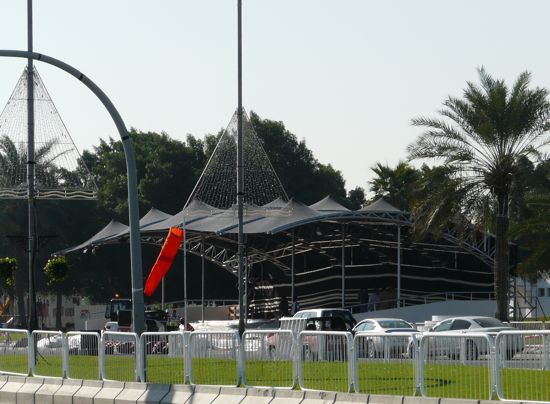
I was afraid to go any closer, as people were practicing for the parade, security might not like me taking photos, but how cool is this? They used original beit as-shar (house of hair, i.e. wool) fabric for the inner lining of the review tent. I totally love it. This fabric was originally made mostly from goat hair, but also stripes of sheep and camel hair. I have some. It’s tough and strong, and in panels, woven by the women. I don’t think they make tent bodies like this any more.
FYI: How Long is a Generation?
So I get on a track and I can’t get off, like a little hamster running on the wheel. I got to thinking about generations, and how long ago is 10 generations and so I had to ask Google the question: How long is a generation? Don’t you love Google? They always have an answer.
Now I know something new. Now I will share it with you. This comes from Ancestry.com
Research Cornerstones: How Long Is a Generation? Science Provides an Answer
How Long Is a Generation?
By Donn Devine, CG, CGI
We often reckon the passage of time by generations, but just how long is a generation?
As a matter of common knowledge, we know that a generation averages about 25 years—from the birth of a parent to the birth of a child—although it varies case by case. We also generally accept that the length of a generation was closer to 20 years in earlier times when humans mated younger and life expectancies were shorter.
In genealogy, the length of a generation is used principally as a check on the credibility of evidence—too long a span between parent and child, especially in a maternal line, has been reason to go back and take a more careful look at whether the evidence found reflects reality or whether a generation has been omitted or data for two different individuals has been attributed to the same person. For that purpose, the 20- and 25-year averages have worked quite acceptably; birth dates too far out of line with the average are properly suspect.
But now, researchers are finding that facts differ from what we’ve always assumed—generations may actually be longer than estimates previously indicated.
Several recent studies show that male-line generations, from father to son, are longer on average than female-line generations, from mother to daughter. They show, too, that both are longer than the 25-year interval that conventional wisdom has assigned a generation. The male generation is at least a third longer; the female generation is about one-sixth longer.
As early as 1973, archaeologist Kenneth Weiss questioned the accepted 20- and 25-year generational intervals, finding from an analysis of prehistoric burial sites that 27 years was a more appropriate interval but recognizing that his conclusion could have been affected if community members who died away from the village were buried elsewhere.
Why Age Matters
In a more-recent study regarding generation length, sociologist Nancy Howell calculated average generational intervals among present-day members of the !Kung, contemporary hunter-gatherer people of Botswana and Namibia whose lifestyle is relatively similar to that of our pre-agricultural ancestors. The average age of mothers at the birth of their first child was 20 years and at the last birth 31, giving a mean of 25.5 years per female generation—considerably above the 20 years often attributed to primitive cultures. Fathers were six to 13 years older than mothers, giving a male generational interval of 31 to 38 years.
A separate study, conducted by population geneticists Marc Tremblay and Hélène Vézina, was based on 100 ascending Quebec genealogies. Researchers found a generational interval, based on the years between parents’ and children’s marriages, to average 31.7 years, and they determined that male generations averaged 35.0 years while female generations averaged 28.7 years.
Biological anthropologist Agnar Helgason and colleagues used the Icelandic deCODE genetics database to arrive at a female line interval of 28.12 years for the most recent generations and 28.72 years for the whole lineage length. Male line lineages showed a similar difference—31.13 years for the recent generations and 31.93 years overall. For a more mathematically appealing average, Helagason and fellow researchers recommended estimating female generational line intervals at 30 years and male generational intervals at 35 years, based on the Quebec and Iceland studies.
Calculating Ideas
What does this mean to the genealogist? When assigning dates to anthropologically common ancestors 50 or more generations in the past, using the “accepted” 20 or 25 years as a conversion factor can produce substantial underestimates of the time interval.
For my own purposes, however, given the imprecision of the various results and my own need for an estimate that lends itself to easy calculation, I decided that three generations per century (33 years each) for male lines and 3.5 generations per century (29 years each) for female lines, might work better when I needed to convert generations into years.
To check the accuracy of my values, I decided to compare the generational intervals from all-male or all-female ranges in my own family lines for the years 1700 to 2000. I was pleasantly surprised to see how closely the intervals agreed with the estimates I was using. For a total of 21 male-line generations among five lines, the average interval was close to 34 years per generation. For 19 female-line generations from four lines, the average was an exact 29 years per generation.
In genealogy, conclusions about relationships are subject to change whenever better evidence is discovered. Similarly, it’s the nature of the physical and biological sciences that current understandings are subject to change as more data becomes available and that data’s interpretation becomes more certain. So, for now, when genealogists want to convert generations to years and create probable date ranges, using an evidence-based generational interval—like Helagason’s 30 and 35 years or one that you’ve developed based on your own family history research—may be the best solution.
Donn Devine, CGSM, CGISM, a genealogical consultant from Wilmington, Delaware, is an attorney for the city and archivist of the Catholic Diocese of Wilmington. He is a former National Genealogical Society board member, currently chairs its Standards Committee, is a trustee of the Board for Certification of Genealogists, and is the administrator for Devine and Baldwin DNA surname projects.
November 9, 1989 The Fall of the Wall
Twenty years ago tomorrow, and I still hold my breath in wonder.

I was doing a very untypical thing for me – I was headed for the Czech border with three military-wife friends, to buy crystal. There was an unusual amount of traffic, all coming from the border, and the cars – not the normal beautiful cars you find on the German autobahns, but the fiberglass cars coming out of the Soviet Union and Eastern Bloc – miles and miles and miles on end, all headed West.
When it happened, we didn’t have a clue. There had been rising signs of unrest in the East, but that happens, and has always been ruthlessly put down.
The US had been in Germany forty years. In the most recent years, all the posts and all the military housing had undergone significant updatings – significant and expensive. If you asked anyone about the possibility of the wall coming down (Berlin Wall, for those of you who were not alive) they would just laugh.
“We’ll be here forever,” they would say.
So too, would Germans say.
“We’ve been divided for too long. We think differently,” they would say “We could never be re-united.”
In one joyful night, that all changed. As we reached our stop and went for dinner in our Gasthaus, the television showed the cars flowing over the borders, and the young dancing on the wall in Berlin. It was one of those rare occasions when the world held it’s breath in wonder and amazement; we did not know this was a possibility. Such joy!
Germany has struggled to make the reunification work. Even now, in the west, Germans will gripe about how all their tax monies are going to the east, and those from the east are taking their jobs, but in essence, the reunification has been a success, and the greater Germany is an amazing fact-of-life I never thought I would see in my life.
I still celebrate November 9th in my heart. Twenty years! It seems like yesterday.
Mermaid Fabric
One of the things my friend and I were seeking on our Souk Quest was mermaid fabric. My friend has a grand daughter who loves to be The Little Mermaid, and I knew that the exact right fabric existed in the souk, I had seen it and didn’t have any excuse to buy it.
We found it. It is perfect – sea green, and shiny scales:
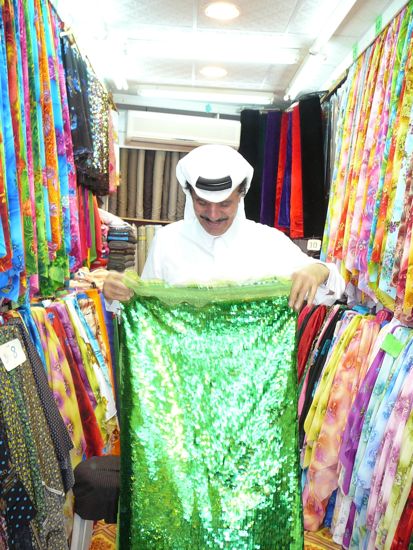
Doha is full of wonderful fabrics for dress-up.
Too Much Food
AdventureMan and I have lived more years outside our own country than inside it. We have lived on-and-off in the Middle East for more than 30 years. You’d think we would know everything by now, but we are still delighted to discover new things and to learn from the culture in which we are living.
Our Kuwaiti friends were good about letting us peek inside the culture, telling us stories of family life “before oil” and Kuwait traditions. Like women aren’t supposed to eat too much when they to to someone’s house for dinner or the people will say “do you think she has never seen food before?”
On the other hand, it is shameful not to provide enough food, so you always prepare way more than the group invited can possibly eat, like in ten years.
Sometimes a lot of the food goes to waste, but I have also discovered these wonderful plastic bags and tin trays found in every supermarket in the Middle East. What doesn’t get eaten now – gets eaten. I admit it, I am a lazy wife. I don’t like cooking big meals when it is just the two of us, so I love being able to pull something out of the freezer and have it all heated up and fresh for dinner.


It also makes me feel very ecological to have food in the freezer, ready to fix, and to know that not a lot went to waste. We are learning from our son and his sweet wife, and all the young adults in our family, who are WAY more ecologically aware than we ever were, and we thought we were pretty good, the generation who invented recycling.
AdventureMan used to bring home people for dinner, mostly guys from out of town in town for a short time who needed a home-cooked meal. We always had food in the freezer, something I could pull out on short notice.
One time, I made beef burgundy. When I went to serve it, I looked for the cheesecloth bundle of spices and couldn’t find it. I looked and looked, and then I figured I must have taken it out earlier and forgot I’d done it. Then, during dinner, one of the men had a very puzzled look on his face – he was chewing on the spices ball! I was SO embarrassed, but they all just laughed, thank God.
Family Worship
One of the great blessings of visiting our son and his wife is just spending time together doing the normal things that families do when Mom and Dad don’t live many time zones away in a far and distant land earning a living. This last weekend, we were able to attend church together, which was one of the highlights of my visit with them.
We found a lovely church, Christ Episcopal, in downtown Pensacola. It has organ music, and as my husband says “they sing REAL hymns!” We smiled to see so many families there, from the youngest babies to older folk – the church welcomes us all.


And then AdventureMan spotted the Lutheran Church next door and said “Oh! They have a church souk!”

It was a truly glorious day.
Digging Up the Saudi Past
By DONNA ABU-NASR
Associated Press Writer
RIYADH, Saudi Arabia —
Much of the world knows Petra, the ancient ruin in modern-day Jordan that is celebrated in poetry as “the rose-red city, ‘half as old as time,'” and which provided the climactic backdrop for “Indiana Jones and the Last Crusade.”
But far fewer know Madain Saleh, a similarly spectacular treasure built by the same civilization, the Nabateans.
That’s because it’s in Saudi Arabia, where conservatives are deeply hostile to pagan, Jewish and Christian sites that predate the founding of Islam in the 7th century.
But now, in a quiet but notable change of course, the kingdom has opened up an archaeology boom by allowing Saudi and foreign archaeologists to explore cities and trade routes long lost in the desert.
The sensitivities run deep. Archaeologists are cautioned not to talk about pre-Islamic finds outside scholarly literature. Few ancient treasures are on display, and no Christian or Jewish relics. A 4th or 5th century church in eastern Saudi Arabia has been fenced off ever since its accidental discovery 20 years ago and its exact whereabouts kept secret.
In the eyes of conservatives, the land where Islam was founded and the Prophet Muhammad was born must remain purely Muslim. Saudi Arabia bans public displays of crosses and churches, and whenever non-Islamic artifacts are excavated, the news must be kept low-key lest hard-liners destroy the finds.
“They should be left in the ground,” said Sheikh Mohammed al-Nujaimi, a well-known cleric, reflecting the views of many religious leaders. “Any ruins belonging to non-Muslims should not be touched. Leave them in place, the way they have been for thousands of years.”
In an interview, he said Christians and Jews might claim discoveries of relics, and that Muslims would be angered if ancient symbols of other religions went on show. “How can crosses be displayed when Islam doesn’t recognize that Christ was crucified?” said al-Nujaimi. “If we display them, it’s as if we recognize the crucifixion.”
In the past, Saudi authorities restricted foreign archaeologists to giving technical help to Saudi teams. Starting in 2000, they began a gradual process of easing up that culminated last year with American, European and Saudi teams launching significant excavations on sites that have long gone lightly explored, if at all.
At the same time, authorities are gradually trying to acquaint the Saudi public with the idea of exploring the past, in part to eventually develop tourism. After years of being closed off, 2,000-year-old Madain Saleh is Saudi Arabia’s first UNESCO World Heritage Site and is open to tourists. State media now occasionally mention discoveries as well as the kingdom’s little known antiquities museums.
“It’s already a big change,” said Christian Robin, a leading French archaeologist and a member of the College de France. He is working in the southwestern region of Najran, mentioned in the Bible by the name Raamah and once a center of Jewish and Christian kingdoms.
No Christian artifacts have been found in Najran, he said.
Spearheading the change is the royal family’s Prince Sultan bin Salman, who was the first Saudi in space when he flew on the U.S. space shuttle Discovery in 1985. He is now secretary general of the governmental Saudi Commission for Tourism and Antiquities.
Dhaifallah Altalhi, head of the commission’s research center at the governmental Saudi Commission for Tourism and Antiquities, said there are 4,000 recorded sites of different periods and types, and most of the excavations are on pre-Islamic sites.
“We treat all our sites equally,” said Altalhi. “This is part of the history and culture of the country and must be protected and developed.” He said archaeologists are free to explore and discuss their findings in academic venues.
Still, archaeologists are cautious. Several declined to comment to The Associated Press on their work in the kingdom.
The Arabian Peninsula is rich, nearly untouched territory for archaeologists. In pre-Islamic times it was dotted with small kingdoms and crisscrossed by caravan routes to the Mediterranean. Ancient Arab peoples – Nabateans, Lihyans, Thamud – interacted with Assyrians and Babylonians, Romans and Greeks.
Much about them is unknown.
Najran, discovered in the 1950s, was invaded nearly a century before Muhammad’s birth by Dhu Nawas, a ruler of the Himyar kingdom in neighboring Yemen. A convert to Judaism, he massacred Christian tribes, leaving triumphant inscriptions carved on boulders.
At nearby Jurash, a previously untouched site in the mountains overlooking the Red Sea, a team led by David Graf of the University of Miami is uncovering a city that dates at least to 500 B.C. The dig could fill out knowledge of the incense routes running through the area and the interactions of the region’s kingdoms over a 1,000-year span.
And a French-Saudi expedition is doing the most extensive excavation in decades at Madain Saleh. The city, also known as al-Hijr, features more than 130 tombs carved into mountainsides. Some 450 miles from Petra, it is thought to mark the southern extent of the Nabatean kingdom.
In a significant 2000 find, Altalhi unearthed a Latin dedication of a restored city wall at Madain Saleh which honored the second century Roman emperor Marcus Aurelius.
So far, there has been no known friction with conservatives over the new excavations, in part because they are in the early stages, are not much discussed in Saudi Arabia, and haven’t produced any announcements of overtly Christian or Jewish finds.
But the call to keep the land purged of other religions runs deep among many Saudis. Even though Madain Saleh site is open for tourism, many Saudis refuse to visit on religious grounds because the Quran says God destroyed it for its sins.
Excavations sometimes meet opposition from local residents who fear their region will become known as “Christian” or “Jewish.” And Islam being an iconoclastic religion, hard-liners have been known to raze even ancient Islamic sites to ensure that they do not become objects of veneration.
Saudi museums display few non-Islamic artifacts.
Riyadh’s National Museum shows small pre-Islamic statues, a golden mask and a large model of a pagan temple. In some display cases, female figurines are listed, but not present – likely a nod to the kingdom’s ban on depictions of the female form.
A tiny exhibition at the King Saud University in Riyadh displays small nude statues of Hercules and Apollo in bronze, a startling sight in a country where nakedness in art is highly taboo.
In 1986, picnickers accidentally discovered an ancient church in the eastern region of Jubeil. Pictures of the simple stone building show crosses in the door frame.
It is fenced off – for its protection, authorities say – and archaeologists are barred from examining it.
Faisal al-Zamil, a Saudi businessman and amateur archaeologist, says he has visited the church several times.
He recalls offering a Saudi newspaper an article about the site and being turned down by an editor.
“He was shocked,” al-Zamil said. “He said he could not publish the piece.”
—
Associated Press Writer Lee Keath contributed from Cairo.
Irrelevant Clothing, Shoes and Scissors
It doesn’t matter how long I have been living in the Middle East, it doesn’t matter how many times I have made the trip back and forth, I never seem to get it quite right.
I knew it was going to be less hot in Seattle. I knew it. And still, I didn’t pack a single pair of closed toe shoes, a single pair of nylon stockings, and only a couple long sleeved things. It doesn’t matter that I have lived in Seattle, that I know Seattle, when I am in the middle of the heat and humidity of August in Doha, I lack the imagination to think clearly about the coolness of August in Seattle. I have a lot of lightweight cotton dresses . . . hmmm, so irrelevant in Seattle.
I keep a storage locker here. It started when we moved our parents from their big house to a 2 BR condo (with a water view 🙂 ) and Mom had separated out some of her treasures to divide among us movers. The problem was, I didn’t really want to take them with me (bulky and I would have to bring them back) and I have already imposed on the sister who lives here with a bunch of my stuff, so I finally decided to rent a storage locker. I discovered as a landlord, it actually comes off my taxes. I still have to pay for it, but it isn’t a total loss. I keep Seattle supplies in the locker, too.
When I went to the locker yesterday to pick up some more long sleeved stuff, and my Seattle hairdryer, and my Seattle make-up and living supplies (dishwashing soap, coffee filters, paper towels, laundry soap, etc.) yesterday, with my Mom in the car, nothing went right. My code didn’t work. I had to go inside, leaving my Mom sitting in the car, and it took them a while to work out what was wrong.
(“We don’t have seven number codes! . . . .Hmmm, , mmm, , , yeh, it says you have a seven number code all right, . . .. so here is your new code . . . )
And the new code didn’t work either.
They opened the gate for me, I went to my locker, and with my Mom sitting in the car, discovered my laundry soap had leaked during the time between visits, and with my Mom sitting in the car, I had to clean it all up AND dig out some relevant clothing, and some wrapping paper for gifts I need to send, and scotch tape and scissors (yes, I keep all the things that I frequently use in the locker so I don’t have to buy them again and again and again.) I also grabbed the bag of cosmetic items – like shampoo, toothpaste, my Seattle toothbrush, etc.)
My poor Mom! Remember her? She is still out there sitting in the car!
(The code didn’t work on the way out, either.)
So after all that sitting in the car, I treated Mom to a trip to Trader Joe’s, a place we both love. I picked up sugar snap peas; I just eat them like candy, instead of candy, they are SO good, and some sushi for later on, and Mom picked up things that were really bad, like triple gingersnaps and a wonderfully fragrant new Rosemary Tree.
On the way home, she said “you know you have some stuff in the guest bathroom” and I assured her that I did not, that it was all my middle sister’s stuff, and she said “No, Little Diamond looked at it while she was staying here and said it was yours, that it was stuff you use.” Hmmm. Little Diamond said that?
So when we got back to Mom’s house, I checked the cupboard, and there was one of those zipper bags like (ahem) I always use, and inside was . . . yep. Another hairbrush. Another Seattle toothbrush. Scotch tape. Scissors. My particular make-up back-ups. Shampoo. I brought it with me, and I had two almost identical zipper bags full of Seattle supplies. I can only imagine that sometimes when I get here after all those hours of traveling that my mind is just so addled I am not thinking.

It also makes me feel a little weird that Little Diamond knows me so well that she can identify MY things with just a glance at the contents of the plastic bag, LLOOLLLL! I am that predictable?
On my way over to my Mom’s, I had stopped at the local Fred Meyer’s, a Target-like local store I just love. Now that I am in Seattle, I see things differently. I see things I can hardly resist, like something in me feels like getting ready for the winter, but then, Thank God, my sterner self jerks me back just as I am reaching for:

Look at those socks! Look at those colors! I can barely resist, they are such a hoot! but then . . . where would I wear them? Even if I were abaya’d, people could see my bright polka-dot chartreused ankles and it would draw unwanted attention . . . . maybe just around the house . . .
But no . . . around the house – look at these!
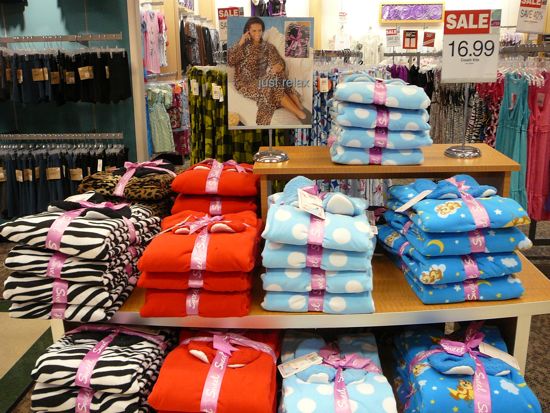
Thick, fuzzy sleepers, only $16.99, like we wore when we were kids, only these are for grownups, and oh! look at that zebra print! The cheetah! They are almost irresistable!
And so irrelevant in Doha!
Maggie O’Farrell and The Vanishing Act of Esme Lennox
Maggie O’Farrel’s The Vanishing Act of Esme Lennox is also a book club pick, but oh, what a pick! I remember somewhere reading a review; I might never have picked this book up if I hadn’t needed to read it for the club. And oh, what I might have missed!

It’s like the scariest book ever written, scary in a Margaret Atwood kind of way, a reminder that women have not had rights for very long, and that those rights are still very fragile. When economies go bottoms-up, when unemployment begins rising, women are often the first to suffer, and women’s rights the first to go. In hard times, men will be preferred hirings, because they have families to support, laws to “protect” women are passed, especially laws which “protect” her finances, meaning gives the power of the money management to some man to do for her, or “protect” her person by requiring that some man accompany her to keep her from dangers. Protection = control. It keeps some smart, thinking women submissive to men who are in every way their inferior.
In Vanishing, Maggie O’Farrel writes of such a woman, Esme Lennox, who is a fey spirit, born in India, with the eyes of an artist. While her “good” sister Kitty obeys the rules, walks the straight and narrow path, Esme is messier. As she grows to adolescence, her eccentricity and her rebellion against the constricts of the life in turn-of-the-century Scotland chafe, she yearns for more room to breathe, intellectually, socially, as her family, her community and her society continues to pressure her to conform.
One of the key events in the book is the death of Esme’s baby brother, of typhoid fever. Abandoned, Esme sits holding her dead brother’s body for three days until her family returns (the baby-keeper also died and the other employees deserted while Esme’s family was away). Esme is devastated, but the focus is on her mother, who is wrought with guilt and isolates herself, and Esme, only a little girl, is forbidden to even say her beloved baby brother’s name. Part of what plays a huge role in this book is society, expectations, and all that is hidden and unspoken – as Esme becomes, a family secret, locked away for sixty years.
Their grandmother swept into the room ‘Kitty,’ there was an unaccustomed smile on her face, ‘stir yourself. You have a visitor.’
Kitty put down her needle. ‘Who?’
Their mother appeared behind the grandmother. ‘Kitty,’ she said ‘quickly put that away. He’s here, he’s downstairs . . . ‘
. . . .
Esme watched from the window-seat as her mother started fiddling with Kitty’s hari, tucking it behind her ears, then releasing it. . . . . Ishbel turned and, catching sight of Esme at the window, said ‘You, too. Quickly now.’
Esme took the stairs slowly. She had no desire to meet one of Kitty’s suitors. They all seemed the same to her – nervous men with over-combed hair, scrubbed hands and pressed shirts. They came and drank tea, and she and Kitty were expected to talk to them while their mother sat like an umpire in a chair across the room. The whole thing made Esme want to burst into honesty, to say, let’s forget this charade, do you want to marry her or not?
She dawdled on the landing, looking at a grim, grey-skied watercolour of the Fife coast. But her grandmother appeared in the hall below. ‘Esme!’ she hissed, and Esme clattered down the stairs.
In the drawing room, she plumped down in a chair with high arms in the corner. She wound her ankles round its polished legs and eyed the suitor. The same as ever. Perhaps a little more good-looking than some of the others. Blond hair, an arrogant forehead, fastidious cuffs. He was asking Ishbel something about the roses in a bowl on the table. Esme had to repress the urge to roll her eyes. Kitty was sitting bolt upright on the sofa, pouring tea into a cup, a blush creeping up her neck.
Esme began playing the game she often played with herself at times like this, looking over the room and working out how she might get round it without touching the floor. She could climb from the sofa to the low table and, from there, to the fender stool. Along that, and then –
She realized her mother was loooking at her, saying something.
‘What was that?” Esme said.
‘James was addressing you.’ her mother said, and the slight flare of her nostrils meant, Esme knew, that she’d better behave or there would be trouble later.
As with many inconvenient women, Esme ends up committed at a loony-bin, and sixty years later, is released into the custody of a grand-niece who never even knew Esme existed.
The thoughts, trials and escapades of three women, Esme, her sister Kitty, and Iris, the grand-niece, intertwine through out the book, and the picture is cloudy at first, blurry, shifting, fragmented The pattern becomes more and more clear as the three threads of thought are woven – ever more tightly – together.
I could not put this book down. Finding out how the picture came together became more important than checking my messages, my blog, or fixing dinner. It was compelling, and resulted in a quick and unforgettable read.
Recent Comments
intlxpatr on Yellowstone: Old Faithful to C… Michelle on Yellowstone: Old Faithful to C… Cathy on No Grown-Ups in Charge intlxpatr on Waiting for Snow intlxpatr on Waiting for Snow Wikipedia Donate Button

Amazina


Early Voting in Florida


 Here There and Everywhere