Three Movies
Most of the time, I work in silence. I have a lot of things I need to think about, and the silence helps me think. When I am ready for some entertainment, I usually listen to BBC. Occasionally, as in the last three days, I turn on the TV, more for background noise than anything else.
Most of the shows I like the best have sharp women as main characters – I love Veronica Mars! I enjoy The Closer, and Crossing Jordan. I love how they overcome their dysfunctions, and how they use their smarts to solve cases. I love it that they screw up from time to time, and have to suffer the consequences, but that they overcome their screw-ups and prevail.
The last three days, I watched parts of three movies. In the first, Braveheart, we were watching Mel Gibson playing Braveheart, but I was constantly distracted by his preening. Have you seen Braveheart? It’s like he is conscious of the camera on him every minute, we the viewers are merely mirrors, absorbing and reflecting his glorious countenance – how annoying! His vanity distracted from a pretty good movie.
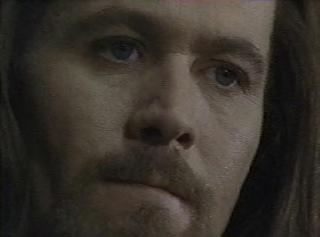
Then I watched segments of Dracula playing Ludwig von Beethoven. I am from a family of movie watchers; my son and husband know all the names and rush to IMDb to check out anachronisms, historical inaccuracies, goofs in continuity, etc. All I know is that every time he went to kiss one of those Viennese women, I wanted to scream “Watch your neck!”
The movie was interesting, and they made good use of all Beethoven’s most loved music, and they used it appropriately. Oldman did a good job of bringing Beethoven to life and making his deafness tragic and believable. He also shows the fickleness and cruelty of the audience for whom he made his music.

Then, yesterday, there was Jack Bauer playing Paul Gauguin! In the early parts of the movie, he lived in a luminously violet painted interior, one I am dying to copy. But that is not the point. Jack Bauer is a stoic. Stoicism is great when it comes to playing a guy who has so many bad things happen to him in the space of 24 hours.
(this is also beside the point, but can you imagine being married to a guy like Jack Bauer? Like he would never tell you what he was really up to, the most exciting times in his life are not with you and his children but off protecting the United States of America, he comes back to you addicted to heroin, or totally burned out and just when you have him all patched up again he gets a call that his services are needed, and you don’t hear from him because he is all caught up in his latest adventure and then after 24 hours he comes home again, a total wreck? What kind of family life is THAT??)
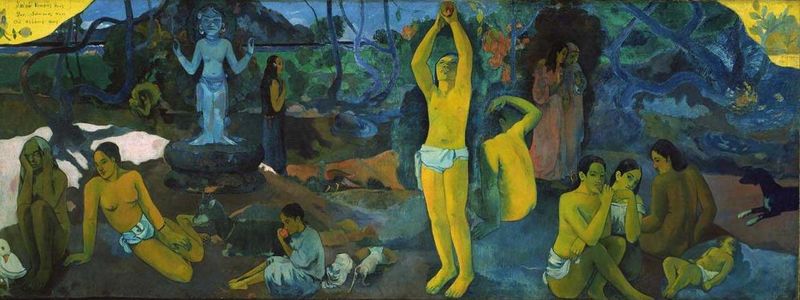
As Paul Gauguin, he leaves his stockbroker existence and becomes a starving painter, then a starving painter who somehow makes it to the South Seas to paint some of the most amazingly colored art every created but his facial expression never changes much. Paul Gauguin was all about passion – and it is just too much a stretch for Jack Bauer. He is not a believable Gauguin. He is not even a believable Frenchman. He barely moves his hands! I would watch the movie again, however, just for a glimpse of those violet colored walls.
It must be a problem for actors, especially TV actors who become too closely associated with one role. I had to look up his real name: Kiefer Sutherland. Fortunately, a new season of 24 starts in just three days. If you ever want to feel sorry for Kiefer Southerland, look at his dad’s resume’ of movies: Donald Sutherland. It wouldn’t be easy to live up to that legend.
A Moment for Mirth
As we complain about traffic, write passionately about the environment, and wonder what on earth is going on with our government(s) (What? you thought it was just Kuwait?) and even worse, as we start to talk about the good old days, back in the day . . . whoa! Oh no! We are starting to sound . . . like our parents!
So, for a moment of fun, take a look at a song from a very old musical, The Music Man, set over a hundred years ago, where he talks about the new phenomenon corrupting the youth of the country. Watch how the parents get all worked up. And remember – it is all part of his agenda.
Motherhood in 2:55
I saw this on Good Morning America, and then my oldest, dearest friend sent me the same in an e-mail. Motherhood condensed into 2 minutes and 55 seconds. Very original.
Every time I listened to it I understood it better! Adventure Man is rolling on the floor!
Peter Bowen: Wolf, No Wolf
“You have to take this. You’ll really like it,” Sparkle insisted as I inwardly groaned, thinking of the TWO stacks of unread-must-reads by the side of my bed, and my already bulging suitcases.

“I know it doesn’t sound like something you’ll like,” she went on, slightly frustrated with me, with herself, “but once you start reading, you’ll get into it.”
Not exactly a ringing endorsement, but good enough for me. I always KNOW what I think she will love, and she has done me many a favor in return, introducing me to authors and series worth reading.
“It’s about Montana. The main character is mixed Indian and French and some other things, a grandfather, and it all takes place in a small town in Montana . . . ” she sort of fizzles out. “I’m really not doing a very good job of making this interesting.”
And she sighs in frustration.
So, about a month later, just because I love my sister, I pick the book up and start reading while waiting for my husband to get home for dinner. As it turns out, he is very very late – and I am very very glad. I don’t want to stop reading!
When you first jump into Wolf, No Wolf by Peter Bowen, it takes you a minute to adjust your ear to the way they talk. These aren’t people most of us have met before. Gabriel DuPre´ is m´etis, a mixed blood. His ancestors are French who came early to the great continent that is now the US, Canada and Mexico, and they trapped and hunted, married native American wives, and developed a culture all their own. His language pattern is similar to that of the Cajun in Louisiana.
He is a cattle brand inspector in this small Montana town. His children are grown, he has so many grandchildren he can’t remember all their names. Every now and then, he pins on his deputy sherrif badge to solve a mystery in the small town of Toussaint, Montana.

Here is how Wolf, No Wolf opens:
Du Pre´ fiddled in the Toussaint Bar. The place was packed. some of Madelaine’s relatives had come down from Canada to visit. It was fall and the bird hunters had come, to shoot partridges and grouse on the High Plains.
The bird hungers were pretty OK. The big game hunters were pigs, mostly. The bird hunters were outdoors people; they loved it and knew it, or wanted to. The big game hungers wanted to shoot at something big, often someone’s cows.
Bart had bought a couple thousand dollars’ worth of liquor and several kegs of beer and there was a lot of food people had brought. Everything was free.
Kids ran in and out. The older ones could have beers. Bart was tending bar. Old Booger Tom sat on one of the high stools, cane leaned up against the front of the bar.
“You do that pretty good for someone the booze damn near killed,” said Booger Tom. “I know folks won’t be in the same room with the stuff.”
“Find Jesus,” said Bart. “It’s not too late to save your life.”
He went down to the far end of the bar and took orders. Susan Klein, who owned the saloon, was washing glasses at a great pace.
One of Madelaine’s relatives was playing the accordion, another an electric guitar. They were very good.
Du Pre´ finished. He was wet with sweat. The place was hot and damp and smoky, so smoky it was hard to see across the room. The room wasn’t all that big, either.
Madelaine got up from her seat, her pretty face flushed from drinking the sweet pink wine she loved. She threw her arms around Du Pre´ and kissed him for a long time.
“Du Pre´,” she said, “you make me ver’ happy, you play those good songs.”
. . …
Someday this fine woman marry me, thought Du Pre´, soon as the damn Catholic church, it tell her OK, your missing husband is dead now so you can quit sinning, fornicating with DuPre´.
I’ve never hung out in a bar in Montana, fiddled, or had a girlfriend named Madeleine (!), but already I feel like I know these people and this life. Peter Bowen is the Donna Leon of Montana, introducing us to the kind of crimes that happen in those sleepy looking towns we drive past on the superhighways, glancing at, or stopping to fill our gas tanks.
DuPre´ is a good man, and, like many a good man, sometimes has to do a bad thing to protect those he is sworn to protect. Policing is not pretty business.
The first story has to do with the re-introduction of wolves back into the Montana highlands, something not at all popular with those who have been raising cattle there. The second book in this two-book collection has to do with serial killers, how they stay under the radar, and how very difficult it is to catch them.
In both books, it is as much about a new way of living and thinking as it is about solving the crime. DuPre´ consults often with his friend Benetsee, the local medicine man, who sees things we don’t see. One of the FBI Agents is Harvey Wallace, also more than half native American, whose real name is Harvey Weasel Fat. The books are about how men and women fight, the nature of male friendships and female friendships, and very much about the human condition wherever we may be.
Life is short. I can never live in all these places long enough to even scratch the surface of the flavor of each variety of life. But these books help, they give us glimpses into another way of thinking, another way of doing things, and stretches our little minds just a little so that we learn to think more flexibly.
So who is going to write the Kuwait detective series? Who will take us into the diwaniyyas seeking information, who will take us out on the shoowi to gather information against those delivering drugs to Kuwait, with whom will we camp in the desert, avoiding explosives left over from the Iraqi invasion? I think his name is Anwar al Kout (the light of Kuwait!) and his wife is Suhail (the Yemeni Star!) – somewhere out there is someone who can take us into Kuwait and bring it alive. Where are you?
(You were right, Sparkle. I loved it!)
Wooo Hooooo Doctor Diamond!
I am bursting with pride. And she’s not MY daughter, I have nothing to do with her success, she’s done this all on her own. My niece, Little Diamond is now DOCTOR DIAMOND!
I don’t imagine I will remember to think of her as Doctor Diamond all the time; I will probably still call her Little Diamond.
Little Diamond, Doctor Diamond, we are all so proud of you. We dance of joy at your accomplishment, and your determination, and how very very GOOD you are! Wooo Hooooooooo!

So here is something very cool. There is a Wikipedia article that tells you all about academic dress for different levels of educational attainment. In the olden days, and at a very few universities today, gowns (like robes, kind of like abyaa3t) are worn to classes. With each level you attain – Bachelor’s degree, Master’s degree, Doctorate – you get to wear different additions – capes, hoods, etc.
Most of the time you never get a chance to wear them again after graduation. Unless you are an academic, and then you wear them for every university graduation. It is particularly colorful when all the professors troop in, very medieval, wearing their university colors and their degree colors (yes, those are different.)
Woooo Hooooo, Doctor Diamond, c’mon over here and we will have a robe made of silk with sparkles on it! Adventure Man asks if we get a family discount for consultations?
Nemirovsky: Suite Francaise
Within five seconds of starting this book, you are in Paris, flurrying with the Parisians. It’s hot, it’s June, it’s 1940 and the Germans are coming, it is time to get out of town. We are in the middle of preparations to evacuate, with several families, couples and individuals as they make their preparations.
Have you ever been evacuated from a house or hotel due to sudden fire? Have you ever wondered why, in the seconds you had to prepare to leave, you made the choices you did? I groaned as I lived with people carefully packing their linen tablecloths and bird cages; but it’s different when it is not YOU. What I admire so much about Irene Nemirovsky’s book is that you are THERE, you feel so much a part of it. I can tell you what it was like, the desperation as “we” evacuated Paris, and later, as we lived with the enemy using our house for billeting.
The Suite Francaise is two parts, Storm and Dolce. As you reach the end of Dolce, you have a strong feeling that there should be more, and indeed, as you read, seeking satisfaction, the appendices, you discover the book was intended to have four or five sections. The interpreter who put the manuscript together, filling in from Nemirovsky’s notes, has done a masterful job on the two sections that were somewhat complete, but, unfortunately, Nemirovsky, a Catholic, had a Jewish parent, and that was enough to get her arrested, transported to a concentration camp and executed, all within a very short time. The correspondence between her husband had the authorities, in the short time between her arrest and death, is desperate, and chilling.
You can’t help but be heartsick at the loss to this world of such great talent. You can’t help but wonder what this book, as good at it is, might have been as a larger whole?
Nemirovsky, above all, has an acute eye for French thinking, French manners, French mannerisms, and above all, for French class distinctions. The dialogues are SO perfectly believable, as are the depictions of the manner in which people under the worst kind of stress can behave with both inhuman kindness and insensitive cruelty toward one another.
You know how I am always wondering what my cat is thinking. . . I share an excerpt of the book with you. I believe Nemirovsky knows what a cat is thinking!
The cat poked his nose through the fringes of the armchair and studied the scene with a dreamy expression. He was a very young cat who had only ever lived in the city, where the scent of such June nights was far away. Occasionally he had caught a whiff of something warm and intoxicating, but nothing like here, where the smell rose up to his whiskers and took hold of him, making his head spin. Eyes half closed, he could feel waves of powerful, sweet perfume running through him: the pungent smell of the last lilacs, the sap running through the trees, the cool, dark earth, the animals, birds, moles, mice, all the prey, the musky scent of fur, or skin, the smell of blood . . . His mouth gaping with longing, he jumped on to the window sill and walked slowly along the drainpipe. This was where a strong hand had grabbed him the night before and thrown him back . . . but he would not allow himself to be caught tonight.
He eyed the distance from the drainpipe to the ground. It was an easy jump, but he appeared to want to flatter himself by exaggerating the difficulty of the leap. He balanced his hindquarters, looking fierce and confident, swept his long black tail across the drainpipe and, ears pulled back, leapt forward, landing on the freshly tilled earth. He hesitated for a moment, then buried his muzzle in the ground. Now he was in the very black of night, at the heart of it, at the darkest point. He needed to sniff the earth: here, between the roots and the pebbles, were smells untainted by the scent of humans, smells that had yet to waft into the air and vanish. They were warm, secretive, eloquent. Alive. Each and every scent meant there was some small living creature, hiding, happy, edible . . . June bugs, field mice, crickets and that small toad whose voice seemed full of crystallized tears . . . The cat’s long ears – pink triangles tinged with silver, pointed and delicately curly inside like the flower on bindweed – suddenly shot up. He was listening to faint noises in the shadows, so delicate, so mysterious, but, to him alone, so clear: the rustling wisps of straw in nests where birds watch over their young, the flutter of feathers, the sound of pecking on bark, the beating of insect wings, the patter of mice gently scratching the ground, even the faint bursting of seeds opening. Golden eyes flashed by in the darkness. There were sparrows sleeping under the leaves, fat blackbirds, nightingales; the male nightingales were already awake, singing to one another in the forest and along the river banks.
And I imagine that the above all took place in the space of about 15 – 30 seconds!
If Nemirovsky can capture a cat’s thoughts so eloquently, just imagine what she can do with the French!
The second part of the Suite, Dolce, takes place in a small farming village and ties many of the evacuees from Storm loosely with the village and subsequent events. In Dolce, we live with a young married Frenchwoman in the home of her mother-in-law who blames her for enjoying life while her own son, the young woman’s husband, is a prisoner of war in Germany. If that weren’t bad enough, soon a young German officer is sent to live with them.
We have lived among the evacuating Parisians, in Storm, and now, in Dolce, we are living in the provinces, with it’s stultifying conventions. There are whole passages where the restrictions of polite French countryside society make it so suffocating, you almost have trouble breathing. And yet, as they do in every society, the young find ways around the conventions, risk their lives, risk their reputations, and live thinking that no-one sees what they are doing, while the elders bite their lips in horror. Fascinating reading. Nemirovsky’s genius to to make you feel you really are THERE.
Yemeni Star
I give up.
I am throwing myself on your mercy.
A week ago, Adventure Man heard a morning radio show on 99.7, “Superstation”, in which a meteorologist at the Kuwait Airport mentioned a particular star, which when it appears above the horizon in Kuwait, the ancient inhabitants would know that cooler temperatures were on the way.
Adventure Man is sure he called it The Yemeni Star, because it appeared over the horizon in the general direction of Yemen.
I’ve google’d it to death and can’t find anything. I called in the superstar Googler, Little Diamond and even she had to admit defeat.
Kuwaiti friends and bloggers – please, ask your elders if they know of the Yemeni Star. I think the weatherman said it was the nomadic peoples who would watch for it. I am guessing that in Kuwait, there are few nomads left, but a great number of descendants of nomadic peoples. Or, if you have an astronomer, or weather person in your family, could you ask them?
I don’t know why it matters to me, but it does.
Summer Fruit Crisps
If you haven’t cooked before, and are interested in beginning, Crisps are a good place to start. They are easy, don’t take a lot of time, and you get instant – and delicious! – gratification. Now, while fresh fruit is abundant in Kuwait (and elsewhere) is a great time to try a crisp.
These recipes are from Mary Cullen’s Northwest Cook Book, 1946. My aunt gave it to me before she died, and some of my best cooking efforts have been based on recipes from this book. They are simple, but . . . simply GOOD!
Apple Crisp
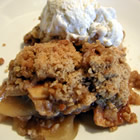
Crisps are wonderful when made with fresh fruit, and not so much trouble as a pie requiring crusts. Here, the topping is delicious, and easy.
5 cups apples
1/2 cup butter
1 cup sugar
3/4 cups all purpose flour
1 teaspoon cinnamon or nutmeg
Peel, core and slice apples and place in a greased baking dish or cassarole (a ceramic pie dish is perfect, but you can also use a ramekin, or something not too deep, not too shallow).
Using a pastry blender, or a metal whisk, or an electric mixer, work together the butter, sugar, salt, flour and spices.
Pack closely around apples.
Bake in 425 degree oven for 45 – 50 minutes. Serve with whipped cream or ice cream.
Berry Crisp or Peach / Apricot / Plum Crisp
Substitute berries (peaches or apricots or plums) for apples. If berries are very tart, sprinkle with 1/2 cup sugar mixed with 1/2 cup flour before covering with crumb mixture.
Rhubarb Crisp
Use diced rhubarb in place of apples. Mix 1/2 to 1 cup sugar and 1/2 cup flour with rhubarb before placing in baking dish.
Chevy’s Fresh Mex
At one time Adventure Man worked in Saudi Arabia, and came home every three months craving Mexican Food. His all time favorite restaurant was Chevy’s, which specializes in FRESH FRESH Mexican food.
Mom may be 84, but she is always up for a new experience. I asked her if she would like to try Chevy’s, and she was sure she would like to try it. You ROCK, Mom!

Mom’s Tostada Salad with beef:

My Spicy Salmon Fajita:

Totally delicious, but too much food! We brought home enough food for two or three more meals!
Men’s Evolutionary Role
I love BBC Health News and find the most amazing stories there, things I don’t see anywhere else. Today’s has to do with women living longer, and studies on aging.
Women, not men, ensure the success of future generations, work suggests.
Grans surviving beyond the menopause appeared to increase the likelihood that their own children went on to have children, a Sheffield team found.
Yet grandfathers had very little influence on their offspring’s reproductive success, Proceedings of the Royal Society B reports.
But experts were quick to stress that both grandparents play a vital role in families and society.
The Sheffield University authors reason that women thrive following the menopause from caring for their own children and grandchildren.
In their study, grandmothers gained two extra grandchildren for every 10 years they survived beyond the menopause.
This link was not found with aged granddads, however.
Instead, the scientists say the “evolutionary” argument for a man’s survival to a ripe old age is to continue to churn out sperm and procreate.
You can read more about the study, conducted in Finland, HERE.
Recent Comments
intlxpatr on Yellowstone: Old Faithful to C… Michelle on Yellowstone: Old Faithful to C… Cathy on No Grown-Ups in Charge intlxpatr on Waiting for Snow intlxpatr on Waiting for Snow Wikipedia Donate Button

Amazina


Early Voting in Florida


 Here There and Everywhere